




Abstract

A serial biotech entrepreneur, Jonathan Thon, is the founder and CEO of STRM.BIO, a pre-clinical, VC-backed biotechnology company that is leveraging extracellular vesicles (EVs) to deliver gene therapies. Prior to launching STRM.BIO, he founded and served as CEO / CSO of PlateletBio where he helped develop next-generation allogeneic cell therapies for the treatment of human diseases. Today, he has an audacious goal–to democratize gene therapy by developing a simpler, safer, and more affordable way to deliver treatment.
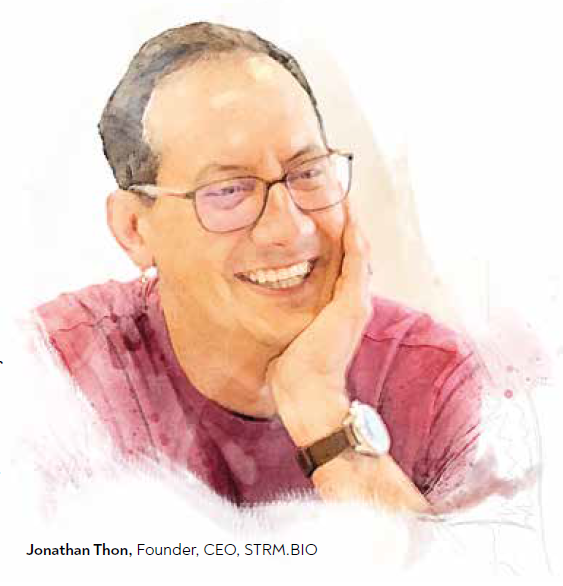
Dr. Thon describes to Inside Precision Medicine the need for next generation delivery vehicles for gene therapies and how the use of microvesicles offers differentiated advantages over both viraland exosome-based approaches.
I like to draw a parallel between the state of the gene therapy field and what the microprocessor did for personal computing. Before the invention of the microprocessor in the late 1960s, computers filled whole rooms. The ability to rapidly transfer data between different memory locations on increasingly tiny and cost-effective microprocessors revolutionized the field and brought computing technology into every home, democratizing the personal computer, and creating a new industry.
Credit; STRM.BIO

Gene therapy needs a similar breakthrough. The once-laborious process of identifying the genetic variants responsible for inherited disorders is now relatively straightforward, and innovations such as CRISPR–Cas9, base editing, and prime editing mean that the gene editing process itself is no longer the technical bottleneck. Multiplexed therapies that can edit multiple genes in parallel have the potential to expand the applications of gene therapy beyond relatively rare single-gene disorders for the first time. And yet the list of approved gene therapies remains short, while the cost and the risks of the current therapies remain high. The principal obstacle now limiting the widespread application of this lifesaving technology is the safe and efficient in vivo transfer of the editing constructs into the right cells. Solving this delivery problem would reinvigorate the field and help bring new treatments and cures for diverse diseases into every hospital.
Given the potential for gene therapy, there is significant interest in the field to identify better routes of delivery. That's the focus of STRM.BIO and we envision a future where gene therapies are capable of treating many more diseases and many more patients than is currently possible.
Biotech was a natural fit for me as it presses at the boundaries of what we know and what is possible. The thirst for a greater understanding and better tools to answer our most important questions drives me.
I began my undergraduate career at McMaster University in Ontario, Canada by specializing in biotechnology and genetic engineering, and then earned my PhD in biochemistry at the University of British Columbia. During my academic career, I became exposed to the blood transfusion space and recognized that the key problem was not in the storage time or sterility of products, but in our dependence on a volunteer donor blood system. The question of whether we could disconnect product from donor by making human cells/tissues for transplant led me to pursue a post-doctorate fellowship at Harvard where my work focused on making blood cells from pluripotent stem cells in culture. This idea that we could leverage existing biology to solve clinical manufacturing and delivery challenges became a central theme of my research and the foundation of my lab when I became a faculty member. At Harvard my team began developing platforms for commercial manufacture and scale up of cell-based therapeutics. This was the genesis of Platelet Bio, my first biotech startup, which served as a translational vehicle for this technology. I ran Platelet as its chief executive officer and chief scientific officer for nearly seven years before stepping away in 2019 to found STRM.BIO.
We founded STRM on a hybrid-virtual operating model. The idea was to avoid reinventing infrastructure and recreating pre-existing expertise when we could leverage them instead to accelerate programs and keep our focus where it matters–our research. When we first began pitching the operational idea behind STRM in the fall of 2019 (pre-COVID), it was met with little enthusiasm. Frankly, it was very hard to get investors to return our calls. A couple months later, in February 2020, COVID became our new reality. The premise that we could leverage existing infrastructure and work remotely suddenly became a lot more exciting and attractive. It also turned out to be true! This approach made it possible for STRM to move a lot faster than any of us expected in our first year of operation and accelerate while others were slowing down during a global pandemic.
STRM turned out to be the right company built at the right time under the right operating model.
Microvesicles offer differentiated benefits. They are a larger class of extracellular vesicles, with a carrying capacity similar to that of adenoviruses. As such, they can be used to deliver a diverse range of cargos, including combination constructs required for multiplexed gene editing applications and next generation base/ prime editors that are increasingly becoming larger and more difficult to package otherwise. As part of the body's intercellular communication network, microvesicles have an innate ability to encapsulate RNAs, DNAs, and proteins and to efficiently deliver this cargo into other cells. Because they bud from the cell surface membrane, microvesicles inherit the complex combination of surface proteins expressed by their source cell which can be modulated, making them a highly tunable option for diverse gene therapy applications. Microvesicles have more immune privilege than lipid nanoparticles and viruses, allowing for repeat dosing. As microvesicles are naturally secreted into the blood and other bodily fluids from multiple cell types, they have been present in every blood transfusion and organ transplantation ever performed, beginning long before their formal discovery and characterization; they're also present in other blood and biological products. This long history demonstrates their safety.
At the core of gene therapy is the fundamental idea that one can cure a disease as opposed to treating its symptoms. The final bottleneck is delivery. It is critical to the future of the field that the next generation of gene therapies be implemented as simple injections in standard clinical settings. The current ex vivo approach, in which a patient's cells are edited in culture and then re-transfused, is not a sustainable model. The patient must undergo immune system ablation before receiving an ex vivo gene therapy treatment, which can have severe side effects or even be fatal. These treatments require specialized facilities and training and are too expensive to be supported by payers as a routine option. A solution that meets all these criteria will democratize gene therapy by providing a simpler, safer, and more cost-effective way to deliver treatments and cures as standard of care for diverse diseases. The ability to make gene therapies a viable therapeutic option for people. This is an area that is ripe for disruption and the remaining challenge that needs to be overcome to realize the promise of curative therapies. STRM.BIO is that solution.