Abstract


Gary Pestano, PhD, is the chief development officer at Biodesix, Inc., a solutions-based diagnostics company. Biodesix has leveraged Droplet Digital™ PCR (ddPCR™) for molecular biomarker research and clinical sample testing for years, taking advantage of the technology's sensitivity, precision, accuracy, and absolute quantification of nucleic acids for non-invasive translational applications. Pestano and his scientific teams recently had the opportunity to act as beta users for Bio-Rad Laboratories' QX600™ ddPCR System.
The current areas of promise in blood-based nucleic acid testing, e.g., with GeneStrat ddPCR, include drug therapeutic monitoring in oncology and disease detection. For example, molecular monitoring tools can detect resistance and response markers in metastatic disease, minimal residual disease (MRD) following cancer treatment, and early-stage disease as part of broad genetic screening. Of course, these applications will need to meet robust regulatory requirements to advance into routine clinical practice, but promising data exists using available technologies, including Droplet Digital PCR.1
Sensitive and specific reagents that also allow for multiplexed detection of targets in a single specimen
Ability to deliver precise, reproducible results under defined conditions for specimen collection
A workflow that can be integrated into our secure systems, such as laboratory information management systems (LIMS) and behind firewalls
Support systems and field support
Ease of use by our trained clinical laboratory staff
The sensitivity and robustness that comes with the inherent specificity of ddPCR technology for counting molecules is a significant advantage in multiple clinical areas where it is important to define quantitative measures. For example, ddPCR technology is ideal for establishing thresholds for response, or for recurrence, determining the amount of a gene or cell therapy in circulation, or identifying genetic imbalances. We view this as a requirement, especially in blood-based diagnostic testing.
We compared multiple partition technologies and Next-Generation Sequencing (NGS) approaches when we were initially looking to add blood-based rare variant detection to our cancer testing portfolio. Bio-Rad had (and continues to have) the most comprehensive in-silico validated and ready-to-go menu of PCR targets, as well as sensitive and clinical lab user-friendly software and instruments. Cost per reaction was also a factor that favored ddPCR technology.
Advances that have kept ddPCR technology relevant to labs like ours include a continually expanding menu, applications across multiple fields, such as cell and gene therapy, the ability to create our own assay designs, as well as improved ancillaries and software upgrades for workflow management and data analysis.
Having a responsive service team with local technicians is also tremendously important, as this is critical in a clinical laboratory for maintaining our ability to deliver timely and quality results. Amidst COVID-19 pandemic-related supply shortages, having a partner like Bio-Rad was significant to us, as our workflows remained uninterrupted in all ddPCR testing lines.
We have published and presented on several applications showing the utility of using ddPCR technology in the clinic for the detection of rare variants including for monitoring in oncology.1, 2, 3
Based on these results, we have implemented ddPCR technology in multiple areas of our clinical services testing portfolio:
GeneStrat® ddPCR testing for physician practices
Biopharmaceutical services, including clinical trial participant screening and monitoring
Consortia for quality standards and harmonization of testing reagents
Most of our current applications are in oncology—specifically, the detection of rare variants in blood specimens. In the pandemic, we also offered rapid and sensitive ddPCR testing for SARS-CoV-2 from nasal specimens.
Other research groups in academia and the pharmaceutical industry have published reports of ddPCR technology's superior performance vs qRT-PCR, as well as peer-reviewed examples of using GeneStrat ddPCR testing.4, 5
Biodesix has also used ddPCR to analyze single nucleotide and insertion/deletion somatic variants to validate NGS testing approaches, since this technology is very sensitive and has been proven to support accuracy evaluation by alternative technologies.6
The QX600 System is an incredibly powerful instrument! We loved the robust and reproducible performance combined with the easy-to-use, familiar interface. Our lab team was able to almost immediately produce data with standards to support reproducibility studies.
We are taking full advantage of the advanced multiplexing capabilities of the QX600 System, evolving our own 6-plex assays for rare variant detection in our blood-based assays. Some workflow enhancements and cost savings are also possible because of our ability to multiplex assays.
Our initial results support our selection of this platform to collaborate with our clinical partners in the development of a high-quality molecular minimal residual disease (MRD) test for solid tumors.
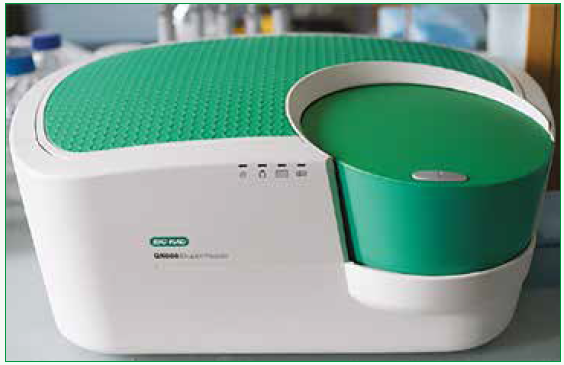
We anticipate leveraging this instrument for rare variant detection as a method of analyzing multiple mutations for MRD and therapeutic response testing for our blood-based oncology offerings. We also expect that this will drive the development of novel, multiplexed assays that were not possible before. On a collaboration front, it is critical that diagnostic test developers establish strong collaborative scientific partnerships with both manufacturers and clinicians.