




Abstract
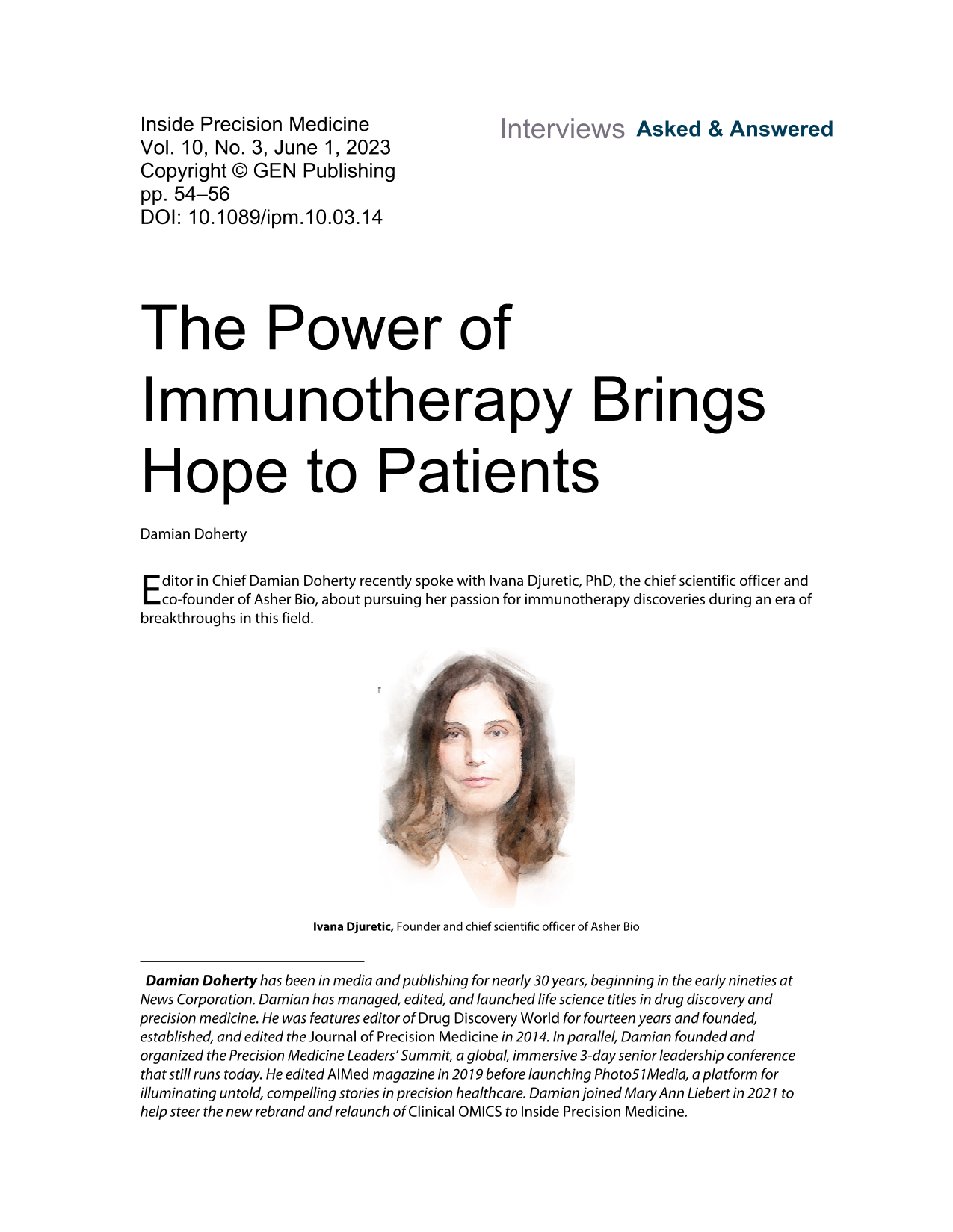
Editor in Chief Damian Doherty recently spoke with Ivana Djuretic, PhD, the chief scientific officer and co-founder of Asher Bio, about pursuing her passion for immunotherapy discoveries during an era of breakthroughs in this field.

At Harvard, my studies in the field of cytokines and T cell differentiation led me to seminal discoveries. I discovered that a transcription factor called Runx3 that normally programs the CD8 T cell lineage and blocks the CD4 T cell lineage is also reinduced in CD4 T cells later in their differentiation to enable their immune functions. As part of my research, I used immune cells and cytokine genes to study how cells are programmed into different cell lineages/cell types, and showed that immune cell fate decisions are reinforced by feed-forward regulatory circuits involving transcription factors and cytokine genes. I'm proud to have had my work published in Nature Immunology, Immunity, and the Journal of Experimental Medicine.
So I was excited to take my first job in industry, which was at a biotech start-up focused on small molecule drug discovery. As I started to learn more about drug development, it occurred to me that maybe inhibiting one pathway with a small molecule isn't enough to cure complex diseases that might be more effectively treated with drug modalities that can impact multiple pathways.
Following my tenure at Celgene, I moved to the West Coast and took on the role of head of cytokine biology at Pfizer's Cancer Immunology Discovery Center in South San Francisco. At Pfizer, I advanced novel programs in cancer immunotherapy as well as being involved with leading-edge T cell redirection programs, including bispecific antibodies and allogeneic CAR-T cell therapies.
In the area of allogeneic cell therapies, I developed and tested strategies to enhance their persistence, avoid allogeneic rejection, and enhance CAR T cell activity in solid tumors. My work on bispecific antibodies included CD3 bispecifics for targeted tumor therapy, and I developed a strategy for T cell redirection with an FLT3 bispecific in acute myeloid leukemia. I also worked on immune modulating biologics, including cytokines.
I gravitated towards this “in between” modality where you can impact multiple pathways with an agonist. You can also rationally develop it and it's not such a manufacturing challenge as cell therapies. That's how I, and my Pfizer colleague and co-founder of Asher Bio, Andy Yeung, became interested in immune modulators and immune agonists. Pfizer closed its Discovery Center in San Francisco in 2018, and at that time, I decided to take a leap as an entrepreneur and co-founded Asher Bio with Andy.
Our innovative approach at Asher Bio achieved cis-targeting, which is the engagement of two molecules on the same cell. Cis-targeted immunotherapy engages both an immunomodulatory receptor and a specific target that directs the therapy to the desired immune cell type. The key feature of cis-targeted immunotherapies is that they focus on a singular immunoregulatory target, which can result in an unprecedented level of selectivity for the subtype of immune effector cells that drives the desired effect—thereby overcoming pleiotropic effects.
There was one academic paper published in 2014 that described how one cytokine—interferon alpha—could be targeted to one cell type. It was just a single example. This was exciting because it seemed very achievable and the technology didn't seem too complicated, but it was early. It was only tried on one cytokine, however. We asked the big question: whether it would work on other cytokines. And if it worked on many other cytokines and it was a rule across the board, then it would be amazing to have that as a platform. Andy and I decided that this was something that just had to be worked on.
Our cis-targeting approach is distinct from other targeted immunotherapies that focus their drug design on directing their therapy to the location of disease, such as the tumor microenvironment. However, in engaging receptors on immune cells, they often activate many immune cell types in and outside of the intended location, leading to a lack of selectivity to the tumor and side effects on healthy cells.
In contrast, our uniquely selective approach with cis-targeting can allow us to therapeutically target only the immune cell types that matter in treating diseases, particularly cancer.
AB248 demonstrated highly compelling anti-tumor activity in multiple preclinical tumor models, showing superior efficacy to other IL-2 therapies currently available and in clinical development for the treatment of cancer. In contrast to native IL-2, AB248 drives selective, unparalleled expansion of CD8+ T cells. AB248 elicits minimal activation of Tregs, which counteract productive immunity, and minimal activation of other IL-2 responsive cell types that may contribute to dose-limiting toxicity.
We are also advancing AB821, a CD8-targeted interleukin 21 (IL-21), designed to selectively activate CD8+ T cells via a pathway distinct from and complementary to IL-2. IL-21 enables T cells to kill tumor cells more effectively by enhancing their cytotoxic function.
Beyond AB248 and AB821, we have rapidly developed and are advancing a pipeline of immunotherapies to address patient populations with unmet medical needs. While our primary focus is on oncology, the modular nature of our cis-targeting platform allows us to leverage other immunomodulators and immune cell types to expand into additional therapeutic areas, including infectious and autoimmune diseases.
One thing that helped along the way is the great advice from colleagues and friends. I'm now happy to share my insights and my experience with others as they begin their journeys. We all encounter the same problems, and having a network to learn from and share advice is invaluable for everyone.