




Abstract
Abstract
Background:
Condensation aerosols are produced when a drug is vaporized and then cools in the inhalation air. Because energy is applied to vaporize the drug, there is a potential concern that the air temperature might not be well tolerated. A literature review indicates that the proper metric for this is the wet-bulb temperature (Twb) of the inhaled air. Twb measures the total energy of the air, including moisture content, and reflects the potential impact on safety and tolerability.
Methods:
The Staccato® system (Alexza Pharmaceuticals, Mountain View, CA) uses thermal vaporization for aerosol generation and was used in a series of studies to characterize the peak transient value (peak Twb) of the air coming out of the device. These studies evaluated peak Twb over a range of air flow rates (15–45 L/min), ambient conditions [15–30°C and 15 to 90% relative humidity (RH)] and vaporization temperatures.
Results:
Under nominal conditions (30 L/min air flow, 25°C and 50% RH), peak Twb was 28.8 ± 0.6°C (mean ± standard deviation). Over the range of operating conditions tested, mean values for peak Twb ranged from 26.2 to 33.3°C with similarly low variances. When operated under a combination of extreme conditions, peak Twb was measured to be 39.9 ± 0.1°C (mean ± standard deviation).
Conclusions:
Technical standards indicate that the upper limit on inhaled Twb for safety and tolerability is 50°C, and inhalation at that temperature can be sustained for 1 h. Peak values of Twb from the Staccato system are well below that threshold, approximately 30°C at nominal conditions and approximately 40°C at a combination of extreme conditions. Moreover, the peak lasts for only a few seconds, well under the time limit of 1 h. These results suggest that aerosols generated with the Staccato system will be safe and well tolerated.
Introduction
The Staccato system uses thermal vaporization for aerosol generation, and operates on the principle whereby a solid thin film of drug (typically less than 10 microns thick) is coated onto a chemically inert substrate that is heated during the inhalation cycle. The nature of the Staccato system technology is such that the heating of the substrate is very rapid (typically within 0.5 sec), and the micron-level thickness of the drug film ensures that the residence time of the drug in contact with the heat source is of a similarly short duration. The rapid heating and vaporization of the drug in combination with the inert substrate and surrounding airflow create a very pure aerosol for inhalation.(1–3) Figure 1 shows a typical temperature versus time trace of the surface of the metal substrate in a Staccato device at actuation, and this shows that the substrate reaches a peak temperature of approximately 400°C in about 0.25 sec and subsequently cools down rapidly. The heating in this case is achieved via a chemical reaction in a sealed stainless steel container, and so the energy source for heating is finite and releases approximately 400 Joules typically. Temperatures of this magnitude are required to vaporize the drug film quickly enough to minimize thermal degradation and produce the full aerosol in a single breath.
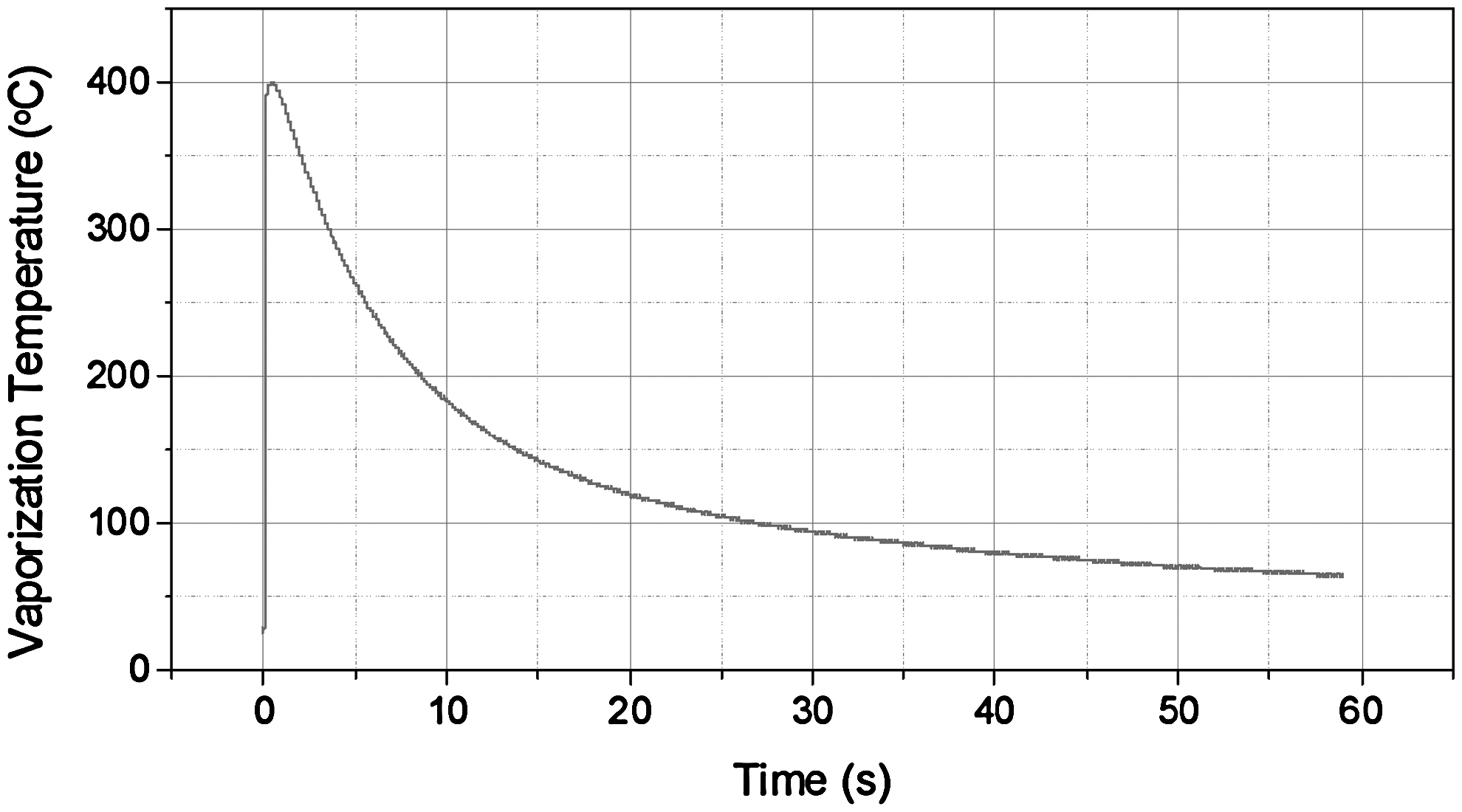
Typical temperature versus time trace of the heated metal substrate in the Staccato platform.
Due to the fact that the inhalation air is flowing past the heated substrate in order to entrain the aerosol, the air stream also absorbs thermal energy from the heated substrate by convective heat transfer. The exit temperature of the air stream from the device is, therefore, slightly higher than the inlet air temperature. As a result, the development of a thermal aerosol technology must take into account the safety and tolerability of the elevated temperature of the inhaled air stream. Prior research and existing standards show that the safety thresholds for inhaled air temperature can be higher than normal body temperature, and they also show that the most relevant thermal metric for inhalation air is the wet-bulb temperature.(6,7) The wet-bulb temperature is a parameter in which the dry-bulb temperature of the air (as measured by a standard thermometer) and the relative humidity of the air are thermodynamically combined to represent the total energy content of the air. Figure 2 shows the relationship between dry-bulb temperature, wet-bulb temperature and relative humidity; the curves in this figure were calculated from industry-standard psychrometric formulae.(8) The in vitro studies described in this article compare the thermal output of the Staccato system to prior research and existing safety standards.

The relationship between wet-bulb temperature, dry-bulb temperature and relative humidity for dry-bulb temperatures ranging from 10–90°C and relative humidity values ranging from 5–95%.
Methods and Materials
The test articles for the experiments were Staccato single-dose devices. The Staccato system device consists of the following major components: a lower housing assembly, consisting of a medical-grade polycarbonate plastic housing that forms half of the airway and a printed circuit board assembly (PCBA) for breath sensing and actuation; an upper housing, made of the same medical-grade plastic to form the other half of the airway; and a heat package, which is the stainless steel container that houses the exothermic chemical reaction used for vaporizing the drug coating. A schematic of the Staccato system is shown in Figure 3. This schematic shows the drug coating on the heat package, but in most of the experiments presented here, the drug coating was not applied, that is, the devices were placebo units. For one set of experiments the drug coating was applied, and in those cases, the drug was loxapine in the amount of either 5 mg (all 5 mg coated on one side of the heat package) or 10 mg (5 mg coated on both sides of the heat package). Most of the experiments used devices with heat packages that produced transient peak temperatures at the nominal 400°C value, although in some cases, heat packages with a transient peak temperature of 430°C were used to evaluate extreme conditions.
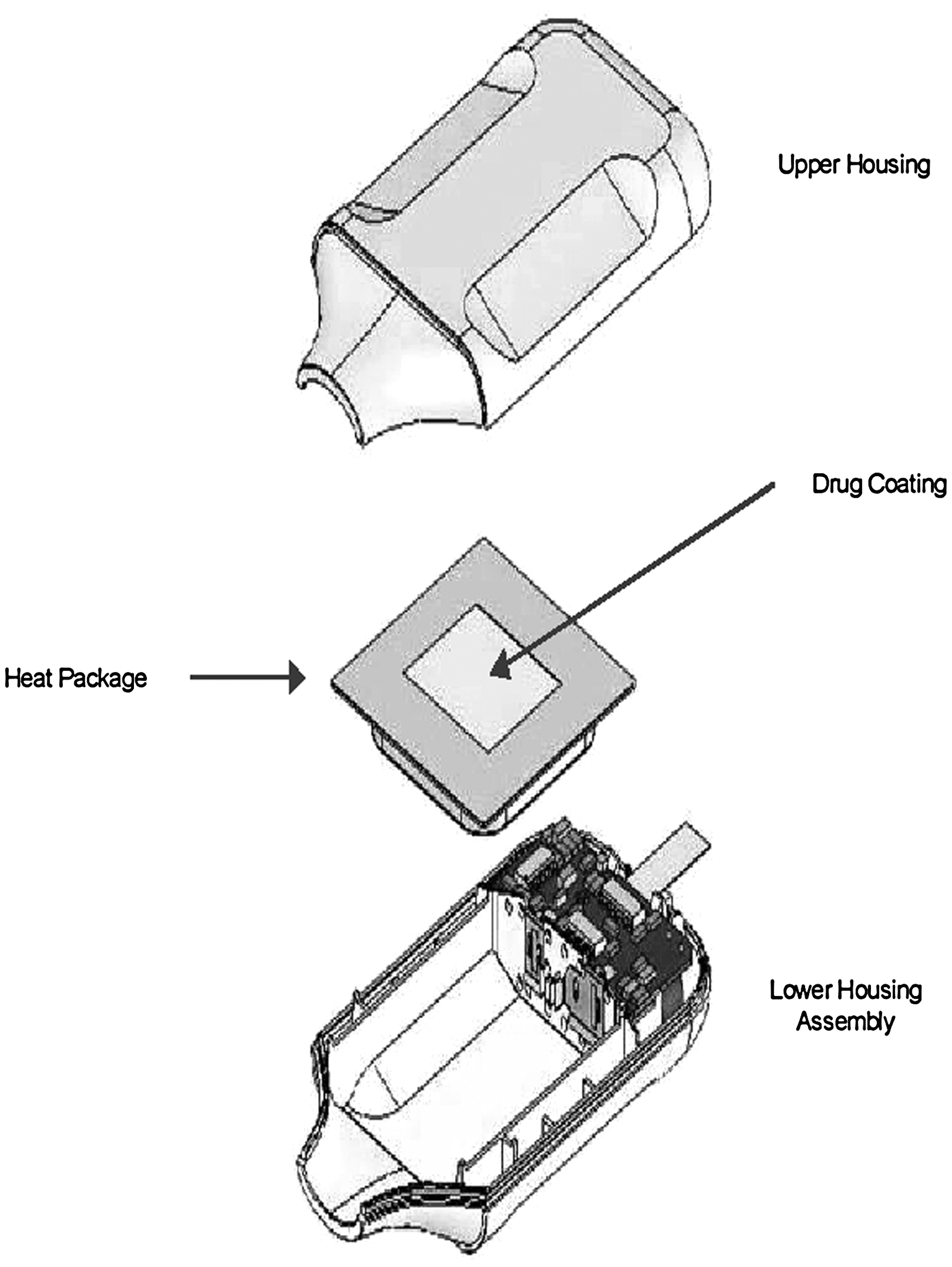
Staccato system schematic, showing the major components (upper housing, lower housing assembly, heat package and drug coating).
Exit air temperature was measured with a test apparatus consisting of an array of seven K-type thermocouples (OMEGA Engineering, Stamford, CT) near the exit plane of the mouthpiece of the Staccato device. The response time for the thermocouples was less than 50 msec. The thermocouple plane was located 1.7 cm from the exit plane of the mouthpiece, which was the closest possible location. The apparatus was verified for the correct air flow rate value and the absence of leaks prior to every trial. Figure 4 shows a schematic of the overall test setup, which also includes a vacuum pump, a solenoid valve, and a needle valve to adjust and activate the air flow, and a TSI 4000 Series flow meter (TSI, Shoreview, MN) to measure the air flow. All experiments were conducted inside a temperature and humidity controlled chamber (PGC, Black Mountain, NC). Standard conditions were set at 25°C/50% relative humidity (RH). Devices were stored in the chamber for a minimum of 1 h prior to performing the air temperature measurement, in order to allow for equilibration with the environment in the chamber.
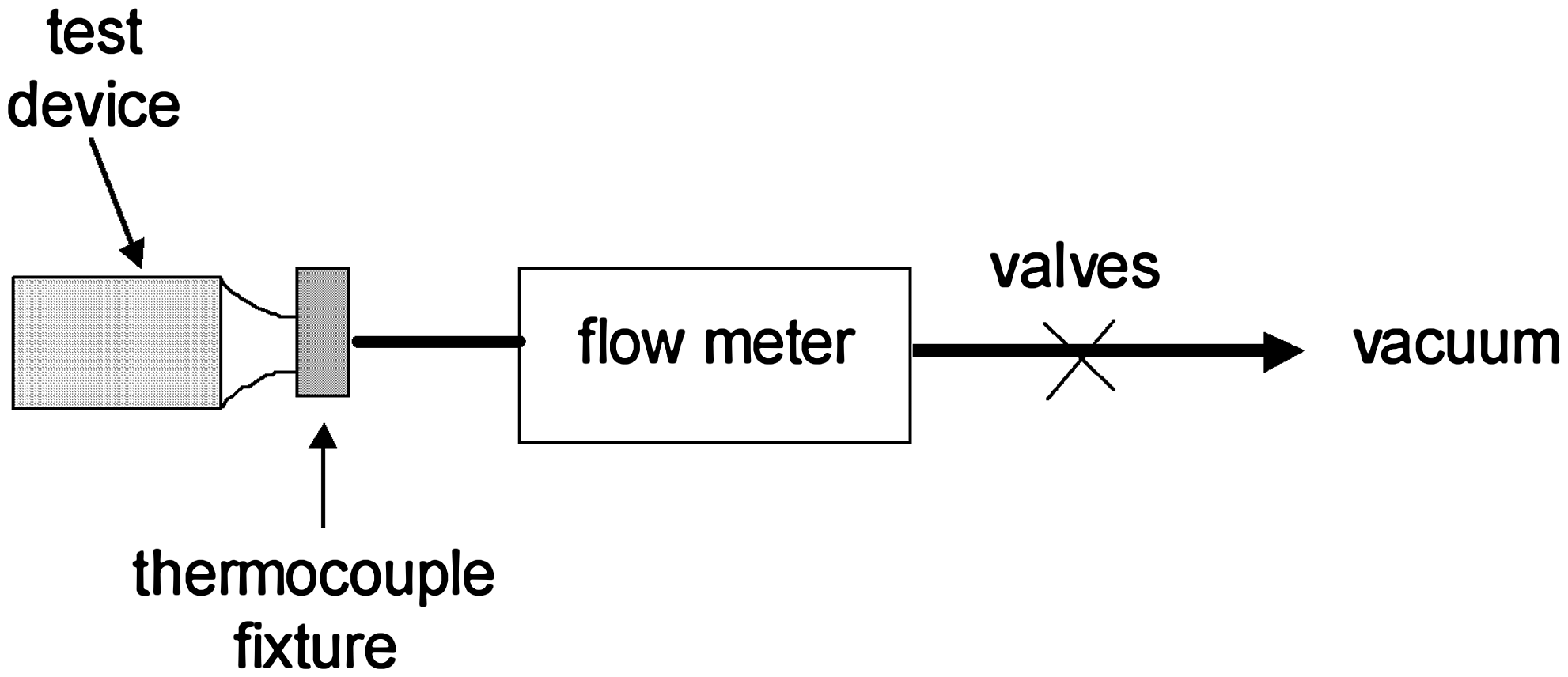
Schematic of test apparatus.
In each experiment, the peak temperatures of the seven thermocouples were measured with Fluke 52II calibrated digital thermometers (Fluke Corporation, Everett, WA), and the average from these seven peak temperatures was calculated. The conversion to wet-bulb temperature was then done by calculating the enthalpy of the air at the exit of the device from the average peak temperature (dry bulb) measured at the exit plus the absolute humidity of the entering air stream, and then interpolating the wet-bulb temperature at which a saturated airstream would yield the same enthalpy based on industry-standard psychrometric data.(8)
Results
The peak wet-bulb temperature of the air stream coming out of the Staccato devices (peak Twb) was measured under a variety of conditions intended to simulate a range of foreseeable use conditions. The nominal test condition is as follows: 25°C ambient temperature, 50% ambient RH, 30 L/min air flow rate, 400°C transient peak vaporization temperature, and no drug coating. Peak Twb was then measured while varying each parameter individually in order to assess the effect of that parameter. When all of the individual effects had been observed, a final “worst case” test condition was run with each parameter set to the value that would induce an increase in peak Twb. The following sections present the results from each of these experiments.
Nominal condition—placebo versus active
Table 1 shows results for peak Twb using active (drug-coated) and placebo (no drug coating) devices, all tested under nominal conditions for ambient temperature, flow rate, and heat package temperature. The results in Table 1 show that the presence of drug in the air stream does have an effect on peak Twb, on the order of 0.5 to 1.0°C per 5 mg of drug loading. This is most likely due to the fact that the aerosol particles themselves are depositing on the thermocouples and creating a higher reading due to their higher heat capacity, rather than actually increasing the temperature of the surrounding air. For other drugs that might have a hydrate form, the effect on peak Twb will be negligible due to the small doses of drug involved relative to the amount of air inhaled. For practical purposes, subsequent experiments were conducted with placebo units in order to avoid possible contamination of the thermocouples with aerosolized drug particles. The results shown in Table 1 indicate that the placebo test results are only minimally different from those with active devices.
The effect of variable ambient conditions and air flow rate
Table 2 shows results for peak Twb for various air flow rates, ambient temperatures, and ambient RHs. The nominal conditions are presented again from Table 1 for reference. Each of the other test conditions had all other parameters constant at the nominal value except for the parameter and value listed in that row; for example, when the flow rate was varied, the temperature and RH were held constant at the nominal values. The results in Table 2 show that increasing the ambient temperature or ambient humidity will increase the peak Twb, while increasing air flow rate will decrease the peak Twb. These trends are expected, as higher ambient temperature or humidity will increase the energy of the air stream, whereas higher air flow rate will increase the amount of air absorbing the energy from the device. RH has the strongest effect, increasing the peak Twb by nearly 5°C in going from an ambient environment of 50% RH to 90% RH. Ambient temperature has the next strongest effect, with a nearly 4°C increase in peak Twb in going from an ambient environment of 22 to 30°C. Air flow rate has the smallest effect, with an increase of only about 2°C in peak Twb going from 30 to 15 L/min.
RH, relative humidity.
The effect of vaporization temperature
Table 3 shows results for peak Twb for a more energetic heat package with the nominal conditions presented again from Table 1 for reference. The results in Table 3 show that increasing the energy output from the heat package will increase the peak Twb. However, the effect is small, with a roughly 2°C increase in peak Twb for a 30°C increase in peak vaporization temperature. Although this may seem like an unusually small effect, it makes sense given the thermal profile for the heat package shown in Figure 1. The transient temperature used as the characteristic for the heat package (400°C nominally, 430°C for the extreme condition) exists only for a short period of time. Additionally, the 430°C vaporization condition releases a total of only ∼20 J more than the 400°C unit. Therefore, the actual increase in energy output of the heat package is quite small for a 30°C change in peak temperature, and the small change in energy output translates into a small change in peak Twb.
Extreme conditions combined
Table 4 shows results for peak Twb for a test condition with all of the parameters set at the extreme value selected to increase the wet-bulb temperature. In other words, this was run at high ambient temperature (30°C), high ambient humidity (90% RH), low air flow rate (15 L/min), and high heat package temperature (430°C). The purpose for testing this combination of parameters was to evaluate what would result from a worst-case scenario. The results in Table 4 show that the cumulative effect of the various parameters on peak Twb is approximately additive within the range of parameters tested. The individual effects of the parameters (from Tables 2 and 3) add up to increase peak Twb 11.8°C, whereas the results in Table 4 show an increase in peak Twb of 11.1°C from the nominal condition, that is, the mean value for peak Twb for this extreme condition was 39.9°C. As described in Table 1, the presence of drug will add approximately 1°C, pushing the peak Twb value for the extreme condition to just over 40°C. As is detailed in the discussion below, the approximate limit for Twb for human tolerability is 50°C (for up to an hour of exposure). The data from these experiments show that even under an extreme set of conditions, the peak Twb from the Staccato device is only slightly above 40°C.
Discussion
In experiments with human subjects, Killick(6) was able to show that inhalation of air at a dry-bulb temperature of 130°C was tolerable for up to 2 h, and Takahashi et al.(7) showed that inhalation of air at a dry-bulb temperature of 90°C for several minutes was similarly tolerable. Interestingly, both Killick et al. and Takahashi et al. found that the dry-bulb temperature of the inhaled air stream was less important than the total energy as represented by the wet-bulb temperature. Killick's findings were that inhalation of air at a wet-bulb temperature of 60°C was tolerable for the same 2-h time limit as was 130°C dry-bulb temperature, and Takahashi et al. found that inhalation of air at a wet-bulb temperature of 55°C was similarly tolerable. In fact, Takahashi et al., note that “the wet-bulb temperature was the controlling factor in the user's perception of heat, the dry-bulb temperature had no effect on the heat perception.”
Although Takahashi et al., and Killick simply assessed the tolerability of the inhaled air, other researchers have made in vivo measurements of air temperature in the upper respiratory tract. For example, McFadden et al.(9) used thermistors mounted on narrow tubes inserted into the tracheobronchial tree to conduct thermal mapping of airflow in the upper airways during inhalation and exhalation of air streams. The thermistors reached as far as 47 cm into the respiratory tract (from the tip of the nose) and thermal mapping was conducted for various air flow rates and inhaled air temperatures. The results from these studies show that there is a substantial amount of evaporative heat transfer that takes place in the respiratory tract, which is a naturally very humid environment. In other words, inhaled air that is relatively dry will rapidly equilibrate with the body's humid environment due to mixing with the relatively high heat capacity of the humid air in the respiratory tract. Inhaled air that is relatively moist will not equilibrate nearly as rapidly because of the closer balance in heat capacity between the inhaled air and the environment in the body. As such, the moisture content of the inhaled air plays a significantly stronger role in determining the tolerability of that air stream, as evidenced by the work of Takahashi et al., and Killick, who found that the wet-bulb temperature was the key determinant of tolerability.
When developing a product, it often helps to have established standards to use as design guidelines, and the empirical research described above has led to the establishment of such standards. In the United States, there is a standard established by the National Institute for Occupational Safety and Health (NIOSH) for maximum temperatures from closed-circuit breathing apparatus such as is used by firefighters.(10) The NIOSH standard recommends an upper limit of 50°C wet-bulb with no limitation on duration given. In Europe, there is a similar standard set by the European Committee for Standardization (CEN). The CEN standard(11) also recommends an upper limit of 50°C wet-bulb, in this case, with a limit on time of 1 h. The data presented in this article show that not only is the peak Twb from the Staccato system well under the limit prescribed by these standards (30 to 40°C for the Staccato system vs. 50°C from the safety standards), the duration of thermal exposure with the Staccato system is orders of magnitude shorter than what is prescribed by the standards (4–5 sec for a single breath with the Staccato system vs. 1 h or more from the standards). Therefore, the aerosol generated by the Staccato system should not pose any thermally related safety concerns.
Footnotes
Author Disclosure Statement
No conflicts of interest exist.