




Abstract
Abstract
Background:
Aerosol particles may be generated from rupturing liquid films through a droplet formation mechanism. The present work was undertaken with the aim to throw some light on the influence of film dimensions on droplet formation with possible consequences for exhaled breath aerosol formation.
Methods:
The film droplet formation process was mimicked by using a purpose-built device, where fluid films were spanned across holes of known diameters. As the films burst, droplets were formed and the number and size distributions of the resulting droplets were determined.
Results:
No general relation could be found between hole diameter and the number of droplets generated per unit surface area of fluid film. Averaged over all film sizes, a higher surface tension yielded higher concentrations of droplets. Surface tension did not influence the resulting droplet diameter, but it was found that smaller films generated smaller droplets.
Conclusions:
This study shows that small fluid films generate droplets as efficiently as large films, and that droplets may well be generated from films with diameters below 1 mm. This has implications for the formation of film droplets from reopening of closed airways because human terminal bronchioles are of similar dimensions. Thus, the results provide support for the earlier proposed mechanism where reopening of closed airways is one origin of exhaled particles.
Introduction
Film rupture and droplet formation was first studied for flat soap films, and the effect of surface tension, film thicknessm, and viscosity were explored for example by McEntee and Mysels.5) Later, film droplets from bursting air bubbles at the sea surface were introduced as a mechanism for sea salt aerosol formation. Spiel6) showed that the droplets have considerable speed in the general direction toward the edge of the bubble and proposed that primary droplets, impacting on the surface, may generate secondary, smaller droplets. Another observation by Spiel6) was that no droplets were formed from bubbles smaller than 2.5 mm. When considering sea salt aerosol formation, effort has been made to link wind speed or white cap coverage with particle production rate and size distribution.7) However, the film droplet formation process itself, connecting film properties to droplet number and size, has received little attention.
A particle source of considerable interest is humans themselves. Aerosol particles in the form of droplets are generated in the human airways as we cough, laugh, speak, and even as we breathe. These particles leave the body with exhaled air.(8–12) The source strength is low, but there are other aspects that have caused a rising interest in human exhaled particles. The endogenously formed particles exist as droplets of respiratory tract lining fluid (RTLF), originating from the airways.(9,11) The exhaled particles may carry pathogens that transmit airborne infectious diseases, such as measles, influenza virus, and small pox,(13–15) but they may also contain indicators of various lung conditions.(11,16,17) The literature suggests two different mechanisms for generating the particles. The first mechanism is connected to high air velocities together with dynamic compression of the airways, for example, when coughing or sneezing.(18–20) Such activities cause instabilities in the layer of RTLF and mucus, that may produce droplets from shaking and vibrating airway walls.(20) The second mechanism is based on the formation of film droplets as discussed above, in connection with reopening of closed airways.
Airway closure takes place in the vicinity of the terminal bronchioles during deep exhalation, when compression of airways causes the RTLF layer to become unstable.(21) The RTLF then flows from the airway wall and reshapes into a liquid meniscus that occludes the airway.(22–25) When the bronchioles reopen during the subsequent inhalation, it is assumed that a film of RTLF is spanned across the passage. When this film ruptures, droplets may form in analogy with film droplets from soap films or from bursting air bubbles at the sea surface.(6,7) Indirect experimental evidence of formation of film droplets in connection with airway closure and reopening has been presented recently.(10,12,26)
The present work was undertaken with the aim to study the influence of various physical quantities on film droplet formation. This was done by experimentally mimicking the film droplet formation process in a purpose-built instrument, where fluid films were spanned across holes of different diameters. The information thus obtained applies to film droplet formation in general, but could specifically be employed to make statements about where in the airways film droplet formation may or may not take place.
Materials and Methods
System layout
The experimental setup was designed to count and size the droplets formed when a flat, geometrically well-defined film ruptures and is schematically depicted in Figure 1. The chamber (A) was made of acrylic glass and flanged to allow the lid to be removed and give access to the interior. An open top stainless steel container (B) (W×L×H 15×100×120 mm3), located inside the chamber, held the working fluid. An exchangeable perforated stainless steel plate (C) may be lowered into the working fluid or pulled out of the fluid to hang free above the vessel by means of a metal rod (D) passing through a gas tight seal in the lid of the chamber. A flow of dry, filtered nitrogen gas was introduced through the entrance (E), passed the chamber, and left through the exit (F) located in the opposite chamber wall.

Setup for studying particle formation from bursting liquid films. The bottom illustration is a section through the top illustration, viewed in the direction of the section arrows. (
To make a measurement, the initially submerged perforated plate was lifted out of the working fluid, and was allowed to hang free inside the chamber. Excess fluid was allowed to drain off the plate, back into the container. This process was aided by a fixed scraper (G) that removed superfluous fluid from the plate when lifted out of the container. This left a fluid film spanned across each hole in the plate. When the film burst, film droplets were formed. These droplets were carried by the gas flow to be measured with the downstream instrumentation.
A Grimm dust monitor model 1.108 (Grimm Aerosol Technik GmbH, Ainring, Germany) (H) provided information on size and concentration by means of single-particle light scattering. It was operated in a 6-sec averaging mode and delivered concentration data in 15 size intervals, from 0.3 to greater than 20 μm. The device drew a flow of 1.2 L min−1. A condensation particle counter (TSI CPC 3010, TSI Inc., Shoreview, MN, USA) (I) provided total concentrations for droplets larger than 0.01 μm. This instrument drew a flow of 1.0 L min−1 and was operated in a 6-sec averaging mode. The dew point of the gas was measured with a cooled mirror hygrometer (System 1100 DP Hygrometer, General Eastern Industries, USA) (J). The incoming flow was set to 2.7 L min−1, and excess gas was allowed to escape to vent (K).
Plates
Six plates were used and their characteristics are given in Table 1. The need for a certain stiffness of the plate when passing the scraper required a thickness greater than 0.1 mm. This, together with the desire to keep the ratio between thickness and diameter small, the reason for which will be discussed later, limited the hole diameter downward to around 1 mm. It was found that films formed from some working fluids, in the plate with 8-mm holes, ended to burst before the hole was completely out of the fluid in the container. This meant that the film surface when the film burst was unknown. However, calculations were made assuming 8-mm diameter films.
Working fluids
Five working fluids were selected and are presented in Table 2. Some of the fluids were chosen to illuminate the influence of properties such as surfactant solubility and surface tension on the film droplet formation process, while others were selected because they contain constituents that have been found in RTLF. Concentrations sometimes had to be chosen so that manageable times for rupture were obtained (less than 5 min).
The table gives the name, composition, surface tension, absolute viscosity, and density of the working fluids. It also gives the average specific droplet formation capacity (SDFC) of the working fluid and the average diameter of the droplets that were generated, together with the standard deviation.
Alveolar RTLF is isotonic, which means that it has an osmolality close to 0.287 Os kg−1. It appears that most of this osmolality is provided by soluble ionic compounds, for example NaCl.(27) Isotonic NaCl, 9.0 g NaCl (PA, Merck) dm3 solution, was therefore chosen as one working fluid. It was also chosen as the base for all other working fluids.
Phosphatidylcholine (PC) is found in the surfactant layer in alveolar RTLF. The surfactant is mainly composed of phospholipids (∼80%), cholesterol (∼10%), proteins (∼10%), and small amounts of carbohydrates. The phospholipids, in turn, are dominated by PC, but there are also large amounts of phosphatidylglycerol present.(28) The solubility of PC in water is very low. The PC solution used as a working fluid contained isotonic NaCl solution saturated in L-α PC (∼60%, Sigma Aldrich) at 20°C.
The PC/protein mix contained 1.2 g bovine albumin (≥98%, Sigma Aldrich) in 1 dm3 isotonic NaCl solution, which was saturated in L-α PC at 20°C. This working fluid was chosen to find any obvious synergistic effects of adding protein to the PC solution.
Sodium Dodecyl Sulfate (SDS) is an effective surfactant that is used in for example household detergents. It is known to reduce the surface tension of water, and is soluble at 150 g L−1. Here, 0.40 g SDS (GPR RECTAPUR) was dissolved and diluted by isotonic NaCl solution to make 1 dm3 SDS solution. The measured surface tension of this solution indicated that it contained highly surface active impurities such as dodecyl alcohol originating from decomposition of the original substance.(29)
Curosurf® (Nycomed) is a suspension indicated for the treatment of respiratory distress syndrome (RDS) in premature infants by lowering a pathologically elevated surface tension in the alveoli. This is necessary to stabilize the alveoli and to enable an efficient gas exchange during the whole ventilation cycle. The active substances of Curosurf® are phospholipids, lipids, and two hydrophobic low molecular weight proteins (SP-B and SP-C) extracted from porcine lung. The main constituent is dipalmitoylphosphatidylcholine. The protein fraction constitutes about 1% of the solution and is important for the spreading of the preparation across the alveoli. One mL of Curosurf® contains 80 mg porcine lung lipids and proteins, NaCl, and H2O. Here, 1.5 mL Curosurf® was diluted with isotonic NaCl solution to give 250-mL suspension.
The surface tension of the liquids were measured with a KSV Sigma 70 tensiometer (KSV NIMA, Espoo, Finland) using the ring method. Kinematic viscosities were determined by capillary viscometry using a calibrated Ubbelohde viscometer (Cannon Instrument Co., State College, PA, USA) submerged in a constant-temperature water bath at 298±0.02 K. Conversion to absolute viscosities was made by multiplying the sample densities obtained from measurements using a density meter (DMA, Anton Paar GmbH, Graz, Austria) at the same temperature.
Measurement protocol
Before measurements, plates and steel container were cleaned with ethanol and machine washed at 343 K with Extran AP 22. They were then rinsed repeatedly in milli-Q water. One measurement run comprised a minimum of ten separate experiments. In an experiment, the initially immersed plate was lifted from its original position in the working fluid, and hung free inside the chamber as the gas flowing through the chamber transported the droplets formed to the downstream instrumentation where concentrations and size distributions were measured. When a zero count was reached, that is when all particles had been swept out of the chamber by the gas stream, the plate was resubmerged into the working fluid, and the next experiment could begin. The total number of particles generated was calculated by summing the product of concentration (particles L−1), flow rate through chamber (L s−1) and averaging time for the concentration measurement (6 sec). This quantity was then divided by the number of holes in the plate and the surface area of one hole. The result is the number of droplets formed per unit surface of fluid film and will hereafter be referred to as specific droplet formation capacity (SDFC) (particles mm2).
Results
Comparing the averages taken over all experiments for a working fluid it is seen in Table 2 that SDFC drops with decreasing surface tension. This was true for all working fluids except the PC/protein mix. The average values over the experiments in each measurement run are presented in Figure 2. In some cases, experiments in a run could scatter significantly as can be seen from the standard deviations also given in Figure 2. The data displayed show no obvious general trend between film diameter and SDFC. The two solutions with the highest surface tension, the NaCl solution and the PC/protein mix, both show a decrease in SDFC with increasing film diameter while the SDS solution and the diluted Curosurf show an increase. The formation from the PC solution appears insensitive to film dimension. No clearly visible trend toward reduced SDFC with reduced diameter of the films is seen and there is no indication that a film of a diameter of around 0.6 mm, the expected diameter of a terminal bronchiole,(30) cannot generate droplets from any of the working fluids investigated here.
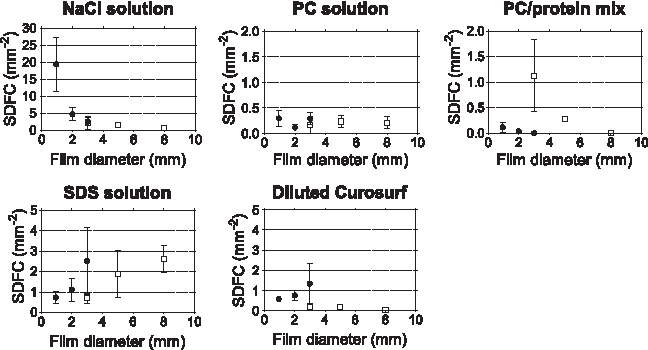
The number of droplets generated per mm2 of available film, that is, specific droplet formation capacity (SDFC). The filled circles represent thin plates (plates 1–3) and the empty squares represent thick plates (plates 4–6). The error bars denote the standard deviation of the average values.
The size distributions obtained by the Grimm dust monitor all peaked at the smallest size interval (0.3–0.4 μm). It was therefore difficult to estimate the shape of the distributions below this size. Nonetheless, by subtracting the total number of droplets counted by the Grimm dust monitor from the total number of droplets counted by the CPC, an additional size bin with limits 0.01–0.3 μm was obtained. The average droplet diameters taken over all experiments for a working fluid are found in Table 2. No obvious relation was found between surface tension and droplet diameter. An average droplet diameter was also calculated for each measurement run. These values are plotted in Figure 3. The standard deviations are quite large, but it appears that the smallest droplets generally were generated from the plates with the smallest hole diameters.

Average droplet diameter. The filled circles represent thin plates (plates 1–3) and the empty squares represent thick plates (plates 4–6). The error bars denote the standard deviation of the average values.
Discussion
SDFC values ranged between 0 and 20, but rarely exceeded 5 droplets per mm2. Droplets were generated from films as small as 0.95 mm in diameter. This can be compared to previous work on bubble bursting in sea water, performed by Spiel.(6) Spiel dealt with sphere segment-shaped films (bubbles on a liquid surface), whereas the films in the present work are flat. However, the droplet formation process should be next to identical in both cases. Calculating SDFC from Spiel's data, values ranged between 0.5 and 13 droplets per mm2, which is in the same range as in the present work. Bubbles with diameters from 2 to 14.6 mm were investigated, but no droplets were observed from bubbles smaller than 2.5 mm in diameter. It is, however, possible that droplets actually were generated, but that they were too small to be detected by Spiel's instrumentation.
The experiments in this work appear simple to perform. Still, the calculated SDFC's show a considerable variability between experiments in a measurement run that, in principle, should yield identical results. Some of the variability is connected to the nature of the film rupture process. A film may rupture because the liquid layer between the gas–liquid interfaces has become so thin at one point that the opposing interfaces interact. Here, the thinning is caused by drainage and evaporation of water. Drainage, in turn, is caused by gravitation and the scraper used to remove excess liquid from the plates. The scraper was necessary to keep the time taken for rupture of all films in a plate within manageable limits. Evaporation from the plates was evidenced by an increase in dew point when the plates were lifted out of the working fluid to start an experiment. Gravitation tends to cause thinning of the upper part of a vertical film while evaporation causes an even thinning of the entire film. The balance between gravitational loss and evaporation determine where the rupture takes place and thus the direction and velocity of the droplets formed. Droplet direction and velocity are important for the fraction of droplets lost due to impaction and possible secondary droplet formation.(6) Any presence of impurities in the chemicals used should affect all sets for a given working fluid in a similar way and not contribute to the scatter in data.
Effects of measurement setup
A hole in a plate is, in principle, a pipe segment with diameter d and length l corresponding to the plate thickness. When a film ruptures, droplets are formed from the rapidly receding edge of the film. The droplets have a velocity and a general direction toward the inside walls of the hole.6) The probability of hitting the walls is linked to the l/d ratio. In a case with large l/d ratio it is expected that many droplets would impact on the wall and be lost or possibly generate secondary droplets.
Thus, the thin plates (plates 1–3) and the thick plates (plates 4–6) did not necessarily show the same trend. Thick plates generally gave fewer droplets than did thin ones. When comparing the only hole size (3 mm) where two plates with different thicknesses were available, the thick plate gave fewer droplets than the thin one except for the case with the PC/protein mix. This might be explained by the reasoning above, that some droplets generated in the thick plate impacted on the walls and were lost. The distal airways are characterised by a length to diameter ratio of at least 2.(31) No influence on the primary process of droplet formation from the receding film is expected by the l/d ratio. However, a large l/d ratio would enhance the secondary effect of wall impaction loss and fewer droplets would be available for exhalation than indicated by the present results.
Effects of working fluids
The only computational fluid dynamics (CFD) work to model the number and size distribution of droplets generated by a rupturing liquid film that the present authors were able to find is that of Haslbeck et al.(32) Notably, Haslbeck et al. modelled rupturing RTLF films with varying surface tension, density, and viscosity as the basis for their calculations. The results showed that number and size distributions were sensitive to variations in surface tension, as a higher surface tension resulted in slightly smaller droplets and increased the quantity of droplets. Varying density had no effect and varying viscosity had almost no effect. Unfortunately, this work suffers from lack of resolution in the small size range and is difficult to compare with the present work.
The only physical parameter other than film size that was varied in the present work was surface tension. It appeared that high surface tension promoted high SDFC, whereas no relation between surface tension and average droplet diameter was found. Again, it is recognized that these observations are based on films spanned across holes in a plate, but the results should also apply to situations where the length-to-diameter ratio of the hole is larger, for example, in airways. The surface tension is important because the behavior of a receding film after rupture is determined by the surface tension in relation to the viscosity of the film liquid. Sünderhauf et al.(33) define a dimensionless number Γ that specifies the ratio between capillary and viscous forces in a two-dimensional plane liquid sheet as
Conclusions
High surface tension favors the formation of droplets generated from bursting fluid films of low viscosity. The number and sizes of the droplets did not vary much, even though working fluids with no insoluble and soluble surfactants were used in the experiments. Droplets were generated from all films, with diameters from 0.95 to 8 mm, and nothing in this work shows that droplets can not be generated from even smaller fluid films. This suggests that film droplet formation can occur in the terminal bronchioles of the human airways as a result of reopening closed airways, even though the resulting liquid films are small. It is also suggested that efficient film droplet formation should take place in the mucus-free parts of the respiratory system because the presence of high viscosity material in the film would inhibit droplet formation through the abovementioned mechanism.
Footnotes
Acknowledgments
The work was supported by the Centre for Environment and Sustainability (GMV) in Gothenburg, Sweden, and by the Swedish Research Council Formas (2009-789).
Author Disclosure Statement
No conflicts of interest exist.