




Abstract
Abstract
Background:
The Mastersizer X (Malvern Instruments) used to be the reference device for assessing droplet size distribution of aerosols by laser diffraction, but it has not been updated and has gradually been replaced by the Spraytec (Malvern Instruments), which is considered to provide greater accuracy and higher acquisition speed.
Methods:
The aim of this study was to compare the use of the two diffractometers to characterize medical liquid aerosols in a wide range of droplet sizes, using four nasal sprays to produce large droplets (10–180 μm) and 10 nebulizers to produce smaller droplets (0.5–20 μm). The influence of the inhalation cell provided with the Spraytec on the measurements was also determined.
Results:
Correlation between the devices was low for large droplets (R2=0.37) and high for smaller droplets (R2=0.97). The Spraytec overestimated the median diameter of small droplets by 14%, and Bland-Altman tests showed no equivalence (limits of agreement over 20%). An artifact peak in the large size range was observed with the Spraytec, which could be due to difficulty for the multiple scattering algorithm to process high-density aerosol clouds. The difference was reduced to 5% by using the inhalation cell provided by the Spraytec with a 15 L/min aspiration.
Conclusion:
The Mastersizer X and the Spraytec cannot be considered as equivalent laser diffraction devices, but the difference can be reduced with the Spraytec inhalation cell.
Introduction
O
The Mastersizer® X, developed by Malvern Instruments (Malvern, Worcestershire, UK), is one of the most popular laser diffraction devices and is considered as the reference for laser diffraction methods. Its correlation with cascade impactors for liquid nebulizers has been well established.(7,11,12)
However, the development of the Mastersizer X laser diffractometer (LD) has recently been stopped, and it has gradually been replaced by the Spraytec® LD, which is considered to be more accurate and have a better acquisition speed.(13) Its acquisition frequency is 10 kHz (500 Hz for the Mastersizer X LD), allowing a live display of the distribution and far more acquisition points to be averaged.
The Mastersizer X LD and the Spraytec LD have been tested with the same calibrated latex micrometric spheres provided by the manufacturer.(14) Some studies have also compared the performance of the Spraytec LD with that of other devices, for pressurized metered dose inhalers (pMDIs) and dry powder inhalers (DPIs).(3,15) With regard to pMDIs, a correlation (R2=0.80) has been demonstrated between the Spraytec LD used with an inhalation cell and the Andersen cascade impactor.(15) With regard to DPIs, a correlation has been demonstrated,(3) both between a cascade impactor (Multistage Liquid Impinger) and Spraytec, and between Mastersizer X LD and Spraytec LD for mass median aerodynamic diameter and percentage of droplets with a Dae less than 5 μm (R2 ranging between 0.9 and 0.98). However, the equivalence between the two diffractometers has not been demonstrated for liquid aerosols with a wide range of droplet sizes.
The aim of this study was to compare the use of the Spraytec LD and the Mastersizer X LD to characterize the droplet size distributions of liquid aerosols. Aerosol measurements with the Spraytec LD were performed with and without the inhalation cell provided by Malvern Instruments, which is expected to maximize the accuracy of the measurements, and were compared with the Mastersizer X results.
Materials and Methods
Aerosol devices
Four different nasal sprays and 10 nebulizers (seven jet nebulizers and three mesh nebulizers) were tested, allowing a large range of droplet sizes (between 0.5 and 180 μm) to be covered.
The four nasal sprays were: Pivalone® (tixocortol pivalate; Pfizer, New York, NY), Rhinofluimicil® (acetylcysteine, tuaminoheptane sulfate; Zambon France, Issy-les-Moulineaux, France), Nasonex® (mometasone fuorate; Schering-Plough, Kenilworth, NJ), and Rhinocort® (budesonide; AstraZeneca, London, UK).
The jet nebulizers were: Pari LC Sprint® (Pari, Starnberg, Germany), Pari LC Star® (Pari), Mistyneb® (Cardinal Health, Chateaubriant, France), NL20® (La Diffusion Technique Française, St Etienne, France), Sidestream® (Respironics, Bognor Regis, UK), UP-DRAFT II Optineb® (Teleflex, Research Triangle Park, NC), and NL9M® (La Diffusion Technique Francaise).
The three mesh nebulizers were: Microair® (Omron, Kyoto, Japan), Aeroneb Go® (Aerogen, Galway, Ireland), and Eflow Rapid® (Pari).
Mastersizer X
In the first set of experiments, the volume droplet size distribution was measured by a Mastersizer X LD (Malvern Instruments) equipped with a He-Ne laser (λ=632.8 nm) with a beam diameter of 18 mm. The Mastersizer X LD can be fitted with three different lenses, each one covering a specific droplet size range: the 45-mm lens covers droplet sizes from 0.1 to 80 μm, the 100-mm lens covers sizes from 0.2 to 180 μm, and the 300-mm lens covers sizes from 1.2 to 600 μm. Preliminary tests did not detect droplets larger than 180 μm with the 300-mm lens whatever the aerosol device, including the nasal sprays. Therefore, the 100-mm lens was considered as the best compromise and was used throughout the study. In the software, the dispersion code was set as “polydisperse” and optic presentation as “2QAA,” representing water droplets in air.
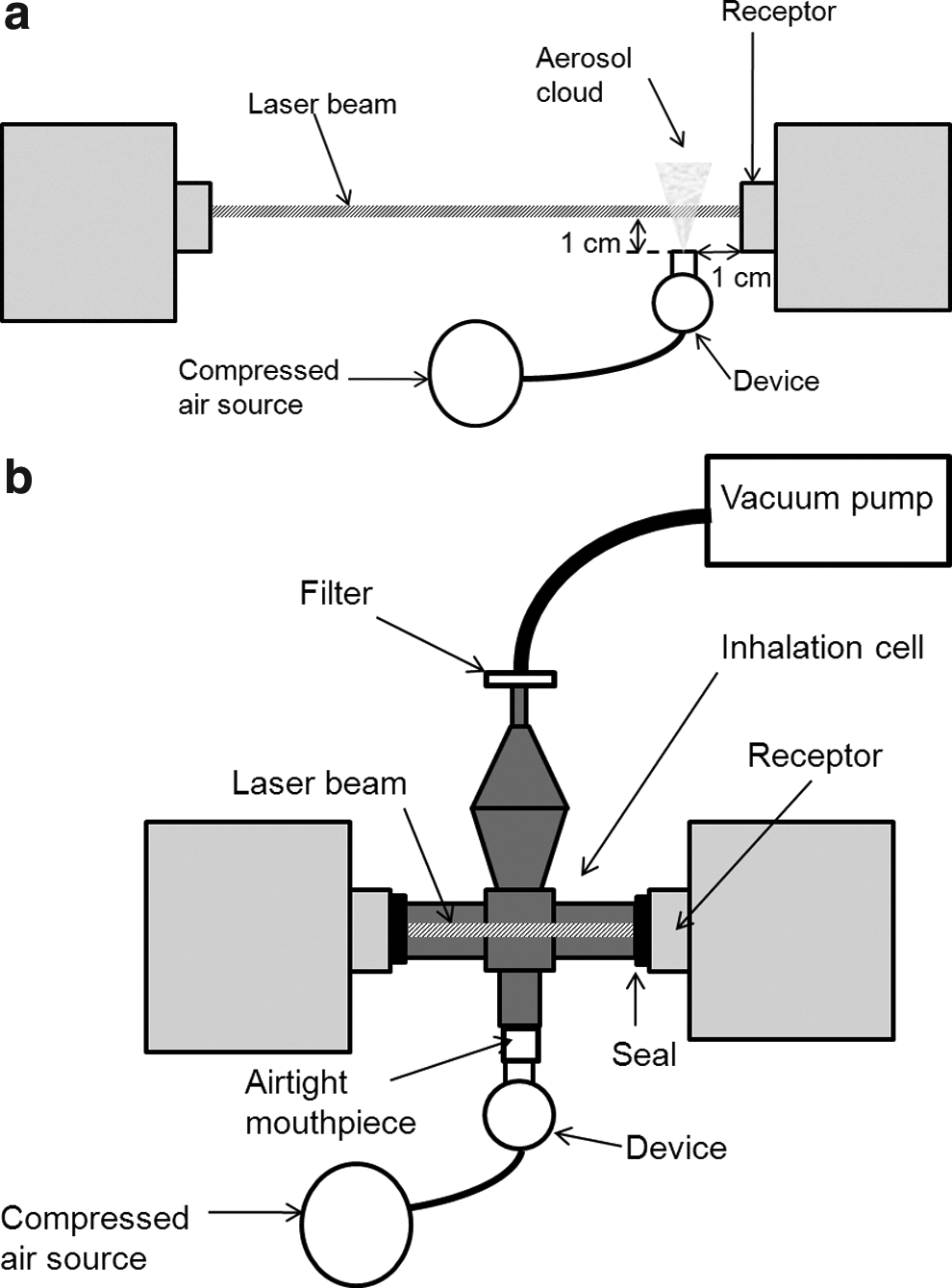
For the nasal sprays, each device was oriented vertically and placed under the laser beam. For each device, measurements were based on five puffs actuated manually and separated by 3 sec. An extraction pump operating at 40 L/min was used to avoid ambient air contamination.(16) The device was fixed 1 cm under the beam to measure the whole aerosol output cone, and about 10 cm from the receptor lens to avoid contact between the droplets and the diffractometer.
Each nebulizer was placed 1 cm from the laser beam (Fig. 1a), minimizing the distance between the nebulizer output and the measurement point, to avoid droplet evaporation,(17) and as close as possible to the receptor (around 1 cm) to mitigate vignetting.(7) Each nebulizer was tested six times for 1 min, each one with 4 mL of saline. The measurements were made randomly.
Spraytec
Without inhalation cell
The Spraytec LD (Malvern Instruments) was equipped with a He-Ne laser with a 632.8-nm wavelength and a 10-mm beam diameter. This diffractometer had been calibrated and validated by Malvern Instruments during the previous year. Unlike the Mastersizer LD, the Spraytec LD acquires the volume droplet size distribution of the aerosol cloud instantaneously, with an acquisition frequency of 10 kHz. Only one lens (300 mm focal length) was needed, covering sizes from 0.1 to 900 μm. In the Spraytec LD software, air and water were defined as nebulized fluids to set the refractive index. The spray was defined as polydispersed, and the multiple scattering algorithm was activated. The distribution obtained was then averaged (n=6), and the relevant parameters were extracted to be compared with those obtained with the Mastersizer X LD. The experimental setup for both nasal sprays and nebulizers was the same as the one described for the Mastersizer X LD. The measurements were made randomly.
With inhalation cell
The Spraytec LD was equipped with an inhalation cell (Fig. 1b), connected directly to the transmitter and the receptor, and sealed to ensure air tightness. This cell was supplied with the Spraytec LD and adapted to be installed directly on the Spraytec LD bench. The cell ensures the confinement of the aerosol within the beam area and avoids perturbations from the environment.
A vacuum pump (Fig. 1b) was connected to the cell outlet with a constant flow rate of 15 L/min to aspirate all aerosol droplets. The connection between the pump and the cell was airtight to maintain the connection between the nebulizer and the cell inlet, using a deformable mouthpiece. A filter was placed after the cell outlet. The closed cycle enabled the aerosol cloud to be canalized in the cell and the volume of aerosol to be relatively constant through the laser beam. Each nebulizer was tested six times for 1 min, each of them with 4 mL of saline. The measurements were made randomly.
Analysis
Parameters
Various parameters characterizing droplet size distribution were compared, based on ISO 13320 guidelines(18): Dv(0.1) (10% of the droplet volume has a diameter under that value), Dv(0.5) (50% of the droplet volume has a diameter under that value), Dv(0.9) (90% of the droplet volume has a diameter under that value), the percentage of droplets with a diameter less than 10 μm (for nasal sprays), and the percentage of droplets with a diameter less than 5 μm (for nebulizers).
Corrected distribution
For some devices, the distribution obtained with the Spraytec LD can be distorted by an error peak of large droplets. According to the manufacturer, this peak can be artificially removed by deleting some of the detectors using the Spraytec LD software, to avoid misalignment errors. Even if it is the only known way to handle this problem, this method depends on operator judgment and implies reduced measurement accuracy. The first 10 detectors, located near the center of the receptor lens and corresponding to low diffraction angles, were therefore removed from the distribution. The distribution was recomputed, and a corrected plot and new relevant parameters were obtained and compared with the Mastersizer X LD values.
Statistics
A Bland-Altman test(19,20) was performed to compare the distributions obtained with the Mastersizer and the Spraytec, with and without the inhalation cell. This test computes the differences between two different assays in relation to their average value. It then provides a bias (global average difference) and the limits of agreement between two sets of measurements. These limits are defined as bias±1.96 SD (standard deviation of differences), and their values indicate whether the measurements can be considered as equivalent. In this study, we chose to define acceptable limits of agreement as±10%.
In addition, a correlation test was used to compare the results obtained with the Mastersizer X with those obtained with the Spraytec to determine the linearity between the diffractometers.
Results
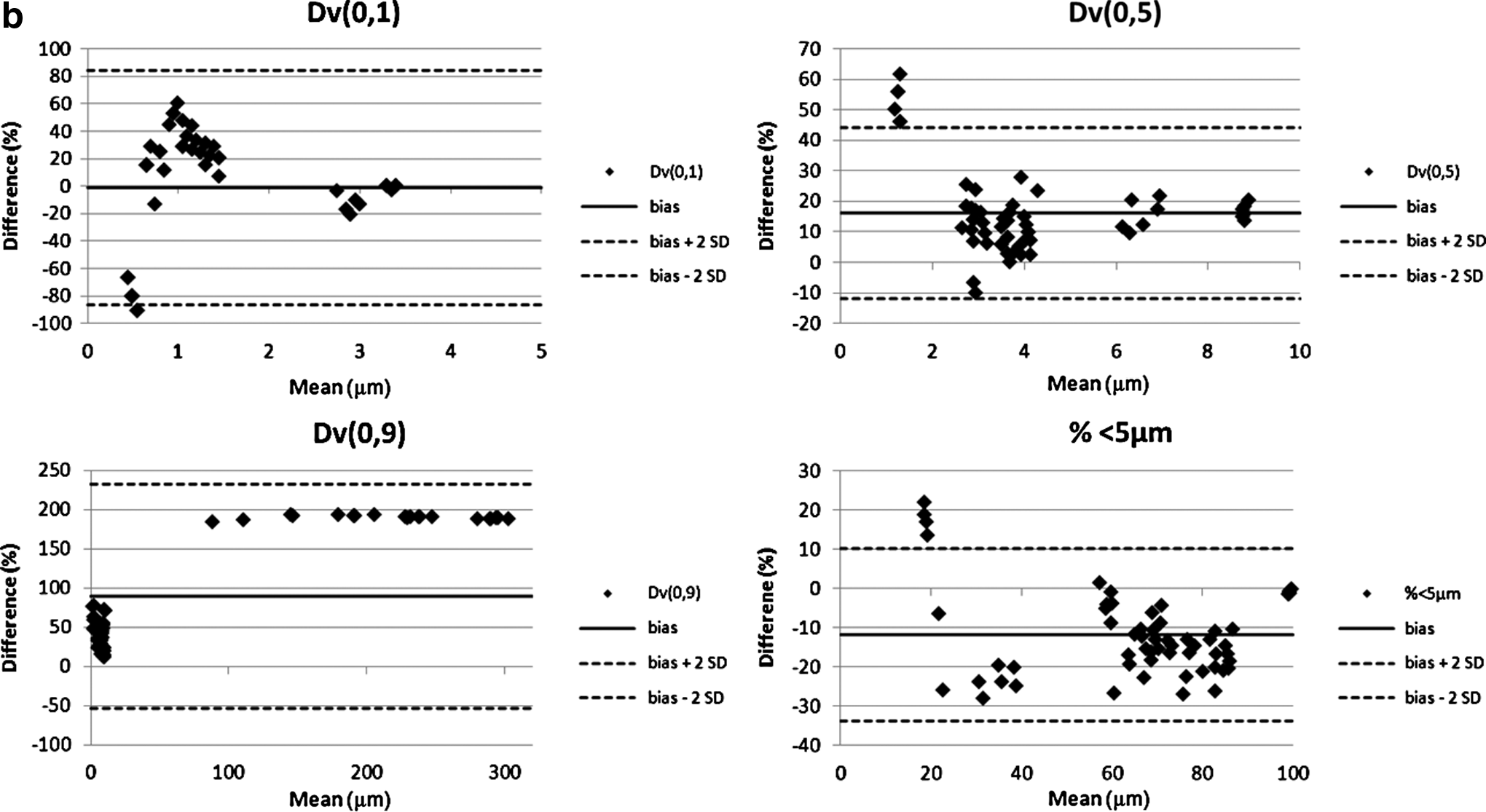
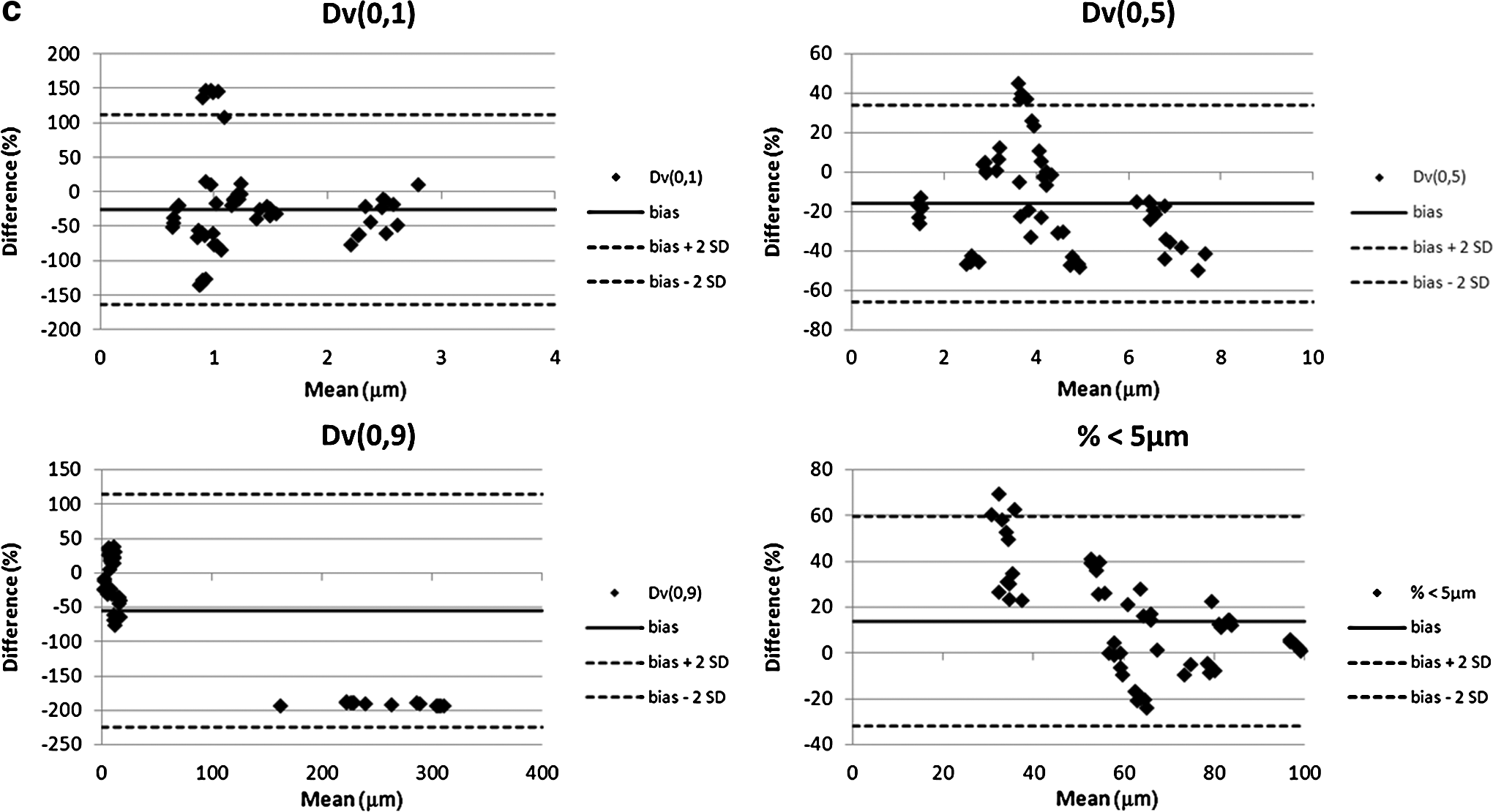
The Bland-Altman plots for all the devices showed no equivalence between the Mastersizer X LD and the Spraytec LD. The limits of agreement were too high for Dv(0.1) (70%), Dv(0.5) (30%), and Dv(0.9) (130%) (Fig. 2).
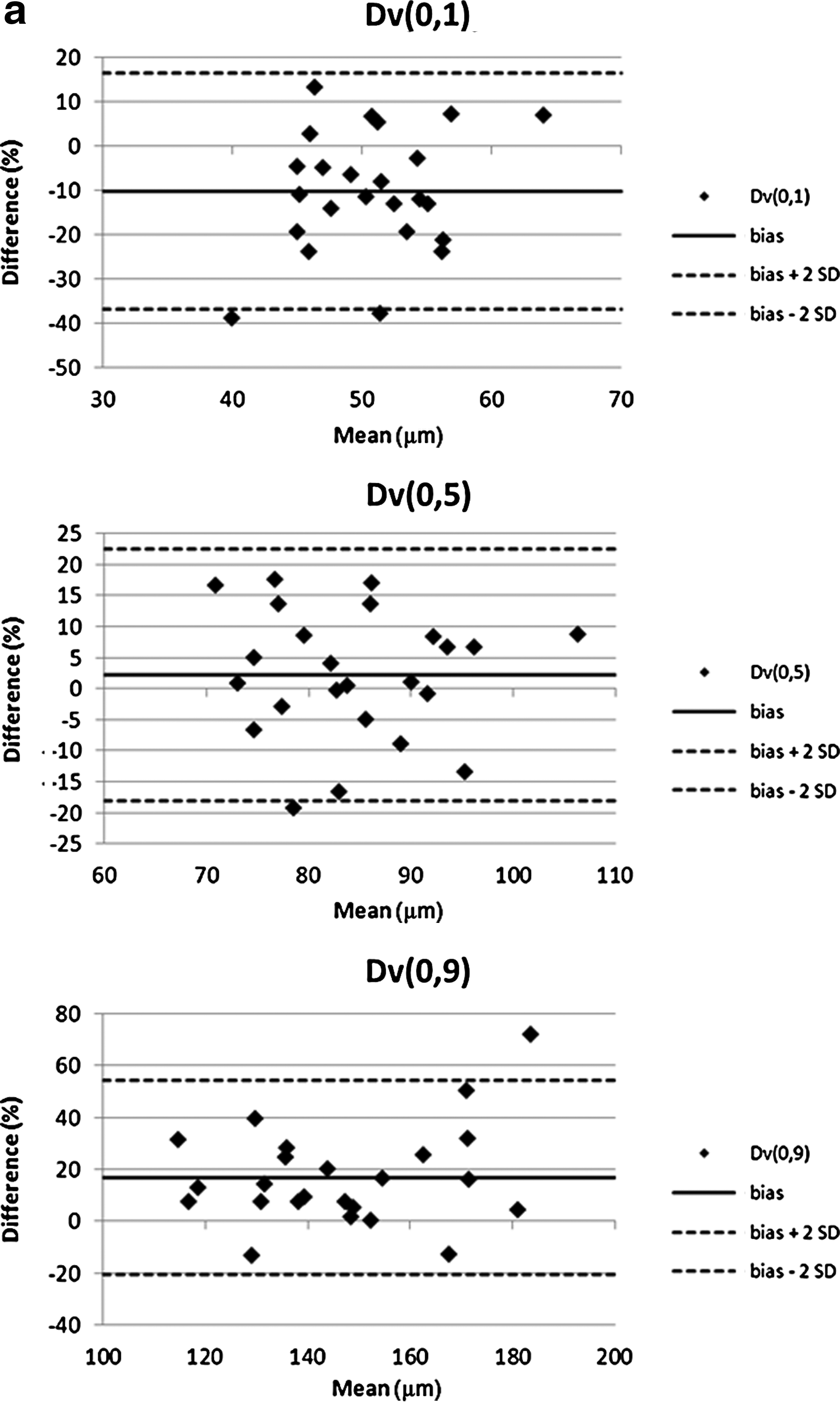
Bland-Altman plots.
Nasal sprays
The distribution parameters given by the diffractometers are summarized in Table 1. Droplet sizes ranged from 10 to 180 μm, with a Dv(0.5) varying from 75 to 95 μm. The Spraytec LD detected a small fraction of droplets (<0.3%) with a Dae less than 10 μm, whereas the Mastersizer LD detected no droplets in that range. The Mastersizer X LD and the Spraytec LD were not equivalent for nasal sprays. The limits of agreement were high for all the parameters [25% for Dv(0.1), 20% for Dv(0.5), 40% for Dv(0.9)]. However, the mean difference for Dv(0.5) was close to 0. The correlation coefficient of the Dv(0.5) was 0.37, which was judged to be too small to establish a linear relationship.
Nebulizers
Standing cloud
The diameters obtained by the Mastersizer X LD and the Spraytec LD are summarized in Table 2. The variation of Dv(0.1) produced by the two diffractometers was different for each nebulizer, but the values obtained were of the same order of magnitude. However, the Dv(0.5) measured by the Spraytec LD was always greater than the one obtained with the Mastersizer X LD for all nebulizers. Furthermore, for five of the nebulizers, the average Dv(0.9) given by the Spraytec LD was more than 100 μm, significantly greater than the Mastersizer X value. This can be explained by the fact that the Spraytec LD detected a peak of large droplets (>100 μm).
The percentage of droplets with a diameter less than 5 μm was lower for the Spraytec LD with all nebulizers.
The Bland-Altman tests for Dv(0.5) showed limits of agreement around 20%, with a large difference (+15% with the Spraytec LD). These limits reached 80% for Dv(0.1), and the test for Dv(0.9) was irrelevant because of the large droplets detected only by the Spraytec.
The correlation coefficient was high for both the Dv(0.5) (R2=0.97) and the percentage of droplets with a diameter less than 5 μm (R2=0.96). The median diameter was 14% greater with the Spraytec LD than with the Mastersizer X LD. Moreover, the percentage of droplets with a diameter less than 5 μm was 13% lower with the Spraytec LD. This indicates that the Spraytec LD distribution was less spread out but with a slightly shifted peak value.
Removal of large droplets
The significant difference between the measurements for the Dv(0.9) suggests that the Spraytec may detect very large additional droplets (between 100 and 1,000 μm) compared with the Mastersizer X LD. The effect of these droplets on the global distribution was removed to analyze whether the previously recorded difference between the diffractometers could be explained. By way of example, the corrected plot for nebulizer NL9M is presented in Figure 3.
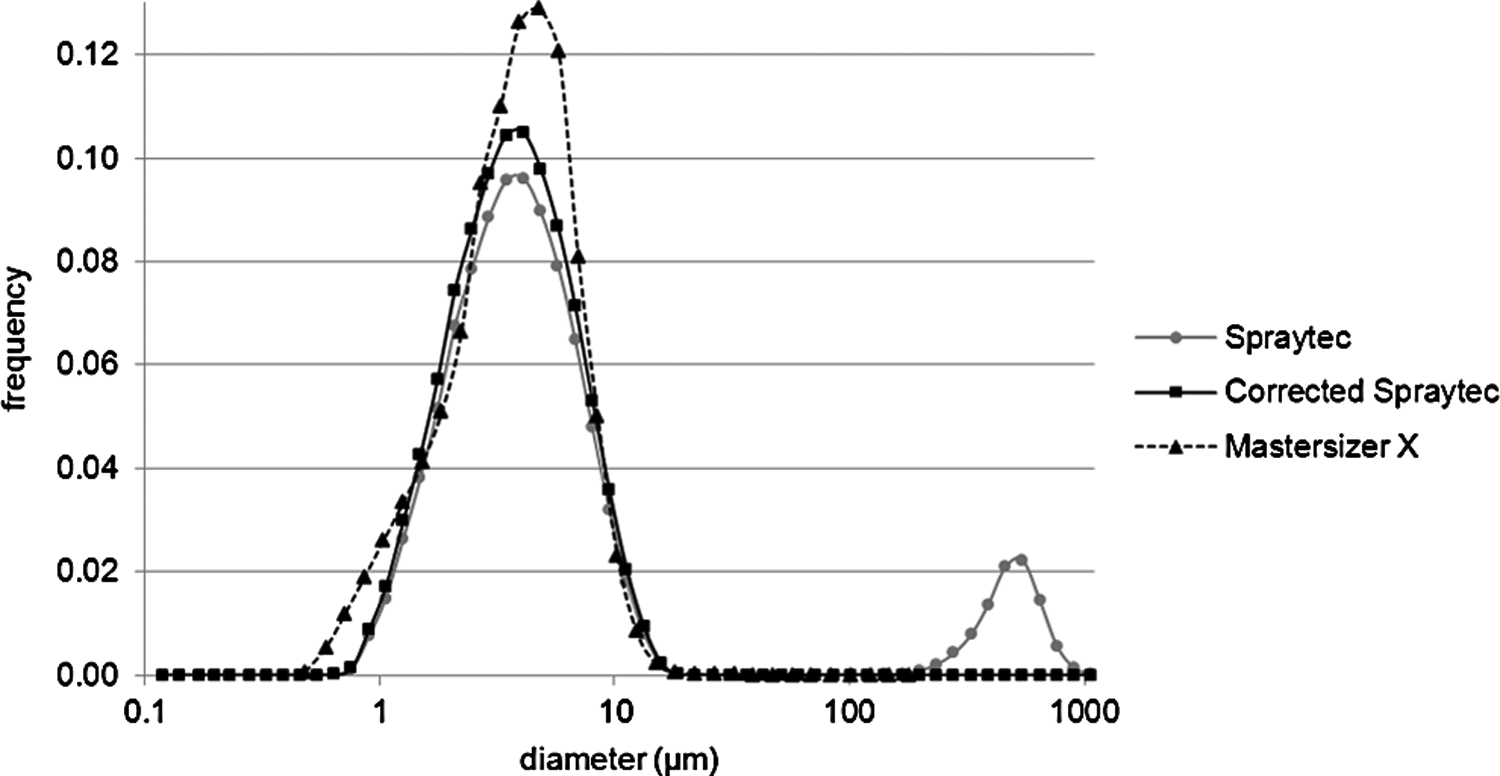
Droplet size distributions obtained with the two diffractometers for the NL9M nebulizer.
The correlation coefficient between the devices was high (R2=0.97). The Spraytec LD still overestimated the Dv(0.5) by 5% compared with the Mastersizer X. With regard to the percentage of droplets with a diameter less than 5 μm, the difference was also reduced to 5%.
However, the removal of large droplets did not completely remove the difference between the diffractometers (Fig. 4). Indeed, the limits of agreement remained high [90% for Dv(0.1), 30% for Dv(0.5), and 40% for Dv(0.9)], and even after removing the peak of large droplets, the diffractometers could not be considered as equivalent.
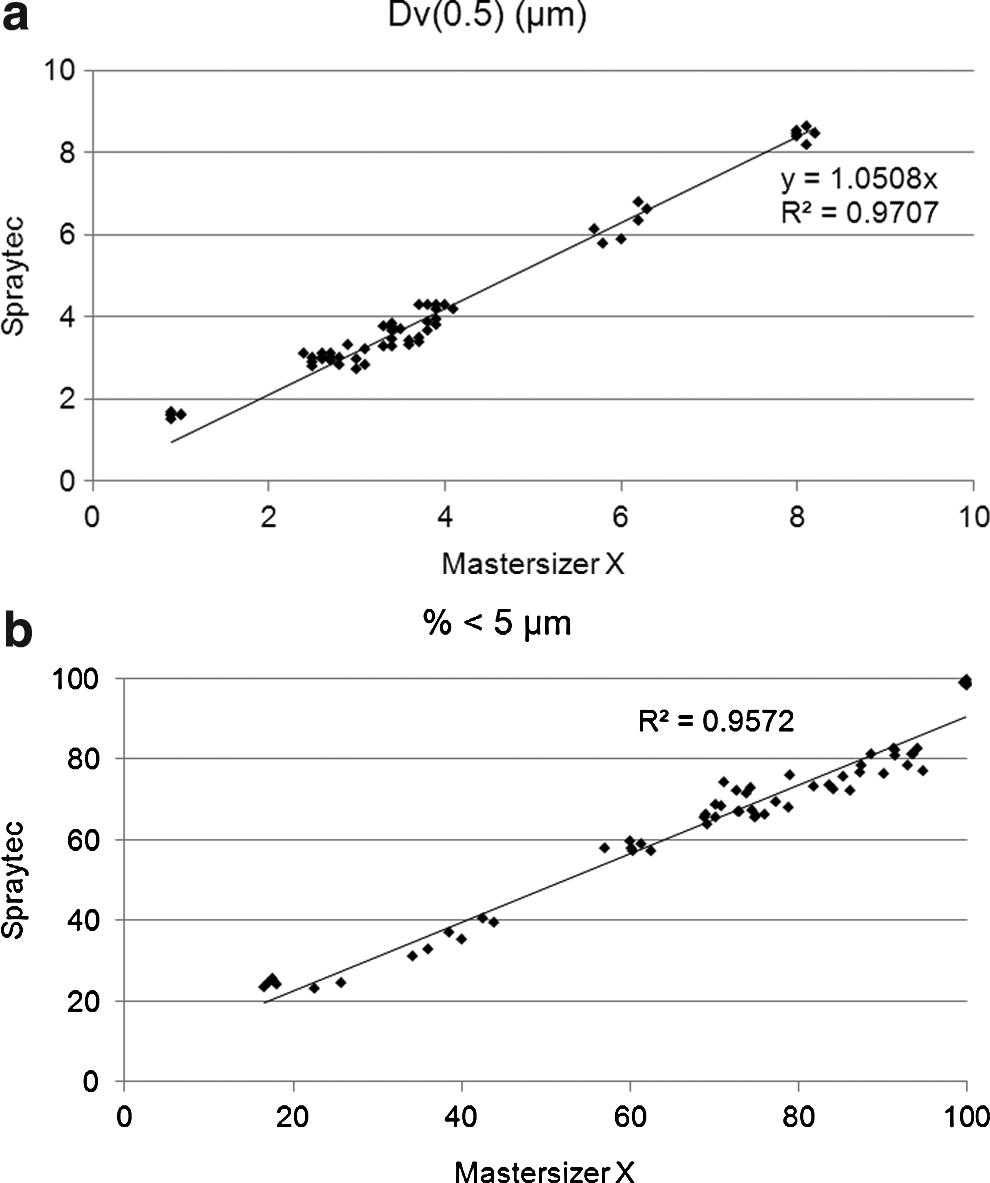
Modified correlation plots after removal of large droplets.
Inhalation cell
Table 2 summarizes the results obtained with the Spraytec LD when the inhalation cell was set up. For the Dv(0.1), Dv(0.5), and Dv(0.9), the values in standing cloud (without the cell) and with the cell were recorded. The large droplets that the Spraytec LD detected in standing cloud were not detected when using the inhalation cell.
For all jet nebulizers, the median diameters measured with the cell were lower than those measured in standing cloud. Only the Dv(0.5) of the Aeroneb Go increased with the cell.
With regard to the percentage of droplets with a diameter less than 5 μm, the value was higher with all nebulizers when using the inhalation cell, but no relevant pattern could be determined from these results.
Figure 5 shows the influence of the Spraytec LD inhalation cell on the droplet size distribution for the NL9M. The inhalation cell reduced the peak of large droplets, but did not remove it completely. Moreover, more droplets with a diameter less than 1 μm were detected, but the main peak was stable. The distribution was similar to that of the other nebulizers.
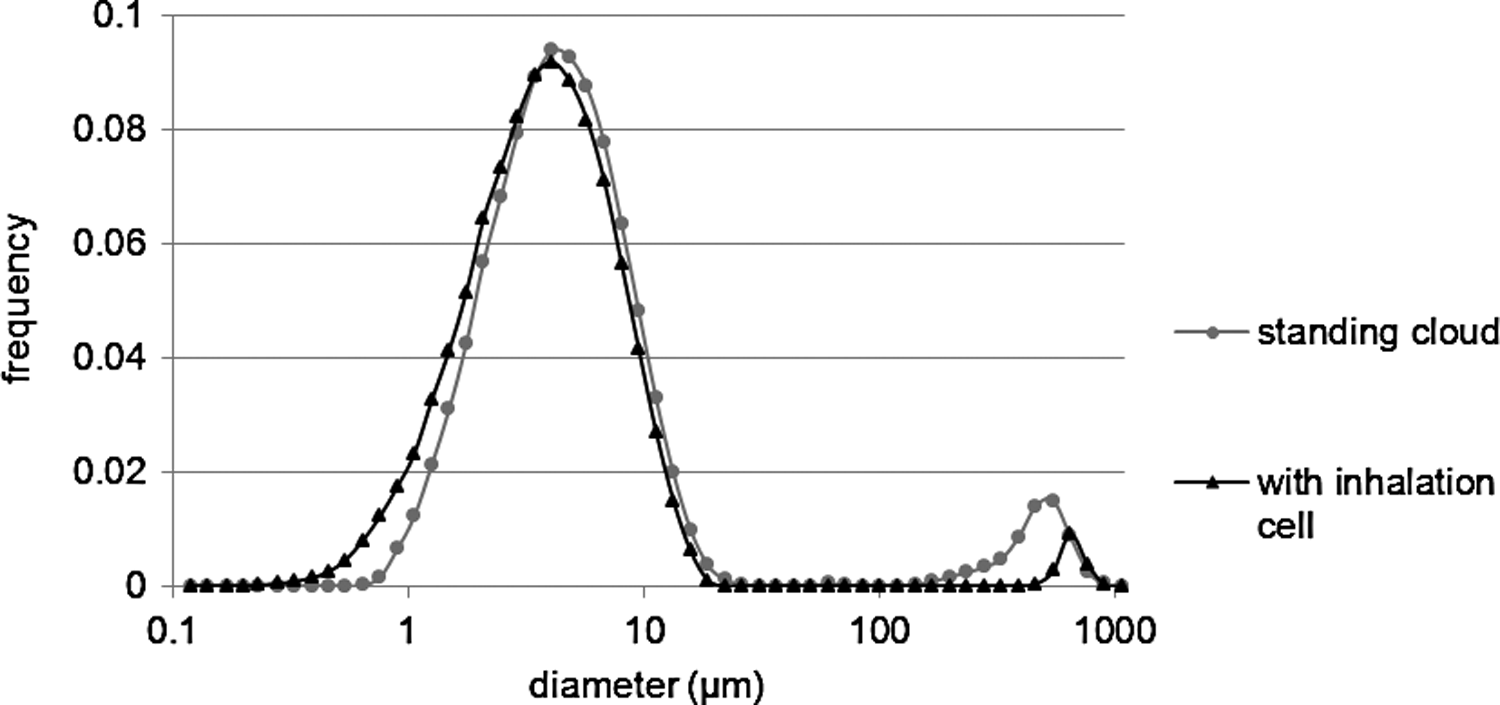
Influence of the inhalation cell on droplet size distribution for the NL9M nebulizer with the Spraytec.
There was no equivalence between the measurements with and without the cell for the Dv(0.1), Dv(0.5), and the ratio of droplets with a diameter less than 5 μm (limits of agreement around 80%, 50%, and 40%, respectively). The test for the Dv(0.9) was irrelevant because of the detection of large droplets in the standing cloud operating mode.
Discussion
This study demonstrates that two different diffractometers, the Spraytec and the Mastersizer X LD, operated by the same operator, cannot be considered as equivalent, whatever the droplet size range and whatever the conditions of use of the Spraytec LD.
To characterize the sources of divergence in these experimental conditions, the comparisons focused on two ranges of Dv(0.5): small (1 to 10 μm; nebulizers) and large (70 to 100 μm; nasal sprays).
For large droplets, the correlation between the diffractometers was low (R2=0.37), and there was no linear relationship between data obtained with the Mastersizer X LD and the Spraytec LD. The percentage of droplets with a diameter less than 10 μm detected with both diffractometers was under 1%. The fact that the Spraytec LD detected a very low fraction (0.3%), whereas the Mastersizer X LD detected none, could be explained by the higher sensitivity and acquisition frequency of the Spraytec LD. Droplets exit the spray with a velocity of around 10 m/sec. The time they take to pass through the laser beam is thus 1.8 msec for the Mastersizer X LD, whose sampling time is 2 msec, and 1 msec for the Spraytec LD, whose sampling time is 0.1 msec. This could explain why the smaller droplets (under 10 μm), representing a minority, were taken into account by the Spraytec LD but not by the Mastersizer X LD.
For small droplets, there was a strong correlation (R2=0.97) between the two diffractometers, but the Dv(0.5) obtained with the Spraytec LD was 14% greater. Finally, the agreement between the techniques was low, and they cannot therefore be considered as equivalent.
The difference was caused mostly by a peak detected by the Spraytec LD in the large size range (100–1,000 μm). No droplets were ever detected in that size range with inertial impaction or with the Mastersizer X LD for the tested devices. Therefore, this peak should be considered as an artifact that can be explained by various hypotheses:
• Beam steering deviates light at small angles and mainly affects the proportion of light detected by the inner diodes. Consequently, the droplet size distribution overestimates the large-droplet population and may exhibit a supplementary peak in this size range.(21) However, beam steering should only be observed when the aerosol is produced with a propellant gas (like pMDIs) with a refraction index that differs from the air index.(9) Therefore, this effect does not seem relevant in the context of this study. Moreover, a measurement with no liquid in the nebulizer (air only) showed no artifact, making this hypothesis definitely invalid. • The Spraytec LD detectors have a much smaller surface area than the Mastersizer X, making this device more sensitive to small angular variations close to the axis. The large sizes correspond to low diffraction angles. With the improved sensitivity of the detectors, the device could detect low light intensity from the laser beam after many scatterings from droplets. The Spraytec LD is more prone to be disturbed by ambient noise. Its multiscattering algorithm is designed to manage high-density sprays(22) and then probably takes into account that it may be sensitive to every slight angular perturbation, including those coming from the environment. However, the appearance of the peak is random, so it could not be explained only by sensitivity differences. • The difference between the results obtained by the two diffractometers could also be explained by the different algorithms used to process the data. Unlike the Mastersizer X LD, the Spraytec LD uses an additional multiple-scattering algorithm that theoretically handles scattering on many droplets, which occurs when the aerosol cloud is dense. To estimate the influence of droplet concentration, an experiment was conducted with the Pari LC Plus nebulizer, changing the orientation of the mouthpiece, thereby modifying the width of the aerosol cloud in the laser beam. By reducing the width, and therefore the amount of scattering, the peak disappeared, indicating that the algorithm was probably not suited to managing excessive scattering.
The peak was then canceled by removing the first detectors (starting from the center, corresponding to low angles) and redrawing the distribution. With that correction, the correlation for the median diameter (Fig. 4a) was slightly higher, and the difference was lowered to 5%, but with no increase in equivalence.
The Spraytec LD is provided with an inhalation cell, which allows the aerosol to be restricted within a defined area. By adding a vacuum pump, it also allows the aerosol flow rate to be regulated. The Spraytec LD equipped with the cell detected fewer large droplets. However, the peak of large droplets was not removed, but only reduced. The agreement between the use of the Spraytec LD in standing cloud and the use with the cell was very low (limits of agreement around 40%). The higher ratio of small droplets with the cell could be explained by two phenomena: there is a greater distance between the nebulizer outlet and the beam, and larger droplets could be impinged inside the cell before reaching the beam. Furthermore, recirculation of small droplets could occur inside the cell. This peak causes an error in the distribution and leads to an overestimation of the characteristic diameters. However, the cell provides a measurement technique with a reduced difference and should be used to obtain a more accurate estimation of droplet size.
With the inhalation cell connected to a vacuum pump, the experimental setup for the Spraytec LD is different from the standing cloud setup with the Mastersizer X LD. Processes governing droplet transport through the measurement zone and liquid evaporation operate differently. Some nebulizers can produce different droplet size distributions with a 15 L/min aspiration. Therefore, these setups cannot theoretically be compared. The aspiration is used to simulate a patient's constant air-flow rate, as when using cascade impactors, which allows a more accurate measurement of the aerosol cloud when the flow rate is low, for example, with some mesh nebulizers. The use of the cell should therefore be considered for droplet size measurements.
Conclusion
In conclusion, taking the whole liquid aerosol droplet size range, the Mastersizer X LD and the Spraytec LD cannot be considered as equivalent. The Spraytec LD overestimates the droplet size of nebulizers compared with the Mastersizer X LD. This overestimation can be reduced by removing an error peak of large droplets, observed with most nebulizers. This peak is reduced when using the inhalation cell provided with the Spraytec LD, which should therefore be used to ensure better accuracy of the measurement.
Footnotes
Acknowledgments
We would like to thank the ANR for providing us with a Spraytec and the Centre Region for providing the inhalation cell.
Author Disclosure Statement
Nicolas Lelong and Laurent Vecellio are employees of DTF Medical.