




Abstract


Oral Abstracts
Invited Speakers
BEYOND FEV1: LATEST BIOMARKERS FOR ADULT AIRWAY DISEASE
Biomarkers of adult airway disease facilitate drug development and are an essential complement to established measures of clinical efficacy and surrogate endpoints for clinical outcome. Biomarkers are defined as “a characteristic that is objectively measured and evaluated as an indicator of normal biologic process, pathogenic process, or pharmacologic responses to a therapeutic intervention,” whereas surrogate status is reserved for those biomarkers that are intended as a substitute for a measure of clinical efficacy measure, such as how a patient fells, functions, or survives. Biomarkers measure biological activity and can be instrumental to the decision-making process in early phase development and dose selection, while also providing mechanism of action and aid in identifying treatment responders. In adult airways diseases such as asthma, COPD, and cystic fibrosis, markers of lung function, physiologic function such as mucociliary clearance, airway inflammation, exhaled gas analysis, thoracic imaging, and systemic markers each provide potential biomarkers of disease activity that have served important uses towards monitoring disease activity and therapeutic response. An incomplete understanding of disease mechanism, heterogeneity of pathologic processes, and the diversity of host response stand as potential impediments for identifying and validating biomarkers of disease activity for use in therapeutic development. While measures of CFTR activity such as sweat chloride and nasal potential difference have been highly informative for the treatment of cystic fibrosis by CFTR modulators, the surprising lack of correlation among individuals between the change in lung function and sweat chloride have continued to raise questions about the appropriate use of this biomarker in the eyes of the FDA. This provides a seminal example of the potential advantages and pitfalls of the use of biomarkers to assess clinical activity.
CHALLENGES AND LIMITATIONS FOR TESTING EFFICACY OF NEW AEROSOL THERAPIES IN CHILDREN
Despite the marked progress in measuring efficacy and delivery of aerosol therapy in adults, this form of therapeutics in young children with respiratory disease still poses a number of unique challenges. The young child is often not cooperative during administration of the aerosol; thereby, leading to difficulties with adherence and delivery of the medication as well as parental frustration. Other challenges include the unique anatomic features of the younger child, which include rapid lung development, smaller airway size and a less mature upper airway. Adequate aerosol deposition represents a potential limitation secondary to more rapid respiratory rates in this population and small airway diameters. These limitations are especially amplified in young children with respiratory diseases that lead to increased secretions, lower airway inflammation and bronchospasm within these smaller airways. Several barriers are also associated with evaluating efficacy of aerosol therapies. First, use of radio-labeled particles to assess aerosol deposition or effects on mucociliary clearance is limited by concerns over radiation exposure and the expertise needed to perform these measurements. Quantifying lower airway drug levels in this population typically utilizes bronchoscopy, an invasive technique that requires sedation; however, induced sputum has been used in older children for this purpose. Finally, other classic endpoints such as FEV1 cannot be used in the youngest population to evaluate therapeutic effects. Given these challenges, identifying a sensitive and appropriate outcome measure that effectively detects a treatment response remains difficult, especially in multicenter trials.
PRE-CLINICAL STUDIES IN SHEEP USING AEROSOLS TO TARGET ASTHMA AND CHRONIC BRONCHITIS
The sheep is a large animal model that has been used extensively to investigate the pathophysiological mechanisms that contribute to asthma, chronic obstructive pulmonary disease (COPD) and cystic fibrosis (CF). Advantages of this larger model over smaller animal species include similarities to humans in terms of lung size, morphology and physiology, as well as the ability to obtain reproducible measurements of pulmonary function and whole lung mucociliary clearance (MCC) that are relevant to clinical studies. These measures can be obtained under normal conditions or after aerosol challenge with agents that induce symptoms which mimic disease states, e.g. specific antigen for asthma, or human neutrophil elastase (HNE) for COPD. In terms of drug development, the ability to deliver compounds either by nebulizer and/or as a dry powder under controlled conditions and perform dose response studies for optimal dose assessment, improves the ability to correctly characterize the efficacy of novel drugs. In this presentation, various experimental designs used to evaluate the effects of aerosolized compounds on pulmonary function and MCC and their efficacy against the pathophysiological changes resulting from allergen challenge (early and late bronchoconstriction and airway hyper responsiveness) and HNE-induced airway abnormalities (bronchoconstriction, slowing of MCC and inflammation) will be discussed.
Infectious Disease Aerobiology, Microbiology Division, Tulane National Primate Research Center, Tulane University School of Medicine, NEW ORLEANS, LA, United States of America
Mucosal vaccination has been a goal for many dedicated to eliciting dual immunity in target populations. The prospect of achieving a serological response while concomitantly inducing an antibody response within the mucosal tissues takes on special importance when vaccinating against respiratory pathogens. Few vaccine products contain the particular componentry to stimulate both serological and mucosal immune response; past studies have shown that vaccines usually will bias the response based either upon the vaccine platform and/or the selected adjuvant. Demonstration of dual immunity - or eliciting an appropriate mucosal response in an animal model that is consistent with the predictive clinical response is a technical challenge that few vaccines candidates have successfully achieved. One such example is the ongoing development of a vaccine for protection against aerosolized ricin toxin, an extremely toxic plant-derived lectin that continues to be a concern as biological threat (bioterrorism) agent. Aerosol exposure to ricin causes an overwhelmingly local mucosal response in the lower respiratory system, involving indiscriminate apoptosis, loss of vascular integrity, and eventual alveolar flooding from an exceedingly small inhaled dose (>5 μg/kg). Experimental vaccine(s) and therapeutics under development have all targeted a common localized response in lung mucosa mediated through antibody-antigen interaction in order to achieve protection. The leading candidates under development for protection against ricin have been evaluated in the nonhuman primate (rhesus) disease model and have shown mixed utility to prevent intoxication. Study results suggest that optimization of delivery and formulation of vaccines and antibody-based therapies that are specifically formulated to elicit a mucosal response may be required to maximize effectiveness and achieve better protection in the respiratory system against an agent such as ricin toxin.
MODES OF NONINVASIVE POSITIVE PRESSURE VENTILATION AND MASK INTERFACES EMPLOYED
Noninvasive ventilation (NIV) for acute respiratory failure has gained much clinical interest over the past 20 years. The evidence strongly supports its use in patients presenting with an exacerbation of chronic obstructive lung disease, and it may also be used in other patients with obstructive lung diseases such as those with asthma or cystic fibrosis. The interface distinguishes NIV from invasive ventilation. A variety of interfaces are commercially available for NIV; these include the nasal mask, nasal pillows, hybrid mask, oronasal mask, total facemask, and helmet. These are available in various sizes from various manufacturers. Although there are advantages and disadvantages for each interface type, the oronasal mask is most commonly used for acute respiratory failure. When selecting an interface, of particular concern are patient comfort, the potential for mouth leak, and the risk of facial skin breakdown. In North America, bilevel ventilators are commonly used for NIV, which use a single limb circuit with a leak port that serves as a passive exhalation port for the patient. Bilevel ventilators typically provide PSV or pressure control ventilation, but some also provide adaptive pressure ventilation. Critical care ventilators have traditionally been designed for invasive ventilation, but newer generations have modes for NIV. For critical care ventilators, dual limb circuits are used and these have inspiratory and expiratory valves, and separate hoses for the inspiratory gas and the expiratory gas. An essential element for the success of NIV is selection of the best interface and ventilator settings to meet the patient's needs.
FACTORS INFLUENCING AEROSOL DELIVERY IN PATIENTS RECEIVING NIPPV WITH AN EMPHASIS ON THE ROLE OF HUMIDITY
Noninvasive positive pressure ventilation (NIPPV) is commonly employed as the first line of mechanical ventilation in critically ill patients. Aerosol delivery in patients receiving NIPPV is influenced by 1) the type of ventilator, 2) mode of ventilation, 3) type of mask interface, 4) humidity and density of the inspired gas, 5) type of aerosol generator, 6) breathing parameters, 7) drug-related factors, and 8) patient-related factors. Although the nose is not bypassed during NIPPV, high airflows employed during NIPPV may cause dryness of the nasal mucosa, a sharp rise in nasal resistance and the potential to induce bronchial hyper-responsiveness. Moreover, undirectional airflow, e.g., breathing with the mouth open, markedly reduces humidification of inspired air. ICU ventilators and high flow oxygen devices provide dry wall gases with <5% relative humidity (RH), whereas flow generators designed for NIPPV deliver ambient air whose RH depends on the level of air conditioning. Despite the potential to reduce aerosol drug delivery, the use of a heated humidifier or heat and moisture exchanger prevents drying of the nasal and upper airway mucosa, promotes patient comfort, and facilitates mask use. Continuous gas flow, high inspiratory flow rate, air leaks, and asynchrony between patient and machine-delivered breaths are other impediments to aerosol delivery during NIPPV. During bi-level ventilation, placement of the nebulizer with relation to the leak port, the level of inspiratory pressure support and continuous positive airway pressure also influence the amount of aerosol delivered. On the other hand, NIPPV reduces respiratory rate and aerosol particle size and has the potential to improve drug delivery to the lung periphery. With careful attention to various factors to optimize inhaled drug delivery during NIPPV, it is possible to attain efficiency of drug delivery (≥10%) similar to that achieved in patients receiving invasive mechanical ventilation.
Acknowledgments: Supported by Graduate School of Medicine, Knoxville, TN. No grant funding was received for this work.
Department of Pharmaceutics, Virginia Commonwealth University, RICHMOND, VA, United States of America
Aerosol delivery to the lungs during non-invasive ventilation (NIV) is characterized by poor delivery efficiency (<1–10%) due to high depositional losses in the delivery tubing, cannula and nasal airways. In part, this is due to the particle size of the aerosols generated by commercial nebulizers. Enhanced condensation growth (ECG) is a technique that employs submicrometer drug aerosols to minimize depositional losses within the delivery setup and nasal airways. Condensational growth of these aerosols in the presence of co-administered heated and humidified air produces micrometer-sized droplets in the lungs allowing airway deposition to occur. In this study, in vitro experiments and computational fluid dynamic (CFD) simulations were used to compare the delivery of conventional nebulized aerosols with ECG aerosols generated from the Aeroneb Lab nebulizer and dried in a prototype dryer system to produce submicrometer particles. In vitro lung delivery efficiency of these aerosols was assessed and deposition in the delivery setup and nasal model determined with steady state and transient inhalation profiles. For both steady state and transient inhalation, deposition in the delivery tubing and cannula was low (∼10%) for the submicrometer ECG aerosols. Delivery through the nose to the airways during steady state flow using ECG was about 90% of the recovered dose. A series of strategies including streamlining the cannula geometry and inhalation synchronized aerosol administration were combined with the ECG approach to improve lung delivery of the drug during transient inhalation. The use of the ECG approach may allow efficient pharmaceutical aerosol delivery to patients receiving NIV.
Acknowledgements: NIH
Parion Sciences, Inc., DURHAM, NC, United States of America
Trans-nasal pulmonary aerosol delivery via nasal cannula offers benefits over the oral administration for a range of patients and healthcare care settings. Trans-nasal delivery originated during non-invasive ventilation with high flow therapy, utilizing high flow nasal cannulae. However, the clinical utility of trans-nasal aerosol delivery has been historically limited by low pulmonary deposition (1–4% in Chua et al. 1994), significant rainout in the nasal cannula, and the absence of available delivery systems capable of efficiently delivering aerosols though ergonomic, comfortable cannulae. Over the last decade, novel approaches and evaluation of novel delivery systems identified critical factors for improving trans-nasal delivery. First, the potential for efficient aerosol delivery via nasal cannula and loss of efficiency due in part to large particles was described by Corcoran et al. Second, Ari and Fink demonstrated the dilutive effects of increasing gas flow and the benefits of improved laminar flow with heliox at higher flow. Third, Bennett and Zeman, while exploring the nasal deposition of fine particles, described the potential for decreased nasal deposition and improved overall pulmonary deposition with 1μm and 2μm monodisperse carnauba wax particles. Lastly, the in-silico and in-vitro work of Longest and Hindle demonstrated the potential of enhanced condensational growth and excipient enhanced hygroscopic growth to improve trans-nasal pulmonary deposition efficiency. Building on these concepts and integrating them with additional innovative technologies, a novel trans-nasal pulmonary aerosol delivery (tPAD) platform with nasal cannulae optimized for aerosol conductance was developed by Parion Sciences. The tPAD platform achieved ∼ten-fold higher pulmonary deposition efficiency (∼38% of the emitted dose) compared to the established trans-nasal pulmonary deposition efficiency values, with minimal deposition in the nose in healthy adult subjects. These advances support the future clinical use of the trans-nasal aerosol delivery to the lung with a variety of therapeutic agents to treat a broad range of pulmonary disorders.
ENSURING PATIENT SUCCESS: IMPROVING ADHERENCE THROUGH CONCORDANCE (Report of IPAC-RS Workshop)
Poor adherence to prescribed treatment plans, which may result from insufficient knowledge or training about their disease, medication, inhaler(s), treatment schedule or other factors, can lead to poor outcomes for asthma and COPD patients. There is a growing emphasis on patient-focused, collaborative approaches that center care on patients, have been emphasized to improve adherence and outcomes. The Patient Concordance Steering Committee (PCSC) of the International Pharmaceutical Aerosol Consortium on Regulation and Science (IPAC-RS), a panel of health professionals, patient advocates, and members of industry, was formed to investigate how adherence and concordance in asthma and COPD might be improved through collaborative efforts. During 2010–2012, the Committee held regular meetings and organized a public workshop to foster dialogue between patient advocates, health care professionals, payers, and industry. It also reviewed literature identified through PubMed using the keywords asthma, COPD, health literacy, compliance, adherence, concordance, communication, patient involvement, device selection, education, technique demonstration, and self-management. The results of this workshop and literature review suggest that further implementation of a collaborative, patient-centered approach to care for asthma and COPD patients that engages a multidisciplinary group of health care professionals, families, caregivers, employers, health systems, pharmaceutical companies and regulatory authorities and encourages communication, careful selection of devices, and appropriate instruction may contribute to appropriate use and result in improved outcomes.
EMERGING TECHNOLOGIES FOR ELECTRONIC MONITORING OF ADHERENCE, INHALER COMPETENCE AND TRUE ADHERENCE
The additional health costs associated with poor medication adherence have been estimated at anywhere between $77Bn and $200Bn annually. In an age where developing novel medicines with significant health-economic benefit is becoming increasingly difficult, it is unsurprising that the World Health Organization has suggested that “improving adherence might be the best investment for tackling chronic conditions effectively”. However, a key problem is that it is difficult to obtain true data on adherence without employing accurate quantitative approaches such as electronic monitoring. For inhaled therapies, the situation is further complicated, in that the patient must not only take medication at the appropriate interval, they must employ the correct inhaler technique at that time. Failure to do so is known to be associated with poor health outcomes. Thus, to understand whether a treatment intervention is likely to be beneficial, it is important to be able to accurately measure True Adherence, that is recording the number of doses of medication that are correctly taken within a treatment regimen. There are devices either in development, or on the market, that can now provide the relevant data. However, this is still not of benefit unless the data are translated into information that either the health care providers or the patients will act upon. The use of the I-neb nebulizer with I-neb Insight Online software demonstrates the potential that these technologies can offer in terms of improving care in chronic disease. Not only do patients benefit from coaching to improve inhaler technique, health care providers can tailor their advice to suit the needs of the individual patient. Experience shows this approach can lead to improvements in True Adherence that persist well beyond the intervention.
OPTIMIZED STEROID DELIVERY IN SEVERE AND PEDIATRIC ASTHMA: IMPROVED COMPLIANCE AND EFFICACY
AEROSOL DEPOSITION IN REDUCED GRAVITY
The deposition of aerosol in the human lung occurs mainly though a combination of inertial impaction, gravitational sedimentation and diffusion. For 0.5 to 5 μm-diameter particles, the primary mechanism of deposition is sedimentation, and therefore the fate of these particles is markedly affected by gravity. Studies of aerosol deposition in altered gravity have mostly been performed in humans during parabolic flights both in microgravity (μG) and hypergravity (∼1.6G), where both total deposition during continuous aerosol breathing, and regional deposition using aerosol bolus inhalations were performed with 0.5 to 3 μm particles. While total deposition increased with increasing gravity level, only peripheral deposition as measured by aerosol bolus inhalations was strongly dependent on gravity with central deposition (lung depth<200 ml) being similar between gravity levels. More recently, the spatial distribution of deposited particles was also assessed both by MRI in small animals with 1μm particles and by gamma scintigraphy in humans with coarse particles (MMAD=5.1 μm). For small particles (1μm), the central-to-peripheral ratio (C/P) of deposited particles was less in μG than in 1G, illustrating the more peripheral deposition that occurred in μG with small particles. Because of the absence of sedimentation, fewer particles deposited in the airways in μG, increasing the number of particles transported to the lung periphery where they eventually deposit due to mixing and diffusive mechanisms. Conversely, for coarse particles, the absence of gravity caused less particles to deposit in the lung periphery than in the central region (C/PμG>C/P1G) where deposition occurred mainly in the airways in μG. Indeed, coarse particles deposit either by inertial impaction, a mechanism most efficient in the large and medium-sized airways, or by gravitational sedimentation, which is most efficient in the distal lung.
REGIONAL DEPOSITION OF INHALED AEROSOLS IN SMALL ANIMALS BY SPECT/CT
Gamma imaging, 2-dimension and 3-dimensional, has long been used to quantify the total and regional pulmonary dose in humans. However recent advances in imaging equipment and analysis tools have allowed these tools to expand into small animals. With over 80% of preclinical studies being conducted in small animals the ability to quantify total and regional pulmonary dose is paramount for the conduct of safety and efficacy studies, extrapolation of dose into larger species and into clinical settings. The small animal SPECT/CT instruments have been developed and designed to allow use with species including mice, rats, guinea pigs, ferrets and rabbits. Together these have increased the utility of SPECT/CT technologies and driven technologies to the point where current small animal SPECT/CT systems having higher resolution compared to their clinical counterparts. Recent SPECT/CT studies have been used to characterize the regional deposition of a range of different pharmaceutical aerosols in mice, rats, ferrets and rabbits. These data have often supported previous deposition data and have similarly highlighted differences. For example historically submicron aerosols were reported to largely be exhaled by small animals, recent SPECT/CT analysis of these aerosols indicates that when MMAD is decreased to 0.5 μm the total pulmonary deposition is increased and the pulmonary deposition in the alveolar regions of the lungs is also increased. The complex analysis tools also facilitate the ability to quantify the regional deposition of an aerosol. These tools allow more accurate quantification of dose and development of ‘targeted’ aerosols for inhalation in small animals.
PARTICLE DEPOSITION IN THE DEVELOPING RAT LUNG
Effects of postnatal developmental changes in lung architecture and breathing patterns on intrapulmonary particle deposition are not well understood. We measured deposition of 2-μm sebacate particles in anaesthetized, intubated, spontaneously breathing WKY rats on postnatal days (P) 7 to 90 by aerosol photometry. Breathing parameters were determined by body plethysmography. During postnatal growth tidal volume increased substantially from 0.19 mL (P7) to 2.1 mL (P90) while respiratory rate declined from 182 to 113/min. Accordingly, minute ventilation increased from 34.5 to 233.4 ml/min. Breath specific deposition was lowest (9%) at P7 and P90 and highest at P35 (almost 16%). Breath-by-breath deposition variability was about 25% lower between P7 and P21 than at P35 and P90. Interindividual variability of deposition increased from P7 to P90 by almost a factor of 2. Particle deposition per unit of time and surface area increased from P7 on, peaked at P35 and showed a minimum at P90. We estimated a deposition of 450, 690 and 290 particles/(min x cm2) at P7, P35 and P90, respectively, at an inhaled particle number concentration of 10E5/cm3. Multiple regression models showed that deposition depends on the mean linear intercept as structural component and the breathing parameters, tidal volume and respiratory rate (r2>0.9). Micron-sized particle deposition was dependent on the stage of postnatal lung development. A maximum was observed during late alveolarisation (P35), which corresponds to human lungs of about 8 years of age.
Acknowledgements: Supported by National Heart, Lung, and Blood Institute, Grant HL-070542
DEPOSITION OF CARBON NANOTUBES IN THE HUMAN RESPIRATORY TRACT REPLICAS
Carbon Nanotubes (CNTs) aerosols may appear in occupational environments where they could be inhaled by the workers causing potential health problems. Therefore, investigating the deposition of CNTs in the human airway is important and necessary to assess the health risk posed by the occupational exposure to these particles. This study used a nebulizer to aerosolize Stacked-cup Carbon Nanotube (SCCNT) and Single-walled Carbon Nanotube (SWCNT), and employed an electrostatic classifier to classify the CNT aerosols by electrical mobility. The size-classified CNT aerosols were then measured by a sequential mobility particle sizer (SMPS), an electrostatic precipitator (ESP), a micro-orifice uniform deposition impactor (MOUDI), and a TEM to obtain their physical characteristics and morphology. The deposition study was conducted by delivering the size-classified CNT aerosols into a well-defined human nasal and oral- tracheobronchial airway replica. The deposition fractions and deposition efficiencies of the CNT aerosols in the airway were determined by the concentration ratios of the CNT aerosols measured at the inlet and the outlets of the replica. The deposition results showed that very few CNT aerosols were deposited in the upper airway which implies that most of the size-classified CNTs in this study could easily transport down to the lower human airway. The results suggest that the deposition mechanism for the size-classified CNT aerosols, studied in this work, is likely diffusion. These data acquired will be used in the development of a human respiratory tract deposition model for related CNTs.
ENGINE-OPERATING LOAD INFLUENCES DIESEL EXHAUST COMPOSITION: CARDIOPULMONARY AND IMMUNE RESPONSES
Abstract not submitted.
US Environmental Protection Agency, CHAPEL HILL, NC, United States of America
Combustion of diesel fuel contributes to ambient air pollutant fine particulate matter (PM) and gases. Fine PM exposure has been associated with increased mortality due to adverse cardiac events, and morbidity, such as increased hospitalization for asthma symptoms and lung infections. Controlled exposure studies with diesel exhaust (DE) have been used, in part, to examine if epidemiological observations between PM exposure and health effects had biological plausibility. In our facility, exposures of healthy, young adult human volunteers were exposed to either 100 μg/m3 DE to identify markers of exposure and effect. At 100 μg/m3 exposure, small changes in plasma cytokine and clotting factors were observed without lung function changes. Urinary naphthalene and phenanthrene appear to surrogates of the exposure. For 300 μg/m3 DE exposures, we examined lung function effects with both concurrent and sequential 300 ppb ozone (O3) exposure. Subjects received either air FA, O3, DE, or DE+O3 on Day 1, followed by only O3 exposures on Day 2. Exposures were for 2 hr with intermittent, moderate exercise. For lung function on Day 1, FA and DE did not induce FEV1 changes, O3 decreased FEV1 16±3%, while DE+O3 decreased FEV1 22±4%. On Day 2 after the O3 challenge, subjects who were exposed to DE on Day 1 had a greater FEV1 decrement (18±4%) compared to the FEV1 decrements of subjects (11±3%) receiving air exposure on Day 1. Lung function recovered to approximately pre-exposure values within 4 hr at similar rates in all groups on both Days 1 and 2. These data suggest that simultaneous DE+O3 exposure can synergistically decrease FEV1, and sequential DE followed by O3 exposures can induce a greater FEV1 decrement than FA/O3 exposures.
Disclaimer: This is an abstract of a proposed presentation and may not represent official US EPA policy.
Funding by US EPA; Protocols approved by the UNC Biomedical IRB.
DIESEL EXHAUST AND THE NASAL INFLAMMATORY RESPONSE TO INFLUENZA
Diesel exhaust enhances allergic inflammation, and pollutants are associated with heightened susceptibility to viral respiratory infections. The effects of combined diesel and virus exposure in humans are unknown. We therefore tested whether acute exposure to diesel modifies inflammatory responses to influenza virus in normal and allergic humans. We conducted a double-blind, randomized, placebo-controlled study of nasal responses to live attenuated influenza virus (LAIV) in normal volunteers and allergic rhinitics exposed to diesel (100 μg/m3) or clean air for 2 hr, followed by standard dose of virus and serial nasal lavages. Endpoints were inflammatory mediators (ELISA) and virus quantity (qRT-PCR). To test for exposure effect, we used multiple regressions with exposure group (diesel vs. air) as the main explanatory variable and allergic status as an additional factor. Baseline levels of mediators did not differ among groups. For most post-virus nasal cytokine responses, there was no significant diesel effect, and no significant interaction with allergy. However, diesel was associated with significantly increased interferon-γ responses (p=0.02), with no interaction with allergy in the regression model. Eotaxin-1 (p=0.01), eosinophil cationic protein (p<0.01), and influenza RNA sequences in nasal cells (p=0.03) were significantly increased with diesel exposure, linked to allergy. In a second study in allergic rhinitics using a different diesel engine, the DE effect on ECP was reproduced. Finally, peripheral blood NK cells from normal volunteers exposed to DE in vitro had blunted cytotoxicity and other activation markers. We conclude that short term exposure to diesel exhaust leads to increased eosinophil activation and increased virus quantity after virus inoculation in allergic rhinitics. This is consistent with previous literature suggesting a diesel “adjuvant” effect promoting allergic inflammation. Our data further suggest that DE may be associated with reduced virus clearance, possibly via blunted function of NK cells.
This research was supported by grants from the National Institute of Environmental Health Sciences (P30 ES010126, R01 ES013611). This research was funded in part by US EPA Cooperative Agreement CR83346301, but has not been subjected to review and does not necessarily reflect EPA policy. Mention of trade names or commercial products does not constitute endorsement or recommendation for use.
EPIDEMIOLOGY OF CANCER AND DIESEL EXHAUST
Concern has been raised for >40 years that exposure to diesel engine exhaust results in lung cancer. In June 2012, a Working Group met at the International Agency for Research on Cancer (IARC; Lyon, France) reassess the carcinogenicity of diesel engine exhaust. The most influential epidemiological studies assessing cancer risks associated with diesel-engine exhausts investigated occupational exposure among railroad workers, workers in the trucking industry, and non-metal miners. The assessment of lung cancer risk in trucking industry workers and in non-metal miners included the finding of a positive exposure-response relationship with occupational elemental carbon exposure. This talk will review the approach to historical exposure reconstruction and the epidemiologic studies that supported the conclusion of the Working Group that diesel engine exhaust is carcinogenic to humans (IARC Group 1).
Boehringer Ingelheim Pharma GmbH & Co. KG, INGELHEIM, Germany
The therapeutic success of inhaled medications relies on three major columns: the inhalation device, the pharmaceutical formulation and the patient. While the first two parameters are extensively investigated from the very beginning of the drug product development process, the specific human anatomy and breathing behavior is often not taken into account. Currently used cascade impaction methods of the USP/Ph.Eur. for determination of the particle size distribution of pharmaceutical aerosols are highly effective quality control tools but not intended to resemble the human in vivo conditions. Achieving good correlations between in vitro methods and in vivo performance is a major challenge but worthwhile to design safe and efficient inhaled medications for pediatric application. Therefore idealized/realistic replicas of the infant mouth, nose and throat region in combination with an electronic lung to mimic inhalation profiles were used to assess performance differences of several inhalation devices (MDIs, SMI, DPIs, VHCs) and powder formulations in children aged 1–5 years. In addition, studies with monodisperse aerosol particles (3, 5 and 7μm) at different constant air flow rates were conducted to determine the optimal particle size to enter the pediatric lung. The whole data set was compared to the results using an adult model. The pediatric models showed a higher sensitivity to the different devices and formulations, especially the ones <3 years of age. Aerosol particles ≤3 μm had the optimal size to deposit in the lung of very young children.
PEDIATRIC IN VITRO AND IN SILICO MODELS OF DEPOSITION VIA ORAL AND NASAL INHALATION
Deposition of inhaled aerosols in pediatric populations is of interest both in respiratory drug delivery and in exposure risk assessment. Because aerosols must pass through the extrathoracic airways prior to reaching the lungs, deposition in the extrathoracic airways plays an important role in both cases. However, compared to adults, much less data is available on extrathoracic deposition in children. Recent progress using airway replicas has begun to address this issue. Indeed, the use of realistic replicas for benchtop inhaler testing is now relatively common during the development and in vitro evaluation of pediatric respiratory drug delivery devices. Recently, in vitro correlations for prediction of extrathoracic deposition, for either oral or nasal inhalation, have also been developed based on deposition in moderate numbers of such realistic replicas. These correlations incorporate individual subject dimensions via dimensionless analysis, thereby reducing the intersubject scatter that normally plagues such correlations. The recent development of idealized replicas for infants and children, that capture average deposition in a similar manner to the Idealized Alberta Throat, provide a standardized platform for inhaler testing and risk exposure assessment in pediatric populations. In vitro and in silico methods to estimate extrathoracic deposition in pediatric populations have thus advanced dramatically in recent years. The present talk will give an overview of current understanding of in vitro and in silico models of deposition via oral and nasal inhalation.
ELEMENTS OF MASK DESIGN FOR SUCCESSFUL AEROSOL DELIVERY
Masks for providing aerosols to infants and children appear in various shapes, dimensions, and materials and are arguably the single, most important, link in the chain between the source of aerosol generation and the lungs. However, there is little scientific evidence to support the design of existing, generally available, pediatric masks. Current facemasks for pediatric aerosol therapy have been merely smaller versions of those used for adults with little consideration given to infant's/toddler's special needs and facial dimensions.
From a clinical perspective, the most important element is the fact that most infants resist a face mask. They often resist treatment by squirming and crying and by repeatedly pushing the mask away. It has been suggested that infants' resistance to the mask is caused by fear of being smothered and this accounts for their crying and squirming. It has been shown that crying during aerosol administration is detrimental to effective aerosol therapy in children and all possible efforts should be made to avoid it.
From a design perspective the major elements that affect the efficiency of aerosol delivery using face masks are: 1.Vertical and horizontal alignment of the mask to the face, 2. Anatomically contoured and comfortable fit, 3. A tight seal between the mask and the infant's face 4. Minimal dead space. These design issues are a particular problem in infants and very young children whose face, in the first few years of life, undergoes rapid and marked developmental change while at the same time their dead-space:tidal volume ratio, at least to age about 18 months, is relatively high. This presentation will discuss these elements as they relate to improving aerosol delivery. Integrating them into an evidence-based approach, resulted in masks that are applied very gently as the child sucks on the incorporated pacifier. This results in an improved mask to face seal, minimizes dead space, and considerably increases acceptance by infants (and caregivers). This approach has been shown to improve the likelihood of adequate lung aerosol deposition.
THE CHALLENGE OF AEROSOL DELIVERY IN MECHANICALLY VENTILATED NEONATES
Aerosolized medications have been used in the NICUs for decades, despite a lack of inhaled therapies specifically designed and approved for ventilated newborns. Consequently there is a paucity of good studies to document efficacy of such therapy. Additionally development in this space has been limited given the small market size of inhaled therapies for neonates leaving clinicians and scientists with no alternative but to adapt aerosol devices designed for adult and pediatric patients to support NICU-based inhalation therapies. This summary of clinical studies of inhalational therapies in the NICU for treatment of various conditions in mechanically ventilated neonates as well as analysis of pre clinical studies including of in vitro based experiments, is an attempt to point out problems and challenges related to respiratory care of the smallest patients.
In summary based on the knowledge we have it is difficult to draw clear conclusions about the effectiveness of inhalational therapies for neonatal pulmonary morbidities, because many studies did not provide sufficient information about the aerosol generator used, aerosol characteristics, method of drug delivery or the delivered dose. Recent in vitro studies help clinicians to understand how to improve inhalational therapies among ventilated newborns, nevertheless future research should focus on more standardized and optimized aerosol delivery in this population.
Keywords: infant, mechanical ventilation, aerosols, intensive care
SUCCESSES AND FAILURES WITH AEROSOLIZED BIOTHERAPEUTICS: A RECAP AND LOOK FORWARD
Two strikingly different biotherapeutic programs that have profoundly influenced the medical aerosol field have involved insulin and rhDNase. rhDNase was an early commercial success. In contrast, inhaled insulin was not. But the lack of commercial success of insulin should not be the sole measure of success. In every other respect this development program was a triumph of ingenuity and persistence. Clearly the insulin program was more complex and evolved through an era of great change in terms of device and formulation options. In fact, the mere existence of the program spurred interest and advances within the field. High efficiency devices for solutions and powders were conceived and various engineered particle technologies emerged. Delivery efficiencies markedly improved with concomitant reductions in dose-variability thus rendering the inhalation route more attractive for a range of indications and drug molecules. The emergence of biotechnology in a broad sense brought a wealth of new molecular entities that could, have and can be administered via inhalation: alpha-1-antitrypsin, leuprolide, SLPI, growth hormone and interferon to name a few. However, the challenges encountered with the insulin programs have also brought a heavy dose of pragmatism to bear and rarely do we now see ‘hope-driven’ projects in early development. Looking ahead, perhaps we won't see the same frequency of ventures to deliver biomolecules to the lungs but rather we will see well-conceived drug-device combinations tailored to patient populations of interest that have a realistic probability of success.
STATE OF THE FIELD: MANUFACTURING AND DEVICE OPTIONS FOR THE DELIVERY OF BIOTHERAPEUTICS
Respiratory drug delivery is currently dominated by small molecule therapeutics, but interest in inhalable dosage forms of peptides, proteins, and more complex biotherapeutics, such as virus or bacterial vectors is increasing. The development of inhalable biotherapeutics requires attention in several key areas, such as prevention of degradation or preservation of bioactivity during processing, stabilization for long term storage, and efficient and reproducible dose delivery. Compared to small molecules, biologics are subject to more numerous and more complex degradation or inactivation mechanisms, some of which are still poorly understood or analytically inaccessible. Hence, product design of biotherapeutics remains largely empirical. In many cases formulation experience from one process is transferred to another, e.g. from lyophilization to spray drying, without a clear mechanistic understanding of the process differences.
The presentation will give an overview of recent developments in formulation and process design for dry, inhalable dosage forms of biotherapeutics. Analytical models will be presented that can accelerate the development of low temperature spray drying processes. We will discuss delivery device selection in the context of dosing requirements and patient use scenarios.
THE DELIVERY OF TOSAP POWDERS WITH DAS181 TO TREAT INFLUENZA
Temperature-controlled Organic Solvent Assisted Precipitation (TOSAP®) is a proprietary platform lyophilization technology that allows the preparation of microspheres in appropriate size for targeted deposition in the respiratory tract. The dry powders are composed of homogeneous, mono-dispersed amorphous microspheres that are suitable for various routes of administration including inhalation, nasal, oral, subcutaneous, and intravenous. This high yield technology can be applied to a wide range of substrate, including but not limited to protein, antibody, polymers, and small molecules. Storing as lyophilized dry powder can extend the shelf life compared to the corresponding solution formulation. Easily scalable process can be adjusted from milligrams for research and development to kilograms for manufacturing. GMP manufacture at kilogram scale was successfully demonstrated. DAS181 is a broad spectrum host-targeted antiviral therapeutic that is being developed for treatment of influenza and parainfluenza infection. The preparation of a protein dry powder containing DAS181 for oral inhalation is presented. The particle size control is achieved by adjusting formulation and lyophilization parameters. Targeted local lung deposition is particle size dependent, supported by cascade impaction and laser diffraction data, as well as in vivo studies. In addition to DAS181 delivery, applications of using TOSAP technology in other areas such as suspension for injections and combination therapeutics are also presented. TOSAP technology is shown to be a simple, robust and versatile lyophilization process.
INHALED INSULIN: STILL COMPELLING
Between 1995 and 2008, the two major global insulin marketers (Lilly and Novo Nordisk) mounted full inhaled insulin development programs in competitive response to a program led by Pfizer (a non-insulin supplier) who obtained FDA and EMA approval for their inhaled dry powder insulin, Exubera™ in 2006. When Pfizer abruptly withdrew their product from the market in 2008 after being commercially available a very short time citing “commercial reasons” (not safety or efficacy) Lilly and Novo quickly dropped their programs too. Today one company, MannKind, is in late Phase 3 with their inhaled insulin, Afrezza™. Numerous patient preference studies suggested that inhaled insulin was overwhelmingly preferred to injections. More than 118 clinical trials including 48 phase 3 trials have been published on the pharmacology, safety and efficacy of inhaled insulin. Inhaled insulin was shown to be non-inferior to injected regular insulin as measured by glycosylated hemoglobin (HbA1c). And it was found to be statistically superior as measured by fasting plasma glucose and trending to significance for post prandial glucose. Inhaled insulin was also found to have less hypoglycemia events in Type 2 patients, and to cause less weight gain. In addition to being non-invasive, inhaled insulin appears to work better than injected insulin. Early safety concerns that inhaled insulin would damage lung function or cause an undesirable immune response have been shown to be unfounded. Although numerically more lung cancers were seen among Exubera clinical trial patients who were former smokers (6) than comparators (1), the incidence was rare, not statistically significant, subject to bias and less than expected in former smokers (10 cancers expected in both groups). The Lilly program found more neoplasia in injected comparators (3) than in the inhaled group (2). And MannKind has found only 2 cases in 6000 patients, also less than expected. The risks of severe complications (death, stroke, amputation, blindness, kidney failure, Alzheimers) in diabetics who do not take insulin, in order to avoid daily injections, are extremely high. Inhaled insulin remains compelling.
GETTING TO THE RECEPTORS: IMPACT OF AEROSOL PARTICLE DISSOLUTION, DRUG RELEASE AND CELLULAR UPTAKE
The emergence of corticosteroids with a wide range of solubilities and uptake/release-modulated drug particulate systems for inhalation (e.g., liposomal ciprofloxacin; Lipo-CPFX) has provided an opportunity to explore the lung biopharmaceutical processes governing local pharmacological action at the cellular level. We have used in vitro lung epithelial Calu-3 cell monolayers in the Transwell system to assess the cellular anti-inflammatory activities of different steroids and Lipo-CPFX. Aerosol drug particle dissolution appeared to limit cellular uptake and thus anti-inflammatory activities for the poorly soluble but locally stable “soft” steroid, fluticasone propionate (FP). In contrast, beclomethasone dipropionate, despite a comparable solubility to FP, showed drug loss from the cell surface, rather similar to readily soluble steroids. For this prodrug, rapid post-dissolution local hydrolysis likely enabled maintenance of dissolution sink conditions. Accordingly, for a range of steroids, cellular anti-inflammatory activity was shown to be well correlated with the product of molar “intrinsic” anti-inflammatory potency and cellular drug uptake, regardless of aerosol, solution or suspension application. Meanwhile, for Lipo-CPFX, drug uptake was 5–10 folds slower in the Calu-3 monolayers, compared to unencapsulated solution ciprofloxacin. This phospholipid particulate-based temperature-dependent uptake is believed to produce longer mucosal drug retention, while immediate pharmacological effects are unlikely, without the addition of “free” ciprofloxacin. Indeed, Lipo-CPFX appeared capable of exerting cellular anti-inflammation for prolonged periods. In summary, drugs for local lung delivery should be designed with high “intrinsic” pharmacological potency, but they are also to be optimized to produce the desired cellular uptake profile via control of physicochemical and pharmaceutical properties.
Acknowledgement: Aradigm Corporation for Lipoquin™ gift
DRUG TRANSPORT ACROSS THE EPITHELIAL BARRIER: IS IT ALL JUST DIFFUSION?
It is the aim of this presentation to summarize the state-of-the-art and future directions of drug transporter research in pulmonary biopharmaceutics Transporters in the lung epithelium may alter airway residence times of drugs, modulate access of drugs to intracellular targets and submucosal lung tissues, and thereby potentially influence drug absorption profiles into the systemic circulation. Nevertheless, the identity and spatial distribution of drug transporters in respiratory epithelial barriers remains mostly unknown. Determining the exact localization of transporter proteins is particularly challenging, considering that the lung comprises more than 40 different cell types, for which appropriate in vitro models are often lacking.
Many drug compounds that are therapeutically inhaled as aerosols, for example, β2-receptor agonists and anti-muscarinergics, carry net positive charge at physiologic pH values. This allows hypothesizing organic cation transporters, e.g., OCT/Ns (SLC22A1-A5) and MATE1 (SLC47A1) are involved in the absorption and clearance processes of these drugs in the lung. Moreover, β2-receptor agonists and glucocorticosteroids have been suggested to be substrates of efflux pumps such as P-glycoprotein (ABCB1), the multidrug resistance-related proteins (ABCC1-9) or breast cancer-related protein (ABCG2).
Functional data is now emerging, confirming interactions of inhaled medicines with pulmonary drug transporters both from clinical studies and pre-clinical experiments. Nevertheless, the molecular identity of many of these interactions is still elusive, physiological transporter substrates that act, e.g., as neurotransmitters, regulate lung fluid homoeostasis, stress response and immune reactions, need to identified, and species differences between experimental animals and human patients need to be determined. In addition, it is important to study the contribution of transporter gene polymorphisms to inter-individual variations in pulmonary drug absorption.
Acknowledgements: Grant funding by Science Foundation Ireland
Respiratory Medicine, Bern University Hospital, BERN, Switzerland
Nanocarriers have been proposed for promising novel diagnostic, therapeutic approaches, as well as for vaccination strategies in a variety of human diseases. Specifically, the delivery of nano-sized carriers to the lung has been receiving increasing interest due to the large surface area provided by the gas exchange region, limited local proteolytic activity, non-invasive administration, and thin anatomical barriers for systemic access. Pulmonary antigen presenting cells (APC) such as macrophages and dendritic cells are considered as sentinels of the immune system due to their strategic localization, their phagocytic activity and ability to present antigen. In particular, respiratory tract dendritic cells, as key APC in the lung, constitute an ideal target for vaccine delivery. To improve efficiency of vaccination and develop new strategies, an in-depth characterization of APC populations throughout different respiratory tract compartments is essential. Furthermore, nanocarrier size, material and surface properties are key factors when designing new carriers, as these parameters not only determine deposition within different respiratory tract compartments, but will also influence interaction with lung tissue components and immune cells. Clarifying which APC/dendritic cell populations primarily interact with nanocarriers and traffic these from different respiratory tract compartments to lung draining lymph nodes is paramount to understanding related downstream inflammatory and immune responses. Such data will be fundamental to rationally design future novel particulate systems in the nano-size range for novel applications in the respiratory tract, such as pulmonary vaccination.
Acknowledgements: Grant funding by the Swiss National Science Foundation and the Swiss Respiratory Society
University of North Carolina, CHAPEL HILL, NC, United States of America
There is a significant unmet need in the delivery of respiratory drugs that target or de-target macrophages depending on the desired site of action. Alveolar macrophages present a significant barrier to efficient pulmonary drug delivery applications because of i) their rapid and undesirable clearance of certain deposited drugs in the lung whose site of action involves non-macrophage targets, like aerosolized therapeutics targeted to the alveoli and epithelial cells; or ii) by their protection and harboring of disease targets, such as infectious bacteria like tuberculosis, which makes it difficult to treat effectively. We have been interested in designing particles for use in dry powder inhalers that have the ability to target or de-target alveolar macrophages in order to increase their therapeutic index. Using PRINT®, a top-down nano- and micro-molding particle fabrication technique based on soft lithography, we were able to generate unique micron-sized particle geometries with aerodynamic diameters between 1–5 μm but with volumes that ranged between 5 – 45 μm3 which was achieved by controlling particle shapes. Over two-fold reduction in particle uptake by alveolar macrophages with select shapes was observed indicating the potential for tailored avoidance of macrophage clearance in the lung. These shaped particles were also shown to remain in the lung for an extended period of time without inducing inflammatory cytokine release, which holds promise for localized and sustained pulmonary therapeutics. Integrating drug delivery design with particle geometry engineering to modulate phagocytic tendencies may lead to novel therapeutic and diagnostic paradigms for a wide range of diseases.
Acknowledgements: Funding by the NIH Pioneer Award and NSF Graduate Research Fellowship
Comprehensive Pneumology Center, Institute for Lung Biology and Disease, Helmholtz Zentrum München, NEUHERBERG, Germany
Chronic rhinosinusitis (CRS) is a common chronic disease of the upper airways with considerable impact on quality of life. Since current approaches to treat CRS using topical and systemic steroids and antibiotics often fail, functional endonasal sinus surgery (FESS) has been the primary approach for treating CRS. The paranasal sinuses are involved in CRS, but they cannot be reached by conventional nebulizers or nasal pump sprays. Pulsating aerosols are a new drug delivery technology reaching the paranasal sinuses of CRS patients enabling new topical therapy options for CRS.
99mTc-DTPA vibrating aerosols were applied in CRS patients before and 2–3 months after FESS. The deposition distribution in the upper airways was measured by gamma camera imaging. The mass median diameter (MMD) was 3.0μm with a geometric standard deviation of 1.6. Before FESS, 56.7+/−13.3% of the nebulizer output deposited in the nasal cavity. 4.0+/−1.7% of the deposited fraction was found in the paranasal sinuses. No aerosol deposition was detected in the lung. At least two months after FESS 46.7+/−12.7% of the nebulizer output deposited in the nasal cavity and 6.1+/−2.2% of the deposited fraction was found in the paranasal sinuses. Nasal deposition decreased after FESS due to increased nasal calibres after surgery. Moreover, sinus deposition significantly increased after FESS, which is also an indication for resolved nasal obstructions.
Vibrating aerosols can deliver significant doses into posterior nasal spaces and paranasal sinuses, providing alternative conservative therapy options before and after sinus surgery. Patients with chronic lung diseases may also benefit from vibrating aerosols, since these diseases partly manifest in the upper airways.
Acknowledgement: The study was supported by Pari GmbH, Starnberg, Germany and by the Bayerische Forschungsstiftung (AZ 914-10).
Department of Mechanical and Nuclear Engineering, Virginia Commonwealth University, RICHMOND, VA
Predicting the performance of respiratory drug delivery strategies is difficult due to challenges associated with simulating pharmaceutical aerosols and the complexities of the respiratory tract. Computational fluid dynamics (CFD) provides an effective method to address factors associated with the physics of pharmaceutical aerosols. A new stochastic individual path (SIP) modeling approach offers an effective method to capture delivery throughout the lung in three-dimensions. In this study, a CFD and SIP modeling approach is combined with in vitro experiments in order to predict the performance of both conventional and new pharmaceutical aerosol delivery systems. The in vitro experiments are used to both validate the aerosol deposition predictions and to provide necessary initial information for the computational model. For all delivery strategies considered, model predictions of deposited drug mass match in vitro experimental results very closely. Considering conventional inhalers, the model results provide new insights into where drugs are delivered in the conducting airways. For example, a softmist inhaler platform is shown to improve delivery efficiency of drug by over an order of magnitude in the lower conducting airways compared with a high quality DPI. Considering new delivery strategies, condensational growth is shown to be an effective method for eliminating extrathoracic deposition and potentially targeting the site of deposition. In summary, a combination of CFD and SIP modeling together with in vitro experiments provides new insights into delivery with conventional inhalers and forms the basis for developing novel highly effective strategies capable of targeting deposition to and within the lungs.
Acknowledgements: NIH and US FDA
Medical Gases Group, Air Liquide Santé International, LES-LOGES-EN-JOSAS, France
Helium-oxygen has been used for decades as a respiratory therapy conjointly with aerosols. It has been shown, under some conditions, as a means to provide more peripheral particle deposition. If this greater outer deposition is thought to be along a serial path, then in contrast we can also consider deposition along parallel paths that are quite different, especially in a heterogeneous, pathological lung. It is in this context that it is hypothesised that helium-oxygen can improve regional deposition, leading to more homogenous deposition, by increasing ventilation to obstructed lung regions. This hypothesis is based on mathematical and in vitro modelling of the fundamental mechanisms of fluid flow and aerosol deposition in the respiratory tract, specifically related to inertial flow resistance caused by turbulence and changes in airway direction. Ongoing studies using 3D imaging techniques provide visual examples of this improvement in asthmatics. Further analysis is also underway to assess these effects quantitatively. Thus helium-oxygen might be able to improve the efficacy of those inhaled drugs that would benefit from a more peripheral and homogenous deposition distribution to ventilation deficient lung regions.
IMPROVING THE SPREADING OF DELIVERED AEROSOLS BY ADJUSTING DRUG CARRIER PROPERTIES
Current inhaled drug delivery systems depend entirely on aerodynamic mechanisms to distribute drugs within the lungs. Related aerosol and patient factors can be modified to target and improve delivery but uniform drug distribution in the airways is still difficult to attain especially in the setting of lung disease. Low surface tension liquid aerosol carriers and particle coatings offer additional opportunities to disperse aerosol medications after deposition, improving dose uniformity and potentially increasing the dose delivered to small airways and sites of low ventilation. Surface tension driven flows are generated as amphiphilic molecules rapidly locate to and disperse over liquid surfaces along concentration/surface tension gradients. Such flows are thought to contribute to the peripheral delivery of instilled surfactant replacement therapies. Studies of aerosol deposition and post deposition dispersion on model airway surfaces have demonstrated substantial increases in treated area with surfactant-based liquid aerosol carriers (10X saline). Surfactant coated particles self-disperse over distances ∼1 cm away from the deposition site in similar experiments. In vivo techniques to depict drug deposition and post deposition dispersion are being developed. A small group of cystic fibrosis patients (n=8) inhaled Technetium 99m labeled sulfur colloid particles mixed in surfactant and saline based liquid aerosols on alternate study days. The distribution of the deposited particles was externally tracked over 30 minutes after delivery. Though no significant differences in primary measurements of drug distribution were detected, trends potentially indicative of post-deposition spreading were noted.
Funding: NIH 1 R01 HL105470-01, Cystic Fibrosis Foundation Therapeutics
ESTIMATING DOSE DELIVERY OF INHALATIONAL THERAPEUTIC PRODUCTS TO CHILDREN: CURRENT METHODS AND THE NEED FOR STANDARDIZED ASSESSMENT
Estimation of the therapeutic dose delivery to the lung from inhalational devices is difficult for all patient groups. Standard cascade impaction can provide useful information about the reproducibility and consistency of the device/formulation itself, but significantly overestimates the dose delivered to the patient, and does not take into account anatomical and physiological variability. This variability is amplified when estimating the dose a child would receive, considering the magnitude of the changes that occur from infancy to adolescence. Clinical trials of therapeutic efficacy are costly and difficult to conduct in children, particularly when trying to prove therapeutic equivalence between devices. These studies are not feasible in the early stages of device/formulation development, or when comparing many different devices/formulations. Other in vivo methods have their own limitations. Inspiratory filter studies provide information about total body dose but not the lung dose. Lung deposition can be determined from radioisotope studies, but these are invasive and have long-term potential risks for children. Breath simulation with filters or cascade impaction provides potentially more useful data, initially with artificial sinusoidal or square waveforms, and now using variable breath patterns that incorporate the effect of the inhaler device on inspiratory parameters. Dose delivery is still overestimated, as oropharyngeal impaction is not accounted for; hence the development of oropharyngeal models to be used with breath simulation, using either an absolute filter to capture drug at the base of the oropharynx, or a cascade impactor to quantify drug delivery. However, the methods used for these assessments vary greatly between labs; including the oropharyngeal models and breath simulation settings used to represent infants and children of different ages. The development of a standardised set of models representative of different age groups, and standardised testing parameters, would enable more robust and realistic estimations of dose delivery to children using therapeutic inhalers.
University Hospital Southampton, SOUTHAMPTON, United Kingdom
Assessing deposition of inhaled drug products using radionuclide imaging is useful in estimating the amount of medication inhaled and its topographical distribution. In addition, because imaging enables comparison of two aerosolized products in terms of both whole lung dose and deposition pattern, imaging has potential application in assessing bioequivalence. However, to date, imaging studies have been conducted without common standards and this has led regulatory agencies to question the value of imaging data. To address this issue, the ISAM Regulatory Affairs Networking Group convened the Sub-committee for the Standardization of Lung Imaging Techniques in early 2010. The aims were (i) To identify key areas in radionuclide imaging that could be standardized, (ii) To determine the essential information to allow standardization and (iii) To publish a consensus statement that incorporated practical recommendations. This paper describes the content of this consensus statement. It provides practical guidance on standardizing radiolabel validation and image acquisition and analysis, using planar (2D), SPECT and PET imaging modalities. Studies with standardized imaging techniques could make government regulators more confident in using them to support claims of bioequivalence and therapeutic equivalence, and would allow more direct comparisons of data from different laboratories. Combining data from studies conducted by different groups could lead to multi-center studies and more rapid development of devices for inhaled therapies. The consensus statement has been published as a supplement in the Journal of Aerosol Medicine and Pulmonary Drug Delivery entitled “Standardization of Lung Imaging Techniques for Aerosol Deposition Assessment of Orally Inhaled Products”.
THE CHALLENGE OF RELATING SCINTIGRAPHIC DEPOSITION DATA TO PK DATA
For the approval of new, orally inhaled drugs, as well as for showing bioequivalence (BE) for orally inhaled generic drugs it is essential, to know the dose which reaches the lungs. The EMA guideline to prove BE for orally inhaled drugs states, that the drug dose, which reaches the lungs, can be shown either by PK data or by data derived from scintigraphic imaging measurements.
Since this guideline is released in 2009, the discussions do not cease, which method is the most appropriate. This work will compare the two methods and attempt to correlate them.
PK measurements show the amount of drug, which reaches the systemic blood stream. Therefore the measurement shows the systemic exposure after inhaling a drug and is essential as a safety measure. To be a measure for the dose, which reaches the lungs, the following information is needed: systemic bioavailability (BA), oral BA and the effectiveness of a charcoal block. If this information is unknown, the absolute amount of drug in mg cannot be calculated. For cross-over trials, the amount deposited in the lungs can be estimated by the area under the curve (AUC) plasma concentration until the time point when gastrointestinal absorption is assumed AUC0-xh. For peripheral deposition or its change in cross- over studies, the time to reach maximum concentration can be used tmax.
Imaging techniques do show the activities deposited in the regions of the respiratory tract and the amount of drug remaining in the device. From these measurements, the drug dose, deposited in the regions of the respiratory tract can be easily calculated. The discussion around that method is regarding the validation of the labeling method and its stability. C/P ratio is a parameter, to describe central versus peripheral deposition in the lungs, in relation to the lung perimeters.
The two methods can only be correlated when BA of the substances are known. PK is a reproducible measure for systemic safety, imaging an established method to measure the deposited drug dose in the lungs.
Hot Topics
Fraunhofer Institute for Toxicology and Experimental Medicine ITEM, HANNOVER, Germany
The surfactant Continuous Powder Aerosolization (CPA) technology is intended for continuous administration of an aerosol for inhalation by preterm neonates on non-invasive ventilatory support. The CPA allows efficient aerosolization of dry surfactant powder, generating an aerosol of high concentration. In a subsequent humidification step, aerosol particles are heated and covered with a surface layer of water. The wet surfactant aerosol is then conducted via a tube to the patient interface (e.g., nasal prongs).
Performance testing of nebulizers currently follows DIN EN 13544-1. Since this norm applies to nebulizers designed for adults, a new test strategy for the special requirements of a device for neonates had to be implemented. In particular, these requirements had to take into consideration neonatal respiratory physiology and operation of the CPA system in a ventilatory circuit under elevated temperatures.
With the newly developed test rig, performance of the CPA can be characterized by measuring the aerosol output and output rate at the exit of the aerosol tube as well as at the outlet of the nasal prongs. Performance at the outlet of the nasal prongs is measured making use of an artificial lung with a hard-coded breathing profile of a preterm neonate. Results obtained with the test rig show that 50 to 60% of the surfactant leaving the aerosolizer as dry powder reach the exit of the aerosol tube as humidified with a temperature of 37 °C. Total delivery of surfactant at the prong exit is about 20% when applying the hard-coded breathing profile.
Acknowledgements: This work was funded by Nycomed GmbH; Nycomed: a Takeda Company, Konstanz, Germany.
FEASIBILITY TESTING OF LOW MOLECULAR WEIGHT HEPARIN (LMWH): LOADED LARGE POROUS PEG-PLGA MICROPARTICLES FOR THE TREATMENT OF ASTHMA
This study was designed to investigate the efficacy of LMWH containing microparticulate formulations in allergen-sensitized rat asthma model. It has been evident from recent reports that heparin and related compounds exhibit significant anti-inflammatory activities by interfering leukocyte adhesion and migration owing to their structural similarity with endogenous heparan sulfate and thus prevent mediators released from mast cells. In the present investigation, LWMH microparticles were prepared by double emulsion-solvent evaporation method and characterized for physical properties, in-vitro drug release, respirability, in-vivo absorption and safety. To evaluate the anti-asthmatic efficacy of the optimized once-a-day formulation, an animal model of asthma was developed by sensitizing Sprague-Dawley rats with intraperitoneal ovalbumin-alum suspension and subsequently challenging with intratracheal ovalbumin. Marked increase in inflammatory cells infiltration into the lungs and protein levels in bronchoaveloar lavage fluid (BALF) was observed in asthmatic rats. However, intratracheal administration of LMWH particles led to significant reductions in inflammatory cells and protein levels in BALF by about 60% and 67%, respectively. LDH and ALP levels in the blood and BALF of asthmatic animals were significantly increased after allergen challenge, while LMWH particles treated animal did not show increase in the levels of these injury markers compared to non-asthmatic animals. Further, microscopic observations of lung sections revealed significant narrowing of airway lumen and goblet cell hyperplasia in asthmatic animals, which were prevented in animals treated with LMWH particles. Overall, LMWH particles showed promising efficacy in experimental asthma model and has the potential to be established as a novel therapeutic alternative for asthma.
School of Pharmacy, Royal College of Surgeons in Ireland, DUBLIN 2, Ireland
Inflammatory lung disease is associated with the activation of inflammation pathways inciting secretion of cytokine and chemokine proteins, and progressive recruitment of macrophages, mast cells, and neutrophils to the lungs. siRNA offers a highly specific means of impeding this pathway and combined with inhalation represents a unique means of targeting inflammation. Alveolar macrophages (AMs) are a key cellular component of inflammatory lung disease and therefore an attractive target for anti-inflammatory siRNA. We bioengineered siRNA-loaded poly(lactic-co-glycolic acid) PLGA microparticles (MPs) for optimal inhalation and transfection of AMs. The process of siRNA encapsulation in MPs was optimised using a double emulsion technique and the resulting particles characterised for size, shape, aerosol characteristics, encapsulation efficiency and siRNA integrity. The cell uptake of siRNA-loaded MPs was determined by flow cytometry, confocal laser scanning microscopy and high content analysis (HCA) with MPs capable of transfecting up to 55% of cells. Anti-TNFα siRNA-MPs were prepared to study the functionality of encapsulated siRNA in Lipopolysaccharide (LPS)-stimulated macrophages as a model of inflammation. The MPs were able to decrease TNFα expression by 45% over 48 hrs in differentiated THP-1 compared to negligible knockdown using commercial transfection reagents and offered significant, controlled release siRNA knockdown of TNFα in primary monocytes for up to 72 hours. Cytotoxicity and immunogenicity screens showed cells remained viable and MPs did not cause significant immunogenicity compared to commercial controls which showed 4.7 fold increase in TNFα expression. Furthermore, intratracheal dosing of siRNA-MPs into LPS-inflammation mouse models showed the formulation to be well tolerated.
Acknowledgments: Grant funding by Science Foundation Ireland SFI 07/SRC/B1154 and Health Research Board (HRB) of Ireland PHD/2007/11
Defence Science and Technology Laboratory, PORTON DOWN, SALISBURY, WILTSHIRE, United Kingdom
Liposome-encapsulated ciprofloxacin for inhalation (CFI) was investigated as a putative post-exposure therapeutic agent against Yersinia pestis, the causative agent of plague. The high mortality rate of pneumonic plague and the potential for person to person transmission led to the classification of Y. pestis, by the US Centers for Disease Control, as a Category A agent of concern.
The efficacy of CFI against Y. pestis strain CO92 was determined using a mouse model. Mice were challenged by the inhalational route and treated 24 or 48 hours post challenge with 50 mg/kg orally delivered ciprofloxacin, 50 mg/kg CFI delivered via intranasal instillation to the lung or CFI delivered in an aerosol. A single dose of oral ciprofloxacin administered at 24 hours post-challenge did not prevent mortality. However, it did increase the mean time to death to 5 days compared to 3 days for untreated mice. Conversely, a single dose of CFI administered as an aerosol at 24 hours post-challenge provided approximately 70% protection and significantly improved survival when compared to a single dose of ciprofloxacin (P<0.001). A single dose of CFI delivered by the intranasal route provided 100% protection and significantly improved survival compared to a single dose of ciprofloxacin (P<0.0001).
Consequently, this preliminary study suggests that CFI is a promising prophylaxis for use in the event of a deliberate release of Y. pestis.
© Crown copyright 2012.
Creare Inc., HANOVER, NH, United States of America
Aerosol delivery effectiveness depends on efficient deposition of the agent on the targeted airway tissues and the spatial distribution of the delivered material. Influenza vaccine delivery targets the mucosal tissue surfaces beyond the nasal valve and above the vocal cords. Delivery efficiency can be assessed as the fraction of the dose deposited in the target area and the fraction of the target area reached by the dose.
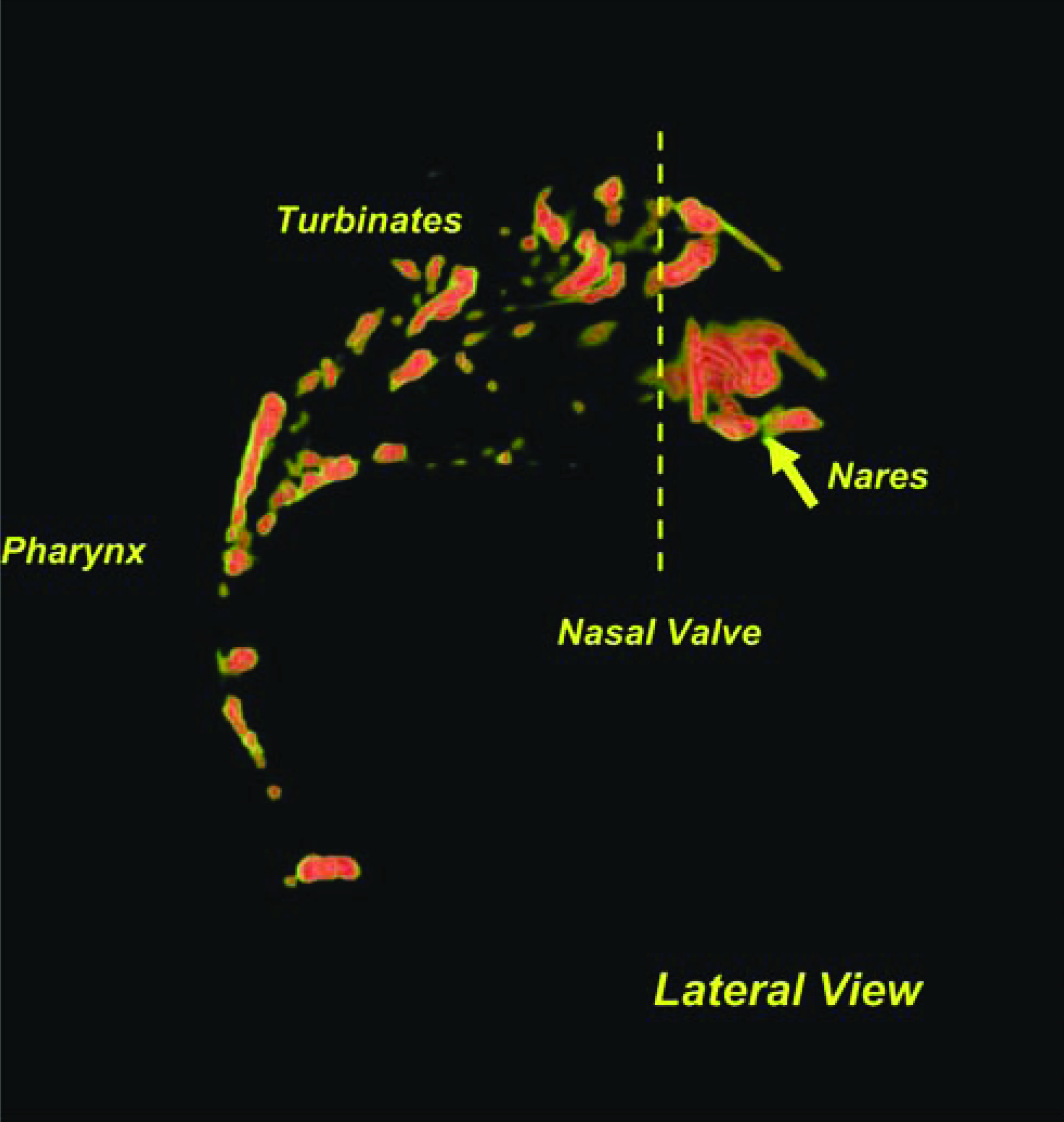
Current quantitative techniques for characterizing nasal airway deposition involve radiolabelled tracer techniques—such as gamma scintigraphy—performed in humans, animals, or airway phantoms. Gamma scans provide planar images from which the signal intensity can be measured. By overlaying the images of anatomic structures, which are not visible in the scan, a proportional deposition by section of the nasal airway can be determined. The spatial deposition information from gamma scintigraphy is limited to reasonable two-dimensional quantitative analysis. We present a preliminary demonstration of a three-dimensional technique for imaging deposition for aerosol delivery systems. The technique is based on Dual Energy Computed Tomography (CT). Dual energy CT is similar to conventional CT imaging, except that two measurements are made simultaneously at different energies. The two measurements allow for significantly greater discrimination between different materials, allowing CT contrast agents to be quantitatively imaged. We demonstrated the feasibility of the technique in a nasal airway phantom using both a dry powder inhaler and a spray device. The technique provided quantitative, 3-D deposition patterns with high-spatial resolution. This technique also has potential for use with animals or humans.
Dual Energy CT Scan of Dry Powder Inhaler (DPI) Deposition in a Child Nasal Airway Phantom
Acknowledgements: SBIR funding provided by US Centers of Disease Control and Prevention
Massachusetts General Hospital and Harvard Medical School, BOSTON, MA, United States of America
Whether developing new aerosol compounds or validating drug delivery systems it can be important to evaluate the delivered drug in pharmacological terms. Two such parameters are the concentration on the inner surface of the airways (CIS) and the dose per milligram of lung parechema (LPD). While two-dimensional imaging provides indices of central to peripheral deposition, limited spatial resolution and lack of anatomical information prevent assessment of CIS or LPD. Here we present a method to estimate global and lobar CIS and LPD using the fusion of PET deposition and CT anatomical imaging. We evaluated these parameters in the PET-CT deposition images of 11 bronchoconstricted asthmatics in whom we expected an amplified regional contrast of CIS and LPD. Estimates of aerosol deposition in central airways per unit airway volume were on average 22 times greater than estimations from raw PET data. This deposition distributed onto the airways' surface with an average lobar CIS of 47E-6 of the total lung deposition (TLD) per square mm. CIS was highly variable among subjects (COV=0.42) and among lobes (COV=0.43). Average lobar LPD was 0.9E-12 TLD per mg. Although less variable than CIS amongst subjects (COV=0.15), it was similarly variable amongst lobes (COV=0.43). We conclude that the analysis of PET-CT aerosol deposition images has the ability to yield regional pharmacological parameters that may be important in drug translational development and in the evaluation of aerosol delivery systems.
Acknowledgments: Sponsored by NIH grants HL86717 and HL68011, and by support from Air Liquide
MUCOCILIARY AND ABSORPTIVE CLEARANCE MEASUREMENTS IN PEDIATRIC AND ADULT CYSTIC FIBROSIS SUBJECTS AND HEALTHY CONTROLS
We are exploring the use of multi-probe aerosol techniques for quantifying pathophysiological changes in cystic fibrosis including changes in airway liquid hyper-absorption, epithelial injury, and inflammation. Our technique involves the inhalation of a liquid aerosol containing a small molecule probe, Indium 111 DTPA (In-DTPA), and a particle probe, Technetium 99m sulfur colloid (Tc-SC). The absorptive component of DTPA clearance is calculated as total DTPA clearance rate minus the particle (mucociliary) clearance rate. Studies in epithelial cell cultures have demonstrated increased rates of DTPA absorption in the CF airway, an association between liquid absorption and DTPA absorption rates, and DTPA absorption decreases in response to osmotic therapies. Subjects inhaled from a nebulizer containing 296 MBq of Tc-SC and 56 MBq of In-DTPA in 3 ml saline (adults 4 min, peds 2 min) using breathing controls to maximize airway deposition. They were then imaged continuously for 80 minutes. At t=10 minutes, subjects inhaled isotonic saline (IS) for 10 minutes. Adult subjects inhaled 7% hypertonic saline (HS) during the same time period on an additional testing day to measure DTPA absorption response. When compared to healthy adult controls (n=9; age 32.2±15.6 yrs; FEV1%p=99±9%), pediatric CF subjects (n=9; age=10.4±1.3 yrs; FEV1%p=90±15%) had similar Tc-SC (mucociliary, MCC) clearance rates and total In-DTPA clearance rates, and significantly increased absorptive clearance rates. CF ped/adult control - post IS MCC: 31±20/35±16%, p=0.67; total In-DTPA 58±17/48±14%, p=0.19; DTPA abs 28±8/14±6%, p=0.0005. CF adult baseline and HS response data is pending and will be available at time of presentation. All±SD.
Funding: NIH R01 HL108929-01
Battelle Memorial Institute, COLUMBUS, OH, United States of America
SPIONP were synthesized by chemical co-precipitation and surface-modified with −COOH groups through covalent bonding (14C labeling was also developed). Nano-aerosol was generated out of water suspension SPIONP (15 nm core) using Collison nebulizer under high pressure (∼80 psi) helium, mixed with oxygen, dried with HEPA filtered air, and delivered to the multi-tier nose-port exposure carousel. Aerosol concentration (∼107 particles/cm3) and particle size (∼70 nm CMAD) were monitored using Scanning Mobility Particle Sizer (SMPS). Micro-Orifice Uniform-Deposition Impactor and Scanning Electron Microscopy were provided to characterize nano-particles sampled from the exposure atmosphere. Spatial uniformity (3–6% RSD) of the nano-aerosol distribution across the nose-only exposure unit was confirmed using SMPS. Temporal stability (11–20% RSD) gravimetric filter analysis was conducted each hour of exposure.
Two 4-hours inhalation exposures of male BALB/C mice (30 mice/study) were conducted. One exposure was followed by MPD and transcriptomics analysis. The second exposure was followed by pharmacokinetic and biodistribution analysis using ultrasensitive AMS. Respiratory physiology measurements were conducted and total inhaled mass was estimated. Blood, lung, heart, liver, brain, head, and other tissues were analyzed. Both studies demonstrated similar lung clearance (∼55–70% after 2 days post-exposure and ∼36% after 7 days post-exposure). Small amounts of SPIONP were detected in the liver, spleen, upper GI and olfactory bulb over 7 days post-exposure using AMS. 815 genes were significantly changed in SPIONP exposed mice at the end of the 4-hour exposure period. Data demonstrated strong transcriptional response that persisted through 6 hour post-exposure and gradually declined over the next 7 days.
Acknowledgements: This work was supported by the Battelle Fundamental and Applied Systems Toxicology (B-FAST) Team.
UTILIZING AN EFFICIENT AIR-LIQUID INTERFACE CELL EXPOSURE SYSTEM (ALICE) FOR IN VITRO EFFICACY TESTING OF AEROSOLIZED LIQUID DRUGS
In this study, we introduce the ALICE technology for in vitro efficacy testing of aerosolized, inhalable drugs under physiologically realistic air-liquid interface conditions and perform a proof-of-principle study with a well established anti-inflammatory drug, the proteasome inhibitor Bortezomib (Velcade®).
Using fluorescein as surrogate drug the ALICE system showed uniform deposition of the nebulized drug into transwell inserts of multiwell plates with a well-to-well variability of <20% (95% confidence level for 6-well plates). Furthermore, 88+/-12% of the invested drug was delivered to the multiwell plate. This corresponds to an average cell-delivered fraction of 19% due to the limited cell coverage of standard multiwall plates. During a typical exposure 200μl of drug is nebulized and deposited onto the cells within about 5 min.
The refined ALICE system was used to test the efficacy of Bortezomib with challenged pulmonary cells (A549). Stimulation of A549 cells with TNF-α induced a 12-fold activation of the IL-8 promoter. Application of a single dose of aerosolized Bortezomib (6μl of 50μM Bortezomib per 6-well insert; 200μl were nebulized) reduced the chymotrypsin-like proteasome activity by 80% and induced a statistically significant therapeutic effect 24 h after the treatment. For the highest Bortezomib concentration (400μM), the IL-8 promoter activity decreased to below 40% compared to untreated TNF-α stimulated cells. Cell viability was not affected for any of these conditions (assessed by WST-1 and LDH). The ALICE is a compact, efficient and easy to use system for exposing air-liquid interface cells to liquid aerosols under clean bench conditions. The successful “inhalation-like” in vitro treatment of challenged A549 cells with Bortezomib shows the potential of the ALICE technology for in vitro efficacy and safety testing of novel drugs for inhalation therapy.
Acknowledgement: Supported by the Munich Leading Edge Cluster m4 – Personalized Medicine and Targeted Therapies
Student Presentations
Department of Biopharmaceutics and Pharmaceutical Technology, Saarland University, D-66123 Saarbrücken, Germany
With respect to deposition of nanoparticulate drug carriers in the peripheral lungs, the primarily encountered biological matter is the lung surfactant layer, which besides phospholipids contains also proteins. In particular the pulmonary collectins surfactant protein A (SP-A) and D (SP-D) can bind a variety of structural patterns and favor the alveolar macrophage (AM) clearance of foreign material. In first studies with lung surfactant proteins and other proteins we have addressed the interactions with metal oxide nanoparticles (NPs).1–3 In a more recent study, we investigated the involvement of SP-A and SP- D in triggering the uptake of differently modified NPs (starch, ST; and phosphatidylcholine, PL) by macrophages in an immortalized murine AM cell model (MH-S cells). Using flow cytometry and confocal microscopy, we could demonstrate that SP-A or SP-D both can exert strongly stimulating effects on the NP uptake by AM. By means of gel electrophoresis, these effects were shown to be due to adsorption of SP-A or SP-D. Moreover, the agglomeration of NPs was influenced upon protein adsorption, which also contributed to the extent of NP uptake by AM. In addition, we could show that the presence of artificial surfactant lipids or isolated native surfactant lipids essentially modulates surfactant protein-mediated effects regarding macrophage uptake of NPs.4
Our ongoing work underscores the need to thoroughly investigate such bio-nano interactions in the lungs, as they might profoundly determine the fate of NPs deposited in the lung. Current work focuses on controlling interactions between nanoparticulate drug carriers and endogenous compounds of the lung lining fluid that govern macrophage internalization. This approach holds promise for more selective and efficient treatment of macrophage-related infections, as occurring e.g. in early tuberculosis.
1. Ruge CA, Kirch J, Cañadas O, Schneider M, Pérez-Gil J, Schaefer UF et al. Uptake of Nanoparticles by Alveolar Macrophages Is Triggered by Surfactant Protein A. Nanomedicine : Nanotechnology, Biology, and Medicine 2011; 7 (6): 690–693.
2. Schulze C, Schaefer UF, Ruge CA, Wohlleben W, Lehr C-M. Interaction of metal oxide nanoparticles with lung surfactant protein A. European Journal of Pharmaceutics and Biopharmaceutics 2011; 77 (3): 376–383.
3. Schaefer J, Schulze C, Marxer EEJ, Schaefer UF, Wohlleben W, Bakowsky U et al. Atomic Force Microscopy and Analytical Ultracentrifugation for Probing Nanomaterial Protein Interactions. ACS Nano 2012; 6 (6): 4603–4614.
4. Ruge CA, Schaefer UF, Herrmann J, Kirch J, Cañadas O, Echaide M et al. The Interplay of Lung Surfactant Proteins and Lipids Assimilates the Macrophage Clearance of Nanoparticles. PLoS ONE 2012; 7 (7): e40775.
Drug Delivery, Helmholtz-Institute for Pharmaceutical Research Saarland, Saarland University, SAARBRUECKEN, Germany
Barrier properties like functional tight junctions and hence high transepithelial electrical resistance (TEER) values are of utmost importance in drug delivery research. Till date there is no cell line available that reflects the crucial barrier properties of human primary alveolar type I (AT I) cells. By lentiviral transfection we immortalized the primary AT I cells, which were developed as a model for the human air-blood barrier (ABB) in our lab years ago. It has been reported, that the loss of cellular identity and the correlated cellular functions is a big disadvantage of transformation and particularly the use of classical transformation genes like hTert or SV40LTAg often causes cellular de-differentiation. However, to overcome this obstacle a set of 33 so called “mild proliferators” was chosen in our study, which can under certain circumstances also enable cell proliferation. The cell lines underwent characterization regarding their epithelial origin, the expression of lung-cell-specific markers and their barrier properties by morphological studies, immunofluorescence staining techniques, real-time PCR and TEER measurement. The new alveolar cell lines conserved epithelial characteristics, have an immortal life-span (sigmoid growth curve, currently passage 30, freezable/thawable), show tight junction expression (TEER>1000 Ω·cm2) and exhibit AT I-like marker expression. We assume that these new alveolar cell lines could provide considerable advantages in terms of reflecting the in vivo situation of the air-blood barrier and could serve as an in vitro model for various applications. This system could allow standardized toxicity and transport studies for newly developed compounds and delivery systems and could be helpful in elucidating infection pathways across the respiratory tract in the context of aerosol transmitted infectious diseases (e.g. swine flu, tuberculosis, etc.) and their treatments.
Department of Pharmaceutics, Virginia Commonwealth University, RICHMOND, VA, United States of America
Pharmaceutical aerosol delivery to the lungs during invasive and non-invasive ventilation is associated with dose variability and drug depositional losses. In part, these losses are due to regions of sudden flow contraction and expansion, and angle changes within the circuit. To address this issue, key components of two delivery circuits were produced using streamlined designs that originated from computational fluid dynamics simulations. Aerosol drug deposition was determined in a model invasive delivery circuit consisting of an Aeroneb adult T-adapter connected to a wye connector and then an endotracheal tube (7–9 mm diameter). Similarly, deposition was determined in a model non-invasive delivery circuit consisting of an Aeroneb neonate T-adapter and an Optiflow nasal cannula connected using 20 cm of tubing (10 mm diameter). Albuterol sulfate aerosols were generated using the Aeroneb Lab Nebulizer and delivered to the circuits with humidified air (>90%RH, 25°C) at 30LPM. Commercial and custom-made streamlined T-adapters, wye connectors and cannula designs were tested in each system. For the invasive ventilation circuit, deposition in the commercial wye connector was high (33.8±1.2%). The streamlined wye connector reduced deposition to 5.1±0.8%. As the endotracheal tube size was increased, this 6 fold reduction in depositional losses resulted in higher delivery fractions of the drug to the patient. For the non-invasive ventilation circuit, there was significant deposition in the neonate T-adapter (30.6±1.9%). A streamlined design T-adapter resulted in deposition losses of 5.7±0.4%. The combination of streamlined T-adapter and cannula improved total delivery fraction through the non-invasive circuit by a factor of approximately 2x.
Acknowledgements: NIH
The University of Oklahoma Health Sciences Center, OKLAHOMA CITY, OK, United States of America
CPZEN-45 is a derivative of caprazamyin which has been shown, in vitro, to kill mycobacteria. The purpose of the present study was to determine the disposition of CPZEN-45 after administration of solutions by the IV and SC routes and aerosol powder by the pulmonary route. The day before the study, animals underwent cannulation of the jugular vein for blood sampling. Blood samples were collected at predetermined time points. Bronchoalveolar lavage (BAL) was performed after the last blood sample. Lung and spleen tissues were resected and frozen until analysis. CPZEN-45 concentrations in blood, BAL and tissues were determined by HPLC. Plasma concentration versus time curves after IV and pulmonary administration were statistically similar, suggesting that the drug is rapidly and efficiently absorbed after pulmonary administration, which reflected in the time after maximum plasma concentration (Tmax). The route of administration also influenced favorably the CPZEN concentrations in the airways (BAL concentrations) and in the lung tissue at the end of the blood sampling period. Non-compartmental analysis of plasma concentration versus time also revealed a favorable influence of the route of administration on key pharmacokinetic parameters for CPZEN-45. The potential of the pulmonary route of administration to administer CPZEN-45 is supported by drug concentrations in the lungs, the primary site of tuberculosis infection, and by the pharmacokinetic parameters.
Key Words: Tuberculosis, Pharmacokinetics, CPZEN-45, pulmonary route, guinea pig model
Institute of Anatomy, University of Bern, BERN, Switzerland
Inhalation of engineered nanoparticles (ENPs) in industrial processes, in consumer products, but also in medicine poses a largely unknown risk. Thereby, persons with pre-existing lung disease are more vulnerable.
Based on previous work a chamber for efficient deposition of (nano) particles out of a continuous air-stream on cell cultures has been developed. It allows simultaneous particle deposition on 24 individual cell cultures by electrostatic deposition under controlled conditions (85–95% RH and 37°C). The new chamber has been characterized in terms of deposition efficiency, spatial distribution of particles and compatibility for cell exposures. In first experiments, re-differentiated human bronchial epithelia (HBE) with established air-liquid interface and the bronchial cell line BEAS-2B were exposed to Ag- and C-nanoparticles.
Particles were evenly distributed on inserts except for the edge, where fewer particles were deposited. Particle deposition efficiency was in the range of 15%. The exposure treatment itself was not cytotoxic, as lactate dehydrogenase release in BEAS-2B cells exposed to inert particles was not different from unexposed controls. Preliminary results from Ag- and C-nanoparticles exposures indicate a greater sensitivity of HBE from a donor with cystic fibrosis compared to healthy HBE and BEAS-2B cells.
Thus, the Nano Aerosol Chamber for In-Vitro Toxicology (NACIVT, www.nacivt.ch) combined with advanced cell models, i.e. HBE from healthy and diseased donors provides a highly realistic in vitro system for safety testing of ENPs. Moreover, the combined system allows studies with novel therapeutic aerosols with particle diameters up to micrometer size.
Acknowledgements: Funding by the Swiss National Science Foundation
Poster Abstracts
Imaging, Modeling, and Physiology of Aerosols in the Lung
THE EFFECT OF CHRONIC TREATMENT WITH IMMUNOSUPPRESSIVE DRUGS ON MUCOCILIARY CLEARANCE IN A VAGOTOMIZED MURINE MODEL
Previously, we have demonstrated that mucociliary clearance (MCC) is diminished after surgery in lung transplant patients (Laube BL, et al. J Heart Lung Transplant 2007; 26:138–144). However, the explanation for the reduction in MCC is unknown. We hypothesized that chronic treatment with a commonly prescribed regimen of immunosuppressive drugs significantly impairs MCC. We tested this hypothesis in a murine model of lung transplantation. For 6 days, seven vagotomized control mice were intraperitoneally injected with three 100 μL doses of phosphate buffered saline once daily and eight vagotomized immunosuppressed mice were injected with three 100 μL injections of tacrolimus (1 mg/kg), mycophenolate mofetil (30 mg/kg), and prednisone (2 mg/kg) once daily. Then, mice inhaled the radioisotope 99mtechnetium and underwent gamma camera imaging of their lungs for 6.5 hrs. Counts remaining in the right lung at 6–6.5 hrs were background and decay-corrected to time 0 counts and divided by time 0 counts. Retention at this time point was subtracted from 1.00 and multiplied by 100% to obtain percent removed by mucociliary clearance. At 6–6.5 hrs, MCC was significantly slower in the immunosuppressed mice, compared to controls, with 7.78±5.9% cleared versus 23.01±11.7% cleared, respectively (p=0.006). These preliminary results suggest that chronic treatment with immunosuppressive medications significantly slows MCC in vagotomized C57BL/6 mice. These findings could shed light on why MCC is reduced in lung transplant patients whose lungs are denervated during surgery and who are chronically treated with immunosuppressive drugs post surgery.
Medical Gases Group, Air Liquide Santé International, LES LOGES-EN-JOSAS, France
Helium/oxygen mixtures have been used to improve aerosol delivery by increasing deposition in peripheral airways. In addition, the influence of the aerosol size distribution on deposition pattern is well-known. Therefore, in assessing aerosol delivery systems with helium-oxygen, knowledge of gas property effects on aerosol generation is important. These effects on aerosol generation must be accounted for when gauging changes in deposition pattern arising from altered fluid and particle transport. In the present study, an aerosol delivery system consisting of a vibrating mesh nebulizer and holding chamber was assessed prior to use in an aerosol deposition study with helium/oxygen. Laser diffraction experiments were conducted to investigate the influence of breathing pattern and carrier gas (air versus helium/oxygen 78/22%) on size distributions of saline droplets delivered from Aeroneb Solo nebulizers used with an Idehaler holding chamber. Differences in the volume median diameter (VMD) and geometric standard deviation (GSD) between various breathing patterns studied were small compared to differences between individual nebulizers. Further, average VMDs and GSDs were not significantly different between helium/oxygen and medical air. Accordingly, the aerosol delivery system can be used to directly study the effects of helium/oxygen on regional deposition patterns. In particular, the potential for helium/oxygen to increase delivery of therapeutic aerosols to obstructed airways through increased ventilation of obstructed lung regions holds promise for the treatment of severe respiratory disease.
Acknowledgements: Funded by Air Liquide
The University of Oklahoma Health Sciences Center, Oklahoma City, OK, United States of America
CPZEN-45 is a new drug entity considered for the treatment of multi-drug resistant (MDR) tuberculosis. A reverse-phase high-performance liquid chromatographic (HPLC) method was developed and validated to determine CPZEN-45 concentrations in biological matrices. CPZEN-45 was extracted from guinea pig's plasma, bronchoalveolar lavage (BAL), lung and spleen tissues by sequential extraction with acetonitrile and quantified by a Waters HPLC coupled with a ZORBAX Bonus-RP (4.6×75 mm), guard column and UV detection at 263 nm. The mobile phase was 20:80 acetonitrile: water with 0.05% TFA. The CPZEN-45 peak was eluted at 5.1 min with no interference with the peaks of impurities from plasma, BAL, lung or spleen tissues. Recovery of CPZEN-45 from guinea pig plasma, BAL, lung and spleen was >95%. The limit of quantification was 0.29 μg/ml which was more than 5 and 21 times lower than the reported minimal inhibitory concentration (MIC), 1.56 μg/ml for Mycobacterium tuberculosis H37Rv and 6.25 μg/ml for MDR-TB, respectively. Limit of detection was 0.05 μg/ml. The HPLC method appeared to be sensitive, reproducible and accurate for quantification of CPZEN-45 in guinea pig's plasma, BAL, lung and spleen tissues to be used in subsequent drug disposition studies in the animal model.
Acknowledgement: Grant funding by the NIH (1R01AI091882-01)
National Taiwan University, TAIPEI, Taiwan
Vibrating mesh nebulizers have been reported to have increased output efficiency, minimal residual volume, and high percentage of particles in the emitted respirable and fine particle fraction. This work aimed to investigate and identify the major operating parameters of vibrating mesh nebulizers and their effects on the characteristics of aerosol output. The vibrating mesh plates were customarily made to contain 279∼4606 tapered holes. The aperture size was uniform on each plate and varied from 3 to 12 μm. The aperture distance also varied from 75 to 450 μm, to examine the potential of droplet coagulation. The aperture plates vibrated at a fixed frequency (100∼300 kHz), which caused the ejection of liquid droplets. These nebulizers were mainly evaluated with 0.9% sodium chloride solution. A syringe pump was employed to carry the solution to the vibrating mesh plate. An aerosol size spectrometer (Welas 3000) was employed to measure the aerosol number concentration and size distribution. The droplet size was found to increase with increasing aperture diameter. The distance between apertures and the frequency applied to the mesh plate did not significantly affect the aerosol concentration and size distribution. For each vibrating mesh of different aperture size and aperture number, there is an optimal vibrating frequency to stably deliver maximum amount of aerosol output. This maximum feeding rate increased with increasing aperture number and applied electric current, but the aerosol size distribution remained the same. Vibrating mesh aerosol generators can be orientation independent, if equipped with capillary transport device, such as fibrous absorbent materials.
Acknowledgements: Financial support by National Science Council, Taiwan.
AEROSOLIZED PEPTIDE CONJUGATED NANOERYTHROSOMES CONTAINING FASUDIL FOR THE TREATMENT OF NON-SMALL CELL LUNG CANCER
Non-small cell lung cancer (NSCLC) accounts for approximately 85% of lung cancer cases and current chemotherapy for NSCLC is nonspecific that produces several off target effects such as anemia, ototoxicity and nephrotoxicity. In this study, we have tested the feasibility of CARSKNKDC, a lung specific homing peptide, conjugated nanosized erythrocyte ghosts as carriers for the inhalational and targeted delivery of fasudil, an investigational Rho-kinase inhibitor that has shown promise for the treatment of NSCLC. CAR conjugated nanoerythrosomes (NERs) were prepared by hypotonic osmotic lysis plus extrusion method. NERs were evaluated for size, entrapment, nebulization stability, in vitro release and in vivo drug absorption profile. In vitro cytotoxicity of formulations was studied in Calu-3 and A549 cells. Formulations were also tested for their efficacy in inhibiting migration, invasion and rho-kinase expression and inducing apoptosis. NERs were spherical and homogenous with an average size of 151.34±2.32. Entrapment efficiency was 49.81±1.77% and NERs were stable upon aerosolization. CAR-NERs induced 50% cytotoxicity in 6 hrs compared to normal NERs and plain fasudil and exhibited more efficacy in inhibiting ted migration and invasion of A549 cells. CAR-NERs inhibited rho-kinase expression as determined by Western blot analysis and ELISA assay. Compared to plain fasudil administered by intravenous or pulmonary route, erythrosomal fasudil showed prolonged availability after pulmonary administration. This study suggests that nanoerythrosomes hold promise for the treatment of NSCLC as evidenced by cytotoxicity and rho-kinase inhibition studies. Further in vivo efficacy studies are underway to investigate the feasibility of this approach in animal models.
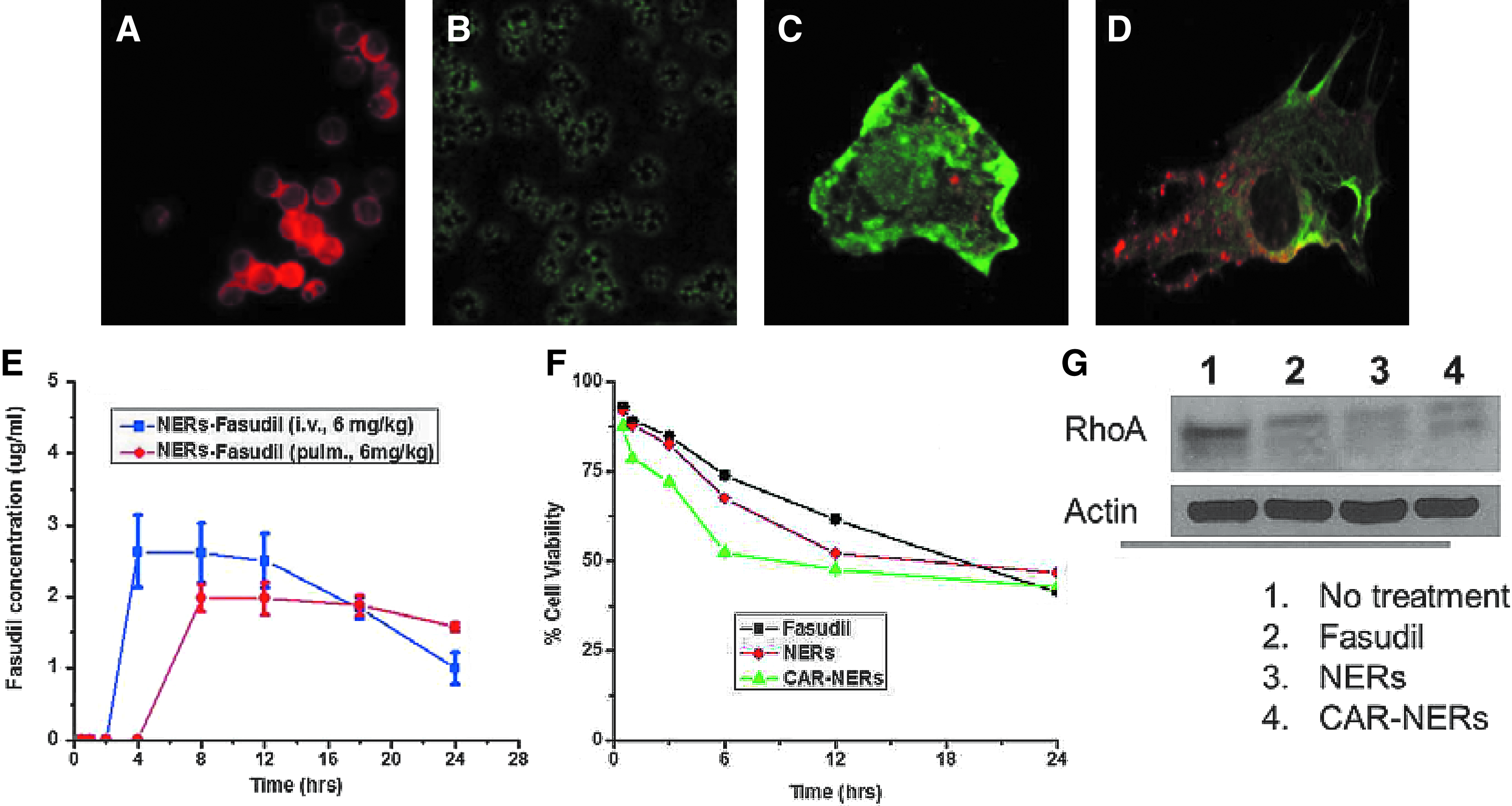
(A) NERs containing fasudil, (B) CAR conjugated NERs, (C) Uptake of normal NERS by A549 cells, (D) Uptake of CAR-NERs by A549 cells, (E) Pharmacokinetic study of NERs, (F) Cell viability assay and (G) RhoA expression Western blot analysis.
The nonaqueous spray formulations are attractive alternatives to aqueous spray formulations for seasonal and year – round nasal allergies. This study compared the human regional nasal deposition and clearance patterns of radiolabeled nonaqueous spray of beclomethasone (BDP, 80 μg, Qnasl) from a metered dose inhaler (MDI) to aqueous sprays of fluticasone propionate (FP, 50 μg, Flonase) and mometasone furoate (MF, 50 μg, Nasonex) from respective nasal pumps. The FP, MF and BDP nasal formulations were radiolabeled with technetium 99-m and validated prior to human studies. The clinical study was an open-label cross-over design and used up to nine male patients with allergic rhinitis (AR). The deposition analysis was conducted by 2D and 3D gamma imaging with magnetic resonance imaging (MRI) for anatomical identification. No BDP patients (0/8) exhibited anterior nasal drip while 6/8 patients for FP and 6/8 patients for MF showed nasal drip. Throat deposition was observed for all three products. The FP throat dose varied from 0.1% to 17.6%, the MF throat dose varied from 0.0% to 4.7% while the BDP throat dose was more reproducible (range 0.0% and 1.7%). The retention of the three formulations over ∼14 minutes showed an increased nasal retention for BDP. This was substantiated by patients exhibiting decreased back-of-the-throat deposition where clearance mechanisms are more rapid than the clearance mechanisms in the nose. This study showed that with a dry MDI of BDP, there was less drug dripping from the patient's nostril and back of the throat compared with aqueous pump sprays of FP and MF.
Acknowledgements: This work was funded by Teva Pharmaceuticals. The authors would like to recognize inviCRO for development of data analysis tools.
Department of Medicine, University of California, San Diego, La Jolla, CA
The deposition of >0.5 μm particles in the lung is strongly influenced by gravitational sedimentation, with deposition being reduced in low gravity compared to normal gravity (1G). Reduced sedimentation also affects the distribution of inhaled aerosol and as a consequence deposition patterns. Using gamma scintigraphy, we measured regional deposition and retention of radiolabeled particles (99mTc-labeled sulfur colloid, MMAD=5.1μm, GSD=1.6) in five healthy volunteers. Particles were inhaled in a controlled fashion (0.5 L/s, 15 breaths/min) during multiple periods of microgravity (μG) aboard the NASA Microgravity Research Aircraft and in 1G on a separate occasion. In both cases, deposition scans were obtained immediately post-inhalation and at 1h30, 4h and 22h post-inhalation. The distribution of deposited particles in the large (DEaw,large), intermediate (DEaw,interm), and small airways (DEaw,small) as well as in the alveolar region (DEalv) was derived from these data and is listed in the table as mean±SD (*=p<0.001 when compared to 1G data). The data show a profound shift in the distribution of deposited particles away from the lung periphery towards the large airways when particles are inhaled in μG. This is the direct result of the absence of gravitational sedimentation that has the greatest effect in the distal lung where airway size is small and residence time high, with a consequent increase in the deposition fraction in the central airways where particles deposited mainly by inertial impaction.
Acknowledgements: This study was funded by the National Space Biomedical Research Institute through NASA NCC 9–58.
National Taiwan University, TAIPEI, Taiwan
Human lung is not only an aerosol collector but also an aerosol generator. Previous lung deposition studies have shown that aerosol deposition efficiency were strongly dependent on particle size, breathing pattern, aerosol charge distribution and lung morphometric parameters. On the other hand, the generation rate of exhaled breath aerosols (EBA) was mainly controlled by the tidal volume. The main objective of this work was to study the relationship between the exhaled breath aerosols and the lung deposition efficiency. The experimental system consisted of a test chamber, a mouthpiece, a pneumotachograph flow meter, and a particle counter. Both tests shared the same experimental apparatus except the aerosol generating system. For regional lung deposition measurement, a stable aerosol output was essential, while aerosol-free air was supplied to the chamber when conducting the EBA measurements. The volunteers were asked to follow sinusoidal breathing patterns which were generated by using a piston-cylinder breathing simulator. The subjects were instructed to perform percentage of forced vital capacity (20, 40, 60%FVC) and fixed tidal volume (500, 750 and 100 mL) with different breathing frequency (10, 12, 14, 15 breath/min). The results showed that the EBA counts increased with increasing tidal volume, but nearly not affected by the breathing frequency. The regional deposition data showed that local deposition efficiency increased with penetration volume. The correlation analysis showed that total lung deposition efficiency increased with increasing EBA counts, a somewhat confusing phenomenon, indicating that a subject who collects aerosols more efficiently, generates more aerosol particles through tidal breathing.
Acknowledgements: Financial support by the Institute of Occupational Safety and Health, Taiwan.
ESTIMATING LUNG DEPOSITION OF BOLUS INHALATION WITH THE ICRP 66 DEPOSITION MODEL
Estimating lung deposition via a mathematical model is a useful tool, to estimate the lung dose and the regional distribution of inhaled particles without in vivo investigations. One of the most common lung deposition models was published 1994 in the annual reports of ICRP, with the number 66[1]. That model is based on experimentally measured regional particle deposition in the human lung of monodisperse aerosols inhaled in a single breath and was adapted by Köbrich et al. for polydisperse aerosol parameters soon after its publication[2].
Pharmaceutical inhalation devices like MDI's or DPI's usually deliver particles as a bolus where aerosol particles are not distributed equally across the whole inhalation volume. Especially for breath actuated devices the drug delivery starts after a certain inhaled volume and ends when the dose is aerosolized, which is not necessarily the end of the inhalation. To be able to use the ICRP model with such bolus inhalation manoeuvre, three single breath depositions with different inhalation volumes need to be calculated {total inhaled volume (Depo1), volume until the beginning of the bolus (Depo2), volume until the end of the bolus (Depo3)}. All other deposition calculation parameters are equal for the three calculations. By subtracting these single breath depositions, the deposition of the bolus can be calculated {Depo1-Depo2-(Depo1-Depo3)}.
Because the ICRP model divides the respiratory tract into 5 regions and regards each region as a filter, which deposits particles with a characteristic efficiency
1. ICRP, Human Respiratory Tract, Model for Radiological Protection. Annual ICRP 24. Vol. 66. 1994: ICRP Publication.
2. Köbrich, R., G. Rudolf, and W. Stahlhofen, A mathematical model of mass deposition in man. Ann Occup Hyg, 1994.
Université Catholique de Louvain, Louvain Drug Research Institute, BRUSSELS, Belgium
The PEGylation of the F(ab’)2 anti IL-17A antibody fragment and the biological characterization of the generated conjugate are presented. This modification aims to generate an optimized candidate therapeutic for the treatment of bronchial hyperreactivity (BHR). The murine anti IL-17A antibody was initially digested by pepsin to produce the F(ab’)2 fragment. Then, N-hydroxysuccinimide (NHS) activated ester-PEG of 40 kDa was added to react with the fragment available primary amines. Factors affecting the degree and the yield of PEGylation, including pH, incubation time, PEG:antibody molar ratio and protein concentration were tested. The extent of modification was evaluated by Sodium Dodecyl Sulphate Polyacrylamide Gel Electrophoresis (SDS-PAGE). Cation Exchange Chromatography (CEC) was used for removal of PEG excess and purification of PEGylated species. The efficacy of the generated anti IL-17A constructs in binding to and inhibiting the biological activity of IL-17A was assessed and compared to the one of the full-length antibody. Optimal conditions were observed when anti IL-17A F(ab')2 (4mg/ml) at pH 8.2 was allowed to react with branched PEG40-NHS activated ester at a PEG:antibody molar ratio of 6:1 at room temperature, under agitation for 30 min. Upon purification, 34% unreacted, 42% mono-PEGylated and 24% multi-PEGylated F(ab’)2 fragment were obtained. The mono-PEGylated fragment appeared to have a slight decrease in its binding activity (4-fold) and its in vitro inhibitory potency (2-fold) rendering it a good candidate for in vivo studies. Further investigation is needed for the determination of the pharmacokinetic profile and in vivo therapeutic efficacy in BHR models.
Acknowledgements: Grant funding by the Walloon Region, Belgium
Applied Research Associates, Inc., Raleigh, NC, United States of America
Assessment of the dose and site of deposition of inhaled cigarette particles and associated carcinogenic components in the lung aids in the interpretation of biological response and adverse effects. Available deposition models developed for environmental aerosols are not capable of reliable predictions of smoke particle deposition in the lung mainly to due to the differences in the respiratory maneuver and their physico-chemical and aerodynamic properties. A mechanistic model for cigarette smoke particle deposition was developed that included cigarette-specific colligative and non-colligative effects on deposition. Using Maxwell's equation for diffusion, particle size change by hygroscopicity and phase change of semi-volatile components were calculated. In addition, the particle size change model included particle coagulation which depended on particle concentration and airway deposition. The cigarette smoke particles were found to grow rapidly by absorbing water vapor and the diameter increased by 50–100%. The non-protonated component of nicotine in the cigarette smoke was found to rapidly undergo phase change from the particle phase to the gas phase. A multi-component, mechanistic model of inhaled cigarette smoke particle transport was developed which accounted for particle size change and hydrodynamic interactions of the particles. Particle deposition was higher in the tracheobronchial region than in the alveolar region. Model predictions agreed with available measurements in the literature for both the oral cavity and lung. The proposed model is a powerful tool for studying the fate of individual smoke constituents.
Acknowledgement: This study was funded by British American Tobacco
Novartis Pharmaceutical Corp., San Carlos, CA, US
The dose delivery performance of inhalable porous particles as a function of powder properties was assessed using the “Alberta” throat (DeHaan and Finlay et al., 2001). Engineered placebo powders were prepared using the PulmoSphere™ technology, which is based on spray-drying an emulsion feedstock to produce porous particles with well-controlled size and density. These placebo powders are useful surrogates for a class of potent active formulations. As part of study design, particles with range of particle size and density were manufactured, representing a particle design space relevant to dry powder inhalers. The Alberta throat provides an in-vitro estimate of ”lung dose”, and was used to study the effect of flow rate, particle size and density on dose delivery performance using the Simoon blister-based inhaler. Commercially available inhalers with lactose-blend formulations were also evaluated to provide a comparative benchmark. The in-vitro lung doses measured with the Alberta throat were compared to predictions from semi-empirical numerical models. Data from the Alberta throat and numerical models were used to rank order dose delivery performance over a pressure drop range of 1–6 kPa. Powder fluidization and aerosol emission for the PulmoSphere powders was favored by low particle density and large geometric diameter, while improved lung dose and flow rate dependence were favored by powders with median particle diameter Ⅵ2.5 microns. In comparison, traditional lactose blend formulations showed significantly lower lung dose and increased airflow dependence. The rank-ordered in-vitro results for the different formulation types are consistent with published in-vivo results from clinical trials with similar formulations (Duddu et al., 2002).
1. DeHaan, W. H., Finlay, W. H. In Vitro Monodisperse Aerosol Deposition in a Mouth and Throat with Six Different Inhalation Devices. Journal of Aerosol Medicine.
2. Duddu, S. P., Sisk, S. A., Walter, Y. H., Tarara, T. E., Trimble, K. R., Clark, A. R., Eldon, M. A., Elton, R. C., Pickford, M., Hirst, P. H., Newman, S. P., Weers, J. G. Improved Lung Delivery from a Passive Dry Powder Inhaler Using an Engineered PulmoSphere® Powder. Pharmaceutical Research.
AN IMPROVED MATHEMATICAL MODEL OF THE HUMAN LUNG THAT ACCOUNTS FOR THE DEPOSITION EFFECT OF CHARGE ON AEROSOL PARTICLES
When charge is present on aerosol particles deposition is likely to be enhanced. An improved predicting lung deposition model has been developed which can be executed using a personal computer. It has advantages over previously published formulations since it can deal with deposition efficiencies as high as unity with minimal computational effort. This has been achieved by using the natural definition of change in particle concentration over an airway length and by transforming the deposition surface integral into a line integral, using Green's theorem. The results are in good agreement with published experimental data for both highly-charged and natural-occurring aerosol. If the level of charge is sufficiently high, deposition is enhanced and the regional deposition of aerosol may be influenced. The model has been used in aerosol therapy to assess the performance of clinical nebulizers with regard to total and regional deposition.
Dept of Physics, Faculty of Science, UAE University, Al-Ain, P.O. Box: 17551, United Arab Emirates
Electrical charge as inhaled particles may increase particle retention in the lung. All therapeutic aerosols produced by devices such as nebulizers, metered-dose inhalers and dry powder dispersers consist of charged particles. Charged particle deposition in the lungs, during the administration of therapeutic aerosols, can be controlled by adopting various strategies. These include prescribed breathing patterns, pulsing of aerosol during inhalation and by control of particle size and charge. For inhalation of charged aerosols of low particle number concentration deposition force, for particles close to the airway wall, is dominated by the electrostatic “image” force. If particle number concentration is sufficiently high, space-charge depositional forces become dominant. Space charge is often the important deposition mechanism in the early airway generations whereas the “image” mechanism tends to become more important in the smaller airways. In this work we look critically at the space-charge and image charge expressions that have been used to predict charged particle deposition in the lungs and we derive new expressions accounting for airflow.
DTF-Aerodrug, Faculté de Médecine, F-37032 TOURS, France
The purpose of this study was to design a numerical model simulating the nebulization process inside a jet nebulizer and to compare it with experimental data obtained from various measurement methods. Such a model allows a better understanding of the atomization process and a determination of the relevant physical parameters influencing the nebulizer output. A model based on the Updraft nebulizer (Hudson) was designed with ANSYS Workbench and meshed in 4 μm cells. Geometry and boundary conditions were set in ANSYS Fluent with experimental data and the relevant model parameters were determined through an axisymmetric 2D simulation. 3D calculations were made at two air flow rates (2L/min and 8L/min) to account for different turbulence regimes. Experimental methods such as laser diffractometry, phase Doppler anemometry and CCD camera were used to characterize the spray output. Image acquisitions made with CCD camera showed similar liquid patterns as numerical results, such as film formations or droplet spreading. VMD predicted by numerical results are close to distributions obtained from image processing (26 μm vs. 21 μm at 2L/min; 17 μm vs. 14 μm at 8L/min). However, size is overestimated in relation to PDA and laser diffractometry, due to different sizing method and size range. Numerical simulation then provides a good modeling of the phenomena causing droplet atomization and could help understanding nebulizer output with defined parameters.
Inamed GmbH, Gauting, Germany
The aim of this study was to evaluate the dose delivery characteristics from the low resistance Breezhaler® dry powder inhaler used with the once-daily LAMA glycopyrronium (Seebri®) in an in-vitro study. The dose delivery characteristics of 50 μg drug in inhalation capsules were measured on different simulated COPD patient breathing patterns.
Seven representative patient inhalation flow profiles were selected from 26 COPD patients to cover the range of patients' parameters and inspiratory flow profile variables caused by disease severities, from moderate to severe. Based on the results of the aerodynamic particle size distribution analysis, the theoretical respiratory tract deposition for each of the simulated patient breathing patterns was estimated with the ICRP 66 deposition model.
The delivered dose ranged from 38 μg to 43 μg per capsule as collected by the Next Generation Impactor. Fine particle mass (<5μm) ranged between 19 μg to 25 μg. This is equivalent to 38% to 51% of the nominal dose of 50 μg. The MMAD ranged from 2.7 μm to 2.9 μm and the GSD from 1.9 to 2.0.
In summary, the Breezhaler® inhalation device delivers a consistent dose and high fine particle fraction of glycopyrronium across a broad range of simulated inspiratory flow profiles representative of COPD patients of different disease severities. The results of the theoretical respiratory tract deposition calculation provided a good indication that a pretty consistent glycopyrronium dose at the intrathoracic target site is achieved following simulated COPD patient inhalation profiles including the lower measured flow rates and inspiratory volumes.
MONODISPERSE AEROSOL DEPOSITION IN COMPARTMENTS OF THE EXTRA-THORACIC AIRWAY: IN VIVO
Therapeutic aerosol particles deposit in extra-thoracic airways (ETA's). Radiolabelling and imaging techniques can identify ETA deposition. To date, analysis of ETA sub-compartmental deposition has not been undertaken in vivo. Differences in compartmental morphology affect localized flow and deposition. Investigating compartmental deposition is important in predicting the fate and health effects of inhaled particles.
12 asthmatics (FEV1=76.8% pred) inhaled radiolabelled monodisperse albuterol aerosols: 1.5-, 3- &, 6-μm from spinning-top aerosol generator at 30- & 60-L/min. ETA's were divided into 4 sub-compartments: oral (O), pharyngeal (P), laryngeal (L), tracheal (T) using scintigraphic images and, deposition calculated.
Slow flows (30 L/min) increased oral deposition of 1.5 & 3 μm (compared to 3 μm, 60 L/min; p=0.0109). High flows (60 L/min) increased laryngeal deposition of 3 & 6 μm (compared to 1.5 & 3 μm, 30 L/min; p=0.0002). Tracheal deposition for 1.5 μm increased at both flows compared to 6 μm, 60 L/min (p=0.0041).
Deposition within ETA compartments is dependent on particle size and flow. As aerosol particle size decreased, deposition in the pharyngeal and laryngeal compartments decreased but tracheal deposition increased. Increasing the flow from 30 to 60 L/min increased laryngeal deposition.
Center for Environmental Medicine, Asthma and Lung Biology
Cigarette smoking is a risk factor for viral infections, yet the mechanisms underlying this susceptibility remain unknown. Natural killer (NK) cells play an important role in fighting influenza and signals from epithelial cells (EC) likely regulate NK cell activity. We have previously shown that markers of cytotoxicity are reduced in nasal NK cells from smokers after influenza infection. This study investigated if human EC from smokers and nonsmokers differentially affect NK cell activity in the context of influenza infection.
EC were infected with influenza and subsequently co-cultured with NK cells. NK cells were also incubated with apical washes and basolateral supernatants of EC to identify the role of soluble mediators.
At baseline, co-culturing NK cells either directly with smoker EC or stimulating with basolateral supernatants from these cells reduced markers of cytotoxicity. Similarly, after influenza infection markers of cytotoxicity as well as levels of IFN-γ, IL-4 and granzyme B were decreased in NK cells incubated with basolateral supernatants of smoker EC.
Co-culturing NK cells with EC from smokers reduced markers of cytotoxicity in NK cells through a potential mechanism involving EC-derived soluble mediators. Thus, EC-mediated modification of NK cell activity may contribute to the higher susceptibility to influenza infections seen in smokers.
Acknowledgments: The work was supported by Swiss National Science Foundation, NIH, EPA and FAMRI.
DOSE EMISSION CHARACTERISTICS OF BUDESONIDE FROM A COMBINATION DRY POWDER INHALER (DPI) IS DEPENDENT ON THE ACCELERATION OF FLOW AND INHALED VOLUME
The characteristics of the dose emitted from a DPI are dependent on the degree of de-aggregation. We have modified the mixing inlet Andersen Cascade Impactor (ACI) method described by Nadarassan et al (Eur J Pharm Sci. 2010;39(5):348-5) so that air drawn through the ACI at 60L/min is counterbalanced by supplementary air flow introduced by the mixing inlet so that an inhalation profile drawn from the supplementary air is replayed through the inhaler at the induction port. We have used different combinations of flow and volume to determine the dose emission characteristics of budesonide from a 160/4.8 Symbicort® Turbuhaler (AstraZenca, Sweden). Ten doses were used for each determination and after each determination the residual dose was captured into a dose emission unit. Three separate dose emission determinations were made for each profile. The table below summaries the inhalation profiles and the mean(SD) dose emission data (in μg unless stated).
(IV – inhalation volume, ACC – acceleration of the inhalation flow, TED – total emitted dose, RES – amount in dose sampling unit, FDP – fine particle dose).
The aerodynamic dose emission characteristics of budesonide from a combination with formoterol in a Turbuhaler are influence by the acceleration of the flow and the inhaled volume.
University catholique de Louvain, Louvain Drug Research Institute, Pharmaceutics and Drug Delivery Group, BRUSSELS, Belgium
The current Bacille Calmette and Guérin (BCG) vaccine fails to protect adults against pulmonary tuberculosis. Boosting BCG with subunit vaccines could increase protection against tuberculosis. Pulmonary vaccination is a promising route to deliver vaccines as it acts at the site of infection. In the present study, BALB/c mice were vaccinated with BCG by the subcutaneous route. Three months later, mice were boosted by intratracheal instillation in the deep lungs of the subunit vaccine composed of recombinant antigen 85A (Ag85A) of Mycobacterium tuberculosis (M.tb) alone or combined with the mucosal adjuvant CpG. Mice were then divided in two groups, one for the immunization study and the other one for the challenge study. In the immunization study, sera, spleens and broncho-alveolar lavages were taken three weeks after boost. In the challenge study, mice were challenged intratracheally with a virulent strain of M. tb six weeks after boost. Mycobacterial load was quantified four and twelve weeks after challenge, both in lungs and spleens. BCG boosted with Ag85A with or without CpG stimulated specific humoral as well as cellular immune responses by increasing IgG titres in sera and splenocyte proliferation in vitro, respectively. Moreover, the boost of Ag85A and CpG showed a Th-1 phenotype by inducing high in vitro production of IFN-γ and IL-2 by splenocytes. However, mycobacterial load did not decrease due to the boost, either in spleens or in lungs. The pulmonary delivery of Ag85A with CpG provides good immune responses but needs further optimization to achieve good protection.
Acknowledgements: Grant funding by the Fonds de la Recherche Scientifique Médicale
CNRS, IRPHE UMR7342, 13384, Marseille, France
During the last decades, numerous in vitro experiments have been proposed to mimic airflow dynamics and deposition patterns of inhaled aerosols in models of lower airways. These experimental developments are needed to assess and validate the computational works employed to quantify two-phase flows features in complex realistic geometries with high spatio-temporal resolutions. So far, most in vitro studies have focused on airflow dynamics characterization. Previous aerosol deposition experiments have mainly provided total or regional deposition efficiency in human or animal models. Yet, the individual particle trajectories and local deposition patterns have been barely investigated, and tracking particle dynamics together with local flow structures still represents a challenging task.
The objective of the present work is to characterize unsteady local deposition patterns of aerosols within in vitro simple geometries, as a function of airflow properties. The instantaneous flow velocity fields are obtained using 2D Digital Particle Image Velocimetry (DPIV). The measurement of aerosol concentration fields on the wall is achieved using Rhodamine water solution to provide tracer particles and the Planar Laser Induced Fluorescence (PLIF) technique. Two experimental phases will be presented. The first phase will be dedicated to the case of a round turbulent two-phase jet impinging on a plate under steady flow conditions. This standard case will allow the setting and optimization of the experimental set-up. The second phase will study the case of a two-phase flow generated in a bend geometry using a controlled mechanical ventilation. The deposition patterns obtained for different breathing conditions will be discussed.
DTF-Aerodrug, Faculté de médecine, F-37032 Tours, France.
Intranasal aerosols deposition inhaled through the nose is often studied using in vitro nasal cavities models. But these models have not been validated as relevant models to predict in vivo deposition. This study compares in vivo nasal aerosol deposition to in vitro nasal aerosol deposition with two nasal cast models: A plastinated head model (NC1) and its replica in plastic (NC2). Two types of nebulizers were used with 99mTc-DTPA in 7 healthy volunteers, NC1 and NC2. An in vitro experimental setup was used to reproduce in vivo aerosol inhalation with NC1 and NC2. Aerosol deposition was quantified by gamma camera in nasal, ethmoid and maxillary sinuses (MS) regions and was expressed in term of nebulizer charge. The distribution of aerosol deposited was determined along the 3 axes of nasal cavities (x, y and z).
There was no statistical difference in terms of nasal, ethmoid and maxillary sinuses (MS) aerosol deposition between in vivo and NC1 (p<0.05) but there is a difference between in vivo and NC2 (p>0.05). The mean of all NC1 aerosol distributions was included in the standard deviation (SD) of in vivo aerosols distributions while the mean of NC2 aerosol distributions was excluded from the in vivo SD, exclusively for x-axis.
Depending on its quality, a nasal cast model can be a relevant model to predict aerosol produced by nebulizers.
LEFT-TO-RIGHT ASYMMETRY OF AEROSOL DEPOSITION IN THE HUMAN LUNGS
Gamma camera measurements have revealed that deposition patterns of 100 nm diameter 99mTc labeled carbon particles exhibit distinct differences in lobar distribution after peripheral and shallow bolus inhalation (Möller et al., 2009). For deep bolus inhalation, the deposition ratio between left and right lung was about 0.8, consistent with their respective volumes. In contrast, for shallow bolus inhalation, significantly more activity was deposited in the left lung relative to the right lung with an activity ratio of about 1.7. In the present modeling study, these bolus inhalation experiments were simulated with the asymmetric, stochastic deposition model IDEAL, considering lobar-specific asymmetry and asynchrony of lung ventilation. While computed and experimental deposition distributions exhibited excellent agreement for deep bolus inhalation, the predicted left-to-right lung deposition ratio for shallow bolus inhalation was significantly smaller than the measured value. Calculations of aerosol boluses targeted to different lung depths and for different lung volumes indicated that this change in lobar ventilation occurs only at the very end of inhalation. These dramatic changes of lung ventilation at the end of the inspiration phase with nearly exclusive ventilation to the left lung could only be modeled by a constrained expansion of the left lung. Thus shallow aerosol bolus inhalation could be used to enhance drug delivery to the left lung.
Imperial College London and Royal Brompton Hospital, LONDON, UK
Cardiothoracic Anesthesia and Intensive Care, Lund University Hospital, LUND, Sweden
Surfactant has a proven effect against RDS when instilled endotracheally. It would be advantageous if it could instead be inhaled as an aerosol, avoiding the need for tracheal intubation. PARI Pharma has developed a neonatal nebuliser system incorporating eFlow® technology for this specific use and it has been tested with the pulmonary surfactant marketed as Curosurf® (Chiesi Parma, Italy). We assessed the lung deposition of surfactant in-vivo and in-vitro.
For the in-vivo assessment, one-day-old piglets inhaled nebulised surfactant mixed with technetium-99-labelled nanocolloid. A gamma camera measured the lung deposition. For the in-vitro assessment, we employed the PrINT cast model of a preterm baby at conditions close to reality, using an incubator, humidified air, a bubble CPAP system and a breathing pattern, typical of a preterm baby.
Both in-vivo and in-vitro, nasal prongs, a mask or a tracheal tube served as nebuliser-patient interface.
Lung deposition of nebulised Curosurf® is shown in Table 1.
Lung Deposition of Nebulised Surfactant via Different Patient-Nebuliser Interfaces
Lung deposition was comparable in-vivo and in-vitro and the in-vitro set-up should therefore be useful in experiments aiming at optimization of the lung deposition. The deposition that we found might be sufficient for treatment of RDS. Efficacy studies in preterm babies are needed to prove this.
During inhaled therapies for the treatment of pulmonary diseases, upper airways (UA) anatomic arrangement can act as an unwanted filter, which limits the amount of drug delivered to the lungs. The minimal UA constriction is defined by the vocal folds aperture within the larynx, called the glottis. This anatomical singularity yields to a complex jet-like tracheal flow, which can be determinant on particle transport and deposition by inertial impaction. The present study aims to characterize the glottal dynamics during in vivo human breathing, and to predict the effect of a realistic mobile glottis on the aerosol filtering in the larynx using CFD modeling.
Firstly, the glottal dynamics during eupnea, tachypnea and hyperpnea breathing were investigated using synchronized video recording of laryngofibroscopic examination and oral airflow measurements. Direct measurement of subglottal air pressure was also performed to determine transglottal pressure drop changes. Glottal geometrical variations were then deduced from an image processing analysis and used to develop a 3D dynamic model of the glottal aperture. Finally, numerical two-phase flow simulations were conducted using experimental unsteady airflow conditions, for both motionless and realistic glottal configurations. The results of the experimental measures show that the glottal geometry observed during a breathing cycle can be extremely variable depending on the respiratory phase, volume magnitude and frequency. Inter-subject variability of the identified glottal motions is also established. The CFD simulations demonstrate that the glottal geometry variations strongly influence the laryngeal jet dynamics, transglottal pressure drop and aerosol deposition within the laryngeal area.
Medical Gases Group, Air Liquide Santé International, LES LOGES-EN-JOSAS, France
An analytical, mechanistic model was used to mimic aerosol inhalation experiments on healthy adult male subjects, simulating particle deposition within the lungs for two aerosols (MMAD=5.3μm and 3.1μm) and two carrier gases (air and a 78/22% helium-oxygen mixture). Simulations were performed using asymmetric lung morphologies based on subject's morphometric data extracted from High Resolution Computed Tomography images (e.g., length and diameter of the first airway generations) and lobar volumes, completed for deeper generations by symmetric subtrees. The gas ventilation distribution is calculated using a model that includes resistance, inertance, and compliance of the airways. Comparisons with experimental measurements have been done for tracheo-bronchial and pulmonary deposition, based on 2D gamma camera acquisitions just after inhalation and after 24h. 3D SPECT data have also been analysed to estimate the fraction of aerosol deposition in each of the five lobes. The results show a good correlation between experiments and simulations for tracheo-bronchial deposition, e.g., for the large aerosol the mean fraction as percentage of inhaled is 16.8±2.1 (experiment) vs. 15.4±1.6 (simulation) with air (n=7) and 15.4±1.6 vs. 12.4±3.7 with helium-oxygen (n=2) as the carrier gas. However the pulmonary deposition is systematically underestimated by our simulations suggesting that the ventilation distribution model needs improvement. Nevertheless, the high complexity of the human lung morphology is well described in terms of both inter-subject and intra-subject variability (e.g., distinction between the right and left lungs), as shown in the figure. This preliminary work suggests modelling deposition in heterogeneous lungs is possible.
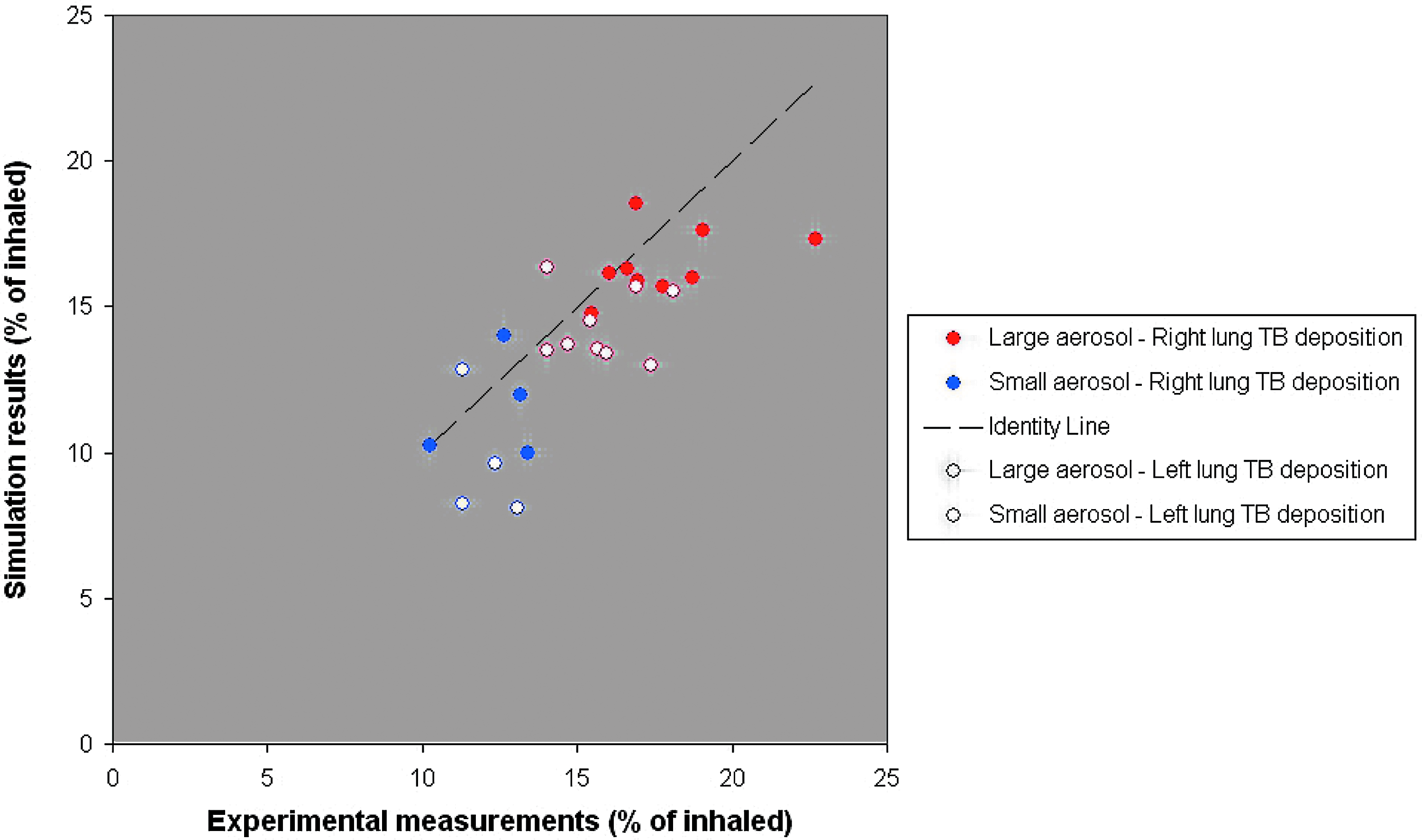
University of Iowa, College of Pharmacy, IOWA CITY, IA, United States of America
Pseudomonas aeruginosa infections are the leading cause of mortality among people with cystic fibrosis. The formation of bacterial microenvironments called biofilms provides protection, enabling the bacteria to resist the host's immune system and treatment by antibiotics, and leads to chronic infection. Thus, current treatments are ineffective in completely eradicating the infection. The goal of this study was to assess the effectiveness of a combination therapy, containing a nutrient dispersion compound and an antibiotic, on the eradication of P. aeruginosa biofilms in vitro. We hypothesized that nutrient dispersion compounds would entice bacteria to exit the biofilm as planktonic-like bacteria and enhance the eradication of the bacteria with traditional antibiotics. Young mucoid P. aeruginosa biofilms were grown in the MBEC peg assay (Innovotech) for 24 hours. Mature biofilms were grown in Lab-Tek chambered coverglass for 4 days. Then bacterial biofilms were treated for 24 hours with combinations of antibiotic (ciprofloxacin, amikacin, tobramycin, polymyxin B, colistin, colistin methanesulfonate and erythromycin) and dispersion compound (sodium citrate, succinic acid, xylitol, and glutamic acid). Young biofilms were quantified for incidence of biofilm growth by optical density and mature biofilms were quantified for the percent live biofilm bacteria in confocal microscopy images. Young biofilm growth was reduced with 15 out of 24 combinations, while the mature biofilms were susceptible to 4 out of 26 combinations. Our studies indicated that the biofilms comprised mainly bacteria with low metabolic activity and that access to these bacteria was enhanced by the disruption of the biofilm matrix upon bacterial dispersion.
Acknowledgements: Grant funding by the PhRMA Foundation.
Aerosol Research Laboratory, University of Alberta, EDMONTON, Canada
The size and temperature of the droplets of hygroscopic aerosols, as well as the thermodynamic state of the carrier gas, change due to transport of water vapor and heat between dispersed droplets, carrier gas, and airway walls. A coupled numerical model is developed to examine the effect of using helium-oxygen instead of air on hygroscopic size changes and deposition of inhaled aqueous solution aerosols. Transport properties of helium-oxygen are remarkably higher, e.g., coefficient of water vapor diffusion in helium-oxygen is 2.3 times more than air. This gives rise to a noteworthy increase in hygroscopic size changes. Polydisperse aerosols with initially isotonic droplets and lognormal size distributions are considered. In each lung generation, coefficients of heat and mass transfer are estimated based on realistic assumptions. Evaporation and condensation are simulated by solving the two-way coupled heat and mass transfer differential equations for both the continuous and dispersed phases. Once the droplet sizes are known, deposition is calculated based on previously published equations. The results include regional deposition data for a variety of size distributions for both helium-oxygen and air, as well as size and temperature variations in the respiratory tract of the dispersed droplets and carrier gas. The results reveal that helium-oxygen tends toward less deposition in the extrathoracic airways and more drug delivery to the lungs, which could have strong implications in aerosol inhalation therapies. Furthermore, from a hygroscopic point of view, these differences in deposition distribution are greater as the number concentration of droplets decreases.
Acknowledgements: Funded by Air Liquide
BIODISTRIBUTION AND TRAFFICKING OF INTRANASALLY ADMINISTERED MONODISPERSE BIODEGRADABLE PARTICLES
Size and chemistry are known to play an important role in particle biodistribution and cellular uptake. The synthesis of monodisperse biodegradable polyanhydride particles of multiple sizes has enabled us to systematically evaluate the role of initial particle size and chemistry on biodistribution and trafficking. In this work we used a murine model to evaluate the biodistribution of intranasally administered 200 nm, 400 nm, and 2 μm (nominal size) poly(sebacic acid) particles and commercial polystyrene particles of approximately the same size. The biodistribution of these particles was evaluated using fluorescent imaging of excised organs at four time points up to two days post administration. Cellular uptake was evaluated for the lung and lymph nodes by labeling tissue homogenates for specific cell types. While all three particle sizes were present in the lungs six hours after administration, the quantity of the 400 nm particles present, as determined through mean fluorescence intensity, was greater than that of both the smaller and larger particles. After deposition the amount of 400 nm polystyrene particles persisted in the lungs over 48 hours, while the amount of biodegradable particles decreased after 24 hours. Based on cell surface marker expression, we observed significant differences in the cell populations with which the biodegradable and polystyrene particles interact. The insights gained from these studies into the roles of particle size and chemistry will enable the rational design of nanoparticle-based adjuvants and delivery systems for vaccines against respiratory pathogens.
SUBSTITUTION OF L-LEUCINE WITH D-LEUCINE IN SPRAY-DRIED RESPIRABLE POWDERS FOR CONTROL OF PSEUDOMONAS AERUGINOSA INFECTION
Secondary Pseudomonas aeruginosa infection is a significant factor in reducing quality of life for cystic fibrosis patients. L-leucine is a well-known dispersibility agent for respirable dry powders. However, L-amino acids have been implicated as a nutritional source for P. aeruginosa biofilm growth. In this study, we instead designed formulations with D-amino acids. Trehalose/D-leucine and trehalose/L-leucine powder formulations (80:20%w/w) of three batches each, were spray-dried with a Büchi B90 spray drier. The powders were subjected to a number of characterization techniques. Modulated differential scanning calorimetry and low frequency shift Raman spectroscopy showed that trehalose remained amorphous during spray-drying (Tg∼120°C) while L- and D-leucine crystallized. A newly developed, modulated compressed bulk density tester found compressed bulk density of trehalose/L-leucine and trehalose/D-leucine to be similar (700–720 kg/m3). The spray-dried powders were also dispersed from an Aeroliser DPI, into an Alberta Idealised Throat and filter assembly, at 60 L/min air flow rate (n=9). The filter deposition (representing lung dose fraction) exceeded 40% of loaded dose (20±1mg) for both formulations. The primary particle size, measured by an Aerodynamic Particle Sizer, was 3.82±0.04 um (trehalose/L-leucine) and 3.25±0.03 (trehalose/D-leucine). We have successfully produced dispersible spray-dried L- and D-amino acid powder formulations, using a theoretical approach to study design. The results of our study demonstrate that L-leucine can be substituted with D-leucine without reducing aerosol performance, and remove a biofilm nutrition source from a respirable powder formulation.
Acknowledgments: Supported by the Natural Sciences and Engineering Research Council of Canada.
School of Paediatrics and Child Health, University of Western Australia, PERTH, W.A., Australia.
Early research in children has indicated that oral inhalation via mouthpiece was more efficient than the combination of oral and nasal inhalation which occurs when using a facemask. Changes in inhaler formulations as well as spacer and facemask design have highlighted the need for new comparative studies of VHC use, particularly focusing on the age at which children can be taught to transition from facemask to mouthpiece. Nine children aged 4–5 years (5 male) with stable asthma were recruited. A transmission scan of each patient was taken, using a 37MBq 99mTc flood source. 2–3 actuations of a 99mTc-labelled albuterol pMDI (ProAir, TEVA) were administered through an antistatic VHC (OptiChamber Diamond, Philips Respironics) either with a facemask (LiteTouch, Philips Respironics) or mouthpiece, while the patient's inhalation pattern was simultaneously recorded (Fig. 1). Anterior and posterior planar scintigraphic scans were taken immediately after administration. Mean (SD) lung deposition (% label dose) was 17.4 (9.4)% with the facemask and 21.3 (8.4)% with the mouthpiece (p>0.05). Peripheral lung deposition was consistently higher with the facemask than the mouthpiece (0.9 (0.7) vs 0.6 (0.2)), at levels approaching significance (p=0.07). Oropharyngeal/gastrointestinal (OG) deposition was significantly higher with the facemask; 24.3 (8.9)% vs 19.7 (3)% (p=0.05); this difference was more marked in children aged 4.5 years and above (27.2 (7.5)% vs 19.8 (3.4)% (p<0.02)). Lung deposition with the facemask appears higher than previously reported, due to a combination of factors including the inhaler formulation, and use of an antistatic spacer with a flexible, well-fitted facemask.
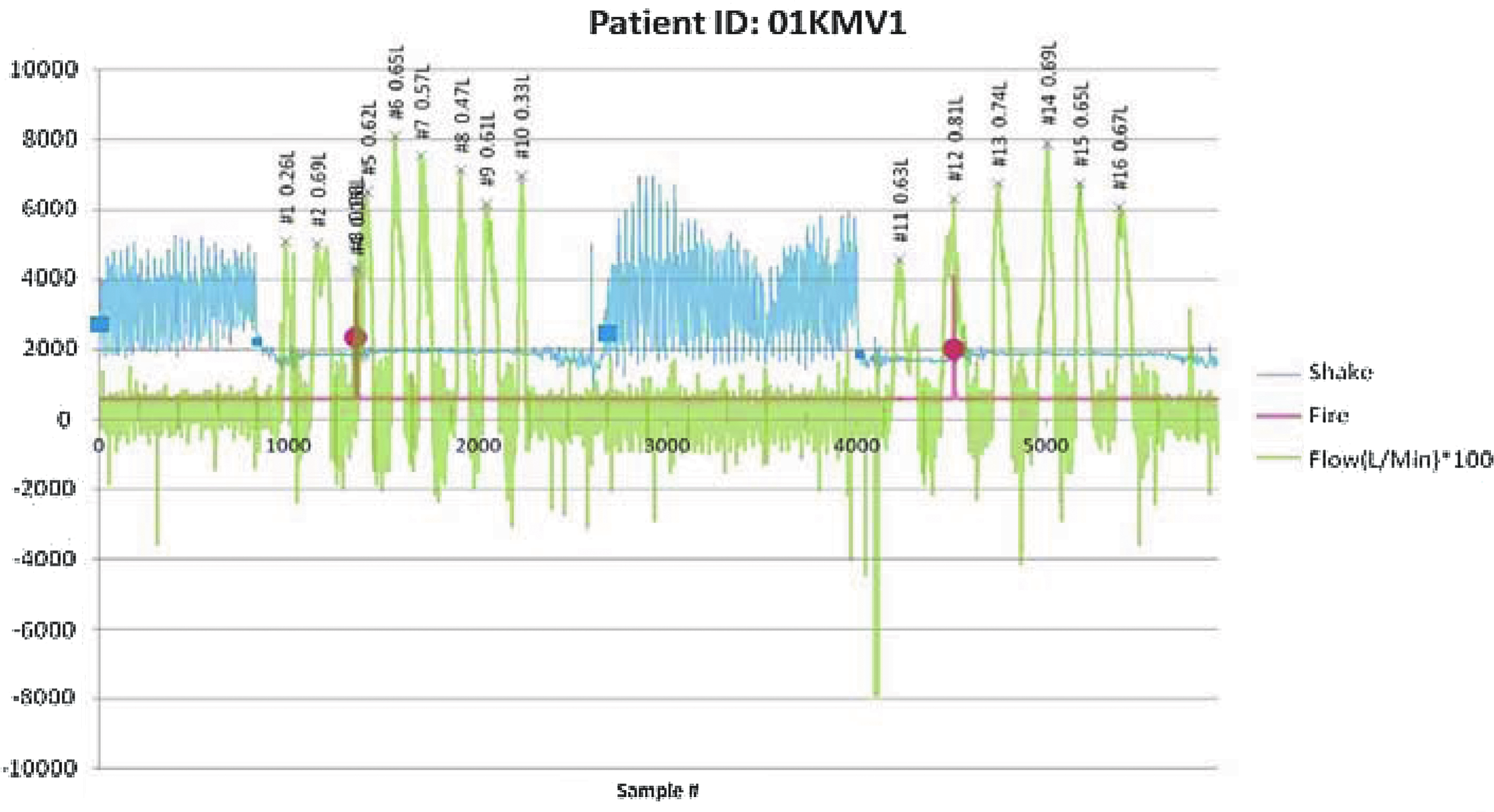
Breathing pattern recorded using a datalogger, during administration of radiolabelled albuterol, also showing shaking of pMDI and synchronisation of firing with inhalation
Acknowledgements: IRB approval for this study was obtained from the Princess Margaret Hospital Ethics Committee (1868/EP). This work was supported by a grant from the PMH Foundation (Perth, Western Australia). Partial sponsorship was provided by Philips Respironics (USA).
Novel amphiphilic cyclodextrins (CDs) modified with lipophilic and cationic sub-units have been developed that have been shown to transfect a number of cell types [1, 2]. However, the suitability of this non-viral vector for pulmonary siRNA delivery has not been assessed to-date. To address this, a series of high content analysis (HCA) and post-nebulization assays were devised to determine the potential for CD-siRNA delivery to the lungs.
CD-siRNA nanoparticles at a range of mass ratios (MRs) 10–100 were examined for size and zeta-potential. In-depth analysis of nanoparticle uptake and toxicity in an airway epithelial cell model, Calu-3, was examined using HCA assays. Nebulized CD-siRNA nanoparticles were assessed for volumetric median diameter (VMD) and fine particle fraction (FPF) and compared to saline controls. Post-nebulization stability determined by comparing luciferase knockdown elicited by CD-siRNA nanoparticles pre- and post-nebulization.
CD-siRNA nanoparticles were cationic and ≤200nm in size and led to significantly higher levels of siRNA uptake into Calu-3 cells compared to RNAiFect treated cells at all MRs (p<0.001, n=3x4), with evidence of toxicity only at MRs 50–100. Nebulization of CD-siRNA nanoparticles using the Aeroneb resulted in VMDs of 5μm and FPFs of 57% at all MRs. CD-siRNA mediated luciferase knockdown at MR=20 was found to be 39.8±3.6% pre- and 35.6±4.55% post-nebulization, comparable to the commercial transfection reagent, RNAifect.
CD-siRNA nanoparticles can be effectively nebulized for pulmonary delivery of siRNA using the Aeroneb technology. This work provides an integrated nanomedicine-device combination for future in vivo pre-clinical and clinical studies of inhaled siRNA therapeutics.
Acknowledgements: This work was supported by grant SFI 07/SRC/B1154
1. O'Mahony, A.M., et al., Org Biomol Chem, 2012. 10(25): p. 4954–60.
2. O'Mahony A.M. et al. ACS Chem Neurosci., 2012. Oct 17;3(10):744–52.
School of Pharmacy, Royal College of Surgeons in Ireland, Dublin, Ireland
To date, there have been a number of studies investigating the effectiveness of vibrating mesh nebulizers in delivering test formulations, however there has not been any comprehensive analysis of vibrating mesh nebulizers' ability to successfully nebulize solutions across a wide range of different physicochemical properties. To address this, a range of approved pharmaceutical excipients, including preservatives, surfactants and viscosity enhancing agents, were tested for their effects on fluid physicochemical properties including surface tension and viscosity. Viscosity was measured using a Brookfield Viscometer with an ultra low adapter attached. Surface tension was examined using a LAUDA TD1C ring/plate tensiometer (Lauda GmbH, Germany). The output rate for each fluid was then determined in mg/min by nebulizing 1g of each sample using the Aeroneb Pro nebulizer (Aerogen Limited, Galway, Ireland).
From these results an insight into the impact of fluid properties on device performance could be derived and enable the considered selection of formulation parameters for future applications of the Aeroneb Pro. Output rates for each sample were plotted as a function of (density x surface tension)/viscosity versus output to normalize the data. Fluids with viscosities between 0.9667 – 2.73cP and surface tensions between 31.933 – 70.7mN/m were successfully nebulized. With the information gathered it is possible to more accurately predict how a formulation will perform with the Aeroneb Pro nebulizer and to tailor formulations to ensure optimal device performance.
Acknowledgement: This work was supported by Aerogen Ltd., Galway, Ireland
ACCUMULATION OF LIPOSOMAL CIPROFLOXACIN INTO ALVEOLAR MACROPHAGES: IN VITRO STUDIES WITH NR8383 CELLS
In light of its potential benefit against infectious bacteria resistant to phagocytic ingestion, the kinetics and mechanisms of accumulation for liposomal ciprofloxacin for inhalation (Lipo-CPFX) into rat alveolar macrophage NR8383 cells were characterized and compared to those for unformulated ciprofloxacin (CPFX). Lipo-CPFX or CPFX was incubated at 10–200 μg/ml with the NR8383 cells at 37°C in culture. Ciprofloxacin accumulation and efflux were then determined via HPLC-fluorescence analysis of the cell lysates and incubation media. The accumulation was also assessed upon 50 mM NH4Cl (a pH-elevating agent) or 10 % formalin (a membrane protein crosslinking agent) treatment, or in the presence of 0.02 mM cytochalasin D (a phagocytosis inhibitor), 5 mM sodium azide, 50 mM 2-deoxy-D-glucose (ATP depleting agents) or 5 mM probenecid (an inhibitor of multidrug resistance proteins, MRPs). The Lipo-CPFX accumulation vs. time profiles were biphasic, where rapid drug uptake was followed by efflux, reaching the asymptotic equilibrium at Ⅵ2 h. The NH4Cl treatment diminished this rapid uptake; the formalin treatment decreased the accumulation by 18.6±8.5 %. The Lipo-CPFX accumulation was not inhibited by cytochalasin D and rather increased by 1.5±0.2, 1.8±0.2 and 1.8±0.7 fold in the presence of sodium azide, 2-deoxy-D-glucose and probenecid, respectively. The efflux kinetics for Lipo-CPFX was apparently first-order and consistent with that for CPFX. Overall, accumulation was 1.1–2.9 fold greater for Lipo-CPFX than CPFX. Taken all together, Lipo-CPFX enabled greater macrophagic drug accumulation than CPFX, likely resulting from rapid cell membrane lipid fluidity-dependent uptake of the liposome despite cell energy-dependent MRPs-mediated efflux of ciprofloxacin.
Acknowledgements: Lipo-CPFX gift from Aradigm Corporation
Department of Clinical Medicine, Trinity College Dublin, Dublin, Ireland
Aerosolized therapeutics has emerged as a promising alternative to systemic drug delivery for the treatment of various diseases including lung cancer. The main aim of our work is the development of a biocompatible nanocarrier system suitable for drug delivery by nebulization. Magnetite Fe3O4 nanoparticles (MNPs) were selected because of their excellent physicochemical properties and their successful use as a clinical reagent for diagnostics and drug delivery. To improve the dispersibility and biocompatibility, MNP core particles were modified by surface coating with biocompatible polymers poly(lactic-co-glycolic acid) (PLGA), polyethylene glycol or dextran, and their physicochemical properties were characterized. Utilizing a series of standardized biological tests we confirmed that the developed MNP-based nanocarrier system was biocompatible, as no cytotoxicity was observed in vitro when applied to the cultured human lung epithelial cells. Moreover, these MNPs were well-tolerated in vivo in mice when applied intranasally as measured by glutathione and IL-6 secretion assays after 1, 4, or 7 days post-treatment. To examine the therapeutic efficacy of the developed MNP preparations, a poorly soluble flavonoid quercetin with reported anti-cancer and anti-inflammatory potential was loaded in the polymeric shell of PLGA-coated MNPs. These drug-loaded MNPs were applied to the human lung carcinoma cell line A549 following a single round of nebulization, imitating aerosol delivery to the lungs in the clinical setting. The quercetin-loaded MNPs significantly reduced the number of viable A549 cells, which was comparable when applied either by nebulization or by direct pipetting. The present study has implications for targeted delivery of nanocarrier-based drugs and poorly soluble medicinal compounds via the inhalation route.
GASEOUS DISTENSION OF THE GASTROINTESTINAL TRACT IN MICE ASSOCIATED WITH RESTRAINT TUBE CONFIGURATION IN AN INHALATION STUDY
Gaseous distension of the gastrointestinal tract (GDGIT) due to aerophagia has been described in a variety of species including rodents, rabbits, horses and humans. In rodents and rabbits GDGIT has been associated with obstructive proliferative lesions in the nose and nasopharynx and experimental occlusion of the nostrils. We conducted a chronic inhalation study in mice in which a high rate of GDGIT was initially observed. The original configuration of the restraint tubes, used to hold mice during exposure, was a parallel sided structure with metal end bars and mesh screens to prevent animals from escaping into the exposure system. Observation of the restrained animals suggested that they were chewing the metal bars during exposure. We hypothesized that a combination of chewing activity and extended neck posture caused by the tube restraint resulted in aerophagia and subsequent GDGIT. Modifying the restraint tubes to incorporate tapered end caps of sufficiently low diameter to prevent the animals from exiting and removing the metal end bars and mesh screens resulted in significantly decreased mortality from GDGIT. To our knowledge GDGIT has not been associated with exposure system components in inhalation studies. Here we demonstrate a unique pathogenesis for GDGIT in mice related to restraint tube configuration. We believe that morbidity and mortality from GDGIT can be minimized or prevented by the use of tapered end caps without metal end bars or mesh screens.
Huntingdon Life Sciences Ltd., 100 Mettlers Road, East Millstone, New Jersey, US.
These data represent a series of studies designed to provide a comprehensive assessment of the utility of Respiratory Inductance Plethysmography (RIP) for the generation of nonclinical cardiorespiratory safety pharmacology data in dogs and non-human primates (NHP). RIP calibration methods, including the use of facemask in conscious and sedated animals as well as the use of intubated anesthetized animals for comparison are described. Accuracy of the calibrations was assessed by CO2 rebreathe maneuvers. In addition, the ability of the RIP system to accurately assess subtle changes in breathing parameters was assessed by measurement of the effects of both positive (respiratory excitatory) and negative (respiratory inhibitory) challenges. The utility of the phase angle parameter for use as an index of airway resistance changes was also assessed via the response to a methacholine challenge. Finally, telemetry-derived cardiovascular parameters (ECG, blood pressure, and heart rate) and RIP-derived respiratory parameters (respiration rate, tidal volume, and minute volume) were determined simultaneously in a group of NHPs for 24 hr pretest, 2 hr predose and 24 hr postdose for a test article dose. Analysis of data following a single dose of the test article demonstrated test article-related changes in cardiovascular parameters for up to 23 hours after dose. These data show that the integrated assessment of cardiovascular and respiratory parameters is achievable continuously for at least 24 hr postdose. The use of RIP to assess the effects of a novel compound on the respiratory system complements, but does not interfere with, the cardiovascular assessment of new drugs.
EFFECT OF DOSE VOLUME ON AEROSOL DELIVERY WITH MESH AND JET NEBULIZERS DURING NONINVASIVE VENTILATION: AN IN VITRO MODEL
Aerosol administration during noninvasive ventilation (NIV) has not been well described, but frequently applied in acute care settings. We quantified the efficiency of jet nebulizer (JN), and mesh nebulizer (MN) with 3 dose volumes. An adult teaching manikin received bilelevel ventilation via facemask (Respironics) with adult settings (PIP/PEEP of 12/5 cmH2O and 15 breaths/min). Drug was collected on an absolute filter placed distal to the trachea of the model prior to the test lung. Albuterol sulfate (2.5 mg) was nebulized with JN (MistyMax, Airlife) at 8 lpm O2 and MN (NIVO, Respironic) with dose volumes of 3 mL, 1 mL and 0.5 mL (n=3). Drug was eluted from the filter with 0.1 HCl and analyzed by spectrophotometer (276 nm). ANOVA with p<0.5 was significant. Table shows mean percent of albuterol dose (±SD) deposited distal to the trachea. Reducing dose volume made a greater difference with JN than MN (p<0.01). MN delivered greater inhaled dose with all dose volumes than JN with largest (3 mL) volume tested (p<0.01). During NIV with this invitro model using adult settings, inhaled drug delivery was several fold greater with MN than SVN at all dose volumes tested. Further in vivo studies will be required to determine the clinical impact of greater aerosol deposition in patient during severe exacerbation.
Massachusetts Institute of Technology and Massachusetts General Hospital, BOSTON, MA, USA
This work evaluated the extent that the deposition of aerosols is related to the heterogeneous ventilation of bronchoconstricted asthmatics. 11 mild-to-moderate asthmatic subjects were imaged with PET-CT (Biograph 64; Siemens AG) in the supine position. HRCT images of the chest were obtained after methacholine challenge and at the end of the study. The specific deposition of aerosol in the periphery (sDP) was imaged with dynamic PET during and after the inhalation of 13N-NH3 labeled aerosol delivered via mouthpiece from a vibrating mesh nebulizer (Aeroneb Solo, 4.5 μm VMD) used with an Idehaler holding chamber. Regional ventilation per unit of gas volume in (sV) was assessed from the washout rates of 13N-NN gas following a bolus injection of the tracer in saline solution. Peripheral regions were identified as those PET voxels within a lobe that would not reflect deposition within the central airways. Heterogeneity in both sV (COV=0.25±0.09) and sDP (COV=.38±0.16) were observed between the subjects. Considering all lobes, the distribution of normalized peripheral sDP correlated with the normalized sV (R=0.57). Those subjects breathing with faster breathing frequencies during inhalation tended to have poorer relationships between sV and sDP (R=−0.89). Understanding the ventilation deposition relationship at a regional level may help to develop strategies for inhaled therapies and provide validation for CFD models of aerosol deposition.
Acknowledgments: Sponsored by NIH grants HL86717 and HL68011, and by support from Air Liquide and Airogen
Massachusetts General Hospital and Harvard Medical School, BOSTON, MA, USA
In severe asthma, bronchodilators are sometimes administered with a mixture of helium and oxygen (HeO2) to lower central airways resistance and improve peripheral aerosol deposition. CFD models, however, suggest that reduction of turbulent mixing by HeO2 could increase heterogeneous deposition of aerosol among lung regions. Here we evaluated the heterogeneity of specific ventilation (sV) and peripheral aerosol deposition (sDP) with the two carrier gases in bronchoconstricted asthmatics, and looked at how these measures were co-varied. 21 mild-to-moderate asthmatics subjects were studied following a methacholine challenge (10 of them while breathing HeO2). The lobar distributions of sDP of 13N-NH3-labeled inhaled aerosol (Aeroneb SoloTM, 4.5μm VMD), and specific ventilation (sV), assessed from the washout rate of 13N-N gas, were imaged with PET-CT. sDP, sV and central-to-peripheral ratio of deposition (C/P) were evaluated for each lobe. Both carrier gassed had similarly heterogeneous sV and sDP. Although both carrier gasses had similar average C/P between lobes, the C/P stratification was more uniform with HeO2 than air (P<0.0001). HeO2 deposition also tended to correlate better with ventilation. With air, but not with HeO2, breathing at faster frequencies during nebulization led to a poor sDp-sV relationship. Although limited power may have obscured potential differences of HeO2 on sDp and sV heterogeneity and C/P, we found no evidence of a more peripheral or heterogeneous deposition with HeO2.
Acknowledgments: Sponsored by NIH grants HL86717 and HL68011, and by support from Air Liquide and Aerogen
Massachusetts Institute of Technology and Massachusetts General Hospital, BOSTON, MA, USA
Defining the anatomical location of central airways is needed for analysis of aerosol deposition images. When structural information is not available empirical ROIs are used that may not accurately sample the central airways anatomy. We present here a method to define anatomically based ROIs derived from CT scans of 24 individuals. For each individual, ROIs sampling lung periphery (P), intrapulmonary central airways (C) and the extrapulmonary airways (E) were defined (indROIs). Central regions were those likely to sample deposition within a fixed portion of the central airways. indROIs were scaled to a standard lung size and shape and averaged across subjects to create aveROIs. In contrast to conventional black-and-white ROIs, aveROIs are grayscale images where each voxel expresses its likelihood of being an indROI voxel. The aveROIs were rescaled to the individuals' lung outline, and the depositions sampled by the aveROIs were compared against those sampled by the indROIs. Total deposition per subject were similar between indROIs and aveROIs (within 16%) but the deposition assigned to the P, C and E were not; aveROIs sampled 26% less P deposition, and 79% and 47% more for C and E, respectively. 2D projections of indROIs and PET deposition (simulating scintigraphy) yielded similar differences. However, visual inspection suggests that central aveROIs included deposition immediately adjacent to the central indROIs and thus the aveROIs may overcome limitations of black-and-white ROI definition. More importantly, anatomically based aveROIs may be useful to analyze and compare deposition images lacking detailed structural information.
Acknowledgments: Sponsored by NIH grants HL86717 and HL68011, and by support from Air Liquide.
University of Alberta, EDMONTON, AB, Canada
The effect of ambient conditions on in vitro mouth-throat and lung deposition was investigated for the following pressurized metered dose inhaler (pMDI) formulations: 1) beclomethasone dipropionate (BDP) solution in 13% w/w ethanol, 1.3% w/w glycerol and HFA 134a propellant solution (“BDP HFA 134a”); 2) BDP solution in 13% w/w ethanol and HFA 227 propellant solution ("BDP HFA 227"); 3) Flixotide Evohaler™ (fluticasone propionate 250μg/dose suspension in HFA 134a). The testing apparatus was an Alberta Idealised Throat connected to an inline filter and a vacuum pump. The apparatus, and the pMDIs prior to discharge, were kept within an environmental chamber. Single doses (3 replicates) from each pMDI formulation were collected in the apparatus according to an experimental matrix, containing the following variables: relative humidity (RH) (0%, 35%, 80%); temperature (20°C, 40°C); air flow rate (28.3, 60, 90 L/min). The results suggest that delivered lung dose fractions from the formulations are affected by relative humidity, while air flow rate and temperature have a limited and inconsistent effect. For the solution formulations, an increase in RH from 30 to 80% had a general decreasing trend in fractional delivered lung dose (35% decrease the worst case). Flixotide™ suspension exhibits different behavior, with lung dose fraction falling sequentially (50% decrease the overall worst case), as RH is increased from 0% to 30% to 80%. The in vitro lung delivery of pMDI formulations is affected by ambient conditions, implicating variability in inhaler performance when used in different climates, or when used outside of air conditioned rooms.
Dept. of Mechanical and Aerospace Engineering, University of California at San Diego, La Jolla, CA, USA
Understanding the fate of inhaled aerosols in the lung may help in assessing their toxic or therapeutic effect. We used a combination of experimental studies and computational simulations to assess the distribution of inhaled particles in healthy rat lungs. Airflow simulations were performed (using an in-house finite element solver (simtk.org)), by coupling realistic 3D airways to 0D models representing the downstream lung. The resistance and capacitance parameters were estimated from the time varying tracheal pressure measured during the aerosol exposure and from the breathing pattern used in the experiments (Oakes et al. 2012 Summer Bioengineering Conference). Using Lagrangian particle tracking, trajectories of 0.95 μm-diameter particles were calculated in the 3D model during inspiration. The distribution of inhaled particles in each lobe of the lungs was derived from these predictions and compared to experimental data of aerosol deposition obtained from magnetic resonance (MR) images of rat lungs ventilated in a controlled fashion (TV=2ml, 80 breath/min) with 0.95 μm particles (Oakes et al. 2011 Am. J. Respir and Crit Care Med., 183:A2463). Good agreement was found between the percent of particles delivered to each lobe from the numerical simulations and the percent of particles deposited in each lobe calculated from the MR images (see Figure 1). Assuming that deposition at the lobar level is proportional to the number of particles delivered to each lobe, our data suggest that the numerical model accurately predicts particle distribution. This type of approach can be extended to disease models and their effect on aerosol deposition.

Deposition fraction in the 5 lobes of a healthy rat lung. Error bars represent the standard deviation between rats.
Acknowledgements: This work was supported by grant 1R21HL087805-02 from NHLBI (NIH), National Science Foundation Graduate Fellowship (J. Oakes), Burroughs Wellcome Fund Travel Grant (J. Oakes), team INRIA grant, and the Burroughs Wellcome Fund (A. Marsden).
Whilst investigating the potential of pMDI formulations to deliver plasmid DNA (pDNA), we utilised an Andersen Viable Sampler (AVS) with collection dishes containing cell growth media to capture pDNA. Cell cultures were then exposed to collected media to estimate pDNA transfection integrity. With increasing complexity of the pMDI formulations, we sought to establish a more sensitive, “abbreviated” AVS (AAVS) method (containing Stages 2, 5 and 6). To validate the AAVS, we chose a marketed pMDI formulation, Airomir, which has an active (albuterol) with aerodynamic characteristics similar to pDNA particulates likely to reach appropriate lung regions. The assessment of Airomir was compared in the AAVS, AVS and an Andersen Cascade Impactor (ACI). The results indicate that there were no significant differences (p>0.05) in “respirable” albuterol (i.e. FPF4.7, mean±SD), between ACI (61.3±1.00%), AVS (55.3±10.8%) and AAVS (53.6±8.60%). There were statistically significant differences between MMAD's estimated in the ACI (2.23±0.01 μm) compared to the AVS (1.93±0.12 μm) and AAVS (1.84±0.08 μm), however the magnitude of the differences are unlikely to be of practical importance. Similarly, there were small but significant differences between GSD's estimated in the ACI (1.70±0.05) compared to the AVS (1.48±0.06) and AAVS (1.58±0.04). Surprisingly, given the restricted data set, the AAVS offers the potential for a precise and accurate screening method for pDNA and other labile biotechnology products in the particle size range targeted for peripheral lung delivery.
THE EFFECT OF AEROSOL DEVICE AND ADMINISTRATION TECHNIQUE ON DRUG DELIVERY IN A SIMULATED SPONTANEOUSLY BREATHING PEDIATRIC MODEL WITH TRACHEOSTOMY
Evidence on aerosol delivery via tracheostomy is lacking. The purpose of this study was to evaluate the effect of aerosol device and administration technique on drug delivery in a simulated spontaneously breathing pediatric model with tracheostomy. Using the jet (JN- MicroMist), mesh nebulizer (MN- Aeroneb Solo) and pMDI (ProAirHFA), the direct administration of aerosols in spontaneously breathing patients (unassisted) was compared to administration of aerosol therapy via a manual resuscitation bag (assisted) attached to the nebulizer and synchronized with inspiration. An in-vitro lung model consisted of an uncuffed tracheostomy tube (4.5 mmID) between a collecting filter (Respirgard) and a simulator with breathing parameters of a 2 year-old child (RR:25 bpm, Vt:150 mL, Ti:0.8 sec, PIF:20 L/min). Albuterol sulfate was administered with each nebulizer (2.5 mg/3 mL) and pMDI with spacer (400 ug) (n=5). Drug collected on the filter was eluted with 0.1 N HCl and analyzed via spectrophotometry. Table shows the percent of nominal dose delivered to the tracheostomy tube (mean±SD). Regardless of the administration technique, the pMDI with spacer was most efficient than either nebulizer (p<0.05), while greater deposition was observed with MN compared to JN (p<0.05). The trend of higher deposition with unassisted versus assisted administration of aerosol was not significant. Drug deposited distal to the tracheostomy tube with pMDI was greater than JN or pMDI. Delivery efficiency was similar with unassisted and assisted aerosol administration technique in this in-vitro pediatric model.
THERAPEUTIC AEROSOL PARTICLE DEPOSITION IN COMPARTMENTS OF THE EXTRA-THORACIC AIRWAY: COMPARISON OF IN VIVO AND IN VITRO
Inhaled therapeutic aerosol particles must by-pass the extra-thoracic airway (ETA) before reaching the lungs. Internal geometric differences between ETA sub-compartments result in different compartmental deposition patterns that contribute to local side effects while reducing lung deposition. Realistic ETA models can be used (in vitro) to forecast deposition in patients (in vivo). Radiolabelling and gamma-scintigraphy can quantify ETA deposition.
12 asthmatics (FEV1=76.8 % pred) inhaled radiolabelled β2-agonist aerosols of: 3- & 6-μm from spinning-top aerosol generator (STAG) at slow & fast flows (30- & 60-L/min). These experiments were repeated using simplified ETA models connected to STAG at mouth and suction pump at trachea base. ETA sub-compartments were defined: oral cavity, pharyngeal, laryngeal, trachea, and deposition quantified.
Deposition (in vitro and in vivo) was similar in all compartments for 3 μm aerosol inhaled at low flow and for 3- and 6-μm aerosols inhaled at both flows in pharyngeal compartment. Oral deposition was significantly greater (p<0.01) in models compared to patients for 6 μm aerosol at low flow, and both 3- and 6-μm aerosols inhaled at high flows. This deposition pattern was reversed in trachea. Laryngeal deposition for the 6 μm aerosol at both flow rates was greater in patients than models.

Comparison of percentage deposition in compartments of the extrathoracic airway (in vivo vs. in vitro) for 2 monodisperse aerosols inhaled at 30 and 60 L/sec
Aerosol deposition within the sub-compartments of the ETA was comparable between the simplified models and patients in half of all the combined aerosol particle size and flow rate experiments. Deposition within the pharyngeal compartment was similar regardless of the combined effects of aerosol particle size and flow.
FESS is often used to treat chronic rhinosinusitis in patients for whom maximal medical therapy has failed. Computational fluid dynamics (CFD) simulations of nasal airflow after FESS are being used to study drug delivery so robust mesh structures are needed. A three-dimensional sinonasal cavity was reconstructed using MimicsTM from a post-surgery CT scan in a patient who underwent bilateral FESS. Graded tetrahedral meshes with 0.25–8 million cells were created using ICEMTM. FluentTM was used to simulate steady-state, inspiratory, laminar airflow using a fixed outlet pressure, and outlet flow (OF) and posterior septum pressure (PSP) were obtained. Using the mesh at which asymptotic behavior appeared in OF and PSP, hybrid meshes with one to four 0.1mm-thick prism layers were generated. Using the hybrid mesh at which asymptotic behavior appeared in TND fraction, hybrid meshes with 1 to 6 prism layers within that total zone thickness were generated. Nebulized, mono-dispersed particle transport (1–15μm MMAD) was simulated using FluentTM and total nasal deposition fraction (TND) in each hybrid mesh was compared. Asymptotic behavior of OF and PSP appeared at a tetrahedral cell density of 4 million. The addition of prism layers decreased predicted TND for all particle sizes. TND became asymptotic when 3 0.1mm-thick prism layers were used. This mesh has the advantage of saving generation and simulation time compared to models with greater cell densities or number of prism layers. Future work will involve experimental validation of particle deposition and exploration of these parameters for sprayed particles.
Institute of Pharmacy and Biochemistry, J Gutenberg University, MAINZ, Germany
A head-to-head comparison of contemporary inhalers in real patients is difficult because of the variability inevitably introduced by the patients. Therefore in-vitro data on the dose passing the mouth-throat region was acquired using the realistic Alberta throat model. Three inhalers (Respimat®, Breezhaler®, and Genuair®) were compared. From the investigation, important input is obtained for consideration in the patient leaflet or other recommendations for use. The inhaler outlets were centered with the mouth cavity and aligned with their axis parallel to the “tongue”. Passing the air from the throat through a mixing inlet, the size classification was performed in a Next Generation Impactor at constant flow (100 L/min) while the flow through the inhaler was variable. Drug quantitation was performed using HPLC. The inhalers have different air flow resistances (Respimat: 22300 Sqrt(Pa)*s*m−3, Breezhaler: 36200 Sqrt(Pa)*s*m−3, Genuair: 58400 Sqrt(Pa)*s*m−3. As the generation of aerosol is independent of air flow in the Respimat inhaler, only the simulation of very fast inhaling patients creates drug impact in the throat, while in most dry powder inhalers, a relatively high air flow is required for de-agglomeration of the drug particles. This in turn entails higher deposition of all constituents of the powder formulations in the mouth-throat region. The data suggest that the Respimat Soft Mist Inhaler is an excellent inhaler which by its unique spray technology makes use of a large amount (approx. 50–70% in vitro) of the metered drug which compares well to 44–63% in vivo (P Brand, 2007, Pneumologie, Vol. 61).
Acknowledgements: Warren Finlay provided 3d-Data of his idealized mouth-throat model.
IN VITRO CORRELATIONS FOR THE ESTIMATION OF THE DEPOSITION OF MICROMETER-SIZED AEROSOLS IN THE ORAL AIRWAYS OF ADULTS AND CHILDREN DURING INHALATION OF TIDAL BREATHING PATTERNS
The knowledge of deposition of micrometer-sized particles in the oral airways of adults and children during tidal (sinusoidal) breathing is useful in the prediction of the required nebulized dose that can pass the extrathoracic airways and reach the lungs. Despite all the progress in the research area of respiratory deposition, there remains a need for subject specific correlations that include the geometry of the airways; thus, this study investigated the deposition of 0.5–6 μm jojoba oil particles, which were generated using a six-jet Collison atomizer and delivered to oral airway replicas of nine adults as well as nine children 6–14 years old. Next, deposition for each particle size was measured during inhalation of four sinusoidal breathing patterns for each age group, and correlated to the geometry of the airways to reduce the intersubject scatter that naturally exists when dimensions of the airways are not accounted for. The proposed correlations are useful for estimating the deposition of a known particle size inhaled at a specific average flow rate in the oral airways of a subject with known airway geometry. Such information may be helpful in designing and using delivery devices during tidal breathing both for adults and children.
New Devices and Emerging Therapies
Pharmacy, University of Huddersfield, HUDDERSFIELD, United Kingdom
During acute exacerbations patient inspiratory effort will be reduced and thus their ability to create sufficient turbulent energy inside a DPI to de-aggregate the metered dose may be reduced. We have measured the inhalation pressure profiles of 18 asthmatics, mean (SD) age 42.0(11.8) years, on days 1–4 following their admission with an acute exacerbation. These measurements have been made using placebo versions of a Diskus (DSK), Easyhaler (EASY) and Turbuhaler (TBH); inhalers with medium, medium/high and high resistance.
All parameters improved during the recovery phase after their acute exacerbation. Although PIF was lower for the high resistance DPI the pressure changes and acceleration were greater suggesting better de-aggregation. During patient use these parameters should be the focus and not flow. PIF should not be used to compare patient use with each device.
PIF - peak inhalation flow; ΔP - peak turbulent energy; Accel - initial acceleration of the inhalation; IV - inhalation volume. All p<0.001 except TBH IV<0.05
Pharmacy, University of Huddersfield, HUDDERSFIELD, United Kingdom
During routine practice emphasis is placed on the peak inhalation flow (PIF) when patients use a DPI. However other aspects of the patient's inhalation manoeuvre are important. We have measured the inhalation pressure profiles of asthmatic children (CHILD; n=16, FEV1 79% predicted), asthmatic adults (ADULT; n=53, FEV1 72%) and COPD (n=29, FEV1 42%) patients when they inhaled through placebo versions of an Aerolizer (AERO), Diskus (DSK), Turbuhaler (TBH) and Easyhaler (EASY) using their 'real life' DPI inhalation technique. These are low, medium, medium/high and high resistance DPIs. A summary of the inhalation characteristics is presented below.
Although peak inhalation flows were faster for the DPI with lowest resistance the pressure change corresponding to the peak turbulent energy and the acceleration of the pressure change at the start of the inhalation was greatest for the DPI with the highest resistance suggesting better de-aggregation.
PIF - peak inhalation flow, ΔP - peak turbulent energy, Accel - acceleration rate, IV - inhalation volume, Ti - duration of inhalation.
Pharmacy, University of Huddersfield, HUDDERSFIELD, United Kingdom
Flow dependent dose emission is widely reported but the effect of the inhaled volume (IV) and the acceleration of the inhalation flow (ACC) has not been rigorously examined. We have adapted our mixing inlet Andersen Cascade Impactor method (Nadarassan et al, Eur J Pharm Sci. 2010;39(5):348–54) to study the effect of IV and ACC on the dose emission characteristics of SX and FP from an Advair® 500/50 Diskus (also known as Seretide® Accuhaler, GlaxoSmithKline). The method uses inhalation flow at 60L/min with the input of supplementary flow at the same rate. An inhalation profile is drawn from the supplementary arm which is replayed at the induction port with the inhaler in situ. Inhalation profiles ranging from 240–1000 ml with peak inhalation flows ranging from 20–60L/min have been used. 10 doses were used for each determination. A summary of the data (n=3 determinations) is shown in the table above.
Total dose emission for the lowest to highest ACC ranged from 38.9–41.0μg for SX and 413.3–460.8μg for FP
The results show the influence of ACC rather than IV with this product.
Novartis Pharmaceuticals, SAN CARLOS, CA, United States of America
In vitro estimates of aerosol drug dose delivered to the lungs during mechanical ventilation are influenced by the bench model used. For example, in vitro models of mechanical ventilation have typically demonstrated a 40% to 50% reduction in delivered dose for heated and humidified (wet) versus non-humidified (dry) inspiratory gas. Placement of an aerosol generator between the ventilation circuit and an endotracheal tube (ETT; 8.0 mm ID) resulted in delivery of more vancomycin under wet (68% at 80 lpm inspiratory flow) than dry conditions, but this was likely due to drug raining out in the airway and dripping into the inspiratory filter.
Since efficacy of aerosol vs. liquid drug may differ in vivo, we modified the model by a) placing an active humidifier between the test lung and the inspiratory filter (simulating exhaled heat and humidity), b) elevating the inspiratory filter, and c) adding traps to collect non-aerosol drug. Vancomycin was aerosolized with a vibrating mesh nebulizer placed distal to the ETT during simulated adult mechanical ventilation using a PB 7200AE ventilator. Mass balance was determined by HPLC.
Using the modified model the differences in mean inhaled dose (mean±SD) between wet and dry conditions at 80 lpm (20±2% wet and 23±1% dry) and at 40 lpm (46±1% wet and 47±4% dry) are eliminated. In summary, using active humidification during exhalation, elevating the distal airway tip, and using traps to collect rainout improved both sensitivity and specificity of in vitro aerosol delivery measurements during mechanical ventilation.
Study supported by Nektar Therapeutics
Novartis Pharmaceuticals, SAN CARLOS, CA, United States of America
NKTR-061 (BAY41-6551, Amikacin Inhale) is a drug-device combination product being co-developed by Bayer HealthCare and Nektar to treat intubated and mechanically ventilated patients with Gram-negative pneumonia. The product uses a proprietary vibrating mesh nebulizer system (PDDS Clinical) with amikacin sulfate formulated for inhalation (3.2mL of 125mg/mL) for a 10-day bid course of therapy. It is designed for use with mechanical ventilators for intubated patients. For patients who are extubated before completing the course of therapy, a Handheld (Off-ventilator) device has also been configured. This study was intended to determine the in vitro lung doses of the two delivery systems.
An in vitro on-ventilator model was used to estimate the lung dose (ELD) of aerosolized amikacin post-endotracheal tube during mechanical ventilation. In comparison, the ELD for the Off-ventilator device was calculated from the fine particle fraction (FPF<5μm) post-mouthpiece, multiplied by the in vitro delivered dose post-mouthpiece. FPF<5μm reflects lung deposition observed during Phase 2 clinical trials. Eighty one nebulizers (VMD: 4.4±0.5μm; output rates: 0.23±0.10mL/min) were tested for each system. Amikacin sulfate content of each dose was determined by HPLC. Results were analyzed using a least squares fit with 95% confidence limits. The average ELDs were 50±9% (On-ventilator) and 49±11% (Off-ventilator) of the nominal dose.
These results support using the PDDS Clinical with two delivery systems to administer aerosolized amikacin to treat intubated and mechanically ventilated patients with Gram-negative pneumonia. The PDDS Clinical allows patients who no longer require intubation to achieve a comparable pulmonary without dose adjustment when extubated.
Comprehensive Pneumology Center, Institute for Lung Biology and Disease, Helmholtz Zentrum München, Neuherberg, Germany
It has been suggested that Nasal High Flow (NHF) might clear anatomical dead space in upper airways. Individuals with high dead space to tidal volume ratio ventilation (i.e. patients with chronic obstructive pulmonary disease, COPD) may benefit from dead space reduction by decreasing carbon dioxide re-breathing and increasing oxygen delivery to the lung.
Airways were filled with radioactive 81mKr-gas through the nose and a gamma camera was used to study the upper airway clearance in 10 healthy volunteers during breath holding. Following inhalation of 81mKr-gas bolus a nasal cannula with NHF at 15, 30 and 45 L/min was inserted in the nostrils and the kinetics and compartmental efficiency of Kr-gas clearance from upper airways was investigated. Respiration and breath holding was monitored with a pressure belt. Clearance was also studied in an upper airway model with infrared-CO2 absorption imaging using a high speed camera. After filling the model with CO2 clearance was studied by flushing air into the model through a cannula at different flow rates (15–45 L/min).
Kr-gas clearance half time in the anterior and posterior nasal cavity was 0.95±0.40s and 1.50±0.49s, respectively at 15 L/min NHF and decreased with an increase of NHF. NHF 45 L/min caused clearance of Kr-gas down to the larynx. In the upper airway model clearance half time was 0.55±0.1s at 15 L/min NHF and similarly decreased with increasing NHF.
The study confirms upper airway clearance during NHF and it is flow dependant. The effect of breathing pattern on the efficiency of dead space clearance needs to be investigated.
CHARACTERISATION OF H441 CELLS AS AN IN VITRO MODEL OF HUMAN DISTAL LUNG EPITHELIUM
No continuously growing cell line of human alveolar epithelial phenotype and the ability to form polarised, electrically tight monolayers is available to date. We investigated if the human lung adenocarcinoma cell line, H441, has potential to serve as an in vitro model of human distal lung epithelium. Barrier properties were studied by immunocytochemistry (ICC) against the tight junction protein, ZO-1, and measurement of TEER. The expression of P-glycoprotein (P-gp) and organic cation/carnitine transporters (OCT/Ns) was investigated by ICC and immunoblot. Uptake of ASP+, [14C]-TEA and [3H]-acetylcarnitine was performed to determine OCT/N function. Furthermore, the effects of TEA, MPP+, amantadine, verapamil, hemicholinium-3, D-carnitine and ergothioneine on organic cation uptake were studied. H441 cells formed confluent, electrically tight monolayers with peak resistance values between 600 and 1000 Ω×cm2, after 8 days in culture. Presence of P-gp, OCT1, OCT2, OCT3, OCTN1 and OCTN2 was confirmed by Western blot and ICC. The uptake of cationic substrates was generally time and temperature-dependent. TEA, amantadine and verapamil markedly inhibited ASP+ uptake into H441 cells, whereas the effect of MPP+ was less pronounced. In the case of [14C]-TEA, verapamil and MPP+ most efficiently inhibited uptake, whilst amantadine and HC-3 did not show an effect. D-carnitine and ergothioneine significantly attenuated [3H]-acetylcarnitine uptake into H441 cells. H441 cells are the first cell line of human distal lung epithelial origin with the ability to form monolayers with appreciable barrier properties. Moreover, drug transporter expression and activity is consistent with data reported for human alveolar epithelial cells in primary culture.
Acknowledgements: Grant funding by Science Foundation Ireland
Trinity College Dublin, DUBLIN, Ireland
Beta 2-agonists are cations at physiological pH. Here, we studied if β2-agonists are substrates and/or inhibitors of putative organic cation transporters (OCTs). Uptake of [3H]-salbutamol into alveolar (A549) and bronchial (Calu-3) epithelial cells was assessed in the presence of OCT modulators. The inhibitory potential of β2-agonists (i.e., salbutamol and formoterol) on [14C]-tetraethylammonium (TEA) uptake was also studied. In HEK-293 transfectants [3H]-1-methyl-4-phenylpyridinium (MPP+) was used as substrate. [3H]-salbutamol transmonolayer transport studies were carried out in A549 and Calu-3 cells, respectively. TEA uptake into A549 cells was reduced to 15.4% (formoterol) and 54.5% (salbutamol). TEA uptake into Calu-3 cells was 72.6% (formoterol) and 83.6% (salbutamol) of control, respectively. [3H]-MPP+ uptake into HEK-293 cells was inhibited by both β2-receptor agonists, however, formoterol showed a much stronger inhibition than salbutamol. In OCT-transfected HEK-293 expression systems, β2-agonists exerted the strongest inhibition on OCT1 followed by OCT3. OCT2 were only marginally affected and only at non-physiological concentrations. [3H]-salbutamol uptake was not inhibited by typical OCT substrates in A549 and Calu-3 cell lines. [3H]-salbutamol transport across Calu-3 cell monolayers revealed Papp values of 6.8±0.9·10−7 cm/s (A-to-B) and 6.2±1.4·10−6 cm/s (B-to-A). OCT mediated uptake was attenuated by β2-agonists in respiratory epithelial cells. HEK-293 data suggested OCT1 to be mainly involved. However, no OCT mediated uptake was observed. Transport of salbutamol was net-secretive across Calu-3 cells, due to a yet to be identified efflux transporter.
Acknowledgements: Grant funding by Science Foundation Ireland
ATOMIZATION OF LIVING CELLS FROM AQUEOUS SUSPENSIONS
Acknowlegements: Work supported by governmental funds for science in 2010-13 (project NN 209 023 339) and included in COST action MP1106.
AEROSOL DROPLET SIZE IN THE PULSED JET NEBULIZATION

ACKNOWLEGEMENTS: Work supported by governmental funds for science in 2010-13 (project NN 209 023 339) and included in COST action MP1106.
InspiRx Inc., NEW BRUNSWICK, NJ, United States of America
Department of Pharmaceutical Sciences, College of Pharmacy, The University of New Mexico, Health Sciences Center, Albuquerque, NM 87131.
The current vaccine against Mycobacterium tuberculosis, the Bacille Calmette Guerin (BCG), has a highly variable efficacy rate of 0–80%. This variability has been shown to be the result of, at least in part, human ingestion of environmental mycobacteria (EM) that are found in soil and water. Recent literature suggests that the lung airway acts as an isolated immune environment in the body, which may makes it the ideal target for vaccination without EM interference. In addition, while intradermal vaccination generates immune cells systemically, there is little to no protection generated in the lung. It is only with inhaled vaccines that a robust pulmonary immune response is generated in the airways. We exploit this phenomenon using an inhalable dry powder BCG to vaccinate mice which have been chronically exposed to EM prior to pulmonary vaccination. Live BCG was spray dried using a lung compatible excipient to yield dry powders with a mass median aerodynamic diameter (MMAD) of 3–6 μm. The MMAD of the BCG dry powder was confirmed using a Next Generation Impactor. The viability and immunogenicity of the BCG dry powder were analyzed using a plating method and an in vitro macrophage infection assay, respectively. Mice were chronically exposed to EM before being vaccinated with our BCG dry powder. Murine airways were assayed for BCG specific immune cells using flow cytometry and ELISAs. In conclusion, this protocol provides an optimized method for preparing a live BCG vaccine as an inhalable immunization delivery platform for EM exposed mice.
Acknowledgments: Grant funding by the Gates Foundation Grand Challenges Exploration
DTF-Aerodrug, Faculté de Médecine, F-37032 TOURS, France
The airways are a promising alternative to the systemic route for the delivery of local-acting monoclonal antibodies (Mabs). Inhalation allows the non-invasive delivery of drugs into the lungs, but implies drug dispersion through the airways as an aerosol. It is well known that Mabs subjected to stresses, such as aerosolization, can aggregate, thereby potentially affecting their efficacy and safety. We previously showed that mesh nebulizers are the most reliable devices to efficiently administer liquid formulations of Mabs into the lungs and limit formation of massive insoluble subvisible aggregates. In this study, we evaluated the ability of surfactants, which are usually added to stabilize injectable Mab products, to avoid generation of small size and subvisible aggregates during nebulization. We compared aggregation of a human polyclonal IgG upon mesh-nebulization in the presence of various concentrations of surfactants using Diffusion Light Scattering (DLS) and microscopy. Viscosity of formulations and aerosol aerodynamical characteristics in terms of distribution and diameter were also evaluated. Although surfactants significantly reduced formation of antibody particles from a range of 10-4 to 10-1 % (v:v), high concentrations critically altered flow rate of mesh nebulizers. Moreover, levels of IgG in the formulation also impacted on aggregation. Altogether our results show that addition of surfactants is valuable to stabilize IgG during aerosolization process. However, considering the lack of consistent data on the safety of surfactants delivered through the pulmonary route and concentration impact on aerosol flow rate, levels of surfactants would rather be maintained as low as possible.
Acknowledgements: Grant funding by the French army.
Centre d'Etude des Pathologies Respiratoires INSERM U1100/EA6305, Université François Rabelais de Tours, Faculté de Médecine, F-37032 TOURS, France.
The objective of this study was to evaluate the performances of a new spacer called Combihaler (Protec'som, France) to improve drug delivery either from nebulizer or pMDI.
To assess the Combihaler chamber in clinical conditions, assembly includes a respirator (Volume controlled, Vc=450mL, f=15/min, PEEP=6, P max=19, Ti / Ttot=40/60) and a model of adult lung Dual TTL 5600i (Michigan Instruments). Ventilation parameters were measured with and without the new spacer. A filter was placed after the endotracheal tube to measure aerosol delivery. Amikacin (1g/8ml) was nebulized with an Aeroneb (Aerogen, Ireland) and a T piece or a Combihaler. Salbutamol was delivered with a pMDI (Salbutamol) and a T-piece (Allegiance Healthcare Corporation) or a Combihaler. Drug deposited on filter was assayed. Amikacin was measured with an electrochemical tracer and salbutamol was measured by spectrophotometry.
The use of the Combihaler didn't change the ventilation parameters (p=0.82). The mass of amikacin deposited on the filter was twice higher with the Combihaler chamber compared with the Aerogen T-adapter (394.4±8.9 mg vs 142.4±4.9 mg). The mass of salbutamol deposited on the filter was increased with Combihaler chamber in comparison with T-piece (62.7±0.7 μg vs 18.8±1.9 μg).
In conclusion, the Combihaler chamber didn't modify ventilator parameters and increased drug delivery by mesh nebulizer and pMDI.
Department of Mechanical and Nuclear Engineering, Virginia Commonwealth University, Richmond, VA
Enhanced condensational growth (ECG) has been shown to improve pulmonary aerosol delivery through a nasal cannula interface by introducing submicrometer particles that combine with heated and humidified air in the nasopharynx to cause aerosol size increase. An aerosol delivery system capable of producing submicrometer aerosol particles with minimal system losses is required for the successful implementation of ECG. Computational fluid dynamics (CFD) was used with in vitro experimental results to evaluate aerosols generated using an existing radial aerosol mixer design and an improved aerosol mixer with a compact heat-transfer region. Aerosol delivery through the commercially available Optiflow nasal cannula, a divided (D) nasal cannula, and a divided and streamlined (DS) nasal cannula was also considered. The improved mixer was shown to reliably produce submicrometer aerosols (900 nm) with device depositional losses that were 3 times lower than the radial design at flow rates of 10 and 15 LPM. The DS cannula was demonstrated to reduce depositional losses by a factor of 2–3 in comparison to the Optiflow and D cannulas at flow rates of 10 and 15 LPM. The DS cannula was also shown to be capable of delivering 80% or more of conventional size particles to the nose at flow rates up to 15 LPM. The optimized system has an overall high delivery efficiency of about 90% and it effectively produced submicrometer particles. The system may be combined with the ECG concept to improve drug delivery when used with non-invasive ventilation and high flow therapy.
Acknowledgements: NIH
University of Iowa, IOWA CITY, IA, United States of America
The goal of this study was to develop erythromycin-loaded poly(lactic-co-glycolic acid) (PLGA) nanoparticles with optimized particle size, maximum drug loading, and surface properties tailored to target the lung epithelium. PLGA nanoparticles were fabricated using the solvent diffusion method. Formulation and process parameters (injection needle diameter and concentrations of PLGA, erythromycin and the surfactant poly(ethylene maleic anhydrite)) were varied in a factorial design to control particle size and % drug encapsulation. Particles were characterized to determine their geometric size by dynamic light scattering, zeta potential by electrophoretic light scattering, and % drug encapsulated and release rate by UV spectroscopy. PLGA concentration had the largest effect on particle size, increasing the size from 70 to 3000 nm with an increase in PLGA concentration from 3.3 – 33.3 mg/ml. The nanoparticle fabrication process was optimized to fabricate particles with narrow unimodal particle size distribution at low PLGA concentration and heated aqueous phase. Drug loading up to 62% was achieved. To enhance specific uptake of the particles into lung cells, particles were coated with a bacterial ligand, lipooligosaccharide from non-typeable Haemophilus influenzae (NTHi LOS), using the carbodiimide coupling reaction. The coating was detected by IR and NMR spectroscopy and quantified via ELISA. Chemical conjugation of NHTi LOS was detected via amide bonds using IR spectroscopy and signature 1H NMR signals of oligosaccharides in LOS. Successful formulation of these nanoparticles will provide a sustained-release formulation for targeted delivery of antimicrobials to treat epithelial penetrating infections.
Acknowledgements: Grant funding by the National Institutes of Health (1R2HL11387601).
Department of Mechanical and Nuclear Engineering, Virginia Commonwealth University, RICHMOND, VA, United States of America
The purpose of this study was to develop a capsule-based dry powder inhaler (DPI) that could effectively deaggregate a submicrometer dry powder formulation for the excipient enhanced growth delivery approach. A submicrometer combination particle formulation was produced using a spray dryer and its aerosol performance in prototype DPIs was characterized using the Next Generation Impactor (NGI). Capsule operating chamber (CoC) with various sized and aligned air-inlets were studied in combination with an optimized mouthpiece design. The air-inlets investigated were a single inlet (CoC-S), double inline inlet (CoC-DIL), and double staggered inlet with different levels of offset. Air-inlet diameters were selected corresponding to a 4 kPa pressure drop at a flow rate of approximately 45 Lmin−1. Capsule wall impactions with each CoC were analyzed using a high speed camera. Powder was aerosolized through the DPIs at 4 kPa using the NGI and a square inhalation waveform. Decrease in capsule aperture increased mean percent fine particle fraction less than 1 μm (expressed as % of emitted dose (FPF<1μm/ED). Capsule-to-wall impactions were not observed with CoC-S and as the degree of air-inlet staggering increased, impactions decreased. Maximum capsule-wall impactions were observed with CoC-DIL which was the best performing device. The resulting ED, FPF<1μm/ED and FPF<5μm/ED with CoC-DIL from three replicates (mean±SD) were 63.9±2.9%, 30.9±0.6% and 93.8±0.7%, respectively. Future studies will seek to improve the ED by reducing retention in the capsule and flow passage. This study showed that the CoC-DIL was capable of effective deaggregation of the submicrometer powder formulation.
Department of Mechanical and Nuclear Engineering, Virginia Commonwealth, University, Richmond, Virginia, USA
Aerosol drug delivery during non-invasive ventilation (NIV) including high flow therapy (HFT) through a nasal cannula interface is known to be inefficient due to high depositional losses. To improve respiratory drug delivery during NIV, the concept of enhanced condensational growth (ECG) was recently proposed in which submicrometer aerosols are delivered to one nostril and warm air saturated with water vapor is delivered to the other nostril. Using a similar excipient enhanced growth (EEG) approach, submicrometer particles composed of a drug and hygroscopic excipient are delivered to both nostrils through a nasal cannula interface. The submicrometer particles are inhaled through the cannula interface and nasal passages resulting in low depositional losses. Subsequent aerosol growth in the tracheobronchial (TB) airways occurs for ECG and EEG, due to mixing with the inhaled saturated air or the natural relative humidity of the airways, respectively. The objective of this study is to evaluate the growth and deposition characteristics of nasally administered submicrometer aerosols throughout the conducting airways for ECG and EEG delivery methods. Computational fluid dynamics simulations were validated based on in vitro experiments in a characteristic nasal airway model extending through the trachea. Results indicate that the ECG and EEG approaches both produce very low nasal depositional losses and increased the aerosol size to 2 μm and above within the conducting airways. Ultimately, the proposed technology will provide a highly effective method for delivering pharmaceutical aerosols to patients for local or systemic therapy during NIV.
Acknowledgments: NIH
ABSTRACT WITHDRAWN
IMPACT OF MMAD, ACCOUSTIC AIRFLOW AND BREATHING PATTERNS ON INTRASINUS DRUG DEPOSITION IN A REALISTIC NASAL CAST
Targeting delivery of nebulized drug into the maxillary sinuses is a main issue to improve clinical outcomes in patients with sinus disorders. To enhance the drug deposition in sinuses, the impact of 100 Hertz (Hz) acoustic airflow, MMAD (9μm, 3μm, 500nm and 250nm) and breathing pattern (no breathing, 10 breaths/min I/E=1 TV=750mL; 15 breaths/min I/E=40/60 TV=500mL) were investigated using a realistic nasal cast.
After segmenting airways from high resolution computed tomography scan images, rapid prototyping technology was employed to build stereolithographic resin nasal replica. Using gentamicin as a marker, 168 experiments of aerosol deposition were performed with changes of particles size and breathing features under different nebulization conditions (100Hz acoustic airflow or not).
The results of drug deposition clearly demonstrate that micrometric aerosol can be efficiently deposited into the maxillary sinuses. We also confirmed that 100 Hz acoustic airflow led to increase the deposition of drug into the maxillary sinus by a factor 2–3 (e.g. 9mg/L vs 4mg/L for the 3μm particles). Finally a significant increase of drug intrasinus deposition was observed with the decreasing airflow rate.
Acoustic airflow, specific breathing patterns and aerosol size are the main parameters piloting drug intrasinus deposition. We emphasized in this study that the optimum deposition was obtained for micrometric particles with no breathing and 100Hz acoustic airflow. These fundamental data could improve benefits of drug deposition for the patients.
THE EFFECT OF FUNCTIONAL CARRIER PARTICLES ON THE MASS TRANSFER RATE IN ARTIFICIAL BRONCHIAL MUCUS
The efficacy of aerosol therapy may be improved by altering the structure of bronchial mucus using mucolytics, e.g., N-acetylcysteine (NAC). NAC was proposed recently1 as the main component of, so called, functional carrier particles (FCPs) for powdered medicines delivered to the lungs by inhalation.
This work is focused on the influence of FCPs on transport rate of a model compound (rhodamine B) through a thin layer of reconstructed bronchial mucus (RBM). The rheological properties of the RBM were measured with the rotational rheometer at shear rates and temperature relevant to physiological conditions. The rate of mass transfer in the mucus was determined using thermostated diffusion chamber. Rhodamine content in donor and acceptor cells of the diffusion chamber was determined by spectrofluorimetry.
The results indicate that the viscosity of mucus modified with pure NAC and FCPs is reduced by up to 53% and 42%, respectively (depending on the concentration). Determined effective diffusion coefficients De for rhodamine reveals the direct relationship between the mass transfer rate and rheological properties of RBM, which may be tuned by mucolytics. De value increased from 25·10−7 for RBM to 42·10−7 cm2/s for RBM with added FCPs, and it was not much less than for RBM modified by pure NAC (55·10−7cm2/s). Addition of the stabilizing FCP component, dextran, caused only slight increase of mucus viscosity and, in consequence, a small decrease of mass transfer rate. Obtained results indicate that FCPs may be used with benefits in inhalation drug delivery to diseased lungs.
1. Odziomek M, Sosnowski TR, Gradoń L. Int J Pharm. 2012; 433: 51–59.
Acknowledgements: Grant funding by the Polish National Science Centre (UMO-2011/03/N/ST8/04912)
University Hospital Jena, Dept. for Pediatric Pulmonology, JENA, Germany
Fraunhofer Institute for Toxicology and Experimental Medicine, HANNOVER, Germany;
With every breath the human lung emits droplets originating from the Lung-Lining-Fluid. Their analysis requires collection and enrichment in/on suitable media. Current methods are cryogenic condensate sampling, filtration, or by commercial multistage impactors. Because small amounts of analytes are incorporated in large matrices, i.e. the condensed water vapor, the filter material and several impaction foils biochemical analysis is impeded. Therefore, a new technique was developed for localized sampling and enrichment of the droplets directly on an analytical membrane minimizing/avoiding sample preparation. Using a single stage slit-impactor exhaled droplets larger than 0.2 μm impacted in a narrow 120 μm strip on a membrane suitable for immunodetection. For 6 subjects breath aerosols were collected and analysed for different proteins (albumin, SP-D, alpha-1-antitrypsin). Parallel to droplet sampling their total mass was determined using an optical particle counter allowing for standardization of the biochemical results. Immunodetection of the samples confirmed the localized collection of breath particles. For all subjects, there was a good correlation between optical density and the particle mass collected. with high reproducibility. Total mass for a 10-minute sampling period could be as small as about 3 ng. Particle collection by impaction in combination with measurement of physical aerosol properties is a promising technique for breath particle characterization. It provides highly concentrated microsamples from Lung Lining Fluid for consecutive biochemical analysis. Importantly, this sampling method delivering a localized, one-dimensional sample on a narrow strip bears the potential to be adjusted to other methods for analysis, especially those based on phoretic and chromatographic techniques.
Acknowledgements: Supported by German Research Foundation (Ho2158/1-2).
Philips Respironics, Respiratory Drug Delivery, PARSIPPANY, NJ, United States of America
Inspiratory flow rate may affect deposition of aerosol in the upper airways.1 We conducted in vitro investigations into the effect of flow rate on the aerosol characteristics from pressurized metered dose inhalers (pMDIs) and valved holding chambers (VHCs). We present the results of Next Generation Impactor (NGI) throat deposition for pMDI vs 2 anti-static VHCs. Each VHC (pre-washed and air dried) was tested with 3 HFA pMDI formulations: ProAir HFA, 90 μg albuterol sulfate (ALB); Atrovent HFA, 17 μg ipratropium bromide (IPB); and QVAR HFA, 100 μg beclomethasone dipropionate (BDP). Primed pMDIs were shaken before actuation (except IPB) and connected to an NGI (extraction flow=30 L/min). After 10 actuations, drug deposited in the throat and on the stages of the NGI was quantified using High Performance Liquid Chromatography. Tests were performed with each pMDI alone, with each pMDI-VHC combination, then with each pMDI again. Tests were repeated using an NGI flow rate of 15 L/min.
Percentage Deposition in Throat (Throat Dose/Total Emitted Dose).
In tests with pMDI alone the percentage deposition in the throat was much higher than in tests with VHCs, and a greater proportion of emitted dose was deposited in the throat at lower flow rates. In addition to reducing throat deposition, overall, use of the VHCs also minimised the impact of flow rate upon throat deposition. This may have clinical significance if in vitro results were reflected in vivo.
1) Newman SP, et al. Eur J Respir Dis. 1981; 62:3–21.
Valved holding chambers (VHCs) can circumvent poor hand-breath coordination in patients using pressurized metered dose inhalers (pMDIs). We investigated the effect of an inhalation delay on drug dose delivered via 3 VHCs: OptiChamber Diamond (Diamond; Philips Respironics); AeroChamber Plus Z-Stat; and AeroChamber Plus (Z-Stat and AC Plus; Monaghan Medical Corp.). Results for 0 s and 10 s delays are presented. VHCs were pre-washed, air dried, and tested with 3 HFA pMDI formulations: ProAir HFA, 90 μg albuterol sulfate, (ALB); Atrovent HFA, 17 μg ipratropium bromide (IPB); and QVAR HFA, 100 μg beclomethasone dipropionate (BDP). The primed pMDI was fired into the VHC, then, after a delay of 0 or 10 seconds, an extraction flow through the VHC and attached filter was initiated (30 L/min). After 10 actuations, drug deposited on the filter and VHC was analyzed using High Performance Liquid Chromatography. Tests were repeated for each drug formulation.
The largest reduction in dose after a 10 s delay occurred with the conventional AC Plus VHC. Results for both anti-static VHCs (Diamond and Z-Stat) were similar with all 3 drug formulations. The largest impact of inhalation delay occurred with the BDP formulation. The ratio % of filter dose with the anti-static VHCs against the conventional AC Plus VHC was greater at 10 s, demonstrating a faster depletion of medication. Ratios were similar for Z-Stat and Diamond VHCs.
% Filter Dose (Filter Dose/Total Dose Recovered) and Ratio % Filter Dose.
%
Local, targeted, cell-specific RNA interference (RNAi)-based therapies could improve patients' ability to control asthma. Allergen-induced airway dysfunction was shown to be prevented by downregulating IL-13 expression which is produced in large amounts by activated CD4+ Th2 cells and mediates inflammation and airway hyper-reactivity in asthma. However, pathologic changes in asthma can also be stimulated by various Th2 cytokines, which are produced upon activation of the upstream transcription factor GATA-3. Therefore, therapeutic interference with disease-causing GATA-3 has been reported to be a promising approach in ovalbumin (OVA)-sensitized mice. Since activated T cells (ATCs) overexpress the transferrin receptor (TfR), which is an internalizing transmembrane receptor that mediates endocytosis or internalization of transferrin-bound iron, this receptor can be exploited as a gate to address the targeting specificity of siRNA delivery. Here, we have shown TfR overexpression of CD4+ Th2 cells upon activation with anti-CD3 and CD28 and have designed TfR-targeted nanocarriers that deliver GATA-3 siRNA specifically to primary ATCs. ATCs transfected with fluorescently labeled siRNA showed more successful intracellular delivery of siRNA (MFI=116) as compared to Lipofectamine (MFI=30.6) and 69% specific target gene knockdown ex vivo. We are currently optimizing inhalable formulations and downstream effects of GATA-3 knockdown ex vivo and in vivo.
Acknowledgements: Funding by the Wayne State Start-Up Grant.
DOSE DELIVERY CHARACTERISTICS OF BREATH-ENHANCED AND BREATH-ACTUATED JET NEBULIZERS WHEN RUN ON SIMULATED BREATHING
We investigated the output characteristics of a number of nebulizers using simulated breathing. Results relating to the breath-enhanced and breath-actuated jet nebulizers that are commercially available are presented. Three of each nebulizer brand were filled with 2.5 mL salbutamol (albuterol) (5 mg/2.5 mL) as per drug manufacturer's recommendations, and tested using a breathing pattern (BP) of Tv=500 mL, f=15 bpm, and I:E ratio 1:1. A filter was connected and sealed to the mouthpiece of each nebulizer. Each nebulizer was tested in triplicate using 6 L/min medical air to nebulize into the BP until sputter plus 60 s. Time until sputter (nebulization time) was noted and aerosol deposited on the filter was analyzed using High Performance Liquid Chromatography. Particle size was determined using a Malvern Mastersizer S. The delivered dose was multiplied by the % particles <5 μm and divided by the nebulization time to determine the respirable output rate.
There was a wide range in performance characteristics between the nebulizers. The longest nebulization time and the highest delivered dose were shown for the AeroEclipse II, and the shortest nebulization time and fastest output rate were shown for the SideStream Plus. Where delivery time is an important consideration, breath-enhanced nebulizers with high respirable drug output rates could be an effective delivery option.
DELIVERY OF HIGH DRUG PAYLOADS ACROSS ANTIBIOTIC CLASSES VIA iSPERSE PARTICLE ENGINEERING TECHNOLOGY
The iSPERSE dry powder pulmonary delivery technology offers the potential to efficiently administer high antibiotic doses via a dry powder inhaler (DPI). The iSPERSE approach is one where the drug-containing engineered particle is both dense, facilitating higher unit dose per volume, and dispersible across flow rates, through the addition of salts from the iSPERSE toolbox. Antibiotic delivery directly to the lungs reduces systemic exposure, non-specific organ toxicity, and achieves maximal concentration at the site of action. Due to long nebulization times, delivery of antibiotics by dry powders to improve patient convenience has gained momentum, but an unmet need remains for alternative DPI antibiotic formulations for treating localized lung disease. The work presented herein demonstrates iSPERSE flexibility across antibiotic classes with a tetracycline class, an aminoglycoside, a glycopeptide, floroquinolones and an oxazolidinone. Combinational therapy was also demonstrated using a dual antibiotic combination. All formulations had small geometric particle size (<5 μm determined by laser diffraction), relatively high density (tapped density of >0.4 g/cm3), and efficient delivery to the lungs (fine particle fraction <5.6 μm of greater than 45% determined by a collapsed two-stage cascade impaction method). Formulations were also shown to be dispersible independent of flow rate from 20 to 60 sLPM, with complete powder emptying across flow rates and a volumetric particle size of <5 μm determined using a laser diffraction system. The iSPERSE platform offers the opportunity for efficiently delivering high dose antibiotics independent of flow rate across antibiotic classes.
onTARGET: AN INTELLIGENT INHALATION TECHNOLOGY FOR TARGETED AEROSOL DELIVERY TO THE LUNGS
The onTarget inhalation system is designed to noninvasively deliver aerosols to specific sites within the human respiratory system. This form of targeted drug delivery has the ability to treat localized diseases with lower doses of aggressive drugs therefore resulting in fewer systemic side effects. The onTarget technology is designed around 2 principles: controlled aerosol release position and laminar flow. Unlike conventional inhalers which dispense a well dispersed mixture of air and aerosol into the entire inhaler mouthpiece, onTarget isolates the aerosol stream from the main airflow inside the inhaler. This allows for the aerosols to be released from a controlled position that determines where the particles will deposit in the lungs. An adaptive nozzle directs the aerosol release position by the use of lightweight, multifunctional shape memory alloy (SMA) wires. The interior of the inhaler body was designed to ensure laminar airflow over a wide range of airspeeds. Systematic CFD simulations were conducted to analyze the interior flow patterns for various nozzle deflections at different airflow rates. The simulation results determined maximum airflow rates for given nozzle deflections while maintaining laminar flow. The onTarget technology has the potential to inspire the development of highly efficient oral inhalation devices.
Dose Delivery Characteristics of the Nebulizers When Run on Simulated Breathing.
Dry powder inhalers (DPIs) are a mainstay for respiratory drug delivery, but these devices are known to produce high mouth-throat deposition and drug loss. Increasing powder deaggregation during the formation of the aerosol increases the fine particle fraction and improves delivery to the lungs. In vitro experiments were conducted with concurrent computational fluid dynamics (CFD) analysis to determine the governing physical characteristics that have the greatest impact on the deaggregation of carrier-free powders from a capsule-based platform for the generation of micrometer and submicrometer aerosols. Correlations of experimentally measured mass median diameters (MMD) were developed with respect to existing flow-based, turbulence-based, and particle-based parameters as well as a new Non-Dimensional Specific Dissipation (NDSD) parameter. These aerodynamic factors were evaluated using CFD simulations for eight different airflow passages including a standard constricted tube, impaction surface, 2D mesh, inward radial jets, 3D grids, and rod arrays. The performance of these eight devices in terms of the aerosol produced was evaluated using in vitro experiments. Turbulence was found to be the strongest mechanism for deaggregation of the carrier-free formulation considered, and the NDSD parameter provided the best correlation across a functionally diverse set of inhalers. The newly proposed NDSD parameter accounts for turbulent energy, exposure time, and the inverse of the turbulent length scale. A 3D rod array design was shown to achieve the maximum NDSD and the greatest fraction of particles less than 1μm. This new parameter can be used to develop next-generation devices that efficiently produce aerosols for drug delivery applications.
Acknowledgements: NIH
ADVANCED METHODS TO ASSESS THE POTENCY OF AEROSOLIZED LIVE ATTENUATED VIRAL VACCINES
Aerosol delivery to the lungs or nasal airways is a promising new method of vaccination. However, standard laboratory techniques to collect aerosolized vaccines and assess their residual potency are needed to facilitate aerosol vaccine development. This can be especially challenging for live virus vaccines which require cell cultures to assess potency. Previous studies have used vacuum filtration, liquid impingers, or next generation impactors to collect and assess live virus vaccines. However, vacuum filtration results in incomplete recovery and evaporative losses, impingers can result in dilution of vaccine to concentrations below the limit of detection for viral culture, and next generation impactors are expensive and require complex collection procedures.
We assessed direct aerosol collection into fixed volume closed centrifuge tubes and compared the results to vacuum filtration and liquid impingers. For each method a custom fitting connected the aerosol device to the collection equipment. Measles and rubella vaccines were reconstituted and aerosolized using vibrating mesh systems. The potency of the captured aerosol vaccine was determined by standard plaque assay and compared to unaerosolized vaccine to determine residual potency. Collection efficiency, the proportion of the aerosolized dose collected, was assessed gravimetrically.
Aerosolized measles vaccine showed no significant loss in potency with any collection method. Direct collection and liquid impingers yielded higher collection efficiency than vacuum filtration. Direct aerosol collection is a simple reproducible method for assessing potency retention in vaccine aerosols from vibrating mesh systems. This method is not suitable for jet nebulizers because of the air volume generated by these devices.
School of Pharmacy, Royal College of Surgeons in Ireland, Dublin 2
For efficient intracellular delivery of siRNA to airway cells, it must be encapsulated in nanoparticles. To this end, we have developed “muco-inert” particles using highly PEGylated (80%) poly(ethyleneimine)-poly(ethyleneglycol) (PEI-PEG(10kDa)) to encapsulate siRNA that effectively transfect airway cells[1]. To harness these siRNA-nanoparticles for treatment of respiratory disease an effective means of delivering them via inhalation is required. Herein, Aerogen®'s vibrating mesh nebulizer technology was harnessed to aerosolize PEGylated siRNA-nanoparticles and determine their bioactivity post-nebulization.
Nebulized siRNA-nanoparticle droplets were analyzed for volumetric median diameter (VMD) and fine particle fraction (FPF). Reporter gene knockdown (luciferase and GAPDH) knockdown was assessed pre- and post-nebulization in an undifferentiated and fully differentiated, mucous covered Calu-3 monolayers. Finally, siRNA-nanoparticles were nebulized through a twin-stage impinger (TSI) onto polarized Calu-3 monolayers as an in vitro model of lung deposition.
Nebulization of nanoparticles resulted in 57% FPF and VMD of ∼5μm. PEGylated siRNA nanoparticles (PEI-PEG siRNA) applied directly to polarized Calu-3 monolayers resulted in superior GAPDH knockdown compared to PEI (47.2%±4.02 vs. 24.2%±11.24). Furthermore, gene knockdown was better retained post-nebulization by PEI-PEG-siRNA nanoparticles than PEI-siRNA (29.9±8% vs. 2.44±16.5%). Crucially, in the TSI model, knockdown up to 57±9.3% in differentiated monolayers was observed using PEI-PEG siRNA-nanoparticles which was significantly higher than PEI, which failed to elicit any knockdown at this dose. Using the TSI model, only negligible knockdown was ever observed in PEI-siRNA nanoparticle treated cultures (1.62±6.49%).
PEGylated nanoparticles can be effectively nebulized for pulmonary delivery of siRNA using the Aeroneb technology. This work provides an integrated nanomedicine-device combination for future in vivo pre-clinical and clinical studies of inhaled RNA therapeutics.
Acknowledgements: This work was supported by grant SFI 07/SRC/B1154.
1. Hibbitts, A., et al., Screening of siRNA nanoparticles for delivery to airway epithelial cells using high-content analysis. Therapeutic Delivery, 2011.
EVALUATION OF INTRANASAL DELIVERY OF A VIABLE BACTERIAL AEROSOL FOR BOVINE IMMUNIZATION
Mycobacterium bovis is the causative organism of tuberculosis in cattle. Delivery of a mycobacterial vaccine to cattle may prevent infection as it does in humans inoculated with Bacille Calmette Guérin (BCG, attenuated M. bovis). A model organism, Mycobacterium smegmatis, was used to evaluate delivery of viable bacteria via nasal catheter. M. smegmatis and leucine (5:95 %v/v) solution was spray dried (Buchi B-290 Mini Spray Dryer; inlet temperature=90°C; outlet temperature=42–46°C). Aerodynamic size of viable microorganisms was determined by inertial impaction (Andersen 6 stage Viable Impactor, operated at 28.3L/min). Powders of spray-dried bacteria were dispersed (PennCentury insufflator) and collected on nutrient agar plates at each stage of the impactor. Bacterial cell counts (colony-forming units, CFU) on collection plates incubated for 48 hours were consistent with a viability median aerodynamic diameter of 4.5 μm and geometric standard deviation of 1.4. Powder dispersed through a 176 cm catheter delivered 78.2% by mass at the outlet. Bacteria, delivered from the catheter, exhibited growth equivalent to a dose of 2×10² CFU/mg of powder. Intradermal BCG has been shown to induce protection in cattle at doses as low as 103 colony-forming units (Skinner et al., 2001) equivalent to a 5mg dose delivered by catheter. Live respirable vaccine powders will not require cold chain, needles or hazardous waste disposal and could eventually be used to rapidly inoculate large numbers of animals.
M.A. Skinner, D.N. Wedlock, B.M. Buddle. Vaccination of animals against Mycobacterium bovis. Rev Sci Tech., 20 (2001), pp. 112–132
INSERMU110/EA6305, Faculté de médecine de Tours, Tours, guillel@free.fr
Stony Brook University Medical Center, NY
Acknowledgements: supported in part by Philips Respironics and InspiRx, Nostrum Pharmaceuticals, LLC.
Aerogen Limited, IDA Business Park, Dangan, Galway, Ireland
Uniformity of dosing across subjects and administration routes is a crucial requirement in pre-clinical and clinical studies. With this in mind, we have developed a protocol for dose normalization of an aerosolized measles virus vaccine administered to cynomolgus monkeys (Macaca fascicularis) by inhalation. Initially, macaque breathing regimen (tidal volume, breathing frequency and I:E ratio) were measured using plethysmography in 9 monkeys across a range of 3.3–6.5 kg body weight, using a Paediatric pneumotachometer. Subsequently, these regimen were reproduced on a breathing simulator attached to an absolute filter. The effect of the breathing regimen on the percentage inhaled dose delivered was determined using albuterol. Albuterol was nebulized using a vibrating mesh nebulizer (Aeroneb Pro, Aerogen, VMD=3.5μm) and the percentage inhaled dose was determined by extraction of drug from the filter, using spectrophotometric analysis at 276nm. Tidal volumes ranged from 24 to 46 ml (average 29.5±7.1). Breathing frequencies ranged from 19 to 31 breaths per minute (average 25.7±4.5). I:E ratios ranged from 0.7 to 1.6 (average 1.1±0.3). As expected, increased body weight was associated with larger tidal volumes, increased breathing frequency and larger I:E ratios. High tidal volumes were associated with increased percentage inhaled dose. Varying breath rate and I:E ratio did not significantly affect dosing efficiency. Animals in a weight range of 3.5–4.5 kg showed little variation in breathing regimen, resulting in a percentage inhaled dose of 24.8±2.3. This would suggest that within this range the need for titration of doses is negated and this will be determined in future in vivo studies.
Huntingdon Life Sciences Ltd., Woolley Road, Alconbury, Huntingdon, Cambs, PE28 4HS, UK.
In both clinical and non-clinical environments the inhaled delivery of drug substances to conscious subjects will typically require larger quantities of the test article than any other route of administration. This difference is greatest for dry powder formulations in which charge and proximity effects are most pronounced, but it is also due to the losses and inefficiencies in the delivery device and aerosol delivery system. Minimizing such losses, particularly when conducting in-vivo lead optimization studies in rodents, provides a means of reducing the cost of drug development. Decreasing the amount of test article required enables the conduct of investigations utilizing inhaled route earlier in a development program, when the test article is most likely to have limited availability and greatest cost.
Over a period of three years GSK Inhaled Sciences has collaborated with HLS to identify aerosol generation methods to minimize powder usage for inhaled delivery to conscious non-clinical species. The principle alternative delivery methodology that has been commonly employed, intra-tracheal insufflation, achieves particulate deposition dissimilar to conscious inhaled delivery and can produce artifactual toxicological and pharmacological outcomes.
The results of work sponsored by GSK Inhaled Sciences to characterize an existing capsule-based aerosol generator and design and manufacture an alternative instrument are presented. If further work is successfully concluded, the instrument developed will facilitate the use of the inhaled route earlier in in-vivo lead optimization studies, so increasing the quality of candidate drugs and reducing compound attrition precipitated by findings in later more resource intensive in-vivo studies.
Aerogen Limited, IDA Business Park, Dangan, Galway, Ireland.
The opportunity for concurrent aerosol delivery during CPAP and NIPPV is limited as a result of inappropriate device design and the importance of how and where the aerosol is introduced into the system. Here we report the performance of a vibrating mesh nebulizer (Nivo nebulizer, Philips), jet nebulizer (Ventstream, Respironics) and pMDI (100 mcg Ventolin Evohaler, GlaxoSmithKline) during simulated Adult and Paediatric CPAP and NIPPV. CPAP was simulated for both adult (BPM 15, Tv 500mL, I:E 1:1, CPAP 4 cmH2O) and paediatric (BPM 25, Tv 155mL, I:E 1:2, CPAP 4 cmH2O) patients using a BiPAP/CPAP ventilator (V60 BiPAP/CPAP, Philips). NIPPV also was simulated for adults (BPM 15, IPAP 20 cmH2O, EPAP 5 cmH2O, Max Vol. 500mL) and paediatrics (BPM 25, IPAP 15 cmH2O, EPAP 5 cmH2O, Max Vol. 155mL). Salbutamol (2.5ml of a 1mg/ml conc.) was nebulized and the percentage inhaled dose characterized following elution from a distal filter and spectrophotometric analysis (276nm).
Results
The Nivo achieved the highest respirable dose of the three devices tested in both adult and child CPAP and NIPPV settings. It should also be noted that although the Nivo and pMDI achieved comparable delivery efficiencies in NIPPV the pMDI delivers a much lower dose as each activation only delivers 100 mcg.
Trans-nasal delivery of aerosols to the lungs using an ergonomic nasal cannula offers benefits over the oral route for a range of patient populations in ambulatory and acute care settings. Furthermore, this route may expand treatment options with improved safety, tolerability, compliance and efficacy for short-acting agents compared to a rapid bolus of aerosol delivered by mouthpiece or mask. However, aerosols from conventional nebulizers are not suitable for delivery via nasal cannulas: they contain a significant proportion of large particles >4μm which impact or sediment in the cannula, and also achieve low trans-nasal pulmonary deposition (1–5% of the emitted dose). A novel trans-nasal pulmonary aerosol delivery (tPAD) platform was developed, incorporating a vibrating mesh aerosol generator, a source of 2LPM ambient air flow, a chamber providing aerosol particle selection, and a custom nasal cannula optimized for aerosol conductance, resembling in dimensions a supplemental oxygen cannula. The resultant tPAD-1 device produced a steady aerosol output emitted from the optimized nasal cannula at ∼2.6 ml/hour (VMD=1.4 μm) for up to 8 hours with minimal rainout or sputter. In a safety, tolerability and deposition efficiency study in healthy human subjects (n=6) with DTPA-Tc99-labeled 7% NaCl, the tPAD-1 device achieved 1) high pulmonary deposition efficiency (38±9%); and 2) low head/nasal (7±7%) and stomach/esophageal deposition (5±7%), based on the emitted dose. The high pulmonary deposition efficiency enables the use of the tPAD platform with a variety of therapeutic agents for a broad range of pulmonary disorders.
GENERATION OF RESPIRABLE ANTIBODY AEROSOLS
Lung cancer, asthma, COPD and IPF potentially can be treated through the delivery of aerosols of monoclonal antibodies to the respiratory tract. However, generation of respirable aerosols of antibodies requires demonstration of high output, reproducibility as well as the maintenance of structural and functional integrity. Aerosols were generated from aqueous solutions of 10% bovine gamma globulin (MW∼160 kDa), dried and concentrated using SUPRAER. Phase contrast micrography showed that the resultant particles were hollow and often crucible shaped. The mass median aerodynamic diameter of these particles generated from 50 mg/ml and 100 mg/ml solutions were 3.9μm and 4.5 μm, respectively. The output aerosols at 34 l/min delivered 22 mg/min and 53 mg/min gamma globulin, respectively. To evaluate the reproducibility of generating hollow antibody particles, as well as the structural and functional stability of aerosols generated with SUPRAER, aerosols of human gamma globulin were generated from 2% human gamma globulin and collected on filters. 21.0±1.1 gm was collected on each of 14 samples. SEC-HPLC of the human gamma globulin showed no aggregation with the chromatograms being essentially identical prior to and following aerosolization. SDS PAGE gels showed no detectable dissociation/degradation relative to the source material. The ELISA showed that the IgG retained its biological function following aerosolization. This provides a new opportunity for the respirable delivery of large masses of high molecular weight antibodies by aerosol directly to the intrapulmonary airspaces with slow deep inhalations for the treatment of lung diseases.
EVALUATION OF VIBRATING MESH NEBULIZER PERFORMANCE DURING NASAL HIGH FLOW THERAPY
The aerosol performance of a vibrating mesh nebulizer (Aeroneb Solo, Aerogen) was evaluated during simulated adult nasal high flow therapy across a range of humidified gas flow rates. Adult high flow nasal cannula were used (Optiflow, Fisher & Paykel). Albuterol (2mg/mL) was nebulized as a marker aerosol. Emitted dose at each flow rate under test (15, 30, 45LPM) was recorded on an absolute filter placed at the exit of the cannula (n=3). A breathing simulator was used to generate the breath (BPM15, Tv 500mL, I:E 1:1) and respirable dose was recorded distal to the LUCY adult airway model (n=3). Drug eluted from the filters was analysed using spectrophotometry (at 276nm) and expressed as a percentage of the nominal dose placed in the nebulizer's medication cup. Time to delivery of a full 3mL dose was recorded at approximately 7 minutes for each run.
Results
As expected, higher gas flow rates were associated with reduced efficiency of delivery of drug through this model of an adult nasal high flow system. This is likely due to impactional losses within the circuit tubing and upper airways of the LUCY model. Respirable dose efficiencies are comparable to those reported in the literature with the Aeroneb Solo nebulizer during both invasive and non-invasive mechanical ventilation. These results provide further proof of concept for concurrent and, for the first time, highly efficient aerosol delivery in nasal high flow setting. Further studies are currently underway on the evaluation of aerosol delivery in both paediatric and neonate nasal high flow systems. Finally, investigation of continuous aerosol therapy over extended periods is warranted.
Aerosol and humidification therapy are commonly used as part of long-term airway management in critically ill patients with tracheostomy. The purpose of this study was to quantify aerosol drug delivery in a simulated spontaneously ventilated adult with tracheostomy in which exhaled humidity is simulated. An in-vitro model of spontaneously breathing adult (Vt:400 mL, RR:20 bpm, I:E ratio 1:2) using an anatomical teaching manikin attached to a collecting filter, heated Passover humidifier and breath simulator. Exhaled heat and humidity at 35–37 C and 95–100% relative humidity was verified with a hygrometer/thermometer. Humidifiers were operated at 10 lpm of oxygen. Albuterol sulfate (2.5 mg/3 mL) was administered via JN and MN first in ambient conditions, and then in conjunction with a heated humidifier (HH) and unheated humidifier (UH). Inhaled drug was collected on a filter and analyzed via spectrophotometry. Table shows the mean % (±SD) of dose delivered distal to the trachea with each device. While delivery efficiency of MN is similar to JN using heated and unheated nebulizers (p=137 and p=0.983, respectively), greater deposition was obtained via MN than JN in room air (p=0.001). Using JN and MN in room air significantly increases aerosol delivery compared to their utilization with heated or unheated humidifiers. Further clinical studies are warranted.
Respiratory department, Tripoli Medical Centre, Tripoli, Libya
Aerosol inhalation as a method of drug delivery to the respiratory tract has become well established in the treatment of asthma and COPD. There are many types of inhaler devices (IDs) now available for delivering treatment. Inefficient inhaler technique is common patient problem resulting in poor drug delivery, decreases disease control and increases inhaler use. The aim of the study was to evaluate practical knowledge and understanding of the use of IDs among the health care professionals (HCPs). 170 HCPs from different hospitals, and private pharmacies were included in the study. Fig 1 shows the knowledge of HCPs on the important steps of using different IDs. It shows that the physicians, mainly consultants, have more knowledge on the use of IDs than the other HCPs and this may be due to the recurrent visits of medical representatives of the pharmaceutical company to the physicians only. It also shows that the pharmacists have poor knowledge, which may contribute to that only 59% of the people working in the private pharmacy are pharmacists and the others are from other different specialties. From the results, we conclude that most of the HCPs have poor knowledge on the use of the different ID, which may affect the efficacy of treatment of patients with asthma and COPD. The deficiencies noted in the present study highlight the need for a system to provide information to the HCP. One possibility is mandatory continuing medical education programs to maintain proficiency.

COMPARISON OF HFNC, BUBBLE CPAP AND SiPAP ON AEROSOL DELIVERY IN PREMATURE BABIES: AN IN-VITRO STUDY
Aerosol drug delivery via high flow nasal cannula (HFNC), bubble continuous positive airway pressure (CPAP) and synchronized inspiratory positive airway pressure (SiPAP) has not been quantified in spontaneously breathing premature infants. The purpose of this study was to compare HFNC, bubble CPAP and SiPAP on aerosol delivery in a simulated spontaneously breathing preterm model. A breath simulator set to preterm settings (Vt: 9 ml, RR: 50 bpm and Ti:0.5 sec) was connected to the trachea of a preterm infant model (DiBlasi) via collecting filter. HFNC (Fisher&Paykel), Bubble CPAP (Fisher&Paykel) and SiPAP (Carefusion) were set to deliver 5 cmH2O and attached to the model via their proprietary nasal cannula. Albuterol sulfate (2.5 mg/3mL) was aerosolized with a mesh nebulizer (Aeroneb Solo) positioned (1) proximal to the patient and (2) prior to the humidifier (n=5). Drug was eluted from the filter with 0.1 N HCl and analyzed via spectrophotometry (276 nm). Descriptive statistics, t-test and ANOVA were applied, with p<0.05 significant. Table shows percent of dose (mean±SD) deposited distal to the trachea. At position 1, the trend to lower deposition across devices was not significant, however, in position 2, drug delivery with SiPAP was less compared to both HFNC (p=0.003) and bubble CPAP (p=0.008). Placement of the nebulizer prior to the humidifier increased deposition with all devices (p,0.05). Device selection and nebulizer position impacted aerosol delivery in this simulated model of a spontaneously breathing preterm infant.
Gilead Sciences Inc., SEATTLE, WA, United States of America
Inhaled epithelial sodium channel (ENaC) blockers are designed to increase airway surface liquid volume, thereby benefiting cystic fibrosis patients. This randomized, double-blind, placebo-controlled, parallel-group, residential, Phase 1 study evaluated the safety, tolerability, and pharmacokinetics of multiple doses of ENaC blocker (GS-9411) in healthy adult volunteers. Inhaled GS-9411 (2.4, 4.8, 9.6 mg) or placebo was dosed twice daily (14 days). 86.1% of treated participants completed dosing (n=31/36). Cough and dizziness (27.8% participants each; most of mild severity) were the most commonly reported adverse events, and occurred both in placebo and GS-9411 treatment groups.
Serum potassium levels exceeded the upper limit of normal (>5 mmol/L), 4 hours after the morning dose in GS-9411 (n=16/24) and placebo (n=4/12) treatment groups (38 incidences total). Retesting revealed potassium levels had returned to normal within 2–3 hours. Arrhythmias were not observed for GS-9411-treated participants and electrocardiographic changes were not considered clinically significant. In urine electrolyte analyses, obtained 0–6 hours after the Day 1 morning dose, mean sodium/potassium ratios significantly increased from values 0–6 hours before dosing. Increased urine sodium/potassium ratios corresponded with high urine concentrations of active GS-9411 metabolites, which presumably inhibited sodium reabsorption in the kidney, leading to the observed transient hyperkalemia in these participants. Inhaled GS-9411 was well tolerated except for the emergence of transient clinically significant hyperkalemia. Design of new ENaC blockers should seek to provide a sustained improvement in mucociliary clearance, while reducing renal exposure to ENaC blockade.
Acknowledgements: This study was sponsored by Gilead Sciences, Inc.
NON-SYMMETRICAL pMDI AEROSOL DEPOSITION ON A SPACER
Spacer devices are used alongside pressurized metered dose inhalers (pMDIs) to assist in the delivery of beta-2 agonist medication to the lungs. A number of volumes are available, all of which are proven to increase the efficacy of the pMDI, as well as reducing the amount of medication deposited in the oropharyngeal and oropharynx regions. It has been found that medication is lost in the spacer device itself.
In this study, a large volume (750 ml) spacer device has been tested to determine the areas at which the most deposition of medication (Salbutamol) occurs. By considering the spacer in four quarters, UV spectrophotometry has been used to calculate the concentration (and hence amount) of deposition in each area as well as the amount of medication released to the patient and that which is lost in the actuator. Inhalation for four different flow rates (15, 30, 45, and 60 L/min) was simulated using a vacuum pump.
Results show that using the large volume spacer will result in up to 80% of the released dose reaching the patient. Of the medication that remains within the spacer up to 64% of the drug will be deposited on the lower half, indicating that the spray angle from the actuator is pointed downwards, therefore re-enforcing spray measurements found in the literature. Also, a larger amount of medication is deposited on the half of the spacer distal from the actuator, indicating that inertial effects and likely turbulence in the released dose are playing a role on deposition.
MicroDose Therapeutx, MONMOUTH JUNCTION, NJ, United States of America
MMI-0100, a cell-permeant peptide inhibitor of MAPKAP kinase 2 (MK2), is in preclinical development for treatment of idiopathic pulmonary fibrosis (IPF) and other, acute fibrotic indications. In the industry standard bleomycin murine model of pulmonary fibrosis, MMI-0100 has been demonstrated to inhibit the development of fibrosis (prevention) as well as to arrest the progression of established fibrosis (treatment). It was of interest to determine whether dry powder inhalation utilizing MicroDose Therapeutx (MDTx) delivery technology would also be feasible as a commercial MMI-0100 product formulation. MMI-0100 was prepared by aqueous spray drying as neat peptide or co-formulated with trehalose. Range-finding spray drying experiments were focused towards the generation of particles having a D50 of 1.1 microns (laser diffraction), consistent with peripheral airways deposition. Spray dried MMI-0100 was characterized via scanning electron microscopy, differential scanning calorimetry, and powder X-ray diffraction. Pulmonary delivery was optimized with the MDTx Dry Powder Inhaler (DPI) over a loaded dose range of 5 mg to 10 mg of the neat peptide, and generated consistent aerosol performance with small particle size (MMAD=∼2.1 microns, GSD=1.5), high efficiency (Fine Particle FractionⅥ70%), that is deemed appropriate for the IPF patient population. Finally, stability studies at accelerated conditions (40 °C/75% RH) for 4 weeks confirmed the absence of physical and chemical changes for spray dried MMI-0100.
Overall, the results demonstrate that MMI-0100 can be spray dried to a sufficiently small particle size that is stable and can be efficiently delivered using the MDTx DPI.
DEVELOPMENT AND DEMONSTRATION OF A BREATH TRIGGERED DRY POWDER NEBULIZER FOR DELIVERY OF MEDICATIONS VIA TIDAL INHALATION
A Dry Powder Nebulizer (DPN) has been developed at MicroDose Therapeutx to deliver therapies to challenging populations for a number of respiratory conditions, including asthma, COPD and respiratory syncytial virus (RSV). The DPN was developed from proof of concept, through a user study to identify the appropriate industrial design, Phase 1 safety studies, and preliminary design verification activities in preparation for later stage efficacy studies. A specialized breath sensor was developed to enable breath-triggered operation of the DPN with low inspiratory flow rates and smaller tidal volumes typical of infants and the severely compromised. A user study, comprised of interviews with parents and their children ranging from 1–24 months, and with Certified Medical Assistants and Pediatric Nurses, guided the commercial design. Phase 1 clinical trial results demonstrated the usability, consistency (pharmacokinetics) and safety of the tidal dry powder inhalation for active (MDT-637 for RSV) and placebo. No effects on pulmonary function were observed for healthy volunteers and asthmatic patients. The highest plasma drug levels observed were ∼50 pg/mL with low AUC coefficients of variation (15–30%). In summary, a DPN has been developed through Phase 1 proof of concept studies that is capable of delivering dry powder medications via tidal inhalation for the first time.
Adolphe Merkle Institute, University of Fribourg, Fribourg, Switzerland
Ciclosporin A (CsA) is an immunosuppressive drug widely used to reduce rejection of transplanted organs such as the lungs. To reduce severe side effects targeted delivery of CsA to the site where the drug is needed would be most desirable. However, interaction of CsA with lung cells and its molecular mechanisms are poorly understood.
The behaviour of liposomal CsA (L-CsA) at the epithelial barrier was studied in vitro by exposing human lung epithelial cells (A549 and 16HBE140 cell lines) to L-CsA at the air-liquid interface by using a sophisticated exposure system. Uptake into cells and translocation of L-CsA was determined by HPLC-MS/MS. Cell viability, epithelial tightness and cell morphology were assessed as well as the release of the (pro)-inflammatory chemokine interleukin-8 (IL-8).
First results showed that aerosolization of different amounts of L-CsA were homogenous and reproducible. Cell viability after 24h post-exposure was not impaired and immune fluorescence stainings revealed the typical epithelial cell morphology in control as well as in L-CsA exposed cells. IL-8 levels were not elevated under any conditions. After 24h only low L-CsA concentrations were found inside the cells and most of the L-CsA was translocated across the epithelial barrier. The applied exposure system combined with lung epithelial cells cultured at the air-liquid interface offers an excellent tool to study the effects of inhalable substances such as CsA under realistic conditions. Further studies are ongoing by comparing different lung cell models as well as different CsA formulations.
Acknowledgements: This study was financed by PARI Pharma GmbH and the Adolphe Merkle Foundation.
Pediatrics and Cystic Fibrosis
Vall d'Hebron University Hospital, Barcelona, Spain
Research Unit of Experimental Physiology, Cruces University Hospital, Bilbao, Spain
Background
Aim
Methods
Results
Conclusion
THE EFFECT OF INHALATION:EXHALATION (I:E) RATIO ON THE DELIVERED DOSE OF COLISTIMETHATE SODIUM FROM 3 NEBULIZERS
The inhalation:exhalation (I:E) ratio of a breathing pattern (BP) can affect drug dose delivered from nebulizers.1 We investigated the effect of a range of BPs on the dose of colistimethate sodium (CMS) delivered from a number of nebulizers. Here we compare results from the breath-activated I-neb AAD System (I-neb) and 2 breath-enhanced nebulizers: LC Sprint (LCS), and LC Plus (LCP) (both with TurboBoy SX compressors). Three of each nebulizer were tested, in triplicate, using 4 BPs simulated with an ASL5000 breathing simulator. BPs had a tidal volume of 500 mL and covered a range of I:E ratios (1:1 to 1:4), frequencies (6 to 15 bpm), and peak flows (21.5 to 23.1 L/min). CMS 1 MIU was reconstituted using water for injection (1 mL for I-neb, 3 mL for other nebulizers) and loaded into each nebulizer. Nebulizers were run until sputter +60 s and aerosol collected on a filter was analyzed by bioassay. Results were normalized against values obtained using the 1:1 I:E ratio.

Colistimethate sodium activity for each nebulizer with each breathing pattern, normalized to the 1:1 I:E ratio.
The dose of CMS delivered to the LCS and LCP nebulizers decreased as the duration of inhalation decreased, but the I-neb nebulizer delivered a relatively consistent dose across all BPs. This could have implications if I:E ratio changes during disease progression.2 CMS is not approved for inhalation in the United States.
1) Hatley RHM, et al. Respiratory Drug Delivery, 2012;3:663–668.
2) Vitacca M, et al. Eur Respir J. 1996;9:1487–1493.
High Performance Liquid Chromatography (HPLC) and bioassay are widely used in the analysis of pharmaceutical compounds, but bioassay is traditionally used for colistimethate sodium (CMS). We analyzed results obtained from a custom HPLC assay and a bioassay of the dose of CMS delivered from a range of nebulizers. Here we present bioassay and HPLC delivered doses from 3 nebulizers. Three of each nebulizer were tested, in triplicate, using 4 simulated breathing patterns according to the method described by Byrne et al.1 Filter eluate was divided between bioassay2 and HPLC assay. The HPLC assay was a reversed-phase gradient assay using a 100×4.6 mm, 2.6 μm solid core C18 column with UV detection. Results were plotted on a line graph and a Bland Altman plot for comparison.3
The results of the HPLC assay were in good agreement with bioassay results. The Bland Altman plot showed that the majority of assay results were within 10% of each other, the mean difference was 2.8%, and the limits of agreement were 14.6% and−8.9%. The HPLC assay tested may be suitable for quantification of CMS in in vitro tests. CMS is not approved for inhalation in the United States.
1) Byrne S, et al. ISAM 2013 abstracts. J Aerosol Med Pulm Drug Deliv.
2) Potter R, et al. J Cyst Fibros. 2010;9(Suppl 1):S42.
3) Bland JM, Altman DG. Stat Methods Med Res. 1999;8(2):135–160.
Department of Pharmaceutical Technology and Biopharmacy, University of Groningen, GRONINGEN, The Netherlands
Children are an important target group for inhalation therapy, but little is known about their intellectual and inspiratory capacities to operate dry powder inhalers (DPIs). Most studies so far have focused either on a specific DPI, or on (single) inhalation parameters and how these are affected by airflow resistance, which leaves many questions for the development of new devices for the pediatric population unanswered. In this study, we investigated the applicability of DPIs in children by a more systematic approach by using a test inhaler with variable airflow resistance and exchangeable mouthpiece design. The test inhaler was instrumented to record inhalation curves and equipped with fiberglass optics (sinuscope) to study the passageway for the aerosol through the mouth cavity. We examined for 103 school children (aged 4–12 years) whether they were able to use the test inhaler according to the instructions given. Nearly all (91) were able to perform one or more correct inhalations. We computed PIFs, inhaled volumes, and inhalation times from in total 256 recordings, and tested relationships with height and airflow resistance upon significance. We also noted preferences for airflow resistance and mouthpiece design, and investigated how these variables affect the inhalation maneuver. Ultimately, we aim to use the data from this study not only for prescribing the most appropriate type of currently marketed DPI to children, but particularly to design a new DPI that performs well within the range of inspiratory capacities (PIF and inhaled volume) to be expected for children.
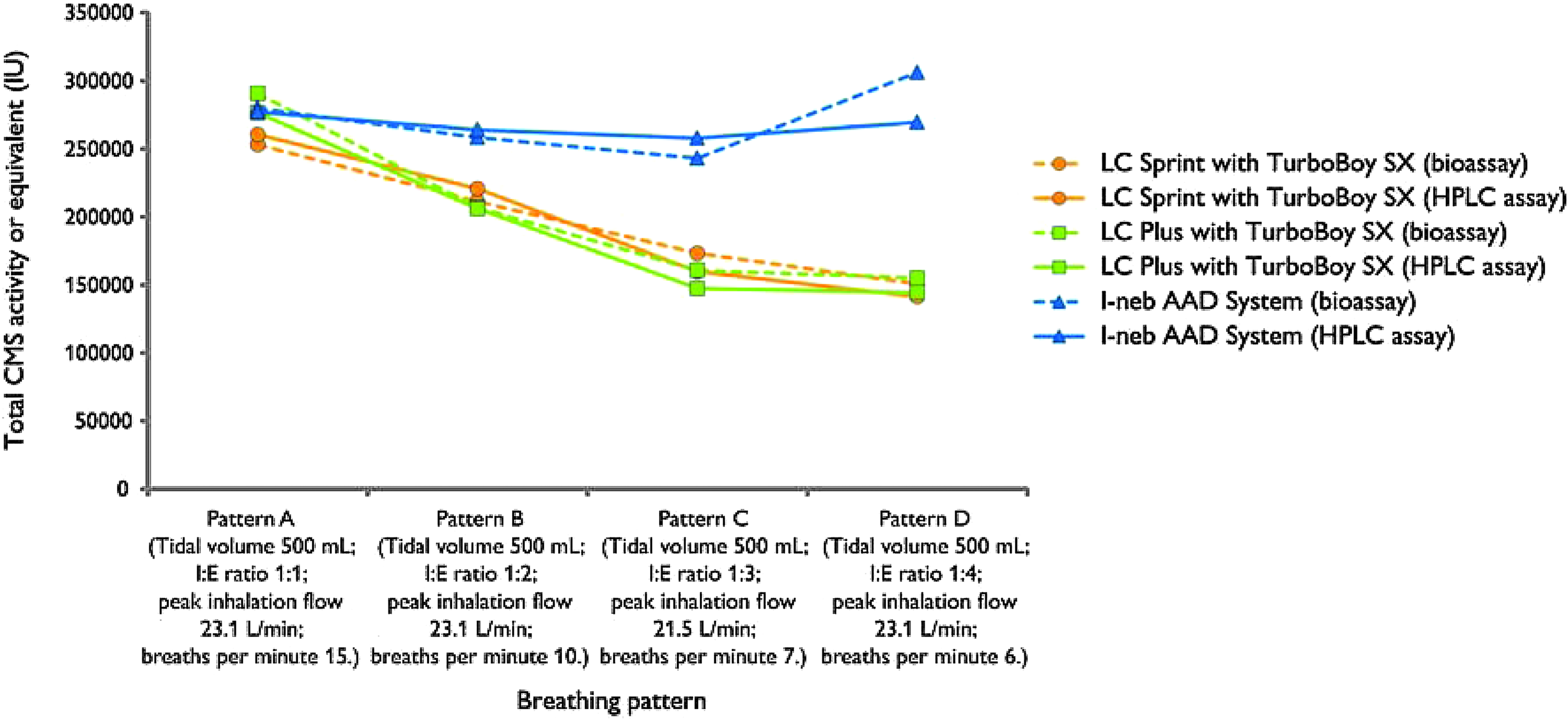
Colistimethate sodium activity (bioassay; dashed lines) or equivalent (HPLC; solid lines) for each breathing pattern, plotted by nebulizer.
An important consideration in aerosolized drug delivery is the loss of drug to deposition in the extrathoracic region that reduces the amount of inhaled aerosol reaching the lungs. While realistic geometries have been used to estimate extrathoracic deposition during in vitro testing of inhalation aerosols, the complex nature of realistic replicas makes them difficult and expensive to accurately manufacture out of durable conductive materials. Furthermore, these realistic replicas mimic deposition in only one individual, who may not be representative of the average geometry for a given patient population. These limitations can be addressed using idealized geometries that provide a measure of the average deposition expected in a given patient population. We have recently developed an idealized child extrathoracic geometry representative of children between 6 and 14 years of age by uniformly scaling the adult Alberta Idealized Geometry. This idealized child geometry replicates the average deposition of 0.5–5.3μm particles observed in realistic replicas of 9 children (Golshahi and Finlay, Aerosol Sci and Technol., 46:i-iv,2012). The present work examines the deposition of aerosol emitted from Budesonide Pulmicort® Turbuhaler® inhalers. Lung deposition of aerosol from a 200μg Budesonide Pulmicort® Turbuhaler® measured using the idealized child throat was 28±2% (ex-actuator dose, n=5,±standard deviation), which agrees with the lung deposition measured in an in vivo study using radiolabelled 99mTc budesonide Turbuhaler® in children, at 29.6±9.4%, 24.4±5.0%, and 34.9±8.0% (total body dose) for children aged 6–8, 9–12, and 13–16 respectively (Devadason et al, Eur Respir J, 10:2023–2028,1997). The idealized child geometry thus appears to allow estimation of lung deposition of inhalation aerosols in school age children using inhalers.
Acknowledgements: CA Ruzycki is supported by a NSERC Canada Graduate Scholarship. WHF gratefully acknowledges funding from NSERC and CIHR.
ALBUTEROL DELIVERY DURING MECHANICAL VENTILATION IN AN EX-VIVO PORCINE MODEL
SPECIFIC TARGETING OF INHALED STEROIDS TO SMALL AIRWAYS IN CHILDREN WITH PROBLEMATIC SEVERE ASTHMA USING THE AKITA: A CASE SERIES
MAP Pharmaceuticals, Inc; Mountain View, CA, USA
Regulatory and Standardization Issues
Trudell Medical International (TMI), LONDON, ON, Canada
The ADAM series of face models was developed to provide clinically pertinent apparatuses for the evaluation of valved holding chambers, and nebulizers equipped with a facemask as patient interface. The child model had open oral and nasopharyngeal airways, obtained from a 4-year old by magnetic resonance imaging. This approach permitted the realization of the facial profile together with the underlying bone structure. The model was constructed at TMI from the 3-dimensional imaging data and the same processes for the infant model were used to create the overlying soft facial tissues. Previous studies had confirmed the mechanical responsiveness to the application of a facemask with a known applied force was within clinical expectations. The model (with surfactant-coated airways simulating the mucosa) was validated by delivering a known mass of salbutamol (1000 μg) via pMDI with antistatic AeroChamber Plus® VHC/inspiratory flow indicator with child facemask applied to the face with a force of 1.6 kg, with a filter located at the model exit (equivalent to just above the carina) to collect delivered aerosol. The model was coupled to a breathing simulator (ASL 5000, IngMar Medical, Pittsburgh, PA) mimicking small child tidal breathing (tidal volume=155 ml, duty cycle=33 %, rate/min=25). Salbutamol (μg) was recovered from the pMDI (209.8±16.3) within the VHC and facemask (347.6±2.6), on the face (19.1±5.8), from the model airways (39.8±8.7), at the model exit (247.9±49.8), and assayed by a validated HPLC-UV spectrophotometric method. Total mass recovery was 86.4±4.0%.
University of Florida, Gainesville, FL, United States of America.
In vitro dissolution testing on an inhaled drug can provide some predictive estimates of its behavior in vivo and thus we aim to develop a robust in vitro test that could be used for IVIVC as well as quality testing. In order to simulate the fluid-capacity-limited dissolution of inhaled drug products, a suitably modified Transwell® system was developed and used to perform in vitro dissolution experiments. In order to mimic the in vivo conditions, the polycarbonate membrane in the Transwell® was replaced with a filter paper, which eliminated the role of diffusion as the rate limiting factor. Size differentiated fractions of drugs, obtained using a cascade impactor, were used for experiments. The rates with which a corticosteroid solution and the corresponding dry powder particles entered the receptor compartment differed significantly (f2=29.7) only when filter paper was used instead of the polycarbonate membrane. Thus we confirmed that the rate-limiting step in this system was dissolution as opposed to diffusion. Experiments were also done to study the sensitivity of this in vitro method to differences in drug loading and particle size and to explore the effect of stirring on the dissolution profiles. The dissolution data for both, hydrophilic and hydrophobic, drugs, in 0.5% SDS solution in PBS as the medium, were in agreement with their respective physicochemical properties and were strongly related to their in vivo absorption rates measured in pharmacokinetic studies.
Department of Pharmaceutics, University of Florida, Gainesville, FL, USA

USE OF A CHILD FACE MODEL WITH REALISTIC SOFT TISSUE MODELLING TO ASSESS VALVED HOLDING CHAMBERS (VHCs) WITH FACEMASKS
Testing of VHC-facemasks requires mimicking facial soft-tissue flexure where the facemask ‘lands', when applied with a clinically appropriate force (i.e.,1.6 kg). A child ADAM-III face model, developed from MRI imaging followed by reconstruction from the imaging data, simulates the facial profile of a 4-year old, together with skin and soft tissues applied to an underlying bone matrix. Two VHCs (n=5 devices/group) with differing facemask geometries (AeroChamber Plus® with inspiratory flow indicator (AC-Plus, Trudell Medical International, London, Canada) and OptiChamber® Diamond® (OD, Philips Respironics, Parsippany, NJ, USA) were evaluated with the model using Flovent-44® (5-actuations each 44 μg/actuation fluticasone propionate (FP) ex mouthpiece, GSK Canada) to examine relative distribution of drug mass retained by the VHC and facemask (VHC-mask), on the exposed part of the face (FACE), in the model naso-/oro-pharyngeal airway (AIRWAY) and at the model exit for delivery to the lungs (DELIVERED). Care was taken with both devices to orient the facemask on the face to minimize leakage, which was small and similar. FP was recovered and assayed by a validated HPLC-UV spectrophotometric method. The model was coupled to a breathing simulator (ASL 5000, IngMar Medical, Pittsburgh, PA) mimicking small child tidal breathing (tidal volume=155 ml, duty cycle=33 %, rate/min=25). The resulting mass distributions are summarized in Table 1.
Mass Distribution of FP/Actuation (μg; mean ±SD) for VHC-Facemasks Evaluated with Flovent ®-44
Total mass recoveries were similar for both device groups and all values were within±15% label claim. The AC-Plus VHC delivered more FP than the OD (unpaired t-test, p<0.001), because of increased mass retention of FP within the OD VHCs.
Environmental/Occupational Health/Toxicology
EFFECT OF INHALED ENDOTOXIN (LPS) ON REGIONAL PARTICLE DEPOSITION AND MUCOCILIARY CLEARANCE IN HEALTHY NONSMOKERS, SMOKERS, AND MILD ASTHMATICS
Endotoxin, a major component of the outer membrane of gram-negative bacteria, has been shown to induce airway inflammation, which in turn may lead to slowing of mucociliary clearance (MCC), a key component of airway defense. We performed an open label inhalational challenge with 20,000 endotoxin units (LPS) in healthy nonsmokers (n=18), smokers (n=12), and atopic asthmatic adults (n=13). No changes in spirometry occurred in any group as a result of the LPS challenge. At 4 hours post LPS challenge, regional particle deposition and clearance (central-peripheral ratio (C/P), clearance through 24 hours (%24hr) as an index of airway vs. alveolar deposition, and MCC as the average of clearance data through 2 hours), were measured by gamma scintigraphy following controlled inhalation of Tc99m-sulfur colloid particles for comparison to a baseline study day. There were no differences in regional deposition indices for baseline vs. LPS challenge in either the smokers or nonsmokers. However, MCC was significantly slowed in the nonsmokers as a result of LPS challenge (MCC=10±9% (challenge) vs. 15±8% (baseline)). LPS had no effect on MCC in the smokers. The asthmatics showed an increase in bronchial airway deposition post LPS challenge compared to baseline (mean C/P=1.87 vs. 1.69 and %24hr=53 vs. 46, p<0.05). When MCC was corrected for differences in deposition pattern between baseline and challenge in the asthmatics, tracheobronchial (TB) MCC from the central region of the lung appeared slowed following LPS challenge (TB MCC=18±20% (challenge) vs. 28±23% (baseline), p=0.06). Mild exposure to endotoxin slows MCC in healthy nonsmokers and mild asthmatics, while MCC in smokers is unaffected by mild endotoxin challenge.
Supported by NIH/NHLBI RO1 HL080337, NIH/NIAID U19AI077437, UL1RR025747 and KL2RR025746from the National Center for Research Resources/NIH.
SURFACTANT INTERACTIONS WITH SUB-MICRON PARTICLES: THE IMPORTANCE OF ROUTE OF EXPOSURE
Previous studies have demonstrated that sub-micron particles can disrupt the function of model pulmonary surfactant films in-vitro. However, different mechanisms of action have been proposed even for particles of the same size and chemistry. In the present study, we focus on identifying how route of exposure alters the mechanism of interaction between surfactants and particles. Three exposure routes were investigated: two traditional routes used heavily in the literature and a more realistic route where particles were aerosolized onto a surfactant monolayer. The surface tension of dipalmitoyl phosphatidylcholine (DPPC) films before and after exposure to particles was monitored during dynamic compression-expansion using a Langmuir-Wilhelmy balance. Surface potential measurements provided additional information on surfactant packing density at the air-fluid interface. Surfactant microstructure was studied using fluorescence and atomic force microscopy. We observed that particle concentration and route of exposure alter both the intensity and the type of interactions observed. For example, when particles were injected beneath the surfactant, electrostatic interactions between the negatively-charged particles and the charged head groups of the phospholipids led to changes in surfactant microstructure. This occurred at a very low particle concentration of 10−3 g/L in the subphase. In contrast, when monolayers were spread on top of a particle-laden subphase, significant changes to surface tension isotherms and surface potential were observed only at high particle concentrations of 0.1 g/L. This resulted from space competition between the particles and surfactants at the interface. These results have implications for particle exposure in various fields, including aerosol medicine and occupational health.
Acknowledgements: Grant funding by the University of Iowa Center for Health Effects of Environmental Contaminants.
INTERACTIONS BETWEEN TOBACCO SMOKE EXPOSURE AND GSTP1 ON LUNG FUNCTION AT 6, 12 AND 18 YEARS
Exposure to tobacco smoke is common in children. Poor detoxification of inhaled pollutants can have severe implications for lung health. Glutathione S-transferase P1 (GSTP1) is expressed in the lungs and plays a crucial role in cellular detoxification. The interactions between tobacco smoke exposure and two polymorphisms in GSTP1 (Ile105Val and Ala114Val) on FEV1, FVC and airway responsiveness (AR) at 6, 12 and 18 years were investigated in a longitudinal cohort. Genotyping was performed using PCR. The frequency of tobacco smoke exposure at each follow-up was 39%, 35% and 57%, respectively. GSTP1 105 Ile/Ile was associated with lower AR at 6 years (p=0.007); after stratifying by exposure status AR remained lower in children with Ile/Ile who were exposed to parental tobacco smoke (p=0.027). At 12 years Ile/Ile was associated with higher FEV1 in non-exposed children (p=0.029). At 18 years GSTP1 114 Ala/Val was associated with higher FVC in non-exposed (passive/active) individuals (p=0.014). These data suggest that GSTP1 may not always modulate the adverse effects of tobacco smoke exposure. Investigating other detoxification networks may clarify the implications of, and potential compensatory mechanisms for, altered cellular detoxification capability of GSTP1, on lung health.
Acknowledgements: Funded by the NHMRC
Adolphe Merkle Institute, University of Fribourg, MARLY, FR, Switzerland
The finding that air pollution profoundly affects human respiratory health has led to increasingly stringent exhaust emission legislations for internal combustion engines. As a consequence, new strategies for improving engine combustion and for exhaust after-treatment have been developed
Estimating their actual effects on emission toxicity however, is very difficult. Since standardized protocols for in vitro testing are lacking, it relies in many aspects on epidemiological studies, which suffer from the inability to differentiate effects of different emission sources, are very time-consuming and cost-intensive.
We have established and optimized an exposure system for exhaust toxicity assessment in human lung cells in vitro which allows taking complete exhaust samples at the tailpipe of an engine of choice and their immediate use for exposure experiments under any desired condition. Using a 3D model of the human airway epithelium as a biological system (consisting of epithelial cells (cell line 16HBE14o-) and human blood derived macrophages and dendritic cells) and a valuable battery of tests to determine different endpoints such as cytotoxicity, oxidative stress and (pro)inflammation, we have performed exposure experiments using a diesel passenger car operated under various settings (e.g. diesel particle filter, biodiesel, fuel additives, different lubrication oils) as a test vehicle.
We will present data that show that because of its versatility, its high robustness and its sensitivity, the combination of our air-liquid exposure system and 3D lung cell culture model provides an adequate tool for fast and reliable investigation of exhaust toxicity as an alternative standard protocol for animal testing.
Acknowledgments: The project is funded by the Swiss Federal Office for the Environment, VSS lubes and Swissoil.
Adolphe Merkle Institute, Université de Fribourg, MARLY, Switzerland
Silver nanoparticles (Ag-NPs) are widely known for their antimicrobial properties. However, the interaction of Ag-NPs with mammalian systems is currently not fully understood. Exposure via inhalation is of primary concern for humans in occupational settings. Here, potential cytotoxic and (pro)-inflammatory effects of 70nm Ag-NPs were investigated by aerosolization onto the surface of a human epithelial airway barrier in vitro composed of epithelial as well as two types of immune cells, i.e. monocyte-derived macrophages and dendritic cells. Different Ag-NP concentrations (0.22–22 mM) and post-exposure times (4 and 24 hours) were applied. Cell viability and (pro)-inflammatory responses were investigated using LDH- and ELISA-assays. To compare these in vitro findings with an ex vivo approach, 250μm precision-cut slices from rat lungs were exposed to 5–30 μg/ml 70nm Ag-NPs under submerged culture conditions in vitro. For both approaches no cytotoxicity was observed. Furthermore, there was no elevated release of the (pro)-inflammatory markers TNF-α and IL-8. Taken together, Ag-NPs do not exert cytotoxic or (pro)-inflammatory effects in both ex vivo cultured precision-cut slices from rat lungs and an in vitro model of the human epithelial airway barrier. In conclusion, these findings demonstrate that both complex cell culture models represent validated techniques to significantly reduce the number of animal experiments.
Acknowledgements: Grant funding by the Federal Office of Public Health Switzerland, the Swiss National Science Foundation, the Deutsche Forschungsgemeinschaft (DFG SPP 1313) and the Adolphe Merkle Foundation.
IMPROVING SURGICAL MASK COMFORT WITH NEW TECHNOLOGY
Figure: [Upper] Receiver Exposure for masks placed on the source. Prototype Masks were comparable to commercial masks and respirators [SF and N95]. [Lower] Filtration of Prototype and SF Masks averaged 70–80%. With imaging, aerosols were captured only by the prototype-fiber layer. Filtration contribution from the other layers was negligible.

Acknowledgements: Supported in part by Crosstex International, Inc.
RESPIRATORY SOURCE CONTROL: KEY TO CONTROLING AIRBORNE INFECTION
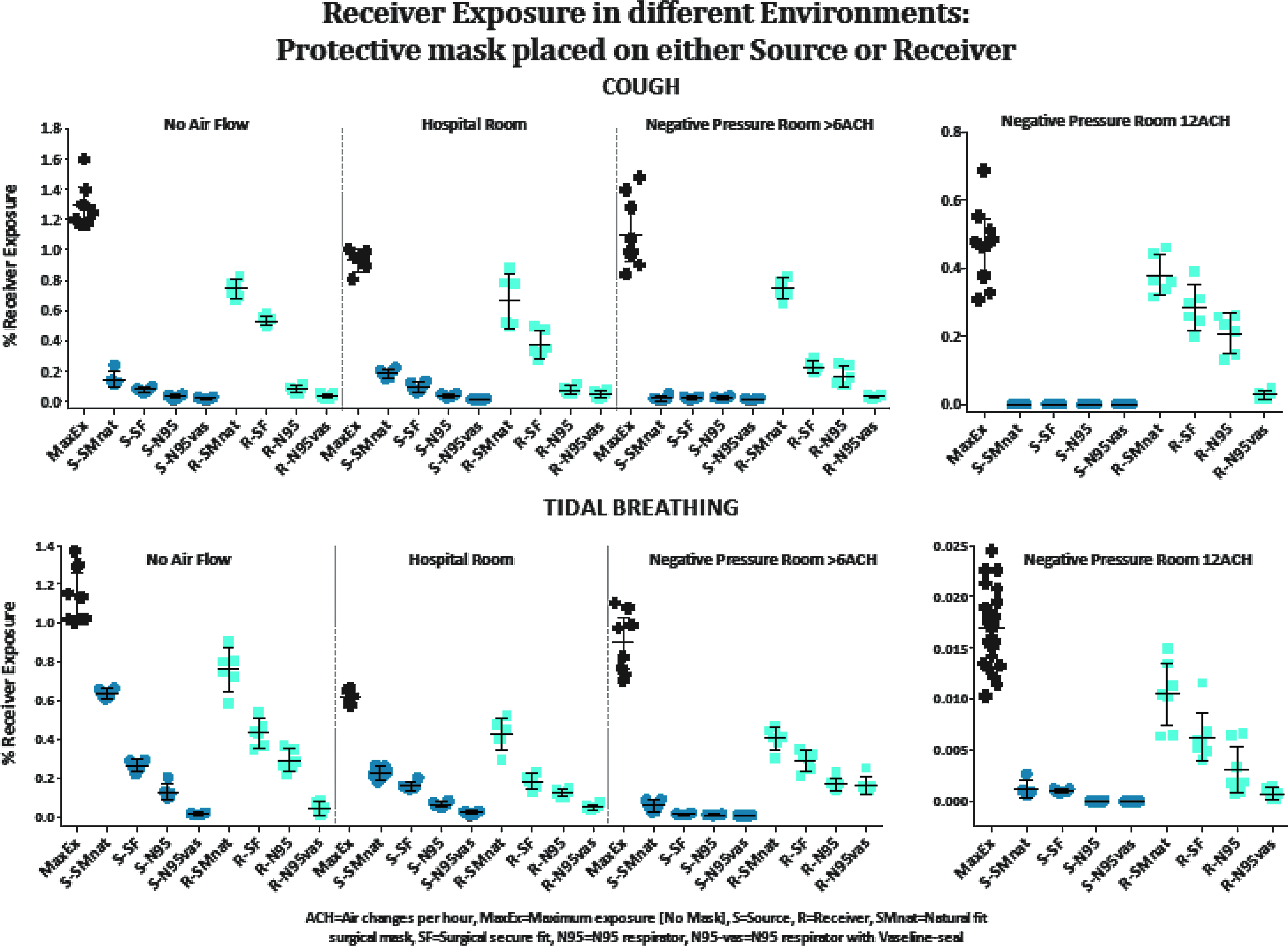
Acknowledgements: Supported in part by Crosstex International, Inc.
DEVELOPMENT OF A HUMAN LUNG CO-CULTURE MODEL SYSTEM FOR HAZARD IDENTIFICATION OF AEROSOLIZED PARTICLES
There is a growing need for lung cell culture model systems to assess potential hazards associated with aerosolized particles. In vivo models for safety testing are being phased out due to increased social, financial, and time pressures. In vitro cell cultures have shown promise as surrogates in screening assays when multiple substances require preliminary information on toxicity. We present an exposure apparatus composed two of critical parts. The first part is an aerosol generator that delivers liquid and/or solid aerosols in the size range of 1–3 μm in diameter. The second part is a co-culture system of upper respiratory tract mammalian cells including epithelial, macrophage, and dendritic cells. The aerosols used in the development of this apparatus include trimellitic anhydride (i.e. solid powder) and toluene-2,4-diisocyanate (i.e. liquid droplet). Both aerosols have been shown to induce inflammation and/or cause irritation in the respiratory tract. This study focuses on comparing the cellular effects before and after aerosol exposure. Specific cytokine expressions of exposed cells compared to control cell populations are as follows: MIP-1 (increase by 50%), TNF-α (increase by 75%), and IL-1β (increase by 20%). The overarching goal is to develop a high-throughput co-culture screening system that could be used in conjunction with current in vivo test models.
Applied Research Associates, RALEIGH, NC, United States of America
An accurate quantification of cigarette smoke deposition in lung airways depends on the amount depositing in the mouth. Significant deposition (>20%) of mainstream cigarette smoke was measured in the upper airways, yet the reasons for this high deposition are not fully understood. A 3D computational fluid dynamics (CFD) model of the mouth and throat region was developed from CT scans. Steady-state airflow rates of 1.05 and 2.5 L/min were used to simulate low-flow puffing scenarios (ANSYS Fluent, v14.0). Transport and deposition of sub-micrometer particles released from a cigarette-sized inlet at the mouth opening was simulated. Predicted deposition of 200–500 nm particles in the oral cavity due to inertial impaction, sedimentation, and diffusion was <6%. The CFD model was used to simulate the size change of particles due to coagulation and condensation of water vapor, and also to study deposition by thermophoresis. At concentrations of 10^9 particles/ml, particles were predicted to increase in size by approximately 50% due to coagulation. With relative humidity in the mouth cavity>90%, particles were predicted to increase in size by ∼1.5-fold due to hygroscopic growth. At a smoke temperature of 40C, thermophoretic effects on particle deposition were negligible. Deposition of 200–500 nm particles with these additional deposition mechanisms implemented still resulted in oral deposition<10%. These simulation results suggest that high deposition in the upper airways could be due to other factors such as cloud effect or enhanced coagulation during mouth-hold and needs further investigation.
This study was funded by British American Tobacco.
BACTERIAL AEROSOL PARTICLE NUMBER CONCENTRATIONS IN INDOOR ENVIRONMENTS OF SEOUL, KOREA
We measured number concentrations of bacterial bioaerosols in several indoor environments of Seoul, Korea. The measurement campaigns had been conducted for four years and the measurement locations included underground subway stations, hospitals, restrooms, libraries, and shopping centers. The outdoor bacterial bioaerosol number concentrations were measured simultaneously for comparison with the indoor concentrations. Most of results of measurements showed that the concentration values were less than the legal regulation limit which was 800 CFU/m3 in Republic of Korea. However, the concentration values were over the limit under specific conditions and showed the relations with several environmental variables such as temperature and humidity. This result can be used for the study of prevention of infectious respiratory diseases, especially bacteria-related air infections.
Acknowledgements: This research was supported by Basic Science Research Program through the National Research Foundation of Korea(NRF) funded by the Ministry of Education, Science and Technology(‘Measurement of airborne microorganisms in public facilities and development of control methods against airborne pathogenic microorganisms', No. 2012-0002857).
DEPOSITION OF FRACTAL-LIKE AGGREGATES IN A CAST OF HUMAN LUNG AIRWAYS UNDER VARIOUS BREATHING CONDITIONS
The model of upper airways (Grgic et al. 2006) and the simplified model of lower airways based on Weibel's data (1963) were used to determine the deposition of diesel exhaust particles into the human airways under quiet breathing and exercise conditions. Both models were connected to Artificial Lung (AL) apparatus (Sosnowski et al. 2006). AL is a set of devices which allows generating airflow in a manner that is most similar to the breathing flow in the mammalian lung. Two types of respiratory curves (V(t)=A/B·(1-cos(Bt))) were taken into consideration: a) curve describes quiet breathing (A=0.4932 (dm3); B=0.9500 (s)); b) curve describes breathing under exercise conditions (A=1.6778 (dm3), B=1.7450 (s)). Diesel engine (described in Penconek et al. 2012) was used to generate the fractal-like aggregates (DEP).
Under the quiet breathing conditions amount of DEPs, that deposited in the airways, is lower than under the exercise conditions. The amount of DEP characterized by morphology similar to spherical particles with high fractal dimension≈2.5 deposited into the respiratory track is higher than amount of DEP characterized by morphology similar to dendrite-like structure with low fractal dimension≈1.7. However, only about 25% of inhaled spherical DEP deposited in lower airways while 40% of dendrite-like DEP deposited in lower airways.
This study may be useful to determine the toxicity of inhaled DEP generated from various fuels.
Grgic, B., Martin, AR., Finlay WH. 2006. J. Aerosol Science 37: 1222–1233.
Penconek A., Drążyk P., Moskal A. Ann Occup Hyg, 2012 DOI:10.1093/annhyg/mes074.
Sosnowski TR., Moskal A., Gradoń L. 2006. Inhalation Toxicology 18:773–780.
Weibel ER, 1963 Zürich, Springer-Verlag.
Acknowledgements: Grant funding by the Polish National Science Center (No. NN209023739)
Institute of Anatomy, University of Bern, BERN, Switzerland
Gasoline exhaust is an important source of atmospheric particles and supposedly contributes to respiratory diseases from inhalation exposure. Persons with pre-existing lung disease are more vulnerable. This study aimed at investigating acute responses of the respiratory epithelium after exposure to photochemically aged gasoline aerosols using advanced technologies from aerosol science and in-vitro toxicology. Exhaust of a gasoline car (EURO 5 standard) was introduced into a smog chamber and secondary organic aerosol (SOA) was produced upon irradiation with artificial sunlight by photochemical processes. Air from the smog chamber was then transferred via a versatile aerosol concentration enrichment system (VACES) into the aerosol deposition chamber. Adjusting the enrichment of particles by up to a factor of 50, the dose of deposited particles on cell cultures could be varied over a broad range. SOA was deposited out of a continuous air-stream simultaneously on 12 individual cell cultures by electrostatic deposition under controlled conditions (85–95% RH and 37°C). Re-differentiated human bronchial epithelia (HBE) with established air-liquid interface and the bronchial cell line BEAS-2B were exposed to the aerosols for 2 hours. First results give evidence for cytotoxic effects of gasoline SOA. In addition, different responses of cell cultures from a donor with lung disease were observed compared to healthy HBE and BEAS-2B cells. The combined technologies of aerosol science and in-vitro toxicology provide a highly realistic system for toxicity testing of environmental aerosols.
Acknowledgements: Grant funding by the Swiss National Science Foundation
Applied Research Associates, RALEIGH, NC, United States of America
Inhaled airborne droplets may deposit, be exhaled, or evaporate as they travel through the respiratory tract. Deposition and evaporation characteristics depend on the physicochemical and thermodynamic properties of the aerosol and conditions in the respiratory airways. The fate of four fragrance materials with widely differing vapor pressures (limonene, linalool, benzaldehyde, and benzyl acetate) was simulated in anatomically accurate computational fluid dynamics (CFD) models of the rat and human nasal passages. Steady-state inspiratory airflow was simulated in each species with a value twice estimated resting minute volume. Droplet transport and deposition was simulated using Lagrangian particle tracking for particles passively released from the nostrils. Particle size change due to phase change was driven by the pressure difference between the droplet surface and the surrounding environment. CFD predictions revealed significant evaporation of these fragrance materials in the nasal passages with evaporation rates dependent on the saturation vapor pressure of the substances. In the human nose, complete evaporation was observed for limonene droplets with an initial diameter ≤5μm, benzaldehyde droplets ≤4 μm, and benzyl acetate and linalool droplets ≤1 μm. Larger droplets did not completely evaporate but decreased in size, thereby reducing deposition by inertial impaction in the nasal passages. Quantification of droplet deposition in the nose has significant implications for lung dosimetry since vapor concentrations and droplet characteristics are altered during transport through the upper respiratory tract.
This study was funded by the Research Institute for Fragrance Materials.
Abstract Author Index by abstract number
Abraham, WM, O-03
Ahmed, T, O-03
Ahsan, F, O-40, P-005
Akouka, H, P-098
Alfadehl, S, P-110
Alfredson, TL, P-108
AlHamad, B, P-046
Allen, IC, O-31
Almond, M, P-114
Alshamli, I, P-093
Álvarez, A, P-100
Amirav, I, O-22, P-061
Amy de la Bretèque, B, P-026
Anderson, R, P-081
Andres, C, P-084
Ansede, JH, P-095
Apicella, MA, P-066
Arensdorf, P, P-097
Ari, A, P-039, P-046, P-092, P-094
Arora-Lakhani, D, O-28
Asgharian, B, P-011, P-122, P-126
Aubert, G, P-070
Azimi, M, O-07, O-50
Azouz, W, P-051, P-052
Azzopardi, N, P-084
Bailly, L, P-021, P-026
Bains, BK, P-045
Baltensperger, U, P-125
Baranda, F, P-100
Barlow, J, P-082
Barry, JJ, O-43
Bartenstein, P, O-32, P-056
Bassett, DP, P-076
Batton, D, P-076
Becker, D, P-097
Becker, S, O-32
Behara, S, P-067
Bennett, M, P-027
Bennett, WD, O-08, P-007, P-089, P-114
Berlinski, A, P-106
Bertrand, E, P-021
Bertucci, L, P-108
Bhagwat, S, P-110
Bhashyam, AR, P-001
Bickmann, D, O-20, P-049
Biddiscombe, MF, P-017, P-024, P-047
Birchall, JC, P-045
Blanchard, JD, O-42
Blank, F, O-30
Boc, ST, P-055
Boiron, O, P-021, P-026
Boraey, M, P-031
Bosco, AP, P-108
Boucher, P, O-08, P-089
Boucher, RC, O-08, P-089, P-095
Boukhettala, Nabile, P-064
Breen, Ellen, P-044
Brenza, TM, P-030
Brighton, Missy, P-018
Bucholski, A, P-099
Burchell, J, P-108
Burgstaller, G, O-47
Burke, CS, P-036
Burtscher, H, O-52
Butruk, B, P-059
Button, B, O-08, P-089
Byrne, S, P-077, P-102, P-103
Caillibotte, G, O-34, P-002, P-026, P-027, P-029, P-040, P-041
Cañadas, Olga, O-48
Canisius, S, P-072
Carrigy, N, O-21
Casals, C, O-48
Cascio, W, O-17
Case, M, O-17
Challoner, PB, P-055
Chan, Hak-Kim, P-012
Chan, P, P-098
Chan, WH, P-004
Chand, Ramesh, P-006
Chen, CC, P-004, P-008
Chen, CW, P-008
Cheng, YS, O-15
Chetcuti, P, P-052
Chong, E-S, P-123
Chronik, B, P-109
Chrystyn, H, P-019, P-051, P-052, P-053
Church, T, P-043
Ciciliani, AM, P-049
Colthorpe, Paul, P-016
Comte, P, P-117
Condos, R, P-085
Contreras, L Garcia, O-51, P-003
Conway, J, O-34, P-027
Cook, R, P-097, P-098
Cooper, TK, P-007
Corcoran, T, O-35, O-37, O-45
Corkery, KJ, P-055
Cox, D, P-116
Cracknell, S, P-037, P-038, P-087
Crosbie-Staunton, K, P-036
Cryan, SA, O-41, P-033, P-034, P-082
Cullen, S, P-034
Cunha-Goncalves, D, P-025
Cuoghi, Erika, P-016
Curran, AK, P-037, P-038
Czerwinski, J, P-117
Daher, N, P-125
Darcy, R, P-033
Darquenne, C, O-12, P-007, P-044
Darweesh, RS, O-28
Daum, N, O-49
Davis, SD, O-02
Davies, C, O-42
de Boer, AH, P-104
De Monte, M, P-084
de Swart, RL, P-086
Delgado-Hernandez, E, P-083
Denk, O, P-099
Desgrange, S, P-033
DeSimone, JM, O-31
Devadason, SG, O-36, O-37, P-032, P-108, P-116
Devlin, RB, O-17
Dhand, R, O-06
Dhandha, V, P-048
Diaz-Sanchez, D, O-17
Dickens, C, P-122
Diendorf, J, P-118
Diot, P, P-015, P-022, P-064
Ditcham, W, P-032
Dolovich, MB, O-37
Dommen, J, P-125
Donaldson, S, O-08, P-089
Donn, KH, P-095
Doody, T, P-036
Doyle, C, P-109, P-112
Dubau, C, P-027
Duckworth, H, P-114
Duffy, C, P-088, P-091
Durand, M, P-022, P-070
Durham, P, O-51, P-083, P-121
Ebert, CS, P-048
Edirimanna, H, P-113
Egle, R, P-099
Egli, D, O-52
Ehlich, Hilke, P-016
Ehrhardt, C, O-29, P-057, P-058
Eickelberg, O, O-32, O-47, P-056
El-Soussi, M, P-051
Enright, H, O-46
Epple, M, P-118
Farkas, DR, P-067
Farnoud, AM, P-115
Feng, S, P-056
Fiegel, J, P-028, P-066, P-115
Fierz, M, O-52
Fine, JM, P-007
Fink, A, P-117
Fink, J, O-08, P-039, P-046, P-054, P-089, P-092, P-094
Finlay, P, P-002
Finlay, WH, O-21, O-25, P-029, P-031, P-043, P-050, P-105
Fiset, S, P-096
Fitzgibbon, CJ, P-078
Fleming, J, O-34, O-37, P-027
Fleming, S, P-098
Flitter, WD, P-095
Forsythe, WC, O-46
Fox, J, P-001
Frank, DO, P-048
Friets, EM, O-43
Frijlink, HW, P-104
Fromen, CA, O-31
Fuchs, C, P-025
Fuller, F, P-089
Gallagher, S, P-036
Galvin, P, P-036
von Garnier, C, O-30
Garshick, E, O-19
Gartner, S, P-100
Gatier, S, P-022
Gausterer, JC, P-057
Geiser, M, O-52, P-125
Giovanni, A, P-026
Girón, R, P-100
Goldblatt, J, P-116
Golshahi, L, O-07, O-21, O-50, P-050, P-105
González, MI, P-100
Goodway, R, P-087
Gouilleux, V, P-084
Gradoń, L, P-071
Grandmont, Celine, P-044
Greenblatt, E, O-34, O-44, P-040, P-041, P-042
Gruber, F, P-099
Guilleminault, L, P-084
Gumaste, A, P-098
Gun'ko, YK, P-036
Gupta, N, O-40, P-005
Haberl, N, P-118
Hagedoorn, P, P-104
Hagos, Y, P-058
Halamish, A, P-061
Hamblin, KA, O-42
Hanif, SNM, O-51, P-003
Harding, SV, O-42
Harris, RS, O-44, P-040, P-041
Harwood, R, P-046, P-092, P-094
Hashish, AH, P-013, P-014
Hatley, RHM, P-074, P-075, P-077, P-102, P-103
Häussermann, S, O-38, P-009
Häussinger, K, O-32, P-056
Hauviller, C, O-20
Hava, DL, P-078
Hayden, CM, P-116
Heeb, N, P-117
Helwich, O, O-39
Herault, O, P-084
Herbst, M, P-114
Hernandez, M, P-114
Herzog, F, P-118
Hess, DR, O-05
Heulitt, M, P-106
Heuzé-Vourc'h, N, P-063, P-084
Heywood, SP, P-010
Hibbitts, A, P-033, P-034, P-082
Hickey, AJ, O-08, O-51, P-003, P-083, P-089, P-121
Hindle, M, O-07, O-33, O-50, P-065, P-067, P-068, P-080
Hirimuthugoda, LK, P-113
Hirn, S, P-118
Hochhaus, G, P-110, P-111
Hodsman, P, P-095
Hoe, S, P-031, P-043
Hofmann, T, O-11, P-072
Hofmann, W, P-023
Hohlfeld, JM, P-073
Holbrook, L, P-080
Holdsworth, DW, P-109
Holt, P, O-30
Holt, S, P-106
Holz, O, P-073
Hosker, H, P-052
Hossain, M, P-061
Hsu, SH, P-008
Huang, SH, P-004, P-008
Huntimer, L, P-030
Huwer, H, O-49
Huygen, K, P-020
Ingram-Ross, J, P-038
Ivey, J, P-031
Iwatschenko, P, O-39
Jabłczyńska, K, P-060
Jamar, F, P-022
Janssens, HM, P-107
Jaspers, Ilona, P-018
Jauernig, Jürgen, P-016
Javaheri, E, O-21, P-029
Jeannet, N, O-52, P-125
Jeffrey, D, P-102, P-103
Johnson, MR, O-08, P-089, P-095
Jordan, S, P-038
Jud, C, P-099
Junqua-Moullet, A, P-015
Juranyi, ZS, O-52
Jurion, F, P-020
Kadrichu, NP, P-054, P-055
Kalberer, M, O-52, P-125
Kalsi, HS, P-017, P-024, P-047
Kandala, B, P-111
Karin, N, O-46
Katz, I, O-34, P-002, P-027, P-029, P-040, P-041
Kelly, B, P-061
Kelly, C, O-41
Kelly, VJ, O-44, P-040, P-041
Khan, Y, P-019, P-053
Khoo, S-K, P-116
Kieckbusch, Thomas, P-016
Kietzig, C, P-009
Kim, NH, P-076
Kimbell, JS, P-048, P-126
Kirkpatrick, A, P-097
Knaus, DA, O-43
Knoch, M, P-025
Koch, W, O-39, P-073
Kone, M, O-44, P-040, P-041
Koussoroplis, S, P-010
Krapf, M, P-125
Kreyling, WG, P-118
Krombach, F, P-118
Kruizinga, TJ, P-104
Kuehl, PJ, O-13, P-006
Kuehn, A, O-49
Künzi, L, P-125
Kuo, YM, P-008
Kurowska, A, P-059
Lagier, A, P-026
Landau, LI, P-116
Lander, C, P-097
Langguth, P, O-20, P-049
Larhrib, H, P-019, P-053
Laube, BL, O-37, P-001
Lawlor, C, P-078
Le Guellec, S, P-022
Le Pennec, D, P-022
Le Souëf, PN, P-116
Leach, Chet, P-006
Leclerc, L, P-022, P-070
Lee, BU, P-123
Legou, T, P-026
Legrain, B, P-084
Lehr, CM, O-48, O-49
Lelong, N, P-015
Lemarié, E, P-084
Lentner, B, O-47
Lenz, A-G, O-47
Lewis, D, P-043
Lewis, N, P-079
Lewis, S, P-095
Lexmond, AJ, P-104
Li, T, O-26
Limbrick, M, P-109
Lin, CW, P-004, P-008
Linner, R, P-025
Locke, LW, O-45
Longest, PW, O-07, O-33, O-50, P-065, P-067, P-068, P-080
Luft, JC, O-31
Lum, L, P-076
MacLoughlin, R, P-033, P-034, P-036, P-082, P-086, P-088, P-091
Macri, NP, P-037
Madarasingha, HP, P-113
Madden, MC, O-17
Mahapitiya, WLS, P-113
Mainz, JG, P-072
Máiz, L, P-100
Majoral, C, O-34, P-027
Malfatti, M, O-46
Malinina, A, P-001
Mansour, Mohamed M, P-120
Marchand, D, P-063
Marsden, AL, P-044
Martin, AR, O-34, P-002, P-040, P-041
Martínez, MT, P-100
Matida, E, P-096
Matinkhoo, S, P-031
May, T, O-49
Mayer, A, P-117
Mazela, J, O-23
McAtamney, C, P-036
McAughey, J, P-011, P-122
McBride, Amber A, P-062
McDonald, Jacob, O-16, P-006
McElvaney, NG, O-41
McGrath-Morrow, S, P-001
Meah, S, P-024, P-047
Meecham, K, P-038
Meiners, S, O-47
Merkel, OM, P-076
Metcalf, A, P-103
Mielgo, V, P-101
Mikheev, VB, O-46
Milner, J, P-109
Minard, KR, O-46
Mitchell, JP, P-109, P-112
Miyamoto, M, P-038
Mogayzel, PJ, Jr, P-001
Möller, W, O-32, P-056
Montesantos, S, O-34, P-027
Montgomery, AB, P-095
Moore, S, P-038, P-087
Moskal, A, P-124
Mossadeq, SM, P-035
Mouheb, N Ait, P-021
Mueller, D, P-099
Mullane, D, P-116
Müller, Loretta, P-018
Müllinger, B, P-072
Murdzoska, J, P-032, P-116
Murgia, X, P-101
Muttil, Pavan, P-062
De Muynck, C, O-39
Myerburg, MM, O-45
Nagel, MW, P-112
Nallathamby, PD, O-46
Narasimhan, B, P-030
Navratil, T, O-08, P-089
Neptune, E, P-001
Newcomb, T, P-095
Newhouse, M, P-061
Newman, SP, O-37
Nikander, K, P-032, P-074, P-075
Niven, R, O-24
Noah, TL, O-18
Nocker, K, P-072
Noga, M, O-21, P-050
Nolan, L, P-033, P-082
Nuttall, M, P-109
O'Driscoll, C, P-033
O'Mahony, A, P-033
O'Riordan, TG, P-095
Oakes, JM, P-044
Oakum, C, P-097, P-098
Odziomek, M, P-071, P-124
Ogier, J, P-033
Oliva, MC, P-100
Overweel, J, P-107
Paintaud, G, P-084
Panitch, A, P-097
Papania, MJ, O-43, P-081
Parent, C, P-063
Pastor, MD, P-100
Patel, B, O-40, P-005
Patel, Rajeev B, P-120
Patton, JS, O-27
Paul, G, P-087
Peden, DB, P-114
Penconek, A, P-124
Perez-de-Sa, V, P-025
Petersen, LK, P-030
Peterson, C, P-097
Petri-Fink, A, P-118
Pfister, N, O-47
Pichelin, M, O-34, P-026, P-027, P-029
Pilewski, JM, O-45
Pitance, L, P-022
Platt, S, P-125
Pleil, JD, O-17
Pohlmann, G, O-39
Porée, Thierry, P-064
Pourchez, J, P-022, P-070
Power, P, P-088, P-091
Prados, MC, P-100
Prévôt, ASH, P-125
Price, Dominique N, P-062
Price, OT, P-011, P-122, P-126
Prisk, GK, P-007
Pritchard, JN, O-10
Pugsley, M, P-038
Raghuvanshi, D, O-51
Ramani, T, P-037
Ramer-Tait, AE, P-030
Ramsey, JM, O-41
Rao, Nagaraja, P-012
Respaud, R, P-063
Reychler, G, P-022
Reynolds, E, P-097
Rey-Santano, C, P-101
Roberts, RA, O-31
Rohrschneider, M, P-110
Roller, C, P-032
Roseau, G, P-084
Ross, SS, P-028
Rota, P, P-081
Rothen-Rutishauser, B, O-30, P-099, P-117, P-118
Rottier, BL, P-104
Rowe, SM, O-01
Roy, CJ, O-04
Ruge, CA, O-48
Ruiz-del-Yerro, E, P-101
Ruzycki, CA, O-21, P-105
Ryan, KB, P-036
Sá, RC, P-007
Saba, G Khadem, O-32
Sabater, JR, O-03
Sakagami, M, O-28, P-035
Salomon, JJ, P-057, P-058
Saluja, B, O-28
Saralaya, D, P-052
Satti, A, P-036
Sayes, CM, P-083, P-121
Scadeng, Miriam, P-044
Schaefer, UF, O-48
Scheinherr, A, P-026
Scheuch, G, P-072
Schmid, O, O-32, O-47, P-056
Schmidmeier, M, O-47
Schneider, S, P-125
Schroeter, JD, P-048, P-122, P-126
Schulz, H, O-14
Schuschnig, U, O-32
Schwagerus, E, P-057
Schwarz, K, P-073
Seelecke, S, P-079
Seemann, S, P-025
Senior, BA, P-048
Serna, P, P-101
Seydoux, E, O-30
Shamsaddini-Shahrbabak, A, P-031
Shemirani, FM, P-043
Shen, TW, O-31
Shukla, V, P-061
Simpson, AJH, O-42
Singal, M, P-126
Singh, Dilraj, P-016
Sioutas, C, P-125
Skaria, S, P-085, P-119, P-120
Slator, L, P-074, P-075
Slowik, J, P-125
Smaldone, GC, P-085, P-119, P-120
Small, D, O-41
Sobus, J, O-17
Solé, A, P-100
Sommer de Gelicourt, Y, P-015
Sommerer, K, P-009, P-016
Son, Y-J, O-07, P-065, P-080
Sosnowski, TR, P-059, P-060, P-071
Soussi, M, P-093
Sprigge, E, P-096
Sriram, S, P-098
Steigmeier, P, O-52
Steiner, S, P-117
Stevens, T, O-17
Stiegel, M, O-17
Stoeger, T, O-47
Strickland, D, O-30
Stumbles, P, O-30
Su, W-C, O-15
Sunbul, F, P-094
Sung, JC, P-078
Suzanne, H, P-015
Taggart, C, O-41
Tajber, Lidia, P-034
Tanguy, C, P-015
Tarsin, W, P-093
Tatkov, S, P-056
Taut, FJH, O-39
Taylor, D, O-08, P-089
Taylor, G, P-045
Teeguarden, JG, O-46
Thakur, A, P-076
Thelin, W, P-089
Thrall, BD, O-46
Thurman, T, P-106
Tian, G, O-07, O-33, P-068
Ting, JP, O-31
Toddywala, R, P-061
Todoroff, J, P-020
Trimble, K, P-108
Tservistas, M, P-025
Tu, Mai Han, P-066
Turner, S, P-116
Turteltaub, K, O-46
Umehara, Y, P-099
Ung, Keith T, P-012
Usmani, OS, P-017, P-024, P-047
Uyttenhove, C, P-010
Valls-i-Soler, A, P-101
van Amerongen, G, P-086
Van Snick, J, P-010
Vanbever, R, P-010, P-020
Vasandani, P, P-061
Vecellio, L, P-002, P-015, P-022, P-063, P-064, P-070
Vehring, R, O-21, O-25, P-031, P-043, P-050
Venegas, J, O-34, O-44, P-002, P-040, P-041, P-042
Verbanck, S, P-024
Verma, NK, P-036
Vignon-Clementel, I, P-044
Volkov, Y, P-036
von Hollen, D, P-032, P-074, P-075
Voshaar, T, P-049
Vourc'h, P, P-084
Wachtel, H, O-20, P-049
Walenga, RL, O-07, O-33, P-065, P-068
Wang, V, P-109, P-112
Wang, W, O-46
Wannemuehler, MJ, P-030
Warnock, DG, P-095
Waters, KM, O-46
Wathudura, SPK, P-113
Weber, B, P-111
Weers, Jeff G, P-012
Weitzel, D, P-098
Werner, O, P-025
West, CS, P-121
White, VS, P-095
Williams, TJ, P-014
Windt, H, O-39
Winkler, T, O-44, P-040, P-041
Winkler-Heil, R, P-023
Winner, L, P-111
Wirth, D, O-49
Wofford, M, P-048
Wolny, M, P-088, P-091
Woodington, B, P-077
Wu, HD, P-004, P-008
Wu, J, P-114
Wyckmans, M, P-084
Yadav, AB, O-41
Yang, J, P-085
Yawn, BP, O-09
Yeates, DB, P-090
Young, S, P-116
Yurteri, C, P-011, P-122
Zanation, AM, P-048
Zanker, Daniela, P-016
Zeman, K, P-089
Zeman, KL, P-007, P-114
Zhang, G, P-116
Zhang, Y, P-030