




Abstract
Abstract
Background:
Respiratory illnesses such as asthma, bronchitis, and chronic obstructive pulmonary disease (COPD) are considered to be debilitating diseases. A variety of inhalation devices have been used to deliver aerosol medication to patients in the treatment of those diseases. Soft Mist Inhalers (SMIs, for example, the Spiriva Respimat) are a new generation of propellant-free inhalers. In this type of inhalation device, inhalable droplets are generated from an aqueous solution. Droplet size and velocity are two of the most substantial factors that impact the deposition of SMI aerosol medication into the patient lungs.
Methods:
In this study, size and velocity of droplets generated from the Spiriva Respimat inhaler were measured using phase Doppler anemometry (PDA). Measurements were taken at four locations along the centerline of the Spiriva Respimat inhaler, in addition to three cross sections (free-spray configuration). In addition, measurements were also performed at a single cross section in confined spray configurations using two separate idealized mouth cavities.
Results and Conclusions:
Measurements along the centerline of the aerosol mist generated using the Spiriva Respimat inhaler (6.5, 25, 100, and 125 mm downstream of the inhaler nozzle’ orifice) showed that droplets at the mouthpiece have the highest velocity of 10.95 m/s, decreasing to 1.33 m/s at the 125 mm location away from the nozzle. The mean diameter D10 values ranged from 3.97 to 3.67 μm at 6.5 and 125 mm locations, respectively. In addition, of the three probability density functions (PDFs) that were tested, the log-normal PDF showed better curve fitting for the empirical data (droplet size distributions) that were measured. The effect of spray confinement using two idealized mouth cavities shows that there was a drop in the particles' velocity for both models on each axes compared with the open-air environment (free-spray configuration).
Introduction
Soft Mist Inhalers (SMIs) are a new generation of propellant-free inhalers. This type of inhalation devices is classified under the nebulizer category since they are used to produce inhalable medication by transformation of an aqueous solution into droplets.(1) The newest delivery system of this kind has been the Spiriva Respimat inhaler (Boehringer Ingelheim, Germany, 2004).(2–4) Spiriva Respimat SMI has several similarities as well as advantages when compared with pressurized metered dose inhalers (pMDIs), such as portability, compactness, and higher lung deposition.(2,3) The device is propellant-free and actuated via a compressed spring inside the housing. Using spring actuation, the device is able to deliver a metered dose of 2.5 μg of tiotropium bromide monohydrate, which is the active medication of the Spiriva Respimat SMI.(3)
Although several studies investigating the behavior of the spray medication issued from the Respimat inhaler have been reported, SMI spray has not been fully characterized.
Pitcairn et al.(5) carried out a study of different inhalers including Respimat and traditional pMDIs. The Respimat contained a budesonide solution and the pMDI composed of beclomethasone dipropionate. The objective of the study was to find the deposition pattern within the lungs. The mean percentage dosage of lung deposition was 52% for the Respimat and 9% for the pMDI. In addition, it was concluded that a lower dosage delivered by the Respimat would provide equal efficacy to higher dosages delivered through the pMDI,(6) which is mostly due to the larger percentage of droplets emitted by the Respimat that fall into the fine particle fraction (FPF) classification (droplets with a diameter less than 5.8 μm).(7,8)
Hochrainer et al.(9) conducted an investigation to determine the spray velocity and spray duration using the Respimat SMI and a variety of chlorofluorocarbon (CFC) and hydrofluoroalkane (HFA) pMDIs. The aerosol mean velocity was measured by a video recording technique, which was taken at a location 100 mm away from the nozzle. The determination of the spray duration was performed via the following approaches: rotating disc video recording and laser light diffraction. The evaluation of the spray duration for the Respimat SMI in comparison to other pMDIs was achieved by the video recording method. Their findings for the mean velocity of the particles generated using the Respimat SMI was 0.8 m/s, besides values between 2.0 and 8.4 m/s for the pMDIs. The mean duration for the spray cloud was 1500 ms for the Respimat SMI and ranged between 150 and 360 ms for the pMDIs.
Longest and Hindle(3) carried out both computational fluid dynamics (CFD) simulations and in vitro experiments to characterize the transport and deposition of aerosol released from the Respimat SMI. The deposition of the Respimat medication was studied in the inhaler mouthpiece (MP), a standard induction port (IP), and mouth–throat (MT) geometry at a fixed inhalation flow rate of 30 L/min. Laser diffraction method was used in the experiments to measure the initial polydisperse particle size distribution.
Numerical results showed that the deposition fraction predictions were in a good agreement with in vitro data, for both IP and MT geometries. MP had the highest medication loss (measured deposition) and ranged from 27% to 29%. This loss in the MP was a result of recirculating flow patterns that surrounded the aerosol spray and transported a large number of small droplets, as revealed in the CFD simulation. In addition, results from CFD simulation showed that both IP and MT geometries had depositions of 4.2% and 7.4%, respectively, which is comparatively lower than the experimental data.
The purpose of this study was to characterize spatially the Spiriva Respimat SMI spray (size and velocity) from the nozzle orifice in ambient conditions, as well as the effect of idealized oral cavity boundary conditions on SMI aerosol characterization. A MATLAB code was used to evaluate the probability density functions (PDFs) and obtain the best curve fitting for the size distribution results. Herein, a phase Doppler anemometry (PDA) system has been used to carry out the measurements at different locations (longitudinally and radially). These results will be of considerable importance for researchers investigating the flow characterization of the SMI, as well as the polydisperse aerosol size distribution and velocity, which can be incorporated into numerical models.
Materials and Methods
Experimental setup
A 1D-PDA system (Dantec Dynamics, Ramsey, NJ) was used in the present study. This system was attached to a 2D traversing support system, which allowed the transmitter and receiver to be moved together, thus enabling multiple measurement points to be investigated without the need of optical realignment. The system is composed of a FiberFlow 60 mm 2D transmitter (f = 160 mm), receiving optics (f = 310 mm), and a HiDense FiberPDA (57 × 50) receiver, which is coupled with the BSA P60 (Flow and Particle Processor). This system was used to measure droplet velocity and size at the Spiriva Respimat inhaler sprays at multiple locations (further description of the system used in the present work can be found elsewhere(10)). The experimental setup for the Spiriva Respimat inhaler spray measurements is shown in Figure 1. Five actuations were employed at each measurement location, with a 60-second holding time between each actuation.
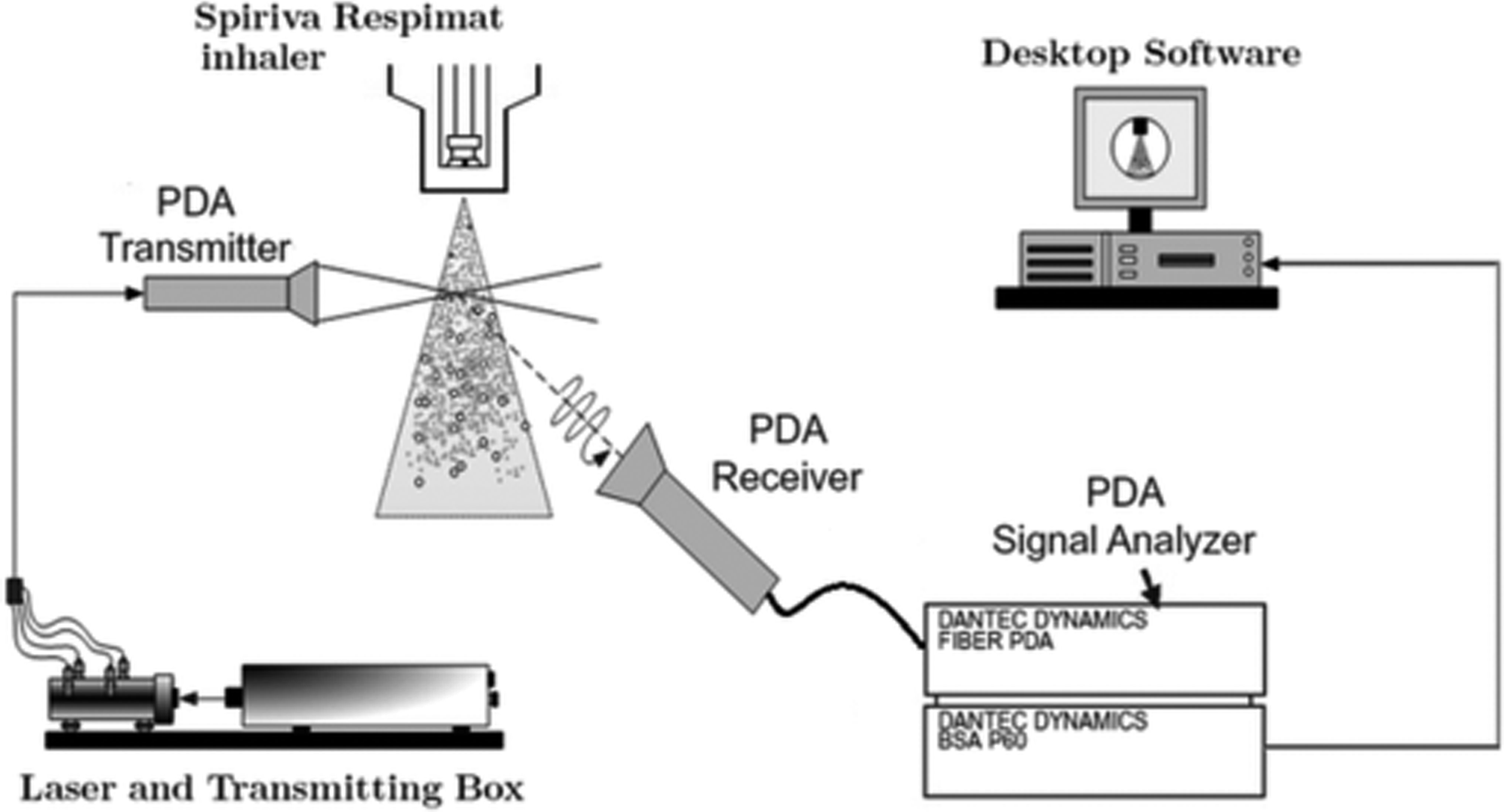
The process diagram of the experiment setup. PDA, phase Doppler anemometry.
The test procedure for data acquisition at each measurement location was taken at ambient laboratory conditions (∼22°C). To characterize the spray spatially, stations are selected to take a discrete measurement at those locations in the flow field. The inhaler nozzle orifice was set to be the origin of measurements, and the measurements were taken at four different axial increments from the origin. The first axial measurement location was defined as 6.5 mm, which corresponds to the edge of the MP; the measurement station positions were defined at 6.5, 25, 100, and 125 mm for the axial stations. A single point measurement was taken at 6.5 mm location, and two cylindrical measurement planes are defined at 25, 100, and 125 mm axial stations, which are the vertical and the horizontal axes, with three radial locations. Figure 2 shows the positions of these locations. The tests were performed and the spray data acquired. Five sprays were actuated at each location to accomplish representative ensemble-mean values.

Experimental measurement locations (6.5, 25, 100, and 125 mm from the nozzle).
Mouth cavity effect
In addition to the actuation of the inhaler in the open-air sounding environment (ambient laboratory conditions), two models representing the mouth confinement (based on the Andersen Cascade Impactor [ACI], IP, and another Idealized Mouth [IM]) were used. The measurements were only taken at 100 mm away from the nozzle orifice of the inhaler to be compared with the measurement performed in an open-air environment. Similar to open-air measurements, three radial locations on both the vertical and the horizontal axes were measured. The inhaler is inserted to each model without obstructing the vents on the Respimat inhaler.
The first model is a replica of the horizontal (top) section for the ACI IP (as displayed in Fig. 3) provided by Copley Scientific Limited (Nottingham, United Kingdom). The second model is the idealized mouth as described by Zhang et al.(11) Only the portion that mimics the mouth cavity (i.e., excluding the throat section) is modeled, as displayed in Figure 4. Both models were manufactured using CREO® SolidWorks software and the Dimension BST 3D ABS printer (Stratasys, Eden Prairie, MN).

Schematic of the ACI IP. ACI, Andersen cascade impactor; IP, induction port.
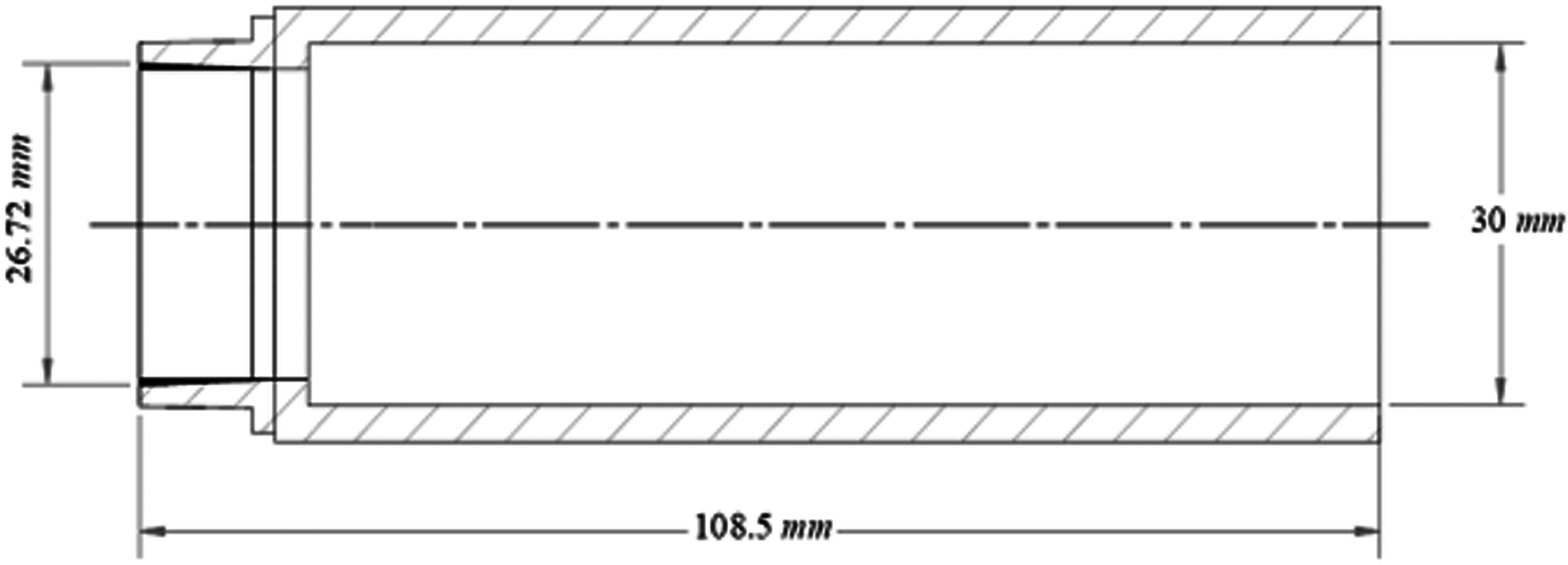
Schematic of the idealized mouth.
Particle size
Deposition of medication into the lungs depends not only on velocity but also on the aerosol particle size.(12,13) Particle size is defined by the arithmetic mean diameter (D10), the volumetric mean diameter (D30), and volume-based median diameter (Dv50).
The arithmetic mean diameter, D10, is the simple average diameter of all particles in the aerosol mist and is calculated using the following equation(14):
where ni is the number-based frequency of occurrence of particles in size class i, having a mean diameter Di, and p the total number of particles.
The volumetric mean diameter, D30, is calculated from the mean of the particle volumes and is determined by(14):
Volume-based median diameter, Dv50, is the particle size within an aerosol, where 50% of its particles (regarding volume) are contained equally above and below what is termed the volume median diameter, Dv50 (VMD). Where particle density is consistent throughout the aerosol, VMD and mass median diameter (MMD) are the same.(15,16)
Particle size distributions
The probability of occurrence of particles with different sizes in an aerosol spray can be gained through the use of PDFs. Hence, distribution fitting methods are utilized on measured experimental data to get the most proper fitting that describes the data. In this study, to calculate the PDFs, three PDFs are designated for the data analysis: (1) Rosin–Rammler, (2) log-normal, and (3) Nakagami as those PDFs showed the best curve fitting in the particle size distribution area.
The Rosin–Rammler distribution function is often used to define the particle size distribution of several types and sizes. The function is particularly appropriate for representing particles generated by crushing processes.(16) Even though it is successfully used to calculate the size distribution in various fields as well as pharmaceutical aerosols, this function can be described by(17):
where x is the independent variable, λ is the mean diameter, and k is the distribution spread.
The log-normal probability distribution function, in which the logarithm of the random variable is distributed normally, is given as follows(17):
where σ represents the shape parameter (the standard deviation of the log of the distribution) and μ is the scale parameter (the mean of the distribution).
Nakagami distribution function is one of the most common distributions for modeling right-skewed positive data sets. It is also used to characterize the droplet size distribution during fog conditions.(18) This function can be expressed as:
where Γ is the gamma function, Ω the scaling parameter, and the m Nakagami parameter, which is related to the shape of the Nakagami distribution.
Results and Discussion
Particle velocity
To characterize the flow generated by the Spiriva Respimat SMI spatially, particle size and velocity were assessed at multiple locations. The mean velocity was used to characterize the flow generated from the Spiriva Respimat inhaler since it was shown that particles close to the center of a spray have consistently high velocity for pMDIs.(19,20) Furthermore, the impact of the distance increment on particle velocity and size was also investigated.
Characteristics of the transient spray velocity
To study the temporal evolution of the spray velocity, fixed points along the centerline are taken to evaluate the ensemble-averaged velocity. The transient event duration for the four locations is very similar (about 1500 ms). Figure 5a–d shows the raw data for the particle velocities as a function of time for five actuations at 6.5, 25, 100, and 125 mm on the centerline away from the nozzle, respectively. The solid line represents the moving average velocity of the released particles, whereas the dashed line illustrates the overall mean velocity (for all particles over time). At 6.5 mm (the edge of the inhaler MP), the highest mean velocity (10.95 m/s) is found when compared with other locations, as expected. The moving average velocity is measured to be ∼17.5 m/s at the beginning of the actuation and then decreases slightly but with a value above the mean velocity (10.95 m/s). At 1200 ms, the moving average velocity fluctuates around the mean value until 1300 ms where a drop below the mean value is observed. For all the other locations, a similar trend is found where the moving average velocity is almost constant and fluctuates around the mean velocities (4.52, 1.35, and 1.33 m/s for 25, 100, and 125 mm locations, respectively, as shown in Table 1).
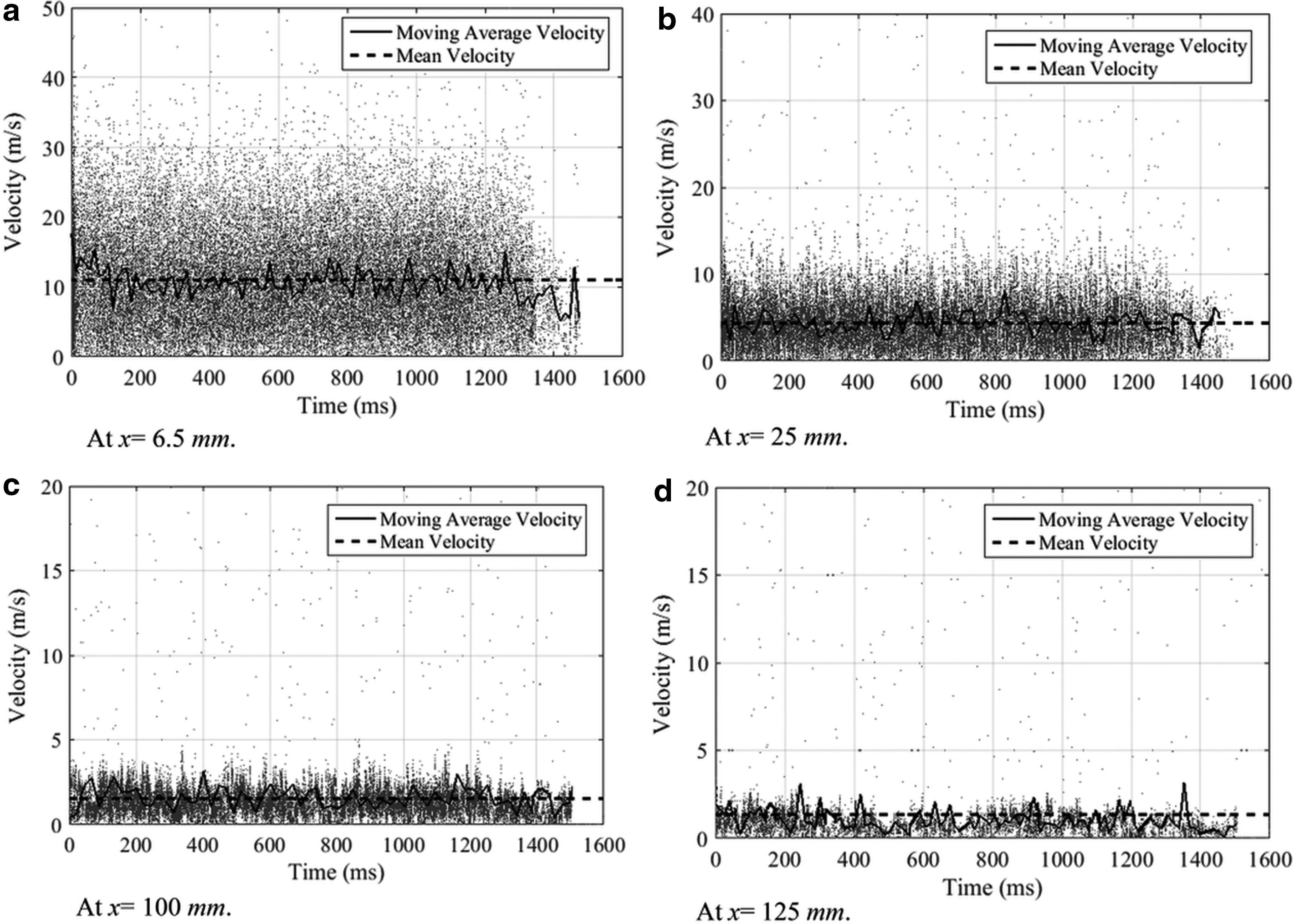
Raw data for the particle velocities for five actuations for the Spiriva Respimat inhaler at different locations.
Mean Particle Velocity for Five Actuations Measured at 6.5, 25, 100, and 125 mm Away from the Origin Along the Centerline of the Spiriva Respimat Inhaler (Units: m/s)
Spatial analysis of the spray velocity
The mean velocity (over the centerline at different distances from the nozzle) spatial analysis for the Spiriva Respimat inhaler is shown in Table 1. The mean velocity decreases from 10.95 m/s at the edge of the MP to 1.33 m/s at the 125 mm location. The difference in velocity between different locations is assessed. A decrease of 58.72% is found between the 6.5 and 25 mm locations, whereas a difference of ∼87% is found comparing the 6.5 mm location with the 100 and 125 mm locations. The evaluation of particles' velocity between the second location with the third and forth locations is very similar with a decline of 70%.
Comparing the velocity reduction obtained using the Spiriva Respimat inhaler with pMDIs results performed in a previous study by Alatrash and Matida,(10) it is found that the velocity decline (58.72%) between the locations 25 and 100 mm away from the nozzle (from 4.52 to 1.35 m/s, respectively) for the Spiriva Respimat inhaler is smaller than the average of all tested pMDIs (33.85 to 9.31 m/s at similar locations from the nozzle or a 72.5% decline).
The results of the velocity spatial analysis for the Spiriva Respimat inhaler are presented in Figure 6 for both axes of symmetry, that is, horizontal, 0°, and vertical, 90° (see again Fig. 2 for the orientations). Figure 6 shows the radial profiles of the axial mean velocities of particles at locations 25, 100, and 125 mm. The velocity is reduced as the particles travel downstream due to evaporation and loss of inertia. The results produce mostly symmetrical profiles at 25 and 100 mm locations. At location 25 mm, the velocity is slightly lower on the 90° axis. Likely due to gravitational effects, a slightly asymmetrical profile is observed at the 125 mm location for the 90° axis.

Axial mean velocity of particles for the Spiriva Respimat inhaler at different longitudinal locations.
Particle size
Characteristics of the transient spray particle size
Figure 7a–d illustrates the raw data for the particle diameters with respect to time for five actuations using the Spiriva Respimat inhaler obtained using the PDA technique. The solid line represents the moving average diameter of the released particles, whereas the dashed line illustrates the diameter D10. At the first three locations (6.5, 25, and 100 mm at the centerline), a large particle size at the end of the actuation is observed. This is a dominant phenomenon in most of the actuations. However, this phenomenon is not observed at the 125 mm location. In addition, for both locations 6.5 and 25 mm, the average is below and close to the mean. At the location 6.5 mm, the mean diameter is found to be 5 μm, a value that decreases lower than the mean until 1120 ms when it increases above the mean as a result of the large particles observed. At location 100 mm, the moving average diameter starts below the mean and keeps fluctuating around the mean value until the start of the enlargement of particles at the end of the actuation. The phenomenon observed in this study was not reported in previous studies(3,7) that investigate the dynamics of the Spiriva Respimat inhaler. This increase in particle size at the end of the actuation could be due to the inhaler spray loading mechanism. However, further investigation is required.
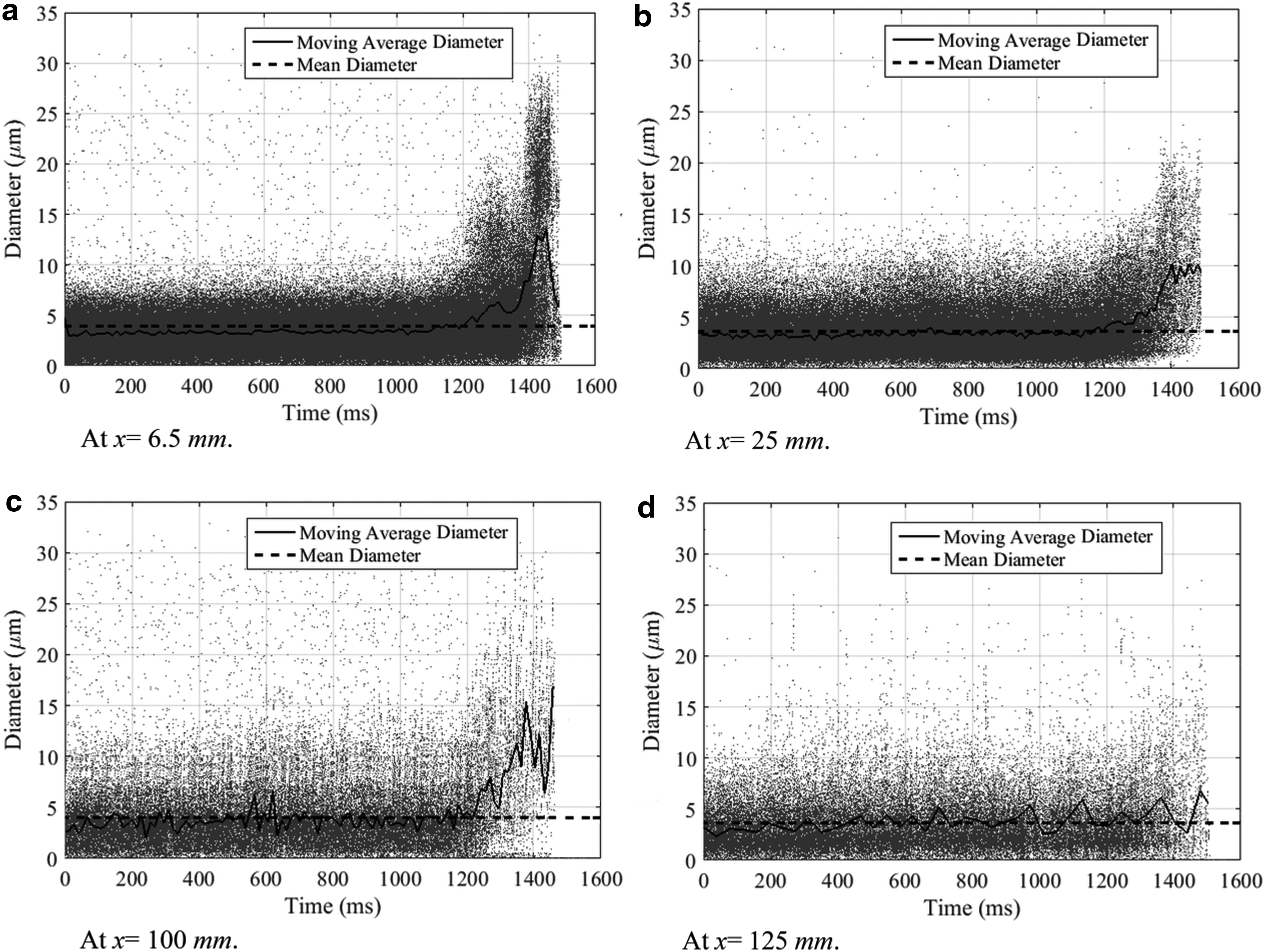
Raw data for the particle size for five actuations for the Spiriva Respimat inhaler at different locations.
Spatial analysis of the spray particle size
D10, D30, and Dv50 for the four locations along the x-axis for the Spiriva Respimat inhaler are presented in Table 2. As shown in Table 2, D10 values varied for all locations, decreasing from 3.97 μm at the location 6.5 mm to 3.32 μm at 100 mm location. Also, as illustrated in Table 2, there is an increase in D10 particle size from the 100 mm to the 125 mm location. This trend is also observed for the VMD Dv50, starting from 3.41 μm at the 6.5 mm location, followed by a decrease in value until location 100 mm (2.59 μm), and then an increase at 125 mm location to 2.92 μm. The reason for the increase in particle size between the 100 and 125 mm location is that the FPF that were smaller 5.8 μm represented only 55% of released particles at 100 mm, which can be clearly observed in Figure 7c. The FPF were 81% and 83% for both locations at 6.5 and 25 mm, respectively. Therefore, most of the small particles would evaporate before reaching the next location, leading to a decrease in particle size at the following location in contrast to the 100 mm location.
Particle Size Measurement for Five Actuations for the Spiriva Respimat Inhaler D10, D30, and Dv50 (Units: μm)
The PDA measurements were taken at the laboratory's ambient conditions where the relative humidity (RH) level is about 20% ± 5%. Therefore, any increase in RH would affect the size of the emitted aqueous aerosols generated by nebulizer measured with the ACI. If the RH is decreased, the particle size distribution is shifted to smaller particles, as a result of evaporation.(21) However, it has been found by Alatrash(22) that there was a slight shift in the particles size distribution due to the humidity effect for the Respimat SMI measured using ACI. The MMD Dv50 was found to be 5.0 and 4.8 μm for ambient RH (40%–50%) and RH >90%, respectively. Moreover, Ziegler and Wachtel(23) reported that there was a significant change in aerosol size distribution in laser diffraction measurements of the Respimat spray as a function of RH (where it was measured by the laser diffraction method inside the modified IP of ACI), which when the RH is increased, the particle size distribution is shifted to smaller particles. Their finding for Dv50 was 5.70 μm for ambient RH (30%–40%), whereas the Dv50 was 4.67 μm for RH >90%.
The effect of the flow rate on particle size distribution was investigated by Ziegler and Wachtel.(23) The flow rate varied between 18 and 38 L/min. For the tested flow rates, the MMD Dv50 value varied between 4.32 and 4.64 μm. Ziegler and Wachtel concluded that the effect of the flow rate on particle size distribution measured by the laser diffraction technique was insignificant.
The volumetric mean diameter, D30, is always reduced as the particles move downstream. Although droplets decrease in size while evaporating, the evaporation rate is a function of droplet velocity and its surface area, thus a continuous shift in particle size and distribution is observed in space and time.
Figure 8 shows the results of the VMD spatial analysis for the Spiriva Respimat inhaler. From Figure 8, it can be observed that Dv50 (at location 25 mm) increases as the radial distance from the center is increased, whereas negligible size variation in the radial direction is observed for the location 100 mm. Whereas for the location 125 mm, Dv50 radial distribution reveals some asymmetry, with larger diameters below the center point, likely due to gravitational and evaporation effects.

Particle volume median diameter spatial analysis for the Spiriva Respimat inhaler at different longitudinal locations.
Particle size distributions
Figure 9 shows the histogram of the experimental data for particle diameters with curve fitting (optimized by a chi-square goodness procedure) using probability distribution functions for the Spiriva Respimat inhaler for both locations 6.5 and 25 mm. In addition to determine how the experimental data will follow any of the selected PDFs, a series of tests are carried out by changing the bin size to observe its effect on the curve fitting using MATLAB function. Contrary to pMDI experiments performed in a previous study,(10) log-normal PDF shows the best curve fitting for the Spiriva Respimat inhaler at both locations, but the histogram is skewed at the 6.5 mm location, which is due to the fact that a higher portion of particles resides in this area. Table 3 presents the optimum parameters for each PDF for both locations.

Histogram of the experimental data of particles diameter with curve fitting of PDFs for the Spiriva Respimat inhaler. PDFs, probability density functions.
Optimum Parameters for Three Selected Probability Density Functions for the Spiriva Respimat Inhaler
Therefore, following these results, the log-normal PDF is used in further analysis of the Spiriva Respimat inhaler experimental data to investigate the size distributions at different time intervals for both locations: 6.5 and 25 mm. Thus, four intervals are used for the entire spray duration. Figure 10 shows that most large particles are released at the last of the time intervals (solid line curve) around 1146 ms for both locations 6.5 and 25 mm as it was observed in the raw data (Fig. 7a, b). This event is in contrast with previously tested pMDIs,(20) where small particles are emitted at the end of the actuation at the 25 mm location.
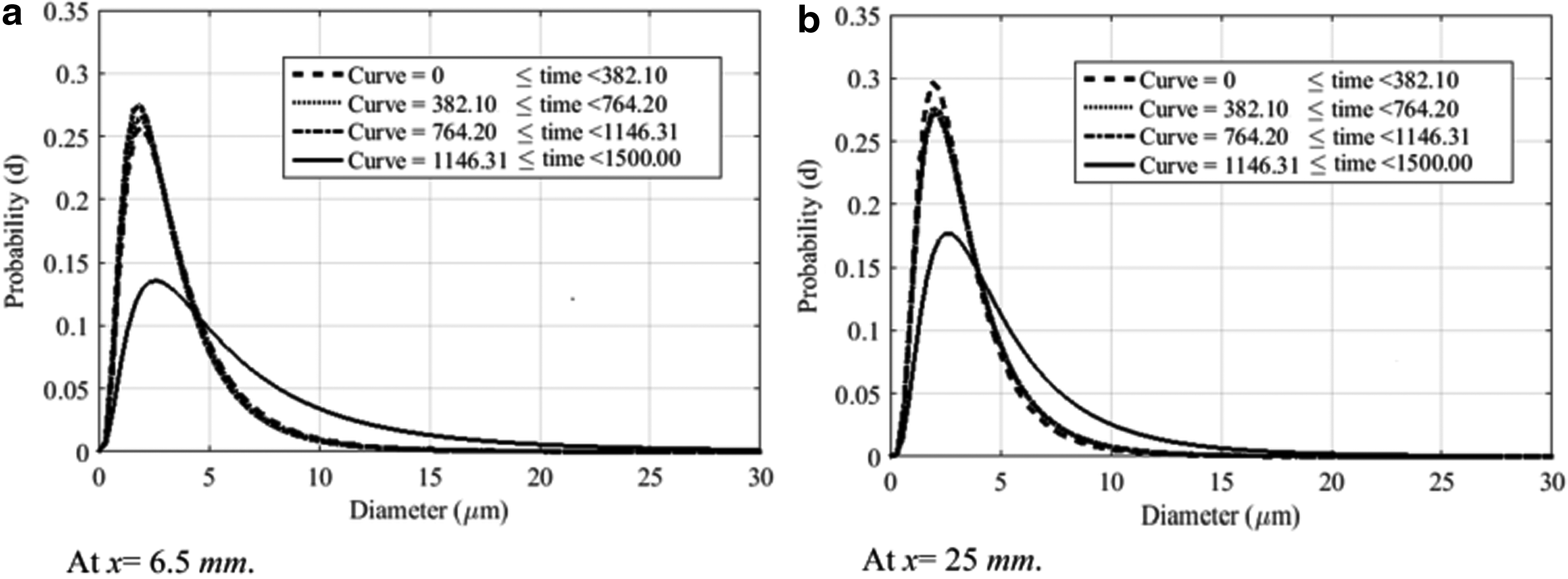
The particles' diameter log-normal PDF of six-time intervals for the Spiriva Respimat inhaler.
Mouth cavity effect
A comparison between the actuation of the inhaler in an open-air environment and inside both models is presented in Figure 11. Both the particles' velocity and the VMD (Dv50) are demonstrated. The results show that there was a drop in the particles' velocity for both models on each axes compared with the open-air environment. This behavior was expected as the flow is being constrained by boundary conditions. The centerline velocity was 0.45 m/s for ACI-IP and 0.49 m/s for Idealized Mouth (IM), and 1.35 m/s when the inhaler was actuated into an open-air environment. The VMD analysis showed that there was an increase in the particles size for both models on each axes compared with the open-air environment, likely due to a change in droplet evaporation rates caused by different mass transfer coefficients from the droplets to the surrounding environments inside the idealized geometries.

Particles' velocity and their Dv50 comparison between actuation of the inhaler in an open-air environment and inside ACI-IP and Idealized Mouth (IM).
Uncertainty Analysis
The absolute measurement principle of the phase Doppler method requires no system calibration.(24) However, since PDA measurements will detect information such as velocity and size of any particle that passes through the measurement volume, simultaneous particles that pass through the measurement volume will slightly bias the data. Consequently, averaging the data would overestimate the acquired mean, and an error would also be introduced in the estimated variance. A method to assess the uncertainty of the particle size and velocity similar to the one proposed by Kapulla and Najera.(25) was performed. The scatter of the particle estimate at a single point can be treated as normally distributed.(25) Thus, the determination of the particle size and velocity uncertainty can be achieved by first determining if each measured particle is statistically independent. Normally, lag time for typical atomization sprays is between 2 and 4 ms resulting in statistically independent acquisition frequency of 250 < f < 500 Hz.(24) Given the average acquisition rate of this study fluctuated around 2.2 kHz suggests conservatively that 35.5% of particle acquired is statistically independent. This analysis resulted in an average uncertainty value of 6.82% on both size and velocity of particles. This uncertainty considers the bias error of the system.
Conclusion
This study investigated both particle size and velocity for the Spiriva Respimat SMI, which is characterized using PDA. The investigation is carried out to examine the effect of sampling distance on the particle velocity and particle size. The following was found:
The highest velocity is found at the edge of the MP with 10.95 m/s, and then, it decreases to 1.33 m/s at the 125 mm location. The transient event duration for the inhaler is almost equal for all locations: ∼1500 ms. The results of the spatial analysis using cylindrical coordinates produced mostly symmetrical mean velocity profiles at different longitudinal locations, except for 125 mm. The mean diameter D10 values varied for all locations, ranging from 3.97 μm at the location 6.5 mm to 3.67 μm at 125 mm location. Log-normal PDF demonstrates better curve fitting when compared against two other PDFs (Rosin–Rammler and Nakagami). Large particles are released at the end of the spray duration, which is in contrast to pMDIs. The effect of the mouth cavity shows that there was a drop in the particles' velocity for both models on each axes compared with the open-air environment. Additionally, an increase in the VMD is found for both models on each axes compared with the open-air environment. This study is specific for this type of drug formulation only (tiotropium bromide). Other types of the Respimat, such as Stiolto Respimat, have different medication (tiotropium bromide and olodaterol) and other formulation such as dry powder formulation. As such, different medications should be tested as the future work.
Footnotes
Acknowledgment
We acknowledge the support of the Natural Sciences and Engineering Research Council of Canada (NSERC).
Author Disclosure Statement
The authors declare there are no competing financial interests.
Reviewed by:
Michael Hindle
Akira Tsuda