




Abstract
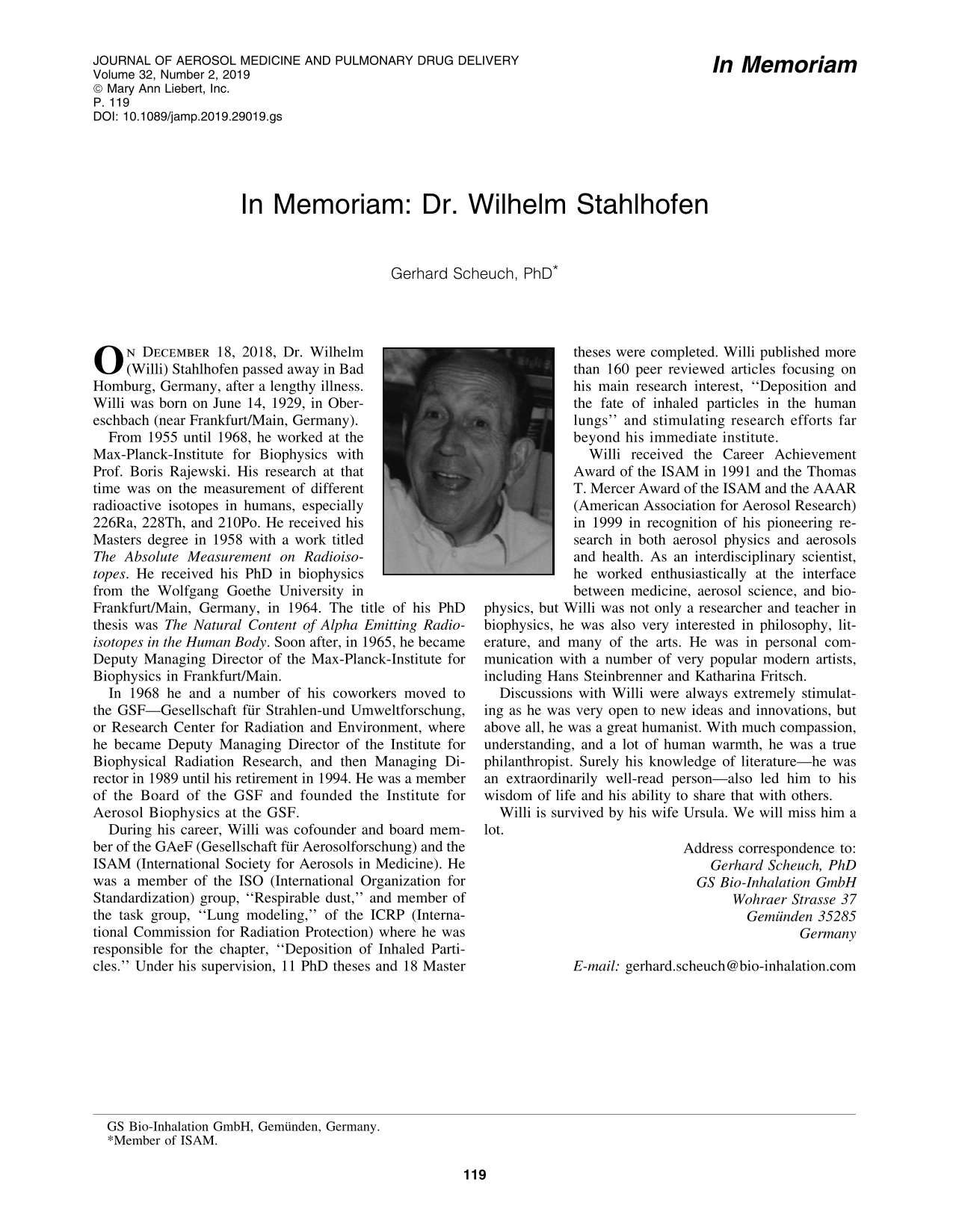
O
From 1955 until 1968, he worked at the Max-Planck-Institute for Biophysics with Prof. Boris Rajewski. His research at that time was on the measurement of different radioactive isotopes in humans, especially 226Ra, 228Th, and 210Po. He received his Masters degree in 1958 with a work titled The Absolute Measurement on Radioisotopes. He received his PhD in biophysics from the Wolfgang Goethe University in Frankfurt/Main, Germany, in 1964. The title of his PhD thesis was The Natural Content of Alpha Emitting Radioisotopes in the Human Body. Soon after, in 1965, he became Deputy Managing Director of the Max-Planck-Institute for Biophysics in Frankfurt/Main.
In 1968 he and a number of his coworkers moved to the GSF—Gesellschaft für Strahlen-und Umweltforschung, or Research Center for Radiation and Environment, where he became Deputy Managing Director of the Institute for Biophysical Radiation Research, and then Managing Director in 1989 until his retirement in 1994. He was a member of the Board of the GSF and founded the Institute for Aerosol Biophysics at the GSF.
During his career, Willi was cofounder and board member of the GAeF (Gesellschaft für Aerosolforschung) and the ISAM (International Society for Aerosols in Medicine). He was a member of the ISO (International Organization for Standardization) group, “Respirable dust,” and member of the task group, “Lung modeling,” of the ICRP (International Commission for Radiation Protection) where he was responsible for the chapter, “Deposition of Inhaled Particles.” Under his supervision, 11 PhD theses and 18 Master theses were completed. Willi published more than 160 peer reviewed articles focusing on his main research interest, “Deposition and the fate of inhaled particles in the human lungs” and stimulating research efforts far beyond his immediate institute.
Willi received the Career Achievement Award of the ISAM in 1991 and the Thomas T. Mercer Award of the ISAM and the AAAR (American Association for Aerosol Research) in 1999 in recognition of his pioneering research in both aerosol physics and aerosols and health. As an interdisciplinary scientist, he worked enthusiastically at the interface between medicine, aerosol science, and biophysics, but Willi was not only a researcher and teacher in biophysics, he was also very interested in philosophy, literature, and many of the arts. He was in personal communication with a number of very popular modern artists, including Hans Steinbrenner and Katharina Fritsch.
Discussions with Willi were always extremely stimulating as he was very open to new ideas and innovations, but above all, he was a great humanist. With much compassion, understanding, and a lot of human warmth, he was a true philanthropist. Surely his knowledge of literature—he was an extraordinarily well-read person—also led him to his wisdom of life and his ability to share that with others.
Willi is survived by his wife Ursula. We will miss him a lot.