




Abstract
Background:
The precaution of airborne transmission of viruses, such as influenza, SARS, MERS, and COVID-19, is essential for reducing infection. In this study, we applied a zero-valent nanosilver/titania-chitosan (nano-Ag0/TiO2-CS) filter bed, whose broad-spectrum antimicrobial efficacy has been proven previously, for the removal of viral aerosols to minimize the risk of airborne transmission.
Methods:
The photochemical deposition method was used to synthesize the nano-Ag0/TiO2-CS antiviral material. The surface morphology, elemental composition, and microstructure of the nano-Ag0/TiO2-CS were analyzed by a scanning electron microscopy/energy dispersive X-ray spectroscopy and a transmission electron microscopy, respectively. The MS2 bacteriophages were used as surrogate viral aerosols. The antiviral efficacy of nano-Ag0/TiO2-CS was evaluated by the MS2 plaque reduction assay (PRA) and filtration experiments. In the filtration experiments, the MS2 aerosols passed through the nano-Ag0/TiO2-CS filter, and the MS2 aerosol removal efficiency was evaluated by an optical particle counter and culture method.
Results and Conclusions:
In the MS2 PRA, 3 g of nano-Ag0/TiO2-CS inactivated 97% of MS2 bacteriophages in 20 mL liquid culture (2 ± 0.5 × 10¹⁶ PFU/mL) within 2 hours. The removal efficiency of nano-Ag0/TiO2-CS filter (thickness: 6 cm) for MS2 aerosols reached up to 93%. Over 95% of MS2 bacteriophages on the surface of the nano-Ag0/TiO2-CS filter were inactivated within 20 minutes. The Wells–Riley model predicted that when the nano-Ag0/TiO2-CS filter was used in the ventilation system, airborne infection probability would reduce from 99% to 34.6%. The nano-Ag0/TiO2-CS filter could remain at 50% of its original antiviral efficiency after continuous operation for 1 week, indicating its feasibility for the control of the airborne transmission.
Introduction
Airborne transmission of viruses, such as coronaviruses,(1–3) influenza,(4,5) measles,(6–8) porcine epidemic diarrhea virus,(9) and foot-and-mouth disease virus,(10) plays a significant role in epidemic infection. Control of the airborne spread of viruses is challenging because aerosolized viruses may survive and remain infectious for hours(7,11,12); airflow control through exceptional ventilation and air purification systems is required for better proficiency.(13,14) Room ventilation and air filtration act to dilute and eliminate infectious airborne viruses, and several epidemiologic studies have underscored its substantial role in the mitigation of airborne transmission.(13–15) Some viruses stay viable and infectious from hours to days on surfaces.(7,11) As a result, antiviral materials for both air and surface purification have attracted extensive attention. Nanosilver has exhibited a strong antiviral potential against a broad range of virus families, including retroviridae, hepadnaviridae, paramyxoviridae, herpesviridae, poxviridae, orthomyxoviridae, and arenaviridae.(16) Nanosilver could bind with virus coat proteins and cell membrane receptors and disturb their structure and function, which prevent viral attachment and entry into the host cells.(17) Nanosilver could also interact with the double-stranded DNA of the viruses.(18)
Our previous study has demonstrated the excellent bactericidal efficacy of zero-valent nanosilver/titania-chitosan (nano-Ag0/TiO2-CS) composite for purifying the supply air in hospital wards.(19) However, due to the different structures and aerosol particle sizes between viruses and bacteria,(20–23) the antimicrobial efficacy of nano-Ag0/TiO2-CS against viruses and bacteria would also be different. Thus, the primary aim of this study is to evaluate the filtration efficiency and antiviral efficacy of nano-Ag0/TiO2-CS filter for viral aerosols, along with the assessment of the infection risk reduction and long-term antiviral efficacy of nano-Ag0/TiO2-CS.
Materials and Methods
This study was conducted in the laboratory (in vitro) using MS2 bacteriophage and its host bacterium. There is no experiment involving any human subject or cell or data.
Preparation of MS2 bacteriophage suspension
MS2 bacteriophage was used as the surrogate of the airborne virus. MS2 bacteriophages were purchased from the Bioresource Collection and Research Center (BCRC), Taiwan (BCRC No. 70235), and the host bacterium, Escherichia coli F2, was also obtained from BCRC (BCRC No. 50354). The MS2 bacteriophage suspension for the viral aerosol generation was prepared according to the following procedure. First, the MS2 bacteriophage was multiplied by the double-layer agar culture technique. The double-layer agar culture plates of MS2 were placed at −20°C for 5 hours, and then the plates were thawed at room temperature. After thawing, the liquid produced was transferred to a centrifuge tube and centrifuged at 10,000 rpm (5000 g) for 10 minutes to precipitate the host bacteria. Finally, the supernatant was filtered with a 0.22-μm pore size membrane to obtain an MS2 bacteriophage suspension free of host bacteria.
Preparation and characterization of the nano-Ag0/TiO2-CS composite
The titania-chitosan (TiO2-CS) composite was prepared according to our previously reported method.(19) Briefly, 15 g of chitosan was completely dissolved in acetic acid solution (600 mL, 3% v/v, pH = 2.6). Then, 2.4 g of P25 TiO2 powder (particle size 25–30 nm; Brunauer-Emmett-Teller [BET] surface area 53.3 m2/g; 80% in the anatase phase and 20% in the rutile phase) was added to the viscous chitosan solution, and then the slurry was nonstop stirred for 24 hours to obtain a viscous colloid. Afterward, 1.02 mL of 25% glutaraldehyde solution, which was used as the cross-linking agent, was added to the viscous colloid, and the mixture was continuously stirred for 8–10 hours. The resultant colloid was then dropped into a 0.5 M NaOH solution using a syringe pump to form solidified TiO2-CS beads, and the solidification proceeded for 24 hours. Then the TiO2-CS beads were collected and rinsed with deionized water until reaching a neutral pH. Finally, the TiO2-CS beads were dried in an oven at 90°C for 12 hours. The 2 weight (wt) % nano-Ag0/TiO2-CS beads were prepared by photochemical deposition method.(24) Concisely, appropriate amounts of AgNO3, TiO2-CS beads, and methanol were mixed in deionized distilled water in a Pyrex beaker. After deaerating by flowing nitrogen (30 mL/min), the sample was illuminated by 350-nm ultraviolet lamps for 6 hours in a photochemical Reactor (Consotech Corp., Taiwan). The electrons generated on the surface of TiO2 were donated to reduce Ag+ to Ag0, while methanol served as a sacrificial agent to scavenge electron holes. Then the 2 wt% nano-Ag0/TiO2-CS beads were collected and dried overnight in an oven at 120°C.
The surface morphology, elemental composition, and microstructure of the nano-Ag0/TiO2-CS composite were examined by the scanning electron microscope/energy dispersive X-ray spectroscopy (SEM/EDS; JEOL JSM-7600F) and the transmission electron microscopy (TEM; JEOL JSM 1400-Plus) at 100 kV, respectively. The sample of nano-Ag0/TiO2-CS for TEM analysis was scraped from the surface layer of nano-Ag0/TiO2-CS beads. These surface samples were ground (in agate mortar) and dispersed in ethanol ultrasonically and then transferred to the Cu TEM grid (300 mesh with a carbon-coated film). The TEM images of TiO2-CS beads (without coated nanosilver) were also recorded for comparison.
Evaluation of antiviral efficacy of nano-Ag0/TiO2-CS composite
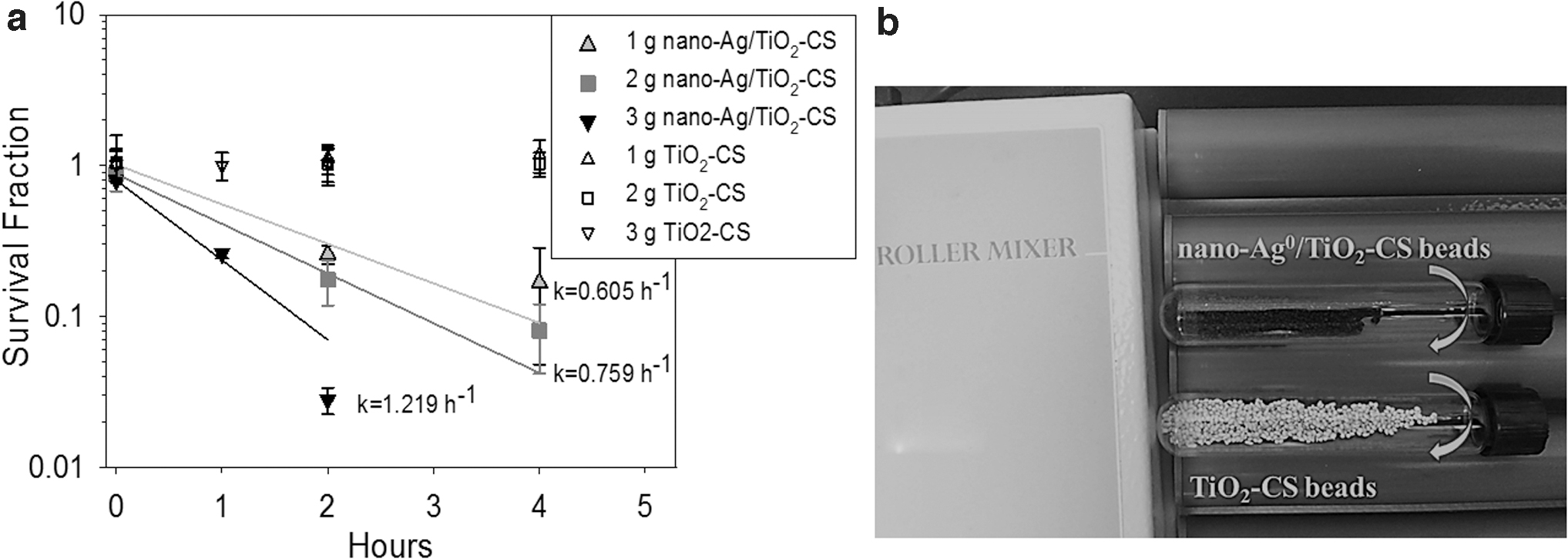
The plaque reduction assay (PRA) was utilized to evaluate the antiviral efficacy of nano-Ag0/TiO2-CS composite. Briefly, 1, 2, and 3 g of nano-Ag0/TiO2-CS beads (or 1, 2, and 3 g of TiO2-CS beads) were added to separate test tubes with screw caps, which contained 20 mL of 0.5% peptone solution. Then 750 μL of MS2 culture was added to each test tube (titer of MS2 = 2 ± 0.6 × 10¹⁶ plaque-forming units/mL). The test tubes containing MS2 cultures and 20 mL of 0.5% peptone solution were served as the control group. Then, all the test tubes lay horizontally on the rotating rods (Fig. 4b) of a Roller Mixer (Digisystem Laboratory Instruments, Inc., New Taipei City, Taiwan). The MS2 liquid cultures and nano-Ag0/TiO2-CS beads (or TiO2-CS beads) were well mixed by continuously rotating the test tube. The MS2 bacteriophage titer in these test tubes was determined at every 2- or 1-hour interval by the double-layer agar technique. Meanwhile, the release of nanosilver in the liquid was analyzed with an Inductively Coupled Plasma Optical Emission Spectrometer (Agilent 725). Peptone solution (0.5%) and deionized water were served as negative controls (without MS2 culture). Each experiment was replicated thrice. The survival fraction (SF) of the MS2 bacteriophage was evaluated by dividing the fraction PFU/mL at each loading of nano-Ag0/TiO2-CS beads (PFUnano-Ag0) or TiO2-CS beads (PFUTiO2-CS) by the fraction of control groups (PFUcontrol):
The SF of the MS2 bacteriophage was described by first-order kinetics:
where k is the inactivation rate constant, and t is time.
Experimental system
According to the experiment parts' function, the experimental system is divided into four parts: the zero-air supply, the viral-aerosol generation, filtration, and sampling parts, as shown in Figure 1. Before each experiment, the experimental system would be disinfected with 75% ethanol for 30 minutes. After the disinfection was completed, a control sample would be taken at the end of the experimental system by a modified AGI30 (Fig. 1) to confirm the decontamination result. Some previous studies(25,26) have demonstrated that 70% ethanol can reduce MS2 bacteriophage titer by 0.7 log10 in 2 minutes and 3.68 log10 in 20 minutes.

Diagram of the experimental system.
The zero-air supply part produced zero air by pushing the compressed air through the dryer (containing alumina and silica gel) to remove the moisture and then through the HEPA capsule (HEPA Capsule PN 12144) to eliminate the airborne particles.
The viral-aerosol generation part includes a rotameter, a Collison nebulizer (3-jet Modified MRE type; BGI) containing the suspension of MS2 bacteriophage, a diffusion dryer, and a Kr-85 neutralizer. The zero air was passing through the Collison nebulizer to generate MS2 droplets. Then, the air carrying MS2 droplets passed through the diffusion dryer to remove moisture and the Kr-85 neutralizer to neutralize the charges, and then the MS2 aerosols were generated. The MS2 aerosol output flow rate was controlled at 3.6 liters per minute (LPM) by a rotameter.
The viral-aerosol filtration part is a bed filter, which contains an acrylic vessel (diameter: 4.65 cm) packed with nano-Ag0/TiO2-CS beads at the thickness range of 0–6 cm, of which a close-up picture is shown in Figure 1. The airstream containing MS2 aerosols flew directly to the bed filter, and the total airflow rate through the nano-Ag0/TiO2-CS bed filter was 12.5 LPM. The removal efficiency of the nano-Ag0/TiO2-CS filter for MS2 aerosols was evaluated by the following equation:
where C0 was the concentration of viral aerosols measured when the filter chamber was empty (no packing), while Cf was the concentration of viral aerosols quantified when the filter chamber was packed with nano-Ag0/TiO2-CS (or TiO2-CS) at the thickness of 0, 2, 4, or 6 cm.
After each experiment, 0.38 g of nano-Ag0/TiO2-CS or TiO2-CS beads in the filter was extracted with 2 mL of 1% peptone solution, and its MS2 bacteriophage titer was determined by the double-layer agar technique. The survival ratio (SR) of MS2 bacteriophage on the surface of nano-Ag0/TiO2-CS (
The MS2 aerosol sampling was performed with an All Glass Impinger 30 (AGI-30) packed with glass beads. The sampling liquid was 1% peptone solution (30 mL), the sampling flow rate was 6 LPM, and the sampling time was 20 minutes. After the sampling, 1 mL of the sampling liquid was taken from the AGI-30, serially diluted, and then cultured using double-layer agar plates to evaluate the MS2 bacteriophage titer. Meanwhile, we used a six-channel (0.3, 0.5, 1.0, 2.5, 5, 10 μm) optical particle counter (OPC; 3016IAQ Lighthouse, Inc.) to real timely measure the viral-aerosol concentration in the inlet and outlet of the viral-aerosol filtration part to evaluate the removal efficiency of viral aerosols at each particle size interval.
Results and Discussion
Characteristics of nano-Ag0/TiO2-CS antiviral composite
A nano-Ag0/TiO2-CS bead is a rough sphere with a diameter of around 1.7 mm, as demonstrated in Figure 2a. The surface of the nano-Ag0/TiO2-CS bead is very rough and porous (Fig. 2b) and composed of spherical TiO2 nanoparticles covered by nano-Ag0, as shown in Figure 2c. The elemental composition analysis demonstrated a high percentage of Ag (wt% = 22%) on the surface of the nano-Ag0/TiO2-CS beads, as shown in Figure 2d.

SEM images of nano-Ag0/TiO2-CS bead
The TEM images in Figure 3a and b show that the nano-Ag0 particles are spherical or elliptical and uniformly deposited on the surface of TiO2 particles, and the particle sizes of nano-Ag0 range from 2 to 16 nm (5.94 ± 2.39 nm). The size distribution of 300 particles of nano-Ag0 was counted from three filters. Figure 3c and d demonstrates the TEM images of TiO2-CS composite, and no Ag was detected in the EDS analysis (as shown in the insert image).
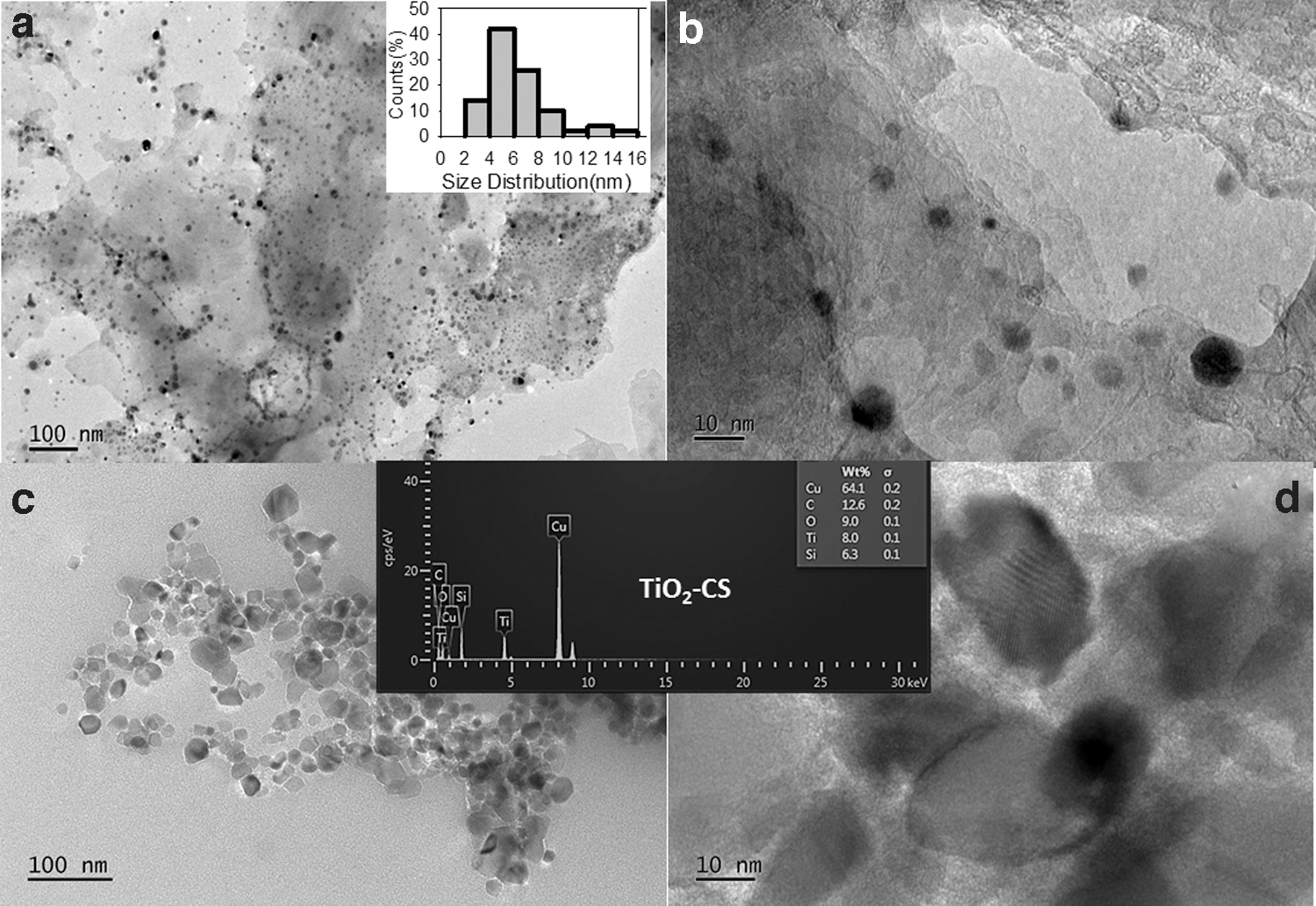
TEM images of nano-Ag0/TiO2-CS composite and particle size distribution of nano-Ag0
Plaque reduction assay
The result of PRA of nano-Ag0/TiO2-CS against MS2 bacteriophages demonstrated the remarkable antiviral efficacy of nano-Ag0/TiO2-CS, as shown in Figure 4a. However, the antiviral efficacy of TiO2-CS beads was not significant. The release of nanosilver from nano-Ag0/TiO2-CS in MS2 liquid cultures is demonstrated in Table 1. In 20 mL of MS2 liquid culture (2 ± 0.5 × 10¹⁶ PFU/mL), 3 g of nano-Ag0/TiO2-CS beads can deactivate 97% of MS2 phage within 2 hours. The survival of MS2 bacteriophages decreased exponentially with the time they contacted with nano-Ag0/TiO2-CS, and the inactivation rate constant for 1, 2, and 3 g of nano-Ag0/TiO2-CS beads in 20 mL of MS2 liquid culture was 0.605, 0.759, and 1.219 h−1, respectively. Liga et al. also investigated the virus inactivation by nano-Ag/TiO2 prepared by photochemical reduction method for drinking water treatment. Their results showed that the inactivation rates of MS2 by nano-Ag/TiO2 were fivefold more than those by TiO2, and the inactivation efficiency increased with the increase of Ag content.(27)
The Release of the Nanosilver in MS2 Liquid Cultures
LOQ = 100 ng/mL.
LOQ, limit of quantitation; nano-Ag0/TiO2-CS, nanosilver/titania-chitosan.
Nano-Ag0 can function as a reservoir for silver ions and therefore prevent the antimicrobial silver ions from being quenched by the anion ions such as Cl− and OH−. Conclusively, nano-Ag0 has better antiviral efficiency than ionic nanosilver.(28,29)
Physical removal efficiency of nano-Ag0/TiO2-CS filter for viral aerosol particles
As shown in Figure 5, the aerosols of MS2 bacteriophage were the nuclei of MS2 and media droplets and their size varied from 30 nm to 10 μm and most of the MS2 aerosol mass contributed by the particles >500 nm (in the range the OPC can cover). Therefore, the OPC was used to measure the filtration efficiency for MS2 bacteriophage aerosols. Besides, our previous study has shown that the “average size distribution of the coughed droplet nuclei was 0.58–5.42 μm, and 82% of droplet nuclei centered in 0.74–2.12 μm,(30)” which was also within the range the OPC can cover. As a result, we chose the OPC to measure the filtration efficiency for MS2 bacteriophage aerosols. In addition, the OPC has the advantage of real-time measurement of airborne viral particle concentration and size distribution. However, the removal efficiency of the nano-Ag0/TiO2-CS filter for viral aerosols obtained by the OPC cannot indicate the inactivation of viable viral aerosols. Thus, the culture-based method (double-layer agar culture) for the measurement of viral titer was also used to evaluate the effectiveness of the nano-Ag0/TiO2-CS filter on the removal of viral aerosols.

MS2 aerosol mass-size distribution (the particles <300 nm were measured by the Scanning Mobility Particle Sizer); the error bars represent the standard deviations of triplicate experiments.
As shown in Figure 6a, the physical removal efficiency of nano-Ag0/TiO2-CS filter for MS2 bacteriophage aerosols measured by the OPC was a function of the particle size of MS2 aerosols. The removal efficiency of the nano-Ag0/TiO2-CS filter for MS2 aerosols increased with the increase of the MS2 aerosol particle size. The highest MS2 removal efficiency occurred at MS2 aerosol diameter of 2.5–4 μm, and the primary filtration mechanisms were inertial impaction and interception.
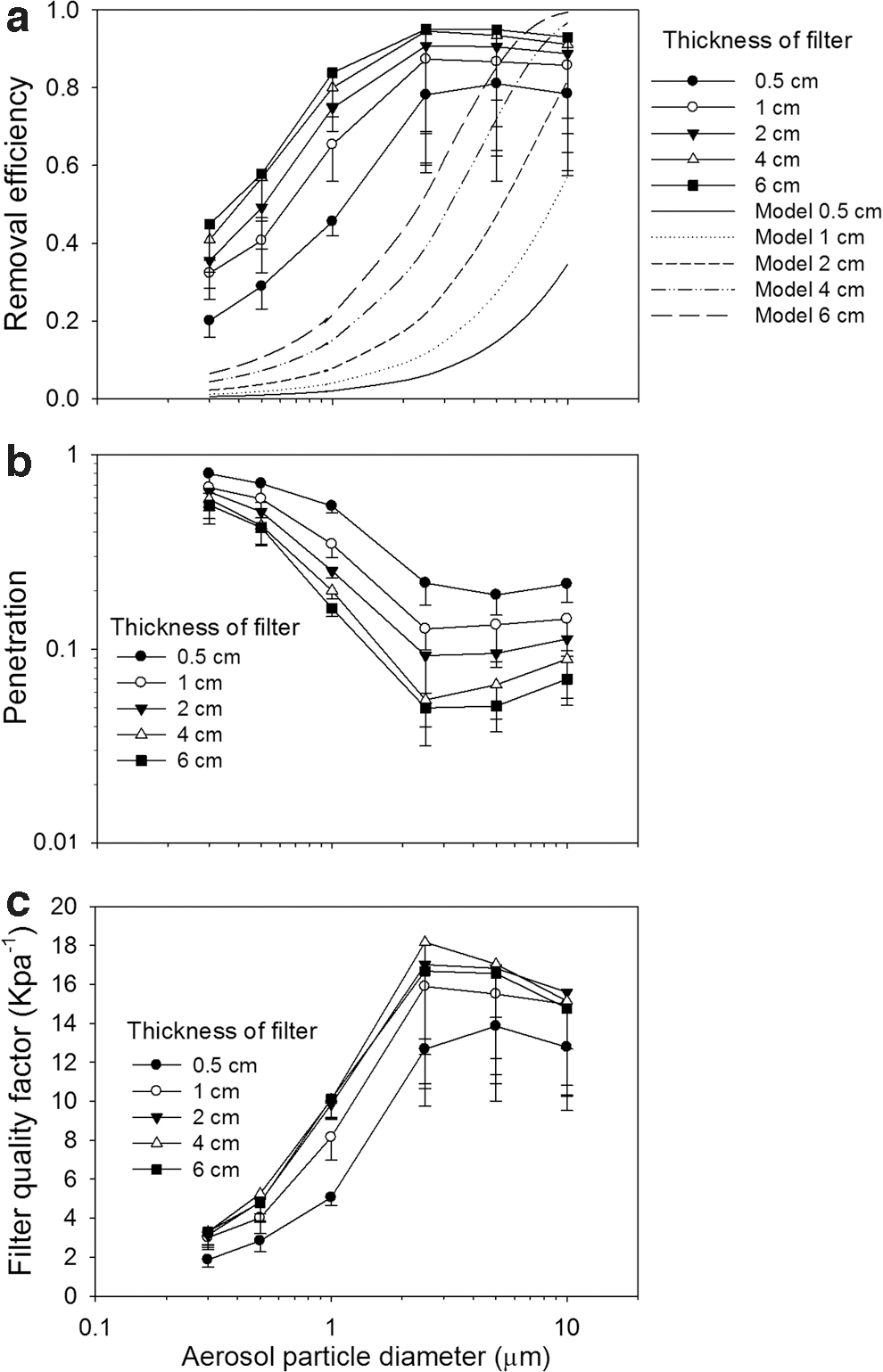
The viral-aerosol removal efficiency increased with the increase of thickness of the nano-Ag0/TiO2-CS filter. When the filter thickness was 2 cm, the removal efficiency of the nano-Ag/TiO2-CS filter for 2.5-μm viral aerosols could reach 89%, and it increased to more than 93% when the filter thickness increased to 6 cm.
We used the model based on single-grain collection efficiency (η0) to estimate the viral-aerosol particle removal efficiency (ηv)(31):
where ɛ is the porosity of nano-Ag0/TiO2-CS filter; L is the filter thickness; DAg is the diameter of nano-Ag0/TiO2-CS bead. The single grain collection efficiency, η0, was presumed to be the sum of each removal mechanism, including impaction, sedimentation, interception, and diffusion, and thus, η0 was expressed as what follows(32):
where η I , η S , η T , and η D represent the single-grain collection efficiency of impaction, sedimentation, interception, and diffusion, respectively. The details of these parameters can be found in Ozis et al.(32)
Figure 7b demonstrates the penetration of viral aerosol particles through the nano-Ag0/TiO2-CS filter. The lowest penetration occurred in the viral aerosol particle size range of 2.5–4 μm, while the maximum penetrating particle size for the nano-Ag0/TiO2-CS filter was 0.3 μm, where the collection efficiency of inertial impaction and diffusion was insignificant. The penetration of viral aerosol particles decreased with the increase of the nano-Ag0/TiO2-CS filter thickness. However, the pressure drop through the filter increased with the increase of filter thickness. A higher pressure drop (resistance) would increase the loading of the fan of the air purification system. A perfect filter requires both a lower pressure drop and lower penetration for viral aerosol particles. Herein, the filter quality factor (qF) was applied to assess the effectiveness of the filter:
where qF is the filter quality factor (1/mm-H2O); P is the penetration of viral aerosol particles; and Δp is the pressure drop (mm-H2O). According to Figure 6c, the filter with the best qF was that one with a filter thickness of 4 cm, and the next three were the ones with the filter thickness of 1, 2, and 6 cm, respectively. Consequently, the nano-Ag0/TiO2-CS filters with a thickness of 1, 2, 4, and 6 cm were used to test their removal efficiency on viral aerosols using the culture-based method.
The removal efficiency of nano-Ag/CS-TiO2 filter for viable viral aerosols
In the filtration experiment for viable viral aerosols, the MS2 aerosol particles first passed through a nano-Ag0/TiO2-CS filter (or TiO2-CS filter), sampled by a modified AGI 30 sampler,(33) and then enumerated by the double-layer agar plate method.
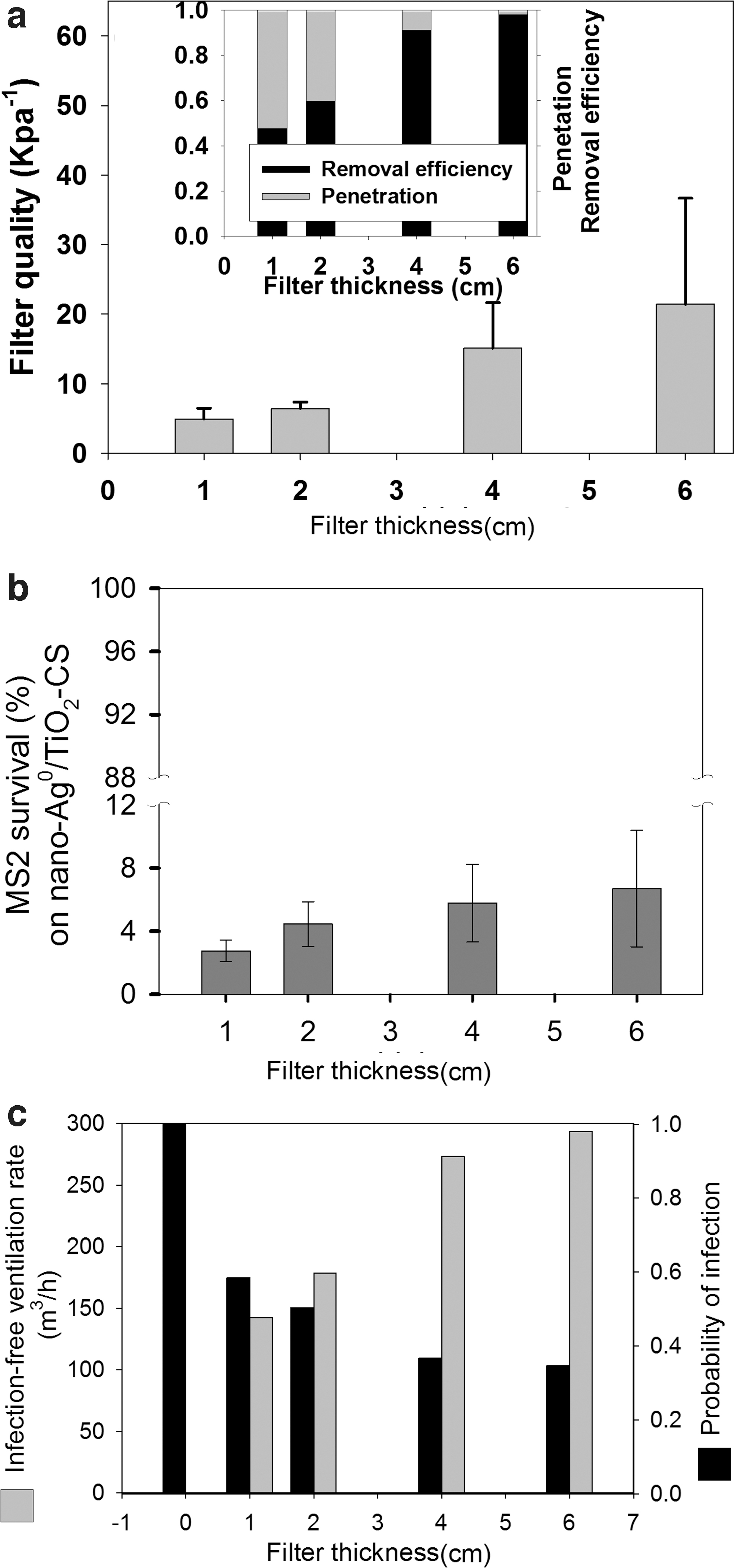
The removal efficiency for MS2 aerosols increased from 0.475 to 0.979 as the filter thickness increased from 1 cm to 6 cm, and the penetration of MS2 aerosols decreased accordingly (Fig. 7a and Table 2). This result was consistent with that obtained by the OPC. However, when the filter thickness was 6 cm, the quality factor was the best, of which the result was inconsistent with that obtained by the OPC. The possible reason for this case is that the OPC measured both viable and nonviable particles, including those produced from the medium of MS2 suspension. However, the double-layer agar culture method enumerated only the viable MS2 bacteriophages. Therefore, the aerosol particles generated from the liquid medium and inactive MS2 bacteriophages could cause the bias of the experimental result.
Removal Efficiency and Filter Quality Factor of TiO2-CS Filter for Viable Viral Aerosols (MS2 Bacteriophage)
After each experiment, the nano-Ag0/TiO2-CS beads (or TiO2-CS filter) in the filter bed were extracted with 0.5% peptone (0.383 g beads were extracted with 2 mL of 0.5% peptone) to verify the MS2 bacteriophage survival on the surface of nano-Ag0/TiO2-CS or TiO2-CS (contact time was 20 minutes) and evaluate the inactivation efficacy of the filters on MS2 bacteriophages. Over 93.3% of MS2 bacteriophages deposited on nano-Ag/TiO2-CS were inactivated within 20 minutes (survival ranged from 2.75% to 6.70%), as shown in Figure 7b.
Assessment of the efficacy of nano-Ag0/TiO2-CS filter on airborne infection control
To assess the feasibility of nano-Ag0/TiO2-CS filter for airborne infection control, the Wells–Riley equation(6,34) was used to estimate the probability of infection under some scenario:
in which pi represents the probability of infection; D is the number of infection cases; S is the number of susceptible; I is the number of infectors; q is the quanta generation rate; b is the pulmonary ventilation rate of a person; t is the exposure duration; and Q is the infection-free ventilation rate. Figure 7c demonstrates the probability of infection predicted by the Wells–Riley model. Accordingly, when the filter thickness increased from 0 to 6 cm, the infection-free ventilation rate increased from 0 to 293 m3/h, and the probability of infection decreased from 99% to 34.6%, implying a promising potential of nano-Ag0/TiO2-CS filter on the control airborne infection.
Assessment of the long-term antiviral efficiency of nano-Ag0/TiO2-CS filter
Joe et al.,(35) developed a model to predict the temporal antiviral efficiency of a silver nanoparticle coated air filter, and we used this model to evaluate the long-term antiviral efficiency of nano-Ag0/TiO2-CS filter:

where ηanti-vir (t) is the temporal antiviral efficiency of nano-Ag0/TiO2-CS filter; ρAg is the coating areal density of the 2 wt% nano-Ag0 on the surface of TiO2-CS beads (∼3 × 10¹⁶ nano-Ag0 particles/cm2); N″in is the flux of upstream virus aerosols flowing to the nano-Ag0/TiO2-CS filter (2.08 × 10¹¹ PFU/cm2/min); t is operation time (minutes); and SR is the survival ratio [Eq. (4)] that signifies the vulnerability of the MS2 bacteriophages against nano-Ag0/TiO2-CS (obtained from Fig. 8a). Assuming that SR declines with an increase in MS2 aerosol particles' coverage on the surface of nano-Ag0, which increases with the filter operation time, and thus, the SR can be modeled as what follows:
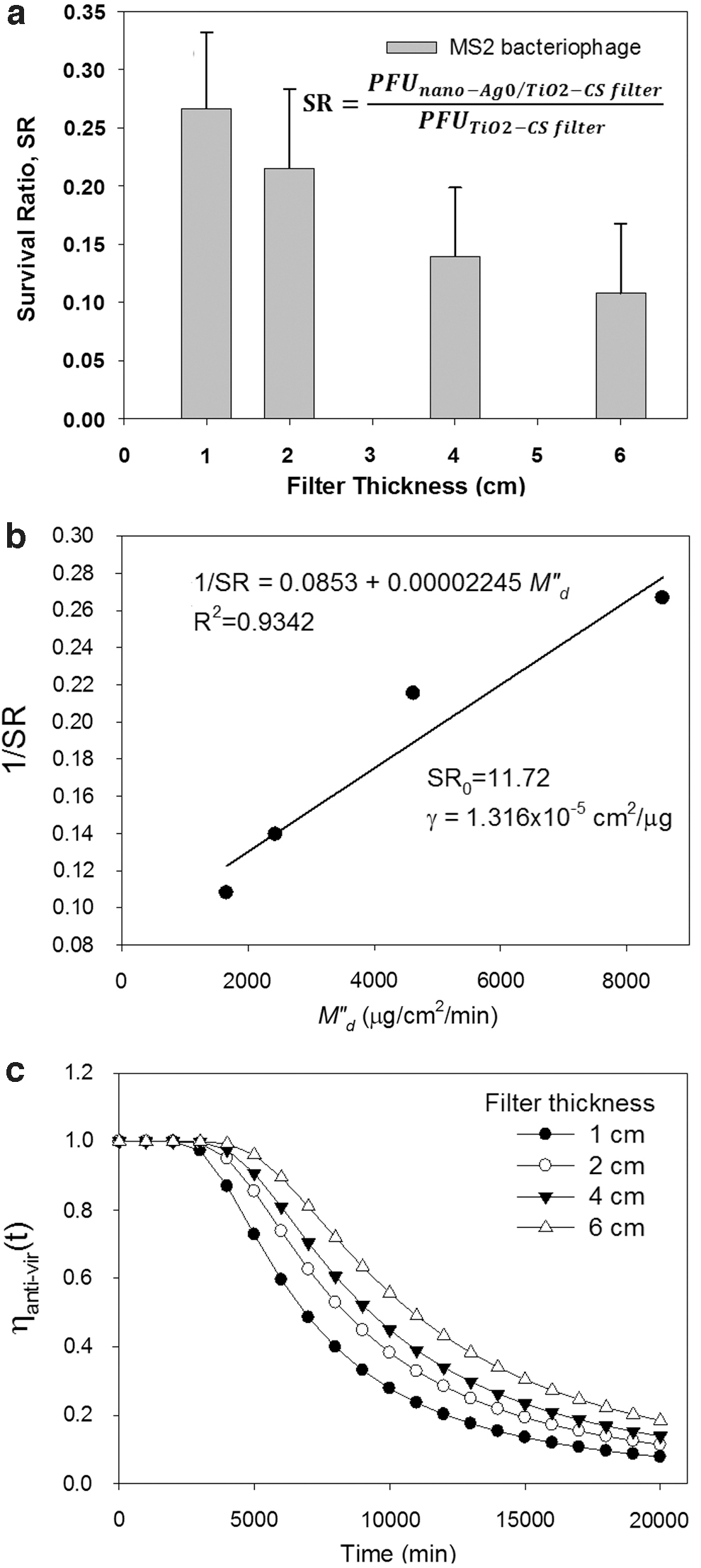

where SR0 represents the vulnerability of the virus against “clean” nano-Ag0/TiO2-CS (no covering on the surface of nano-Ag0); γ is a constant (cm2/μg); and M″d is the mass flux of MS2 aerosol particles (including the media particles) deposited on the surface of nano-Ag0/TiO2-CS filter (μg/cm2/min), which can be obtained by the following equation:

where ηfilter-dp is particle-diameter-dependent removal efficiency of nano-Ag0/TiO2-CS filter for aerosol particles (obtained from Fig. 6a); Cin-dp is the particle-diameter-dependent mass concentration of upstream MS2 and media aerosol particles flowing to the nano-Ag0/TiO2-CS filter (obtained from Fig. 5); Ufilter is the face velocity of the nano-Ag0/TiO2-CS filter; and Afilter is the surface area of nano-Ag0/TiO2-CS filter. To obtain κ0 and γ, we rearrange Equation (10), and get:

The plot of 1/SR versus M″d has an interception of 1/SR0 on the y-axis and a slope of γt/SR0, as shown in Figure 8b. Replacing the term, SR, in Equation (9) with the right side of Equation (10), we get,

We can use Equation (13) to predict the long-term antiviral efficiency of the nano-Ag0/TiO2-CS filter, as shown in Figure 8c. According to the model's prediction, even after continuous operation for 10,000 minutes (around 1 week), the filter could remain at 50% of its original antiviral efficiency when the filter thickness was larger than 4 cm.
Conclusions
In this study, the nano-Ag0/TiO2-CS filter was used for the removal and deactivation of airborne MS2 bacteriophage particles. In the air purification system, the nano-Ag0/TiO2-CS filter could remove up to 93% of airborne MS2 particles, and more than 95% of the MS2 can be efficiently deactivated on the surface of nano-Ag0/TiO2-CS within 20 minutes. According to the prediction of the Wells–Riley model, the infection-free ventilation delivered by the nano-Ag0/TiO2-CS filter could reduce the infection probability from 99% to 34.6%. The filter could maintain 50% of its original antiviral efficiency after continuous operating for 1 week. Conclusively, the nano-Ag0/TiO2-CS filter could be a potential air purification technique to reduce airborne transmission.
Footnotes
Acknowledgments
The authors also thank Miss Yu Wei Tsai and Hsin-Jui Lee for the help with experiments.
Author Disclosure Statement
Dr. I-Jen Wang is an employee of Taipei Hospital, Ministry of Health and Welfare of Taiwan. Dr. Yen-Chi Chen, Chien Su, Wan-Tien Shen, Chun-Hsuan Bai, Ming-Hsuan Tsai, and Dr. Kuo-Pin Yu declare that they have no conflict of interest.
Funding Information
This study is financially supported by the Ministry of Science and Technology of Taiwan (MOST 105-2221-E-010-002-MY3) and Taipei Hospital, Ministry of Health and Welfare. The authors are grateful to the Electron Microscopy Facility at National Yang-Ming University for providing the TEM and SEM images.
Reviewed by:
Tim Corcoran
C.-Y. Wu