




Abstract

Over the past decade, increasing numbers of multidisciplinary teams have been established in response to the growing need to integrate research, education, and healthcare better. The goal of these teams is to develop innovative and effective solutions to complex problems that would not be possible if addressed singularly. 4 Increased funding for team science from public and private institutions has reduced barriers to interdisciplinary scientific research and transformed divergent teams into permanent multidisciplinary fields. In 2007, the National Institutes for Health announced a Roadmap Initiative to bring diverse experts together to solve previously intractable problems, from obesity to mental illness. One of the funded programs launched the Oncofertility Consortium, a national interdisciplinary initiative to explore and expand the reproductive future of young cancer survivors through research and clinical care. This crucial support propelled the field of oncofertility to address the fertility needs and full reproductive options of the AYAO population. 5
Oncofertility is an interdisciplinary field at the intersection of oncology and reproductive medicine that expands fertility options for pediatric and AYA cancer survivors. 6 It is an innovative field comprising scientists, clinicians, social scientists, and humanists who are dedicated to developing new fertility preservation options for young cancer patients who may lose their reproductive abilities to cancer or its treatment, and to integrating multiple fields to reduce cancer patients' barriers to care. 7 The interdisciplinary nature is also matched by the disparate physical locations of the leaders in this field, as Oncofertility Consortium researchers are located across the globe. Professionals from each discipline, including oncology, reproductive endocrinology, law, and bioethics, bring their own vernacular and methodologies to new collaborations and, as such, special efforts must be made to reduce barriers that could hinder communication. 8
Frequent communication is the cornerstone of interdisciplinary team development in order for members to immerse themselves in the language of their collaborators. Through this reciprocity, which promotes intellectual data and information exchanges among participants, a common language is formed. 9 This new language creates a structure by which individuals from disparate disciplines can communicate freely and foster an intellectual environment that accelerates the pace and quality of research and clinical care. Such multilateral relationships have the potential to navigate a team into a cohesive and structured community with a singular focus. Historically, interdisciplinary fields have developed slowly due to communication barriers between disciplines and simple geography issues among subject experts. Now, with the advantages of innovative communication techniques that continue to improve radically each year, members of the field of oncofertility are able to develop this subspecialty at an accelerated pace with frequent and meaningful communication exchanges (Fig. 1). 10 Oncofertility researchers work with institutional information technology experts to identify communication barriers and technology solutions that could bridge these needs. Such tools take into consideration the privacy needs of researchers and clinicians, whether high-quality data images are to be shared, and the number of sites joining a virtual discussion. Similar methodologies may prove useful to other aspects of the AYAO professional community as it aims to speed research and improve clinical care for young cancer survivors.
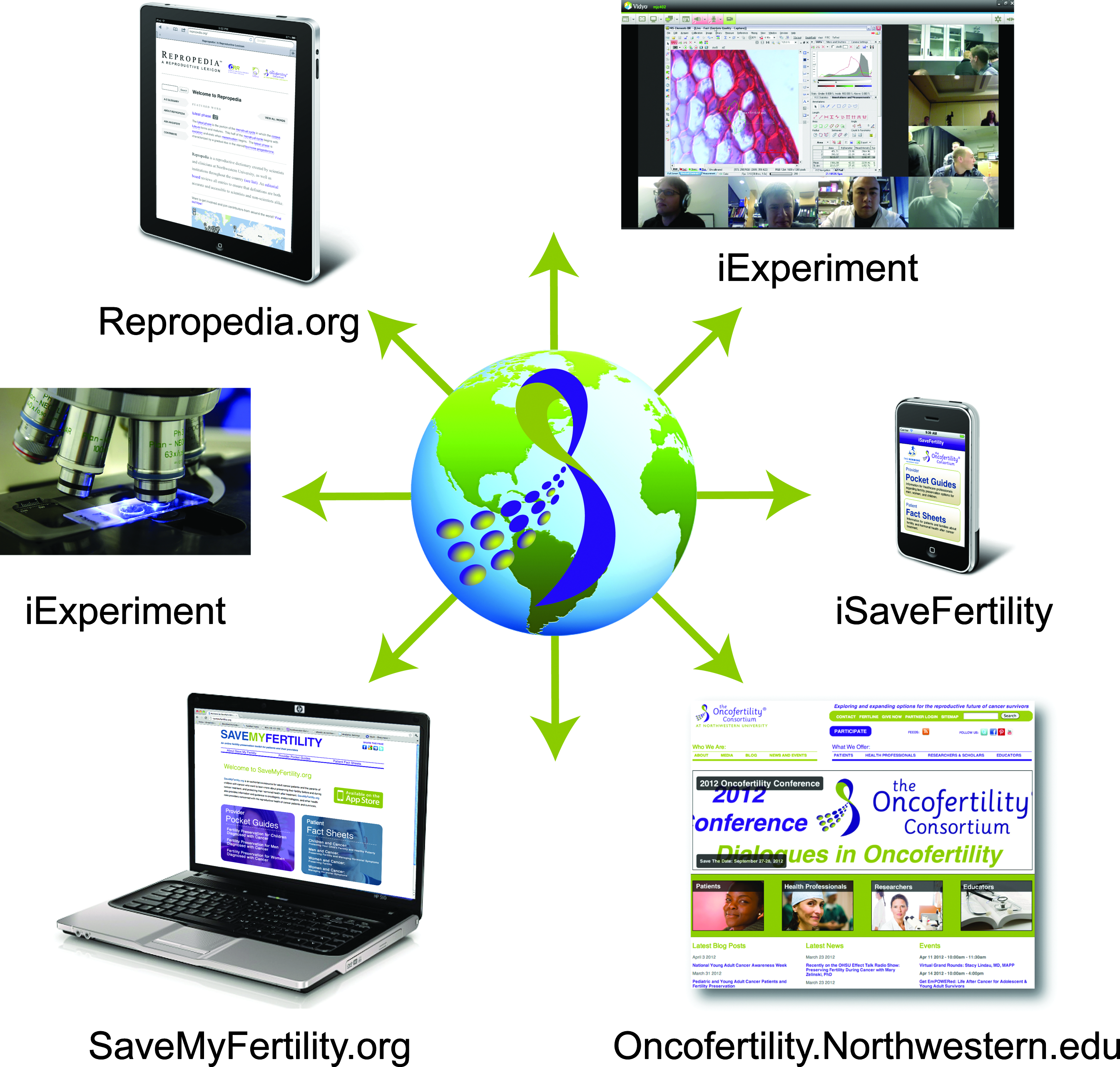
The global oncofertility community utilizes advanced digital and network-based technologies such as mobile technology, virtual microscopy, and patient educational websites to engage in frequent and meaningful communication, and to disseminate research results. Other interdisciplinary groups, including the adolescent and young adult oncology community, may use similar methodologies to advance their research and clinical missions.
Restricted gatherings between small groups of researchers, such as lab meetings, have long been used to discuss in-progress research, solve problems, reduce duplication, and maximize the success of projects. The national group of investigators in the Oncofertility Consortium use emerging computer technologies and broadband networks to communicate through monthly virtual lab meetings using Vidyo (Hackensack, NJ) videoconferencing technology, a distributed and highly adaptable communications system in which up to 10 sites engage in multi-directional sharing of video, audio, and data slides over a broadband network. Using this shared technology, investigators leverage the diverse skills and experiences of all researchers in the Consortium with the intent of increasing the pace of research. 11 Members of the AYAO research community can similarly utilize telepresence technologies to discuss the efficacy of emerging treatment protocols.
Clinicians interested in sharing best practices traditionally use grand rounds presentations to communicate their findings. To facilitate communication between a national group of reproductive and oncology clinicians, the Oncofertility Consortium incorporated current communication technologies into this traditional practice. These virtual grand rounds presentations allow stakeholders to communicate recently published research findings with the larger cancer and fertility community using Adobe Connect (San Jose, CA) technology. With this technology, a single presenter broadcasts video and data slides, and viewers ask text-based questions that can be answered in real time. This managed “one-to-many” model provides mechanisms for immediate in-session communication. An unlimited number of viewers can join these online presentations from anywhere around the world, and archives of these rounds are then housed online for researchers and clinicians to access at will. These clinical meetings allow for better fertility case management of young cancer patients and a shared capacity to act. The AYAO community could utilize similar technology to discuss research-based medical interventions through virtual grand rounds to increase survivorship in this unique population.
Mobile technologies have been widely adopted over the past decade and have transformed many aspects of professional and private life. 12 AYAO researchers and clinicians can utilize mobile technology to further build seamless research and clinical teams around the world. iExperiment was developed for oncofertility researchers to share microscope imaging of ovarian follicles in real time. As scientific breakthroughs occur without warning, this Vidyo technology was developed to work on mobile devices and personal computers across the globe. The ability to enable this form of direct access beyond the lab and the desktop to mobile and tablet devices is a dramatic move to address the widespread adoption of these technologies. Mobile technology can also be utilized to educate healthcare providers about cancer's effects on fertility and treatments to preserve fertility. The Oncofertility Consortium developed an iPhone application, iSaveFertility, for use by healthcare providers. In the first 4 months of its release, metrics indicated that users spent more than 10 minutes on iSaveFertility, the first smartphone application on cancer and fertility, providing some initial evidence that clinicians may learn new health information through mobile devices. The AYAO community consists of an equally diverse and interdisciplinary population of researchers and clinicians that could utilize similar mechanisms to communicate research results for implementation into clinical practice. 13
The AYAO and oncofertility communities both educate patients and their families in the decision-making process. For many decades, patients and researchers relied on providers to disseminate this information, but authoritative and accurate decision-making material can now be conveyed online. 14 In oncofertility, websites convey the physical and psychosocial effects of cancer treatment on fertility and options to preserve reproductive capacity. Furthermore, frequently updated blogs engage patients throughout and after the treatment process. Feedback from patient-oriented websites not only allows oncofertility researchers to improve online communication, but also stimulates the formation of new research questions. Due to their young age, members of the AYAO patient community are more likely to seek out healthcare information online than the general population. 15 AYAO advocates can leverage the technological savvy of young survivors to engage them online. AYAO researchers and clinicians can work with these existing structures or develop their own online programs to educate young patients and their families on new scientific advances and drive new research questions.
During their first year of availability in 2008, the Oncofertility. Northwestern.edu and MyOncofertility.org websites for oncofertility professionals and patients, respectively, received more than 13,000 unique visitors. 16 Expanding the content of such resources to include video, blogs, and mobile capabilities has increased usage more than threefold in just 3 years, indicating that technological advances can increase communication between researchers, clinicians, and patients in diverse communities such as AYAO. 17 Though young patients are likely to embrace emerging technologies, researchers and providers may be more hesitant. Healthcare providers who learned about online provider and patient materials on the SaveMyFertility.org website were asked to complete follow-up surveys. Provider responses included requests for traditional print versions of website materials, indicating that both clinician and patient preferences need to be accounted for when planning communication strategies for this distinct group. Individual feedback from some providers indicated that age may be a factor in the adoption of new technology. 18 The AYAO community can utilize this information to develop an integrative approach to education and engagement that fulfills the needs of young cancer patients and older clinicians simultaneously. 19
The AYAO community integrates the biological, psychological, and social impacts of cancer treatment and survivorship. 20 The nascent field of oncofertility has grown with the support of technology to facilitate communication between professionals that speeds the pace of research, implementation to clinical care, and patient education. We call for financial resources and time dedicated to developing authoritative online resources for the AYAO community. Such efforts will allow the interdisciplinary AYAO community to build a common language that will speed the pace of AYAO research and best serve patients. 21
Footnotes
Acknowledgments
This project was funded by the National Institutes of Health Roadmap for Medical Research, grant 5-UL1-DE019587-05.
Disclosure Statement
No competing financial interests exist.