




Abstract
Purpose:
The purpose of this study was to evaluate the risk of cardiac death in pediatric Hodgkin's lymphoma (HL) survivors and identify high-risk groups that may need additional surveillance.
Methods:
The Surveillance, Epidemiology and End Results program database was queried to analyze the rates of radiation therapy (RT) use and cardiac-specific mortality (CSM) in HL patients, aged 0–21 years, treated from 1973 to 2007. Primary endpoint was cardiac mortality.
Results:
A total of 6552 patients were included. Median follow-up was 12 years (range, 0–40). Median age at diagnosis was 17 years (range, 0–21). The majority were white (85.5%), from western states (41.2%), had nodular sclerosis HL (73.2%), presented with stage I or II disease (51.5%), and received RT (56.1%). Death from cardiac disease occurred in 114 patients (9.2% of all deaths). CSM for the entire cohort at 10-, 20-, and 30-year time points was 0.3%, 1.6%, and 5.0%, respectively. Median age at the time of cardiac death was 39 years (range, 18–58 years). Under multivariate analysis (MVA), adolescent patients (ages 13–21) had higher rates of CSM (hazard ratio [HR], 3.05; p = 0.005). Female gender (HR, 0.43; p < 0.001), patients treated from 1998 to 2007 (HR, 0.19; p = 0.018), and those with lymphocyte-rich histology (HR, 0.14; p = 0.047) had significantly lower rates of CSM. Use of RT was not associated with CSM under MVA (HR, 1.18, p = 0.452).
Conclusion:
The cumulative incidence of CSM in this population analysis of pediatric HL was 9.2%, with a steady decline over the past several decades. Adolescent patients at diagnosis and males were more likely to die of cardiac-related causes.
Introduction
H
Multimodality treatment with chemotherapy and radiation are well-known risk factors for long-term cardiovascular mortality in adult survivors of childhood cancer.1–5 A large European analysis found significantly higher rates of cardiovascular mortality after childhood cancer treatment in people receiving a cumulative anthracycline dose greater than 360 mg/m2 and radiation doses greater than 5 Gy. 5 Numerous other studies describe long-term cardiac toxicities, including myocardial infarction, decreased ventricular function, valvular disorders, and congestive heart failure.6–8 Efforts have been made to minimize the use of treatment modalities, in particular RT that puts survivors at risk for developing these long-term side effects later in life.
We sought to expand these data by using the Surveillance, Epidemiology and End Results program (SEER) database to evaluate the rate of cardiac mortality in the pediatric population. The goal of using this large population database was to potentially identify patient and treatment risk factors associated with higher rates of cardiac death.
Methods
Patient selection
The National Cancer Institute (NCI)-sponsored SEER database, including 18 registries, was queried using SEER*Stat-v8.2.1 (seer.cancer.gov). A total of 8862 pediatric and adolescent patients, aged 0–21years, who were diagnosed with HL between 1973 and 2007 were initially selected. For inclusion, complete data on survival and receipt of RT were required. Patients included were coded as either receiving or not receiving external beam RT; unknowns were excluded (n = 341). A sensitivity analysis was performed categorizing patients with unknown RT as receiving RT and not receiving RT, with similar results. The cutoff year of 2007 was chosen to allow for a minimum 5-year follow-up. A total of 6552 patients met inclusion criteria.
Patient demographics and treatment variables
Patient variables included age, gender, race, census region, year of diagnosis, tumor histology, tumor stage, and receipt of external beam RT. Census region was coded as facility location and defined by SEER and categorized as West/Alaska, East, Northern Plains, and Southwest. Stage designation was based on the Ann Arbor staging system. Receipt of chemotherapy was not included as SEER does not record this information. The primary endpoint of the study was cardiac-specific mortality (CSM). CSM was determined using cause-specific survival coded as diseases of the heart, which is inclusive of congestive heart failure, ischemic heart disease, and other cardiomyopathies. 9 Age at time of cardiac death was determined by adding the follow-up in years to the initial age at diagnosis.
Percent rate of cardiac mortality for the study cohort was calculated by dividing the number of cardiac deaths by the total number of deaths for each time period (every 4-year increments).
Statistical analyses
All statistical analyses were performed using SPSS V22.0 (SPSS, Inc., Chicago, IL). CSM was calculated from the date of diagnosis to the date of death. CSM was first examined using the Kaplan–Meier method. Univariate and multivariate Cox regression analyses were performed using CSM as the outcome with a significance level of p < 0.05. Two-sided p-values and 95% confidence intervals (CIs) are reported. The following variables were included under multivariate analysis (MVA): age at diagnosis (0–12 vs. 13–21 years), gender, race, census region, year of diagnosis (1973–1977, 1978–1987, 1988–1997, 1998–2007), histology, Ann Arbor stage (I/II vs. III/IV), and receipt of RT.
Results
Table 1 illustrates the baseline patient and treatment characteristics of 6552 individuals included in the analysis. Median follow-up was 12 years (range, 0–40 years). Median age at diagnosis was 17 years (range, 0–21 years). The majority were white (85.5%), were from western states (41.2%), had nodular sclerosis HL (73.2%), presented with stage I or II disease (51.5%), and received RT (56.1%). RT use in the study declined from 1973 to 2007 (73% of patients underwent RT in the years 1973–1977 compared with 50% in the years 1998–2007).
NOS, not otherwise specified.
Rates of cardiac mortality (divided by all deaths) declined from 1973 to 2007, with cardiac death rates of 14% in patients treated from 1973 to 1977 compared with 1% in patients treated from 2003 to 2007 (Fig. 1). At the time of this analysis, 1240 patients had died (18.9%); of the 1240 deaths, 114 were cardiac related (9.2%), 716 were due to HL (57.7%), and 410 were from other causes (33.1%). CSM for the entire cohort at 10-, 20-, and 30-year time points was 0.3%, 1.6%, and 5.0%, respectively. Median age at the time of cardiac death was 39 years (range, 18–58 years).
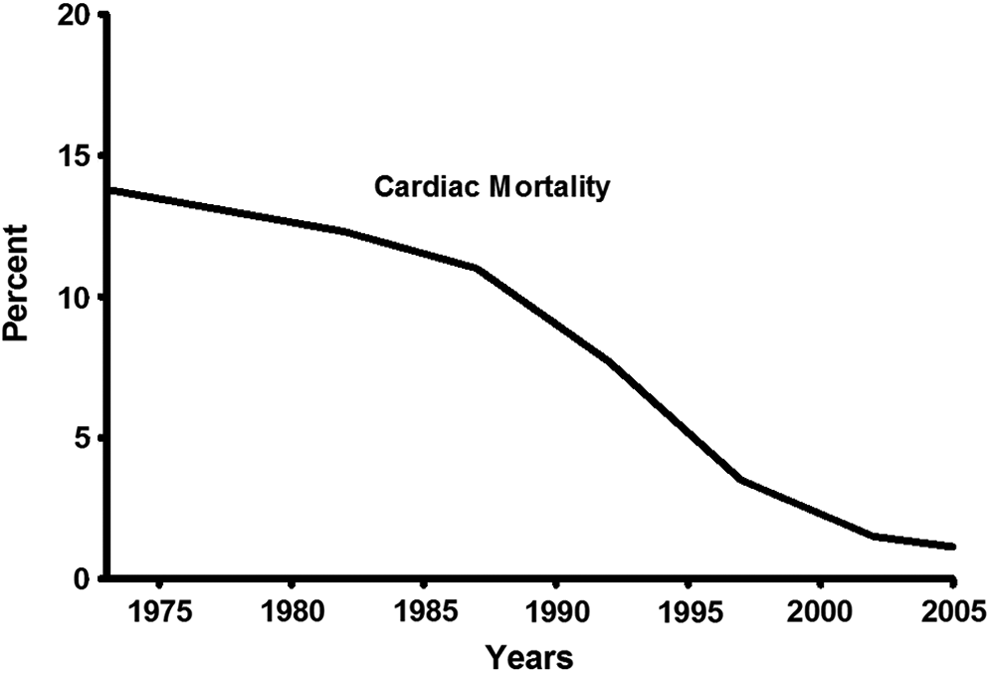
Percent rate of cardiac mortality for the study cohort from 1973 to 2007 queried from the SEER database. Values were calculated by dividing the number of cardiac deaths by the total number of deaths for each time period (4-year increments).
In univariate analysis (UVA), predictors for higher rates of CSM included those patients who were adolescents at diagnosis (13–21 vs. 0–12 years) (p = 0.007) (Fig. 2A). Under UVA, predictors for lower rates of CSM included female gender (p = 0.001) (Fig. 2B) and year of treatment, including 1988–1997 (p = 0.012) and 1998–2007 (p = 0.006). Under MVA, patients who were adolescents at diagnosis had higher rates of CSM (hazard ratio [HR], 3.05; p = 0.005). Female gender (HR, 0.43; p < 0.001), patients treated from 1998 to 2007 (HR, 0.19; p = 0.018), and those with lymphocyte-rich histology (HR, 0.14; p = 0.047) had significantly lower rates of CSM. Use of RT was not associated with CSM under MVA (HR, 1.18, p = 0.452) (Table 2). On subset analysis, RT was not associated with CSM in patients treated from 1973 to 1987 (HR, 1.31; 95% CI, 0.81–2.14; p = 0.273) or 1988 to 2007 (HR, 0.79; 95% CI, 0.29–2.19; p = 0.656) under MVA.
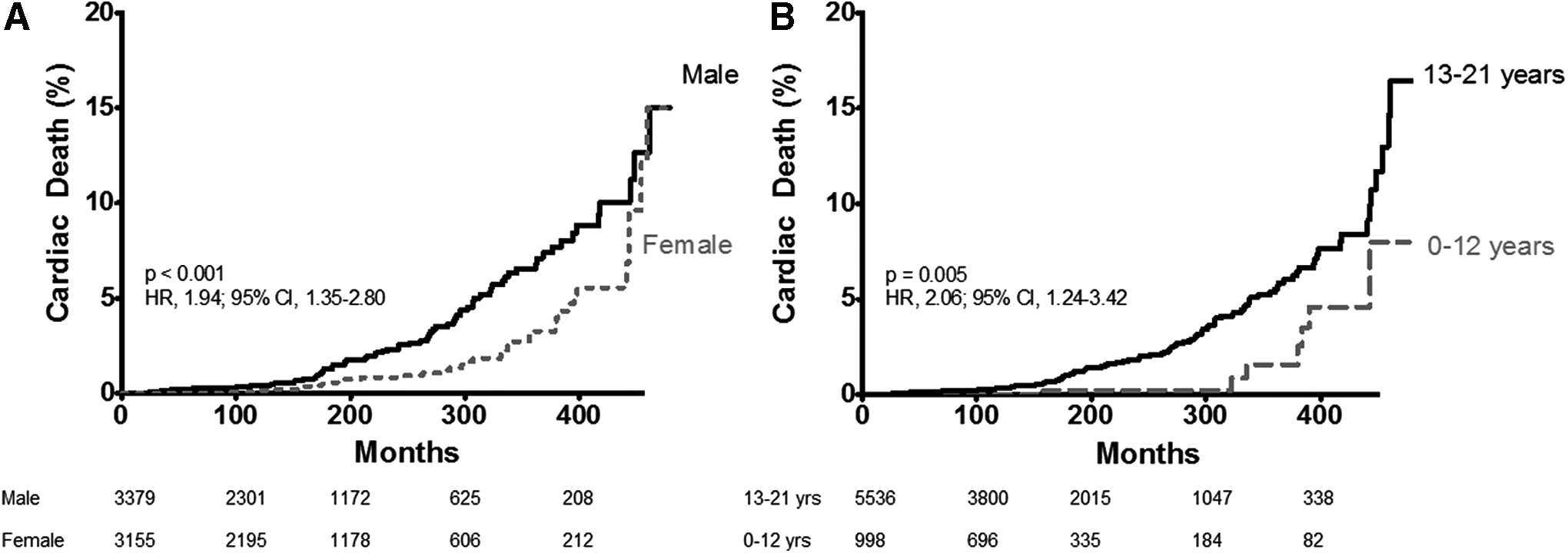
Kaplan–Meier curves demonstrating cardiac-specific mortality by gender
CI, confidence interval; HR, hazard ratio.
Discussion
Treatment-associated cardiovascular toxicity is of significant clinical importance in pediatric HL given the high survival rates. The leading cause of noncancer mortality in HL is cardiovascular disease. 10 Well-described treatment risk factors include RT treatment, especially at doses >30 Gy, dose per fraction, volume of heart in the RT field, and use of chemotherapy, including anthracyclines.7,11,12 The incidence of anthracycline-induced cardiotoxicity ranges from 4% to 36% depending on cumulative dose and age at treatment.7,13 Previous studies demonstrated that RT-induced cardiotoxicity contributes to 2%–5% of overall mortality in patients with HL and includes coronary artery disease (CAD), chronic heart failure (CHF), valvular disease, arrhythmias, and myocardial infarction.6,7,14–16 One study evaluating the rates of CAD on CT angiography in pediatric HL patients found the risk of coronary artery abnormalities to be 16% in the first 10 years after definitive treatment; the risk was 6.8 times higher in patients receiving mediastinal RT, especially >20 Gy. 17 Furthermore, the combination of both RT and anthracyclines can compound these risks when compared with treatment with RT or chemotherapy alone. 18 For example, one study found that the addition of anthracyclines caused a significant increase in CHF (HR, 2.81) and valvular disorders (HR, 2.10) in HL patients undergoing mediastinal radiotherapy; the cumulative rate of CHF after multimodality treatment was 7.9%. 6
To our knowledge, our SEER analysis is the first population-based longitudinal evaluation of CSM for pediatric and adolescent HL patients. The results demonstrate a gradual decline in cardiac mortality for pediatric and adolescent HL since 1973. Cumulative incidence of CSM at 30-year follow-up was 5.0% consistent with other reports. 3 The median age of cardiac mortality in this study was 39 years (∼22 years after their initial diagnosis and treatment). Data from this study support a recent publication by Al-Kindi et al., 19 who queried the SEER database to evaluate rates of CSM in adults (ages 20–49 years) treated for HL. They demonstrated a similar drop in CSM, with a 5-year cumulative incidence decreasing from 1.17% in 1990 to 0.19% in 2006, in addition to showing higher rates of CSM in older patients and males. Male gender and older age at time of cancer treatment have also been demonstrated to be predictive factors for CSM in other studies as well.16,20,21 Somewhat surprisingly and discordant with the literature, RT was not found to correlate with CSM. However, the use of RT has decreased over time, along with a decrease in CSM. Conclusions assessing RT correlation with CSM in the SEER database can be difficult due to lack of information on RT field (i.e., inclusion of the heart within the treatment field) and total dose. Last, data from a recent study reviewing echocardiograms of childhood cancer survivors found similar results demonstrating no correlation between receipt of RT and echocardiographic abnormalities. 22 The authors concluded that this was likely due to the lower median RT dose of their study population and that RT-associated valvular abnormalities may not have been captured as they may occur more than 20 years after treatment. However, the study did find that patients receiving anthracycline doses ≥250 mg/m2 had significantly higher rates of persistent echocardiographic abnormalities.
Data presented in this study demonstrate that adolescent males diagnosed with having HL are at highest risk for cardiac mortality. There may be several reasons, including treatment differences and lifestyle factors between the groups. A recent study evaluating metabolic health risk factors in childhood cancer survivors found that males and adolescent young adults were more likely to have hypertension, obesity, and elevated transaminases; participants in the study with all three risk factors present were males who were in the 18–34 age group. 23 Lifestyle factors, including smoking, inactivity leading to obesity, and hypertension, were thought to be more prevalent in the older age group and among males, which may be contributing to the findings observed in our study as well. Additional studies specific to HL survivors have also shown male gender to be an independent risk factor for developing CAD and myocardial infarction.6,16 It is less likely that treatment itself is contributing to our findings as guidelines for treatment have not significantly differed by gender and age group (pediatrics vs. adolescents). While close monitoring based on current cardiac screening guidelines for childhood and adolescent cancer survivors ought to be followed, our results suggest that adolescent males treated for HL are at exceptionally high risk and perhaps may benefit the most from cardiac screening exams and education on lifestyle modifications.
The risk of CSM is known to be particularly high in cancer patients treated at younger ages. 24 Incidences of CHF in long-term HL survivors have been shown to be 10-fold higher for those receiving treatment before the age of 40 and at follow-up after 20 years. 4 The same study found these rates to be even higher in patients with a family history of heart disease. Similar to our study, the period 20 years after treatment appears to be when most cardiac events occur. A study, including HL patients treated in Britain, found that the relative risk of death from a myocardial infarction was twofold higher than the general population in years 1 through 14 after the start of treatment, fourfold higher during years 15 through 19, and remained significant during years 20 through 24 after the start of treatment. 20 Particular attention therefore during the first 20 years post-treatment is critical and may extend to at least 30 years or more post-treatment, as one multi-institutional study found. 3 Furthermore, models may be helpful in categorizing patients into cardiac risk categories based on age at time of treatment, gender, chemotherapy and radiation use, family history, and patient comorbidities. The Childhood Cancer Survivor Study (CCSS)-CHF is an available risk assessment tool to predict CHF in childhood cancer survivors, including treatment use (radiation, anthracyclines), gender, and age at diagnosis as measures of risk. 2 These models can enable clinicians to better target high-risk patients. Given the unique characteristics of pediatric and adolescent patients, separate models may need to be tested for them.
Additional factors that may be contributing to the decrease in the rate of CSM in this study are improvements in screening and early intervention for this high-risk population. Studies have demonstrated that several modifiable risk factors in adult survivors of childhood malignancies can significantly contribute to CSM, including hypertension, diabetes, dyslipidemia, obesity, and smoking. 1 This has led to better education on lifestyle modifications and use of pharmaceutical interventions when indicated. Furthermore, screening guidelines are now in place for high-risk childhood cancer survivors. The current NCCN guidelines suggest a stress test/echocardiogram at 10-year intervals after RT is completed. 25 The Children's Oncology Group (COG) long-term follow-up guidelines established cardiovascular screening recommendations in survivors of childhood cancer. These guidelines suggest baseline electrocardiogram and echocardiogram. Patients who receive mediastinal radiation with or without anthracyclines should be closely followed by annual physical exams and every 1–2-year echocardiograms with fasting blood glucose and lipid profiles.26,27 The European Society for Medical Oncology (ESMO) also provides a similar list of recommendations to screen for chemotherapy and radiation-induced heart disease. 7
While RT was not found to impact cardiac mortality in this analysis, we expect the potential contribution of RT to cardiac toxicity to continue to decrease as the treatment paradigm for HL continues to evolve. For example, over the past several decades, RT doses and treatment fields have significantly decreased. The transition from high-dose extended-field RT to involved-field RT and more recently involved nodal radiotherapy, which covers only postchemotherapy treatment nodal volumes, has substantially reduced cardiac dose by as much as 50%.28,29 In addition, response-adapted RT identifying a select group of patients who may not need additional RT after chemotherapy is currently underway in multiple studies and may further reduce rates of RT-induced cardiac mortality. 30
Our study has several limitations. SEER does not contain certain patient and treatment characteristics, including smoking status, alcohol consumption, body–mass index, and other associated medical conditions (e.g., lung disease), all of which are potential confounders for our results. RT total dose, fraction size, and treatment site were unknown and therefore conclusions on RT use and CSM cannot be made from this study. Additionally, we could not account for anthracycline-induced cardiotoxicity, which is known to correlate with cardiac mortality. Several studies, including one from Princess Margaret Hospital, demonstrated a strong association between cardiac toxicity and cumulative anthracycline dose received.18,31 Anthracycline-based chemotherapy regimens are known to independently contribute to cardiotoxicity, including decreased left ventricular function, arrhythmias, valvular disorders, and congestive heart failure. 6 Therefore, given the findings in this SEER analysis, it is very likely that anthracycline use and total dose are contributing to CSM. Because the SEER database combines ischemic disease, cardiomyopathy, and myocardial infarction into one category called diseases of the heart, we were unable to differentiate between the different types of events. Last, the low rate of cardiac mortality in the last 10 years demonstrated in Figure 1 may also be related to limited follow-up. While it is likely these numbers would increase with longer follow-up, the downtrend in cardiac death is noteworthy in patients diagnosed and treated over 20 years ago.
In summary, the cumulative incidence of CSM in this large population analysis of pediatric and adolescent HL was 9.2%, with a steady decline over the past several decades. While routine cardiac screening should continue to be performed for childhood cancer survivors, males and patients who were adolescents at the time of diagnosis may be at particularly higher risk for long-term cardiac mortality as demonstrated in our study. In conclusion, cardiac mortality rates appear to be decreasing and will likely continue due to improved awareness on lifestyle modifications and routine cardiac surveillance for childhood and adolescent cancer survivors.
Footnotes
Author Disclosure Statement
No competing financial interests exist.