




Abstract
Purpose:
This article examines how theoretical and clinical applications of social network analysis (SNA) can inform opportunities for innovation and advancement of social support programming for adolescent and young adult (AYA) cancer patients and survivors.
Applications:
SNA can help address potential barriers and challenges to initiating and sustaining AYA peer support by helping to identify the diverse psychosocial needs among individuals in the AYA age range; find strategic ways to support and connect AYAs at different phases of the cancer trajectory with resources and services; and increase awareness of psychosocial resources and referrals from healthcare providers. Network perspectives on homophily, proximity, and evolution provide a foundational basis to explore the utility of SNA in AYA clinical care and research initiatives. The uniqueness of the AYA oncology community can also provide insight into extending and developing current SNA theories.
Implications:
Using SNA in AYA psychosocial cancer research has the potential to create new ideas and pathways for supporting AYAs across the continuum of care, while also extending theories of SNA. SNA may also prove to be a useful tool for examining social support resources for AYAs with various chronic health conditions and other like groups.
Introduction
C
Understanding AYAs' unique support networks is key to improving the health and psychosocial outcomes of AYAs throughout the different stages of coping with cancer. AYAs face unique psychosocial challenges from other age groups (e.g., pediatric and geriatric) facing cancer: identity and sexual development; struggles for autonomy; fertility preservation and reproductive health; neurocognitive effects; schooling disruptions; and isolation from peer and family networks.5,6 During adolescence and young adulthood, social networks develop and change as a person experiences major developmental and social milestones (e.g., romantic relationships, school, and careers) that vary across this age population. Patient and survivor reports of unmet psychosocial needs likely result from services being unavailable, unaffordable, inaccessible, or age inappropriate—or perceived as such.7,8 Despite consistent agreement about the unique needs of this population and the effects of social support on quality of life, research that examines the dynamic processes and structures of social support of AYA oncology patients and survivors remains limited. 4
Social Network Analysis
Despite popular misconceptions that social network analysis (SNA) focuses on social media analyses, SNA was initially developed to study offline social networks. 2 For example, the Tampa Bay Community Cancer Network used SNA to evaluate information and resource flows among partnering organizations to reduce cancer health disparities among minority and medically underserved populations by developing a sustainable, community-based partnership. Although not focused on AYA specifically, SNA visualizations and analysis from this study provided insight into the current network function so that the partnering organizations could identify strategic areas for improvement and maintain effective information and resource flows. 4 Going forward, SNA could help examine questions such as how referral patterns among AYA oncology healthcare providers (e.g., community cancer center, private practice, academic hospital) or how varied staffing structures of AYA oncology clinics affect utilization of social support resources.
SNA offers a distinct and useful approach to help address the need for additional research into AYA oncology psychosocial support and quality of life, while also informing targeted, developmentally appropriate programming and resources. 4 SNA measures and maps the pattern of connections between individuals and groups, which enables examination of the formal and informal networks or systems of relationships.7,9 Such networks influence the multifaceted delivery and experience of psychosocial support, including the flow of information, the movement of resources, and the availability of appropriate psychological or emotional support. Thus, SNA can help researchers identify how AYA social support networks evolve in beneficial or problematic ways across the continuum of care at individual, group, and community-wide levels of analysis. SNA could provide further insights into the effects of different patterns of social relationships on long-term health and well-being, while also informing evidence-based social support interventions. Practically, SNA can also help people be more strategic in leveraging existing connections and building new ties to improve health and psychosocial outcomes of AYA cancer patients and survivors. Yet, despite the potential it offers, SNA remains underutilized in AYA cancer community research.
The next section considers the theoretical and clinical applications of SNA for the AYA cancer community.
Using SNA for the AYA Cancer Community
Theoretical applications
Applying SNA theories to the AYA oncology community can also provide theoretical insights into the development and function of peer networks more broadly while extending core SNA ideas. Although several social network principles are relevant to AYA oncology communities, homophily, proximity, and network evolution offer intuitive starting points for challenging, contextualizing, or extending current SNA theories while gaining a deeper understanding into current AYA patient and survivor social behaviors and phenomenon.
Psychosocial support or social support refers to the emotional, instrumental, and/or information needs, both perceived and actual, that are fulfilled by one's social network. 8 As the field of AYA oncology works to improve the health and psychosocial outcomes of AYAs facing cancer across the continuum of care, there is a critical need to identify and understand AYAs' unique social information needs. Social information needs describe the range of information and services that facilitate creating and maintaining supportive social networks. 10 Understanding social information needs is critical to designing and maintaining effective AYA social support programming. 10
Emerging health-related research into large-scale online cancer networks and local organizational resource flows highlights the potential of SNA and visualizations to provide insights into AYA oncology social support. For example, SNA research examining information flow in cancer-related social media networks provided preliminary insights into how large-scale health-related social media networks function among cancer patients and survivors generally, while also highlighting the value of network visualizations for research and practice insight and recruitment.11,12 For those unfamiliar with SNA, network data are often presented using network visualizations or sociograms—an engaging and accessible bird's eye view of an individual's or group's complex social networks. In a basic network diagram, dots represent nodes (e.g., patient, survivor, and organization) and lines represent connections or ties between nodes. Network statistical analyses consider the interdependencies of network structure and social life. Descriptive statistics such as network density (number of actual ties/number potential ties) and node centrality (a property of a node's position in a network; the structural importance of a node) can help analysts learn more about the network and how it functions, including hidden or surprising influential actors.7,12,13 Predictive statistics and qualitative analysis are also possible. Given that online support communities have become a prevalent mechanism for accessing social support and healthcare resources, particularly among AYAs, more insight is needed into how online social networks can more effectively serve the diverse social information and social support needs of AYA oncology patients and survivors.5,6,14
Homophily describes people's preference to seek out and create and maintain ties with those who are most similar to them. 15 Initial studies focused on how similarities on visible demographic attributes (e.g., age, race, and sex) influenced tie formation, although more current research focuses on salient social identities, for example, being an AYA survivor could be a salient social identity. 16 Proximity describes how people who are physically or electronically close are more likely to interact and create ties.1,13,17,18 In AYA contexts, proximity may manifest in local support group meetings, through “cancer camps”—week long retreats for survivors/patients, or connections on social media. Imerman Angels, an organization that matches AYA cancer patients to a peer for social support, matches peers by age, gender, cancer type (homophily), and location (proximity), if possible. 19 This service, along with many other connection-based resources for the community, centers around the idea that ties or connections will be more likely to occur when peers are similar to each other.
Although these organizations offer great resources for creating new social support ties, there may be more effective ways of creating or maintaining beneficial ties in the AYA oncology community. Anecdotal evidence suggests that friendships formed through these connection-based community resources may transcend common assumptions of homophily and proximity with members creating and maintaining friendships with those who differ in age, gender, race, cancer type, cancer stage, and geographic location. Figure 1 provides a visualization of two different networks that would either support or contradict the theory of homophily by cancer type. There can also be variation in how much individuals would want to incorporate their cancer experience into their social and personal identity. Such individuals might reject being in a homophilous cancer network. This potential fluctuating change speaks of the needed fluidity and flexibility of support services during the care continuum and beyond. Social support needs change and evolve, which gives further evidence to the need for tailored, appropriate, and diverse support resources.

Visualizations of AYA cancer survivor social support networks that are either homophilous or not homophilous. AYA, adolescent and young adult.
Additional factors may contradict theories of homophily and proximity, or other unidentified homophily or proximity factors could drive tie formation and maintenance. By studying the development, maintenance, and dissolution of ties in this community, scholars can gain a deeper understanding of how homophily and proximity inform tie formation more generally, as well as how AYAs create social cancer support networks. These insights can then be used to improve current social support programs and services to the AYA community.
Evolutionary approaches to social networks focus on exploring the wide array of sociocultural processes and factors that influence the adaptation, change, and survival/dissolution of a social network.13,20 Evolutionary processes provide a useful means of considering how people's social support networks change as their health status changes. As people move across the care continuum, their social support needs change as does their (perceived) access to resources. Consequently, their network adapts and evolves to accommodate these shifting social support needs and resources.21,22 For example, Figure 2 provides a hypothetical visualization of how an individual's (ego) network might evolve from precancer diagnosis to post-treatment as the availability of sources of support changes. The sudden exposure to many connection-based resources for survivors can flood new members with an overwhelming amount of potential new ties that may negate their potential positive effects. Survivors need appropriate support for these new networks to be effective. 23 Conversely, an individual may also experience a high need for certain networks, yet have no access to the needed support source.
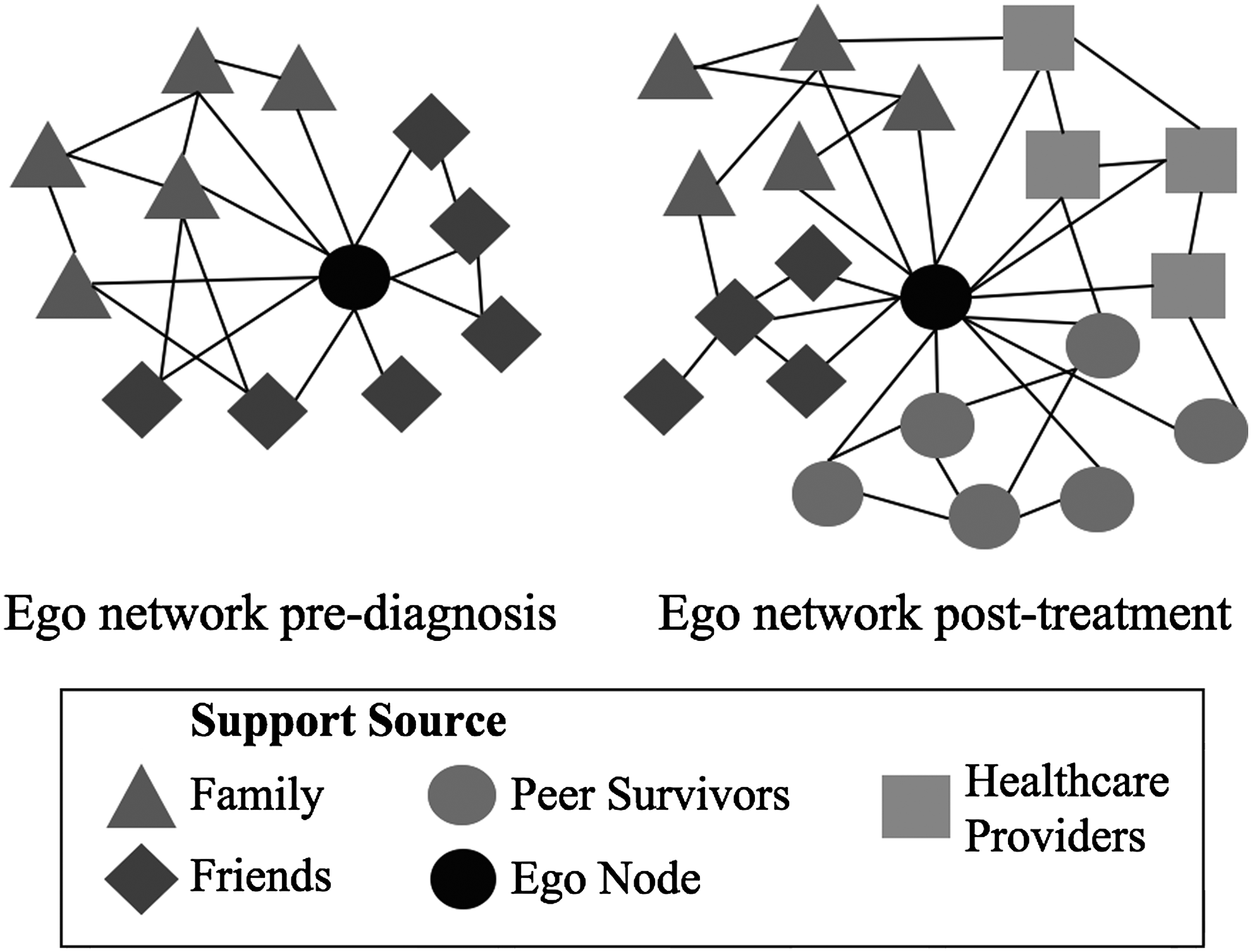
Visualizations of an ego network's social support change from precancer diagnosis to post-treatment of cancer.
Examining the change in social networks through relational, information, and activity ties of an AYA oncology patient or survivor could offer insight into how to support beneficial socioadaption. Tracking the change of a new member's social network from the time they enter an AYA oncology community to when their network stabilizes can lend insights into individual needs and resources, as well as underlying theoretical processes that influence whether a beneficial or effective social support network forms. Understanding how ties form, maintain, or dissolve in AYA oncology social support networks is important because these ties provide the necessary social resources that help buffer sociopsychological stress and improve quality of life.4,24,25 SNA and other methods have been applied in a limited way to understanding social support in other oncology communities and the general population; however, the specific needs, challenges, and resources of the AYA community suggest the need for further analysis.4,26 In sum, by using SNA theories to explore AYA oncology communities, not only can healthcare providers and AYA resources improve clinical services based on these theories, the AYA community can also provide a rich collective to explore, extend, test, and possibly challenge current SNA theories.
Clinical applications
Peer support activities should foster typical AYA development, facilitate growth and adaptation, minimize psychosocial distress, and improve quality of life.27–29 Yet, initiating and sustaining effective AYA peer support programming require identifying diverse psychosocial needs among AYA individuals; finding ways to offer support and recruit AYAs at different phases of the cancer trajectory; and increasing awareness of psychosocial resources and referrals. 1 SNA helps map and expose hidden relationships or information and resource flows (and disconnects) between individuals and institutions implicated in AYA social support.
Diverse ages and needs across the AYA cancer population create challenges with design, recruitment, group composition, and sustainability of peer support services.30,31 Building on existing research examining the exchange of information and emotional support among AYAs within a digital network, SNA could be used to consider how multiple independent variables (e.g., marital status, physical or electronic proximity, age, and social media site) affect whether social ties form among AYA groups or individuals. 12 Network level data could help identify group differences and similarities on density or diversity over time. SNA can also focus on individual (ego) networks and their ties (alters) to help increase understanding of the unique social support needs of an AYA cancer patient/survivor. This can be used to tailor outreach, distribution, and awareness of resources, and recruitment strategies for social support communities.
Treatment completion is a critical transitional phase where it is important to monitor for unmet psychosocial service needs as many individuals experience increased anxiety and distress; a need for information on post-treatment follow-up care; and uncertainty about life after cancer. 32 Yet, there may be other critical times across the cancer care trajectory where people need social support. SNA can be used to visualize changes in AYA patient and survivor peer support networks and needs across the care trajectory, allowing clinicians to measure social networks and desired outcomes at diagnosis, during treatment, and post-treatment. By examining factors such as diversity and salience of node type (e.g., fellow survivors, family, providers, classmates, and friends), network density, ties between nodes, and the relative strength of the ties, clinicians can gain insight into which network patterns of support improve well-being.
Given the clear connection between effective social support and long-term well-being, there is ongoing attention and effort to improve recruitment of AYAs and to increase awareness of AYA social support resources using varied and innovative recruitment strategies. 25 Engagement with and efficacy of social support services are likely mitigated by a number of factors, including but not limited to treatment effects, personal preferences, and accessibility. SNA can be used to evaluate and improve targeted distribution and awareness of resources across online and offline contexts by identifying brokers or key influencers who may otherwise remain hidden. Brokers are individuals who connect those who would not otherwise be connected, thereby enabling knowledge and resource dissemination. Healthcare providers are often tapped to serve as brokers to help connect AYAs with new network ties and support resources.33,34 The “node centrality” (position in the network) of both the patient and his/her healthcare team in the cancer community may affect access to information and support resources. Access to information and support services is particularly critical among AYAs, who are often caught between the pediatric and adult cancer communities.
The availability of resources for AYA cancer survivors varies by survivor characteristics, healthcare system, and geographic location. 26 Survivorship resource disparities require increased outreach, training, and collaboration. By providing increased access to educational resources and peer support along with more frequent emotional and physical symptom tracking, digital social support mechanisms promise the potential to minimize disruption to social roles while strengthening coping resources.24,32 Yet, limited studies provide empirical data supporting their utility. 35 SNA could be used to examine the impact of digital social support on online and offline AYA oncology networks (e.g., by evaluating whether certain types of ties form under what conditions; what level of network density and diversity is sufficient to achieve desired psychosocial support outcomes).
The field of AYA oncology has emerged over the past decade through the collective advocacy efforts of clinicians, survivors, advocates, physicians, and researchers to help improve health and psychosocial outcomes for AYAs facing cancer. 2 AYA cancer care in the United States is delivered across a broad range of healthcare settings, including academic institutions, National Cancer Institute designated cancer centers, free-standing community cancer programs, ambulatory care clinics (such as radiation clinics and chemotherapy infusion units), individual practices, and medical oncology groups. 36 There is growing awareness of the need for integrated strategies that allow young adults to benefit from the combined expertise of pediatric and adult oncologists in systems that identify both the complex disease and psychosocial issues specific to this population. 37 There is a robust and active network of AYA advocacy coalitions and support organizations. Since the field is still young, SNA of policy and clinical care initiatives could provide insight into policy effects on AYA social support. AYA program networks could be compared over the past 10 years to see how policy advances have affected the availability of psychosocial support services for AYA cancer patients and families. 10 SNA could also be used to comparatively examine awareness of relevant social support resources within and across different networks. Visualizing the connections within and between healthcare provider and patient/survivor networks could help identify influential ties and gaps between these networks that could benefit from better integration.
Implications
The use of SNA in the field of AYA psychosocial oncology can provide innovative and relevant applications to improving clinical and social support research, programming, and resources for patients and survivors while also advancing theoretical concepts within SNA. In addition, SNA concepts and methods can be applied to studying additional subgroups within the AYA oncology community, such as caregivers, healthcare professionals, researchers, and volunteers. Beyond these applications, other groups like the AYA oncology community can benefit from the generative nature of these potential studies and the findings and applications of network theory. SNA holds the potential to advance our current understanding of the AYA oncology patient/survivor experience while offering opportunities for continued improvement and creation of resources and services for this underserved community.
Training Resources
Like all data analysis, applying SNA requires carefully considering research goals and assumptions. Borgatti et al. provide a step-by-step guide to designing network studies with or without demographic data using their UCINET software, although the research design and analysis principles apply if people use other network analysis software such as R, NodeXL, or Gephi.7,38–41 For example, bounding the set of nodes included in a study is a particular challenge. 7 Depending on one's research question and philosophy, a study may involve random or snowball sampling, or a census. If network boundaries are clear, researchers often study the complete network (i.e., the population of people at a cancer camp and their reported ties with each other). Alternatively, researchers may randomly select a sample of individuals from a known population and study their personal networks (i.e., egocentric networks). 7
Because missing ties or nodes can have a substantial effect on descriptive and predictive statistics, care needs to be taken in generating nodes and ties for analysis to ensure the data can answer the research question validly without overburdening respondents. 42 Researching online social networks or using existing network data can simplify data collection. However, offline and online networks are not necessarily identical nor is archival research always an effective proxy. Balancing the demands of the research question and the burden on participants is key. Phone records, text records, recent email, directory lists, common name lists, and social media accounts also provide a way to simplify data collection. Some scholars have introduced gaming techniques that may involve common names to help generate connections with less cognitive load and increased accuracy. The time to complete a survey or to gather the data thus depends on the research question, research design, as well as the characteristics of the network(s) being studied. Sample size will greatly vary depending on these factors as well.
Sample size in network data does not work the same as in conventional surveys because networks are independent by definition. Variations include sampling one individual's entire network or every tie within an organization or group.7,9 The type of SNA, population group, research question, research design, and access will all inform on how large of a sample is appropriate.7,9 Considering creative and alternative data sources and collection techniques is necessary. 7
Collaborating with SNA experts or starting with smaller clearly bounded complete networks or ego-centric networks from a known population can aid one's introduction into the qualitative and quantitative analyses of social networks. Borgatti et al.s' step-by-step guide can be complemented with numerous books, articles, workshops, courses, and programs available for people interested in using and applying SNA. 7 For example, the International Network for Social Network Analysis is the professional association for academics and practitioners that provides preconference workshops on SNA as part of its mission. Centers such as the LINKS Center for Social Network Analysis at the University of Kentucky and Northwestern's SONIC lab hold methodological and theoretical workshops designed for beginners to advanced professionals across multiple disciplines who want to map and measure relationships and information flow in AYA onco-logy networks.
Footnotes
Acknowledgment
Casey Walsh, MSW, is supported by an American Cancer Society - Joe and Jessie Crump Foundation Medical Research - Fund Training Grant (OSW-16-246-01-SW).
Author Disclosure Statement
No competing financial interests exist.