




Abstract
Objective:
Describe incidence rates for the most common cancers in Latin American adolescents and young adults (AYA).
Methods:
Incidence data were extracted from the Cancer Incidence in Five Continents series, available online (IARC). Age-standardized incidence rates and trend analysis were calculated. Trends were calculated by joinpoint regression analysis to obtain average annual percentage change values.
Results:
There were 22,990 invasive incident cancer cases in AYA between 1998 and 2007, obtained from 24 population-based cancer registries. The most common cancer in males was gonadal germ cell tumor, with incidence rates ranging from 1.7 to 7.0/100,000; in females the most common cancer was thyroid cancer, with rates ranging from 0.9 to 10.0/100,000. Incidence trends were limited to four regional populations and increased for all malignancies, in males from 1.8% to 3.4% and in females from 0.9% to 1.8%.
Conclusions:
Cancer incidence rates in Latin American AYA are low. There are few PBCRs with long-term data, and therefore, the results herein presented are a partial view of cancer in Latin American AYA populations.
Background
I
Population-based cancer registries (PBCRs) can provide information on cancer incidence and estimate the burden of cancer in geographically defined populations and thus provide the basis for prevention, early detection, and monitoring of cancer trends. 5
In 2012, for Latin America and the Caribbean, 533,000 new cancer cases were estimated in men (ASR 187.6/100,000) and the most frequent cancers were prostate, lung, colorectal, stomach, and bladder. Regarding women, 563,000 cases were estimated (ASR 170.7/100,000) and the most frequent were breast, cervix uteri, colorectum, lung, and stomach. 1 Carcinomas, lymphomas, and skin tumors were most frequent among AYAs.6,7 High incidence rates of cervix–uterus carcinoma were observed in most PBCRs of Brazil. 6
Latin American countries estimate cancer incidence with data from regional PBCRs, except Costa Rica and Uruguay, which are national registries8,9 (Fig. 1 and Supplementary Table S1; Supplementary Data are available online at www.liebertpub.com/jayao). Within 2003 and 2007, Latin American PBCRs represented ∼8% of the population, 9 much less than what is observed in developed countries. 10 Despite the low coverage, these registries present high quality, and incidence data are described in volumes IX and X of the Cancer Incidence in Five Continents (CI5) volumes, (IARC).9,11,12 Moreover, it seems that economic inequalities within Latin America limit investments in PBCRs, and the overall number of registries 4 available for temporal trend studies are few. 8
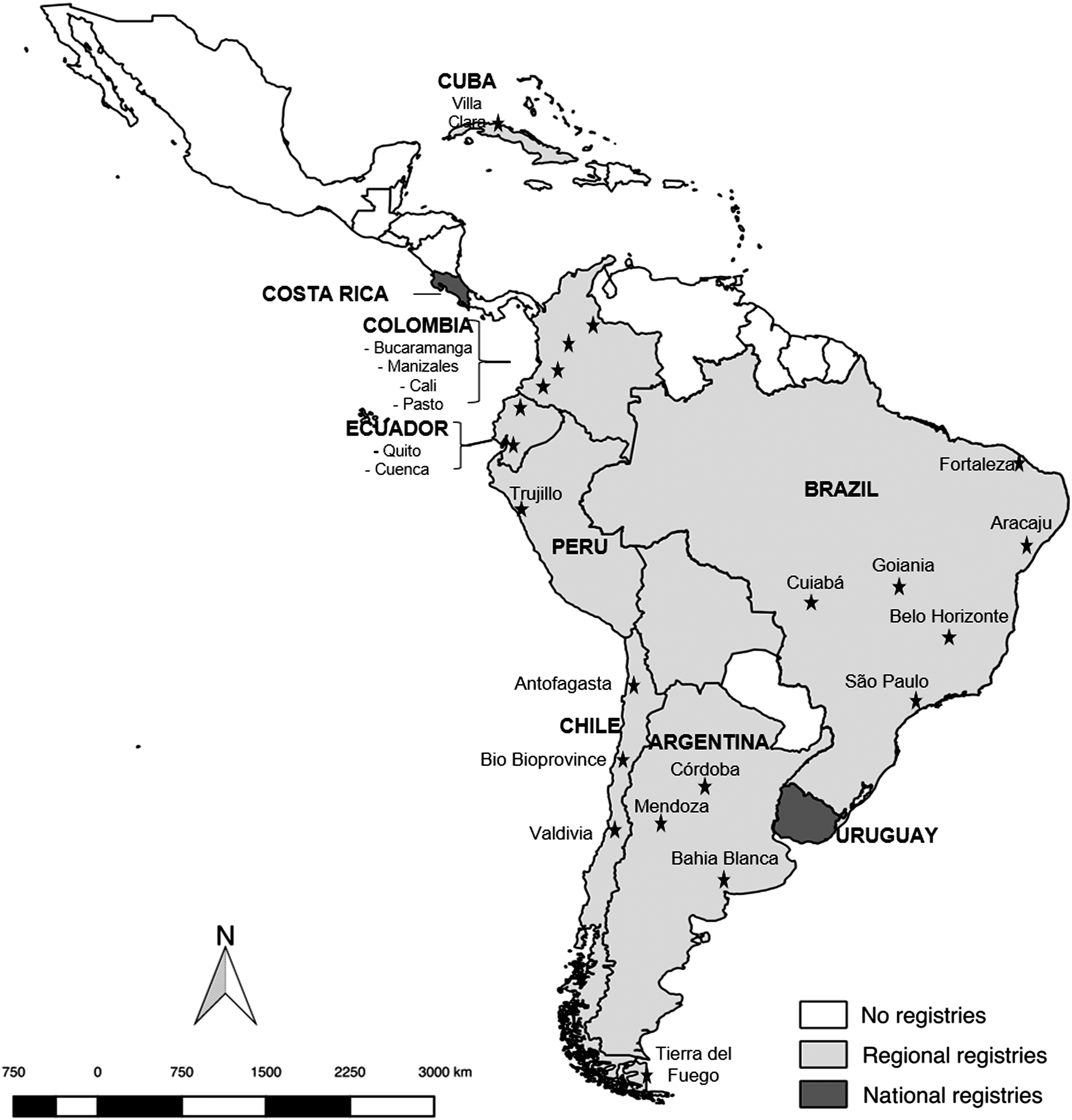
Geographical distribution of the 24 selected populations Population Based Cancer Registries in Latin American Countries. Cancer Incidence in Five Continents (volumes IX and X). Note: Adapted by the authors from Volumes IX and X of CI5 (IARC).
There are few studies on cancer incidence in Latin American AYA, this study aimed to describe cancer incidence in Latin American AYA, based on 24 selected populations of Latin America. Descriptive epidemiology of the malignancies in AYA can increase awareness on the most common cancers for this age group and improve early diagnosis in this population.
Methods
A descriptive ecological study is presented herein, with incidence data from PBCRs. The PBCRs are frequently part of the epidemiology department, and it collects all new cancer cases diagnosed in a geographically defined population (national or regional) in a period of time. The abstraction of the new cancer cases is carried out on annual basis by trained registrars that collect the information from the data sources available in the area (cancer hospitals, outpatient clinics, radiotherapy, pathology laboratories, mortality data, and so on). All data are checked against quality indicators recommended internationally by IARC. IARC aggregates data from PBCRs worldwide, and after an evaluation by an editorial board, data are made available at the IARC Website (http://ci5.iarc.fr/CI5I-X/Default.aspx). Most of the PBCRs are recommended by the government for cancer control. Physically the PBCRs are located at universities, cancer centers, or health secretaries from the municipalities.11,13,14
Incidence data for Latin American AYA were extracted from 24 PBCRs (Fig. 1): two national PBCRs (Costa Rica and Uruguay) and 22 regional PBCRs. All registries presented sufficient quality to be included to volumes IX and X of Cancer Incidence in Five Continents (CI5, IARC). Data are publicly available at the IARC website (http://ci5.iarc.fr/Default.aspx).9,11,15
The AYA were analyzed corresponded to the age group from 15 to 29 years. 16 The Latin American PBCRs included were from Argentina, Brazil, Chile, Colombia, Costa Rica, Cuba, Ecuador, Peru, and Uruguay. Incidence rates for AYA were obtained online, with 5-year data (1998–2002 and 2003–2007), publicly available from CI5 (http://ci5.iarc.fr/Default.aspx).
Incidence data for AYA trend analysis were extracted from CI5plus for the period 1988 to 2007, and four PBCRs presented publicly available data series: Cali (Colombia), Costa Rica (National), Goiania (Brazil), and Quito (Ecuador) at (http://ci5.iarc.fr/CI5plus/Default.aspx). 15 Data quality indicators for PBCRs include the following: (1) Historic data methods: (a) Stability of incidence rates over time, (b) Age-specific incidence curves, and (c) Childhood cancer; (2) Proportion of cases microscopically verified (MV%), greater than 75%; (3) Proportion of unknown basis of diagnosis; (4) Mortality:Incidence (M:I) ratio; and (5) Death certificate methods (DCO%), less than 20%. This study considers MV% and DCO%, data quality indicators available at (http://ci5.iarc.fr/Default.aspx).9,11,17
Incidence and trend data were analyzed for invasive cancers, excluding nonmelanoma skin cancer (NMSK). The 10 most frequent cancers were described, according to Birch's classification16,18–20: Leukemias (All, Lymphoid, Myeloid, Unspecified); Lymphomas (All, Non-Hodgkin Lymphoma, Hodgkin Lymphoma); Central Nervous System and Other Intracranial and Intraspinal Neoplasms (Central Nervous System); Germ cell and trophoblastic neoplasms of nongonadal sites (gonadal germ cell tumors [GGCTs] and Ovary); Carcinomas (Connective, Thyroid, Colon, Stomach, Cervix, and Breast).
Age-standardized incidence rates were calculated using Segi's world standard population (ASR), as modified by Doll. 21 The incidence rates were smoothed for 3 years. Trend analysis excluded those cancers with under five cases registered per year in the PBCRs.
Average annual percentage changes (AAPCs) trends were analyzed by the Linear Regression Model, using Joinpoint version 4.4.0.0 (January, 2017) from the National Cancer Institute, Bethesda, MD available at http://surveillance.cancer.gov/joinpoint/download. 22
Homocedasticity was assumed during trend analysis. The independent variable was the year of diagnosis, while standardized incidence rates, gender, topographies, and PBCRs were the dependent variables. AAPC was estimated, by gender, for the most incident cancers. Statistical significance was determined by a 95% confidence interval (95% CI) and Student's t-test with p ≤ 0.05.
Results
In the period 1998–2007, 24 Latin American PBCRs presented data on cancer incidence rates for nine countries. The majority of the PBCRs were regional, with two national PBCRs: Costa Rica and Uruguay. The population coverage of these 24 PBCRs was 37,439,373 inhabitants, of which 7,944,980 were AYA: 10.5% (3,916,979) were males and 10.8% (4,028,001) were females (Supplementary Table S2). The AYA population covered by the 24 PBCRs corresponded to 5.5% of the entire AYA population in Latin America (143,981,000 AYA in 2005). 23
In the period 1998–2007, there were, on average, 22,990 incident cancer cases in AYA in the 24 PBCRs. The majority of cases affected females 54.73% (12,583). The most common cancers in females were thyroid (17.9%), cervix (12.1%), lymphomas (12.1%), and breast (8.7%). In males, the most frequent cancers were GGCT (18.5%), lymphomas (17.5%) and leukemia (12.1%) (Table 1).
Data from 24 selected PBCRs of Latin America. Source: CI5, Volumes IX, X. Source: J Ferlay, et al., Cancer Incidence in Five Continents, CI5plus. IARC CancerBase No. 9. Lyon, Int. Agency Res. Cancer. (2014). http://ci5.iarc.fr
Bahia Blanca, Cordoba, Mendoza and Tierra del Fuego (Argentina); Aracaju, Belo Horizonte, Brasília, Cuiabá, Fortaleza, Goiania and São Paulo (Brazil); Bio-Bio Province, Region of Antofagasta, Valdivia (Chile); Bucaramanga, Cali, Manizales and Pasto (Colombia); Costa Rica (national registry); Villa Clara (Cuba); Cuenca and Quito (Ecuador); Uruguay (national registry); Trujillo (Peru).
In bold: higher and lower rates.
GGCT, gonadal germ cell tumor.
The highest incidence rate for all cancers (except NMSK) in males was verified in Chile (Valdivia), 40.1, while in females, the highest incidence rate occurred in São Paulo (Brazil), 44.0/100,000 (Tables 2 and 3). Incidence rates for GGCT, the most common cancer in males, ranged from 1.9 in Brazil (Brasilia) to 24.4 in Chile (Valdivia) (Table 3). Thyroid cancer was the most incident in females, with highest rates in Brazil, São Paulo (10.0/100,000), followed by cervical cancer in Chile, Valdivia (7.8/100,000) (Table 4).
Cancer Incidence in Five Continents, volumes IX and X.
Period with less than 100 registered cases.
DCO, death certificate only; MV, microscopic verification; PBCRs, population-based cancer registries.
In bold: higher and lower rates.
Cancer Incidence in Five Continents, Volume IX and X. Available in J Ferlay et al., Cancer Incidence in Five Continents, CI5plus. IARC CancerBase No. 9. Lyon, Int. Agency Res. Cancer. (2014). http://ci5.iarc.fr
In bold: higher and lower rates.
CNS, central nervous system; HL, Hodgkin lymphoma; NHL, non-Hodgkin lymphoma.
Cancer Incidence in Five Continents, Volume IX and X. Available in J Ferlay et al., Cancer Incidence in Five Continents, CI5plus. IARC CancerBase No. 9. Lyon, Int. Agency Res. Cancer. (2014). http://ci5.iarc.fr
In bold: higher and lower rates.
Trend analysis for the 20-year study period (1988–2007) identified four PBCRs within the period with temporal data available for analysis. As a result, there was a subset of four regional PBCRs from four countries. The total population covered by the four PBCRs was 9,018,567 inhabitants in 2005, of which 1,267,823 (14.1%) were AYA males and 1,292,311 (14.2%) were AYA females (Supplementary Table S2).
Trend analysis in Latin America (1988–2007) considered an average of 10,784 incident AYA cancer cases, of which 4993 (46.30%) cases occurred in males and 5791 (53.69%) cases affected females. Throughout a 20-year period, there were significant increases for all cancers, for both genders, in AYA of these selected populations. The highest AAPC across all malignancies occurred in Colombia (Cali) in males (3.4%) and females (1.8%). There was a 5.2% increase in male GGCT incidence in Quito (Ecuador) and a 5.6% increase in Costa Rica. For females, thyroid cancer increased 6.1% in Costa Rica, and 3.7% in Quito. Female leukemia decreased 3.9% in Costa Rica (Table 5). The results of trend analysis must be interpreted only for the selected populations with temporal trends. However, it is important to describe these trends highlighting the effort of PBCRs in providing reliable continuous data on cancer incidence for more than 10 years. Quality indicators such as MV% and DCO% were reliable for the period 1998–2007 for the 24 selected PBCRs, across all age groups; therefore, the results obtained are consistent. From 1988 to 2007, the percentage of cases microscopically verified was between 73.3% and 91.7% in males and between 75.9% and 93.1% in females. Incident cases based on death certificates only varied from 17.8% to 3.0% for males and from 14.4% to 3.8% for females (Supplementary Table S3).
Cancer Incidence in Five Continents, Volumes IX and X. Available in J Ferlay et al., Cancer Incidence in Five Continents, CI5plus. IARC CancerBase No. 9. Lyon, Int. Agency Res. Cancer. (2014). http://ci5.iarc.fr
Specific cancers with less than five cases per year were excluded from the analysis.
The AAPC is significantly different from zero at alpha = 0.05, p < 0.001.
AAPC, average annual percentage change; CI, confidence interval; NMSK, nonmelanoma skin cancer.
Discussion
The most frequent types of cancers in AYA, for both genders in selected populations of Latin America, were thyroid, GGCTs, lymphomas, cervix, breast, and leukemia, similar to other populations in the world.3,24–26 A recent Brazilian study described carcinomas, lymphomas, and skin cancer as the most frequent cancers in AYA of this country. 6 Estimated cancer incidence rates for all cancers in Latin American AYA were lower than those found in AYA of Europe and North America. 15 These lower rates could be due to new data from 14 new PBCRs (2003–2007). New PBCRs could present random variations that are common in the initial years of their activities, 27 and could therefore result in underestimation for the period. The Lancet commission for Latin America has stated that the limited number of cancer registries has hindered the design of credible cancer plans and primary prevention programs. 28 PBCR implementation in Latin America is urgent to better calculate cancer estimates and enhance cancer control.
The different incidence rates observed in Latin American countries could be associated with socioeconomic and regional disparities.28,29 Latin American countries present pronounced socioeconomic differences and these are related to diagnosis and treatment.25,30–32 Also, there is unequal distribution of cancer services, 29 as observed in Brazil. 33
Throughout the 20-year period (1988–2007), there was an increase in incidence for all cancers in Latin American AYA in the selected populations. Increases were also verified in the United States (20 to 34 years), 34 while in Australia, trends were stable for both genders. 35
In Latin America, Chile presented the highest GGCT incidence rates in the world (24.4); in Europe, the Nordic countries present high rates, however, these are half of those found in Chile (12.2). 36 GGCT carcinogenesis can be determined intrauterus, 37 with associated factors such as family history of cancer, cryptorchidism, impaired spermatogenesis,38,39 as well as Hispanic origin. 40 There was a 5.5% increase in GGCT incidence in Quito (Ecuador), higher than in Australia 35 and the United States. 34 The high incidence rate in Quito can be related to early diagnosis and completeness of cancer cases registration.
The highest incidence rate of thyroid cancer in AYA was found in females (24.4) of Kwangju, Republic of Korea 15 ; in Latin America, the highest rate was detected in São Paulo (10.0) (Brazil). High rates of thyroid cancer can be a result of overdiagnosis.34,41 Regarding thyroid cancer, data from SEER (1984–2010) verified an increase of 3.2% in AYA males and 3.8% in AYA females; also, these tumors were larger, suggesting that diagnostic techniques are not the only factor responsible for increases in trends. 42 In Latin America, increasing trends for thyroid cancer were verified in females of Costa Rica (2.8%), but there are no data available on staging to verify the tumor size. In general, among AYA, carcinomas, besides being rare, present different clinical behavior than when diagnosed in adults. Thyroid carcinoma presents the best prognosis, differently from adults. 43
Breast cancer in AYA females is rare and can indicate genetic predisposition. 44 The highest global incidence of breast cancer in AYA occurred in Italy (9.8); in Latin America, the highest incidence was observed in São Paulo (Brazil), 5.0 from 2003 to 2007. 15 In the United States, incidence increased by 1.0% in women aged 25–29 years. 34 In Latin America, the low number of incident cases prevented trend analysis to be carried out.
Colon cancer is uncommon in AYA and little is known about its incidence in younger age groups. The highest incidence rates of colon cancer in AYA were found in males of Jinxing city, China (3.3), and females (3.7) in Australia. 15 In Latin America, lower rates were observed in Bahia Blanca (Argentina) in males (2.3) and females (2.8). In the United States, there was an increase of 2.5% in the incidence of colon cancer in individuals aged 20–44 years. 45 In Australia, between 1982 and 2007, there was an increase in colorectal cancer in young adults. Prediagnosis colonoscopy is associated with a significant reduction of mortality rates. 32 However, herein, it was not possible to evaluate colon cancer trends in AYA due to the small number of registered cases.
Lymphoma is the second most common cancer in Latin American AYA, and more frequent in males, as occurs in other regions of the world. 25 Lymphoma reaches its incidence peak between 20 and 29 years of age. 3 HL presented the highest incidence rates in males of Sao Paulo (Brazil) 3.2/100,000, while for females the highest incidence rates were verified in Bahia Blanca (Argentina) 4.5/100,000. 15 However, globally, the highest incidence rates in AYA occurred in Italy (11.4). HL was the most incident cancer among adolescents in the United States, 25 and in Australia, HL incidence increased by 2.6% in female AYA. 35 In Latin America, the highest incidence rates for NHL were observed in males (5.0/100,000) of Bahia Blanca (Argentina) and in females of Quito (Ecuador) (2.5/100,000). Globally, the highest incidence rates for NHL were observed in Italy (6.2/100,000), for both genders. 15 The introduction of better diagnostic techniques can contribute to increase the temporal incidence of NHL, 46 although other unknown risk factors may also play a role.
Worldwide, the highest incidence rate of leukemia in AYA was observed in males (9.8/100,000) of Italy (Biella) and in females (5.4) of China (Cixian). 15 In Latin America, leukemia was the third most incident cancer and the highest rate was observed in males (7.0/100,000) of Colombia (Bucaramanga) and females (4.2/100,000) of Chile (Valdivia). 15 In Australia, the incidence of leukemia lymphocytic increased by 3.6% in males. 35 An increase of leukemia incidence was observed in females of Costa Rica (3.3%). Increased incidence of leukemia in children has been attributed to having children later in life 47 and late exposure to infections as a child. 48 In AYA, there is no clear risk factor related to the increase of leukemia incidence; moreover, the biological and clinical characteristics of AYA leukemia do not experience the same improvement in diagnosis and treatment as child leukemia. 49 The reason for decreased incidence of leukemia in AYA of Costa Rica remains unclear.
The highest CNS incidence rates in AYA occurred in males (5.1/100,000) of Norway and in females of Italy and Poland (4.4/100,000). 15 In Latin America, the highest rates were observed in males (4.2/100,000) of Goiânia (Brazil). The incidence rates were similar to other countries and this can be related to better access to diagnosis, including improved availability of computerized tomography machines.
The highest AYA Cervical Cancer (CC) incidence rates in the period 2003–2007 were observed in Europe, in the United Kingdom (England and Northern Yorkshire) (7.5/100,000), 15 and in Korea. 50 The incidence rate for CC among AYA in Brazil is high and warrants intervention in terms of both prevention and control. 51 In Latin America, rates were also high: 6.8/100,000 in Goiânia (Brazil), while in the United States (SEER 9) incidence was 2.1/100,000. 15 In Australia, there was a 2.7% reduction in incidence. 35 No increases were detected in cervical cancer trends in Latin American AYA, during the study period. The prevalence of HPV in Latin American females younger than the age of 25 years is ∼25%. 52 The high prevalence of HPV in Latin American AYA could increase the future burden of cervical cancer in this age group.
In this study, it was observed that the most frequent malignancies in Latin American AYA were similar to other regions of the world, but incidence rates were lower than those of developed countries. The incidence rates observed herein have a limited role in cancer control and prevention in Latin America due to the low number of PBCRs. Despite this weakness, it was possible to identify that the most common cancers were akin to those detected in other parts of the world. GGCT presented the highest incidence rates in Latin American AYA males (Chile). GGCT is a highly curable malignancy and these high incidence rates require further analytical studies to identify the regional risk factors. Thyroid cancer also has high incidence rates in Latin America, which could be due to overdiagnosis as observed in the United States. 41
Data quality indicators from the PBCRs provide information on diagnosis. 53 Microscopic verification has improved throughout the 20-year study period, certainly due to more accurate diagnosis in Latin American cancer patients. Therefore, the rates and trends described herein are consistent and represent the preliminary profile of cancer incidence in Latin American AYA.
The main limitation of this study is the analysis of only 24 selected populations of Latin America in two periods. Furthermore, temporal data were available for just four PBCRs (three regional and one national). However, information has been generated about cancer incidence in AYA. Nevertheless, strategies are required for the implementation of PBCRs in Latin America. One of these strategies has been the Global Initiative for Cancer Registry Development (GICR), promoted by IARC. In Latin America, a regional center was established in Argentina (Buenos Aires) to support Latin American PBCRs. 54
Population-based cancer incidence data enabled the description of the profile of cancer incidence and trends for 24 selected populations in Latin American AYA. The most incident cancers were similar to those of other countries of the world, but incidence rates were lower. Finally, there is a lack of sufficient PBCRs to enable a more comprehensive analysis on cancer incidence in Latin American AYA. Therefore, it is recommended to strengthen policies aimed at improving PBCR activities toward a better understanding of AYA cancer incidence patterns in this region.
Highlights
Cancer incidence rates were low in adolescents and young adults (AYA) of Latin America.
The most frequent cancer in AYA was gonadal germ cell in males.
Thyroid cancer was the most common malignancy in females.
Footnotes
Author Disclosure Statement
No competing financial interests exist.
References
Supplementary Material
Please find the following supplemental material available below.
For Open Access articles published under a Creative Commons License, all supplemental material carries the same license as the article it is associated with.
For non-Open Access articles published, all supplemental material carries a non-exclusive license, and permission requests for re-use of supplemental material or any part of supplemental material shall be sent directly to the copyright owner as specified in the copyright notice associated with the article.
