




Abstract
Purpose:
Infertility is a potential adverse effect of cancer treatment, and future fertility is an important issue for cancer patients. In Portugal, the Centre for Fertility Preservation of CHUC, EPE, conducted a project to develop and disseminate oncofertility information resources. In this study, we report the results of the specific component of this program, which intended to produce information resources that promote patients' awareness of the subject and to support decisions concerning fertility preservation.
Methods:
Guidance for writing health information for patients and criteria for developing decision aids were gathered. Information needs were assessed (literature review and locally applied questionnaire). Resources were pre-tested with a sample of patients and professionals. Their readability, presentation quality, and ability to support decisions were evaluated.
Results:
General information handouts on infertility risk and decision aids about fertility preservation options were developed and positively evaluated. The resources are currently being distributed in collaboration with several national organizations.
Conclusions:
Through our multidisciplinary information program, reproductive-age cancer patients now have access to relevant information resources that will support timely, shared decision-making concerning fertility preservation.
Introduction
I
In this context, oncofertility, a term coined in 2006 by Teresa Woodruff, has recently emerged as a multidisciplinary field with the purpose of fulfilling the needs of cancer patients regarding their reproductive potential. 5 Several professional organizations in the field of oncology have published recommendations regarding FP, advising health professionals to discuss infertility risks and FP options with all cancer patients of reproductive age.6,7 However, a number of published studies indicate that not every oncologist is following these orientations and a considerable proportion of cancer patients is still not informed about the risks and possibilities regarding FP.8–13 Moreover, surveys of reproductive-age cancer patients and survivors disclose gaps in the information received about the opportunity of preserving fertility, the techniques available, or the possibility of consultation with a reproductive medicine specialist.14–17
Decisions regarding FP, especially for female cancer patients, are complex and preference sensitive, that is, they need to consider patients' values for benefits and harms across options. 18 All options come with risks and success rates, and decisions concerning FP often have to be made in a short time frame, along with other treatment decisions and in a period of great emotional distress. Several patient-related factors contribute to a quality decision-making process, including patients' values and attitudes, support from family and friends, and the acquisition of information.19,20 Information resources conceived to support decisions in healthcare such as decision aids21,22 or decision trees 23 provide a more clear understanding of the available options, facilitate discussions, and increase patients' and professionals' involvement in the decision-making process.
In the specific setting of infertility risk in cancer patients, the access to specialized information concerning FP improved patients' knowledge of the available options 24 and reduced decisional conflicts. 25
In Portugal, oncofertility is of increasing importance in the context of quality of life in cancer survival. Recently, several Portuguese scientific societies, including the Sociedade Portuguesa de Medicina da Reprodução (Portuguese Society for Reproductive Medicine, SPMR) and the Sociedade Portuguesa de Oncologia (Portuguese Oncology Society, SPO), in cooperation with the national hematology and andrology professional societies, published and endorsed the “Portuguese Recommendations for Preserving the Reproductive Potential of Cancer Patients.” 26 This document was the final outcome of the first and second Portuguese Oncofertility Meetings in 2015 and 2016. The Portuguese Centro de Preservação da Fertilidade (Centre for Fertility Preservation, CFP) of Coimbra Hospital and University Centre (CHUC), EPE, was a leader in this process and has been working actively since 2012 to promote local and national awareness of oncofertility. In cooperation with the Liga Portuguesa Contra o Cancro (Portuguese League Against Cancer, LPCC), a Portuguese nonprofit cancer patients organization, the CFP conducted a project to develop and disseminate oncofertility information resources, directed both to health professionals and cancer patients. In this study, we report the results of a specific component of this information program, which aimed to produce information resources for cancer patients to promote their informed participation in decisions in the context of infertility risks and FP.
Methods
Assessment of information needs
A literature search on Medline, through PubMed, was conducted to identify primary quantitative studies evaluating cancer patients' information needs or gaps in knowledge concerning infertility risks and FP options. The search equation was built using the following MeSH terms: Patient Education as Topic; Consumer Health Information/methods; Health education; Antineoplastic Agents/adverse effects; Infertility, Female; Infertility, Male; Sperm Banks; Cryopreservation; Reproductive Techniques, Assisted; and Fertility Preservation. The eligible articles were retrieved, and their results were gathered and organized. In addition, a questionnaire directed to cancer survivors who had been diagnosed in reproductive age was applied locally * . These self-reported, anonymous questionnaires were distributed by clinicians in follow-up consultations at several clinical departments of CHUC, EPE. Demographic, reproductive, and clinical information were requested. Participants were asked to rate, on a 5-point Likert scale (ranging from Not important to Extremely important), their self-perceived importance of discussing specific information topics regarding infertility risks and FP before cancer treatment initiation. An additional question queried patients on the usefulness of several information strategies (from Not useful to Extremely useful). The study received approval from the local ethics committee and the questionnaire was previously tested in a small group of cancer survivors. Patients were informed of the objectives and methods of the study, and all participants signed written consent.
Development of information resources
The information resources were designed to target cancer patients of reproductive age (18–40 years) with a recent cancer diagnosis (any type of cancer) before treatment initiation. To include relevant, yet specific, information for each gender (for instance, about fertility markers), distinct resources were developed for male and female patients.
Bearing in mind that the risk of infertility is not acknowledged by many cancer patients17,27–30 and the complexity of the decision-making process regarding FP, particularly in women, two different types of written patient information resources were planned: (1) general information handouts with the aim of raising awareness of the effects of cancer and cancer treatments on fertility and (2) decision aids with the aim of supporting decisions in the context of FP.
With the purpose of producing quality written health information materials, searches were conducted in Medline, through PubMed, to find general guidance for writing health information for patients. For the specific production of decision aids, the criteria included in the DISCERN instrument 31 (www.discern.org.uk/index.php) were taken into account. DISCERN consists of 16 key questions intending to evaluate the reliability of the publication, the information provided about treatment choices, and its overall quality. This tool was designed to not only help users of consumer health information judge the quality of written information about treatment choices but can also be used as a checklist for authors and producers of written consumer health information.
Published evidence on infertility risks and FP options in cancer patients was identified and the most current evidence-based knowledge on clinical indications, time requisites, success rates, risks, and advantages/disadvantages of each FP technique was gathered.
Evaluation of information resources
Readability
Readability is a measure of the facility with which a text is read, according to the length of words and sentences. Preliminary versions of the information resources were tested for readability using the Fernandez-Huerta index, a modified version of the Flesch Reading Ease score for the Spanish language. 32 In the Flesch Reading Ease score, the results range from 0 (the worst level, very difficult to read) to 100 (the best readability level). Usually, a reading ease of 60–70 is considered standard (Table 1). 33
The number of words and syllables was estimated using the software TextMeter, an application of text statistics for the Portuguese language. After the first readability results, improvements were made by using alternative, shorter words and building less complex sentences.
Pre-test
The first drafts of both the general information handouts and the decision aids were provided, along with an evaluation form, to reproductive-age cancer patients and survivors by oncologists and psychologists in FP and follow-up consultations. They were also evaluated by a variety of healthcare professionals with direct or indirect involvement in the care of reproductive-age cancer patients (Table 2). These groups evaluated the content, language, and layout of both information resources. In addition, the ability of the decision aids to support shared decisions was assessed by asking if the different options were presented in a balanced way; if the information on each option was sufficient; and if the information would increase the knowledge about the options, and would help patients to discuss the options with their oncologist and promote their participation in decisions.
Quality
The quality of the information resources was assessed using Ensuring Quality Information for Patients (EQIP), a tool designed to measure the presentation quality of all types of written healthcare information, 34 and the above-mentioned DISCERN instrument. 31
A flow diagram showing the sequence of steps in the development process can be seen in Figure 1.
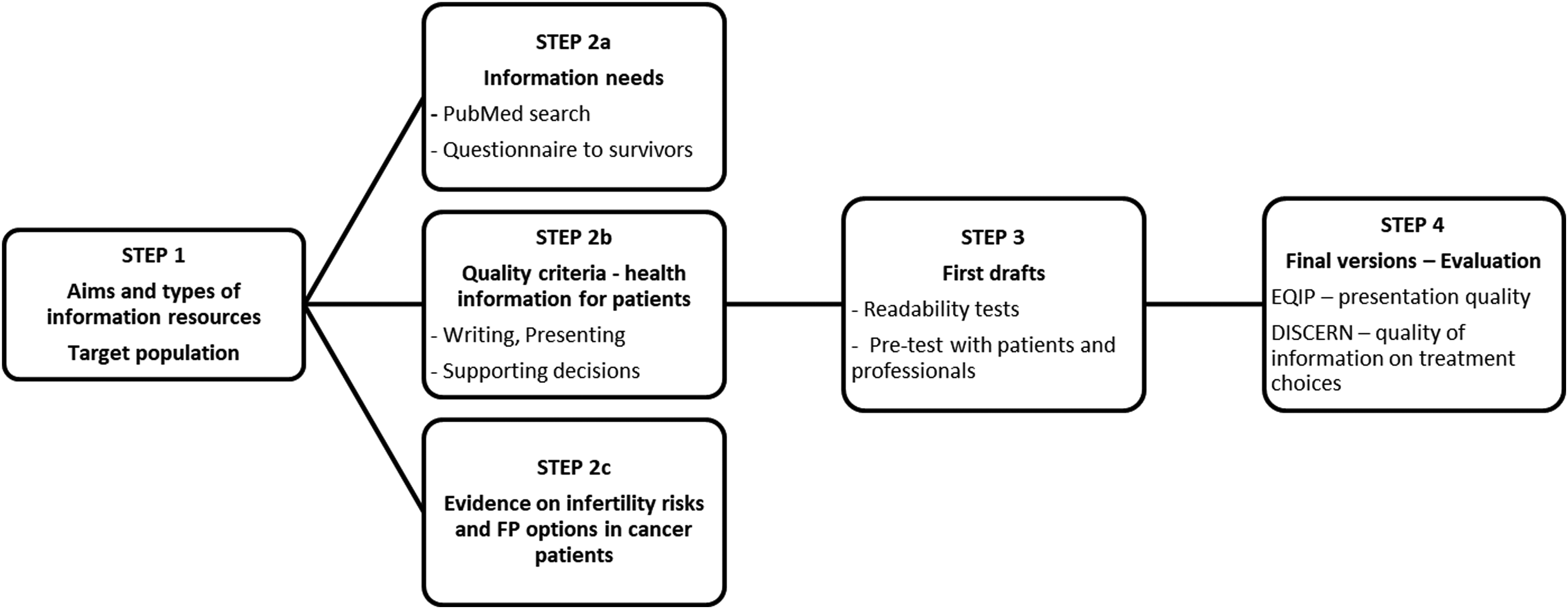
Flow diagram showing the sequential steps in the development of information resources.
Results
Information needs
In accordance with the defined eligibility criteria, 10 published articles were selected and analyzed.17,18,27–30,35–38 Data on methods and results on reported patient information needs or gaps in knowledge were collected from each individual article and are presented in Table 3.
FP, fertility preservation.
In relation to the identification of local information needs, a sample of 31 cancer survivors answered and returned the questionnaire. It was not possible to calculate the response rate, as the total number of questionnaires distributed to patients by clinicians is not known. The mean age (±SD) of the participants was 34.4 years (±6.5), corresponding to a mean age of 26.6 years (±7.5) at diagnosis. Most participants were females (n = 27), and the most frequent cancer diagnoses were lymphoma (n = 9), breast cancer (n = 8), and osteosarcoma (n = 8). The majority of survivors (n = 23) had been treated with systemic chemotherapy. Almost one third (n = 10) reported effects of cancer treatments on fertility and 15 answered that they did not know or were unsure of those effects. Two patients used an FP technique before treatment initiation, and three patients had children after cancer treatment. Table 4 presents the information topics included in the questionnaire. All topics were rated as Extremely important to be discussed or Very important to be discussed by a significant majority of participants. Concerning the strategies that are useful to inform cancer patients on these topics, consultation with a reproductive medicine specialist and the supply of information through written information resources or the internet were the most valued.
Information resources
The contents of the information resources were developed with our previously mentioned purposes in mind (Development of Information Resources section) and the information needs most frequently identified in the international literature and/or reported by the local sample of survivors.
General criteria for writing health information for patients were collected from several published guidance documents39,40 and organized according to the following themes: content (e.g., clearly defined aim), language (e.g., avoid paternalism and value judgments, use active voice, and avoid technical terms), organization (e.g., use bullets and write short, single idea paragraphs), layout and graphics (e.g., avoid uppercase and italic and align text to the left), illustrations (e.g., use only to improve understanding), and learning and motivation (include interactive materials). These criteria supported the process of writing and organizing the information content.
In the general handouts, the information was organized in the format of Questions & Answers as a form of dividing text and making it more attractive to read. 40 In the decision aids, after a brief introduction discussing the relevance of shared decision-making regarding FP, contents were structured according to the two main decision points: (1) the decision to use or not use an FP technique and (2) when applicable, the decision of which FP technique to choose. In each decision point, the positive and negative aspects of each option were presented. Moreover, in the second decision point, detailed information on the procedures and target populations for each FP technique was included. A third section was designed with a set of three questions & answers regarding general issues such as costs, maximum length of cryopreservation, and fate of the nonused cryopreserved cells/tissues. Interactive components to increase learning and motivation (i.e., a box that patients can use to write questions and a small knowledge quiz at the end) were developed for all information resources. In the final section, other relevant sources of information were presented, including the address of the CFP's website and contact numbers of national telephone helplines on cancer and oncofertility.
Tables 5 and 6 display images of the front page and briefly outline the contents included in the handouts and decision aids, respectively. As the local sample of survivors reported that provision of information through the internet would also be a useful strategy, the information contents were also adapted to be digitally displayed on the CFP's website.
Evaluation of the information resources
Readability
The final versions of the handouts informing of the possible effects of cancer (and cancer treatments) on male and female fertility were rated by the Fernandez-Huerta readability index as fairly difficult (score of 51). Readability of the decision aids to support FP decisions was classified as difficult, with scores of 46 for the male and 49 for the female decision aids.
Pre-test
In general, both cancer patients and healthcare professionals rated the information resources as easy to read, with contents that are relevant, complete, and well organized. Only a few minor changes were necessary, mainly of language and sentence structure. In addition, decision aids were considered by all participants as useful for shared decision-making and clinical practice.
Quality assessment
All information resources scored high on presentation quality, with EQUIP scores varying between 77% and 89%. Consistent with the recommendations from this tool, the resources produced are “ready for distribution and should be reviewed in two to three years.” According to criteria from the DISCERN instrument, the overall quality of the two decision aids developed was high (4 or 5 scores in all questions). According to the instructions provided in DISCERN, the information materials were classified as “useful and appropriate sources of information about treatment choices and have the ability to support the patient's decisions.”
Publication and dissemination
The handouts informing of cancer and cancer treatment effects on male and female fertility were published in 2015 by the LPCC, which is also circulating these resources through its campaigns and website. With the collaboration of the Ordem dos Farmacêuticos–Secção Regional de Coimbra (Portuguese Pharmaceutical Society–Center Regional Section; SRC-OF), the handouts were also distributed to pharmacies all over the country, to reach the population in a larger scale. More recently, the LPCC has also published the decision aids that are being distributed to oncologists and other cancer care clinicians, reproductive medicine specialists, and FP centers, with the cooperation of SPMR and SPO.
Furthermore, all the produced information content is available, in Portuguese, on the website of the Centre for Fertility Preservation of CHUC, EPE (www.centropreservacaofertilidade.pt).
Discussion
We believe that our systematic method for the provision of patient information—assessing information needs, providing information to meet those needs, pre-testing the information resources with the target population, and assessing their quality with validated instruments—is a sound approach to facilitate decision-making among cancer patients in the context of infertility risks and FP options. Moreover, the use of quality decision aids that describe the path of patient decision-making and the consequences of each separate decision will lead patients to more informed clinical judgments.41,42
Our results indicate that the developed resources are relevant, reliable, and useful and have the ability to support shared decisions in the context of FP. They were positively evaluated by cancer patients, cancer survivors, and health professionals working in the cancer and reproduction settings and achieved high quality scores according to the instruments EQIP and DISCERN. Concerning readability, the general handouts and the decision aids were scored as fairly difficult and difficult to read, respectively, which means they are suitable for readers with at least high-school grade levels. These low levels of readability are potential barriers for their ability to inform patients and support shared decisions; so it is important to further assess the resources in real contexts of decision. Nevertheless, readability scores must always be interpreted with caution. They assume that longer words and sentences are harder to read and do not measure comprehension or indicate if the words are familiar to the reader. For example, some recurrently used Portuguese words in the setting of reproduction and FP, such as “espermatozoide,” “fertilidade,” and “congelação,” are common and easily understandable words, yet they negatively influence the readability scores because of their many syllables. In the specific case of decision aids (scored as difficult to read), it will be important to use direct measures of comprehension, such as their ability to promote shared decision-making and reduce decisional conflict.
The developed resources were designed to target adult patients in reproductive age faced with a diagnosis of any type of cancer. Accordingly, no cancer-specific information about infertility risks or FP options was included. Furthermore, they may not be suitable for children or adolescents with cancer, since younger patients may have distinct needs and preferences regarding the provision of information.43,44 It is also a fact that some of the identified information needs remained unmet. Some topics were beyond the scope of our resources (for instance, the effects of cancer in sexual function, contraception in cancer patients, or information about infertility treatments), while for others, the information would be influenced by the specific type of cancer (such as the risk of genetic transmission of cancer to offspring and the risk of cancer recurrence due to pregnancy). Clearly, these are subjects to include in upcoming information resources. Other limitations of our study are related to methods for the assessment of information needs. Due to time constraints, qualitative studies were not included in the literature search, and the locally applied questionnaire had a small number of participants.
We wish to highlight the multidisciplinary context in which this project has been carried out, involving cancer patients and survivors, a cancer patients' organization (LPCC), oncologists and other cancer care professionals, and professional and scientific societies in the fields of oncology and reproductive medicine. We hope this intense cooperation will contribute to a wider dissemination of the developed information materials to the various stakeholders in the process of cancer care and to a more effective clinical implementation. In addition, it is important to note that information resources directed to oncologists were also developed in the context of this program, including a main booklet with comprehensive contents, tailored to the needs of clinicians working with cancer patients, and a brochure with summarized contents intended for other cancer care professionals and primary care professionals. 45
The developed resources are already available to the Portuguese population and to cancer patients in several institutions all over the country. Our next step will be to evaluate the resources with cancer patients using relevant measures such as acceptability, knowledge, decision conflict, or self-efficacy.
Conclusion
The need to inform cancer patients in an effective and timely manner of their infertility risks, and the possibility and options of FP is a recognized relevant issue in the context of quality of life in cancer survival. Through a systematic approach and establishing a multidisciplinary collaboration, information resources directed to cancer patients' needs were successfully developed and disseminated, and will contribute to timely, shared, and informed clinical decisions in the context of FP.
Footnotes
Acknowledgments
This work was supported by a research grant from the Liga Portuguesa contra o Cancro (Grant LPCC/Celgene 2012). The authors wish to thank Professor Paula Fresco, PharmD, PhD, for her important contributions to revising the article's spelling and grammar.
Author Disclosure Statement
No competing financial interests exist.