




Abstract
Purpose:
Adolescence is a transition period involving complex development processes. A life-threatening disease like cancer jeopardizes this development and often exposes adolescents to hospital environments that are unadjusted to them. Despite growing research on how the physical environment affects the well-being of the (child as) patient, adolescents are often overlooked. We investigated how adolescents experience a hospital stay and how the physical environment influences that experience.
Methods:
We interviewed ten adolescents who are or have been affected by cancer between the age of 14 and 25, and discussed preliminary findings with professional experts.
Results:
In young people's experience of a hospital environment three interrelated themes stand out: support, distraction, control, and autonomy. Adolescent patients primarily look for connections with life outside the hospital. The hospital confronts them with different obstacles, most of which appear to relate to difficulties concerning the loss of these connections. These obstacles include a lack of freedom, control, and autonomy; limited social interaction with friends; inability to participate in daily activities; boredom; and a lack of privacy.
Conclusion:
As a group, adolescent patients clearly have specific characteristics and needs. This specificity, which is largely hidden in the development and transition they are undergoing, explains the need for a hospital environment dedicated to them—be it a separate adolescent ward, or the grouping of adolescents on children's and/or adult wards. Rather than focusing on a superficial list of wishes and needs, the design of this environment should consider the specific reasons driving adolescents' wishes and needs.
Introduction
A
Therefore, we aim to expose how adolescents experience a hospital stay and how the physical environment influences this experience. The study reported here focuses mainly on the experience of current hospital environments. It is part of a larger project, which also considered improvements adolescents suggest.
Eventually, the project intends to give adolescents a voice concerning what a hospital environment should be like for them, thereby sensitizing policy makers, hospital boards and staff, and designers to the fact that a hospital environment dedicated to adolescents asks for different principles than one dedicated to children or adults.
Methods
Participants
Our study focused on young people who are or have been affected by cancer between the age of 14 and 25. We included both youngsters who were being treated for cancer at the time of the study, and young cancer survivors who had been diagnosed within these age limits. More important than their age, however, was their long-term experience as a patient. In semi-structured interviews, ten adolescents were (retrospectively) asked about their experiences concerning the spatial aspects of hospital environments.
With the help of Kom op tegen Kanker, we approached participants through someone they trust, ensuring the choice to participate in this study was fully their own. They were provided with the contact information of the first author (henceforth “the researcher”), whom they were free to contact. As a result, the study was not bound to one specific hospital setting.
Ethical aspects
Approval for this study was obtained from the Social and Societal Ethics Committee of KU Leuven. By signing an informed consent form, which explained the study's aims and what participation would entail, participants approved to the use of obtained data. A separate informed consent form was provided for parents of participants aged under 18. Parents were allowed to attend the interviews if participants so wished.
Data collection
Interviews were directed—though not determined—by a preconceived interview guide, based on an extensive study of related literature. Using semi-structured interviews made it possible for participants to influence the focus of the interview and for the researcher to adjust the course of the interview to each participant's situation. Interviews were audio-recorded and transcribed.
Data analysis
Immediately after each interview, the researcher wrote down first impressions, focusing mainly on participants' behavior during the interview, rather than on the content of their story. Most interviews were transcribed soon after having been conducted. Based on the research questions, transcripts were then analyzed for themes and fragments illustrating them. Eventually, the themes were organized into a tree-like structure of main themes and subthemes, reflecting their role in the participants' stories.
To enhance the quality of the data analysis, preliminary findings from the interviews were discussed with professional experts and attuned to their perspective. Five professionals attended this expert panel, including a staff member of Kom op tegen Kanker, three health professionals of oncological wards, and a nursing student who recently recovered from cancer herself.
Findings
Our findings suggest that in young people's experience of a hospital environment three interrelated themes stand out: support, distraction, and control and autonomy (Fig. 1). The physical environment influences this experience through its sensory qualities, and especially through the flexibility and freedom of choice it affords. In what follows, these findings are discussed in more detail (Fig. 2), to make the specificity of adolescent patients' needs more explicit.

Adolescents' experience of a hospital environment: three interrelated themes, influenced by spatial aspects.
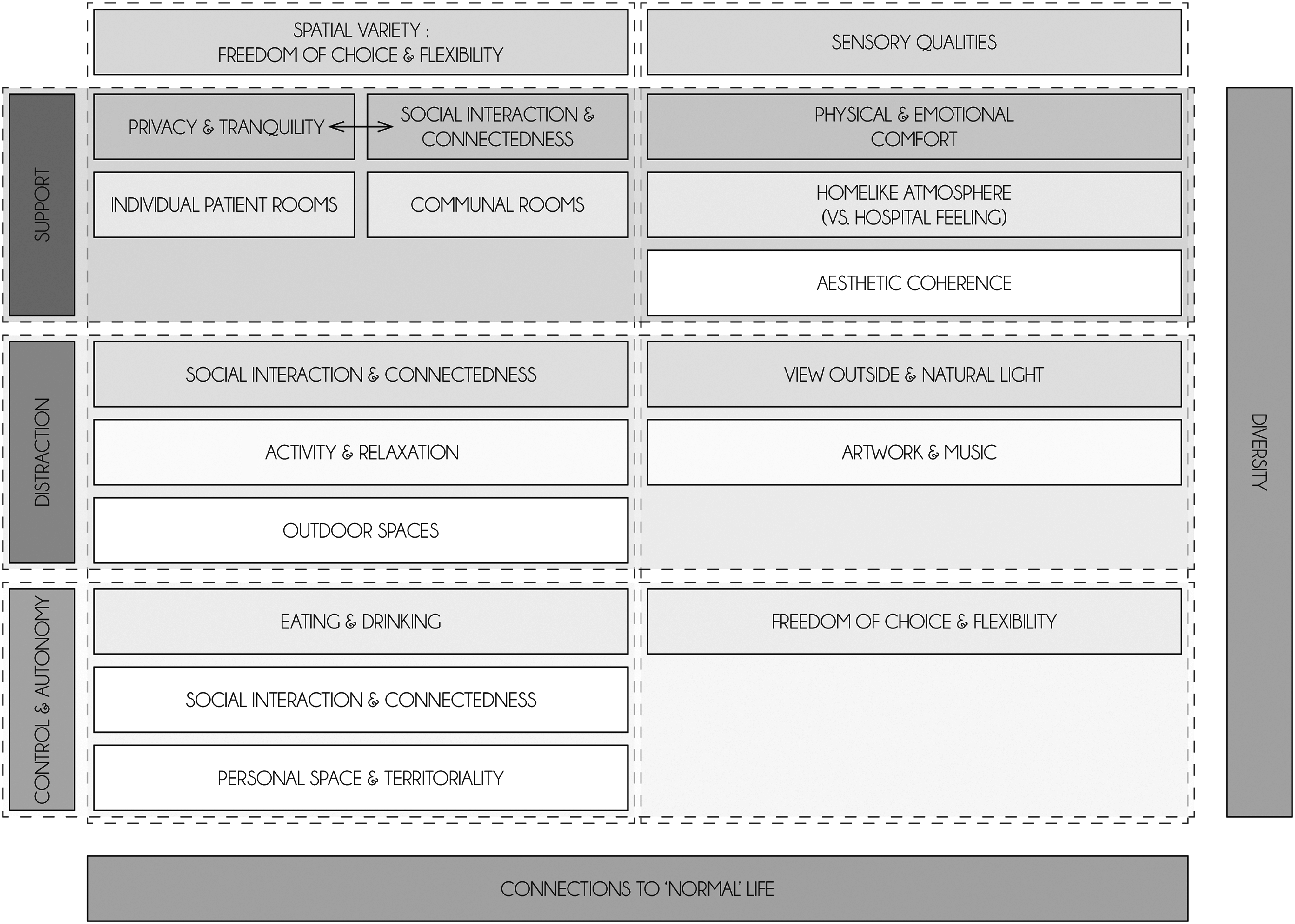
Tree-like structure with main themes and subthemes, connected through two groups of spatial aspects.
Support
The significance of support in participants' experience of the hospital environment relates, first of all, to two of their most specific needs: privacy and social interaction. However important both are in young people's “normal” life, in the hospital they are often incompatible. Participants seem to prefer individual patient rooms, combined with communal rooms, providing them with a proper balance between privacy and social interaction.
I think, if I look at me, I'd personally prefer to for example … have a room for my own, and when I feel the need to interact with someone, that you can go to the common room. (Chloe * , 19/22 ** )
The most important reasons young people give for preferring individual patient rooms, are being alone with their family or partner, following their own rhythm, coping with their situation in their own way, and not having to feel embarrassed or held back because someone can hear and see everything they say or do.
When it comes to social interaction, needs are largely diverging in this ever-changing group. Adolescents are going through a transition, becoming more independent of their parents and increasingly defining their identity as part of a group of peers. Young adolescents share with children a desire for having their parents nearby, even wanting them at their bedside at night, while for somewhat older adolescents their parents' permanent presence often conflicts with their need for privacy. Some participants also find the hospital environment supportive of their own well-being when it attends to their parents' comfort, for example, with a room where they can find other parents' support. Apart from parents' comfort, however, young people's concerns relate to that of friends as well. Some participants indicate that the lack of room and comfort for visitors holds them back from inviting friends, however important their visits are in trying to keep up with life outside the hospital.
It gave me a bit of a difficult feeling … like, although I know now that it wasn't my fault. And sometimes it held me back from inviting my boyfriend, knowing that I'd have to say, yeah, you need to sit on that chair for 4 hours, and there was nothing else we could do. (Chloe, 19/22)
Besides wanting to stay in touch with their friends, some adolescent patients also find support in getting to know other patients of their age and would like the hospital to facilitate this more. Others, however, prefer to withdraw from contact with other patients.
Further, for participants a supportive hospital environment is a homelike environment that puts them at ease, but also allows spending time with family and friends in a comfortable way. In certain ways, they are looking for connections with their life at home, although this implies different things for each one of them. Additionally, they are seeking some coherence in the hospital environment, as it influences their overall perception of it.
The things that were in there didn't really go together, so that makes that it looked a little bit chaotic, and … that you're less willingly to go there, than you actually should be. (Anna, 21/24)
In this homelike atmosphere young people are seeking, an important role is played by colors and decoration, cheering up the cold and boring hospital environment, as different participants describe it. Which colors or decorating elements are preferred, widely differs between participants. Some think certain drawings are childish, while others would not want to see them changed. Surprisingly, it is not necessarily only the younger adolescents who like childhood themes in the hospital environment.
You've got drawings of a dolphin, and flowers. And a clock, with Winnie the Pooh on it or so. And … yeah, it's like, sometimes these are the only things I can see. And I don't mind that it's for children, because if it were a poster from a magazine, then … You'd easily get tired of it, I think. (Julia, 15/17)
Distraction
Participants want the hospital environment to attend to their need to move around and prevent boredom. Friends are not always able to drop by and, as mentioned, the hospital environment is often unadjusted to their visit. Together with the restricted possibility to take part in daily activities like going to school, this makes boredom one of the largest obstacles for adolescent patients. However important activities are to connect this patient group with their “normal” life, participants rarely seem to find the activities offered on a children's or adult ward suited to their age.
You did have a rehabilitation room for example, with a pool and sporting activities, but again that's actually only, yeah, the majority are just older people. So I never actually wanted to do that there, because—yeah, even being healthy it won't be that appealing. You don't want to be needing help every time. (Lucy, 18/22)
Although the hospital's indoor spaces can provide young people with some distraction from sickness, nice outdoor spaces may do so even more, participants suggest, offering them yet another connection with life outside the hospital. Participants explain that being able to go outside now and then could help them cope with the fact that friends and peers are still able to play football or have a drink together, while they feel locked up inside the hospital.
That's something I've felt sometimes as well, that I sat there, knowing, oh, my friends are having a drink on a terrace … and that you then really have the feeling like, ho [sighs], now I have to stay in here. (Mia, 23/24)
Apart from activities, the sensory qualities of the environment offer some distraction too, the most important ones being the presence of natural light and a view to the world outside. These sensory qualities can soothe feelings of isolation or depression, according to different participants who have been confronted with such feelings. This appears to be especially important when treatment does not allow going outside. In this respect, artworks and music are mentioned too. For some, music is a way to take their mind off their situation and find some quiet, for others it enhances the general atmosphere in the hospital. In artworks, participants do not only appreciate the color they add to the hospital environment, some especially like the variation they bring along. It is the discovering of artwork, rather than its content that pleases them.
[I like] the fact that it changes every month, that it's something new, that you can discover some art there, while you're actually there to be sick. (Emily, 23/29)
Autonomy and control
In the middle of developing independence and identity, adolescent patients suddenly lose control of their own life and body. Strengthening a feeling of control and autonomy again can be in small things. When asked about what personal space means for them, most participants mention things like their own pillow or blanket, rather than posters or pictures. But what could strengthen a feeling of independency even more, they say, is being granted choice and control of what they eat and drink, when and where they do it, and with whom. Vending machines in the hallways, for example, allow adolescent patients to get a drink or snack whenever they feel like it. Furthermore, different participants link having a personal fridge in their patient room to a feeling of territoriality. Not only do they like being able to take a snack themselves, they also want to be able to offer visitors something to drink, like they would at home.
To be honest, that's also something that makes a room—like, something that's like home for you, that you have your own food and drinks in the fridge, and that you can take something you like in the evening. (Hannah, 9/32)
Another aspect where young people are looking for some more control and flexibility, is the arrangement of visiting hours.
Those were the usual visiting hours … And yeah, I always think it's a pity, although I totally understand they need to be strict in this, but I think the visiting hours are way to limited. Unless you're a student … or your parents aren't working, everyone you know is working, so it doesn't make any sense. (Mia, 23/24)
Discussion and Conclusion
How do adolescents affected by cancer experience a hospital stay, and how does the physical environment influence this experience? In a period where young people are planning for the future with a whole life ahead of them, a life-threatening disease like cancer, along with treatments and hospital stays, impacts in a particularly profound way.1,7 Rather than focusing on a superficial list of wishes and needs, an adolescent-friendly hospital environment should take into account the specific reasons driving these wishes and needs for this age group. Young people's needs in the hospital seem to be floating between those of children and those of adults. In some ways, they want to be treated as grownups, but in others they do want the same privileges children get. 8 In “normal” life, adolescents slowly transition from being a child to being an adult, and in the hospital, they are suddenly treated as either a child or an adult.
Although we identified support, distraction, and control and autonomy as three components key to their experience, answering these questions unambiguously is complicated by the diversity in this patient group. Moreover, it is often the aspects in which diversity shows that are so specific to adolescent patients. Confirming earlier studies, 8 the expert panel pointed out that young people of similar age do not always get along or share the same opinion, but their perception rather depends on their life stage.
Despite the diversity and this life stage dependency, our study does suggest at least one commonality: of all the different obstacles young people are confronted with in a hospital, most appear to relate to difficulties concerning the loss of connection with life outside the hospital. 9 These obstacles include a lack of freedom, control and autonomy4,10; limited social interaction with friends3,11; inability to participate in daily activities4,10; boredom5,7,12; and a lack of privacy.3,11 Concerning the latter, literature suggests that some adolescents need the company and support of a roommate, 11 while participants in our study agree on the privacy and quiet of an individual room being preferable to this possible support. When it comes to freedom and control, eating and drinking are most frequently mentioned, as was found before. 9 However, our study suggests that young patients also want to comfort visitors with food and drinks, rather than only themselves. The most important contribution of this study, however, is probably that its findings draw attention to the importance of freedom of choice, which turns out to be key to address much of adolescent patients' needs, however diverging they are. The incompatibility of privacy and social connectivity is only one of many conflicts that could be solved by means of freedom of choice, assuring young people's privacy through individual patient rooms, but still offering them the possibility of (different kinds of) social interaction through (different kinds of) communal rooms. Among other things, freedom of choice can also be the answer to diverging needs concerning food and drinks and possibilities for parents to stay the night.
Only one out of ten participants in this study was male. Undoubtedly, this has biased our results and can be considered the main limitation of the study. Since the outcomes of this one interview barely differed from those of the others, the gender perspective could not be addressed in the analysis. Further research should clarify whether and how male and female adolescent patients' preferences vary and how this may alter the findings.
Awaiting this further research, our findings have important implications for design practice. In a hospital, young people are looking for connections with their “normal” life in the first place. Design strategies likely to support them in this search include maximizing freedom of choice, flexibility, and spatial variety; attending to the comfort of visiting family and friends; providing age-appropriate activities, nice outdoor spaces, and internet access; pursuing aesthetic coherence and a homelike atmosphere; and combining individual patient rooms with a variety of communal rooms. Furthermore, translating these design strategies into a hospital environment dedicated to young people may not only meet their specific needs, but can also support the shift from pediatric to adult healthcare, complementing the known transition in time with a transition in space.
In addition, our findings have implications for hospital managers and staff. Indeed, spatial interventions in hospital environments are possible only when the hospital's policy allows them and their success is subject to health professionals' care and mentality. Vice versa such interventions can also support the healthcare and encourage positive changes in mentality. Although our study focused on the relation between patient experience and the physical hospital environment it is important to keep in mind that both are also connected to policy aspects.
In conclusion, even if adolescent patients' needs may somehow resemble those of other patient groups, as a group they clearly have specific features and needs, and this specificity is largely hidden in the development and transition they are undergoing. Because of this specificity, there is a need for a hospital environment dedicated to young people, whether this takes shape as a separate adolescent ward, or as the grouping of adolescents on children's and/or adult wards.
Footnotes
Acknowledgments
This study received support from the Fund Suzanne Duchesne/Kom op tegen Kanker and from the KU Leuven Research Fund [grant n° PDM/16/092]. Our special thanks go to the participants and everyone else who contributed to this study.
Author Disclosure Statement
No competing financial interests exist.