




Abstract
Purpose:
Young adult cancer patients have complex medical and psychosocial needs throughout treatment. Once treatment ends, few young adult cancer survivors (YACS) receive adequate survivorship care. Many YACS do not continue with oncology care after treatment ends. The purpose of this study was to discover the views YACS held about survivorship care and to design age-appropriate survivorship care plans (SCPs).
Methods:
Twenty-seven YACS (n = 27) participated in a group discussion focusing on their post-treatment experience. The concept of SCPs was introduced and participants provided information on how their care was managed after the completion of their treatment, what factors played a role in their oncological follow-up care, and the potential utility of a SCP in the management of their follow-up survivorship care. SCPs were developed for each participant and feedback requested.
Results:
SCPs required 45–180 minutes to complete. Barriers to continued follow-up included: loss of health insurance, poor communication with their oncologist once treatment ended, and ongoing adjustment challenges to work, school, and home life. YACS requested more support for psychosocial issues post-treatment, and more information about long- and late-term side effects from treatment.
Conclusions:
Further research in the utility of SCPs among YACS is warranted as they may have a significant role for YACS. Information on long- and late-term side effects, follow-up care schedule, psychosocial support, and adolescent and young adult-specific resources must be clearly delineated in SCPs.
Introduction
C
In 2005, a seminal report from the Institute of Medicine (IOM), “From Cancer Patient to Cancer Survivor: Lost in Transition,” highlighted the need to recognize survivorship as a distinct phase in cancer care and the need to address the concerns of survivors. 3 The IOM strongly recommended that all patients receive, at the completion of therapy, a customized treatment summary (TS) and a survivorship care plan (SCP) that detailed a plan of ongoing care, including follow-up schedules for visits and testing, as well as recommendations for early detection and management of treatment-related effects (pain, fatigue, premature menopause, depression, anxiety) and other health problems. SCPs serve as a roadmap for patients, and as a communication tool between oncologists and primary care physicians. 4 Beginning in 2015, institutions accredited by the American College of Surgeons were required to provide TS and SCPs to all patients upon completing cancer treatment. 5 However, it is not clear what role SCPs play in the treatment of young adult cancer survivors (YACS).
Young adult cancer patients have distinct issues as they transition from active therapy to survivorship. They are at high risk for medical and psychosocial sequelae from cancer and its treatment.6–10 They have concerns about health and fertility,11,12 concerns about body image, loneliness, social anxiety, 13 greater dependency on parents compared with their peers, 14 and difficulties getting married or obtaining full-time employment.12,15 Young cancer patients have lower levels of well-being compared with other age groups,16,17 and have been reported to experience anxiety due to uncertainty when transitioning from active treatment into the survivorship phase. 18 And yet, the majority of young adult survivors receive inadequate survivorship care with minimal surveillance for late effects.10,19 It is not clear how oncologists and primary care providers can share the responsibilities of survivorship care for young adults, nor how a SCP can help with this.
Adherence to surveillance and follow-up care has been largely unexplored in this population. It is known that rates of treatment nonadherence are high, ranging from 27% to 60%20,21 and are likely higher than in any other cancer population group.22,23 In general, adolescence and young adulthood represent periods of significant psychosocial growth and these patients face a number of developmental challenges, such as starting or graduating college, joining the workforce, developing intimate relationships, or starting a new family. These factors may likely influence adherence to treatment and follow-up recommendations and point to the need for a comprehensive tool to assist this vulnerable population as they transition into a phase of cancer survivorship, which features an array of medical and psychosocial concerns that these patients experience.
A customized TS and SCP may empower survivors to manage, coordinate, and advocate for their survivorship care. 24 Self-efficacy has been especially recommended in the young adult survivor population due to the need for post-treatment symptom management and often complex treatment history. 25 However, what role SCPs may have for YACS has not yet been explored.
As a pilot research endeavor, this study aimed to examine the concept of survivorship and SCPs among adolescent and young adult (AYA) cancer survivors of adult-onset malignancies at a single National Cancer Institute (NCI)/National Comprehensive Cancer Network (NCCN)-designated cancer center using a focus group approach.
Methods
This study was part of a larger focus group study examining survivorship issues among YACS using Concept Mapping analysis (article in preparation). Concept mapping relies on the premise that patients are the true “experts” on their own experience. A combined qualitative and quantitative approach is then employed to capture and analyze this experience. 26 An additional aim of this project was to develop individualized SCPs for each participant and receive feedback on them. The local Institutional Review Board reviewed and approved this study.
Eligibility criteria for the study included survivors who: (1) were diagnosed between 18 and 39 years of age, (2) were diagnosed between January 1, 2005 and December 31, 2011, (3) received all of their treatment at our center, (4) completed the planned course of treatment, and (5) are currently living. A dedicated research associate verified medical records for eligibility.
Our institute's tumor registry identified 1,327 potential YACS (827 female, 500 male) who fit the age and timeframe of diagnosis criteria. Our research associate employed the use of the electronic medical record (EMR) to verify how many of these potential participants met criteria 3–5 noted above. Upon review, 229 eligible survivors were identified, and 27 participated in this study (n = 27). Participant demographics are illustrated in Table 1.
Participant Demographic Information
Participants were asked if they received a (TS) and/or an SCP upon completion of their treatment and whether these documents guided their survivorship care. A personalized SCP detailing each participant's cancer diagnosis and treatment received (chemotherapy, radiation, and/or surgery) was developed by the research associate using data derived from EMR (Fig. 1). An oncologist reviewed the SCPs for accuracy and added appropriate survivorship recommendations per NCCN AYA Guidelines. Completed SCPs were mailed to each participant along with a SCP Feedback Survey. The SCPs developed for this study were intentionally concise and erred on the side of brevity to provide participants an opportunity to share which survivorship care factors were most salient to them. Feedback survey questions pertained to accuracy and potential utility of SCPs. Participants received a $50 honorarium for completion of the study.
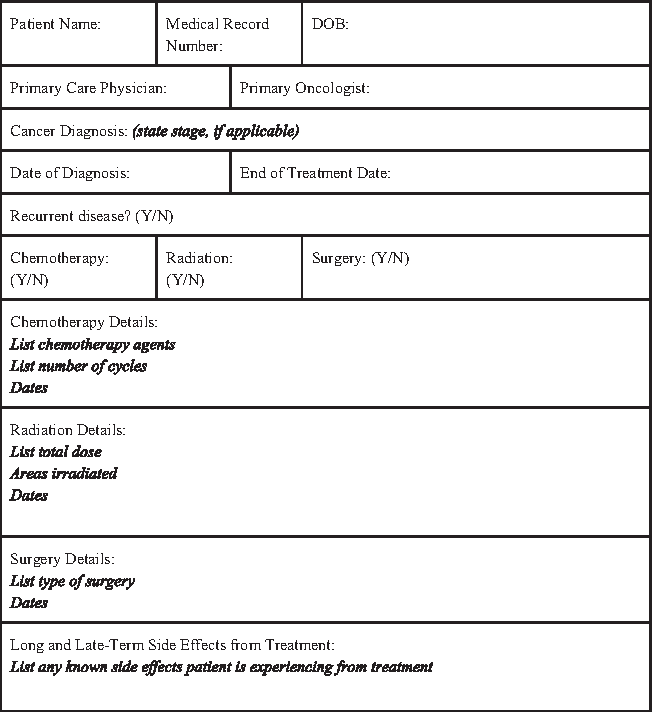
Survivorship care plan template.
Results
Of the 27 YACS who participated in the study, 30% did not continue to receive ongoing survivorship care from either their oncologist or primary care physician after treatment ended and they were deemed to have been lost to survivorship follow-up (Table 1). Upon completion of their treatment, 67% of participants recalled receiving a TS at that time. However, there was no record of any TS in the EMR of any of the study participants.
As part of this study, each participant received a personalized SCP and a feedback survey, 85% of which were returned. Of the 23 feedback surveys that were returned, 100% felt their SCPs were accurate and ∼50% suggested additional information (Table 2). Participants wanted a SCP which included a summary of their treatment with a clear follow-up schedule with their oncologist, suggested follow-up regimen with their primary care physician, recommended screening tests based on their cancer, and information on who to contact for symptoms that may be indicative of a recurrence or long-term treatment effect. Additionally, 57% of participants requested disease-specific and age-related resources, such as psychosocial support, information on how to live a healthier lifestyle (e.g., nutrition and exercise), integrative therapies, etc.
Treatment Summary & Survivorship Care Plan Feedback
TS, treatment summary.
Although time was not officially recorded, information shared during weekly meetings between the study research associate and principle investigator determined that individualized SCPs for each participant took the research associate 45–180 minutes to create depending on the cancer diagnosis, course of treatment, and whether or not the patient had experienced a relapse. These data were obtained through the EMR system. Summarized SCPs were subsequently reviewed by an oncologist for accuracy and the addition of NCCN guidelines for survivorship care, which added an additional 45–60 minutes to the process, for each participant.
Discussion
It is known that young adult cancer patients have complex medical and psychosocial needs throughout their cancer treatment that continue well after treatment ends.10,27,28 There are, however, no specific guidelines for this population regarding late- and long-term treatment effects, recommendations for monitoring for secondary malignancies, or preventative health measures. For pediatric cancer survivors, thorough survivorship guidelines are available through the Passport for Care with the Children's Oncology Group (COG) 29 and the NCCN provides treatment and survivorship guidelines for adults. 30 However, neither captures the unique needs of this vulnerable population. For example, the Passport for Care program helps clinicians build TS based on COG treatment protocols and provides surveillance recommendations that pertain to childhood cancer survivors. The majority of YACS are not treated at pediatric centers and extrapolation of the information in Passport for Care is unlikely to be applicable to them. On the other hand, NCCN provides guidelines specific for disease type, and follow-up recommendations are largely based on risk grouped by disease type without consideration of patients' age or psychosocial factors. NCCN's Survivorship and AYA Guidelines neither discuss age-specific issues or extrapolates information from COG Survivorship Guidelines that may not be reliably used for AYAs, respectively.
This pilot study aimed to investigate how SCPs may be utilized by YACS. Through the feedback received from 27 YACS, this study supports that SCPs can be instrumental in the management of follow-up care. YACS reported ongoing issues, such as chronic side effects of treatment, intimacy and fertility concerns, and financial strain, regardless of disease type and treatment intensity or years after treatment completion. Our data illustrate how follow-up care, after cancer treatment ends, varies from patient to patient, even between those with the same cancer diagnosis, despite receiving care at a single center. A standardized SCP designed for YACS can formalize follow-up care and may improve adherence to scheduled clinical visits.
Studies have been recently published which highlight how an SCP designed for YACS may be effective. In a focus group study of AYA cancer survivors, AYAs expressed a desire to continue seeing their oncologist for follow-up care and not transition to a new provider, 31 a sentiment which was expressed in our study as well. Since that may often not be feasible, SCPs may be helpful in this transition process by providing appropriate cancer treatment history information for healthcare providers and providing guidelines for YACS to adhere to regarding their care and overall health maintenance. A recent systematic review on psychosocial outcomes of YACS found that their experiences are nuanced and meeting their informational needs and providing treatment-related education may improve their follow-up care. 32 As YACS continue to have a significant fear of recurrence, 33 tailored SCPs may have a role in providing the communication and knowledge to allay some of these fears.
In addition to the general TS information which our sample SCP included (diagnosis, chemotherapy, radiation, surgery, and long- and late-term side effects), our study suggests that an optimized care plan should include information regarding potential ongoing treatment, a detailed follow-up schedule, including screening and surveillance tests, details about potential early and late side effects from treatment, information on psychosocial and quality-of-life issues, and pertinent age-specific support resources (such as support groups, cancer coaching, and financial support programs) (Fig. 2).
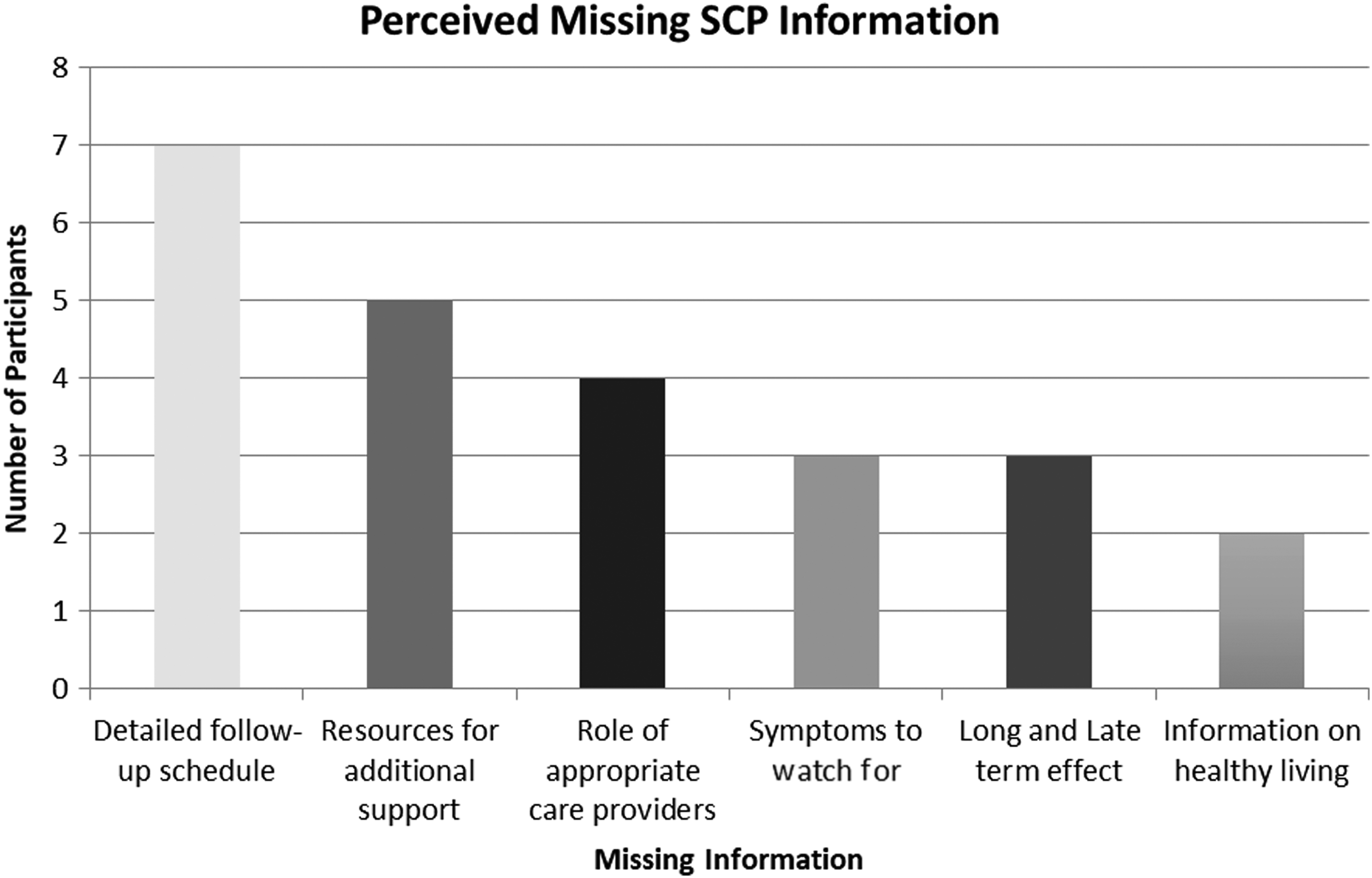
Perceived information missing from survivorship care plans according to feedback surveys.
A barrier to SCP implementation across cancer centers nationally and internationally is that the development of SCPs is often reported as a time-consuming endeavor.34,35 In addition, recent publications on the utility and efficacy of SCPs fail to definitively support or deny their use.36–38 Similarly, developing SCPs for this study took at least 75 minutes per participant, and the feedback informs us that YACS desire more information, not less. Cancer centers will need to continue exploring efficient methods for implementing SCPs into practice, and measure their efficacy as a health information and communication tool for patients.
In summary, SCPs designed specifically for YACS may be well utilized and need to be further explored. Our study found them to be well received and an integral aspect of survivorship care for this population. Although a limitation of this study is the small number of participants, their feedback has provided tangible suggestions for how healthcare providers can build an optimized SCP suitable and useful for adolescent and YACS.
Footnotes
Acknowledgment
This research was supported by the Institutional Research Grant #IRG-02-197-09 from the American Cancer Society.
Informed Consent
Informed consent was obtained from all individual participants included in the study.
Author Disclosure Statement
The authors declare that no competing financial interests exist.