




Abstract
In 2015, a support initiative for adolescents and young adults with cancer, Kræftværket, was created at Rigshospitalet, Copenhagen University Hospital in Denmark. The primary objective of Kræftværket is to provide youth-friendly support, care, and treatment practices. As Kræftværket provides services to both pediatric and adult departments, a network between patients who would otherwise not interact has been created. The initiative is managed by a Youth Coordinator, and specifically trained health professional Youth Ambassadors. Dedicated staff, including Youth Coordinator and the Youth Ambassadors, are essential in maintaining focus on current initiatives for this patient group.
Introduction
Adolescent and young adults (AYAs) with cancer are a patient group with distinctive care needs, in terms of cancer treatment, supportive care, and psychosocial support.1–6 In Denmark as in other countries, gaps in care currently exist for AYAs with cancer, including but not limited to psychosocial support, fertility preservation, effective transition, and survivorship care.1,3,7–9
The World Health Organization (WHO) advocates for an increase in youth-friendly resources that are both functional and useful for this patient population; tools and guidelines have been published with the goal of assisting and standardizing the development of resources and best practices for youth-friendly care.10–12 AYAs require additional resources in treatment due to needs associated with the physical, psychological, and social transition to adulthood, as well as less previous exposure to the healthcare system. 13 Age-appropriate resources tailored for the AYA population are proposed to benefit these patients by addressing their information and specific healthcare needs, as well as providing an environment with peer support and healthcare professionals trained to work with this age group.14,15 Such resources improve communication between patients and their healthcare team, the active involvement of young people in decision-making processes, and physical resources such as youth facilities for activity and socialization. 15 These resources are also capable of addressing the inherent barriers to working with AYAs—such as the intersection between adult medicine and pediatrics. 16
In Denmark, ∼500 AYAs in the age group 15–29 years are diagnosed with cancer each year, which is three times the number for pediatric cancers.6,17 The most common cancers for AYA between the ages of 15 and 29 in Denmark in descending order are central nervous system cancer, testicular cancer, malignant melanoma, lymphoma, thyroid cancer, and leukemia.6,18,19 Rigshospitalet Copenhagen University Hospital in Denmark is a tertiary general university hospital with no dedicated adolescent-specific wards. Annually, in the Copenhagen region ∼200 AYAs receive new cancer diagnoses, with the majority receiving treatment at Rigshospitalet alongside patients referred from other parts of Denmark. 19 To better meet the needs of this patient population, a support initiative was created in 2015 for AYAs with cancer at Rigshospitalet. The aim of this article was to describe how this initiative has been utilized to provide adolescent-friendly facilities, resources, and activities for AYA with cancer at Rigshospitalet.
Methods
Setting
Since 2008, resources for AYAs with critical or chronic illnesses have been provided by the Center for Adolescent Medicine (CAM) at Rigshospitalet. CAM runs the youth café “HR BERG” for young people ages 12–24 across diagnoses and offers individual support for young inpatients. 20 In addition, CAM has developed a training program for nurses, the Youth Ambassador program, and courses in developmentally appropriate care. 21 In 2015, the Danish Cancer Society and the hospital management funded the development of a youth-friendly initiative for AYAs with cancer in close cooperation between the Department of Pediatrics, the Department of Hematology, the Department of Oncology, and CAM. The physical facilities were established through a “Hackathon” event partnering design students and AYAs with cancer experience to create a youth-friendly environment. 22 The final result produced a social dayroom, six youth-oriented hospital wardrooms, and youth-friendly training facilities. The name, “Kræftværket,” which was selected during the Hackathon event, is composed of the Danish words for “power plant” (Kraftværk) and “cancer” (Kræft), evoking empowerment throughout the time of cancer treatment and recovery.
Objectives
The primary objective of Kræftværket is to provide youth-friendly support, care, and treatment practices, to allow AYAs with cancer to connect with peers, and to allow for the active participation and engagement of AYAs throughout the initiative. Other objectives of Kræftværket are to develop multidisciplinary collaboration across adolescent medicine, pediatric, and adult cancer departments, to incorporate knowledge sharing, teaching, and involvement of relevant health professionals; to coordinate political and administrative activities surrounding AYAs with cancer; and to continuously improve quality of care and further research in the field of AYA cancer care (Table 1).
Kræftværket's Objectives and Resources and Activities Utilized to Address Them
Initiative structure
The initiative is managed by a steering group who oversees organization, activities, funding, internal group and external communication, the initiative's evaluation, and the actions of group subcommittees.
The Childhood Cancer Fund (Bornecancerfonden) provided funding for the hiring of a full-time Youth Coordinator managing the events and activities of Kræftværket, as well as serving as an ambassador and supporter of young patients. The Youth Coordinator directly contacts and informs all AYA patients with new cancer diagnoses in the pediatric, hematology, and oncology departments about Kræftværket, current activities and resources available, and opportunities to connect with peers. Alongside the Youth Coordinator, who is trained as a Youth Ambassador, five Youth Ambassadors from adult and pediatric hematology and oncology departments assist in supporting AYAs in Kræftværket and management of ongoing activities.
AYAs with cancer are directly involved in making decisions regarding activities and resources available at Kræftværket. Every 3 months, a youth panel meeting is held to discuss and receive feedback about Kræftværket with AYA cancer patients and survivors to make changes reflecting the needs of young patients.
Electronically, a private digital social media network was created and is currently utilized to connect patients, as well as provide an outlet for communication with the Youth Coordinator for further discussion outside the hospital setting.
Data collection
All AYAs who use the dayroom register on paper with hospital department for anonymized user statistics. Only anonymized patient data were used according to the regulations of the Danish Data Protection Agency.
Results
Since its creation, Kræftværket has served to support AYAs with cancer through the provision of resources, facilities, and activities specific to, and using the input of, this population.
All new AYA cancer patients are greeted by the Youth Coordinator across departments to provide information about resources, facilities, and activities associated with Kræftværket. Individual support when needed throughout the course of treatment and in survivorship is provided by the Youth Coordinator. In addition, the Youth Coordinator assists in grant applications and other academic and bureaucratic processes. Additional support resources are provided by Youth Ambassadors and representatives from the Danish Cancer Society or Youth Red Cross who host drop-in social sessions. CAM provides individual social-pedagogical support for young inpatients after referral. 20
The Danish Cancer Society organization Ung Kræft (Young Cancer) has recently collaborated with Kræftværket (both staff and AYAs) in the development of an educational book for AYAs with cancer. 23 Further resources can be found on Kræftværket's digital platforms, including a newly developed smartphone application. 24
All design inspirations in the youth wardrooms and the dayroom stem from the original Hackathon event, with a cozy, youth-oriented appearance. 22 Functionally, the dayroom also serves as a low-stress environment with social and networking opportunities. The room excludes the presence of small children, parents, and health professionals in white coats. The dayroom is open for AYAs 24/7 based on electronic access control. A fridge with cold drinks, a coffee machine, and snacks as well as board games, video games, and a television are provided. AYAs visit Kræftværket as part of events, with friends from inside or outside the hospital, or as a space to relax or network. Many AYAs utilize the dayroom as an “alternative waiting room” between tests and other outpatient appointments at the hospital.
The youth-oriented wardrooms are marked to remind staff that they are entering a “youth zone.” A whiteboard allows for decoration by the AYAs. When possible, on the adult departments, wardrooms are shared, and it is organized so that when possible AYAs are placed with other AYAs across gender.
Educational, recreational, and networking activities based upon AYA interests are available inside and outside the hospital setting. Educational programs are provided by health professionals on topics such as diagnosis, fertility, intimacy/sexuality, and cognitive deficits in the reorientation phase after treatment. Recreational events are available for fun and to connect AYAs. These scheduled activities include weekly lunch meetings, yoga and mindfulness classes, scheduled lunch meetings with the hospital priest, holiday parties, and an annual anniversary party. In the event of death among Kræftværket users, a nonreligious memorial ceremony is held for the group of users with the attendance of the Youth Coordinator and the relevant healthcare professional. Outside the hospital, cultural event trips are frequently planned to provide a change of scenery and to involve AYAs not currently receiving care at Rigshospitalet, including cancer survivors in the reorientation phase.
A total of 3186 visits to Kræftværket have been recorded from February 2015 to February 2018 from 267 unique visitors. One thousand nineteen visits were reported during Kræftværket events (Fig. 1). The median age of visitors was 25 (range 13–33). Unique visitors attended either the Kræftværket dayroom or an event for a median of four times (range 1–134 visits). Further demographic information is summarized in Table 2.
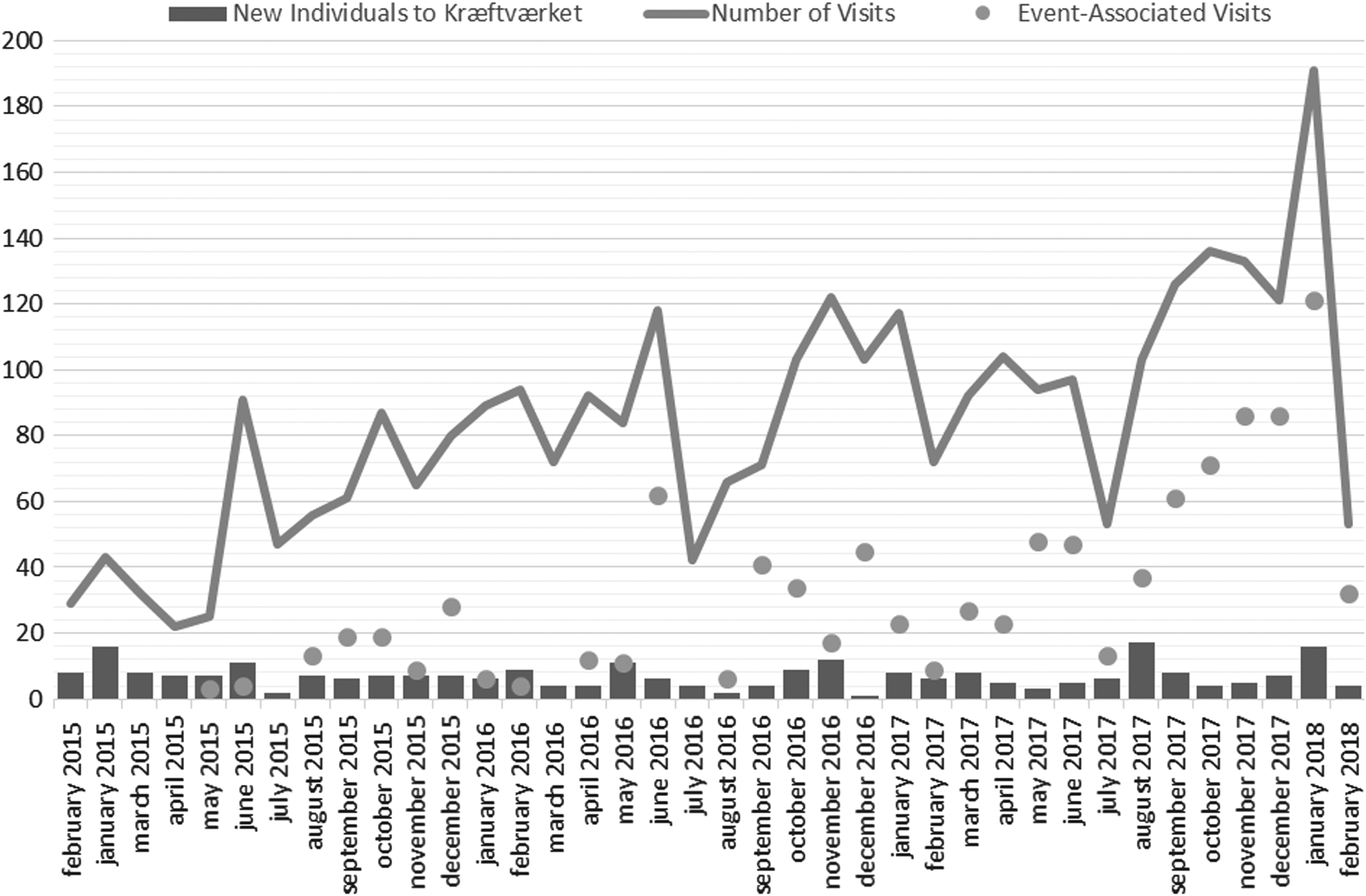
Overall participation, participation in event-specific visits, and new visitors to Kræftværket from February 2015 through February 2018.
Demographic Characteristics of Unique Kræftværket Visitors and Total Visits from February 2015 Through February 2018
Discussion
Youth-oriented resources are frequently advocated for those who work with AYA populations.10–12,14,15 In particular, there is a push toward the creation and provision of resources that directly involve youth in decision-making processes.14,15 Kræftværket has been designed to include AYAs with cancer throughout the course of decision making and improvement, and has seen an increasing use of its events and facilities over time. While Kræftværket meets many of the objectives outlined for successful AYA resources, it is a singular entity tailored toward AYA in the greater Copenhagen area.
One of the most significant principles behind Kræftværket is the idea that “You are not alone.” As Kræftværket provides services to pediatric departments, as well as a wide range of hematology and oncology units, a network between patients that would otherwise not have crossed paths is created. Future resources, such as a smartphone application and a book written in coordination with the Danish Cancer Society,23,24 have recently been developed to provide youth-oriented resources to Danish AYA with cancer outside Copenhagen, who may otherwise be unable to utilize the in-person Kræftværket dayroom and events.
Ongoing focus is needed among healthcare professionals to ensure wide use of Kræftværket and youth-oriented wardrooms. A large hospital population and busy wards present obstacles for healthcare professionals in introducing AYAs to this initiative, and ensuring optimal use of youth-oriented resources and wardrooms. The Youth Coordinator and the Youth Ambassadors at all implicated departments have demonstrated significant benefit in maintaining focus on the initiatives for this patient group.
Further research in regard to AYA cancer patients and survivors who have not utilized Kræftværket is warranted. Due to the current data availability, this could not be included here. Further research examining demographic and health outcome differences as well as preferences among users and nonusers of youth-oriented support initiatives to evaluate the impact of such initiatives is being planned.
Conclusion
AYA initiatives such as Kræftværket are capable of creating youth-friendly resources, facilities, and activities through direct involvement of AYAs, the utilization of youth-trained staff, and close cooperation across departments and settings (pediatrics/adult departments). Other institutions may benefit from the creation of similar initiatives to serve the unique needs of the AYA population. Youth initiatives create an environment that fosters networking among AYA patients, regardless of diagnosis, allowing for social support and network among peers. Further research among users and nonusers of similar AYA approaches is warranted.
Footnotes
Acknowledgments
We acknowledge the Danish Cancer Society, The Child Cancer Foundation, and the management of Rigshospitalet and partnering centers for their role in the creation, management, and funding of Kræftværket. We also acknowledge the Egmont Foundation that supports individual support initiatives based in CAM.
Author Disclosure Statement
No competing financial interests exist.