




Abstract
We evaluated the feasibility of a mentored gardening intervention for adolescent and young adult (AYA) cancer survivors in a hospital-based community garden as a way to improve diet and physical activity, using qualitative data to assess the challenges, facilitators, and areas for future programmatic improvement and replication. Over the course of growing season 2018, AYA cancer survivors tended a garden plot in a community garden under the mentorship of an experienced (master) gardener. AYA cancer survivors were successful in planting and harvesting vegetables from the garden in partnership with their mentors. Qualitative results and future directions for the project are discussed.
Introduction
Adolescent and Young Adult (AYA) cancer survivors demonstrate poor concordance with lifestyle recommendations for diet, physical activity, and body weight.1,2 This is worrying given their increased risk for cancer recurrence or second malignancies, 3 long-term health problems, and poor quality of life. 4 Moreover, cancer affects AYA cancer survivors during a transitional period in their life when they are seeking more independence from their parents and/or when they are building their own connections and families; this can make them susceptible to feeling more vulnerable, dependent, and isolated as they face an uncertain future.5,6
Consuming a plant-based diet and remaining physically active may be associated with better physical functioning and quality of life among adult cancer survivors, 7 and this may potentially affect survival rates.8–10 Participation in gardening may help survivors consume a more plant-based diet, while at the same time increasing physical activity and physical functioning; gardening may also improve social well-being and health-related quality of life.11–13 Prior studies have identified home-based mentored gardening for cancer survivors as a promising strategy 14 to encourage consumption of fruits and vegetables. In addition, urban gardens for patient usage, including cancer survivors, are emerging as strategies to improve access to fruit and vegetables and promote healthier diets. 13
We combined aspects of these prior interventions in designing a mentored gardening intervention for AYA cancer survivors within the setting of a community garden located on a hospital campus. Such a gardening intervention may not only positively affect diet, physical activity, and physical functioning, but also by gardening within a community-based garden and under mentorship of gardening experts there may be psychosocial benefits that impart a feeling of community, solidarity, and meaning for cancer survivors.
Primary aims were to assess the feasibility of a mentored gardening intervention for AYA survivors in a community garden, and to collect qualitative data on the project's outcomes, challenges, and areas for future programmatic development.
Materials and Methods
Setting
The study took place in the Hershey Community Garden, a 225-plot space located on the campus of Penn State Hershey Medical Center 15 and was part of the “Food as Medicine” initiative. 16 Garden members have access to a shed, tools, compost, and watering hoses. Two 8 × 15-foot plots were allocated for this project.
Participants and mentors
AYA cancer survivors were recruited through the AYA clinic of Penn State Cancer Institute between March and April 2018. The director of the survivorship program approached possible participants and flyers were distributed in the clinic. Eligibility criteria were as follows: age 18–39 years; a history of cancer; having received chemotherapy as part of treatment, but completed chemotherapy at least 1 year before study enrollment; stable disease (no planned treatment during the coming year); physician approval; live a reasonable distance from the garden; and reliable transportation to the garden. Exclusion criteria were as follows: currently tending a vegetable garden, or >1 year of overall experience with gardening, non-English speaking, pregnancy, and a medical condition that precluded safe gardening. The study was approved by the institutional review board (IRB); written informed consent was obtained from participants.
Each participant was matched with either highly experienced gardeners or formal master gardeners, recruited through informal contacts and Penn State Agricultural Extension. To be eligible, mentors had to have extensive experience (several years) in vegetable gardening or be master gardener affiliated with Penn State Extension. Moreover, they needed to have interest in mentoring participants; be able to visit the garden on a regular basis; have reliable transportation; be at least 18 years old, and English speaking. Mentors received an informational flyer to explain what was expected of them. They provided verbal consent to take part in the project and to participate in qualitative interviews.
Intervention
The intervention was designed before the start of the study based on the behavioral social networks for activity promotions (SNAP) model,17–19 which acknowledges the importance of three ecological levels in long-term behavior change: (1) where (hysical environment): the community garden, (2) with whom (social network): a network of motivated gardening mentors around each cancer survivor, and (3) what people do together (social network interaction): tending the garden and meeting on a regular basis with the master gardeners and/or other gardeners.
The intervention started in April 2018 with an introductory meeting of participants and mentors in the community garden. Participant and mentor were encouraged to meet in the garden again the following weeks to forge a gardening plan. They were encouraged to meet as regularly as they wished, although the research team encouraged the teams to work in the garden at least weekly. By the end of April, gardeners received a donation of cool-weather plants from the Rodale Institute in Kutztown, PA (e.g., kale, cabbage, lettuce), but gardeners could buy and plant other vegetables. In May, the Rodale Institute provided a donation of warm-weather plants (e.g., corn, melons, tomatoes, peppers, eggplant).
Data collection
Before the start of the project, we collected data using the following surveys: dietary intake screener, 20 international physical activity questionnaire, 21 quality of life short form 36, 22 and patient-reported outcomes measurement information system to assess emotional distress and self-efficacy. 23 Measurements were repeated after the completion of the project (November—December 2018).
Qualitative interviews with participants and mentors took place in June–July 2018 and after the gardening season (November–December 2018). Throughout the gardening season, gardeners noted how often they visited the garden in a log that was kept in a shed in the garden.
A priori, we defined the intervention feasible if we succeeded in recruiting at least four cancer survivors; if participants successfully planned, planted, and harvested produce; tended the garden at least once per week during the whole intervention, and met with their gardening mentor at least once per month.
Results
Five AYA cancer survivors (all women) and four mentors (two women and two men: three master gardeners, one experienced gardener) were recruited for the project. The average age of the AYA participants was 34 years. All had college or master degrees. One of the participants dropped out shortly after enrollment, as she felt she could not commit to tend a garden. The other four participants completed the study.
The frequency with which the gardeners visited the garden varied widely within and between participants, from four times per week to once per month; the average was one to two times per week. Three of the participants worked in the gardens until the end of September; the fourth participant was active in the garden until the 2nd week of July. During the interviews in June–July, participants and mentors reported they had met in person in the garden several times. During the end-of-project interviews, participants and mentors reported that communication had mostly shifted to email and text, additionally some of the participants were in touch with their mentors through social media.
Dietary intake
During the interviews, participants reported they had planted and harvested a variety of vegetables, including peppers, tomatoes, spinach, lettuce, cucumbers, cabbage, zucchini, collard greens, squash, onions, and herbs (basil, mint, and parsley; Fig. 1); participants reported that their dietary intake of vegetables went up during the summer when vegetables were most abundant. Participants reported they felt produce tasted better than produce bought in a grocery store. They also reported cooking more, looking for recipes, and experimenting with fresh produce from the garden.
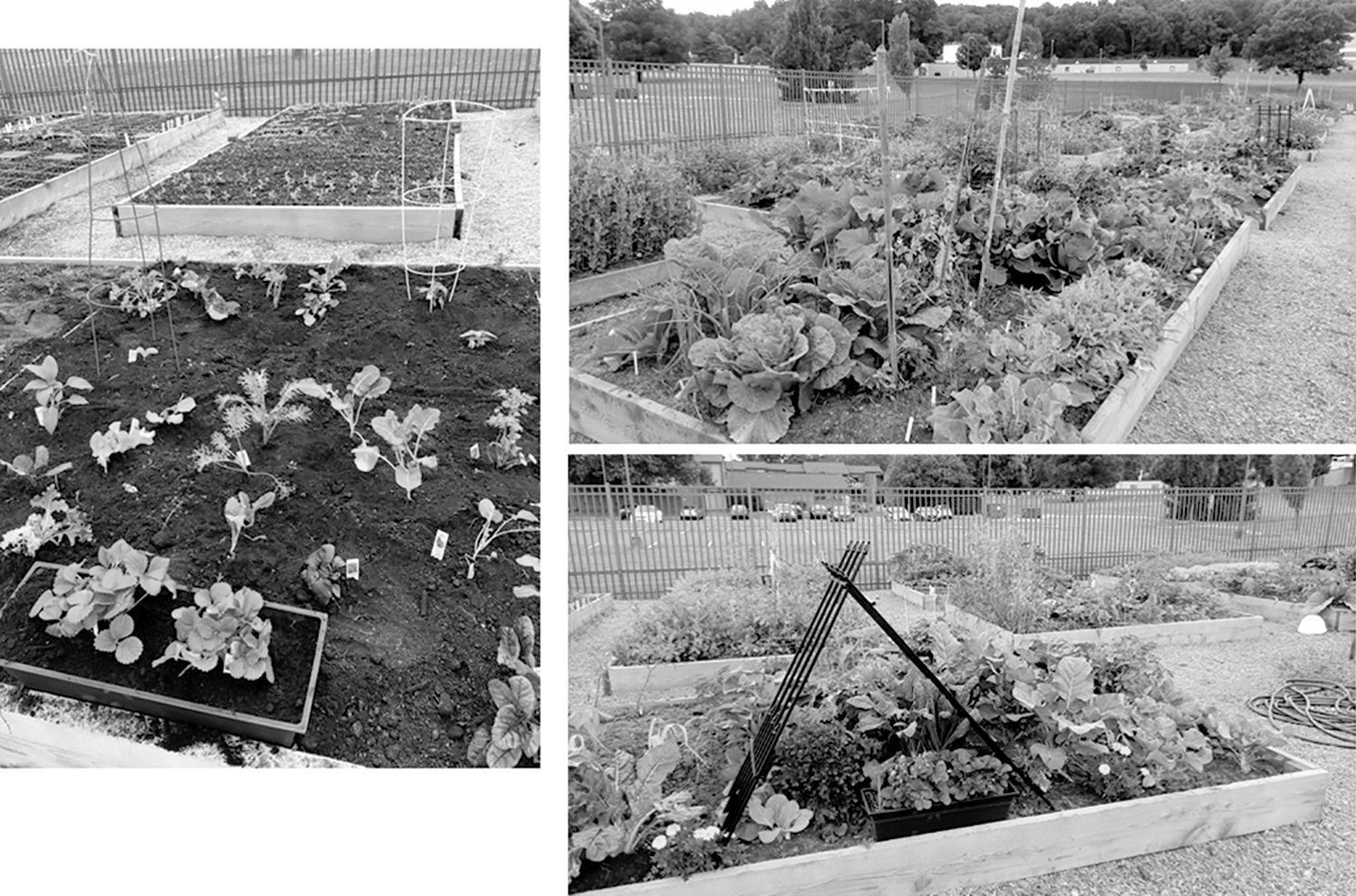
Pictures of the plots of the participants in a mentored gardening intervention for adolescent and young adult cancer survivors.
The survey data showed that dietary intake of fruits and vegetables at baseline was high: on average seven pyramid servings per day, with substantial variation between participants (lowest 1 and highest 15 servings/day). After completion of the study, intake of fruits and vegetables was three pyramid servings per day; this information was collected in November–December, thus a substantial period after most participants had stopped tending their gardening plot.
Physical activity and quality of life
In interviews, participants expressed that they enjoyed being outside in a garden setting and felt excitement and pride about successes in the garden, as well as a sense of ownership/responsibility for their plots. The garden was perceived as a relaxing environment; participants expressed that being in the garden helped them deal with stress and frustration in their lives. Several participants spoke about the joy of involving their significant others, children, and community groups (e.g., girl scouts) in the garden. Participants also reported confidence in growing food in the future. All participants expressed the importance of receiving mentorship from an experienced gardener in starting and maintaining the garden.
The surveys showed that at baseline, one participant had a low level of physical activity, one a high level, and others a moderate physical activity level; this was similar after completion of the project. According to the surveys, quality of life was similar at baseline and follow-up, anger and distress were also similar at both time points.
Challenges
For several participants, personal schedules became busier over the summer, at a time when the garden also required more attention. Participants reported this was sometimes difficult to manage. Moreover, having no control over the weather was perceived as a challenge, as was pest control. By design, participants were assigned a smaller section of a larger garden bed, which sometimes led to frustration when neighboring sections were not well maintained. When the harvest was overwhelming, it was challenging to consume all vegetables while they were fresh, although participants identified that mentors were helpful in providing feedback on preservation strategies. One participant was immunocompromised because of stem cell transplantation and reported using a mask and gloves in the garden, which was not always comfortable in the heat.
Future directions
Suggestions for future directions and improvements, as identified by participants, mentees, and the research team, are presented in Table 1. Overall, participants and mentors reported that greater interaction with the study team and/or other participants would have been appreciated. Participants showed interest in receiving formal education/instruction on gardening and health. Both mentors and mentees suggested taking more time to get to know each other and then to plan and design the plot, and to explore strategies to extend the gardening season. In addition, research team members recommended collection of biospecimens to study potential biological effects of gardening.
Future Directions for Mentored Gardening Interventions Among Adolescent and Young Adult Cancer Survivors
Discussion
Our assessment suggests that a gardening intervention for AYA cancer survivors in a community garden, under the mentorship of an experienced gardener is feasible. Participants successfully planted, harvested, and consumed vegetables from the garden.
Survey data did not suggest an impact on dietary intake, but survey data were collected after the completion of the project, and dietary intake at baseline was already very high. In future work, dietary 24-hour recall data collected throughout and after the season may provide a more sensitive assessment of dietary intake. In addition, the intervention should include formal educational content, including food preservation, cooking skills, and the nutritional benefits of eating fruit and vegetables.
As more extensively described in a book chapter on the psychosocial aspects of the project, 24 participants enjoyed bringing their family and community members into the community garden. As enjoyment of the activities is an important aspect of sustained lifestyle behavior change, 25 future studies could explore this community aspect of the intervention to facilitate long-term lifestyle changes. It may be fruitful to develop mentored gardening interventions where teams of participants share responsibility in caring for an entire garden bed.
The surveys on physical activity, quality of life, anger, and distress did not suggest major changes over the course of the intervention. Importantly, this study was not powered to detect changes, but was designed to assess feasibility of the intervention overall. We did not include a control group and can, therefore, not make any comparisons with those not participating in gardening.
We showed that a mentored gardening intervention for AYA cancer survivors within the setting of a community garden on a medical campus is a feasible intervention. As increasing numbers of hospitals have a community garden on their campus 15 and a master gardener system exists throughout the United States and Canada, there are ample opportunities to develop and foster these collaborative partnerships, and to tie them to the specific needs of this unique population.
Footnotes
Acknowledgments
We thank garden manager Rob Holquist for his help in starting this project, and we appreciate the Hershey Community Garden for its ongoing support for this study. The experienced gardeners and master gardeners generously donated their time for this project, for which we are very grateful. We also thank the Rodale Institute for donating plants for this project.
Author Disclosure Statement
No competing financial interests exist.
Funding Information
No funding was received for this article.