




Abstract
Purpose:
To evaluate the impact of a series of one-day events delivered by Trekstock, a charity supporting young adults with cancer in the United Kingdom.
Methods:
Data on physical activity, mood, perceived support, self-efficacy, and confidence to be active were collected at three time points: before, after, and 2 weeks following the Meet & Move events.
Results:
Ninety-seven young adults with cancer (mean age: 29 years, 35% still receiving active treatment) attended a Trekstock Meet & Move event and participated within the evaluation. Baseline data demonstrated that before attending a Meet & Move event, 27% (n = 23) of young adults reported feeling their cancer excluded them from engaging in exercise, 44% (n = 37) reported concern that exercise will cause pain or injury, and only 38% (n = 32) knew what exercise they could do. Data collected post-event and at follow-up indicated that Meet & Move had a positive impact upon attendees' self-efficacy and confidence to be active with more than half reporting they felt inspired after attending. There was also a significant reduction in reported worry that exercise may cause pain or injury and reported perception of feeling left out of exercise because of cancer (p < 0.05). Following engagement in the Meet & Move events, 45% of attendees had either signed up for an additional Trekstock physical activity program or initiated engagement in a new type of physical activity on their own.
Conclusion:
Trekstock Meet & Move events inspire and motivate young adults with cancer in their 20s and 30s to be active.
Background
It is estimated that 14,898 young adults in their 20s and 30s are diagnosed with cancer each year in the United Kingdom. 1 Thankfully, due to advances in early detection and treatment, approximately 80% of young adults in their 20s and 30s diagnosed with cancer are expected to survive for 5 or more years. 2 The growing incidence of cancer and increase in survival for those aged 20–39 years have led to an increase in the number of young adults requiring cancer support. In 2014, the Macmillan segmenting the million project estimated that there were approximately 200,000 young people in their late 20s and 30s classed as cancer survivors within the United Kingdom. 3
Given that cancer is a disease that most commonly affects those over the age of 60 years most cancer services are designed to reflect the needs of older adults. 4 Teenage and young adult (TYA) cancer care is well established within the United Kingdom for young people diagnosed between 13 and 24 years of age. A young person diagnosed in this age bracket will receive treatment in a principal treatment center or designated hospital by a specialized multidisciplinary team. Following treatment, young people will be transitioned to specialized long-term follow-up or shared care between a TYA survivorship clinic and their general practitioner. 5 However, despite having similar needs, young adults in their late twenties and thirties (age range 25–39 years) do not receive similar age-appropriate clinical care or support. This has resulted in young adults who do not fall within the traditional TYA age bracket reporting poor psychosocial well-being, including feelings of isolation, depression, and anxiety.6–8
Trekstock, a cancer charity based in London (United Kingdom), was established to address this gap by providing emotional and practical support to young adults faced with cancer in their 20s and 30s. Based upon substantial evidence that physical activity is safe, feasible, and has a number of clinical, physical, and psychosocial benefits for cancer patients both during and after treatment,9,10 Trekstock focuses on helping young adults with cancer to be active following their diagnosis. Physical activity behavior has been shown to be a predictor of psychosocial well-being among young adults with cancer 11 and has been recognized by young adults themselves as a means to regain control over their health and well-being. 12 However, less than 50% of young adults with cancer are active. 13 Recent data indicate self-efficacy, confidence, and knowledge are important predictors of exercise behavior among young adults with cancer. 14 Interventions that aim to improve young adult cancer survivors' self-efficacy and confidence to be active through education and peer support are therefore warranted.
Within the United Kingdom, a core recommended feature of the National Cancer Survivorship Initiative (NSCI) “Recovery Package” is the inclusion of a health and well-being event containing support and information on life beyond cancer, including going back to work, managing finances, coping with the long-term effects of treatment, and making healthy lifestyle choices. As many existing well-being events were developed with older adults in mind, Trekstock developed a series of one-day events titled “Meet & Move” to provide opportunities for young adults with cancer to meet with other cancer survivors of a similar age and receive age-appropriate advice on how to live well after cancer diagnosis and treatment. The purpose of this evaluation was to determine the impact of the Meet & Move events on young adults' well-being, self-efficacy, and motivation to exercise. Evaluation outcomes included understanding (1) what motivates young adults with cancer to attend Meet & Move events, (2) if Meet & Move events help address feelings of loneliness, isolation, and worry in young people with cancer, and (3) if attending a Meet & Move events influences the self-efficacy and confidence of young people with cancer to be active.
Methods
Design
Across 2018 and 2019, an evaluation of five Meet & Move events was conducted using a pre-test and post-test design. Participants were asked to complete a self-report questionnaire before, immediately after, and 2 weeks following attending a Meet & Move event. Self-report data on participants' levels of physical activity, mood, self-efficacy, and confidence to exercise were collected alongside open-ended questions to gain young peoples' subjective viewpoint of the Meet & Move events. Queen Mary, University of London Research Ethics Committee, approved the collection of the data.
An overview of the programs of each Meet & Move events is contained within the Appendix. Each event was carried out at a Maggie's Cancer Support centre and consisted of (1) opportunity to engage in physical activity through a group-led exercise session and a yoga class, (2) a food and nutrition workshop centered around a cooking demonstration, and (3) sessions covering the psychosocial impact of cancer. Other activities on offer across the five events included art therapy, gardening, Look Good Feel Better skin and make up sessions, and comedy. Meet & Move events were free to attend for participants. The cost incurred by Trekstock per person to attend a Meet & Move event was £95.66.
Outcomes measures
Demographics questions
Participants were asked to report their age, type of cancer diagnosis, age at diagnosis, and current treatment status.
Physical activity
The Godin Leisure Time Exercise Questionnaire (GLTEQ) was used to assess physical activity at baseline and follow-up. Participants were asked to report the frequency of time they spent carrying out strenuous exercise (e.g., running, jogging, and vigorous swimming), moderate exercise (e.g., fast walking, easy cycling, and easy swimming), and mild exercise (e.g., easy walking, fishing, and bowling). The GLTEQ has been used in previous studies of TYA cancer survivors13,15,16 and has demonstrated reliability and validity within the oncology research setting. 17
Self-efficacy and confidence
The nine-item Self-Efficacy for Exercise (SEE) 18 scale was used to assess self-efficacy to exercise at each time point. Participants were asked to rate on a scale of 1–5 their level of confidence to exercise for more than 10 minutes/exercise for more than 30 minutes/exercise alone/take part in a new form of exercise/exercise even if they were busy with new activities/exercise if they felt tired/exercise if they felt stressed/exercise if they felt depressed. Higher scores indicate greater confidence to overcome barriers to exercise. The SEE scale has previously been used in studies of cancer survivors19,20 and has strong internal consistency (Alpha coefficient 0.92). 18 Participants were also asked to rate on a 5-point Likert scale (1 being not at all and 5 being very much) the extent to which family and friends support them being physically active, if they felt cancer prevented them exercising, their knowledge of help and support to be active, the extent they worry about exercise causing pain or injury, and whether they knew of exercises they were capable of doing.
Mood
To assess mood, a single-item question, whereby respondents rated if they felt happy/hopeful/relaxed/anxious/lonely/troubled, both before and after the event was included within the post-event questionnaire.
Motivation to attend and impact of Meet & Move
Participants were asked to select from the following list their reason(s) for attending a Meet & Move event: to try new physical activity options, to kick start getting back into exercise after my cancer diagnosis, because my friends/family/partner said I should come, I wanted to meet other young adults with cancer, and I wanted to find out more about Trekstock. To understand the benefit of the Meet & Move event, participants were asked to select if they agreed (Yes/No) with the following statements: I feel inspired to be more active, I have picked up new ideas on how to be more active, I feel more confident to exercise regularly, and I now know there are other young people like me who also struggle to stay active. Open-ended questions on what elements of the events were most enjoyable and how the events could be improved were asked at each follow-up time point (immediately after the event and 2 weeks later).
Analysis
SPSS version 22 was used to perform statistical analyses. Descriptive data on participant characteristics, physical activity levels, motivation to attend, and impact of Meet & Move were reported as percentage and mean and standard deviation (SD) values. Changes in participants' levels of physical activity, self-efficacy, and confidence were established using repeated-measures (within subject) analysis of variances (ANOVAs). To examine differences at baseline and follow-up, paired t-tests were used for physical activity and Wilcoxon signed rank test for mood. Standard GLTEQ scoring was used to calculate a leisure score index (LSI), which was used to categorize participants as inactive or insufficiently active (estimated energy expenditure <14 Kcal/kg/week). 21
Results
Participant characteristics
Table 1 displays participant characteristics. Ninety-seven young people with cancer attended Meet & Move events across 2018 and 2019 held in West London, East London, Manchester, Oxford, and Newcastle. All participants completed the baseline questionnaire, 83 completed the post-event questionnaire, and 24 completed the follow-up questionnaire 2 weeks after the event. Participants were between 18 and 43 years of age (mean age: 29 ± 5.49 years). Mean age at diagnosis was 26 ± 7.34 years. Most participants had been diagnosed with cancer during their 20s (n = 42, 50% vs. n = 30, 35.7% diagnosed in their 30s). Eight participants (9.5%) were long-term survivors of a childhood or adolescent diagnosis (diagnosed before the age of 18). The most common cancer diagnoses was carcinoma (n = 37, 44%), of whom 64% (n = 24) reported breast cancer. The majority of participants were still receiving active cancer treatment (35.1%, n = 34) or were in the 1st year post-treatment (35.7%, n = 35). Most young people (55.7%, n = 54) heard about the event online through Instagram, Twitter, or the Trekstock website and came to the Meet & Move event to meet other young people with cancer (66%, n = 64). Forty-one percent of young adults who attended Meet & Move events were active (n = 40 LSI score ≥24, sample mean ± SD = 26.31 ± 34.09) and reported strong family and peer support to be active (42.3%, n = 40 selecting very much so on a 5-point Likert scale, mean ± SD: 4 ± 1.08). At baseline, before attending a Meet & Move event, 27.4% (n = 23) of young adults reported feeling left out of exercise because of their cancer, 44% (n = 37) reported that they were worried exercise will cause pain or harm, and only 38.6% (n = 32) reported knowing what exercise they could do.
Participant Characteristics
SD, standard deviation.
The impact of Meet & Move
As shown in Figure 1, before attending a Meet & Move event, only 8% of young adults reported feeling happy with some reporting feeling anxious, lonely, and troubled. After attending, the proportion of young people reporting feeling happy and relaxed rose significantly (% change: 36% and 24%, respectively p < 0.005).
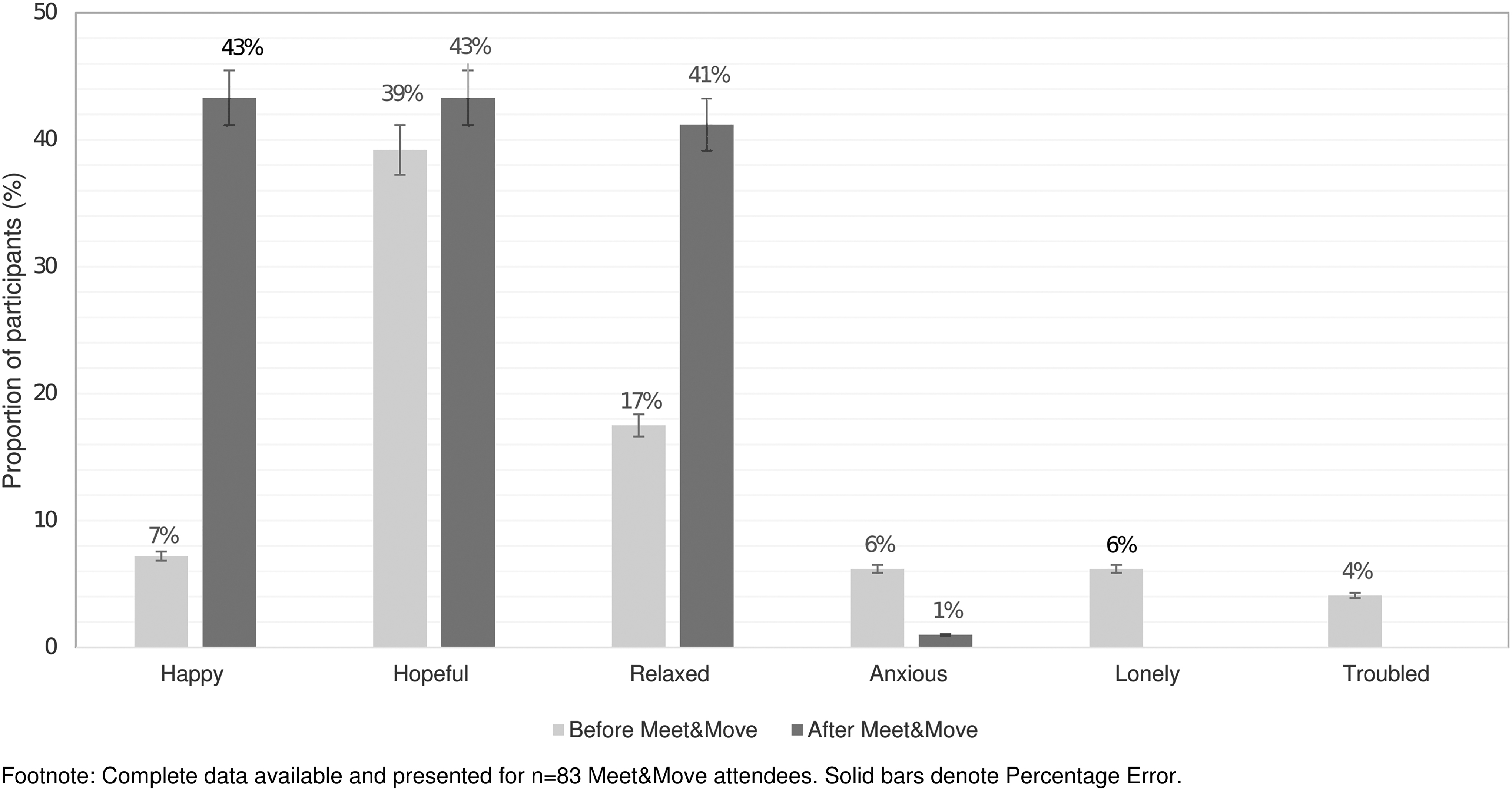
The effect of Meet & Move on participants' mood and feelings.
Figure 2 displays mean scores and change in self-reported rating of perceived support and self-efficacy to exercise. Following Meet & Move, a significant difference in young adults' feelings of being left out of exercise (F(1,17) = 4.33, p = 0.053) and worry that exercise will cause pain or injury was observed (F(1,18) = 4.98, p = 0.038). The Meet & Move events also improved young adults' knowledge about the types of exercise they can do (F (1,16) = 2.75, p = 0.116) and where they can access help and support to be more active (F(1,17) = 4.86, p = 0.495).
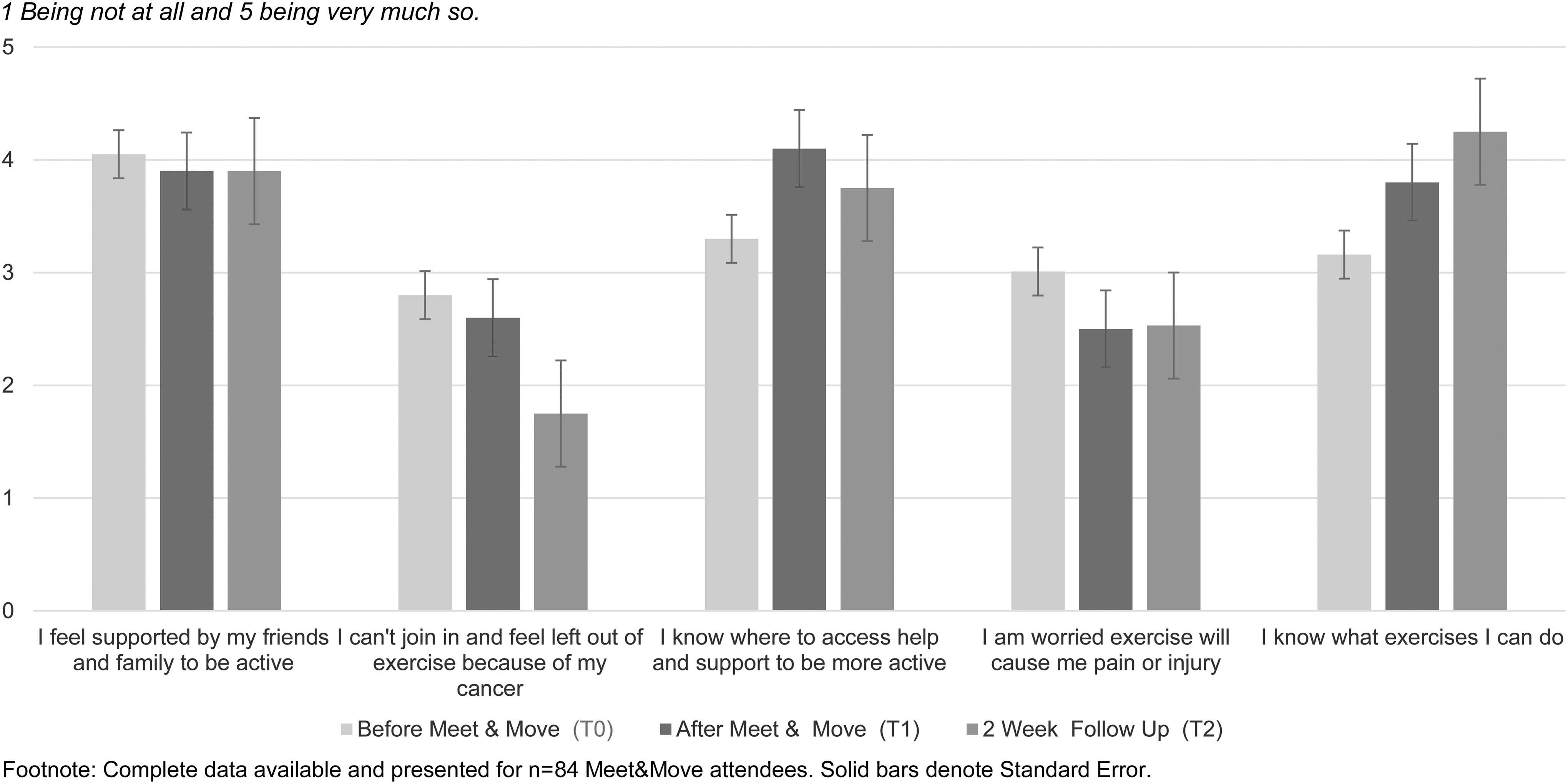
Change in perceived support and self-efficacy.
Following attending a Meet & Move event, 64% (n = 51) agreed with the statement they now knew there are other young people like them with cancer who also struggle to stay active and 52% (n = 41) felt inspired to be active. Forty-seven percent (n = 37) picked up new ideas on how to be more active from attending and 32% (n = 25) felt more confident to exercise regularly. The majority of young adults (94%, n = 78) said they would “definitely” recommend the Meet & Move event to another young adult living with cancer.
Table 2 displays mean scores and change in confidence regarding physical activity. Among young adults who attended the Meet & Move events, overall confidence to exercise was high. Although not statistically significant, results suggest that Meet & Move improved participants' confidence to exercise for extended periods of time and take part in new forms of activity and exercise even when feeling low (e.g., tired, stressed, or depressed).
Change in Perceived Confidence to Exercise
1: being not at all confident and 5: very confident.
ANOVA, analysis of variance.
Forty-five percent (n = 11) of young people who completed the follow-up questionnaire 2 weeks (n = 24) after the Meet & Move event said they had either signed up to the RENEW exercise referral program offered by Trekstock or had started another type of physical activity on their own. There was no significant difference in the reported activity levels of participants at 2-week follow-up in comparison to baseline (p = 0.087). Eighty-seven percent (n = 21) said they would be “very likely” to attend the event again with the remaining 12.5% (n = 5) reporting they would be “likely” to attend again. Most young adults (66%, n = 16) said they would like to attend a Meet & Move event every 2 months.
Written praise and suggestions for improvement from young adults who attended the Meet & Move events are contained within Table 3. Although meeting other young people with cancer was one of the primary reasons young people attended and enjoyed the Meet & Move event, one young person highlighted that meeting other people at a different stage in the cancer journey may be intimidating. Several young people also suggested name badges would be a useful addition to the day to make introductions and starting conversations easier. One young person noted that during the group coaching sessions, there was a tendency for participants to share negative thoughts and experiences.
Open-Response Feedback from Young Adults About Meet & Move
Discussion
This evaluation provides an insight into the benefit of one-day health and well-being events designed specifically for young adults with cancer. Results demonstrate that Meet & Move events have a positive impact upon young adult cancer survivors' self-efficacy and confidence to be active. There was a significant reduction in reported worry that exercise may cause pain or injury and reported perception of feeling left out of exercise because of cancer. Approximately 63%–76% of participants reported feeling happy, hopeful, and relaxed at the end of the event, highlighting the role peer support plays in improving young adults' psychosocial well-being. Forty-five percent of participants who completed the follow-up questionnaire at 2 weeks had either signed up for other Trekstock physical activity offerings or had started another type of physical activity.
Through meeting other young people with cancer, Meet & Move may help address feelings of isolation and fear surrounding being active following a cancer diagnosis. This was demonstrated by the large proportion of participants who acknowledged that the event increased their awareness of other young people with cancer who also struggle to stay active. The need for young people with cancer to communicate with other young people in a similar situation to them is well documented within the literature,4,22 especially given that a cancer diagnosis during early adulthood is incredibly rare and family, friends, and caregivers may not have an understanding about the dormant or latent effects of cancer.23–25 Within one study of 514 young adults diagnosed with cancer in Germany (mean age: 29 years), social support and positive interactions with others were found to be associated with life satisfaction after treatment completion during the first 12 months of survivorship. Awarding microgrants to support women with breast cancer to develop and implement physical activity initiatives in their local area has proved effective in Canada. 26 A similar initiative or a buddy system partnering young people who are at a similar stage of treatment may be an effective way of ensuring Meet & Move attendees can connect with peers who have had a similar cancer diagnosis or are at a similar stage of treatment.
A large proportion of participants reported that the event “inspired” them to be more active and that they would definitely recommend attending. After each Meet & Move event and at follow-up, the number of young adults reporting feeling left out of exercise because of their cancer or not knowing what exercise to do fell significantly. Statistically significant improvements in self-efficacy and confidence to exercise were not found; however, this finding may be attributed to Meet & Move attendees demonstrating high levels of physical activity assurance at baseline. Existing marketing strategies (such as linguistically and culturally tailoring advertisements) previously piloted among hard-to-reach populations27,28 should be tested to attempt to engage more young adults with cancer to attend Meet & Move events. This includes those who have low self-efficacy and confidence to exercise. These individuals may reap greater benefit from Meet & Move events than individuals who already exercise and are engaged with leading a healthy lifestyle. This also applies to those who have high levels of health anxiety or negative emotion toward supportive care interventions. A stepped-care approach, whereby those who are less engaged or who have specific needs receive tailored support, may be an effective means to widen the reach of health promotion initiatives for cancer survivors. 29
A range of young adults with a variety of cancer diagnoses and at different stages of treatment attended Meet & Move, showing that the program of events appeals to young adults at different stages of the cancer journey. However, the majority of young adults heard about the events through Facebook, Twitter, or Instagram. Resources and health promotion materials only available in digital formats require proactive information seeking, which is linked to greater levels of health engagement and higher levels of health literacy. 30 It is likely that Trekstock followers on Facebook, Twitter, and Instagram are engaged and motivated to change their health behavior. Health professionals (inclusive of doctors, nurses, social workers, and members of the allied health professions) have been identified as key gate-keepers to pathways that connect cancer patients with exercise-related resources. 31 Increasing awareness about Meet & Move events among health professionals working in young adult cancer care and providing them with physical resources to sign-post young people toward the online registration is a potential solution to engaging more young adults with cancer with Meet & Move events.
This brief evaluation demonstrates the Meet & Move is well received by, and has a positive impact upon, young people with cancer. However, the evaluation is somewhat limited by the lack of control group. To reduce participant burden, it was felt that each questionnaire should be two-pages long. Although a 2-week follow-up questionnaire was included within the evaluation, a number of participants did not respond or complete this. Future work should aim to explore strategies that encourage young adults with low motivation to change their physical activity behavior to attend Meet & Move events and strategies, which sustain positive lifestyle behavior change long term. Future work should also seek to evaluate the impact of other components of the Meet & Move program such as the nutrition sessions, life coaching, and art therapy. The generalizability of the results is also somewhat limited as the sample predominantly consists of female breast cancer survivors who are highly educated and already active. In acknowledgment of the findings, Trekstock, in partnership with academics from Queen Mary University of London, have carried out a series of public involvement and engagement activities to address how the reach of the Meet & Move initiative can be expanded, specifically toward men.
Conclusion
As per the NCSI, all cancer patients should have access to an education and support event as part of the cancer recovery package. NCSI guidance suggests these events facilitate self-management through the provision of education and support on physical activity and lifestyle behavior change. The Meet & Move events provided by Trekstock offers an age-specific alternative for young people who fall out of the traditional TYA age bracket in the United Kingdom. To expand the success of Meet & Move events, Trekstock is considering existing recovery package resources currently commissioned within the NHS and pathways by which Meet & Move events could be integrated into routine health and social care for young people with cancer.
Footnotes
Acknowledgments
The authors acknowledge the support of the Maggie's Centres charity in supporting the delivery of Meet & Move events. Specifically, Liz Shaladan, Maggie's Centres Operation Manager for the South of England, and the Maggie's Centre Heads at West London, Barts, Oxford, Manchester, and Newcastle. A thank you and special acknowledgment to Toby Peach, Chevy Rough, Liz O'R Riordan, Steph Davies, Teresa Waite, Joelle Rainford, Poppy Stevens, Hannah Niven, Robynne Cranston, Grace Cooper, and Dani Binnington for contributing toward the delivery of the Meet & Move events.
Authors' Contributions
All data were collected by J.R. and S.E.; G.P. analyzed and drafted the article; and A.F. and A.P. provided comments and input upon the article.
Author Disclosure Statement
S.E. is the Chief Executive Officer of Trekstock; J.R. is employed by Trekstock; and G.P. has received remuneration for providing independent consultancy to Trekstock. No competing financial interests exist for A.F. or A.P.
Funding Information
Trekstock received funding from the Next Foundation, LetterOne, the Albert Hunt Trust and the Big Lottery Fund to deliver Meet & Move events. AF is supported by grants from Cancer Research UK and Yorkshire Cancer Research. A.P. was awarded a MITACS scholarship to visit the UK. G.P. was funded by a Pan-London Research Fellowship from RM Partners and The London Cancer Vanguard in 2018.
Appendix
Attendee nos.: 27 female and 6 male
Experts:
Toby peach—compere
Joelle Rainford—yoga sessions and end of the day gratitude
Chevy Rough—mindful movement session talking about mindful training and holistic changes to keep moving
Hazel Wallace—lunch time talk about food to fuel you along with Q&A
Dani Binnington—nutrition sessions, making dips and energy balls
Victoria—group exercise session with one of our Renew program trainers
Steph Davies—life after cancer coaching sessions
Attendee nos.: 11 female and 3 male
Experts:
Toby peach—compere
Ambokile—group exercise sessions
Lynne—relaxation session
Grace—nutrition sessions, easy to make nibbles
Steph Davies—life after cancer coaching sessions
Lucy—garden therapy, bulb planting, and badge making
Attendee nos.: 17 female and 3 male
Experts:
Toby peach—compere
Steph Davies—life after cancer coaching sessions
Teresa—group exercise session with one of our Renew program trainers
Poppy—art therapy sessions
Joelle Rainford—yoga session
Liz O'Riordan—talk at the end of the day about her experience of breast cancer and her book
Attendee nos.: 17 female and 2 male
Experts:
Toby peach—compere
Steph Davies—life after cancer coaching sessions
Dani Binnington—nutrition session, making energy balls and dips
Joelle Rainsford—group exercise sessions based on Trekstock Moves classes run in London, also did greet the day in the morning
Look Good Feel Better—eyebrows and skincare sessions
Hanna—art therapy, using the outdoors to heal and inspire
Karen Hobbs and Alex Farrow—comedy gig session at the end of the day
Attendee nos.: 13 female and 5 male
Experts:
Toby peach—compere
Ellie—life after cancer coaching sessions
Dan—group exercise session with boxing
Sam—yoga sessions, including Nidra at the end of the day, which was a relaxation yoga session
Look Good Feel Better—eyebrows and skincare sessions
Robynne—nutrition sessions, demonstrating making dips and energy balls