




Abstract
Purpose:
Osteosarcoma is the malignant bone tumor most common in children and adolescents. Many cytochrome P-450 (CYP) members detoxify anticancer drugs used in osteosarcoma treatment, and thus, the aim of the present study was to investigate CYP polymorphisms in osteosarcoma patients.
Methods:
The present study investigated DNA from peripheral blood from 70 osteosarcoma patients treated with high doses of cisplatin, doxorubicin, and methotrexate. CYP1A2*1F (163C>A; rs762551); CYP2C9*3 (1075A>C; rs1057910); and CYP3A5*3 (6986A>G; rs776746) polymorphisms were investigated through real-time PCR using TaqMan probes.
Results:
The CYP2C9*3 allele did not present any association with clinical events. The CYP1A2 CC/AC genotypes were associated with ototoxicity occurrence (p = 0.041, odds ratio [OR] = 8.4) and high grades of ototoxicity (p = 0.039, OR = 10.7), when compared with patients carrying the CYP1A2 AA genotype. The CYP1A2 CC genotype was associated with high grades of diarrhea (p = 0.043, OR = 4.6) and fever (p = 0.041, OR = 7.1) in comparison with the CYP1A2 AA/AC genotypes. The CYP3A5 CC genotype was associated with weight loss (p = 0.009, OR = 3.8) and high grades of hepatotoxicity (p = 0.010, OR = 4.3) when compared with the CYP3A5 TT/CT genotypes. The CYP3A5 CC/CT genotypes were associated with high grades of vomit (p = 0.013, OR = 10.8), pulmonary relapse absence (p = 0.029, OR = 9.5), and better overall and event-free survivals (p = 0.017, hazard ratio [HR] = 3.1; p = 0.044, HR = 2.5; respectively) when compared with the CYP3A5 AA genotype.
Conclusion:
CYP1A2*1A and CYP3A5*3 alleles were associated with toxicity events. CYP3A5*3 allele was associated with better survival. Thus, CYP genotypes might be promising markers to tailoring treatment in osteosarcoma patients.
Introduction
Osteosarcoma is a malignant bone tumor derived from primitive mesenchymal cells and the most common in children and adolescents. 1 Studies III, IV, and V by the Brazilian Osteosarcoma Treatment Group (BOTG) found the estimated 5-year survival rates of 59% and 22% for nonmetastatic and metastatic patients at diagnosis, respectively. 2 Osteosarcoma patients are still affected by multidrug resistance and toxicity, so identifying genetic factors for predicting the treatment response could improve the outcome of patients at different risks. 3
Interpatient variability on drug response observed by differences in drug activity and toxicity is determined by genetic polymorphisms, leading to pharmacokinetic and pharmacodynamic changes in the metabolism of a specific drug. 4 Genetic polymorphisms are alterations in the DNA sequence observed in at least 1% of the population, which can lead to changes in structure, stability, and activity of a protein.4,5
Cytochrome P-450 (CYP) is a superfamily of drug-metabolizing enzymes that could be potential markers for personalized therapy. CYP enzymes participate in the phase I of drug metabolism, mediating drug oxidation, reduction, and hydrolysis reactions, therefore activating or deactivating drugs during these processes. 6 A meta-analysis from 19 case/control studies demonstrated an association between CYP1A2 rs762551 polymorphism and cancer risk, mainly in the Caucasian population. 7 CYP2C9 is involved in the metabolism of anticancer drugs such as cyclophosphamide, ifosfamide, etoposide, and tamoxifen. 8 CYP2C9 is predominantly expressed in the liver, representing about 20% of the hepatic CYP content. 9 The CYP3A subfamily is highly expressed in the liver and small intestine and metabolizes 50% of clinically used drugs. 10 CYP3A is the CYP isoenzyme involved in the metabolism of most agents in cancer treatment, among which are cyclophosphamide, docetaxel, doxorubicin, etoposide, gefitinib, ifosfamide, imatinib, irinotecan, paclitaxel, tamoxifen, teniposide, and vincaalkaloids. 11 CYP3A5 represents at least 50% of the total hepatic CYP3A content in humans and its protein is polymorphically expressed in adults. 12
Although many CYP members detoxify anticancer drugs used in osteosarcoma treatment, such as ifosfamide, doxorubicin, etoposide, and cisplatin, the impact of CYP genes to prognosis needs to be further defined. 13 Therefore, the aim of the present study was to investigate CYP polymorphisms in osteosarcoma patients, who were treated with the same protocol and presented complete follow-up of toxicity events during treatment.
Materials and Methods
Patients
We investigated 70 patients with diagnosis of osteosarcoma admitted to treatment in the Pediatric Oncology Institute (IOP/GRAACC/UNIFESP), between 2006 and 2011. The age range of the patients is from 6 to 27, with an average of 16 years at diagnosis. The gender ratio is 1:1 (male: 49%; female: 51%). All patients were treated following the protocol of 2006 by LAGOT (Latin American Group of Osteosarcoma Treatment) (Fig. 1). According to the LAGOT protocol, patients are treated with high doses of cisplatin, doxorubicin, and methotrexate. The clinical data of the osteosarcoma patients and grading of the toxicity events are summarized in Tables 1 and 2, respectively. The toxicity was classified using the Common Terminology Criteria for Adverse Events version 4.03 (CTCAE v4.03) and included the following: cardiac disorders (cardiotoxicity), ear and labyrinth disorders (ototoxicity), gastrointestinal disorders (mucositis, constipation, diarrhea, nausea, and vomit), general disorders (fever), investigations (hepatotoxicity and weight loss), infections and infestations (infection without and with neutropenia), and renal and urinary disorders (nephrotoxicity). This study had the Research Ethics Committee approval from the Federal University of Sao Paulo (n° 1873/11), and all patients agreed to participate by an informed consent.
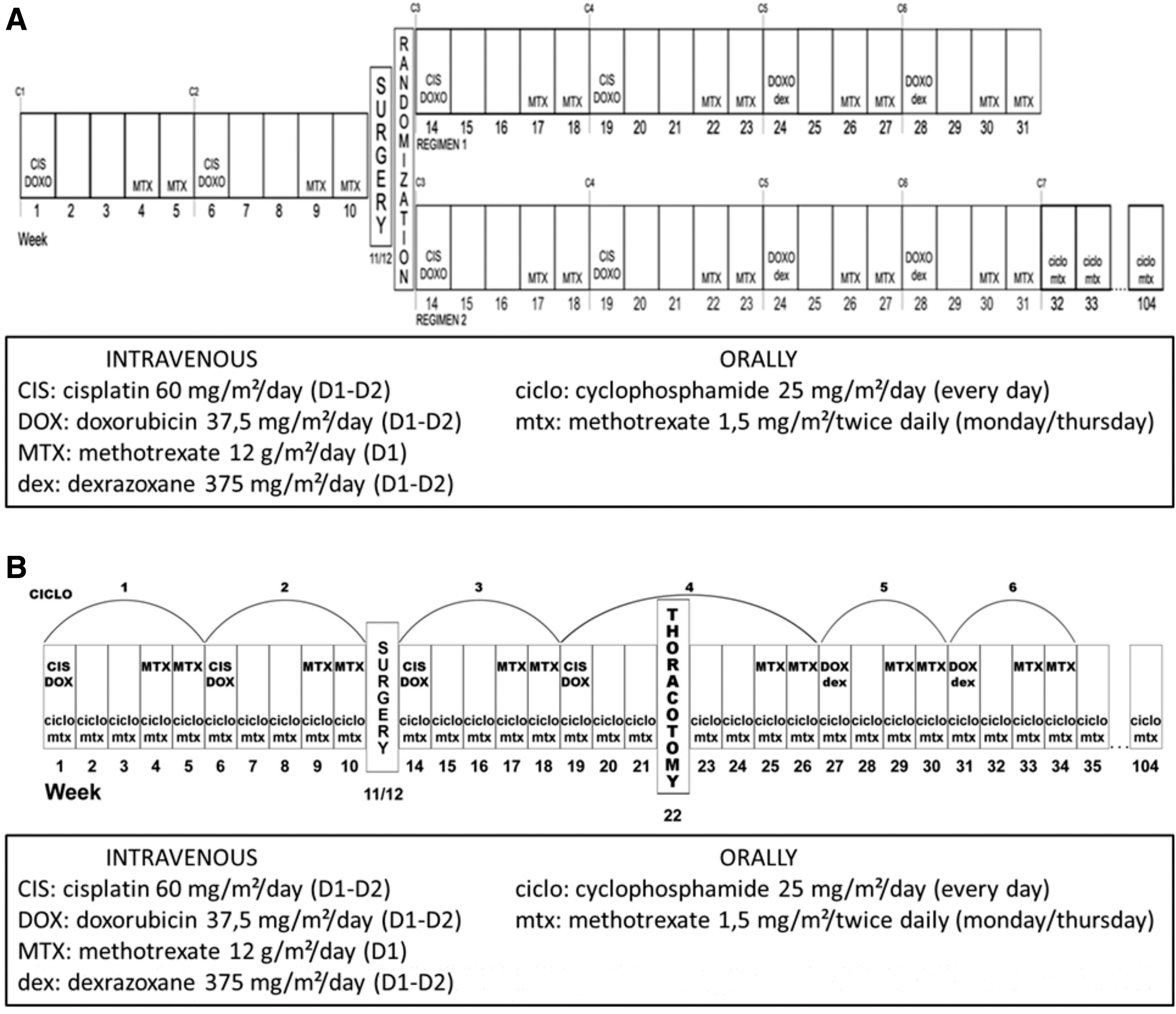
Treatment protocol of 2006 by LAGOT. According to the LAGOT protocol, all patients were treated with high doses of cisplatin, doxorubicin, and methotrexate. The nonmetastatic patients were randomized to receive or not the metronomic therapy (low doses of cyclophosphamide and methotrexate, orally).
Clinical and Pathological Features
N/i, not identified.
Toxicity Events During Osteosarcoma Treatment
Nausea and weight loss are toxicity events that do not present grade 4.
ALT, alanine transaminase; AST, aspartate transaminase.
Genotyping
DNA was extracted from 5 mL of peripheral blood from all patients, using the DNA extraction kit Wizard SV Genomic DNA Purification System (Promega, Madison, WI). CYP1A2, CYP2C9, and CYP3A5 polymorphisms were investigated through real-time PCR using TaqMan probes (Applied Biosystems, Foster City, CA). The alleles investigated were CYP1A2*1F (163C>A; rs762551); CYP2C9*3 (1075A>C; rs1057910); and CYP3A5*3 (6986A>G; rs776746). The probe sequences are summarized in Table 3.
TaqMan Probes Used in Real-Time PCR to Genotype CYP1A2, CYP2C9, and CYP3A5 Polymorphisms
CYP, cytochrome P-450; SNP, single-nucleotide polymorphism.
Statistical analysis
The genotype distribution was analyzed using BioEstat version 5.3 (BioEstat, Belém, PA, Brazil). Data analysis was performed using the GraphPad Prism version 5.0 for Windows (GraphPad software, San Diego, CA). The associations between genotype frequencies and clinical parameters of the patients were analyzed by Fisher's exact test. The chi-square test was used to evaluate if the genotypes were in accordance with the Hardy–Weinberg equilibrium and to evaluate the genotype distribution according to the ethnic group. The overall and event-free survivals were calculated by the Kaplan–Meier method and the survival curve comparison using the log-rank test. Statistical significance was taken when p < 0.05.
Results
CYP genotype frequencies
CYP1A2, CYP2C9, and CYP3A5 genotype distributions and their allelic frequencies are shown in Table 4. All genotype distributions were in accordance with the Hardy–Weinberg equilibrium. The allelic frequencies were CYP1A2 A (63.5%), CYP1A2 C (36.5%), CYP2C9 A (93.5%), CYP2C9 C (6.5%), CYP3A5 C (72.5%), and CYP3A5 T (27.5%). The CYP genotypes were not associated with the ethnic group (Table 5).
CYP1A2, CYP2C9, and CYP3A5 Genotype Frequencies
df, degrees of freedom.
CYP Genotype Distribution According to the Ethnic Group
According to the Brazilian Institute of Geography and Statistics.
Associations between CYP genotypes and clinical events
All associations verified between CYP genotypes and the clinical events are summarized in Table 6. The CYP2C9*3 polymorphism did not present any association with clinical events. The CYP1A2*1A allele (C allele, wild) was associated with toxicity events. The CYP1A2 CC/AC genotypes were associated with ototoxicity occurrence (p = 0.041, odds ratio [OR] = 8.4) and high grades of ototoxicity (p = 0.039, OR = 10.7) when compared with patients carrying the CYP1A2 AA genotype. The CYP1A2 CC genotype was associated with high grades of diarrhea (p = 0.043, OR = 4.6) and fever (p = 0.041, OR = 7.1) in comparison with CYP1A2 AA/AC genotypes. The CYP3A5*3 allele (C allele, polymorphic) was associated with toxicity events. The CYP3A5 CC genotype was associated with weight loss (p = 0.009, OR = 3.8) and high grades of hepatotoxicity (p = 0.010, OR = 4.3) when compared with the CYP3A5 TT/CT genotypes. The CYP3A5 CC/CT genotypes were associated with high grades of vomit (p = 0.013, OR = 10.8) and pulmonary relapse absence (p = 0.029, OR = 9.5) when compared with the CYP3A5 AA genotype.
Associations Between CYP Genotypes and Clinical Events
Hepatotoxicity regarding ALT/AST. This toxicity was grouped differently due to absence of grade 1 in this group of patients.
OR, odds ratio.
Associations between CYP genotypes and survival
The CYP1A2*1F and CYP2C9*3 polymorphisms did not present any association with patients' survival. The CYP3A5*3 polymorphism was associated with better overall and event-free survivals. The CYP3A5 CC/CT genotypes were associated with better overall and event-free survivals (p = 0.017, hazard ratio [HR] = 3.1; p = 0.044, HR = 2.5; respectively) when compared with CYP3A5 TT genotype (Fig. 2).
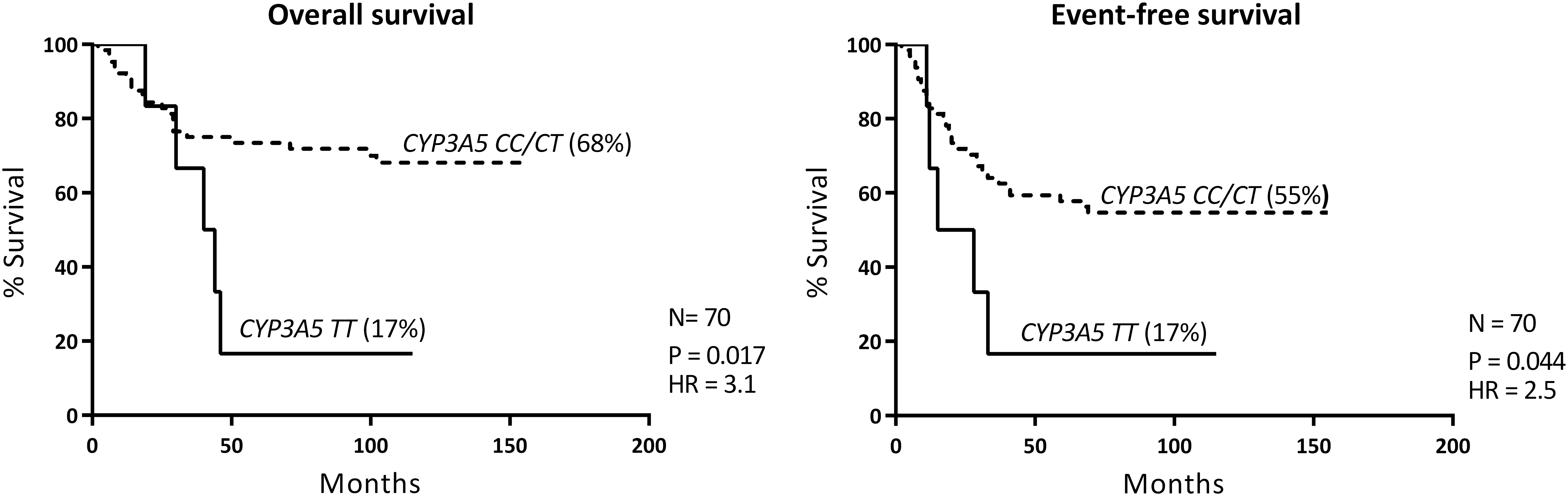
Overall and event-free survivals of the osteosarcoma patients, according to the CYP3A5 genotypes. CYP3A5*3: T, wild allele; C, polymorphic allele.
Discussion
CYP enzymes are involved in almost all anticancer drugs' metabolism and their polymorphisms have been associated with chemotherapy resistance and toxicity events.13,14 Our findings showed that CYP1A2*1A and CYP3A5*3 alleles were associated with toxicity events during osteosarcoma treatment. Moreover, CYP3A5*3 was associated with pulmonary relapse absence and better survivals.
The CYP1A2 gene is coordinately regulated at the transcriptional level by AhR (aryl hydrocarbon receptor) protein that plays an important role in doxorubicin metabolism and acts as a protection against doxorubicin-induced toxicity. 15 Our previous study showed that the adjacent lung (nonmalignant) to osteosarcoma metastasis specimens presented CYP1A2 overexpression compared with the normal lung, indicating a possible role in priming a favorable microenvironment during the establishment of pulmonary metastasis. However, patients with CYP1A2 overexpression in primary osteosarcoma specimens presented better event-free survival. 16
The present study investigated the CYP1A2*1F polymorphism. The CYP1A2*1F allele (rs762551) is characterized by the 163C>A substitution in intron 1 that leads to drug high inducibility. 17 The CYP1A2*1F polymorphism has already been associated with the risk of colorectal adenomas, lung and bladder cancer in Caucasians, and breast cancer in the Jordanian population.18–20 Our findings showed that CYP1A2*1A allele (C allele, wild) was correlated with toxicity events in osteosarcoma patients. The CYP1A2 CC/AC genotypes were associated with ototoxicity occurrence and high grades of ototoxicity when compared with patients carrying the CYP1A2 AA genotype. The CYP1A2 CC genotype was associated with high grades of diarrhea and fever in comparison with CYP1A2 AA/AC genotypes. Thus, the association between CYP1A2*1A allele and toxicity was probably due to the lower doxorubicin detoxification, resulting in more cytotoxicity induced by this drug. Since CYP1A2*1A allele results in a lower inducibility of the enzymatic activity in comparison with the CYP1A2*1F allele and doxorubicin upregulates CYP1A2 expression in osteosarcoma cells.16,17
CYP2C9, representing about 20% of the hepatic CYP content, is involved in the metabolism of anticancer drugs such as cyclophosphamide, ifosfamide, etoposide, and tamoxifen.8,9 The CYP2C9*3 allele (rs1057910) identified by the 1075A>C substitution in exon 7 generates a substitution I359L, which results in decreased enzymatic activity. 21 Previous studies showed that CYP2C9*3 polymorphism was associated with head and neck squamous cell carcinoma risk and poor treatment response in this population. 22 However, in female cases of nonsmall cell lung cancer, the CYP2C9*3 polymorphism was associated with improved survival. 23 The present investigation did not identify any patient carrying the CYP2C9 CC genotype. Moreover, the CYP2C9*3 allele did not present any association with the outcome.
The CYP3A subfamily is highly expressed in the liver and small intestine and metabolizes 50% of clinically used drugs. 10 CYP3A is involved in the metabolism of most agents in cancer treatment, among which are cyclophosphamide, docetaxel, doxorubicin, etoposide, gefitinib, ifosfamide, imatinib, irinotecan, paclitaxel, tamoxifen, teniposide, and vincaalkaloids. 11 CYP3A5 represents at least 50% of the total hepatic CYP3A content in humans and its protein is polymorphically expressed in adults. 12 The impact of CYP3A5 on the osteosarcoma patients' outcome has already been evaluated, showing that high CYP3A5 expression may predict metastasis and poor prognosis. 24 Interestingly, in our previous investigation, the metastasis specimens presented CYP3A5 overexpression when compared with primary osteosarcoma and normal bone. 16
The CYP3A5*3 allele (rs776746) characterized by the 6986A>G substitution in intron 3 results in splicing defect, protein truncation, and consequently, CYP3A5 absence. 12 The CYP3A5*3 polymorphism has already been associated with increased risk of prostate cancer in African populations and increased risk to acute lymphoblastic leukemia.25,26 Previous studies with breast and urothelial cancer patients treated with doxorubicin among other drugs showed association between CYP3A5*3 and toxicity events.27,28 Furthermore, Chinese patients with non-Hodgkin lymphoma, receiving doxorubicin and carrying CYP3A5*3 allele, had better treatment response. 29
The present study showed that CYP3A5*3 allele (C allele, polymorphic) was associated with toxicity events. The CYP3A5 CC genotype was associated with weight loss and high grades of hepatotoxicity when compared with the CYP3A5 TT/CT genotypes. The CYP3A5 CC/CT genotypes were associated with high grades of vomit when compared with the CYP3A5 AA genotype. Therefore, the association between CYP3A5*3 allele and toxicity was probably due to the lower cisplatin and doxorubicin detoxification, resulting in more cytotoxicity induced by these drugs, whereas this allele results in CYP3A5 absence. Probably, for the same reason, we identified the association between CYP3A5 CC/CT genotypes and better outcome, such as pulmonary relapse absence, better overall survival, and better event-free survival, showing that CYP3A5 may be important for chemotherapy detoxification. Thus, low CYP3A5 expression may result in less detoxification, so high chemotherapy efficacy, even this toxicity also reaches normal tissues, causing adverse events.
To the best of our knowledge, this is the first study that investigated CYP1A2*1F, CYP2C9*3, and CYP3A5*3 polymorphisms in osteosarcoma patients, further with a long follow-up (at least 8 years) and an entire report regarding toxicity events during the treatment. Although ototoxicity is a major dose-limiting side effect of cisplatin, and cardiotoxicity is a major problem in the treatment with doxorubicin, the present study showed that osteosarcoma patients also present other important toxicities.30,31 Pharmacogenetic markers can be an important tool to predict the sensitivity to toxicities, indicating when it is necessary to use protective agents or alternative strategies, to reduce mortality and improve quality of life. 32
Therefore, individualized chemotherapy based on the genotypes will help to increase treatment efficacy and reduce toxicity, especially for these drugs, which are characterized by a narrow therapeutic window. 4 Thus, CYP genes may be potential markers for predicting treatment outcome in osteosarcoma, given their important role in metabolizing drugs used in the osteosarcoma protocol. 33
In conclusion, the present study showed that CYP1A2*1A and CYP3A5*3 alleles were associated with toxicity events during osteosarcoma treatment. Moreover, CYP3A5*3 was associated with pulmonary relapse absence and better survivals. Therefore, our findings showed that CYP genotypes are associated with osteosarcoma outcome, and thus, CYP polymorphisms might be promising markers to tailoring treatment in osteosarcoma patients.
Footnotes
Author Disclosure Statement
No competing financial interests exist.
Funding Information
The present study was supported by grants from Sao Paulo Research Foundation (FAPESP 2011/10459-5; 2012/06421-5) and Support Group for Children and Adolescents with Cancer (GRAACC/UNIFESP).