




Abstract
Enrolling adolescents and young adults (AYAs) in psychosocial research studies during cancer treatment is challenging. Successful AYA study recruitment not specific to oncology patients supports social media network advertising and recruitment strategies. However, this brief report describes several challenges to recruiting an appropriate and credible anonymous sample while conducting Institutional Review Board-approved research using social media recruitment. Namely, ethical oversight impeded access to AYAs with cancer and monetary remuneration allured many noneligible AYA participants who accessed the online survey. Lessons learned from this study provide caution for researchers interested in a similar approach and illustrate ways to determine credibility of findings.
Introduction
Adolescents and young adults (AYAs) with cancer represent a population with unique developmental and psychosocial needs,1–3 requiring care that is broader and more intense than at any other time in life. 1 Intense cancer treatments cause adverse symptoms, for example, fatigue,4,5 lack of appetite, nausea, vomiting, 6 pain,7,8 and interruptions in education and social activities. 9 For older adolescents and emerging adults 10 (AYAs 15–24 years old) separation from parents and transitioning to independence require social/peer integration to achieve these unique developmental milestones. During cancer treatment, age-appropriate supportive care is needed to ensure psychosocial functioning and improve treatment outcomes in this group transitioning to adulthood.3,11,12
Accessing AYAs during cancer treatment to participate in psychosocial research studies remains challenging. Enrolling an adequate sample generally requires recruitment from multiple institutions, since AYAs are treated at both pediatric and adult institutions, 13 with few AYA cancer specialty centers available across the United States. Creative strategies for research recruitment during cancer treatment are needed.
Recruitment strategies that consider the life stage of AYAs are needed to enhance research participation. Successful AYA study recruitment not specific to oncology patients supports social media network advertising and recruitment strategies.14–16 The most likely age group to utilize social media are AYAs. Ninety percent of young adults in the United States use social media sites, with the majority accessing social media sites daily. 17 Therefore, we developed a feasibility study to evaluate social media recruitment in this population, with a secondary aim of evaluating the impact of cancer treatment on developmental and psychosocial outcomes. Our project, however, was met with unforeseen challenges, including questionable data from multiple participants. Consideration of risks associated with social media survey recruitment is warranted for other researchers who may be considering similar strategies. The purpose of this brief report is to describe the challenges in using social media recruitment of a national sample of AYAs currently undergoing cancer treatment and to illustrate ways to determine credibility of findings.
Study Overview
The goal of our cross-sectional survey design pilot study was to determine feasibility of collecting data anonymously from a national sample of 30 AYAs currently undergoing cancer treatment. We developed an online survey (stratified by age) with standardized instruments about the impact of cancer, 18 developmental task attainment, 19 perceived social support, 20 identity, 21 and self-efficacy 22 using a secure online database platform called Qualtrics®XM, a tool for building, distributing, and analyzing online data. We designed age-appropriate advertisements targeting AYAs 15–24 years old in active cancer treatment and made the advertisements available through social media platforms such as Facebook, Twitter, and Instagram (see Fig. 1 for examples of advertisements.). AYAs received a US$25 electronic gift card upon survey completion.
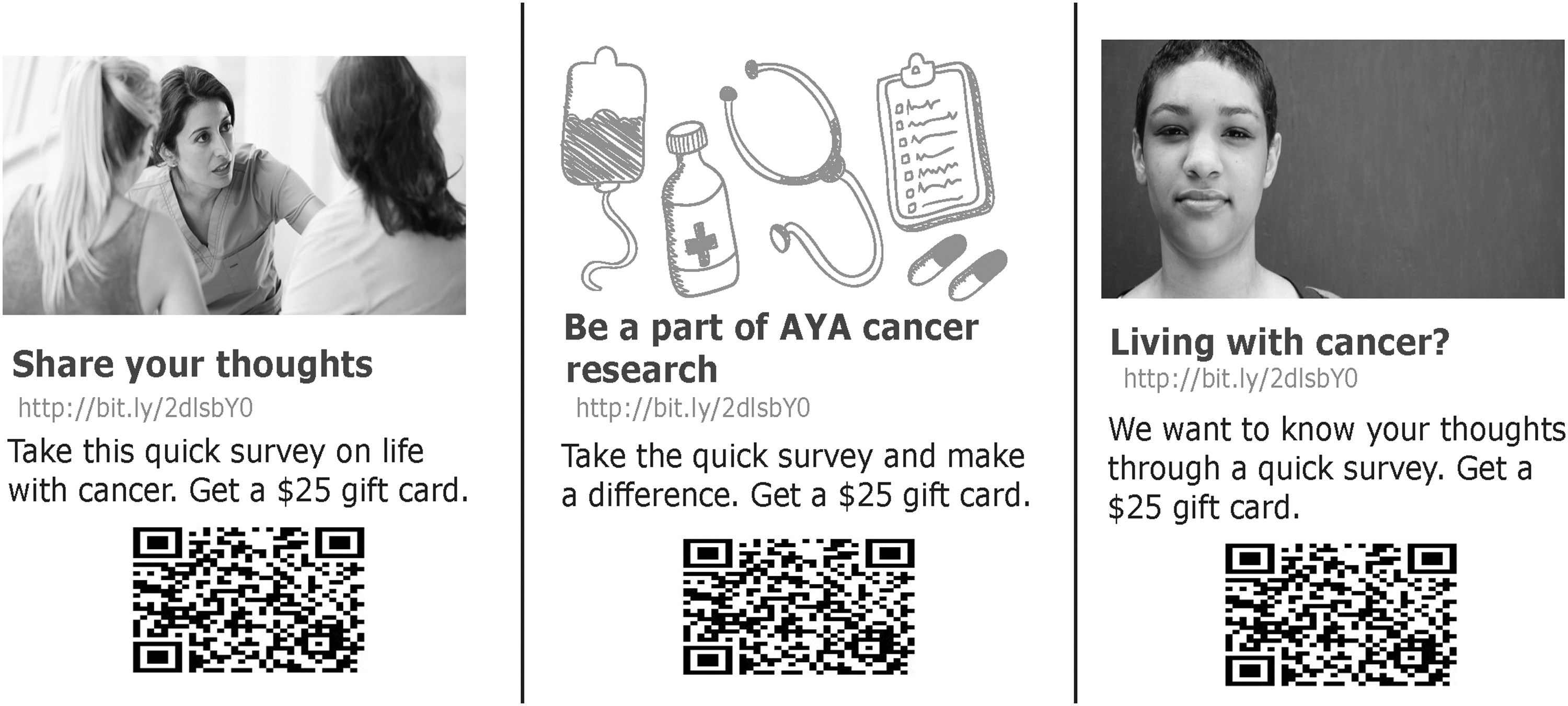
AYA social media advertisements. QR codes and web address were hyperlinked to study consent page, which is currently closed to recruitment. Pictures/graphics were purchased from iStock by Getty for use on advertisements. AYA, adolescent and young adult.
Our goal was to recruit 30 AYAs within 6 months. Inclusion criteria were age (15–24), living in the United States with an ability to read and understand English, ∼2 months from initial cancer diagnosis and not >1 month after completion of therapy. AYAs were excluded with a central nervous system (CNS) or brain tumor diagnosis due to the aggressive treatment options that could alter cognition and confound results of developmental outcomes.
We recruited by creating targeted advertisements on Facebook. We also posted advertisements about our study on our university-sponsored Facebook page, Twitter account, and through Instagram. Our targeted advertisements were geared toward individuals who “liked” postings about cancer, or organizations, for example, American Cancer Society.
We used Qualtrics XM to automatically coordinate online consents and email generation for parental consent of minor adolescents. A 14-day save and resume feature was utilized since some AYAs experience adverse side effects from cancer treatment. This allowed continuation within 2 weeks without losing initial data entry. Study advertisements were hyperlinked to the online consent page. The Institutional Review Board (IRB) approved a waiver of documentation of written consent. However, we obtained online consent for young adults and assent and parental consent from minors before providing a link to the study survey.
Examining Credibility of Findings
Our study was open for ∼3 months without anyone consenting to the study. In February, we paid an additional US$100 fee to boost our advertisements on Facebook, guaranteeing 96,000 views. Two months later, we received our first participant, and within 8 days we had 520 survey responses. Sixty-two percent of the participants stated that they heard about the study through Facebook, 18% through Twitter, and 20% through Instagram.
We carefully examined the data and noticed several red flags. First, many AYAs reported atypical cancers for this age group, such as lung, prostate, pancreatic, gallbladder, and liver cancer. Second, participants were re-entering the survey immediately after the survey was terminated based on exclusion criteria. For example, a participant <15 or >25 might log back in and adjust their age accordingly. Participants selecting “yes” for CNS or brain tumor might log back in and select “no” to avoid being excluded from the survey. We suspected that there were multiple false survey responses and therefore designed a rigorous algorithm to determine valid participation.
We immediately disabled the link to close down survey access. We notified the IRB and filled out an Unexpected Problem Report. Then, we met together as a team to discuss our strategy for sifting through the data. We examined the data closely to determine how to eliminate, if possible, any invalid surveys. Using data routinely collected through Qualtrics, such as exact time and date of the participant starting and ending the survey, the internet protocol (IP) address, and longitude and latitude of each participant entry, we developed an algorithm for eliminating invalid surveys (Fig. 2).

AYA exclusion algorithm. Data collected online were exported to an excel spreadsheet. Two members of the study team independently screened data entries using proposed algorithm. Horizontal arrows describe the number of entries eliminated and reasons for exclusion. Vertical arrows show each layer of exclusion from initial entry into study, n = 520 to final inclusion in sample, n = 4. n, number; US, United States; IP, internet protocol; CNS, central nervous system.
Two members of the team independently screened the surveys. We started with surveys that were completed outside of the United States. This was a national survey, and 99.8% of participants responded yes to confirm U.S. residency. However, 7% (n = 37) showed longitude and latitude linking them to foreign countries, and were therefore eliminated. Several surveys originated from the same IP address. The surveys with the exact IP address and multiple sequential entries that subsequently supplied different email addresses (n = 354) were eliminated. Email addresses were required to obtain the US$25 gift card. The estimated survey response time was 30–45 minutes. Remaining surveys completed in <5 minutes (n = 60) were eliminated. Our study team agreed that our survey, consisting of five standardized measures plus questions about demographics, if completed in 2, 3, or 4 minutes could not accurately reflect the ideas and perceptions of AYAs undergoing treatment for cancer.
Some survey respondents (n = 24) showed conflicting answers in regard to eligibility screening/verification (e.g., age, time since diagnosis, or listed cancer diagnosis as none). Of the remaining 43 surveys, 1 incomplete survey was eliminated, and 2 additional surveys were eliminated due to time (e.g., completed in <5 minutes, 6 seconds). We carefully examined each response in the remaining 40 surveys. We found 36 surveys that had conflicting responses within the same survey. For example, a participant might state he/she is in a committed relationship/married on one standardized instrument, while reporting has not developed an intimate relationship on another instrument. In the end, we had four surveys that could not be excluded with the algorithm that we developed.
We developed a corrective action plan for our study. We requested permission from the IRB to approve a revised letter to be sent electronically to the email addresses of the remaining four anonymous AYAs. The letter explained the delay sending out gift cards related to unexpected problems with ineligible participants needing to be excluded from the study. We extended gratitude to the four participants for participating in our study and shared a link to retrieve their electronic gift card. However, we did not include the four completed surveys with our new study moving forward.
Next, we redesigned our study and obtained IRB approval to recruit through known oncology clinicians across the country. The same advertisements were used for the revised study. However, we supplied a new link to the revised survey, and removed all verbiage on social networking and social media.
Reflecting Upon the Challenges
Protecting the anonymity of vulnerable populations, such as AYAs with cancer, is important to online psychosocial research. However, we encountered several challenges to recruiting an appropriate and credible anonymous sample while conducting IRB-approved research using social media recruitment. Namely, ethical oversight impeded access to AYAs with cancer and monetary remuneration allured many noneligible AYA participants who accessed the online survey.
We initially proposed advertising for our study on AYA oncology social networking and websites. We anticipated a snowball sampling effect with Instagram and Twitter. However, the IRB would not approve our study recruitment approach without receiving signed letters from AYA oncology websites designating willingness to post advertisements. Likewise, individuals overseeing the AYA oncology websites would not agree to post our advertisements without proof that our study was IRB approved. Our adjusted recruitment (targeting advertisements on social networking sites) may have given us access to AYAs who were more removed from cancer, and not actually those undergoing cancer treatment. Overcoming this challenge requires transparency from research studies, such as ours to inform gatekeepers (those charged with authority and ethical oversight) for AYAs with cancer. Collectively researchers need to develop strategies to allay fear that accessing this population for psychosocial research will cause harm, since this safeguard is impeding the advancement of science for this vulnerable population.
We incorporated monetary remuneration into our study protocol, and believe this is worth discussing as a potential motivator behind AYAs falsifying information to gain entry to the survey. AYAs in this study were creative in trying to over-ride eligibility criteria, to get to the end of the survey and receive the US$25 gift card. Completing the survey three or four times could result in US$75–US$100. For each survey entry, a new email address was needed, which did not seem to stop the attempts of multiple submissions. Researchers should consider the possibility that remuneration with an online anonymous study may beguile AYAs who are at an age where steady income is not readily available. Other ways to compensate or thank this population might be to provide a booklet or token from an AYA cancer organization. Meaningful tokens that are not in the form of currency may discourage AYAs with or without cancer from capitalizing on a monetary token. Investigators have found that carefully selecting gifts for research participants that are appropriate to their situation, such as a memory box for bereaved parents, rather than monetary incentive, is well received by research participants 23 (Table 1).
Recruitment Challenges and Potential Solutions
IRB, Institutional Review Board; AYA, adolescent and young adult; IP, internet protocol; DOB, date of birth.
Conclusion
Given the near universal use of social media among AYAs and challenges of recruiting an adequate sample of AYAs with cancer, this approach seemed logical. The decision to utilize social media was well supported in systematic reviews identified during a literature search, with benefits including successful, cost-effective recruitment.24,25 The challenges encountered in our experience provide important opportunities to reconsider social media recruitment pitfalls. Our efforts resulted in questionable data and a labor-intensive process of deciphering authentic responses. While social media recruitment provides access to populations that may otherwise be challenging to engage, it is important that researchers be aware of potential complications and plan strategies for rigorously reviewing responses to determine trustworthiness and data accuracy.
Our study successfully advertised through social media platforms, giving AYAs access to an anonymous online research survey, though, we were unsuccessful in obtaining the targeted amount of credible data from our population. Lessons learned from this study provide caution for researchers interested in a similar approach. For anonymous surveys, we suggest targeting advertisements specifically to AYAs diagnosed with cancer using either AYA oncology-specific websites or known oncology professionals who have access to this population. Ethical oversight is essential for human subjects' research. However, more education and advocacy is needed within local IRBs, and among AYA cancer nonprofit and grassroots leaders to negotiate access to psychosocial research for AYAs with cancer. Researchers interested in maintaining anonymity with social media recruitment in AYA populations should beware of the risks particularly when monetary remuneration is offered and consider developing an algorithm based on collected data to authenticate participant response.
Footnotes
Acknowledgments
The authors thank Christine Siever, Cinzia Caparso, Mari Ellis, and Clinton Loh for their social media advertisement and Qualtrics support.
Disclaimer
Preliminary findings were presented in poster form by a doctoral student (C. Caparso) at a regional conference—Midwest Nursing Research Society 41st Annual Conference Study, Minneapolis, MN (C. Caparso, C. Bell, J. Spruit, K. Kavanaugh, Study Recruitment of Adolescents and Young Adults in Active Cancer Treatment using Social Networking Sites. Feasible? #Beware). No animal or human studies were carried out by the authors for this article.
Author Disclosure Statement
No competing financial interests exist.
Funding Information
This study is supported by the University Research Grant (URG) Program, #142167, Wayne State University.