




Abstract
The article describes how adolescents with cancer utilized an artistic approach to discuss about their social isolation caused by disease and treatment. With the help of professionals, 17 young patients closed in their isolation room described their ideal room (a bit real, a bit of a fantasy place) producing texts and images, subsequently put together into a book. In these days when people are forced to social isolation by the lockdown related to corovavirus disease 2019 pandemic, young patients teach us meaningful life lessons: how social confinement can become an opportunity to focus on yourself, and what is really important in life.
Introduction
As of late 2019 in China, and consequently in many parts of the world from the first weeks of 2020, with the dramatic outbreak of the corovavirus disease 2019 (COVID-19), 1 people have been required to face social isolation forcibly imposed by the drastic measures of lockdown that the various governments have implemented in an attempt to limit the diffusion of COVID-19. Quarantine has imposed on people a radical change in their daily habits, in particular social relationships and physical contacts, which brought consequences on their psychological well-being: among symptoms are mood disorders, anxiety, anger, insomnia, post-traumatic stress symptoms.2,3
Professionals who work with adolescents (and young adults) with cancer are aware that social isolation is a situation that their patients experience regularly. Cancer disease, especially in this particular age group characterized by essential needs of social interaction, can generate conditions of isolation in many different ways. Immediately comes to mind isolation in a sterile room, when a patient has a significant reduction in immune defenses after high-dose chemotherapy or bone marrow transplantation. But, as a matter of fact, adolescent cancer patients, regardless of hospitalization, find themselves living an experience of social distancing for the simple fact of being sick: often an invisible barrier rises between patients (who lose their hair and are waiting for the next cycle of chemotherapy treatments) and classmates (who are waiting for a test at school, a kiss from the dream girl/boy, or a weekend at the beach with friends). Being left out—being treated as different, as sick—is the great fear of adolescents with cancer.4–6
The Milan Youth Project—dedicated to adolescents (15–19 years old) and young adults (defined as up to 25 years old)—aims to optimize clinical aspects of patient care (as the inclusion in clinical trials, e.g.) and to promote a life as normal as possible for the patients in care, by providing them with age-specific spaces and organizing specific activities.7,8 For several years, the Youth Project develops projects that offer young patients tools to express their experiences through creativity and art.9–19 On various occasions, adolescent patients have told professionals how the aspect of isolation was particularly experienced by them and how they wanted to create a project on it.
This article describes how a project called “Condominy” (that means “condominum” or “apartment building”), dedicated to isolation, was created, with a view to tell all the lessons that these adolescent patients recurrently deal with during social isolation, in such a peculiar period related to COVID-19 pandemic in which we all find ourselves living in a somewhat similar situation, isolation, confinement, fear, and uncertainty of the future.
Methods
This project was realized between April 2018 and March 2019. Participating patients were adolescents and young adults (15–24 years) who were receiving treatment at the Pediatric Oncology Unit of the Istituto Nazionale dei Tumori of Milan, or patients who had completed their treatments no more than 1 year previously. No further specific inclusion/exclusion criteria were used. Patients were invited to join this initiative by the Youth Project team (that includes dedicated doctors, psychologists, youth worker, and art project director) and were totally free to join or not the project.
All patients (or their parents/legal guardians for underage patients) gave their written informed consent to their involvement in the project (the Youth Project program is approved by the Research Ethics Committee at the Istituto Nazionale dei Tumori).
As for other artistic projects,9–16 additional specific professionals were involved, that is, artists, architects, modelers, graphic designers, and photographers. These professionals were selected by the Youth Project staff, for their specific technical expertise, but also for their ability in comprehending the need of establishing a challenging relationship with young people with cancer. Professionals were explained the aims of such projects, which used arts to offer patients a novel way to voice their emotions and tell their stories, and to provide a particular form of psychosocial support, complementing the more classical approaches based on interviews.
Closed in the isolation room, young patients described their ideal room, a bit real but a bit of a fantasy place that represents their personality and their dreams. To this end, they produced texts, images, drawings, and music. All these materials were shared with the professionals taking part in the project: the aim was to build architectural models, one for each “room” (Fig. 1). To do this, architects and other professionals tried to identify the features that better represented the description made by the patients, and prepared some sketches. These sketches were shared with each patient, to obtain the final three-dimensional model more consistent with patients' original ideas.
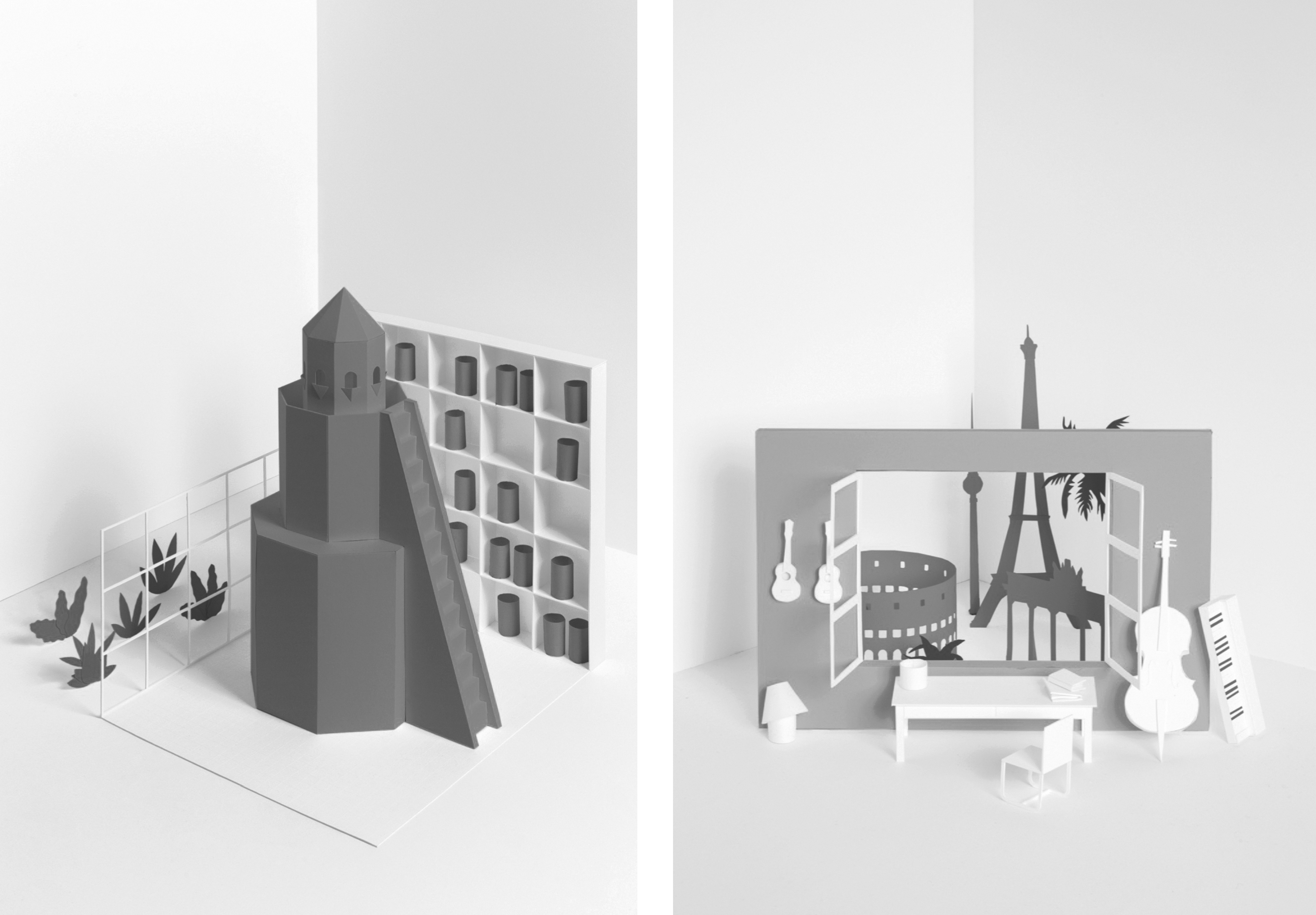
Two architectural models created with the help of professional architects and modelers on the basis of patients' description.
All the work was carried out during group meetings (organized in the dedicated multipurpose room alongside the pediatric unit), but was also developed “at home” using the virtual room of a closed Facebook group that was created for this purpose.
The Youth Project team (and, in particular, the dedicated psychologists) constantly participated to all the discussions and meetings with patients, to guarantee the complete respect of all their psychological aspects.
Subsequently, the different rooms were ideally put together in an apartment building, which become a common space, assembling different feelings, different music, different cities, and different lives. The photographs of the models and the texts were then grouped into a book, including also indication of the playlist for the condominium, with music chosen by the young patients.
The material produced by patients was considered by physicians and psychologists an important source of additional information on young people's inner world. Patients further discussed some of the insights that emerged during the project in personal talks with the psychologists.
For the aim of this publication, all the findings were reviewed: we decided to select patients' texts and thoughts that were more meaningful in describing their emotions and moods, and more useful to explain the project and how arts and creativity might help young people to express themselves. Patients' thoughts were roughly categorized to describe their meaning, for example, the sense of keeping positive things of life or the desire to escape, the sense of suspension, or the sense of anguish.
Results
Seventeen patients aged 16–23 years (median age 18 years; 8 male, 9 females) participated in the project, 12 taking part during their therapy-related isolation period, and 5 being out of therapy but remembering well the isolation period they went through months before. Participating patients had various types of cancer: eight bone/soft tissue sarcomas, four lymphomas, two central nervous system tumors, two carcinomas, and one germ cell tumor.
Some of their thoughts used to describe their ideal room are enlisted in Table 1. Some of the recurring themes are references to their passion for sports and hobbies (motorcycles, traveling, and singing), and to resources to better spend time (books, videos, music, and technology). However, their thoughts told also about the different emotions and moods that isolation could bring (“I was thinking of a room that changes shapes every time you enter”). There was the need to escape (“my room is not big but to me it is without borders”) and the need for protection (“I wish my room was in the center of the condominium”). There were anger, anxiety, anguish (“the walls are shrinking more and more”), and uncertainty for the future; the thoughts of friends who are no longer with them (“today my room is opposite from Melissa's […], she is not there, she will certainly looking for the sun in another city”).
Some of the Thoughts That Patients Used to Describe Their Rooms
In addition to the description of all different rooms, the book contains a chapter entitled “Chatting on the stairs”, which explicitly refers to advice for those who live in isolation. In this dramatic historical time of COVID-19 pandemic and lockdown, their advices are of great actuality. Among others, Martina writes: “When you are in isolation you have to find something to do so you don't sink in boredom: listen to music, watch TV series, read, draw. I also suggest keeping a diary of your thoughts, writing songs, opening a blog and creating an Instagram page where you can post your hobbies.” Rebecca says: “When I was in solitary confinement, my mom brought me travel agency catalogs, to decide and organize the next trip over the summer, when everything would be over: it helped me a lot because it made me dream.” Matteo Davide confides: “It is important to learn to stay alone by yourself. You will discover things about yourself that you didn't know before and, if you learn to feel good about yourself, you can enjoy life better. This is what isolation taught me.”
Mary explicitly tells about the “sense of solitude that one feels even when not in isolation in the sterile room; feeling lonely without love, while being surrounded by people who want to give you affection; feeling alone without friends, because your friends cannot relate to what you are going through”. She continues: “To feel good about yourself, you need to accept the sense of loneliness and start cultivating hobbies and passions abandoned because they depended on someone else's presence. Sometimes, experiencing loneliness is positive. Self-esteem is a feeling that can built up over time, learning how to love oneself: knowing how to take care of oneself gives energy and serenity”.
Discussion
This article tells how young patients of the Youth Project utilized an artistic approach to discuss about their social isolation caused by disease and treatment procedures. In this historical time when the COVID-19 pandemic has forced people across the world to social isolation, the stories of our young patients appear timely and extremely useful.
In this project, young cancer patients, by describing their ideal room representing themselves, their fears, and their hopes, try to face and deal with this suspended time, when life is shut out. By confronting with peers facing same and similar issues of illness and treatment, our patients advice us that to not fall “prisoners,” it takes great determination and imagination. They teach how social confinement can become an opportunity to learn to be alone and to understand what is really important in life.
Certainly, isolation is a challenging time to face and can cause physical and psychological fatigue and stress: among the various emotions emerging from our project, there are also the need to escape or the sense of anger and anguish. For the physicians and the psychologists, the project was a precious window on patients' inner world and was very helpful to better focus on problematic situations in further personal talks.
However, this experience seems to be a novel and positive form of psychosocial support, through group acceptance and shared emotions. One of our patients said: “The Youth Project gave me the opportunity to face and make a friend of my fears.” The condominium that keeps together all young patients' rooms—all their life—represents for them the Youth Project, where they can get together with friends going through similar situations and experience moments of normality, while reminding themselves that before becoming a cancer patient they are teenagers.
By conceiving the idea of a virtual apartment building, the young patients overcame the barriers of solitude: the walls of a sterile room can prevent bacteria and viruses from entering, but they cannot block out emotions from entering and coloring its walls. By closing up in ourselves, instead, we build walls around us that do keep out sadness but also block out the so much needed determination and joy of life. Although “Condominy” begins from the idea of talking and sharing experiences about social isolation, it is truly and deeply about the power of “being together.” This is perhaps the final but most important advice that we all learn from this dedicated project: there is no right way to experience social isolation, but whatever you do, do not choose to be “alone.”
Footnotes
Acknowledgments
The authors thank the Associazione Bianca Garavaglia Onlus. In addition, the authors thank all the professionals who contributed to the development of Condominy projects with their ideas and jobs: Paola Gaggiotti, Cristina Pancini, Federico Casati, Antonio Buonsante, Matteo Candiani, Louis De Belle, Roberta Cesani, Fondazione Alta Mane Italia, and Boite Editions.
Author Disclosure Statement
No competing financial interests exist.
Funding Information
No funding was received for this article.