




Abstract
Purpose:
This study describes the prevalence trends of electronic cigarette (e-cigarette) use in young adult cancer survivors and compares these to the prevalence among young adults without a cancer history. It also examines the association between conventional cigarette use, binge drinking, depression, and other sociodemographic factors, and e-cigarette use in young adult cancer survivors.
Methods:
Cross-sectional analyses, using the Behavioral Risk Factor Surveillance System, 2016–2018, were done. Multivariable logistic regression was used to examine the associations between conventional cigarette use, binge drinking, and depression as well as other factors associated with e-cigarette use in young adult cancer survivors.
Results:
Lifetime e-cigarette use increased from 40.1% in 2016 to 47.4% in 2018. Former smokers were 5.47 times (95% confidence interval [CI]: 3.48–8.61) more likely to be lifetime e-cigarette users and 1.9 times (95% CI: 1.12–3.23) more likely to be current e-cigarette users compared to never smokers. Current smokers were over sixteen folds more likely (adjusted odds ratio: 16.50, 95% CI: 11.59–23.57) to be lifetime e-cigarette users and 2.1 times (95% CI: 1.24–3.57) more likely to be current e-cigarette users relative to never smokers. Furthermore, binge drinking and depression were associated with higher odds of lifetime e-cigarette use, while increasing age was associated with lower odds of e-cigarette use. Compared to females, males were significantly more likely to be current users of e-cigarettes relative to former users.
Conclusion:
Conventional cigarette use, binge drinking, depression, age, and gender were found to be associated with e-cigarette use among young adult cancer survivors. Policies targeted at e-cigarette control among young adult cancer survivors need to be multipronged, simultaneously addressing other harmful practices such as binge drinking and the use of conventional cigarettes.
Introduction
Electronic cigarettes (
In 2012, over three-quarters of youths who were current e-cigarette users in the United States reported concurrent smoking of conventional cigarettes. 9 Although promoted as a safer alternative to conventional cigarettes, e-cigarettes contain several toxins and carcinogens with current evidence suggesting a possible link with various forms of cancers. 10
Young adult cancer survivors have been reported to have a higher prevalence of current smoking compared to those without cancer. 11 A recent study showed that they are more likely to report both lifetime and current use of e-cigarettes relative to their counterparts without a cancer history. 12 This population has the worst morbidity and mortality outcomes when compared to cancer survivors at either extreme of age.11,13 In recent times, the prevalence of both lifetime and current use of e-cigarettes among adolescents and young adults in the United States have been increasing. Current e-cigarette use increased from 11.7% in 2017 to almost 30% in 2019 among high school students and increased by almost 20-fold over the same period among middle school students, increasing from 0.6% in 2017 to 10.5% in 2019. 14 Since some substances in the e-cigarette vapor have been shown to increase the risk of cancer, young adult cancer survivors who use e-cigarettes may be at risk for other cancers with attendant health and economic burden on the survivors, their families, caregivers, and the community.
Various factors have been linked to e-cigarette use. A recent population-based study revealed an association between e-cigarette use and depression. 15 Using the Behavioral Risk Factor Surveillance System (BRFSS) data, researchers found that current and former e-cigarette users were 2 times and 1.6 times more likely, respectively, to report a diagnosis of clinical depression compared to never users. 15 In addition, alcohol consumption is associated with increased lifetime and current e-cigarette use.16–18 However, there is a paucity of studies assessing the factors associated with e-cigarette use in young adult cancer survivors. The diagnosis and treatment of cancer are traumatizing and associated with the emotional and psychological impact on these survivors.19,20 Sociodemographic factors such as race/ethnicity, gender, and urbanicity have been studied and linked with e-cigarette use in young adults with cancer. 12
However, no research to the best of our knowledge has explored the relationship between modifiable factors such as depression, binge drinking, and the use of conventional cigarettes and e-cigarette use in this population. Given that young adult cancer survivors are at risk for another cancer and poorer health outcomes, understanding factors associated with e-cigarette use could inform behavioral modifications to improve the quality of life of these survivors. Using a population-based study, we examined the prevalence of lifetime and current e-cigarette use among young adult cancer survivors and compared these to the prevalence among young adults without a cancer history in the United States between 2016 and 2018. In addition, we assessed the association between conventional cigarette use, binge drinking, and depression and how these relate to lifetime and current e-cigarette use among young adult cancer survivors. We also explored other factors that may be associated with e-cigarette use in this population.
Methods
Data
The BRFSS data collected between 2016 and 2018 were used for all analyses. This is an annual, nationally representative cross-sectional survey of the civilian noninstitutionalized population aged 18 years and older in the United States. All states in the United States and participating territories collaborate with the Centers for Disease Control and Prevention to conduct these surveys. Participants are randomly sampled and administered telephone-based surveys to collect information about chronic conditions, access to care, health-related risk behaviors, and use of preventive health services. The BRFSS is publicly available and deidentified, and since it does not constitute human subjects research, as defined by the code of federal regulations, it does not require the review of the Institutional Review Board. Further information about the study design, methodology, and survey development have been published elsewhere.21–23
Study population
Young adult cancer survivors were identified using survey questions that asked about participant's age and cancer survivorship status. All participants aged 18–39, who responded to having any type of cancer apart from skin cancer, were included in our study as young adult cancer survivors. In addition, we included the population of young adults without a cancer history (18–39 years) in the analyses to compare their prevalence of e-cigarette use to that of young adult cancer survivors from 2016 to 2018.
e-cigarette use
The main outcomes assessed in this study were lifetime e-cigarette use and current e-cigarette use. Participants were asked if they had ever used an e-cigarette and those who answered yes were classified as lifetime e-cigarette users, while those who never used an e-cigarette were classified as never users. Furthermore, they were asked, “Do you now use e-cigarettes, every day, some days, or not at all?” and those who answered that they used e-cigarettes every day or some days were classified as current users, while those who no longer used e-cigarettes were classified as former users.
Measures
Depression
Information about the clinical diagnosis of depression was elicited by asking the participants if a physician had ever told them that they had a depressive disorder (including major depression, depression, dysthymia, or minor depression). Those who answered yes were classified as having a self-reported diagnosis of clinical depression.
Binge drinking
Participants were asked the following question: “Considering all types of alcoholic beverages, how many times during the past 30 days did you have five or more drinks for men or four or more drinks for women on an occasion?” Those who reported ever having up to five or more drinks (men) or four or more drinks (women) on an occasion at least once were classified as binge drinkers while those who never did were classified as nonbinge drinkers.
Conventional cigarette use
This was assessed with the question: “Have you smoked at least 100 cigarettes in your entire life?” Those who answered yes were asked a follow-up question: “Do you now smoke cigarettes every day, some days, or not at all?” Participants who answered that they now smoke cigarettes every day or some days were classified as current smokers, those who answered “not at all” were classified as former smokers while participants who had never smoked 100 cigarettes in their lifetime were classified as never smokers.
Sociodemographic characteristics
The sociodemographic and participant characteristics assessed in this article was based on previous literature and include age (18–24, 25–29, 30–34, and 35–39 years), gender (male and female), race/ethnicity (non-Hispanic white, non-Hispanic black, Hispanic, and non-Hispanic other), level of education (less than high school, high school graduate, some college, and college graduate), income (less than $25,000, $25,000–$49,000, $50,000 or more), marital status (married, single, divorced/widowed/separated), current use of smokeless tobacco (yes, no), lifetime asthma (yes, no), and body mass index (underweight, normal weight, overweight, and obese).
Statistical analysis
Appropriate weights were applied to all conducted analyses to account for the complex survey design of the BRFSS and ensure that data are representative of the general United States population. Overall, 5817 young adults reported a history of cancer between 2016 and 2018. Nine hundred fifty-six (16.4%) of them had missing information on ever use of e-cigarettes, while three had missing information about current use of e-cigarettes. Only participants who reported ever using e-cigarettes (2074) responded to the survey question about current e-cigarette use. Table 1 reports the sociodemographic characteristics of the study population before multiple imputation. Since there were no sociodemographic differences between those with and without missing information (Supplementary Table S1), multiple imputation was used to handle missing data using the assumption that data were missing at random.24–26 After imputing data for those who were missing information on the variables, all 5817 participants were included in the multivariable logistic regression analyses. The same approach was used to handle missing data among young adults without a cancer history. Sociodemographic and participant characteristics were stratified by lifetime and current e-cigarette use using survey proportion and chi-square tests. Also, using survey proportions, the overall (2016–2018) prevalence and year prevalence of lifetime and current e-cigarette use was assessed to visualize trends. Multivariable logistic regression models were used to examine the association between depression, binge drinking, conventional cigarette use, and e-cigarette use (lifetime use and current use) among young adult cancer survivors. Other factors were also examined to assess associations that are specific to young adults with a cancer history. All analyses were performed using Stata SE 16.1 with the significance level determined using a two-sided p-value <0.05 based on the Wald test.
Sociodemographic Characteristics of Young Adult Cancer Survivors by Electronic Cigarette Use in the Behavioral Risk Factor Surveillance System Survey (2016–2018) a
This table shows the sociodemographic and relevant characteristics among young adult cancer survivors before multiple imputation. Nine hundred fifty-six participants were missing information on ever use of e-cigarettes while three participants were missing information on current use of e-cigarettes. Due to missingness in the data, cell frequencies do not add up to the total sample. However, since there were no sociodemographic differences between those with and without missing information, multiple imputation was used to address missingness before logistic regression analyses.
n, unweighted number of observations; wt%, weighted percentages; e-cigarette, electronic cigarette.
Results
Among 2074 young adult cancer survivors who reported lifetime use of e-cigarettes, 31.8% were between age 30 and 34 years, while 29.7% were between 35 and 39 years. Furthermore, the majority of lifetime users of e-cigarettes were female (71.6%), non-Hispanic whites (66.3%) with some college degree (38.0%), earning less than $25,000 (48%) (Table 1). On the contrary, out of 82,418 young adults without a cancer history who reported lifetime use of e-cigarettes, 39.8% were aged 18–24 years, while 23.3% were between 25 and 29 years. Although majority of young adults without a cancer history were male (60.9%), the distribution of other sociodemographic characteristics was similar to that of young adult cancer survivors

Prevalence of
Sociodemographic Characteristics of Young Adults Without a Cancer History by Electronic Cigarette Use in the Behavioral Risk Factor Surveillance System Survey (2016–2018) a
Due to missingness in the data, cell frequencies do not add up to the total sample.
n, unweighted number of observations.
Results of bivariate analyses of lifetime e-cigarette use showed that former smokers were 5.16 times more likely to be lifetime users of e-cigarettes relative to never smokers (unadjusted odds ratio [OR]: 5.16, 95% confidence interval [CI]: 3.55–7.52) while current smokers were 15.58 times more likely to be lifetime users of e-cigarettes compared to never smokers (unadjusted OR: 15.58, 95% CI: 11.9–20.35). Those who reported a history of binge drinking were 2.18 times more likely to be lifetime users of e-cigarettes (unadjusted OR: 2.18, 95% CI: 1.71–2.78). Young adult cancer survivors with a clinical history of depression were 2.50 times more likely to report lifetime use of e-cigarettes relative to those without a clinical history of depression (unadjusted OR: 2.50, 95% CI: 1.98–3.16). Survivors between 25 and 29 years had a 52% higher odds of lifetime e-cigarette use compared to those between ages 18–24 years (unadjusted OR: 1.52, 95% CI: 1.05–2.20) (Table 3).
Factors Associated with Lifetime Use of Electronic Cigarettes Among Young Adult Cancer Survivors in the Behavioral Risk Factor Surveillance System (2016–2018)
Boldface indicates statistical significance (p < 0.05).
OR, CIs, model adjusted for age, gender, race/ethnicity, level of education, income, marital status, lifetime asthma, current use of smokeless tobacco and body mass index. OR presented for all variables compare lifetime use of e-cigarettes to never use of e-cigarettes.
OR, odds ratio; CI, confidence interval.
In the adjusted analyses of associations with lifetime e-cigarette use, we found that former smokers were 5.47 times more likely to be lifetime users of e-cigarettes compared to never smokers (adjusted odds ratio [AOR]: 5.47, 95% CI: 3.48–8.61), while current smokers were 16.50 times more likely to be lifetime users of e-cigarettes compared to never smokers (AOR:16.50, 95% CI: 11.59–23.57). Furthermore, young adult cancer survivors with a history of binge drinking reported 52% higher odds of e-cigarette use relative to those without a history of binge drinking (AOR: 1.52, 95% CI: 1.13–2.04). Similarly, those with a clinical history of depression were 50% more likely to report lifetime use of e-cigarettes relative to those without a clinical history of depression (AOR: 1.50, 95% CI: 1.09–2.06). In addition, we found that young adult cancer survivors were significantly less likely to be lifetime e-cigarette users with each increasing age category. Young adult cancer survivors between 30 and 34 years were 40% less likely to report lifetime use of e-cigarettes (AOR: 0.60, 95% CI: 0.37–0.98) when compared to those between 18 and 24 years. Similarly, those between 35 and 39 years were 54% less likely to report lifetime use of e-cigarettes (AOR: 0.46, 95% CI: 0.27–0.76) (Table 3; Fig. 2a).
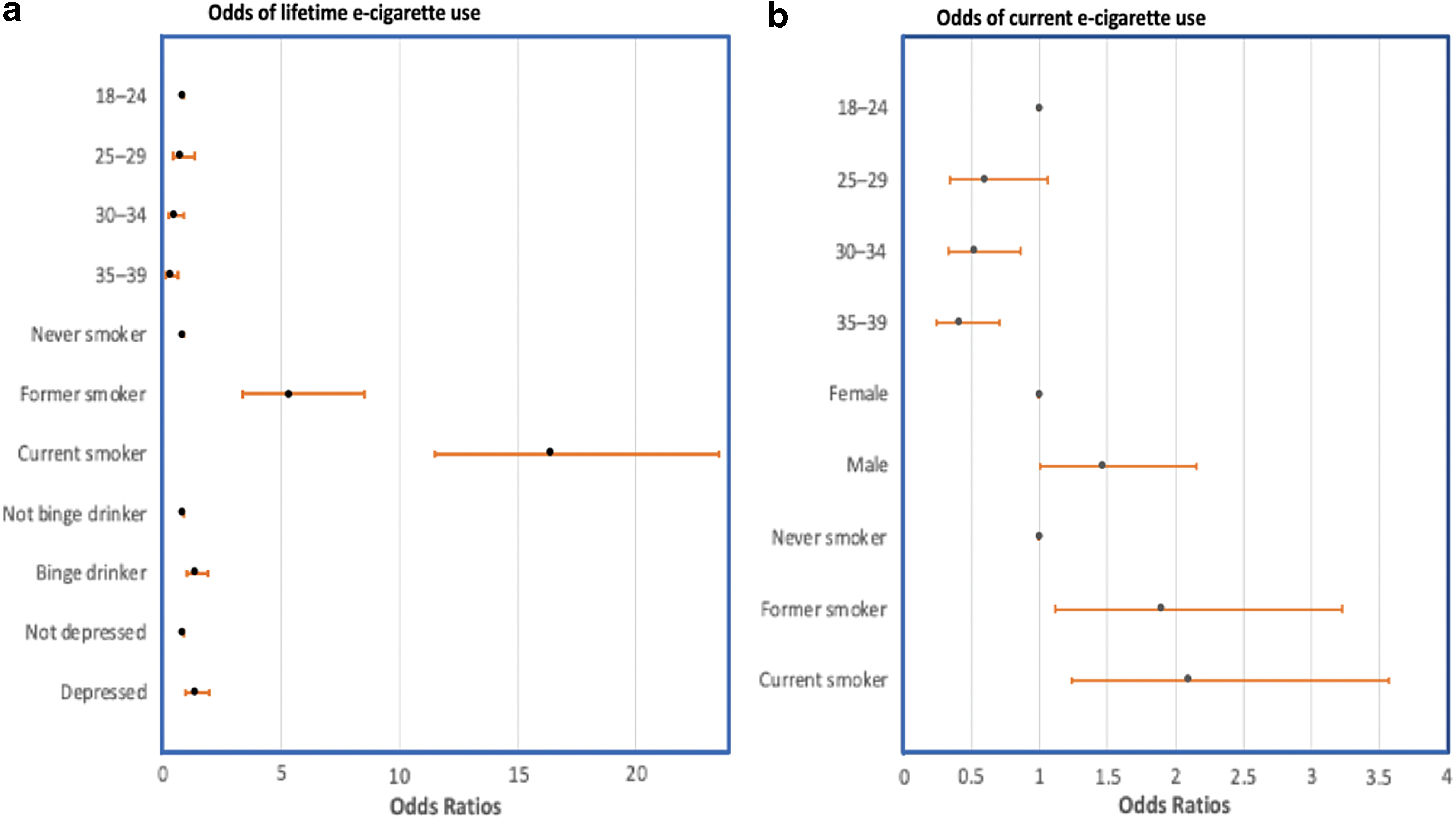
Adjusted odds of
Results of bivariate analysis of current e-cigarette use showed that former smokers of conventional cigarettes were 1.86 times more likely to be current users of e-cigarettes relative to never smokers (unadjusted OR: 1.86, 95% CI: 1.15–3.02), while current smokers of conventional cigarettes were 2.29 times more likely to be current users of e-cigarettes compared to never smokers (unadjusted OR: 2.29, 95% CI: 1.43–3.68). Similarly, those who reported a history of binge drinking were 63% more likely to be current users of e-cigarettes relative to those without a history of binge drinking (unadjusted OR: 1.63, 95% CI: 1.07–2.48). Young adult cancer survivors with a clinical history of depression were 74% more likely to report current use of e-cigarettes relative to those without a clinical history of depression (unadjusted OR: 1.74, 95% CI: 1.21–2.49) (Table 4).
Factors Associated with Current Use of Electronic Cigarettes Among Young Adult Cancer Survivors in the Behavioral Risk Factor Surveillance System (2016–2018)
Boldface indicates statistical significance (p < 0.05).
OR, CIs, model adjusted for age, gender, race/ethnicity, level of education, income, marital status, lifetime asthma, current use of smokeless tobacco and body mass index. OR presented for all variables compare current use of e-cigarettes to former use of e-cigarettes.
In the adjusted analyses of associations with current e-cigarette use, former smokers of conventional cigarettes were 90% more likely to be current users of e-cigarettes compared to never smokers (AOR: 1.90, 95% CI: 1.12–3.23), while current smokers of conventional cigarettes were 2.10 times more likely to be current users of e-cigarettes compared to never smokers (AOR: 2.10, 95% CI: 1.24–3.57). We found no association between current e-cigarette use and binge drinking or clinical history of depression. However, our results revealed an association between different age categories and current use of e-cigarettes, we found that those 30–34 years of age were 47% less likely to be current e-cigarette users (AOR: 0.53, 95% CI: 0.33–0.86), while those of 35–39 years were 58% less likely to be current e-cigarette users (AOR: 0.42, 95% CI: 0.24–0.71) relative to those 18–24 years of age (Table 4; Fig. 2b).
Discussion
This study highlights a rising prevalence in lifetime e-cigarette use between 2016 and 2018 from 40.1% in 2016 to 47.4% in 2018, indicating over a three-fold increase compared to the 12.6% reported in 2014 among United States adults, 13.4% reported among middle and high school students in the United States and 14.8% reported among United States cancer survivors.3,27,28 However, our finding is similar to the prevalence of lifetime e-cigarette use recently reported by another study in the same population and is explained by previous findings in the literature, which state that young adults with a cancer history participate more frequently in high-risk health behaviors than their healthy counterparts.11,12,29 Majority of lifetime and current e-cigarette users in our study were females. This finding may be related to the higher proportion of females in our study at baseline and, hence, may not be reflective of true population rates. We also found that current e-cigarette users are significantly more likely to be males. This association is no different from what has been previously reported.30,31 While males generally describe more reasons for e-cigarette use such as social facilitation and increased energy, females report the use of e-cigarettes mostly for weight control. 32 This may explain the reduced incentive for e-cigarette use among female cancer survivors since the progression of cancer diagnosis and subsequent treatment is commonly accompanied by weight loss. However, male adolescent cancer survivors are likely to be involved in other externalizing behaviors, including substance use, which may further worsen their already compromised health state and worsen their risk for a second cancer. 33 Furthermore, male cancer survivors are at risk of having fertility problems from cancer treatment, and the recent study suggesting a link between e-cigarette use and infertility highlights the need to address the issue.34–36 Our study also reveals an association between age and e-cigarette use. Younger cancer survivors are more likely to ever use or currently use e-cigarettes compared to those in the older age categories. This finding is not surprising as it is similar to previous reports indicating that the glamorized marketing of e-cigarettes is strategically designed to appeal to the most vulnerable younger population. Peer pressure, curiosity, flavorings, and low perceived harm are some of the reasons encouraging the use of e-cigarettes in this population. 30 These underscore the need for gender and age-specific interventions directed at youth, young adults, and especially, young adult cancer survivors before they initiate e-cigarette use. There is also a need for health care providers and other advocacy groups involved in cancer care and management to re-educate young adults, particularly young adult cancer survivors on the dangers of e-cigarette use.
We found an association between lifetime e-cigarette use and depression among young adult cancer survivors. This finding supports a previous report which showed an association between e-cigarette use and depression in the general United States population. 15 Cancer survivors are known to be at increased risk of depressive episodes from the diagnosis and management of their condition. Furthermore, young adults with cancer have substantially higher rates of unique psychological problems and depression when compared to older adults. 37 This may make them more vulnerable to tobacco messaging designed to increase youth uptake of e-cigarettes. On the contrary, the increased lifetime use of e-cigarette use may explain the increased likelihood of clinical depression reported by young adult cancer survivors. It is known that individuals with mental health conditions and cancer diagnoses are more likely to have used e-cigarettes compared to those without this health conditions.12,38 Our study revealed no association between current e-cigarette use and the clinical diagnosis of depression. A clinical diagnosis of cancer and/or depression is often followed by multiple hospital visits, increasing contact between the patients and their health care providers. This potentially exposes them to more counseling and anti-tobacco messaging from health providers and reiterates why physicians are vital in providing accurate health information to cancer patients. Cancer survivors trust their health care providers and are more likely to seek health information from them rather than not.39,40 This relationship allows providers the opportunity to counsel and educate their patients about the harmful effects of tobacco and e-cigarette use on health outcomes, including second cancers.
Our results revealed that young adult cancer survivors who reported binge drinking were more likely to report lifetime e-cigarette use. This is similar to what has been previously reported on binge drinking and e-cigarette use in the general population. 31 Our study also supports what is currently known about the association between e-cigarette use and conventional cigarettes. Several studies have reported that young adults who smoke conventional cigarettes are more likely to use e-cigarettes.8,30,41,42 Concurrent use of e-cigarettes and conventional cigarettes put cancer survivors at increased risk of exposure to high levels of toxins and carcinogens. We found over a 5- and 16-fold increase in the odds of former or current conventional cigarette use, respectively, among young adult cancer survivors with lifetime e-cigarette use. This may suggest that while the rates of e-cigarette use increase in young adult cancer survivors, the tobacco epidemic remains pervasive in this population and calls for stricter policies and heightened regulations to control this menace. Efforts to control e-cigarette use among young adult cancer survivors need to be multipronged, simultaneously addressing other harmful practices such as binge drinking and the use of conventional cigarettes.
Our study is novel in describing the association between e-cigarette use (lifetime and current) and depression, binge drinking, and conventional cigarette use among young adult cancer survivors using a population-based study. In addition, our research uses data that are nationally representative of the noninstitutionalized United States population, making our findings generalizable to the United States population of young adult cancer survivors. However, the study has several limitations. First, this is a cross-sectional study, and as such, we are unable to prove causality. Also, we are unable to rule out reverse causality. For example, we do not know if depression or binge drinking in young adult cancer survivors is causing a surge in e-cigarette use or vice versa. Furthermore, since this was a self-reported study, there is potential for recall bias. Nonetheless, most of the questions asked in the survey were difficult to obtain through other means. The study is also prone to random error from missing data which may affect the precision of our estimates and our conclusions. However, weighting procedures, sampling techniques, and multiple imputation were used to address low response rates and missing data. Our classification of e-cigarette use is different from the conventional reporting of rates of current drug use. Still, our definition is used in published literature to reflect current use of e-cigarettes since participants who are allowed to respond to the question on current use are limited to respondents who report ever use of e-cigarettes. While a greater proportion of the young adult cancer survivors in our study population were older and female, majority of young adults without a cancer history were younger and male. This variation in our comparison group may explain some of the differences in prevalence we noted across the years. Furthermore, this study is prone to potential confounding from unmeasured factors such as marijuana use and other tobacco-related factors such as age at tobacco initiation and state-specific differences in smoke-free protections and tobacco pricing.
In conclusion, we found a higher prevalence of lifetime and current e-cigarette use in young adult cancer survivors compared to young adults without cancer and young adults in general. Our findings also revealed an increasing trend in the prevalence of lifetime and current e-cigarette use among young adult cancer survivors. Furthermore, we found that conventional cigarette use, binge drinking, depression, age, and gender are associated with e-cigarette use in young adult cancer survivors. There is an urgent need for strong policy and regulations to curb the e-cigarette epidemic in this population as well as longitudinal studies to confirm our findings.
Footnotes

References
Supplementary Material
Please find the following supplemental material available below.
For Open Access articles published under a Creative Commons License, all supplemental material carries the same license as the article it is associated with.
For non-Open Access articles published, all supplemental material carries a non-exclusive license, and permission requests for re-use of supplemental material or any part of supplemental material shall be sent directly to the copyright owner as specified in the copyright notice associated with the article.
