




Abstract
Introduction:
Bereavement is often difficult for adolescents to cope with particularly when the death experienced is a friend due to cancer, while the young person is undergoing their own cancer treatment. There is limited research on this specific type of bereavement. The Teenage & Young Adult (TYA) team at The Christie in Manchester recognized the complicated nature of bereavement in this cohort and identified the need to research this area further.
Methods:
A mixed method research strategy was used to explore bereavement experiences of young people, gathering qualitative and quantitative data from a TYA bereavement advisory group and an online survey. Inductive thematic analysis was used to establish themes from the qualitative data.
Results:
Data from the advisory group and survey elicited four main themes: prevalence and emotional impact; maintaining and valuing friendships; communication and conversations; and support and space to grieve. Young people experienced multiple exposures to death, long-term emotional reactions, reflections on mortality, and fears of making new friendships. How a death was communicated was difficult, and bereavement support was lacking. Young people want a formalized bereavement service, provided by specially trained staff, and their own “space” to grieve.
Conclusion:
Young people in this study highlight the complicated nature of bereavement when their friend dies, while undergoing their own cancer treatment. Bereavement support is essential at the time of a death. TYA services bring young people together for peer support so more emphasis needs to be focused on providing bereavement support to reduce the risk of young people experiencing long-term psychological difficulties and negative outcomes later in life.
Introduction
Young people and bereavement
Bereavement in conjunction with the upheaval of normal adolescent development, where the young person may still be learning to develop coping strategies, can make grief very difficult to deal with.1–3 In their study, exploring support for bereaved school children, Ringler and Hayden highlighted the psychological consequences if support is not provided to deal with bereavement at the time, identifying that young people were at increased risk of psychiatric illness and suicidal risk later in adulthood. 4
When a young person undergoing cancer treatment experiences the death of a friend, bereavement can be complex. In Johnson et al.'s study, young people with cancer (ages 13–21) completed a questionnaire, during and 3 years after oncology treatment, exploring experiences of bereavement. 5 Around 37% of young people had experienced the death of a friend, with 66% of these deaths being cancer related. This study demonstrated the long-term psychological implications for young cancer patients, including risk of anxiety or depression, or experiencing ongoing psychosomatic symptoms. 5 However, adolescent bereavement research has predominantly focused on the experience of the death of a sibling or parent to cancer.6,7 There is a distinct lack of research that addresses the loss of a friend during a young person's own cancer treatment.
Teenage and young adult cancer services
The Teenage & Young Adult (TYA) service at The Christie has a strong focus on bringing young people together, helping them to cope with the physical and psychological impact of their cancer diagnosis. Peer support creates a shared experience that is often not found within their pre-existing friendship groups.8,9 The death of a peer can therefore have a significant impact on a young person due to this connection. Survival rates for young people have improved, but ∼250–270 TYAs die each year from cancer in the United Kingdom. 10 It is, therefore, not uncommon that a young person will experience the death of a friend during their cancer experience.
The TYA team noticed that grief was being communicated through the TYA Facebook page (often a dominant means of grief communication for young people 11 ), and there was no formal bereavement support in place. The aim of this study was to increase understanding of the bereavement experience of young people when a friend dies and to establish what bereavement support would be helpful.
Methods
Advisory group and online survey
As little is known about this research area, it was a priority to gather qualitative data by conducting a young person's bereavement advisory group to establish if peer bereavement was an issue. Young people were recruited to the advisory group through an advert on the TYA Facebook page. The group was facilitated by a TYA Occupational Therapist and Youth Support Coordinator, both working within the TYA service. A semistructured interview strategy was used (Appendix A1), with broad questions covering bereavement experiences and support received. Notes were taken during the group to document the conversations. To gather a wider perspective of TYA bereavement experiences, an online survey was created and disseminated through the TYA Facebook page (Appendix A2). The inclusion of the anonymous online survey aims to address issues of recruitment bias and the author's potential influence on young peoples’ ability to talk openly about their experiences, due to the authors working in the TYA service.
Analysis
Responses from the advisory group and the online survey were analyzed using reflexive thematic analysis with an inductive approach. 12 Data were read to identify meaningful information, and text regarding the same issue were grouped together in categories, coded, and given provisional definitions. The thematic analysis resulted in 15 identified categories and the development of 4 key themes: prevalence and emotional impact; maintaining and valuing friendships; communication and conversations; and support and space to grieve (Fig. 1). To increase the validity of data interpretation, data were reviewed independently by both authors, themes were agreed by consensus, and were also reviewed by members of the advisory group.
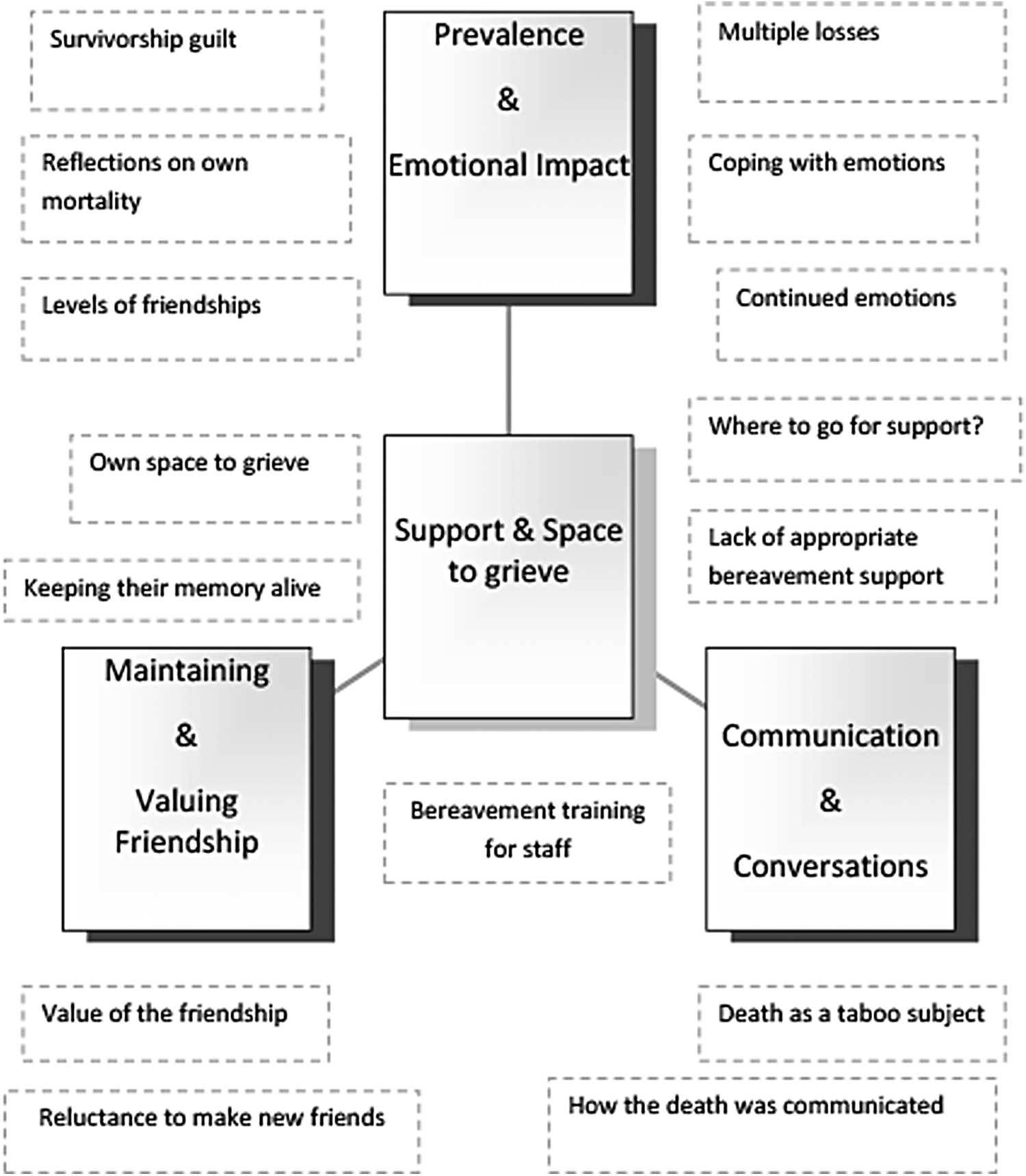
Thematic map.
Results
Participant demographics
Eight young people attended the advisory group: 5 females and 3 males, ages 17–30 (mean = 23.25). The group was representative of cancer diagnoses in TYA's: lymphoma (3), leukemia (2), sarcoma (1), testicular cancer (1), and aplastic anemia (1). Fifty percent of participants had completed treatment more than a year ago and 25% were on active treatment. Forty-five young people completed the online survey (Appendix Fig. A1). The key themes from the data provide valuable insights into TYA bereavement experiences and are explored further.
Prevalence and emotional impact
Young people had experienced multiple losses of friends, with one person in the group attending five funerals in 1 year. A survey responder shared: “I had many friends who died.” Young people described experiencing a range of emotions. They spoke of survivorship guilt where the death created a pressure to be doing more with their own lives: “When one friend passed away I felt guilty as he was braver and stronger that I ever could be” and also resulted in fear and anxiety: “It also makes you question your own future and own mortality,” “Am I going to die too?.” Young people described emotions that were longstanding: “I struggled to deal with it and still do” and “I still carry memories of them every day. I can just get a flash memory and cry.” All survey participants felt that emotional support would have helped them cope with bereavement better: “My emotions are all over the place and at times I can get very angry, having skills to deal with these emotions could have made a difference.”
Maintaining and valuing friendships
Differing levels of friendships were described; young people rekindled friendships with school friends, new friendships developed, and one young person had experienced the death of her fiancé. They also highlighted that staff were not always aware of the connections people had away from the TYA service. Young people spoke openly about the value of the friendship and how to maintain this friendship at the end of life. There was a wish to maintain their friend's memory after their death: one young person naming her child after her friend. There were disclosures about the value of having friends who shared the cancer experience, balanced against reluctance from many to make new friendships after the death of a friend, as they did not want to experience grief again.
Communication and conversations
Young people described negative experiences of how the death was communicated; feeling that death was a “taboo subject” where they felt staff avoided discussions or conversations were limited: “Sometimes it felt as though staff didn't know what to say and I felt guilty for asking about the person who had died” and “I'd asked if a person had died and be told ‘Yes’ but nothing further was said or done.” Sixty-one percent of young people found out about the death of a friend through social media, however, some young people reported they had not found out about their friend's death until after the funeral, which was extremely difficult.
Support and space to grieve
An online survey responder described: “a teenager should not have to face the death of a friend alone.” Young people were confused about where to ask for help and expressed support did not always meet their needs: “I didn't know the appropriate person to contact for support” and “(Support) was restricted due to time and not specialist support.” Regarding bereavement support, 89% of young people had not received any bereavement support, 74% felt they did not receive enough information, and 72% felt that there needed to be improvements in the support provided. Young people felt that bereavement support needed to be given dedicated time and space, and provided by someone with bereavement training. Some young people in the advisory group described feeling guilty for attending a friend's funeral as this was a reminder to the bereaved family that another young person had survived cancer. This created discussions about wanting their own space to grieve.
Discussion
Themes arising from this study highlight the complicated nature of bereavement for young people. Although this was a small-scale study, the valuable information obtained highlights that a young person with a cancer diagnosis is likely to experience the death of a friend, and possible multiple deaths, during their own cancer treatment. Research highlights that young people are at greater risk of experiencing negative outcomes in later life if they experience multiple bereavements, or bereavement alongside other difficulties. 13 This places TYAs at high risk of long-term psychological difficulties as they are coping with the stressors of their own cancer diagnosis alongside potential exposure to multiple bereavements, within the context of not having fully developed effective coping strategies. 2
In addition to the initial emotional impact of the bereavement, young people identified the long-term impact of grief and that they struggle emotionally with the losses many years on. This was reiterated in Johnson's study, where 76% of young people described their loss as “I never got over it” (2017, page 4). 5 Bereavement support at the time would certainly help to reduce long-term grief symptoms.
Young people described the value of the relationship with the friend. They compared themselves with the young person who had died, resulting in survivorship guilt, reflecting on their own mortality, a stronger ability to relate to the peer death and a reluctance to build future friendships. This is supported in research where the perceived closeness to the person who died resulted in more intense grief, and the development of survivorship guilt. 5 This makes TYAs particularly vulnerable to experiencing complicated grief.
These experiences are further complicated by the way a death is communicated to the young person. Young people strongly expressed the need for professionals to discuss death and dying in an open and honest way. Concerns about maintaining confidentiality may impede staffs’ ability to share the details of the death of another young person. Additionally, bereavement training is not a core element of TYA staff training. This may leave staff members feeling either unskilled in communicating a death or unsure as to what they are allowed to share.
The findings from this study triggered the professional body TYAC (Teenagers and Young Adults with Cancer) to complete a UK-wide survey with TYA staff. This survey highlighted inconsistencies in communicating a death and delivery of bereavement support. The development of a TYA bereavement policy and best practice guidance has been recommended.
Outcomes from the study demonstrate an overwhelming need to improve bereavement interventions. Young people in this study expressed a need for formalized bereavement, delivered by trained staff, at the time of their friend's death. This mirrors research findings that young people should be supported to work through their grief to understand and process the death through counselling, peer-support groups, or bereavement-focused group interventions. 5
Results indicated the need to create a safe “space” for young people to express their grief within TYA services. The advisory group developed an annual bereavement event “Remembering Friends.” This is an informal (nonreligious) event, a safe space to celebrate their friend's lives, facilitated by young people and TYA staff. The event involves creative activities to express feelings and share memories of their friends.
Recommendations for clinical practice and future research
There is a distinct lack of research that addresses the loss of a friend during a young person's own cancer treatment. Exploring experiences of peer bereavement, and the longitudinal impact of this bereavement, would be extremely beneficial. Interventions targeting grief in TYAs with cancer would be valuable and should be further researched. As a minimum, TYA services should signpost to community bereavement services. Services should offer a variety of bereavement support interventions and importantly young people need to be central in the development of these interventions. Bereavement training should be made more accessible to TYA staff, including guidance on how to communicate the death of a young person. The authors acknowledge this is not solely a UK issue and TYA oncology services globally would benefit from reviewing their bereavement support procedures and policies.
Limitations
This study has a small sample size, making it difficult to generalize findings. A larger national study with in-depth, recorded interviews completed by a researcher outside of the clinical setting is a priority.
Conclusion
Young people in this study highlight the complex and multifaceted nature of bereavement when their friend dies, while undergoing their own cancer treatment. The study has shown that while bringing young people together during treatment can be immensely beneficial, more emphasis should be placed on providing timely, age-appropriate bereavement support when a young person experiences the death of a friend. This support will help reduce the risk of young people experiencing long-term psychological difficulties and negative outcomes in later life.
Footnotes
Acknowledgments
The project could not have taken place without the hard work and dedication of the young people who attended the advisory group and were committed to develop a celebration event for their peers and passionate about developing TYA bereavement services moving forward. The authors thank The Christie and Teenage Cancer Trust for funding the celebration events. They thank the Clic Sargent Social Work team at The Christie for their involvement in the initial stages of developing the project. They thank Teenage Cancer Trust Stephen Sutton bursary for enabling the authors to present the work at the 3rd global AYA conference, Sydney, 2018 and to Professor Barbara Jones (Steve Hicks School of Social Work, University of Texas) for acknowledging the lack of research in this area and encouraging them to publish this valuable piece of research. The authors also thank Kate Law (TYA Nurse specialist/PhD researcher), Dr Laura Green (Palliative Care Lecturer, University of Manchester), and Nicola Chesman (Specialist TYA Physiotherapist) for giving them their valuable time and constructive feedback.
Author Disclosure Statement
No competing financial interests exist.