




Abstract
Purpose:
Despite the developmental relevance and role in social support, research on relationships between adolescents with cancer and healthy peers is limited. To address this gap, we aimed to describe adolescents' perceptions of their friendships during the 1st year following a cancer diagnosis, including relationship changes, factors that promote/inhibit relationships, and definitions and experiences of peer support.
Methods:
Eligible adolescents were 12–20 years old, <1 year of a new cancer diagnosis, and English speaking. Participants completed 1:1 semistructured interviews that were analyzed using inductive content analysis.
Results:
Fourteen adolescents enrolled and completed interviews (mean [M]age = 14.8, standard deviation [SD] = 1.8; M = 6.3 months postdiagnosis, SD = 3.2 months). Domains included (1) shifting relationships, (2) staying connected, (3) making it hard to stay close, and (4) showing me they care. Relationship changes were positive and negative, and many described a process of recognizing true friends. Staying connected with peers through communication, technology, and feeling up to date promoted closeness, while distance, treatment-related restrictions, and friends' discomfort were hindrances. Adolescents defined supportive friends as those who were there for them, checked in often, and gave them gifts.
Conclusion:
Despite relationship changes, adolescents with cancer desire connection with peers during treatment and perceive that healthy peers provide valuable support. Supporting connectedness to healthy peers during treatment may be a promising future direction to mitigate social disruption and promote well-being.
Introduction
Adolescents with cancer (aged 12
Peer support is highly valued by adolescents with cancer and associated with positive outcomes. Friends are considered a primary source of both practical and emotional support during treatment,9,11–14 promote connectedness to school 9 and social activities,11,15 and help patients feel normal. 16 Indeed, higher perceived peer support has been associated with less depressed mood, anxiety, and general distress. 17 However, peer support remains an unmet need for many adolescents with cancer. 5 Relationships with healthy peers are often negatively impacted during cancer treatment as friendships become distant 10,18,19 and obtaining adequate support is perceived as challenging. 20 As survivors, adolescents struggle to transition back into their peer group21–23 and report poor social functioning and social quality of life for years following treatment.1,24
Programs promoting connectedness with healthy peers have the potential to both mitigate social disruptions during treatment and improve social support, social functioning, and school reintegration for survivors. To inform such programs, a clearer understanding of relationships between adolescents with cancer and their healthy peers is needed, including why friendships change, what modifiable factors that promote or inhibit friendships during treatment, and what behaviors characterize supportive friendships. Using an inductive qualitative approach, the current study aimed to address this gap by describing the perceptions of adolescents diagnosed with cancer between ages 12–20 years on their relationships with healthy peers during the 1st year postdiagnosis.
Methods
Participants
We recruited a convenience sample of adolescents with cancer receiving care at a children's hospital in the Pacific Northwest United States using the following inclusion criteria: 12–20 years old, <1 year postdiagnosis, and able speak and write in English. This study was intentionally limited to adolescents rather than broader AYA age range (i.e., 15–39) as the nature of peer relationships and their role in social well-being differ between these developmental periods. 8 Exclusion criteria included having been diagnosed with a second malignancy, a history of relapsed or recurrent cancer, or a diagnosis that did not require active treatment, as these patients would have a different experience than those with initial cancer diagnoses requiring new separation from peers. Those with any history of developmental delay were also excluded as peer experiences would likely differ from those of typically developing adolescents.
Procedure
All study procedures were approved by the local institutional review board. Potentially eligible adolescents were identified through reviewing upcoming outpatient clinic appointments, and eligibility was confirmed through medical record review. Families were approached over a 6-month period via a mailed opt-out letter that described the study and provided a phone number to opt-out of further contact. Those who did not opt-out within 10 days were then approached by a member of the study team in a two-step process. First, staff called families to introduce the study, informing them that the goal of the research was to better understand how friends can help support young people with cancer. Calls with adolescents <18 occurred with a parent present; verbal parental permission was obtained first followed by verbal assent from adolescents. Adolescents ≥18 were contacted directly and provided verbal consent. Second, as requirements for written documentation of consent were waived for this study, adolescents (or parents, if <18) were then sent an information statement and asked to check a box to indicate their willingness to participate. Within 3 months of enrollment, participants were asked to complete an online survey containing a demographic form and participate in a single, one-on-one semistructured interview. Enrollment was stopped at the end of the 6-month recruitment period.
Measures
Demographic information
Cancer diagnosis, diagnosis date, and patient age were obtained from medical records. Participants self-reported all other demographic information, including categorical choices for race and ethnicity and number of siblings, and an open-ended question for gender. Participants also reported where they were living during treatment and whether they were attending school.
Semistructured interviews
Individual semistructured interviews were conducted via phone by the first author, a female doctoral candidate in psychology, and one female undergraduate psychology honors student. Both received 1:1 training in conducting qualitative interviews. Participants were informed that the interviewers were not associated with clinical care. Interviewers confirmed that the participant was in a private space before the interview. Interviews were digitally audio-recorded and transcribed verbatim by two trained undergraduate research assistants. Interviews were conducted using a specific guide of open-ended questions developed for this study (Table 1) and lasted ∼10 to 20 minutes. Interview questions remained consistent throughout the duration of the study. No field notes were used and participants did not review completed transcripts.
Semistructured Interview Guide
Analytic strategy
We followed the consolidated criteria for reporting qualitative research (COREQ; 25 Supplementary Table S1). Analysis of interview data was guided by a multistep process of inductive content analysis using methods adapted from grounded theory interviews.26,27 Primary and secondary coders were the first and second authors, respectively. Coding was conducted as interviews were completed, using ATLAS.ti. The coding process involved five steps: (1) All texts from transcribed interviews were unitized. Each unit was a direct quotation of a complete idea. (2) Each unit was open-coded, with codes derived verbatim from words used by the interviewee. (3) Open codes were organized into an initial set of categories with descriptions that clearly differentiated each category. (4) Constant comparative analysis was used to verify the distinctions between the categories and verify the accuracy of fit of each unit.28,29 (5) The refined set of categories was grouped into higher order domains. Trustworthiness was protected through formal peer debriefing between the first and second authors. Three comparisons were made in the debriefing process: (1) a comparison between all categories, including an examination of distinctions between categories; (2) a comparison of the adequacy of fit between each verbatim quote and the category; and (3) a comparison of each verbatim quote with all other categories and descriptions.
Participants did not provide feedback on findings due to the short duration of the study.
Results
Description of study sample
See Figure 1 for recruitment information. Adolescents in the final sample (N = 14) were 6.3 months postdiagnosis on average (standard deviation [SD] = 3.2; range = 3.3–12.0) with ages from 12 to 17 years (mean [M]age = 14.8; SD = 1.8; Table 2). One participant was lost to follow-up before completing the self-report demographic information; as some demographic data were obtained from the medical record, and interview data were retained for analysis.
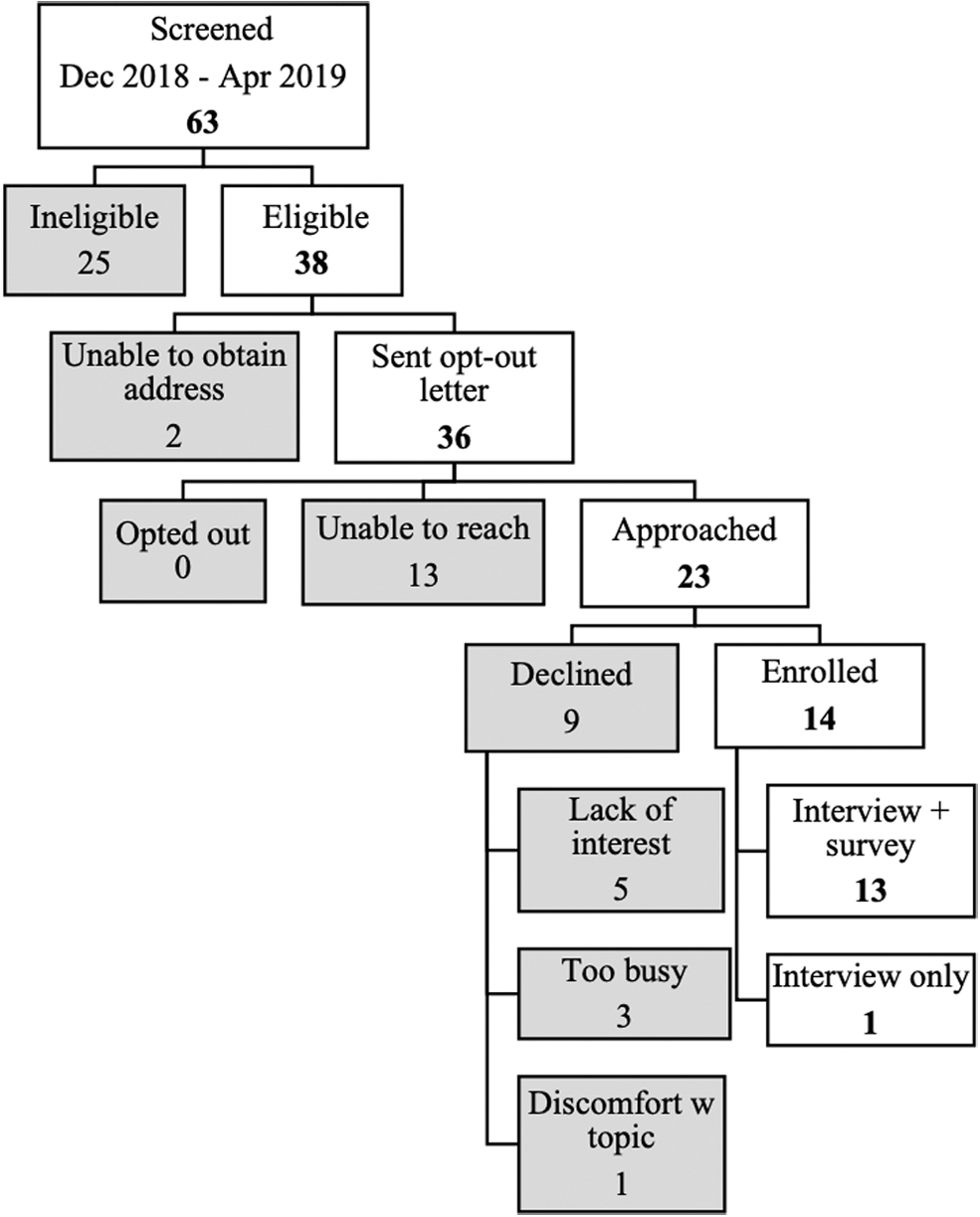
Screening and recruitment information.
Demographic Information
Self-reported demographic information (n = 13).
CNS, central nervous system; SD, standard deviation.
Domains and related categories
Four domains and 12 related categories captured adolescents' experiences with peer relationships during the 1st year postdiagnosis (Fig. 2). As there was no substantial new information derived from the final interviews, we believe we reached saturation for the population of adolescents receiving care at this institution.
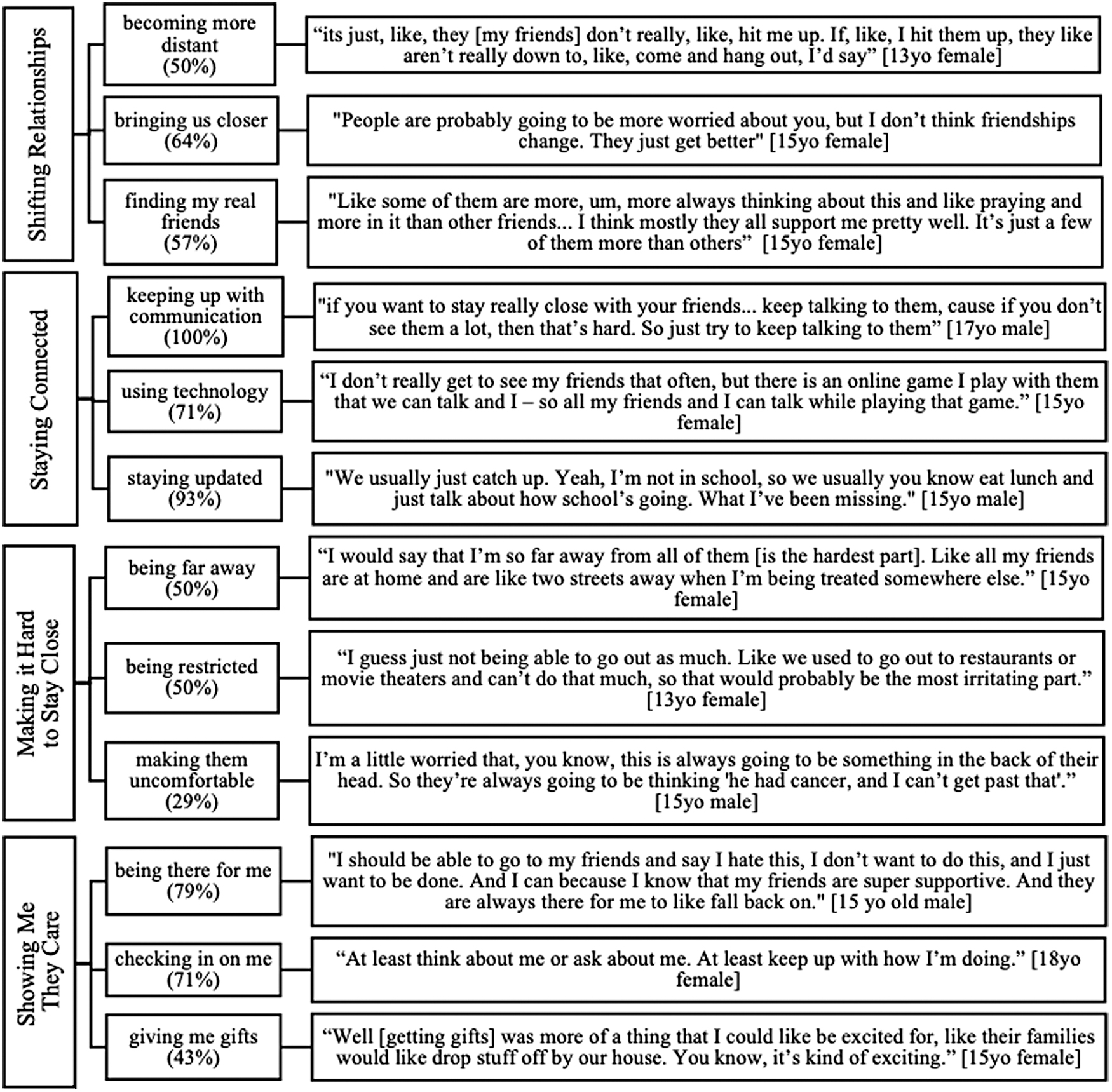
Domains, related categories, and illustrative quotes, including percent of respondents reporting in each category.
Domain 1: shifting relationships
Three categories comprised Shifting Relationships: (1) Becoming more distant, (2) Bringing us closer, and (3) Finding my real friends. In this domain, adolescents described ways in which they felt having cancer had affected the quality and closeness of their friendships.
Becoming more distant
Half of the sample perceived that some of their friendships had become less close since their diagnosis. As one adolescent described this change, saying, “We like talk and stuff, but it's not—we're not as close as we used to be before I like left for a while” (15-year-old female). Most attributed this change to a lack of contact and not being able to see one another as often, although a few perceived that changes were related to friends' discomfort with their diagnosis.
Bringing us closer
In tandem, approximately two-thirds of the sample perceived that cancer had strengthened at least some of their friendships. They felt that having cancer had brought them closer through demonstrating how much they and their friends cared about one another. One adolescent captured this sentiment, saying, “Yeah, it did [change], but not in a bad way, you know what I mean? Like, it changed to a good way, cause we, like, care more about each other” (17-year-old male). Four adolescents reported both here and in the prior category, suggesting that some adolescents experience both positive and negative shifts in their friendships.
Finding my real friends
Just over half of the sample described a process of re-evaluating their friendships and recognizing which were most valuable. Some did this through comparing the ways in which different friends supported them. As one teen reflected,
It definitely… shows you who your true friends really are. And who you know is willing to make that extra step to, ‘I wanna come see you, when can I come see you,’… And there's the friends where it's like, ‘Oh man, sorry, that sucks, hope you get better’… Which is, it's nice, but the people that make the extra effort to come down here and see me are the people that really stick out and are the people I can really tell care about me and my health. (15-year-old male)
For some, this process included reconsidering what they valued in a friend and what had defined their previous friendships. They also experienced shifts in their friend networks, sometimes in surprising ways as their closest friends were not the same people as before their diagnosis.
Domain 2: staying connected
Three categories comprised Staying Connected: (1) Keeping up with communication, (2) Using technology, and (3) Staying updated. In this domain, adolescents described their efforts to maintain relationships with their peers during treatment and what helped them do so.
Keeping up with communication
A major aspect of staying connected with peers was frequent communication. Every participant discussed the importance of talking to friends often, and many felt these communication efforts were critical for maintaining their friendships. As one adolescent observed, “Like, trying to keep up with communication really helps with staying closer with people” (15-year-old female). The importance of maintaining communication was also the most common piece of advice adolescents had for other teens with cancer.
Connecting with technology
Approximately three-quarters of the sample discussed using technology to stay connected with friends. They communicated with friends through video chats, texting, social media, and online videogames, and felt these means helped them stay in frequent contact. As one adolescent described, “Definitely videogames. Like even in the hospital, we brought a Play Station from home, and I was able to stay connected every day” (13-year-old female).
Staying updated
Another aspect of staying connected to peers was staying caught up on one another's lives, with nearly every participant reporting in this category. Conversations with peers primarily involved typical topics, including what their friends had been doing or had happened at school, as one teen said, “…they try to keep me updated on how school is going. Like, you know, and all the drama” (13-year-old female). AYAs also updated their friends on their own lives, although most described discussing normal topics with their friends rather than cancer, as one adolescent said, “Not generally, it [cancer] doesn't come up that much, unless I'm like going to the hospital for a bunch of reasons” (15-year-old female).
Domain 3: making it hard to stay close
Three categories comprised Making it Hard to Stay Close: (1) Being far away, (2) Being restricted, and (3) Making them uncomfortable. In this domain, adolescents describe barriers to staying close with their friends since their diagnosis.
Being far away
Half of the sample discussed distance as a major barrier to maintaining friendships. Many discussed the shift between seeing their friends daily to rarely seeing them. Those who had relocated treatment often found this especially challenging, as one teen described,
I would say just not being at school and being so far away is definitely the hardest part. And so, for the people that I used to go to school with every single day and now I don't go to school with… I miss my friends. [15-year-old female]
Many found it difficult to coordinate seeing their friends even when they were home, felt left out when things happened while they were away, and worried about the status of their friendships when they returned.
Being restricted
Half of the sample described their health and treatment-related restrictions as a barrier to their friendships. Some discussed feeling too sick or fatigued to engage with friends. Many described their immunosuppression as a barrier as they were unable to do the things they used to do with their friends, as depicted in this statement:
Um, mostly just having everything have to be within my own time frame. Like after chemo, there would be days where I wouldn't be able to go and see more than two people… so I wouldn't be able to go to a party or like, go to a group and hang out. Yeah, not being able to be on their time… made it hard. [17-year-old-male]
Making them uncomfortable
Approximately one-third of adolescents noticed that some friends behaved differently toward them since their diagnosis and were concerned about how peers perceived them. As one adolescent described,
Some people are really uncomfortable talking to me. I think just me having cancer in general makes things uncomfortable for them, which I can kind of understand. But it's like, when I try to interact with them, they have a hard time interacting with me. And I would say that's the majority. [15-year-old male]
Some attributed this to peers' inability to handle the pressure of having a friend with cancer. Others were also concerned about how peers would treat them when they returned to school and worried about being perceived as different.
Domain 4: showing me they care
Three categories comprised Showing Me They Care: (1) Being there for me, (2) Checking in on me, (3) Giving me gifts. In this domain, adolescents define what it means for a friend to be supportive and describe instances in which their friends showed their support.
Being there for me
Over three-quarters of adolescents described supportive friends as those they could rely on to be there for them, both physically and emotionally. Being there included regularly asking if there was anything they needed and offering help. Many discussed the particular meaning of friends being with them at the hospital. As one adolescent recalled,
And so, he came down. He drove all the way and showed up, and he was there for like eight hours with me while I was in the ICU… and especially in that moment when I was in this state of, ‘I'm in the ICU, I'm having like three surgeries in a row, I'm diagnosed with cancer, how can it get worse?’… And he just being there kind of lifted a little bit of the weight off. [15-year-old male]
Supportive friends were also those who were there to talk to during difficult times. Adolescents described the importance of knowing they could “vent” to their friends without judgment.
Checking in on me
Supportive friends were those who checked in with them frequently. Over two-thirds of adolescents discussed the value of friends reaching out and asking how they were doing. They interpreted this as a gesture of support and an indication that their friends cared about them, as captured in this statement:
If we're like talking more, like, if we're messaging more that would probably make me think they're actually thinking about me here rather than never saying anything. [15-year-old female]
When asked how they would support a friend with cancer, the majority of participants also said they would do so by checking in frequently and making an effort to maintain contact.
Giving me gifts
Approximately half of adolescents felt that friends demonstrated their support through gifts, including both physical presents and public gestures. They enjoyed receiving gifts from friends, including gift baskets, letters, and forms of entertainment. Describing the value of receiving a gift, one adolescent said, “Receiving the gift baskets from them, that kind of helped me know that they're still thinking about me and they hadn't, like, forgotten about me or anything” (17-year-old male). They also described friends making gestures to show their support, including wearing bracelets with their name and shaving their heads.
Discussion
To address gaps in understanding regarding relationships between adolescents with cancer and healthy peers, the current study used a qualitative approach to describe adolescents' experiences with their friendships during the 1st year following a new cancer diagnosis, including perceived changes, factors they perceived to promote or inhibit closeness, and how they defined peer support.
Our results support and extend existing research. As previous studies have described, adolescents experienced positive and negative changes to their friendships,14,20 including becoming closer to some, while noticing the absence of others,9,10 and discussed a process of identifying their true friends. 16 Unique to this study, adolescents also provided novel description of factors that affected their ability to maintain their friendships. Factors that promoted friendships were maintaining frequent contact, using technology to communicate, and staying updated on life at home. Factors that inhibited friendships were distance from home, feeling restricted by treatment through not being able to engage in typical activities with friends, and noticing some peers' discomfort with cancer. Similar to prior research, our findings underscore the importance of support from friends,14,16 demonstrated through visiting, talking through difficult times, and supportive gestures. 9 These findings also provide novel description of support behaviors such as checking-in and making an effort to stay in touch.
These findings may inform clinical care and development of interventions designed to address unmet social support needs. Extant studies suggest adolescents with cancer desire greater peer support and resources that minimize loneliness.5,30 Our findings suggest that this may be accomplished through promoting connectedness with peers during treatment. This may be accomplished through prioritizing time for talking to friends, providing access to smartphones or videogames, and providing teen-friendly spaces in the hospital for adolescents to socialize with friends. Second, given that some adolescents described becoming distant from friends or noticing their discomfort with cancer, it is possible that adolescents may benefit from support anticipating and navigating such changes in their peer relationships after diagnosis. This may include normalizing experiences of loss and helping them through the process of recognizing their “true” friends. Third, adolescents may benefit from coaching to help define what support means for them, from whom they can seek support, and how they can communicate their support needs to their friends. Finally, developing resources for friends of adolescents with cancer may be beneficial, including cancer education to reduce discomfort and behaviorally specific advice for supporting a friend with cancer.
This study has a number of limitations. First, given our small, English-speaking sample size drawn from a single geographic area, it is unclear if these findings generalize to the broader adolescent cancer population. Second, using phone-based methods may have limited accrual, as 30% of eligible adolescents were unable to be reached via phone for a formal approach. Furthermore, our refusal rate was higher than expected compared with similar studies using in-person approaches. 31 Phone interviews may also have limited engagement and interview duration, as some adolescents may have felt less comfortable sharing their experiences via phone. Third, those who agreed to participate may have been those who had more positive experiences in peer relationships, potentially biasing results. Finally, an important next step will be obtaining stakeholder feedback from both adolescents and healthy peers to inform intervention development, including degree of interest and preferred format, length, and timing.
Taken together, these findings highlight the importance of relationships with healthy peers for adolescents with cancer and the ability of these friendships to provide needed support. During adolescence, peer relationships are a salient aspect of daily life, essential form of social support, and an important context for development. 8 Thus, helping adolescents with cancer maintain these relationships may be a critical pathway for minimizing developmental disruptions and promoting social well-being during and after treatment.
Footnotes

References
Supplementary Material
Please find the following supplemental material available below.
For Open Access articles published under a Creative Commons License, all supplemental material carries the same license as the article it is associated with.
For non-Open Access articles published, all supplemental material carries a non-exclusive license, and permission requests for re-use of supplemental material or any part of supplemental material shall be sent directly to the copyright owner as specified in the copyright notice associated with the article.
