




Abstract
This report addresses physical activity (PA) levels and education preferences in young adult cancer survivors (YACS) and outlines strategies for the design of successful interventions. A cross-sectional design was used to assess PA in 124 YACS, using the International Physical Activity Questionnaire-Short Form. Recommended levels were reported by 20.2% and 42.5% for high and moderate PA in metabolic equivalent of task (MET) minutes/week, respectively, while 37.3% reported low level PA in MET-minutes/week. Eighty percent reported likely to use technology for education about PA. Prior research supports using technology to administer tailored interventions to promote consistent PA among YACS, ideally in nature-based activities.
Background
Young adult survivors of childhood and adolescent cancer (young adult cancer survivors [YACS]) are at risk for developing chronic health conditions, including cardiovascular disease (CVD). 1 Children diagnosed with cancer are treated using modalities, including chemotherapy, radiation, and targeted therapies. The Centers for Disease Control and Prevention (CDC) and the Department of Health and Human Services recommend a minimum aerobic physical activity (PA) of ≥150 minutes/week of moderate or ≥75 minutes/week of vigorous PA. 2 Evidence suggests that YACS are not meeting CDC guidelines for PA.3,4
Physical and functional limitations due to cancer treatment may restrict YACS from engagement in recommended levels of PA. 5 Brain tumor survivors often have sensorineural deficits (e.g., vision loss, hearing loss), neurological dysfunction (e.g., balance, gait disturbances), and neurocognitive deficits limiting their ability to engage independently in specific activities.5,6 Survivors with cardiovascular, musculoskeletal, and endurance limitations or those who received cranial radiation are less likely to engage in optimal PA. 6 Survivors may be more sedentary.7–9 YACS have reported specific barriers to participating in PA: feeling too tired, too busy, or fearful of injury or a preference for sedentary behaviors.8,10
Targeted interventions addressing dietary behaviors and physical exercise, specifically leisure-time activities (e.g., walking), improve health related quality of life (HRQOL) 8 and reduce depressive symptoms. 11 Physical exercise reduces the risk factors for CVD, including waist-to-hip ratio, waist circumference, and endothelial function. 12 Further research is needed to identify physical activities that accommodate the functional limitations present in YACS, reduce their risk for developing CVD, and optimize their HRQOL. This article describes the patterns and frequency of PA and preferences for PA education and engagement strategies in a sample of YACS to plan meaningful and sustainable interventions.
Methods
The setting for this study is a comprehensive childhood, adolescent, and young adult cancer survivorship program located in a large tertiary pediatric medical center in North Texas. The study sample was drawn from over 1200 young adult childhood and adolescent cancer survivors enrolled in the survivorship program who were at least 18 years at the time of this study.
Recruitment of 600 YACS was originally planned for this study to enroll ∼50% of the survivorship population. Inclusion criteria were age (<18 years at the time of cancer diagnosis, ≥18 years at study recruitment), ≥6 months following completion of cancer treatment, and ability to understand English. This project was approved as an exempt study by the affiliated institutional review board. Consent was waived due to the anonymity of data collection unless participants wanted to be contacted later for future interventional studies. YACS were recruited over 36 months using postal mail for hard-copy distribution of the survey with a self-addressed, stamped return envelope and social media channels (survivor program and Stupid Cancer® websites; AYA Oncology Facebook) through a link to an online Qualtrics Survey™.
Measures
PA levels were established using the CDC recommendations. The investigators used the International Physical Activity Questionnaire-Short Form (IPAQ-SF) to measure PA. Although the literature reveals equivocal reports on the validity and reliability of the IPAQ, one study confirmed its suitability as a self-report measure for use in predominantly young adult populations. 13 The IPAQ-SF measures PA of varying degrees of intensity (vigorous, moderate, light [walking]) over the past 7 days to estimate total PA in terms of metabolic equivalent of task (MET)-minutes/week. 14 The total PA is calculated using the following formula: walking × 3.3 + moderate PA × 4.0 + vigorous PA × 8.0 to obtain the total MET-minutes/week. According to established guidelines, high PA requires at least 3000 MET-minutes/week, moderate PA requires at least 600 MET-minutes/week, and low PA represents <600 MET-minutes/week. Sedentary time is calculated separately. For items addressing level of intensity, participants responded to two open-ended items to establish the number of days spent in the respective activity per week, as well as the number of minutes spent per day on the activity.
The remaining health behavior survey items developed by the investigators specifically addressed the YACS' preferences for learning about exercise (e.g., computer, mobile phone, face-to-face, print materials, group meetings) and their preferences for social support related to exercise (e.g., friend, other survivors, significant other, group format). Survey items that addressed walking distance to parks and recreation centers were taken from established environment measures. Responses were measured on a Likert scale (1 representing very likely to 4 very unlikely). Data analysis included descriptive statistics with a focus on PA patterns of the sample. Chi square analysis was used to explore relationships between personal characteristics, environment, and PA. Likert scale responses 1–2 were collapsed into a single response to represent percentage of endorsement, whereas responses 3–4 (representing not likely or very unlikely) were considered a lack of endorsement.
Results
The characteristics of the 124 YACS are found in Table 1. The sample was primarily non-Hispanic white (78.2%). Most YACS received chemotherapy (91%). Overall, 39.5% of YACS reported having physical problems. The mean body mass index (BMI) of this sample was 25.05 kg/m2 (overweight).
Personal Characteristics of Participants (N = 124)
Numbers do not add up to 124 due to skipped items.
The PA levels in this sample were calculated using MET-minutes/week and then placed into categories (high, moderate, and low PA levels). The PA patterns of the sample indicated that 20.2% (n = 40) participate in high levels of PA, 42.5% (n = 53) participate in moderate levels of PA, and 37.3% (n = 31) participate in low levels of PA (Fig. 1). Walking was the most frequently reported form of PA at least four or more days a week; 74.2% of YACS reported that they walk at least 10 minutes a day. Of concern, 86.2% of YACS in this sample reported sitting up to 21 hours/day, which represents sedentary activity.
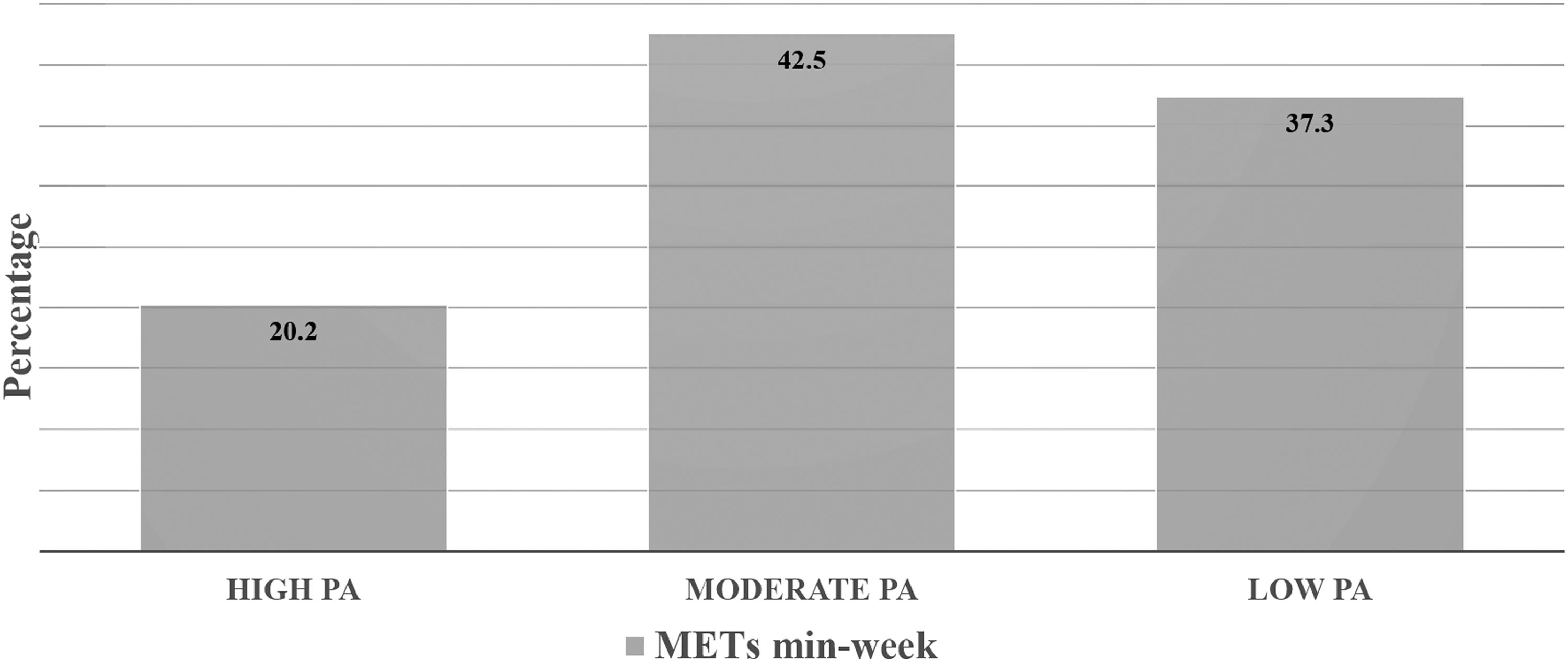
Physical activity levels among participants.
Examination of preferences and engagement in PA did not reveal any statistically significant relationships between current age, gender, years since completion of therapy, or BMI. However, BMI was correlated with YACS endorsing PA in their neighborhood χ 2 (2, N = 116) = 7.590, p < 0.02. Younger YACS (N = 84, 70.6%) were more likely to endorse trails to engage in PA.
Data on the environment (walking distances to parks and recreation centers), preferences of YACS for education and engagement environment for PA, and persons with whom they would like to exercise are found in Table 2. The majority of YACS indicated that they are most interested in exercising with a friend (96.7%) and with other persons with similar interests (89.3%). In addition, YACS embraced technology when learning more about exercise through cell phone (81.8%) or a computer (78.5%). YACS endorsed exercising at the gym (73.8%), in their own neighborhood (73.9%), or on the trails (66.5%). Over 90% also endorsed exercising at home.
Preferences for Physical Activity Education and Engagement Among Young Adult Cancer Survivors and Walking Time to Nature-Based Locations
Numbers do not add up to the total N of 124, but are based on participants responding to each survey item.
Percentages do not add up to 100% due to participants providing multiple selections.
Twenty-two (17.7%) of YACS responded “do not know” to this item.
YACS, Young Adult Cancer Survivors; PA, physical activity.
Discussion
The CDC recommends at least 150 minutes of moderate-intensity PA and 75 minutes of vigorous-intensity PA per week. 2 Of this sample, 37.3% did not engage in moderate and high PA levels using MET-minutes/week calculations. 13 This finding is similar to a recent cross-sectional analysis from the Childhood Cancer Survivor Study which reported that just over 40% of sampled YACS did not meet CDC guidelines for PA. 3 In addition, another report indicated that only 25% of sampled YACS met PA guidelines established by the CDC. 4
In the current study, 42.5% and 20.2% of YACS reported moderate and high PA levels, respectively, indicating that this sample is more physically active than previous reports. However, 86.2% of YACS in the current study sit more than 20 hours on most days of the week, and PA may attenuate this risk. 15 In general, sedentary behaviors (sitting) among YACS may be associated with specific functional and physical limitations (e.g., brain tumor survivors 5 ), which may limit YACS from participating in optimal PA. In the current sample, only 2 (1.6%) were brain tumor survivors, 4 (3.2%) reported having an amputation, and 6 (4.8%) were bone tumor survivors, limiting the ability to make any conclusive associations of physical disabilities like amputation and neurological dysfunction (e.g., balance, gait) in brain tumor survivors to reported PA levels.
Previous reports suggest that PA supports optimal HRQOL8,16 and psychological health 11 in YACS. The impact of regular PA (including leisure time) on HRQOL and opportunities to interact with others within the survivorship community may yield optimal results. YACS with functional barriers may benefit from a range of leisure-time PA to improve HRQOL and overall health. Social support, specifically peer support, is important in this population. 17 YACS in this sample indicated that they would like to talk to others with similar interests and reported that they would likely attend a gym to exercise. Group PA interventions have shown some promise in engaging YACS, 18 suggesting that social support and networks facilitate PA in this population. Nature-based PA was not specifically addressed in this study; however, the participants reported desiring social interactions and activities where other individuals may exercise, such as gyms, neighborhoods, and trails. The need to offer social opportunities in a safe environment amidst the COVID-19 pandemic underscores the value and appeal of outdoor, nature-based PA options.
Limitations
The findings in this study are from a self-reported survey and represent a primarily anonymous sample, which may lead to under-reporting or over-reporting. In addition, the IPAQ-SF has equivocal reports of validity and reliability as a self-reported measure of PA, but early psychometric analysis and some recent reports indicate its suitability for use in young adult populations. Another limitation of this study was the recruitment; despite multiple efforts over 2.5 years to reach this mobile population, the sample size was smaller than anticipated, which may support more strategic use of technology when recruiting and engaging YACS in meaningful interventions.
Implications for intervention
Peer support, social networking, and innovative outdoor interventions to boost PA among YACS may yield successful results19,20 using a tailored approach, goal setting, and motivation. 21 Technology (e.g., computers, phones, and wearable devices) is the mainstream of measuring PA, delivering interventions, and promoting motivation when addressing health behaviors.21,22 Wearable devices provide immediate feedback and submission of objective information on PA engagement to facilitate YACS' improvement in PA behaviors. 23
Innovative nature-immersive interventions warrant further exploration in this population; one example is walking in and among nature, easily integrated into a busy day at work or school, depending on access to open green spaces. In the current sample, 66.4% of participants identified trails and 73.9% identified neighborhoods as locations to engage in PA, indicating opportunities to design nature-based interventions that facilitate community mindedness. In addition, YACS with physical limitations can enjoy nature-immersive interventions such as leisure-time and nature-based activities within their own neighborhoods according to interest and ability. Although access to nature may be a challenge, particularly in densely populated environments, providers can collaborate with local parks and recreation facilities and diverse stakeholders to identify the best available green space and advocate for increasing equitable access to all populations. 24 Providers can also issue prescriptions for nature using systems like Park Rx America 25 for monitoring and adaptation over time. Nature-based activities may be tailored to improve YACS HRQOL, mental, and physical well-being. The dose–response, cost-effectiveness, and long-term benefits of nature-based activities are not yet established, and further research is warranted. Using technology to facilitate motivation, social networking, and data collection will serve to enhance the success and sustainability of a PA program, regardless of setting.
Conclusion
YACS are at increased risk for premature mortality, but increased PA may attenuate this risk. 15 Although YACS in the current study reported moderate or high levels of PA, a substantial percentage reported low levels of PA. To promote optimal levels of PA for this at-risk population, providers can emphasize the benefits of leisure-time PA. Interventions that integrate social support, technology, and time outdoors are very sensible, particularly during a pandemic; 66.4% and 73.9% of participants endorsed trails and neighborhoods, respectively, to engage in PA. Neighborhoods, parks, trails, and outdoor recreational facilities provide free access to PA, circumventing financial constraints and allowing for physical distancing.
Footnotes
Author Disclosure Statement
No competing financial interests exist.
Funding Information
Funding for this study was provided by the Center for Oncology Education and Research, Texas Christian University Nursing, Harris College of Nursing and Health Sciences, Texas Christian University.
There is no grant funding number for this internal grant. The funding source is the Center for Oncology Educational and Research, Harris College of Nursing & Health Sciences.