




Abstract
There is consensus among health care professionals that the needs of young adults (YAs) are poorly met. A service evaluation was performed, using semi-structured interviews to explore how YAs (n = 9) perceive peer support. Findings highlighted the importance of peer support in enhancing the patient experience by fostering meaningful connections and offering opportunities to serve as positive role models to others. Many YAs feel disconnected from their friends, making peer support a valuable source of normality. Participants expressed a preference for weekly 45–60-minute sessions and highlighted the importance of effective promotion and relevant discussion topics to encourage engagement.
Introduction
The needs of young adults (YA), such as emotional and cognitive development, are poorly met by cancer services that tailor more towards the needs of children and older adults. 1 While literature demonstrates the benefits of peer support for older populations,2,3 the YA demographic is often hesitant to engage.4,5 However, the benefits of accessing peer support in an oncology setting could improve the YAs experience.
Though guidelines exist emphasizing the specific needs of this cohort and the importance of specialized care, 6 YAs often lack access to tailored support. A cancer diagnosis during YA years has a unique impact on this crucial stage of life development, disrupting physical health, educational goals, early-stage career aspirations, and psychological well-being. 7
YA cancer patients face several barriers to accessing peer support in an oncology setting, including lack of age-appropriate services, 8 person-centered barriers such as emotional challenges and fear of vulnerability, and logistical issues such as distance. 9 While digital platforms offer alternatives, access and preference vary. Health care professionals should address the way in which services and support are introduced to YAs, which may be through a thorough psychosocial assessment, to ensure comprehensive understanding of the YA’s resilience, risk factors, needs, and associated changes over time.
Enablers to peer support have been documented as the emotional competence to express feelings, positive previous experience seeking help, and education and awareness.10,11 Literature was limited within an oncological setting. To address this knowledge gap, a service evaluation was performed to explore how 18- to 24-year-olds receiving proton beam therapy (PBT) treatment, a form of radiotherapy, perceive and access peer support. Specific objectives were to:
Explore how 18- to 24-year-olds perceive peer support Identify the barriers and enablers to accessing peer support for young adults Formulate recommendations based on the findings
Material and Methods
Ethical approval for the service evaluation was obtained by the departmental Radiotherapy Governance Committee. As qualitative interviews would be performed, ethical approval from City St. Georges, University of London, was obtained (REF: ETH2324-1817). Purposive sampling was used to encourage a range of participants with different diagnoses, genders, and ethnicities. Service users were invited to participate in the service evaluation if they were 18 to 24 years at the time of treatment and completed radical PBT treatment within 18 months from the start of the study. Exclusion criteria included individuals currently undergoing active cancer treatment and those who were non-English speaking.
Interested participants received a participant information sheet detailing the study’s background, purpose, and expectations. Written informed consent was obtained from all interested participants (n = 11), with the interviews taking place in August and September 2024 via Microsoft Teams. Data saturation was reached after the ninth interview, and no further interviews were conducted. Table 1 provides a summary of the participant characteristics.
Characteristics of the Interview Participants

Interviews lasted 30–60 minutes, using open-ended questions. These questions explored YA’s perceptions and experiences of peer support during their PBT treatment. They examined whether participants had received or would have liked to receive peer support, how it impacted them, and any discussions they had with health care professionals about accessing it. The questions also investigated perceived barriers and enablers to engaging in peer support within their age group, the potential benefits of peer support before, during, and after treatment, and ways to facilitate peer connections in an oncology setting. Finally, participants were asked to share their views on what an ideal peer support session would have looked like for them.
The data analysis process followed the five stages of Framework Analysis, 12 due to its widespread application in analyzing semi-structured interview transcripts, enabling the development of categories, descriptions and explanations. This method maintains data integrity, enhancing credibility, 12 and allows the research to provide practical recommendations. The NHS England Biopsychosocial Model of Care 13 was selected as the analytical framework for coding transcripts, aligning with a study conducted in the Netherlands 14 who investigated supportive care needs for YA service users using a similar framework and qualitative studies assessing the psychosocial impact of interventions on individuals. This model captures the strong multi-dimensional nature of health and wellbeing, focusing on enabling care in the NHS, which is required when analyzing support systems such as peer support. Member checking and peer debriefing between the two authors occurred, enhancing credibility. Dependability and confirmability were enhanced by keeping an audit trail. Both authors kept diaries throughout the data collection and analysis process, engaging in reflexivity by acknowledging their individual backgrounds and perspectives.
Results and Discussion
The service evaluation highlighted the significance of peer support, emphasizing its role in providing meaningful support from individuals with shared experiences and an opportunity to be a positive role model for others. Participants expressed that a key challenge was their friends’ inability to relate to their experience, which made it hard to receive meaningful support. This led to a desire to engage with peer support in an oncological setting. All participants indicated that they did not know anyone with a similar cancer diagnosis, and eight participants did not know anyone who had a cancer diagnosis at all. Similar sentiments have been reflected in other studies, where participants expressed feelings of being different from others,15–17 and wanting to engage with people in similar situations to them.
“What I was going through is not something that any of my friends or any of my colleagues, close to my age had gone through or were going through…”—Participant 1
YA cancer service users often strive to mirror the lives of their friends and enjoy the typical experiences of their age group. In a survey of 271 YA service users, 81% of respondents commented that no information had been offered to their friends to explain the cancer, treatment, or side effects. 18 For this reason, it is important that these service users are provided with the means to access support from peers undergoing or having undergone similar oncology treatment.
“The kind of support I would have wanted was maybe knowing more people that have already been through it”—Participant 2
The presence of a positive role model can be essential to an individual.19,20 While some participants felt that they might not personally benefit from peer support sessions, they recognized the value of sharing their own experiences to support others. They expressed a desire to contribute by offering guidance and encouragement, ultimately becoming positive role models for those facing similar challenges.
“Another thing that would motivate me to go is if I was told that I wouldn’t just be going for myself…if it was presented to me in a way where I could theoretically do a lot of help in someone else’s life”—Participant 5
“There were so many little things that I found helped me through my journey, I would love to just like share that with other people”—Participant 3
Some participants viewed peer support as a foundation for forming meaningful friendships with individuals facing similar health challenges. They expressed a deeper desire to connect with peers and share experiences, driven by the rarity of their condition.
“It’s a lot different than when you’re speaking about something that is so vulnerable that you can both connect in because it can be very lonely in that kind of age group. It’s something that would massively benefit not only you know teenagers, but young people as well…to kind of maybe feel a bit visible or a bit, you know, connected in that sense”—Participant 1
“It definitely would have been nice if there was a group of people my age that I knew I could reliably get to know”—Participant 5
Participants highlighted the need to advertise peer support sessions in departments through posters, emails, or verbal reminders to raise awareness and encourage engagement. Some participants believed that if sessions were mandatory, individuals would feel obliged to attend, which could lead to discovering comfort in a supportive environment and fostering connections with peers. This aligns with findings from previous studies, indicating a strong demand for accessible peer support opportunities, which could positively impact the individual’s experience.21,22
“It should be advertised because we want to come”—Participant 6
“I feel like maybe advertisements are always better than just like speaking to someone. See, maybe they’ll just forget. Or I’m just thinking posters, I feel like that’s better”—Participant 8
Participants indicated that establishing a safe, familiar, and comfortable environment would be an enabler to accessing peer support sessions. They emphasized the importance of the environment potentially mitigating feelings of anxiety and vulnerability and enhancing motivation to attend.
“I think the more familiar and comfortable you are with your environment, the more able you are to have conversations and be comfortable to maybe do that thing that isn’t so comfortable, like speaking to somebody you haven’t spoken to before because you were in a place that you feel safe”—Participant 1
When participants described what a peer support session would look like to them, they mostly agreed on the length of time and frequency for each session being weekly from 45 to 60 minutes.
“I feel like timing and location is important…once a week maybe 30 to 45 minutes”—Participant 6
“I think having a session weekly where you do meet people your age and it’s to build those friendships up…I would say between maybe 45 minutes to an hour”—Participant 7
A range of session formats were suggested, including activity-based options, for example, board games, craft activities, drawing, or structured discussions on specific topics.
“So maybe one week you’re having a board game week, but another week you’re doing an easily accessible craft activity…you know doing some drawing or…some clay making…something really simple that is easy to engage with”—Participant 4
“I think that would be nice to encourage different topics into conversation…because I think especially people…who don’t wanna talk about it, they can speak about something else or speak about that topic and then you can like build upon that”—Participant 3
Key discussion topics that could encourage participation in peer support sessions are outlined in Figure 1. This aligns with findings by Fox et al. (2021), who highlighted the importance of codesigned support programmes that reflect the needs and perspectives of stakeholders. 23 To ensure sessions are relevant and well-received, an introductory survey could be used to gather participant feedback on content, scheduling, and delivery preferences. This could enhance both engagement and long-term participation. Online delivery of sessions is also a viable option, with digital platforms effectively implemented in the past.24,25 However, such platforms must be user-friendly and uphold robust security measures to maintain confidentiality and foster a sense of safety and trust. 24

Topics of discussion for peer support generated by participants. Bar One (Top bar): Navigating relationships with friends, family, and dating. Bar Two: Returning to work and life adjustments. Bar Three: Dealing with diagnosis, side effects and symptoms. Bar Four: Body Image. Bar Five: Emotional and mental health. Bar Six: How to manage people’s reactions and feel normal. Bar Seven: Hobbies. Bar Eight (Bottom Bar): Faith and spirituality.
Four participants raised concerns about trusting strangers, expressing reluctance to confide in unfamiliar individuals, and perceiving this as a barrier to engagement. Peer support involves honesty, reflecting on experiences, and relies on a degree of vulnerability. Maintaining a consistent facilitator may foster familiarity and help address concerns about trusting new individuals.
“I think just tying into that kind of confidence is the ability to create those relationships…I think it’s that trust in the group”—Participant 2
“It felt really weird opening up to people and I feel like that was a very big barrier cause it’s like I don’t wanna tell everyone my problems…It’s more like trusting someone new”—Participant 9
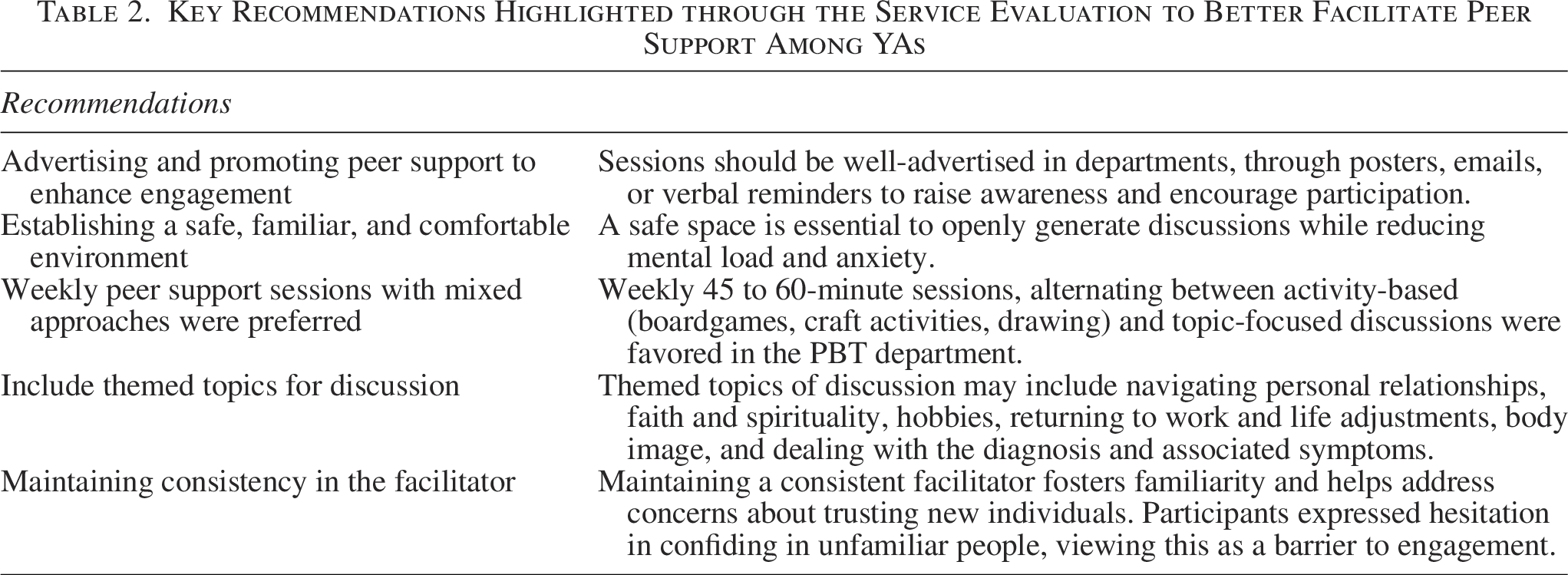
Table 2 presents key recommendations derived from the barriers and enablers identified in the service evaluation on peer support access. These recommendations aim to overcome challenges faced by individuals seeking peer support while enhancing its accessibility and effectiveness.
Key Recommendations Highlighted through the Service Evaluation to Better Facilitate Peer Support Among YAs
Conclusion and Future Research
This service evaluation emphasized the importance of peer support in the YA cohort within an oncological setting. As a distinct group with unique needs, YA cancer patients require age-appropriate care initiated and facilitated by health care professionals. Peer support may enhance the patient experience by fostering meaningful connections and providing opportunities to serve as positive role models. Given that many YAs feel disconnected from their longstanding friends, peer support with other YA oncology patients offers a sense of normality and shared understanding. Participants expressed a preference for weekly, 45 to 60-minute sessions, and emphasized the need for effective promotion and relevant discussion topics to encourage engagement.
Collaboration with other UK PBT centers could provide valuable insights into optimizing peer support facilitation. Partnering with charities or utilizing the expertise of the departmental youth support coordinator could help ensure continuity of peer support before, during, and after PBT, extending to YA service users receiving standard radiotherapy. Age-specific care is essential in empowering YAs with cancer to develop independence, self-reliance, and a sense of purpose.
Authors’ Contributions
K.S.: Conceptualization (lead); data curation (lead); formal analysis (lead); methodology (equal); validation (lead); visualization (equal); writing—original draft (equal); formal analysis (dead); writing—review and editing (equal). M.N.: Writing—review and editing (equal); methodology (equal); visualization (equal); writing—original draft (equal); supervision (lead).
Footnotes
Acknowledgments
The authors are grateful to all the participants for giving their time to participate in the study and to Professor Rachel Taylor and Danielle Fairweather for their support, advice, and guidance with this service evaluation.
Author Disclosure Statement
No competing financial interests exist.
Funding Information
No funding was received for this article.