




Abstract
The article entitled, “Whole-Body Cryotherapy as an Innovative Treatment for COVID 19-Induced Anosmia-Hyposmia: A Feasibility Study,” by Legrand FD, Polidori G, Beaumont F, Bouchet B, Morin A, Derruau S, and Brenet E (Epub ahead of print Jan 13, 2022; DOI: 10.1089/jicm.2021.0254) is officially retracted at the request of the authors.
This request came after the paper had undergone full peer review, three rounds of revisions, acceptance, page proofs, and ultimately, online publication.
The Methods section of the published paper states that the study had “secured University ethics clearance…”1 but the authors explained that, “after re-discussion and internal reassessment, it appears clearly that this study required, according to French law, the approval of a specific committee known as the ‘[C]ommittee for the [P]rotection of [P]ersons (CPP)’ and not a simple ethical agreement. For this reason, [we] request, in good faith, that the article be retracted. We apologize for this delay in taking a position, but this study gave rise to a re-discussion with our peers of the methodology which led us to realize our error ‘a posteriori.’”
The authors' respective institutions have been notified by the publisher.
Journal of Integrative and Complementary Medicine
is committed to upholding the rigors of scientific publishing and the veracity of the literature.
Reference
1. Legrand FD, Polidori G, Beaumont F, et al. Whole-body cryotherapy as an innovative treatment for COVID 19-induced anosmia-hyposmia: a feasibility study. Epub ahead of print Jan 13, 2022; DOI: 10.1089/jicm.2021.0254
Introduction
Olfactory dysfunction (OD) in the form of anosmia or hyposmia is a particularly prominent symptom in COVID-19 patients, with an incidence rate ranging from 34% to 68%, and a female predominance. 1 –3 Paderno and colleagues 4 even demonstrated that OD occurred as the first symptoms in 10% of COVID-19 cases.
Although spontaneously resolved in the majority of cases after within 2–4 weeks, 4 research indicates that up to 50.7% of individuals may have persisting OD at up to 40 days from the onset of COVID-19. 6 In addition, some studies describe that the percentage of patients with OD at 60 days varies between 15.3% 7 and 32.6%, 8 causing a profound effect on quality of life. 5
Though the underlying pathogenic mechanisms in COVID-19 anosmia are still debated, the local inflammation in the nasal cavity is thought to play a pivotal role in causing olfactory loss. 9,10 One hypothesis is that the virus enters the central nervous system through the first neurons of the olfactory pathway, also called olfactory sensory neurons, located in the olfactory mucosa. The olfactory mucosa is a specialized neuroepithelium located in the highest portion of the nasal cavity in direct contact with the external environment below the cribriform plate.
Then, the virus crosses the cribriform plate to reach the olfactory bulbs, which contain the second olfactory neurons. 11 There is preliminary empirical support for this hypothesis, with recent magnetic resonance imaging (MRI) studies showing olfactory bulb inflammation in COVID-19 patients with OD. 12,13
Another hypothesis states that anosmia results from damage to supporting sustentacular cells (i.e., the supporting cells surrounding the olfactory neurons) rather than to olfactory sensory neurons, which suggests that the resulting inflammatory milieu, rather than the direct neuronal damage, is disease-causing. 14 Inflammation of the olfactory clefts in patients with post-COVID OD has been demonstrated from studies using MRI scans, 15 supporting an inflammatory pathophysiological mechanism.
Olfactory training combined with oral steroids has demonstrated efficacy in preliminary studies that included COVID-19 patients with persistent olfactory deficits. 16 However, given the well-known side effects of systemic steroids, alternatives with a low risk of side effects are highly needed.
In the past 10 years, whole-body cryotherapy (WBC) has been documented to be an effective add-on treatment for various neuroinflammatory diseases. 17 Immunomodulation is a potential mediating mechanism through which WBC exerts its therapeutic benefits. For instance, several studies highlighted that exposure to extremely low temperatures leads to a decrease in oxidative stress and reduces the inflammatory response. 18
Using a randomized controlled trial design, this study evaluated the impact of two different doses of WBC on the smelling capacities of former COVID-19 French patients. The first intervention required patients to take two sessions of WBC over one working week. The second, more radical, intervention involved taking daily sessions of WBC over one working week (five consecutive WBC sessions).
Methods
Because there have been no other studies that have investigated the use of WBC for COVID-19 patients suffering from persistent anosmia or hyposmia, an effect size estimate for our primary outcome is not known, which made it impossible to determine an a priori minimum sample size to secure a study power of 0.80 and an α value of 0.05. However, since the goal of this feasibility study was also to estimate an effect size, our sample size considerations were based on the recommended sample sizes of at least 40 when estimating the pooled standard deviation (SD) of any continuous outcome. 19
Having secured University ethics clearance, a convenience sample of 32 women (mean age = 38, SD = 13 years) and 13 men (mean age = 42, SD = 16 years) with persistent anosmia or hyposmia after diagnosis of severe acute respiratory syndrome coronavirus-2 (SARS-CoV-2) infection (positive reverse transcription polymerase chain reaction test) volunteered to be involved and completed informed consent. All patients complained of persistent anosmia-hyposmia that occurred after COVID-19 infection. Eighteen percent of patients presented anosmia or hyposmia without any other symptoms.
Among the remaining participants, dysgeusia (67%), fever (55%), dyspnea (34%), and fatigue (4%) were the four main co-symptoms. Pre-intervention smelling capacities were assessed by using the subjective visual analogue scale (VAS) olfactory assessments (0–100), with “0” = complete loss of smell and “100” = normal smelling ability. Finally, participants were examined by a physician who confirmed that they had no history of ODs or respiratory tract symptoms before COVID-19 diagnosis, and that they had no medical contraindications to WBC.
After pre-intervention testing, participants were randomly and equally assigned, via block stratification by using baseline anosmia as strata. The three subjects having the highest anosmia score were randomly assigned to one of the three groups (“control”; “low-dose WBC”; “high-dose WBC”) by one investigator not involved in the selection or treatment of the subjects. The allocation sequence was generated by a computer in the form of a random number table with three code groups (1 for “control,” 2 for “low-dose,” and 3 for “high-dose”). This procedure of blocking and random assignment continued with the next block of three highest anosmia subjects, and so on and so forth, until all subjects were placed in a group.
During WBC sessions, participants were exposed to extremely low temperatures (−60°C to −110°C) in a double Cryoair chamber (MECOTEC, Pforzheim, Germany) for 3 min. They entered a vestibule chamber at −60°C where they stayed for about 30 sec of body adaptation before passing to a cryochamber at −110°C where they had to remain for 2 min ½. All subjects were minimally dressed: bathing suit, socks, clogs, headband, and surgical mask to avoid direct inhalation of cold air. Participants in the two WBC groups received detailed guidance on what actions to take in case of adverse events.
Smelling capacities were assessed at three points (pre-intervention, post-intervention, 1 week follow-up) by using self-reported VAS olfactory assessments (0–100), with “0” = complete less of smell and “100” = normal smelling ability.
Consistent with CONSORT recommendations for analyzing randomized controlled trial designs, the magnitude of difference between pre-intervention and post-intervention, and then between pre-intervention and follow-up data were compared between groups to identify intervention effects. Consequently, a mixed-design analysis of variance (ANOVA) was used with group (“control,” “low-dose” WBC, “high-dose” WBC) as between-subject variable and time points (pre-intervention, post-intervention, follow-up) as within-subject variable.
In case of significant main or interaction effects, post hoc tests were conducted to examine the effects, including one-way ANOVA, or t tests. For all analyses, the significance level was set at 5% (p ≤ 0.05), as usual. Finally, Cohen's ds were used to indicate the magnitude of differences (effect size) between each of the two WBC groups in comparison to the control group. We used Hedges's correction to adjust d for small sample size. Cohen 19 describes d values as 0.2 being small, 0.5 as medium, and 0.8 as large effect sizes. All analyses were performed by using JASP (version 0.14.1). The data that support the findings of this study are available on request from the corresponding author.
Results
The total sample was 45 participants, and all participants provided data at each time point. No adverse effect was reported in patients from the two WBC groups. The CONSORT flowchart of participants is presented in Figure 1.
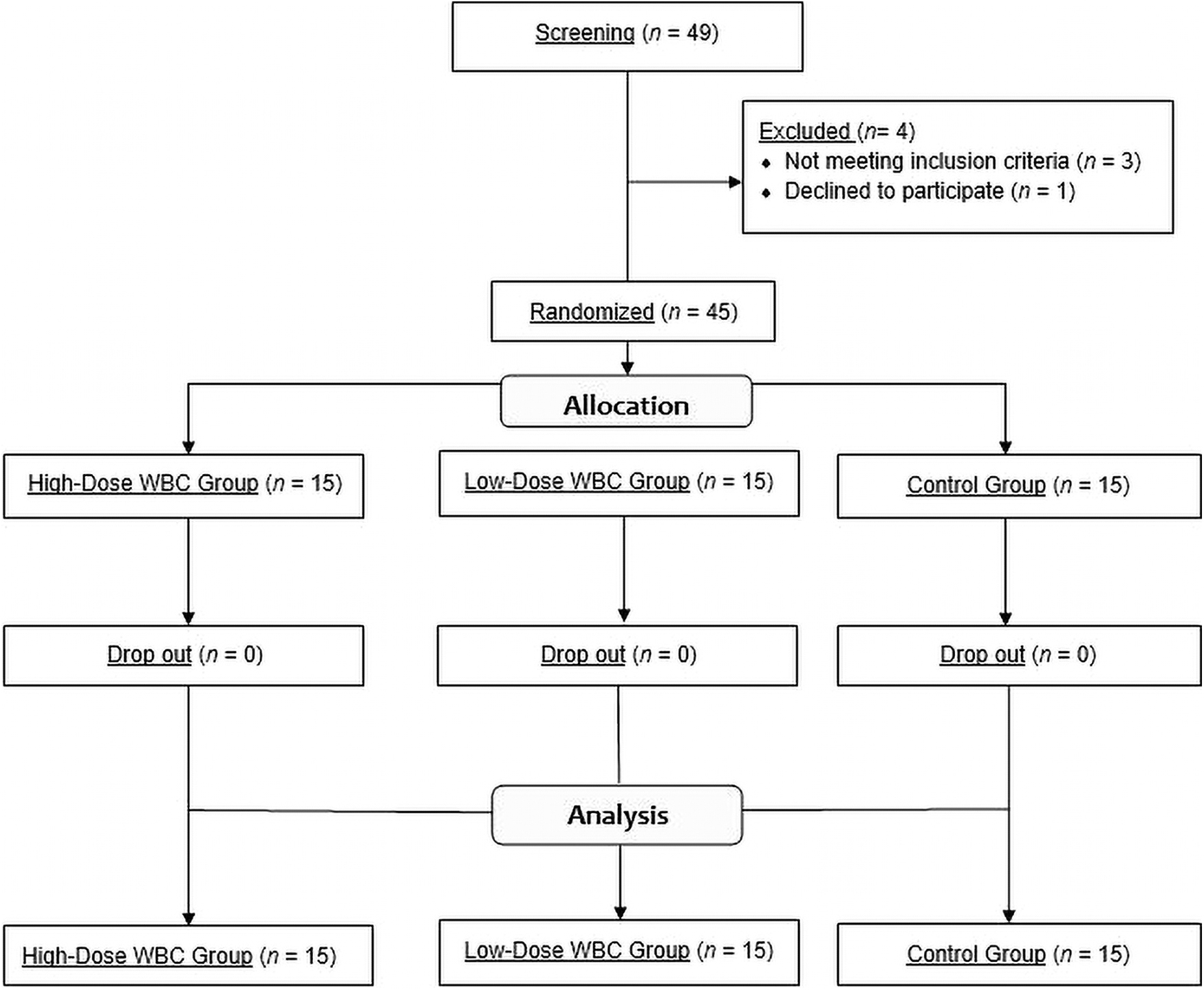
Flowchart of study participants through the trial. WBC, whole-body cryotherapy.
Results of the mixed-design ANOVA (between-subject variable: group; within-subject variable: time points) indicated a significant group x time interaction, F(4, 84) = 17.36, p < 0.001. Age, sex and months of olfactory deficits as covariates did not change the results. Post hoc one-way ANOVAs revealed no significant differences in the mean score of anosmia between the three groups at baseline and post-intervention.
However, 1 week later (at follow-up), participants in the “high-dose” WBC group reported significantly higher VAS scores (namely, less olfactory impairment) than participants in the “control” group [t(28) = 2.66, Bonferroni-adjusted p-value = 0.030, Hedges' corrected effect size = 0.96] and than those in the “low-dose” WBC group [t(28) = 2.74, Bonferroni-adjusted p-value = 0.027, Hedges' corrected effect size = 1.04].
Examination of within-group changes revealed that in participants from the “low-dose” WBC group, the mean VAS score significantly improved from pre- to post-intervention (Hedges' corrected effect size = 1.11), and then again from post-intervention to follow-up, although by a more moderate rate (Hedges' corrected effect size = 0.59). These findings were seen in the participants from the “high-dose” WBC group as well, with even larger effect sizes (Hedges' corrected effect size of 1.56 and 0.99 respectively).
No significant within-group change in self-rated anosmia was noted for participants in the control group. Table 1 shows the mean values of VAS scores according to group and time point.
Mean Visual Analogue Scale Score for the Three Experimental Groups at Each Time Point, and Group Differences at Post-intervention and Follow-Up
CI, confidence interval; SD, standard deviation; VAS, visual analogue scale; WBC, whole-body cryotherapy.
Discussion
What we report here are the results of a feasibility pilot study evaluating the effects of repeated whole-body cold exposure for adults with COVID-19-induced olfactory deficits. The WBC was well received by patients of both genders as testified by the particularly high values of adherence rates (100%), and no reports of adverse effects.
Our brief recruitment period, 1 month in duration, suggests that many patients who wanted to participate could not enter the study because of the short amount of time available to make a decision and initiate action (obtaining a medical clearance for WBC, making time slots vacant for WBC sessions, etc.). In addition, there were significant scheduling restrictions since WBC sessions were offered only on specific dates, which sometimes led to time and scope constraints on other activities. This indicates that the ease of access to the WBC program and schedule flexibility are critical for delivering such a treatment.
Our pre-intervention, post-intervention, and follow-up assessments reveal that WBC could lead to clinically meaningful improvements in self-reported smelling capacities (+25 points on a 0–100 VAS). In summary, our pilot study supports the feasibility and potential utility of WBC in at least a subset of patients with COVID-induced persistent anosmia or hyposmia.
Importantly, the benefits of WBC appeared rapidly (1 week), which is highly valuable given that pharmacologic treatments for postviral OD usually take >4 weeks to show any results. 21 The WBC has been demonstrated to trigger anti-inflammatory actions quite quickly, which could explain our encouraging results. 22 In support of this suggestion, findings by Lubkovska and colleagues 22 highlighted that exposure to extremely low temperatures leads to a rapid decrease in the concentration of pro-inflammatory cytokines interleukin 1α (IL-1α) , and a rapid increase in anti-inflammatory cytokines interleukin 10 (IL-10).
Our study results must be viewed in light of some limitations. First, self-report assessment of smelling capacity directly after the intervention may have been flawed as the participants were not in their natural environment when completing the post-intervention VAS. Rather than being the result of increased anti-inflammatory cytokines and/or decreased pro-inflammatory cytokines, the immediate post-intervention changes in smelling capacity could be explained by reactive increased blood flow in the nasal mucosa, or still other unknown factors.
Second, no blinding of participants was used, which could have influenced the results. A placebo approach will be needed in future studies. Third, this was only a pilot study, so factors other than age, sex, and baseline anosmia scores were not considered as potential confounders. Still another limitation is that no objective biomarkers (e.g., pro-inflammatory and/or anti-inflammatory interleukins) were collected alongside self-reported VAS scores.
Exclusive reliance on self-report is a very sensitive issue, as it is affected by respondents' mental access to requested information. Consequently, replication of the present study using external measurements of smelling capacities (e.g., Sniffin’ Sticks olfactory tests) is highly needed. Finally, our study sample was atypical in that the majority of our participants were female from medium to high socioeconomic status.
Of note, the medical literature suggests that female gender and high socioeconomic status are factors associated with complementary and alternative medicine use among the general population, 23 and these factors may have also influenced our study sample. Men were clearly not attracted toward this feasibility study, and future work will have to explore gender-specific recruitment and intervention effects.
Conclusion
In this pilot study, gains in olfactory function were clinically important in anosmic or hyposmic patients who received high-dose WBC (5 sessions over 1 week), with improvements ≥50% when comparing pre-intervention with follow-up assessments. We conclude that WBC might be beneficial and safe for patients with SARS-CoV-2-induced OD; however, further research is necessary to confirm the findings of this pilot study, and to investigate the mode of action.
Footnotes
Authors' Contributions
All coauthors have reviewed and approved the article before submission. Coauthors' contributions are stated next. B.B. had full access to all the data in the study and takes responsibility for the integrity of the data, and G.P. takes responsibility for the accuracy of the data analysis. Concept and design: E.B., F.D.L., and G.P. Acquisition, analysis, or interpretation of data: All authors. Drafting of the article: G.P., F.D.L., and S.D. Critical revision of the article for important intellectual content: All authors. Statistical analysis: G.P., F.D.L. Administrative, technical, or material support: F.B., B.B., E.B., and A.M. Supervision: S.D., E.B., F.D.L., and G.P.
Acknowledgments
The authors thank all participants who donated their time to take part in this study.
Author Disclosure Statement
No conflict of interest to be reported for any of the coauthors.
Funding Information
This study was registered in the Iranian Registry of Clinical Trials (identifier IRCT 20210708051817N1). The authors have no conflicts of interest to disclose. This research received no funding.