




Abstract
Introduction:
Culinary medicine training combining evidence-based nutrition instruction with experiential cooking application has improved nutrition knowledge, skills, and attitudes in the professional and personal lives of medical students. However, interprofessional culinary training remains largely unstudied among professional students who will be involved in collaborative patient care. The goal of this study was to evaluate the feasibility and effectiveness of an elective interprofessional culinary medicine course for students in the medical, pharmacy, social work, nursing, law, and dentistry schools at the University of Maryland, Baltimore.
Methods:
The interprofessional culinary medicine course was offered in-person at the teaching kitchen of the Nova Institute for Health in 2020 and virtually in 2021 during the COVID pandemic. The training featured five workshops combining instruction in a variety of popular diets, cooking a meal inspired by the diet in focus, and group discussion. Paired t tests were utilized to evaluate changes in pre-/post-training nutrition and interprofessional experience outcomes. Linear regression models were constructed to compare outcomes between in-person and virtual delivery.
Results:
A total of 62 students participated in the culinary medicine training. Confidence in all nutrition knowledge, skills, and attitudes, as well as interprofessional experience outcomes, improved after the training (p < 0.05). Similar improvements were noted in most outcomes with in-person and virtual delivery in linear regression modeling.
Discussion:
Interprofessional culinary medicine training is feasible, and virtual delivery may help enhance replicability in other settings.
Introduction
Food is a powerful factor in preventing or managing many chronic disease states. While nutrition is widely recognized as an important contributor to human health, there has been a shift in the concept of what healthy eating means due largely to the numerous popular diets and dietary trends that have permeated society and seem to conflict with one another. While many popular diets, including Mediterranean, low-carbohydrate, low-fat, plant-based, and Paleolithic diets, all have supportive clinical evidence in preventing or managing chronic disease, 1 –10 navigating what a “healthy” diet means is challenging for many patients.
Given the complexity of nutrition and the importance of food in their culture, as well as in the management of disease, one would expect a plethora of time in health care professional curricula dedicated to these topics. However, The National Academy of Sciences recommends just a minimum of 25 required hours of nutrition education for medical students. Furthermore, only 29% of U.S. medical schools met this minimum in 2014 compared to 38% of U.S. medical schools in 2004. 11
The rapid rise in “culinary medicine” programs, which blend the science of medicine with the art of food and cooking, 12 is now widely regarded as a solution to help fill the needs in medical student nutrition education. One of the prominent features of culinary medicine is consideration of both the physiological and sociocultural components of food while using food as a modality to improve health and well-being. Culinary medicine programs are now offered at over 50 different medical and other professional schools across the United States. Published data have shown that this experiential form of nutrition education results in superior nutrition competency, attitudes, and dietary intake among medical students compared to standard nutrition education. 13 –25
While culinary medicine has shown promise in filling the gaps in medical student nutrition education, there are still unmet nutrition education needs in the training of other health care professionals. Pharmacy students need to be prepared to understand the interactions between medications, foods, and food-based dietary supplements when in clinical practice. However, the current focus in pharmacy curricula is frequently placed on parenteral and enteral nutrition. While an important area for pharmacists to understand, the information is not generalizable to the majority of patients under a pharmacist's care, which overshadows the important role pharmacists have in health and promotion and disease management. 26,27 Nutrition training for nurses is equally vital, as they play an indispensable role in health promotion of their patients in both inpatient and outpatient clinical settings. 28 The last published survey to evaluate nutrition content in nursing curricula took place in 1987. 29 At that time, approximately half of the nursing programs provided ∼32 h of nutrition content. It is not clear how that may have changed over time as the subject has received little attention despite the critical importance of nurses in providing clinical care to chronically- and acutely-ill patients. Dentists have an opportunity several times per year to discuss with their patients the strong associations between nutrition, oral health, and overall human health. 30,31 Data from dental hygiene and dental programs have revealed ∼46 h of nutrition content in dental hygiene programs, compared to just 16 h in dental programs. 29 There are no curricular requirements or published data to the authors' knowledge regarding nutrition education for social work and law students, despite the fact that social workers often address food access and other barriers to healthy nutrition in their clients and many legal professionals play key roles in nutrition policy at the federal, state, and local levels.
While culinary medicine has become increasingly popular as elective training at medical schools, and has recently been shown to be a feasible method to improve nutrition knowledge, skills, and attitudes as part of the core curriculum for medical students at the University of Maryland School of Medicine, 32 this type of training has rarely been offered on an interprofessional basis. An interdisciplinary working group convened by the National Institutes of Health expressed the importance of nutrition education for all health care professionals to address the unmet need for interprofessional collaboration in patient nutrition counseling. 26 Common nutrition competencies across health care disciplines could improve interdisciplinary and team-based health care while positively impacting disease prevention, superior treatment outcomes, and population health. 33
To help fill this need, faculty across health care professional schools at the University of Maryland Baltimore collaborated with staff from the Nova Institute for Health (formerly called the Institute for Integrative Health) to create and deliver interprofessional culinary health training. This elective course was designed to build upon the evidence supporting culinary medicine training for medical students to provide the same opportunities to a diverse group of health care professional students to learn practical, clinically-relevant nutrition information and skills in a novel, engaging, and highly collaborative way. The ultimate goals were to improve nutrition knowledge, skills, and attitudes while encouraging the development of collaborative interprofessional relationships long before participating students enter clinical practice.
Materials and Methods
The University of Maryland Baltimore has a strong emphasis on Interprofessional Education (IPE). The campus has a Center dedicated to IPE which offers numerous grant opportunities to develop unique experiences incorporating students from various disciplines and professional schools. Inspired by the success of the culinary medicine training at the University of Maryland School of Medicine that was exclusive to medical students, 32 the research team was awarded an IPE grant to develop and evaluate interprofessional culinary health training. The core course faculty consisted of personnel from the UMB Schools of Medicine, Pharmacy, and Dentistry. The collective culinary medicine experience of the course instructors included a clinical nutrition researcher from the School of Medicine who previously led the culinary medicine core curriculum training for medical students, several community health promotion personnel who were Safe Food Certified, 34 and several nutrition and dietetics students in training who were accumulating credit hours for their Certified Nutrition Specialist certification. 35 After being immersed in the development of the course with those with previous culinary medicine experience, the course faculty and instructors with no previous culinary medicine experience contributed to both the recipe development and cooking instruction as no formal training is required.
The nutrition lecture content was created and delivered by a nutritional epidemiologist by training and clinical researcher in the School of Medicine. Faculty from the Schools of Pharmacy and Dentistry led the cooking content instruction along with the nutrition and dietetics students, community health personnel, and other nonfaculty personnel affiliated with the course. All three faculty members participated in the interprofessional discussion and evaluated student projects.
In addition to the course faculty, faculty advocates in the Schools of Law and Social Work helped facilitate enrollment in the course from interested students. The course was advertised to each professional school on campus, including Medicine, Pharmacy, Dentistry, Nursing, Social Work, and Law. The degree of advertising within each school varied depending on the engagement of school faculty in the development and implementation of the course.
The course was approved as a 1-credit pass/fail elective through the School of Pharmacy curriculum committee with no credit provided for students from the other participating professional schools. Course activities consisted of workshops and assignments. A total of five workshops were held during the semester. In 2020, each workshop session was 2 h in length and was offered at the teaching kitchen of The Nova Institute for Health, a community-based nonprofit in Baltimore that had previously been involved in extensive nutrition and integrative health research. 32,36 –40 The training featured evidence-based nutrition instruction, cooking of recipes based upon the concepts of the lecture, and group discussion on the potential application of the training to both patient and client care, as well as the students' self-care. This training was inspired by the culinary medicine medical student training at the University of Maryland School of Medicine, but featured numerous adaptations to engage the interprofessional students. Adaptations included a greater focus on food access (of particular relevance to social work students), interactions of foods with medications (of particular relevance to pharmacy students), the role of nutrition and oral health (of particular relevance to dentistry students), and the influence of nutrition policy on dietary patterns (of particular relevance to law students).
There were several assignments included in both course offerings. Assignments included a reflection article focused on the experience of training with students in the various professional degree programs in the course and presentation of a healthier modification of a family or favorite recipe based upon concepts learned in the course.
In-person delivery and content of interprofessional culinary health training
The five workshops provided evidence-based nutrition education on a specific popular diet, information on practical methods to overcome common barriers to healthy eating (e.g., insufficient time, taste preferences, and cost of healthy food), and published clinical evidence on the diet in focus. In addition to a basic lecture on human nutrition and introduction of the concept of nutrient density that can accommodate many different popular diets, there was a specific focus on each of the following popular diets in 2020: Mediterranean, paleolithic, and plant based. During the 2021 offering, the ketogenic diet was added because of its popularity and growing clinical evidence base. The instruction sought to teach students the core commonalities among the seemingly conflicting dietary ideologies, with a specific focus on eating whole foods as opposed to processed foods. Figure 1 shows the nutrition lecture held at the teaching kitchen.
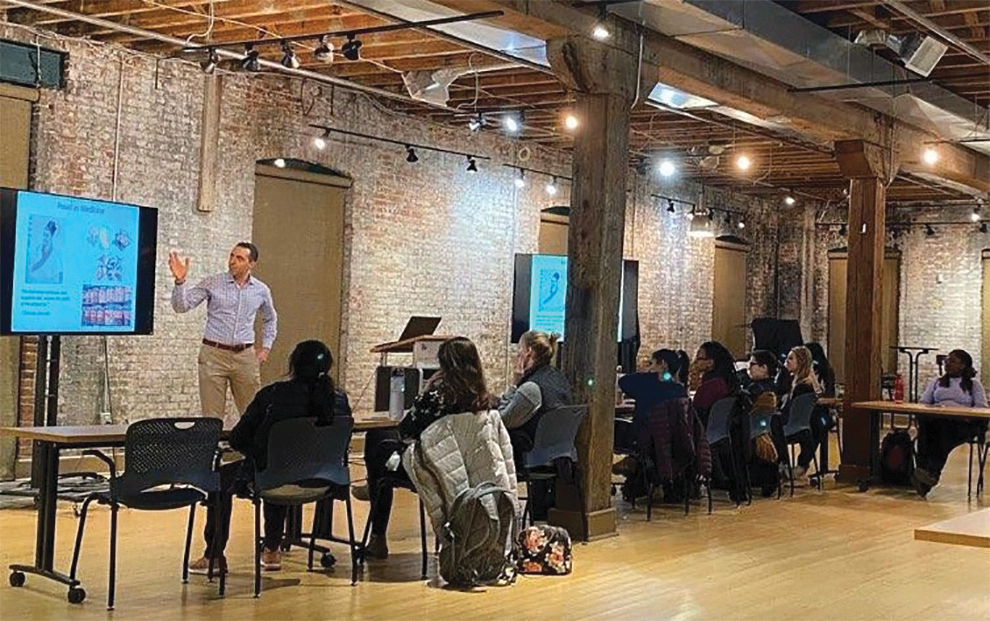
Nutrition lecture held at the teaching kitchen.
During the 2020 course, following each lecture on the evidence and practical application of the diet in focus, a basic cooking skills primer, including kitchen safety, kitchen tool introduction, and knife skills, was provided in the first session before the preparation of the meals. Figure 2 illustrates the cooking skills primer with culinary health course staff. Students then split into groups of five to prepare a three-course meal inspired by the dietary approach of focus in that session. Groups were formed with interprofessional collaboration in mind, in an effort to encourage students from the various professional schools to cook and train with one another. The cooking instruction was led by personnel from the University of Maryland School of Medicine, the Nova Institute for Health, and Maryland University of Integrative Health. Figure 3 demonstrates an interprofessional group of students cooking together.
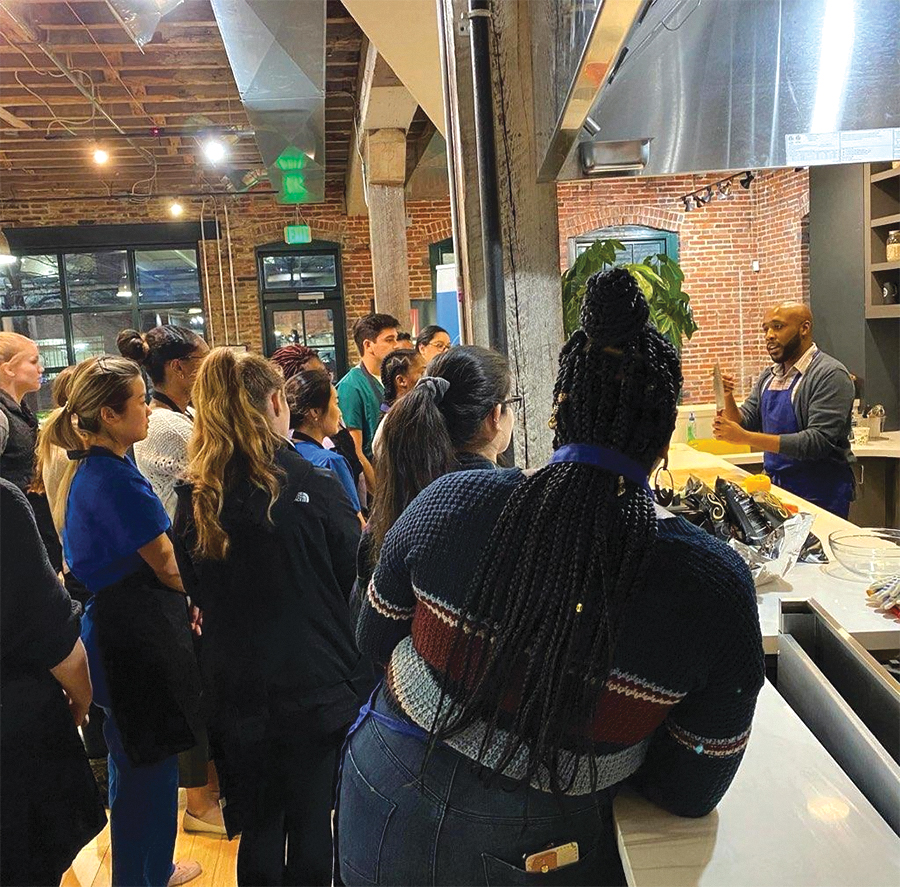
Cooking skills primer with culinary health course staff.

Interprofessional group of students cooking together.
In consideration of the disproportionate burden of diet- and lifestyle-related chronic disease among economically-underserved 41 –47 patients that many of the students would ultimately be caring for in their practices, the barrier of cost to healthy eating among students, 48 –51 and the interest in food access and other social determinants of health expressed by the students, the cost of each meal was designed to be less than $10.
After the meals were prepared, the students then reassembled as a full group to eat together and participate in group discussion with the faculty leaders of the training to discuss their experiences with the culinary training and potential applications to both clinical care and their personal lives. The final workshop featured a brief student presentation of a family or favorite recipe that the student modified based on principles learned during the course.
Virtual delivery of interprofessional culinary health training
The 2021 offering was delivered virtually because of the COVID-19 pandemic. Video cooking demonstrations for each recipe were recorded and provided by the course faculty and instructors from the Nova Institute for Health. Students cooked the meals individually in their homes. The lecture component of the course was also prerecorded by a course faculty member for students to watch at their convenience. The nutrition lecture and corresponding cooking instruction videos were viewed asynchronously and required to be viewed before group discussion sessions that were held through Zoom for each of the training sessions. The class was divided evenly into two groups to encourage involvement of all students in interprofessional discussion in a manner similar to the in-person training. Similar to the in-person offering, the final workshop featured a brief virtual student presentation of a family or favorite recipe that the student modified based on the concepts taught in the course.
Outcome evaluation
The Institutional Review Board of the University of Maryland, Baltimore approved an outcome evaluation of the Culinary Health Interprofessional Elective training (Approval Number: HP-00098224). Permission was obtained from students to use photographs in publication.
Pre- and post-training questionnaires were administered to all participating students. The questionnaires assessed previous interprofessional training experience, confidence in interprofessional collaboration, a variety of nutrition knowledge, skills, and attitudes, as well as specific understanding of the evidence and application of the diets presented during the workshop sessions. Students were also asked how prepared they felt to help patients overcome five common barriers to healthy eating: lack of confidence in ability to prepare healthy food, overcoming food cravings, challenge of eating healthy on a budget, perception of insufficient time to eat healthy, and palatability of eating healthy without excessive added sugar or salt. The nutrition knowledge, skills, and attitudes and healthy eating barrier questionnaires had been evaluated in previous culinary training research. 32 All questionnaire responses were deidentified before statistical analysis.
Statistical methods
Descriptive statistics were computed to characterize the study sample. Surveys were scored on a 1–5 Likert scale for the various preparation, knowledge, and confidence domains that were assessed. Mean pre- and post-training responses to each question were compared with paired t tests. To evaluate the potential impact of in-person versus virtual delivery of the culinary health training, linear regression models were also constructed for each outcome that included both training status (pre vs. post) and delivery method (in-person vs. virtual). Statistical significance was defined as p < 0.05. All statistical analyses were performed in SAS Version 9.4.1 (Cary, NC).
Results
Pre- and post-culinary health training outcomes data were collected from 58 (94%) and 45 (73%) of participating health professional students, during the 2020 and 2021 course offerings, respectively. The study sample included 28 pharmacy students, 19 social work students, 7 dental students, 7 medical students, and 1 law student.
The pre- and post-culinary health training questionnaire responses and statistical comparison of mean changes are provided in Tables 1 –3. Improvements were noted in mean scores of all survey questions, covering the entirety of the interprofessional experience and confidence, nutrition and cooking knowledge, skills, and attitudes, and nutrition counseling confidence domains that were evaluated (p < 0.0001).
Interprofessional Experience and Nutrition Knowledge, Preparation, and Confidence in Clinical Care
p-Values determined by paired t tests.
SD, standard deviation.
Knowledge, Practical Application, and Misconceptions of Popular Diets
p-Values determined by paired t tests.
SD, standard deviation.
Preparation to Address Common Barriers to Healthy Eating Among Patients
p-Values determined by paired t tests.
SD, standard deviation.
Table 1 contains results related to interprofessional experience and nutrition preparation, confidence, and knowledge in clinical care. Before participation in the course, almost 40% of participants had not had an opportunity to work with students in other health care professions. Student confidence in their knowledge about the roles of other health care professionals also rose considerably (p < 0.0001).
Responses related to knowledge, practical applications, and misconceptions of popular diets are contained in Table 2. Before the course, <20% of students reported being knowledgeable about clinical evidence, practical application, and misconceptions surrounding popular diets. After this training, more than 80% of students reported being knowledgeable in this area (p < 0.0001).
Table 3 highlights responses related to student preparation to address common barriers to healthy eating. There were dramatic increases in preparation to address each of the barriers, which included insufficient time, budget constraints, inability to prepare a healthy meal, and food cravings (p < 0.0001).
The improvements noted after the culinary health training were robust to adjustment for delivery method (in-person vs. virtual) in the linear regression models for all study outcomes (p < 0.0007). In addition, delivery method itself was not independently associated with any of the study outcomes, with the exception of comfort in cooking in the kitchen. In-person delivery was associated with greater comfort cooking in the kitchen than virtual delivery (p = 0.02).
Discussion
The development and implementation of an interprofessional culinary health elective course at the University of Maryland Baltimore were feasible and associated with improvements in interprofessional experience and confidence, enhanced nutrition knowledge, skills, and attitudes, and perceived ability to provide nutrition counseling. Both the in-person training and virtual training offered during the COVID-19 pandemic were well accepted and demonstrated similar improvements in all outcomes, with the exception of comfort in the kitchen which was enhanced by in-person training in the teaching kitchen.
While culinary medicine training has become popular in medical schools across the country, to the authors' knowledge, this was the first interprofessional culinary health training and outcomes evaluation offered to students from all schools across a professional campus. A focus on interprofessional care permeated the training. The course was funded by an interprofessional grant, titled in an interprofessional manner (“Interprofessional Culinary Health”), interprofessional teamwork was encouraged throughout the course, and interprofessional collaboration as a means to optimally serve patients and clients was a common theme of group discussion. While there are no data to make a direct comparison, the authors believe that the fact that all participating students had at least some training in their own profession before participating in the course meant that they likely possessed at least some baseline confidence in communicating their professional opinion in the interprofessional engagement activities throughout the course.
Limitations
The delivery model used to offer this interprofessional culinary health elective course is likely to be feasible in other professional training settings, particularly if a virtual component is included. However, there are several limitations to the inference of their findings and replicability of this training in other settings. While the interprofessional culinary health training included students from five of the six UMB professional schools (pharmacy, medicine, social work, law, and dentistry), no nursing students participated in the course and the cohort was not evenly balanced in enrollment across the schools. This is likely the result of varying degrees of involvement from faculty and administration across schools with respect to the development and implementation of the training. Course faculty and/or dedicated faculty advocates from within each professional school appear essential to both enrollment and relevance of the training to all students. Course credit was also only provided to pharmacy students, which also may explain some of the imbalance in enrollment across the professional schools. Future efforts will be aimed at achieving greater balance across the professions represented in the training.
Another prominent limitation for replicability in other settings is that there is unlikely to be a dedicated teaching kitchen on campus to either hold in-person training or record videos for online offerings. That said, the UMB campus from which students were drawn for this training does not have a teaching kitchen on campus. This course was developed in partnership with the Nova Institute for Health, which also enabled access to their teaching kitchen. There are community kitchens located within reasonable distance of most professional schools to help reproduce this model. Furthermore, basic kitchen equipment is all that is needed for training of this nature. Inexpensive and readily available portable induction burners, food processors, and blenders were used at portable group cooking stations and a single oven utilized by the group for the in-person training. All students were able to replicate the meal preparation methods described in the cooking videos at their homes during virtual delivery of the training.
Another limitation related to the feasibility of the interprofessional culinary health training is the cost of food, renting kitchen space, kitchen materials, and staff time required for training setup and cleanup. These costs can be managed through several replicable approaches. The cost of food was contained by utilizing bulk-purchased or frozen ingredients whenever possible. The cost consciousness of the meals was a key feature of the program, as patients and clients in underserved communities similar to those in Baltimore that their students serve often have budget limitations for food. As such, a cap of $10 per meal was set a priori and strictly adhered to as a demonstration of the feasibility for the interprofessional students themselves and the patients and clients that they serve.
The Nova Institute also graciously donated the kitchen space for the interprofessional training, which may be a feasible option at other mission-oriented community kitchens. Even if the teaching kitchen space is not donated, the rental cost is generally reasonable for five sessions of in-person delivery. As for staff time, volunteer graduate students in nutrition and dietetics were enlisted to assist with cooking instruction and interaction with students to help satisfy their required hours for professional licensure.
Most notably, virtual delivery dramatically lowers the cost of interprofessional culinary health training. In comparison to purchasing ingredients to prepare hundreds of meals and several days of teaching kitchen rental and staff time needed to service in-person delivery of the interprofessional culinary health training, virtual delivery of this curriculum requires preparing just four cooking video demonstration meals (each less than $10) in total, ∼8 h of teaching kitchen rental, and far less staff preparation and cleanup time. Virtual delivery of culinary medicine has also been to have potential for positive impact in improving nutrition knowledge and health outcomes and in other settings. 52,53
Conclusion
An interprofessional culinary health elective course appears to be valuable training to help professional students develop their interprofessional communication skills and better understand how they can work as a team to positively impact the nutrition of their future patients, clients, family, and friends. These benefits may ultimately translate into better patient care, as enhanced interprofessional communication has been associated with improved clinical outcomes. 54 The similar improvements noted in the outcomes data between the in-person and virtual culinary health training cohorts may reflect the unique value of virtual delivery, in light of the far lower cost and ability to engage a greater number of students due to the lack of physical space constraints. Future studies should include longer term follow-up to evaluate whether the improvements in interprofessional collaboration confidence and nutrition knowledge, skills, and attitudes persist over time.
Footnotes
Data Availability Statement
The data that support the findings of this study are openly available at Mendeley Data (
Acknowledgments
The authors thank the University of Maryland Baltimore Center for IPE for their funding and support in offering this training. The authors are also grateful to the leadership and staff of the Nova Institute for Health for their shared vision and essential partnership in catalyzing this training. The Nova Institute for Health's provision of the teaching kitchen space, critical support of the operations of the training, and the outstanding cooking instruction and other comprehensive contributions to the interprofessional culinary health training provided by staff members Brandin Bowden and Nicola Norman were all indispensable to the success of the training. The authors are also grateful to the generous donation of food for the training provided by Performance Foodservice. Finally, the authors express their sincere gratitude to the participating students for their enthusiastic engagement in the training and interprofessional enthusiasm. Permission was obtained from students to use photographs in publication.
Authors' Contributions
L.M.H.: conceptualization (co-lead), writing—original draft (lead). G.P.: conceptualization (supporting), writing—original draft (supporting), writing—review and editing (supporting). C.B.: conceptualization (supporting), writing—review and editing (supporting). I.R.: conceptualization (co-lead), writing—review and editing (supporting). B.M.B.: conceptualization (supporting), writing—review and editing (supporting), methodology (supporting). C.R.D.: conceptualization (co-lead), methodology (lead), formal analysis (lead), writing—original draft (co-lead), writing—review and editing (supporting).
Author Disclosure Statement
None of the study authors has a financial interest or benefit that has arisen from the direct applications of this research.
Funding Information
This work was supported by the University of Maryland Baltimore Center for IPE, the Nova Institute for Health, and Performance Foodservice.