




Abstract
Introduction:
This study explored the perspectives of traditional health care practitioners (THPs) practicing in the areas of herbalism, bone setting, and traditional birth attendance, from Akwa Ibom state, Nigeria, on the possibility and implications of applying informed consent (IC) during African traditional medicine (ATM) practice.
Methods:
Semistructured interviews were conducted with 11 THPs, consisting of 5 herbalists, 3 traditional bone setters (TBS), and 3 traditional birth attendants (TBAs), who represented the diverse groups that the study intended to cover. In-depth interviews were conducted using a semistructured guide and were recorded, transcribed, and analyzed using thematic analysis with the assistance of NVivo® qualitative analysis software.
Results:
Participants were seven males (64%) and four females (36%), 35–67 years of age, with 5–25 years of experience as THPs. Forty-six percent of participants were herbalists (27%), TBS, and TBAs (27%). Most participants (82%) were Annang, and (18%) were Ibibio first-language speakers. Three major themes emerged from the data analysis: (i) Existing ethical framework related to IC, (ii) knowledge of consent, and (iii) application of IC during traditional medical practice. These themes and relevant subthemes were explored. All (100%) THPs agreed that it was essential to communicate risks and benefits while allowing patients to ask questions before treatment. All participants (100%) stated that risk communication is essential in ATM, whereas 36% said they communicated all therapy benefits to their patients. Respondents believed patients could make an informed choice if they had complete information disclosure. However, THPs in this study had limited knowledge of formal IC rules and regulations.
Conclusions:
This study revealed that THPs in this setting disclose a diagnosis, risks, some benefits, and treatment options to patients. Consent/agreement was obtained verbally and voluntarily during ATM practice, consistent with IC doctrine. THPs had limited knowledge of the critical elements of IC. However, they suggested that a form of IC that does not conflict with traditional African norms could be applicable in ATM. IC could facilitate documentation and help reduce risks in ATM practice.
Introduction
Informed consent (IC) is an essential ethical principle in medical practice. It is a communication process between health care practitioners and patients that results in an agreement to undergo a medical procedure. Rule 19, part A of the code of medical ethics of Nigeria 1 and section 23 of the National Health Act of Nigeria (2014), 2 prescribe the importance and the process of obtaining consent before medical intervention in Nigeria, especially in the context of Western/orthodox medical practice. 1,2 This study was designed to explore the application of IC during African traditional medicine (ATM) practice in Nigeria, considering that previous studies had identified some limitations regarding the application of the IC doctrine in the African setting. 3 –7 Such limitations include education and language barriers, 4 –6,8 and the impact of cultural belief systems, especially African communitarian ethics, such as Ubuntu/Botho. 3
Ethical conflicts and limitations may arise mainly because the Western-derived principle of respect for individual autonomy clashes with African communalism. 3 However, this research will build more on Akpa-Inyang and Chima's study in 2021, 3 who argued that applying IC in the African context is possible if the consent process is based on relational autonomy. 3,9,10
Previous studies suggested that a relational form of IC can be used in the African context.
3,9,10
Some observers, however, claim that the biomedical paradigm of IC may not apply to ATM since there are two types of traditional medicine (TM)−, the “supernatural” and “herbalism.”
11
Where herbalism refers to using herbs for therapeutic purposes, the “supernatural” is a process by which ancestral spirits diagnose the source of illness and reveal the appropriate therapy to a healer.
11,12
Other studies argue, however, that such conclusions may be misleading since there are several characteristics of TM according to the World Health Organization (WHO), including: Health practices, approaches, knowledge, and beliefs incorporating plant, animal, and mineral-based medicines, spiritual therapies, manual techniques, and exercises, applied singularly or in combination to treat, diagnose and prevent illnesses or maintain well-being.
13
(WHO, 2003).
TM is also defined as: The sum total of the knowledge, skill, and practices based on the theories, beliefs, and experiences indigenous to different cultures, whether explicable or not, used in the maintenance of health as well as in the prevention, diagnosis, improvement or treatment of physical and mental illness.
14
(WHO, 2013).
Accordingly, the WHO Declaration of Astana (2018) on primary health care (PHC) acknowledges that: The success of PHC will be driven by knowledge and capacity-building […], including scientific as well as traditional knowledge, to strengthen PHC, improve health outcomes, and ensure access for all people […] while respecting their rights, needs, dignity, and autonomy.
15
(WHO, 2018).
In the 1990s, international organizations such as the WHO; the United Nations Educational, Scientific, and Cultural Organization (UNESCO); and the United Nations Industrial Development Organization (UNIDO) played a crucial role in TM developments in Nigeria and Africa. This included the announcement of 2000–2010 as the decade for ATM by the Organization of African Unity, now the African Union, at a summit in Lusaka, Zambia, in July 2000, which planned to accelerate the growth of TM throughout the majority of African countries, including Nigeria. 16 –22 Since then, the Nigerian government, traditional health care practitioners (THPs), and the National Institute for Pharmaceutical Research and Development (NIPRD) have created several phytomedicines derived from indigenous medicinal plants. Notable among these is the antisickling medication, Niprisan®, 23 –25 which was introduced in 2006. Niprisan was designed to treat sickle cell anemia, an endemic genetic disorder in Nigeria and other populations of African origin. 26
Other significant examples include the Artemisinin Development Company, currently known as Nigerian Medicinal Plant Development Company (NMPDC), founded in 2005 to promote the cultivation and development of Artemisinin from locally cultivated Artemisia annua for the treatment of malaria. 27
Furthermore, in May 2006, the government of the United States established the Committee for the Promotion, Development, and Commercialization of Nigerian Herbal Medicine Products, while the Bioresource Development and Conservation Program and other nongovernmental organizations performed essential roles in the bioprospecting and recording of indigenous resources. 28 Furthermore, in 2008, the African Network for Drugs Diagnostics Innovation was established by the WHO to enhance regional collaboration in research and development. The Nigerian Herbal Pharmacopoeia was also released (FMOH, 2008). 17 After extensive consultation with stakeholders, the Nigerian government drafted a law to create the Traditional Medicine Council of Nigeria in August 2006, as a result of which a TM policy was established. Nonetheless, this bill for a statute facilitating integration has not yet been enacted. 28 –31
However, despite such efforts at integrating TM into PHC by African countries, only China, the Democratic People's Republic of Korea, the Republic of Korea, Vietnam, and India, seem to have attained the WHO-proposed level of TM integration. 32 Nigeria, Brazil, Ghana, and South Africa are actively pursuing the WHO-proposed level of TM integration and currently include some TM in their health care systems. 16 –22,29,33 –35
In light of the prevalent use of ATM in Nigeria and other African countries, and the envisaged integration with Western medical practice in Africa, and to assist with achieving the envisaged WHO goal of universal health coverage,
20,32
–43
in conjunction with the WHO declaration of Astana,
15
the focus is to strengthen PHC globally by: Supporting, broadening, and extending access to a range of health care services through the use of high quality, safe, effective, and affordable medicines, including, as appropriate, traditional medicines, vaccines, diagnostics, and other technologies.
15
This study aimed to determine whether the IC doctrine is applicable during ATM practice in Africa in general; and Akwa Ibom state, Nigeria, in particular. This research hypothesized that it could be feasible to apply a relational IC process in ATM that will not undermine African conventional values and norms of behavior.
Ethics approvals
Ethics approvals for this study were obtained from the Biomedical Research Ethics Committee (BREC) of the University of KwaZulu-Natal (UKZN) South Africa (BREC 0000525/2019), the Knowledge and Management Subcommittee of the KwaZulu-Natal Department of Health (a local Research Ethics Committee-NHRD Ref No: KZ_201911_18); as well as ethical clearance from the Ministry of Health, Akwa Ibom State, Nigeria (H/PRS/99/Vol.V/728).
Materials and Methods
Study design and sampling methodology
This qualitative study utilized semistructured interviews with an interview guide (Supplementary File S1) to investigate THPs practicing herbalism, traditional bone setters (TBS), and traditional birth attendants (TBAs). We chose these three areas of TM as they involve the administration of medication/herbs, touching, massage, cutting, and rubbing as treatment options. These forms of treatment would ideally require proper consent. Thus, evaluating the three areas of TM practice would help the researchers explore if the IC process is applied in ATM and if the spiritual aspects of ATM hinder information disclosure in these areas that deal with practice healing.
The study employed the grounded theory methodology, a systemic way of obtaining data by a constant comparative method of qualitative analysis and theory generation. 44 This design focuses on generating ideas from data that could end up as a unified theory. 44,45
The inclusion criteria were all THPs practicing herbalism, TBS, or TBAs in Akwa Ibom State, Nigeria, willing to participate voluntarily in the study. THP was anyone who administers traditional integrative or alternative medicine in Akwa Ibom State, Nigeria. THPs who did not practice herbalism, TBS, or TBAs in Akwa Ibom State, Nigeria, or were unwilling to participate voluntarily were excluded.
To capture a diversity of perspectives, a nonprobabilistic, purposeful maximum variation and snowball sampling technique was used to select critical participants among the ones referred to the researchers through snowballing. 46 The researchers identified and recruited potential participants, verified their eligibility, and recruited and trained a qualified research assistant to conduct the interviews in the respondent's native or preferred language. Data were also transcribed from the participant's native language to English under the supervision of the researchers.
Based on biostatistical consultations and a literature review, a target number of 11 participants was considered adequate for this study. 7,47 –51 It has been suggested that it is generally a good idea during qualitative research, such as in-depth interviews, to start with five or six participants and then scale up by further multiples of five or six based on how complicated the subject matter is. The goal is to terminate interviews when data saturation is achieved. Data saturation has been defined as “the point in data collection and analysis when new information produces little or no change to the codebook.” 50 Others have demonstrated that data saturation in qualitative interviews may occur by the 12th interview. 50,51 Adopting these guidelines for our study, we, therefore, terminated interviews after the 11th participant because no new information was being generated, and the researchers, therefore, concluded that the study had achieved both theoretical and data saturation. 50,51
The 11 participants were identified and recruited through the snowball sampling technique, previously described as “a technique for finding research subjects where one subject gives the researcher the name of another potential subject, who in turn provides the name of a third, and so on.” 3 “Snowball sampling may be placed within a broader set of link-tracing methodologies, which seek to take advantage of identified respondents' social networks to provide an ever-expanding group of potential contacts. The process assumes that a ‘bond’ or ‘link’ exists between the initial sample and others in the same target population, allowing for a series of referrals to be made within a circle of acquaintance.” 3,46,52,53
The key informant was the first participant who happened to be a THP and providentially was related to the first author. The key informant then referred the researchers to other participants, who kept referring others until saturation was reached, consistent with snowballing. 45,46,52,53 All THPs invited to participate in the study agreed to be interviewed after full information disclosure. Recruitment of participants stopped once data saturation was achieved. Saturation occurred when interviewing additional participants did not yield any added information, and the ideas provided by the participants were repeated in several cases. 3,50 –53
Study setting
Akwa Ibom state in Nigeria is located along the Atlantic coast of southern Nigeria. The state was created in 1987 from the former Cross River State, Nigeria. It has an estimated population of about 5,272,029 (2016). 54 The state's capital is Uyo, with over 500,000 inhabitants. In addition to English, there are about 20 languages spoken as first languages in Akwa Ibom State. The major languages are Annang, Ibibio, and Igbo, while other minority languages include Eket, Oron, etc. Black African people and indigenous African communities populate Akwa Ibom state, affirming why the researchers chose this location for this study. 54,55 The study location, Uyo, and environs, Akwa Ibom State, are illustrated in Figure 1.
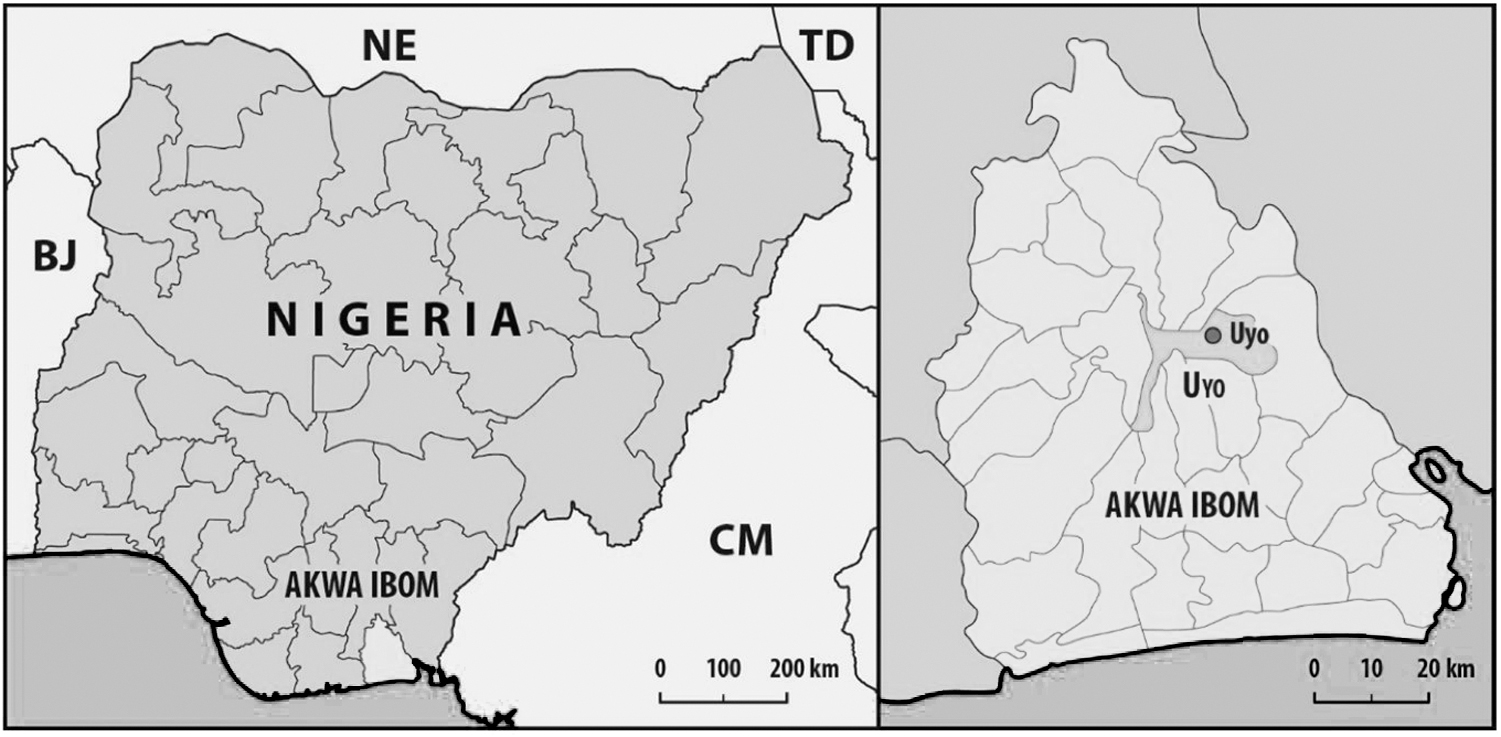
Map of Nigeria showing Akwa Ibom State, and map of Akwa Ibom State showing Uyo its capital and environs, where the study was conducted. (BJ, = Benin Republic; CM, = Cameroon; NE, = Niger Republic; TD, = Republic of Chad.) (Source: Ministry of Land Surveying, Uyo). Adapted from Essien and& Samimi (2019). 55
Data collection and analysis
A trained research assistant who was multilingual in English, Ibibio, and Annang (the predominant local languages spoken in Akwa Ibom State, Nigeria) conducted the interviews, depending on the participant's preferred language of communication, under the supervision of the researchers. The interviews were conducted between November and December 2020, at a prearranged day and time in a private place at the participant's convenience. About half of the interviews were conducted face to face; however, when face-to-face interviews were not possible due to COVID-19 regulations prevalent during that period, 56 telephonic interviews were conducted instead. The interviews lasted between 20 and 40 min in duration. All interviews were audiorecorded and transcribed verbatim.
Study instrument (interview guide)
The interview guide included several predefined open-ended questions (Supplementary File S1). Extensive literature review and pilot testing of the interview guide through two pilot interviews conducted by the researchers were used to develop the study's qualitative codebook. New NVivo® codes and categories were added as they emerged through the process of close analysis of the transcripts and memos from the data collection process. 57
The goal of rigor in qualitative research has been described as “ensuring that the research design, method, and conclusions are explicit, public, replicable, open to critique, and free of bias.” 58,59 To demonstrate this study's trustworthiness, validity, and rigor, the researchers adopted some of the criteria initially developed by Guba, 60 and more recently reaffirmed by other researchers. 58,59,61 The researchers ensured the study's credibility by obtaining proper gatekeeper approvals from the Akwa Ibom state ministry of health, the KwaZulu-Natal health department, and ethical clearance from the University of KwaZulu-Natal Research Ethics Committee. The researchers created an environment allowing participants to decide whether to participate in the study voluntarily. This ensured honesty and full information disclosure by participants. There were frequent meetings and discussions on the research progress, including the analysis process, with the second author, a senior researcher in the field.
The researchers also ensured this study's reliability, dependability, and confirmability by conducting a thorough literature review on IC and ATM in Nigeria and Africa. The researchers also provided an in-depth methodological description to allow the study to be replicated where and when necessary. 57 –61
Qualitative analysis
All verbatim transcriptions from the semistructured interviews underwent thematic analysis. The thematic analysis was conducted simultaneously using NVivo software,
62
and manual techniques.
63
–65
The software application assisted with efficient data storage and the initial development of themes.
62
Interview data were analyzed prospectively. After verbatim transcription and translation, the researchers immersed themselves in the data by reading it in detail. They then temporarily suspended this process to engage in a reflective analysis to identify and describe patterns due to the immersion. This process was repeated until all the data had been examined and meaningful patterns and themes extracted and described to the authors' satisfaction. The above process was done manually. Once these themes were described and captured on NVivo, the researchers reread the interviews to identify any disconfirming data. Thus, the analysis was done in several iterative steps as follows: (a) Initially, the entire transcript was read to obtain an overall sense of the data. The text was then summarized with themes to describe, interpret, and critically analyze the data. (b) After the initial analysis of long texts of verbatim data, expressions with a similar meaning and an immediate part of the context and reference (participant's identifiers) were compiled into categories by classifying and integrating the data.
57,62
(c) This iterative approach helped develop further, modify the analysis, and determine when saturation was reached. Several predetermined categories, informed by the study's aim and literature review, guided the initial analysis process and facilitated the organization of the materials by increasing their efficiency.
62
–65
(d) Furthermore, the initial analysis stage compared incident with incident in each code. Initial codes were then compared with other codes. Codes were then collapsed into themes. This process means the researchers compared incidents in a theme with previous incidents in the same and different themes. This process aided ongoing comparison between old and new codes throughout the analytic process.
57,63
–65
(e) This process of constant comparative methodology contributed to determining when saturation was reached, and there was no need for new data.
49
–51
(f) Saturation occurred when interviewing additional participants did not yield any added information, and the ideas provided by the participants were repeated in several cases.
3,49
–51
Conclusions drawn from the above analysis were then documented in the final descriptive summary, presenting themes and main points from the analysis with verbatim quotations from the informants to exemplify the discussed topics.
Ethical considerations
The written IC document was read out and explained to participants in their preferred language with assistance from the research assistant. Participants were then asked if they had any questions. Most participants preferred to read the document themselves and clarify with the researchers where necessary. Once satisfied that all concerns had been discussed, they were asked to sign the consent form. The Research Ethics Committees reviewed and approved the study protocol and the IC form as indicated above.
Participants' confidentiality was maintained by reporting the data anonymously. Transcribed and data recordings were stored in a secured location and in a password-secured computer to preserve data confidentiality. Written IC was obtained from all participants.
Results
Characteristics of the participants
The study sample consisted of 11 participants, 64% (7) males and 36% (4) females, with an age range of 35–67 years and 5–25 years of experience as THPs. Most of the participants, 46% were herbalists (n = 5), 27% (n = 3) were TBS, and 27% (n = 3) TBAs. The majority (82%) spoke Annang, while 18% were Ibibio first-language speakers. The detailed demographic profile of the study participants is shown in Table 1.
Demographic Characteristics of the Participants
Findings from the thematic analysis
Three key themes and several subthemes were derived from the participant interviews as described in the following paragraphs and summarized in Table 2.
Coding Scheme Developed from Thematic Analysis
ATM, African traditional medicine; IC, informed consent.
Existing ethical framework related to IC in ATM
Disclosure of risks
All participants (100%) believed that risk communication is vital during therapeutic procedures in ATM as complications could occur if risks are not adequately communicated. For instance, 3 (27%) of the participants stated that if a patient takes Ike. * (snuff) along with most African (Nigerian) traditional herbal medicine, it could generate a lot of adverse effects on the body (P2, P8, and P7).
Furthermore, most participants pointed out that they also communicated that taking herbal medication with foreign or “Western” medicine is risky. Quoting P1 for reference, “The no.1 risk is taking the medication along with any foreign drugs.”
Fifty percent of the respondents pointed out that dosage is one of the key risks affecting ATM, and it is vital to communicate. P7 stated, “if you don't follow the exact dosage, it can be dangerous.” Other participants in the same line of thought said that it is crucial to communicate dosage to patients as there is a significant risk of overdosing.
P11 stated, “risk is overdose, so I stress on the risk of treatment.” To emphasize how overdose can lead to death, P9 said, “overdose can be hazardous, especially drugs for mental illness which is supposed to make the patient sleep for many hours, but if you take to overdose, the patient will sleep to death.”
Thus, all the respondents (100%) stated that risk communication is essential in ATM. They even mentioned the most frequent risk they communicate to patients, as presented above. However, the TBAs, while affirming the importance of communicating risk during their procedures, stated that there was less risk in their treatments as they only give what will ease birthing or assist with the safe delivery of pregnant women.
P5 stated, “there is no risk to the treatment because what I will give you will only aid easy delivery.”
Thus, even though the TBAs who participated in this study agreed that it is necessary to communicate risk when there is one, they believed there were no risks to share in their scope of practice or in “traditional midwifery.”
Disclosure of benefits
Participants also stated that communicating the benefits of treatment to patients is essential in ATM practice and that they share the benefits. Four participants, or 36%, stated that they communicated all therapy benefits to their patients, consistent with IC requirements. Some participants were concerned about giving too much information about the benefit, so they only disclosed what they thought the patient needed to know.
P7 stated: Yes, of course, I disclose the benefits, but in most cases, not all the benefits are being disclosed because, in traditional medicine, one herb or herbs can treat many diseases, so you focus more on the disease affecting your patient.
Furthermore, some participants believed that revealing all the benefits at the beginning of the treatment can be risky, especially if the patients know the medication they are administering.
P9 stated, “yes, I do disclose all the benefits of the treatment but not at the initial stage because you wouldn't give so much information at a time.”
Thus, even though some participants are selective in the amount of information they disclose and the time they disclose, they all stated that they did communicate the benefits of treatment to their patients.
Opportunity for patients to ask questions
All participants acknowledged the necessity to allow patients to ask questions.
P1 stated, “it is good to allow patients to ask questions, and for me, many patients do ask a lot of questions for clarification.”
Moreover, for other participants, the concerns vary. Some patients would like to know the duration of the treatment (P2), while patients go further to ask about the names of the roots and the herbs that the THP is administering.
P7 touched on this when he said, “yes, most people ask a lot of questions even if you don't tell them they want to know so they can treat themselves, e.g., if it's a common disease like hypertension, you have to tell them everything.”
The participants pointed out that they allow their patients to ask questions because they do not want to impose treatment on people.
P4 stated, “yes, I allow my patients to ask questions. I don't impose treatment.”
This further shows an inherent ethical framework related to IC in ATM. As presented above, the THPs already communicate risks and benefits and allow participants to ask questions.
Knowledge of consent
This section will show the participant's perspective of IC.
Participants' perspective of IC
Most of the participants only had a basic knowledge of IC. They considered it a process that demands that one disclose everything about the medication you will administer to a patient. In this line of thought, P2 stated, “the Pax herbal products, † bottles its products, and label out all the composition so that you know what you are about taking, and others too could learn.”
This participant wrongly believed that IC demands one to tell the patient the composition of the THP-administered medications. Furthermore, some participants felt that IC means telling the patients the name of the medication they administer.
P3 stated, “yes, I know about informed consent, but I don't disclose all the information about the names of the herbs except you pay to learn herbs.” In addition, P7 postulated, “I know about it, but not all medication has to be disclosed especially if it's a serious disease to avoid self-medication by the patients, self-medication can be very dangerous.”
Thus, there is limited knowledge of what IC is and the requirements for valid IC. However, in this study, researchers went further to give a brief explanation of what IC is before exploring with participants the possibility of implementing IC in ATM practice in Nigeria.
Potential for application of IC in ATM
All participants (100%) believed that it is possible to implement IC in the ATM practice in Nigeria. However, they commented that educational and developmental programs for THPs should accompany the application of IC.
P1 stated: Yes, it is already done by some people, but using machines to turn these herbs into bottled drugs, doing more research on each drug and printing out their compositions so it can be given to the patient to read before administering the drugs so they can have an in-depth knowledge of what they are about to take.
This participant suggested the limitations in ATM that might affect the application of IC. This is because there has to be in-depth knowledge of the medication and the consent process by THPs for the implementation of IC to be practical and possible.
Furthermore, P3 stated: Yes, it can be applied, but I think there should be a platform to help educate traditional doctors because apart from the names of the drugs and what they do, we do not know anything about them.
This further shows the need for extensive in-depth training for THPs regarding ethical issues in TM practice. Furthermore, some participants believed that it is possible to implement IC in ATM if it does not affect their practice, nor does it affect the people's way of life.
P6 added, “yes, it is possible to implement IC as it will improve the practice, but it should not be implemented in a way that changes the basis of our practice in Africa.”
Thus, while it may be possible to implement IC in ATM practice, it would be necessary to consider the African values and norms of behavior.
Finally, some participants pointed out the need for a cooperative group responsible for the leadership, rules, and ethics in ATM. The platform will also be responsible for evaluating and advancing ATM in Nigeria.
P5 stated: I think there should be a formed corporation of all the traditional doctors where they learn more about the rules, ethics, and their practice in the field; also a good platform to educate the masses more on traditional medicine.
This also suggests the need for more research and publications in ATM for THPs and other people to read and learn more about this area of knowledge and its application in practice.
One of the participants' primary concerns was the possibility of IC undermining African communities' systemic values and norms, which was addressed in the previous studies by Akpa-Inyang & Chima 3 and another. 44 Those studies argued that IC could be implemented in African societies but that researchers should consider the socioeconomic status, literacy level, environment, spirituality, and culture of local peoples. 3 –8 However, there is a need for IC to be more culturally sensitive and make itself applicable in the African context, as postulated by Akpa-Inyang and Chima. 3 Applying a more culturally sensitive form of IC in ATM will contribute to the integration of ATM into primary health care systems in Africa because ATM will be practiced within a uniform ethical system.
Discussion
This study explored the possibility of implementing IC in ATM practice from the perspective of African THPs in Nigeria. To do this, the study had to explore the existing ethical framework for ATM practice in Nigeria to see if it relates to the demands of the doctrine of IC. The study discovered that THPs in herbalism, bone setting, and traditional birth attendance or midwifery, believe that it is essential to communicate the risks and benefits of treatment and that it is also vital to allow patients to ask questions. The study further discovered that THPs practicing herbalism and TBS communicate the risks of treatment to their patients. Whereas TBAs or traditional midwives that participated in this study stated that they do not communicate the risks of the treatment to their patients, not because they think it is not essential, but because they do not know of any risks associated with their practice.
This could be due to limited knowledge and the need for better training and improvement in practice methods for TBAS, as reported in previous studies by Oyeneyin et al., from Ondo State, Nigeria, 66 and Amutah-Onukagha and others, also from Nigeria. 67 Reports by Kayombo from Sub-Saharan Africa, 68 as well as studies from other developing countries showed poor knowledge among TBAs and improved maternal morbidity and mortality indices following better training of TBAs. 66 –70
Nevertheless, all respondents in this study agreed that it was essential to communicate risks and benefits and allow patients to ask questions. Furthermore, the research participants believed that if patients knew all the information about their treatment, they could decide freely if they wanted it, which is consistent with the requirements of IC as postulated by Chima. 6
The propensity to disclose the benefits of treatment by some THPs in this study may be related to previous observations from another study among physiotherapists and their assistants in KwaZulu-Natal province South Africa, 71 which suggested that the impetus to disclose the benefits of treatment was designed to encourage acceptance of recommended treatment by patients. This factor could also be similar to the practice among THPs in this study. However, some were more reluctant to disclose all benefits to their patients to discourage self-medication and preserve the secrets of their ATM practice. However, the connection or motivation for disclosing benefits was not explicitly investigated in this study.
The current study further discovered that THPs who practice herbalism, bone setting, and traditional midwifery in this setting had limited knowledge of critical elements of IC, including the rules and regulations regarding its application in therapeutic practice. IC was perceived as demanding that THPs disclose everything they know about the drugs or treatment they administer to their patients. This referred to the ingredients or components of the medications. By contrast, a valid IC process requires disclosure of all the information about treatment, such as diagnosis, risks, treatment options, benefits, recommended treatment, and the right of refusal, as well as risks of refusing recommended treatment. 6,72 Furthermore, patients or health care users need to be competent to decide if they want the treatment, and lastly, the decision must be voluntary. 2,4 –6,71 –73 Thus, all the THPs who participated in this study only had a basic or limited knowledge of the IC doctrine.
Thus, this study found a great need for further training and education for THPs, especially regarding the rules and ethics of practice, including IC. This will enhance THPs' knowledge and will ultimately contribute to a better IC process between patients and THPs and ultimately contribute to a more robust and safer PHC system in Africa as envisaged by the Declaration of Astana, which postulates that “the success of PHC will be driven by knowledge and capacity-building” and to achieve the goal of “enabling individuals and communities to identify their health needs, participate in the planning and delivery of services and play an active role in maintaining their own health and well-being.” 15
This research study also observed that it would be possible to implement IC in ATM in Nigeria and Africa. This is because all respondents affirmed the need to disclose the risks and benefits of treatment. They also reaffirmed the need to allow patients to ask questions. Finally, the study showed that IC is necessary for ATM (using practitioners in herbalism, TBS, and TBAs as an example).
The study raised concerns about the possibility of IC undermining African communities' systemic values and norms, which was addressed in the previous studies by Akpa-Inyang & Chima 3 and another. 34 Those studies argued that IC could be implemented in African societies but that researchers should consider the sociocultural values of local peoples. 3 –8 Therefore, there is a need for IC to be more culturally sensitive and to make itself more applicable in the African context, as proposed. 3 The application of a more culturally sensitive form of IC in ATM will contribute to the integration of ATM into PHC systems in Africa because ATM will then be practiced within a uniform ethical system.
Limitations of this study
This study is limited because it involves a small cohort of THPs practicing in three narrowly defined aspects of ATM in one State in Nigeria. There is a possibility that a more extensive study that is spread in many more states in Nigeria and involves other aspects of ATM may yield a different result. Future studies in this area can also explore the perception and perspectives of consumers of ATM on the application of IC in ATM practice in Nigeria and other African countries. Nonetheless, the fact that such a study was not conducted does not negate the findings from this limited study. Future studies should be designed to evaluate other forms of ATM in different regions of Nigeria and Africa to corroborate and expand on the findings from this study.
Conclusions
Qualitative interviews with THPs in herbalism, traditional bone setting, and midwifery open up a discussion on the ethical framework for ATM practice in Nigeria and Africa. The study shows a lack of knowledge among THPs on the critical elements of IC. This study further reveals the need for further training for THPs, and it is necessary to communicate the risks and benefits of ATM. It is also essential to allow patients to ask questions. We conclude that a relational form of IC that considers the culture and norms of African societies can be implemented during ATM practice in Africa. This will contribute to the integration of ATM with Western medical practice in Africa and enhance primary health care as envisaged by the WHO declaration of Astana. 15
Footnotes
Acknowledgments
This article is derived in part from a research project entitled, “Informed Consent in African Indigenous Medical Practice in Sub-Saharan Africa: A Comparative Study between KwaZulu-Natal Province, South Africa and Akwa Ibom State, Nigeria,” submitted for the award of PhD in Public Health at the School of Nursing and Public Health, University of KwaZulu-Natal, to the first author (F.A.-I.).
The authors also acknowledge the research assistant Dr. Fidelis Udo for his support and contributions toward completing the fieldwork for this project.
Authors' Contributions
F.A.-I. participated in study conceptualization, data curation, formal analysis, investigation, methodology, initial writing, and revisions of the original and revised articles. S.C.C. participated in the study's conceptualization, methodology, secondary analysis, project supervision and administration, validation, and article writing, including review and editing of the original and final articles for important intellectual content.
Author Disclosure Statement
No competing financial interests exist.
Funding Information
This study was funded by an academic Tuition Remission and scholarship award for research and stipendiary support from the College of Health Sciences, UKZN, to the first author (Francis Akpa-Inyang) for his PhD studies.
Supplementary Material
Supplementary File S1
References
Supplementary Material
Please find the following supplemental material available below.
For Open Access articles published under a Creative Commons License, all supplemental material carries the same license as the article it is associated with.
For non-Open Access articles published, all supplemental material carries a non-exclusive license, and permission requests for re-use of supplemental material or any part of supplemental material shall be sent directly to the copyright owner as specified in the copyright notice associated with the article.
