




Abstract
Naturally selected variants of influenza virus encoding truncated NS1 proteins were tested in chickens as candidate live-attenuated influenza vaccines. Their effectiveness correlated with the amount of interferon (IFN) induced in chicken cells. Effective variants induced large amounts of IFN and contained subpopulations with high ratios of defective-interfering particles:IFN-inducing particles (DIP:IFP). Ineffective variants induced less IFN and contained lower ratios of DIP:IFP. Unexpectedly, there was a reversal of phenotypes in mammalian cells. Variants that induced low amounts of IFN and had low DIP:IFP ratios in chicken cells were excellent IFN inducers with high DIP:IFP ratios in mammalian cells, and vice versa. The high DIP:IFP ratios and computer-simulated dynamics of infection suggested that DIP, as an individual particle, did not function as an IFP. The higher efficiency of IFPs in the presence of DIPs was attributed to reduced amounts of newly synthesized viral polymerase known to result from out-competition by defective-interfering RNAs, and the subsequent failure of that polymerase to turn-off cellular mRNA transcription—including IFN-mRNA.
I
All de1NS1 variants are in the A/TK/OR/71 influenza virus background generated using reverse genetics (Wang and others 2008).
The (1-X) represents the N-terminal aa residues that are consensus with the wild-type A/TK/OR/71-SEPRL, and (…Y) represents frame shift associated residues that are not consensus with the wild-type sequences (see Fig. 2 of Wang and others 2008).
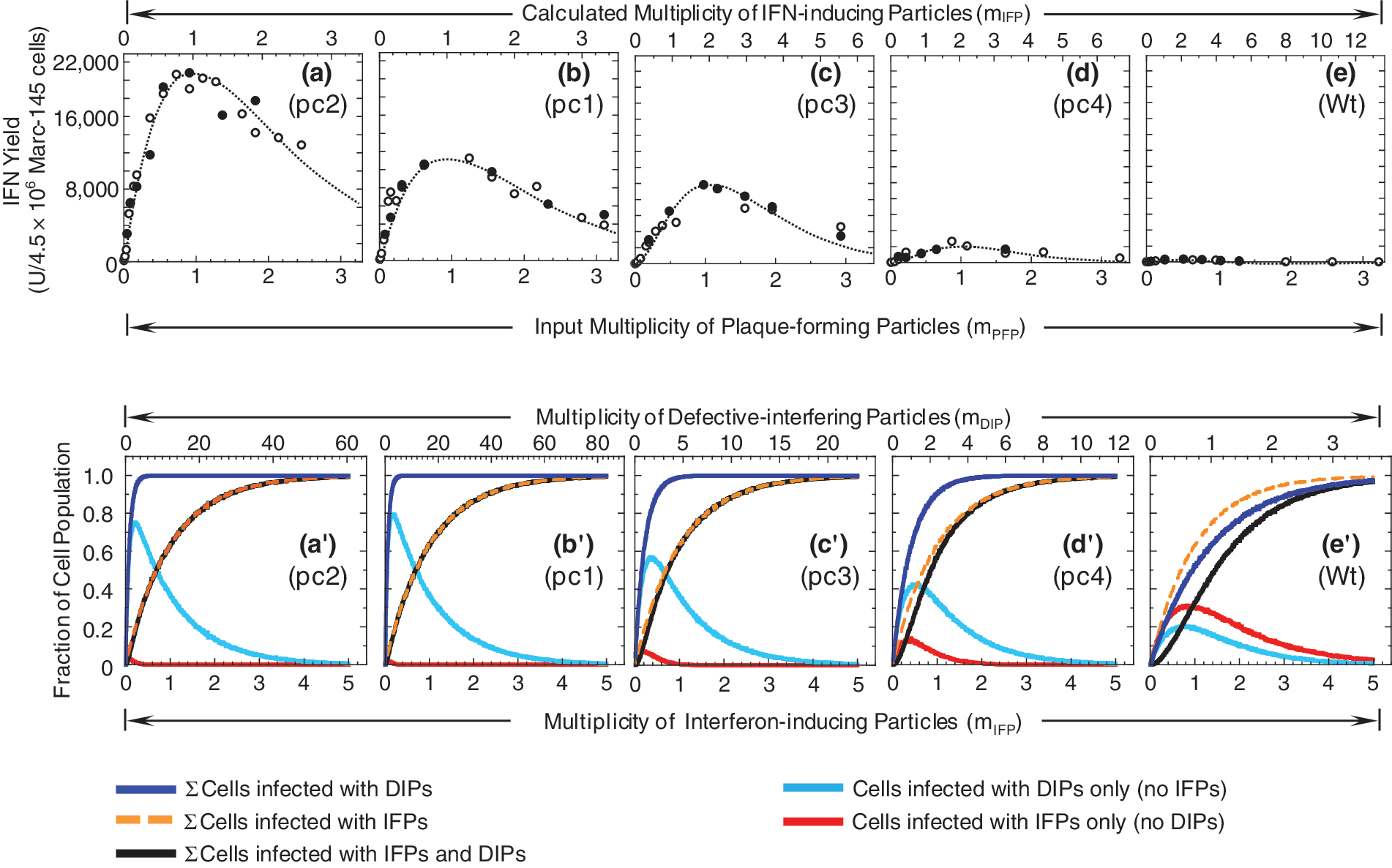
Calculated from the IFN induction dose–response curves based on the statistical process of IFN induction following the Poisson distribution of IFPs in the cell monolayer (Fig. 1a–e) (Marcus 1986; Marcus and others 2010).
Measured using helper-virus-reduction assay (Marcus and others 2009) in Marc-145 cells.
DIPs and IFPs were both assayed in Marc-145 cells.
DIPs were assayed in Marc-145 cells while IFPs were assayed in L(Y) cells. Note: DIP titer of a given stock does not significantly change when measured in different cell lines.
DIPs were assayed in MDCK cells, while IFPs were assayed in aged chick embryonic cells (Marcus and others 2010).
Calculated relative to the IFN U/106 IFP value for the Wt virus.
IFN, interferon; CEC, chicken embryonic cells; IFP, IFN-inducing particle; DIP, defective-interfering particle.
Surprisingly, there was a host cell-dependent reversal of the IFN-inducing phenotype (Table 1) when IFN yields from mammalian cells (Table 1) were compared with those from developmentally aged CEC (Marcus and others 2010). Table 2 shows the order of induction of increasing quantum yields of IFN in IFN Units per 107 CEC (Marcus and others 2010), and 5×10⁶ cells each for both Marc-145 and L(Y) cells (Fig. 1a–e, Table 1).
IFN U/107 CEC; Data as reported in Marcus and others (2010).
IFN U/4.5 × 106 Marc-145 cells.
IFN U/5 × 106 L(Y) cells.
The consistency in the order of increasing quantum yields of IFN for the variants and Wt virus tested in several different batches of developmentally aged primary CEC makes even more compelling the reversal of this order in mammalian cells. Differences in this host cell-dependent reversal of the IFN-inducing phenotype became more apparent when the relative IFN-inducing particle (IFP) efficiency values were compared. That value for each variant was calculated from the titer of the IFPs, the quantum yield of induced IFN, and the number of cells that produced the IFN: these were set relative to the isogenic Wt virus, which was assigned a value of 1.0 (Table 1) (Marcus and others 2010). The enhanced IFN-induction capacity of delNS1 variants is thought in part to favor their use as LAIVs because influenza viruses are intrinsically sensitive to IFN action (Portnoy and Merigan 1971; Sekellick and others 2000; Cauthen and others 2007; Marcus and others 2010). Furthermore, IFN acts as a potent adjuvant for stimulation of the adaptive immune responses (Bracci and others 2005; Marcus and others 2007; Hai and others 2008; Wolff and Ludwig 2009). Both of these attributes likely contribute to the attenuation of the virus and amelioration of the disease (Cauthen and others 2007; Hai and others 2008).
The IFN-inducing capacity of delNS1 variants described herein can be attributed to at least a functional loss of (i) NS1 (Richt and García-Sastre 2009) reflecting its concomitant reduction in IFN induction-suppressing particle activity (Malinoski and Marcus 2012) and (ii) cell RNA polymerase II through the action of viral polymerase (see below)—recognized as small and large UV targets, respectively (Marcus and others 2005). The reversal in the IFN-inducing efficiency of IFPs in avian and mammalian cells (Fig. 1a–e; Table 1) (Marcus and others 2010) reveals a role for host-dependent factors in the regulation of IFN induction and/or production. As noted, one such factor is cell RNA polymerase II, which is degraded upon association with viral polymerase leading to shut off of cell mRNA transcription, including IFN-mRNA (Rodriguez and others 2007, 2009; Vreede and Fodor 2010). By this model, inactivating at least 1 of the 3 viral polymerase genes would abrogate inhibition of cellular transcription, thereby resulting in synthesis of more IFN-mRNA and enhanced levels of IFN, as is observed upon low doses of UV radiation (Marcus and others 2005). Since most influenza virus isolates that express full-size NS1 induce some, although low, levels of IFN, we infer that some transcription of IFN-mRNA precedes the viral polymerase-mediated global turn-off of cell mRNA synthesis, and that its translation proceeds for some time thereafter. This seems plausible since IFN-mRNA appears in cells soon after infection (Sekellick and others 1994). Furthermore, viral polymerase also was implicated in the inhibition of IFN induction by blocking the activation of IPS1/MAVS-dependent IFN-induction pathways (Graef and others 2010; Iwai and others 2010). Thus, viral polymerase suppresses the signaling of IFN induction, as well as IFN mRNA transcription, independently of the NS1 protein.
We propose a novel means to boost IFN induction by IFPs: through functional inactivation of viral polymerase by the co-introduction of defective-interfering particles (DIPs) into IFP-infected cells. We postulate that the preferential synthesis of small RNAs (Fig. 2), some of which function as defective-interfering RNA measurable through defective-interfering particle (DIP) activity, out-compete transcription of at least 1 of the viral polymerase genes, thereby reducing the synthesis of functional viral polymerase (Akkina and others 1984). This would prevent turn-off of cell RNA polymerase II and hence IFN-mRNA transcription as discussed above with respect to the action of UV radiation. We invoke this model to account for our observations that the most effective LAIVs contained the largest DIP subpopulations (Marcus and others 2010). DIPs were detected and quantified by a helper virus-reduction assay detailed by Marcus and others (2009) with minor modifications. Briefly, the test virus was UV-irradiated (∼390 ergs/mm2) to inactivate several logs of PFPs without appreciably affecting DIP activity; the irradiated population and a DIP-free helper virus were used to coinfect Marc-145 cells; the presence of DIPs causes an exponential decrease in helper virus replication in a multiplicity-dependent manner; DIP titers were calculated from the yield-reduction dose–response curves in accordance with the Poisson distribution (Marcus and others 2009). Importantly, our data suggest that DIP, as an individual particle, does not induce IFN as inferred from the high ratios of DIP:IFP subpopulations observed in the delNS1 variants in Marc-145 and L(Y) cells (Table 1), and as measured in different cell types (Marcus and others 2010). If a DIP did function as an IFP, then the IFP titers would be equal to the sum of the titers of DIPs and IFPs. They are not (Table 1).
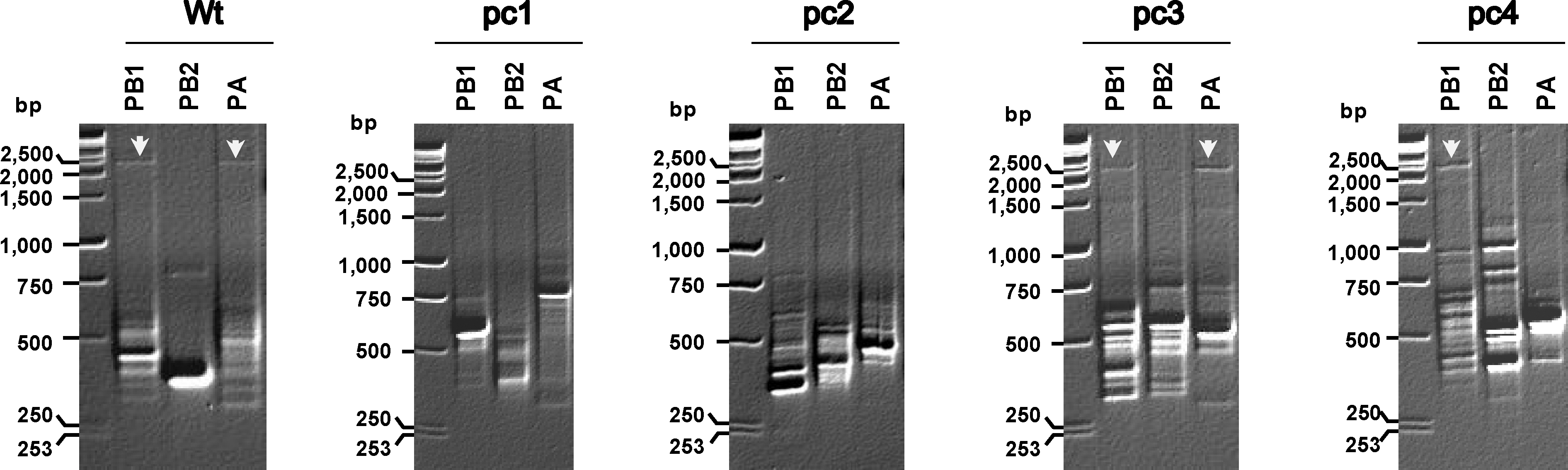
Reverse transcription-polymerase chain reaction (RT-PCR) detection of polymerase gene segment-derived subgenomic defective-interfering RNAs (Dimmock and others 2008) using the following segment-specific primers: PB1, F5′-ATATAAGCAGGCAAACCATTTG-3′ and R5′-ATATCG TCTCGTATTAGTAGAAACAAGG-3′; PB2, F5′-AGCGAAAGCAGGTCAAWTATATTCAATATG-3′ and R5′-ATATGGTCTCGTATTAGTAGAAACAAGGTCGTTT-3′; and PA, F5′-TATTCGTCTCAGGGAGCGAAAGCAGGTAC-3′ and R5′-ATATCGTCTCGTATTAGTAGAAACAAGGTACTT-3′. Viral RNA from egg-grown virus stocks was extracted using QIAamp Viral RNA Mini Kit (Qiagen). RT-PCR was carried out using OneStep RT-PCR kit (Qiagen) under previously reported conditions (Lee and Suarez 2008). Template vRNA used in the reverse transcription step was standardized to 437 ng per 50 μl reaction for all viruses. The RT, 30 min at 50°C; PCR amplification, 35 cycles of melting at 94°C for 45 s, annealing at 53°C for 15 s, and primer extension at 72°C for 150 s; final extension, 10 min. Primer specificity was determined by ability to amplify the target segments in reactions with mixed cDNAs from all the 8 segments. Furthermore, 3 cDNA bands representing defective RNAs were randomly chosen, cloned into PCR®2.1-TOPO vector (Invitrogen), and sequenced to confirm that the primer targeted the projected segment (GenBank Accession Numbers JQ436726 for PA-, JQ436727 for PB2-, and JQ436728 for PB1- representative of a band of defective RNA from pc4, pc3, and pc2, respectively). Arrows show cDNA bands representing full size genomic RNAs.
The 2 variants, D-del pc3 and pc4, that induced the highest amounts of IFN in aged CEC contained subpopulations with the highest DIP:IFP ratios relative to pc1 and pc2, the 2 variants that induced low amounts of IFN (Table 1). This relationship was reversed in Marc-145 cells. Thus, variants that induced the least IFN in aged CEC, that is, pc1 and pc2, were scored as the best inducers in Marc-145 cells, and vice versa (Fig. 1a–d, Table 1). This reversal of the IFN-inducing phenotype concomitant with changes in the DIP:IFP ratios suggests that differences in IFN induction efficiency cannot simply be attributed to differences in the sizes of the small defective RNAs (Fig. 2). However, it appears that coinfection of IFP-infected cells with any DIP may suffice to enhance IFN induction. Also, it is possible that the preferential interaction of RIG-I and small defective RNAs (from DIPs) (Baum and others 2010) may result in IFN induction; however, our quantitative data indicate that DIPs do not function as IFPs, or do so at a lower order of magnitude.
We could not attribute the differences in small-RNA sizes to IFN-inducing efficiency. Notably, the small-RNAs were synthesized from all 3 polymerase genes (Fig. 2). It is striking that no cDNA band was seen for the full-length PB2 segment in all 4 isogenic NS1 variants and Wt, suggesting that at least some PB2-derived small-RNAs out-compete their parental full-length RNA in replication. The predominant PB2-derived small-RNA species in the Wt, about 350 nt long (Fig. 2), was accurately predicted by UV-target analysis (Marcus and others 2009). The differential synthesis of small-RNA species from PB1 or PA gene segments (Fig. 2), some of which may be functional in the context of DIP, appears to be due to differences in the effector domains of the NS1 proteins since the delNS1 variants express C-terminally truncated proteins and tend to display a broader spectrum of small-RNA sizes than the Wt (Wang and others 2008). Taken together, our data indicate that NS1 has a direct influence on the propensity to generate DIPs. This corroborates the role of NS1 in transcription/replication of viral RNA (Wang and others 2010), independent of its function to prevent IFN induction (Hale and others 2008).
In further support of our model we note that the UV dose (calculated to be≈2,500 ergs/mm2, i.e.,≈13 lethal hits to infectivity) inactivated virtually all residual infectivity in the DIP preparations used to treat mice (Easton and others 2011), and had no effect on the activity of DIPs because of their small (≈350 nts) UV-target (Marcus and others 2009; Easton and others 2011). This dose of UV radiation was in the range used to enhance the IFN-inducing capacity of IFPs in most isolates of influenza virus, including DIP-free stocks (Marcus and others 2005). This model accounts for the IFN found in mice that received large numbers of DIPs irradiated with low doses of UV (Easton and others 2011), if one assumes the preparation also contained IFPs.
Considering the central role that IFN induction plays in the expression of the vac+ phenotype, and the new role proposed for DIPs, we examined the dynamics of infection by IFPs and DIPs based on a Poisson distribution of these particles in the cell population. Perl was used to develop a program called Subpopulon to simulate infection at each multiplicity as follows: (i) an array of 10,000 virtual cells was created; (ii) based on the observed titers (Table 1), the number of IFPs and DIPs infecting each cell was determined using the random Poisson function from the CPAN Math::Random module (Math-Random-0.70); (iii) cells that received either IFPs or DIPs only, or both classes of particles, were counted, expressed as a fraction of the whole population (n=10,000) and plotted as shown in Fig. 1a′–e′. The fraction of the cell population infected with≥1 particles of each class for each multiplicity is described by the probability P of having DIPs in cells that may or may not be infected with IFPs, P (r ≥1 DIP)=(1 – e –mDIP); IFPs in cells that may or may not be infected with DIPs, P (r ≥1 IFP)=(1 – e –mIFP); DIPs together with IFPs, P (r ≥1 DIP) · P (r ≥1 IFP); DIPs only, P (r ≥1 DIP) – (P (r ≥1 DIP) · P (r ≥1 IFP)); and IFPs only, P (r ≥1 IFP) – (P (r ≥1 DIP) · P (r ≥1 IFP)), where r is the actual number of DIPs or IFPs that enter the cell, e is the base of the natural logarithm, and m DIP and m IFP are the multiplicities of DIPs and IFPs, respectively. Several features are worthy of note in characterizing the best inducers of IFN (pc2 and pc1 in this case), and predicting vac + variants. (i) Since the DIP content, relative to IFP, was highest for variants pc2 and pc1, the cumulative fraction of cells infected with DIPs (purple) rapidly reached 1.0 with increasing multiplicities, whereas those of pc3 and pc4 were slower in doing so, with Wt being the slowest. (ii) The fraction of cells infected only with DIPs (blue) peaked much earlier than that infected with IFPs (orange), supporting our contention that DIPs per se did not induce IFN. (iii) The fraction of cells coinfected with IFPs and DIPs (black) was congruent with the fraction of cells infected with IFPs for pc2 and pc1 because virtually all cells also were infected with DIPs. (iv) The cumulative fraction of cells infected with IFPs only (red) was highest in Wt populations because the ratio of DIP:IFP was the lowest and fewer cells were coinfected with DIPs. Thus, cells infected only with IFPs produced lower yields of IFN than those coinfected with IFPs and DIPs.
The identification and quantification of subpopulations of noninfectious biologically active particles such as DIPs, IFPs, IFN induction-suppressing particles (Marcus and others 2005, 2009, 2010), and cell-killing particles (Ngunjiri and others 2008) in populations of influenza virus has stimulated interest regarding their potential function in LAIVs and role in the regulation of pathogenesis and disease. From the quantification, interaction, and analysis of IFPs and DIPs in this study, we concluded that the most effective candidate LAIVs or broad spectrum antiviral reagents made from influenza viruses contain IFPs that intrinsically are maximally efficient in inducing IFN, along with DIPs that contribute further to the enhancement of IFN induction. LAIVs modified in this manner are termed M-LAIVs. It also is possible, though not proven, that IFP–cell interactions that result in down-regulation of IFN at high multiplicities (Fig. 1a–e) provide a degree of fine-tuning to virus replication that helps maximize M-LAIV efficacy and action against a broad spectrum of viruses sensitive to IFN. Thus, 3 conditions are proposed to help maximize the efficiency of IFPs in M-LAIV preparations: (i) truncation of NS1 to abrogate NS1-mediated suppression of IFN induction; (ii) coinfection of IFP-infected cells with DIPs to compromise viral polymerase-mediated suppression of IFN-mRNA transcription through turn-off of cell RNA polymerase II; and (iii) UV irradiation to abrogate both viral polymerase- and NS1-mediated suppression. Furthermore, the adjuvant effects of endogenously induced IFN from IFPs that stimulate the response of the adaptive immune system might be enhanced further by the exogenous administration of IFN (Marcus and others 2007). The new role of DIPs in enhancing IFN induction may explain in part why almost 3 decades ago the avirulent H5N2 virus, co-circulating with DIPs, became highly virulent and caused high mortality in poultry when DIPs were lost (Bean and others 1985; Chambers and Webster 1987).
Footnotes
Acknowledgments
The authors thank Dr. Pascal Lapierre (Bioinformatics Facility, University of Connecticut) for writing the Perl Subpopulon program used to simulate infections. The Subpopulon program is available upon request. This study benefited from the services of the Animal Cell Culture Facility of the Biotechnology-Bioservices Center of the University of Connecticut, and a consistent source of primary CEC from Charles River SPAFAS, Storrs, CT. This research was supported by a donation to the University of Connecticut's Virus and Interferon Research Laboratory.
Author Disclosure Statement
No competing financial interests exist.