




Abstract
Reassortment of influenza A viruses is known to affect viability, replication efficiency, antigenicity, host range, and virulence, and can generate pandemic strains. In this study, we demonstrated that the specific exchange of the NS gene segment from highly pathogenic A/HK/156/97 (H5N1) [E92 or E92D NS1] virus for the cognate NS gene segment of A/PR/834(H1N1) [D92 NS1] virus did not cause a significant change in the sizes of infectious particle subpopulations. However, it resulted in 2 new phenotypic changes: (1) de novo generation of large subpopulations of defective-interfering particles (DIPs); and (2) enhancement of interferon (IFN)-inducing particle efficiency leading to an order of magnitude or higher quantum (peak) yield of IFN in both avian and mammalian cells. These changes were attributed to loss of function of the H5N1-NS gene products. Most notably, the NS exchange obliterated the usual IFN-induction-suppressing capacity associated with expression of full-size NS1 proteins, and hence functionally mimicked deletions in the NS1 gene. The loss of NS1-mediated suppression of IFN induction, de novo generation of DIPs, and the concomitant enhancement of IFN-inducing particle efficiency suggest that in an attenuated background, the H5N1-NS could be used to formulate a self-adjuvanting live attenuated influenza vaccine similar to viruses with deletions in the NS1 gene.
Introduction
I
We have defined 4 different subpopulations of influenza virus populations using quantitative methods that are independent of infectivity. These subpopulations do not lead to a productive infection and are termed noninfectious biologically active particles. Identified and quantified based on the unique intracellular biological phenotypes they express, the noninfectious biologically active particles include: noninfectious cell-killing particles (Ngunjiri and others 2008); interferon (IFN)-inducing particles (IFPs); IFN-induction-suppressing particles (ISPs) (Marcus and others 2005, 2010; Malinoski and Marcus 2012a); and defective-interfering particles (DIPs) (Nayak and others 1985; Marcus and others 2009, 2010; Ngunjiri and others 2012a). In most instances, the IFN-inducing particles exist in large excess over infectious particles. However, in some cases, as in this study, the size of these 2 subpopulations is about equal, suggesting that one subpopulation may express both phenotypes.
The segmented nature of the influenza A virus genome, coupled with the independent transcription of each segment, enables different strains of the virus to exchange segments in naturally coinfected hosts (Webster and others 1992) resulting in production of particles with hybrid genomes. Specific gene segments can be exchanged with those from other isolates to produce de novo reassortants through reverse genetics (Chen and others 2008; Li and others 2010; Sun and others 2011). Reassortment often generates new quasispecies populations with altered survival fitness, antigenicity, and the ability to propagate in hosts of avian and mammalian origin, thereby enabling influenza outbreaks and pandemics (Webster and others 1992; Webby and Webster 2001; Neumann and others 2009). Whether all possible combinations of gene segments occur may depend to some extent on the compatibility of the gene constellations that make up reassortant viruses (Subbarao and others 1995; Chen and others 2008). For example, of the 254 possible permutations of the 8 gene segments produced as reassortants by reverse genetics between pairs of different influenza A virus subtypes, up to 28% could not be rescued as infectious virus (Chen and others 2008; Li and others 2010; Sun and others 2011). In the extremes, an exchange of one or more gene segments may allow efficient generation of infectious particles, or none, depending on the degree of compatibility within the new gene constellation (Chen and others 2008; Li and others 2010; Sun and others 2011). The extent to which such reassortments affect generation and expression of noninfectious biologically active particles is yet to be determined.
Herein we report that in both avian and mammalian cells, the specific exchange of the NS gene segment from highly pathogenic A/HK/156/97 (H5N1) [E92 or E92D NS1] virus for the cognate NS gene of A/PR/8/34 (H1N1) [D92 NS1] virus not only resulted in the de novo generation of large subpopulations of DIPs, but also resulted in an order of magnitude higher quantum yields of IFN.
Materials and Methods
Cells and media
Primary chicken embryo cells (CECs) prepared from 9-day-old chicken embryos (Charles River SPAFAS, Inc.) were cultured and developmentally aged in 5 mL of Nutrient Colorado plus Inositol (NCI) medium (Life Technologies) plus 6% calf serum for 9 to 10 days at 38.5°C to allow full maturation and expression of the IFN system in vitro when activated (Sekellick and Marcus 1986, Sekellick and others, 1990). Primary chicken embryonic kidney cells (CEKCs) prepared from kidneys of 18-day embryos (SPAFAS) were cultured in the same medium and used for plaque assays 1 day after seeding and incubation at 38.5°C (Ngunjiri and others 2008). Marc-145 monkey cells were seeded at 0.5-1×10⁶ cells/50-mm dish and grown in MEM plus 5% fetal bovine serum for 8 to 9 days in a 37.5°C incubator before use for IFN induction to optimize the yield of IFN. pH ∼7.1 was maintained through a calibrated injection of an air-CO2 mixture into the incubators.
Viruses
The viruses used herein were synthesized de novo by reverse genetics and kindly provided by R. G. Webster (St. Jude Children's Research Hospital, Memphis, TN). They were propagated once in 9-day-old embryonated chicken eggs (SPAFAS) following inoculation with <1,000 infectious particles as described previously (Marcus and others 2005).
Infectious particle assay
Infectious particles were detected and quantified as PFPs through plaque assay in CEKCs as previously described (Ngunjiri and others 2008; Marcus and others 2009, 2010) because these cells produce little or no IFN following infection with influenza virus (Cauthen and others 2007), and support multicycle replication and plaquing of several low pathogenicity influenza viruses without the requirement of trypsin (Ngunjiri and others 2008; Marcus and others 2009; Moresco and others 2010).
IFN induction and detection
The method of IFN induction in developmentally aged CECs (aged CECs) was described previously (Marcus and others 2010) and used in this study for Marc-145 cells. Briefly, cell monolayers were exposed to increasing doses of virus adjusted with a serum-free medium to a final volume of 300 μL per 50-mm (inner diameter) plastic dish and the virus was attached for 60 min at 37.5°C; unattached virus was aspirated; 2 mL of fresh MEM or 3 mL of the NCI medium was added back for Marc-145 cells and aged CECs, respectively; Marc-145 cells were induced at 37.5°C, while aged CECs were induced at 40.5°C, their optimal induction temperature (Sekellick and Marcus 1986); supernatants were harvested 20 to 22 hpi, acid insoluble proteins precipitated with perchloric acid (final concentration: 0.15 M), held for 24 h at 4°C and the precipitated proteins pelleted at 2,000 g. Lastly, the acid stable type I IFN in the supernatant was neutralized with 4 N KOH, and then assayed for activity using a 50% cytopathic effect (CPE50) assay in a 96-well tray format (Sekellick and Marcus 1986; Marcus and others 2010).
IFN-induction dose–response curves and calculation of IFN-inducing particle titers
Comparisons of IFN-inducing capacities of influenza viruses were based on full dose (amount of virus)–response (IFN yield) curves under single replication cycle conditions to maintain input multiplicities of virus (Marcus and others 2005, 2010; Cauthen and others 2007; Malinoski and Marcus 2012a; Ngunjiri and others 2012a). These curves (Fig. 3) reveal changes in the yields of IFN as a function of a multiplicity-dependent Poisson distribution, P(r)=(e−mmr)/r!, of IFN-inducing particles among the cell population. The type of IFN induction curve reveals the quantum (peak) yield (QY) of IFN and allows the determination of the IFN-inducing particle titer. The type r=1 curves used to fit data in Figure 3 were derived from the general Poisson distribution as follows: P(r=1)=(em/em)QY where, r is the number of IFN-inducing particles required to induce a QY of IFN in the infected cell, e is the base of the natural logarithm, m is the IFN-inducing particle multiplicity, QY is the maximum amount of IFN measured at the peak yield of IFN in the r=1 best fit curve and corresponds to the dose of virus that delivers an IFN-inducing particle multiplicity of 1 to the cell population (Ngunjiri and others 2012a). The titer of these particles is calculated as follows: IFN-inducing particles per mL=dilution factor (DF)×multiplicity of IFN-inducing particles×the number of cells in the monolayer. DF=1,000/x where, x is the amount of virus (μL) that corresponds to a given multiplicity of IFN-inducing particles (shown in upper abscissa of Fig. 3). On average, each monolayer in a 50-mm (inner diameter) dish contained 1×10⁷ CECs, or 4.5×10⁶ Marc-145 cells, respectively.
Detection and quantification of DIPs
An optimized yield-reduction dose–response assay for detecting and quantifying influenza virus DIPs has been described (Marcus and others 2009). Briefly, the test virus was irradiated with ≈390 ergs/mm2 UV (254 nm), a dose sufficient to inactivate infectious particles to a level of 10−4 survival, with a negligible effect on DIPs activity (Nayak and others 1978; Marcus and others 2009); the irradiated virus population and a DIP-free helper virus were used to coinfect MDCK cells; the Poisson distribution of DIPs among the cell population caused an exponential decrease in helper virus yield in a multiplicity-dependent manner. DIP titers were calculated from yield-reduction dose–response curves (Marcus and others 2009).
RT-PCR and NS sequencing
Viral RNA was extracted from 100 μL of each virus preparation using the QiaAmp Viral RNA Mini Kit (Qiagen) and processed according to the manufacturer's protocol. The RT-PCR was carried out using the OneStep RT-PCR kit (Qiagen) under previously reported conditions (Lee and Suarez 2008). The following NS gene segment-specific primers were used for RT-PCR and sequencing: Forward, 5′ TATTCGTCTCAGGGAGCAAAAGCAGGGTG and Reverse, 5′ ATATCGTCTCGTATTAGTAGAAACAAGGGTGTTTT.
Results
Pathogenicity and plaque morphology
Three influenza viruses (provided by R.G. Webster) had been synthesized de novo by reverse genetics: rgA/PR/8/34 (H1N1) herein designated H1N1-NS (D92 NS1) virus; a reassortant rgA/PR/8/34 virus that carries the NS gene segment of the highly pathogenic A/HK/156/97 (H5N1) virus, herein designated H5N1-NS (E92 NS1) virus; and a H5N1-NS (E92D NS1) reassortant virus, which encodes NS1 with an E92D substitution. We recently showed that these viruses were sensitive to IFN action in human, simian, porcine, or chicken cells (Ngunjiri and others 2012b). All 3 viruses recorded an intravenous pathogenicity index score of 0.0 (R.G. Webster, personal communication) demonstrating they were of low pathogenicity (Slemons and others 1991). Figure 1 shows that in freshly plated CEKCs, these viruses formed large plaques with diameters (mean±SD) of 2.65±0.35, 2.31±0.64, and 2.46±0.60 mm for H1N1-NS (D92 NS1), H5N1-NS (E92 NS1), and H5N1-NS (E92D NS1) viruses, respectively. The diameters were measured from high-resolution images (20.87 pixels/mm) of stained dishes using the ImageJ software (Abramoff and others 2004). Notably, plaques formed by H1N1-NS (D92 NS1) virus were consistently more diffuse and less defined than those formed by the 2 H5N1-NS reassortants. The diffused plaques contained intact fibroblast-like cells, which stained with Giemsa within the plaque area. Plaques formed by the H5N1-NS reassortants were devoid of any such cells. The number of plaques that formed was directly proportional to the concentration of virus added to the cell monolayer and revealed an exponential rate of loss of infectivity as a function of UV (254 nm)-radiation dose as previously reported (Ngunjiri and others 2008). Thus, each plaque was initiated by a single infectious particle.

Characterization of plaque phenotypes. Monolayers of chicken embryonic kidney cells (CEKCs) were infected with each virus and incubated at 37.5°C. Plaques were allowed to develop for 72 h. The cells were then fixed with 10% formalin in phosphate-buffered saline for 1 h, washed, and stained with Giemsa (380 μg/mL) for 1 h to enhance visualization of plaques. CEKCs produce little or no interferon (IFN) when induced with influenza virus at 40.5°C even though they readily establish an antiviral state in the presence of IFN (Cauthen and others 2007). In addition, chicken cell cultures produce little IFN when induced at 37.5°C (Sekellick and Marcus 1986). Thus, variation in plaque phenotypes is apparently not due to IFN action.
Comparison of infectious, defective-interfering, and IFN-inducing particle subpopulations
Table 1 records the quantification of subpopulations of infectious, defective-interfering, and IFN-inducing particles in virus populations generated in embryonated chicken eggs. Populations of all 3 viruses contained relatively large subpopulations of infectious particles: mean±SD=1.62±0.96×10⁸/mL, with an average 2.5-fold decrease in titer of these particles for the 2 H5N1-NS reassortants relative to the H1N1-NS (D92 NS1) virus. This contrasts with undetectable levels of DIPs in the H1N1-NS (D92 NS1) virus population (<0.08×10⁸/mL) and their surprising abundance in both populations of H5N1-NS reassortants.
Measured by plaque assay in the IFN-deficient CEK cells (Cauthen and others 2007; Ngunjiri and others 2008).
Measured by yield-reduction assays in MDCK cells (Marcus and others 2009).
Below the detection limit of the yield-reduction assay, i.e., <0.08×10⁸/mL.
Below detection limit (see footnote “e” below).
The H1N1-NS virus did not induce quantifiable amounts of type I IFN in Marc-145 cells.
PFPs, plaque-forming particles; IFN, interferon; IFPs, IFN-inducing-particles; DIP, defective-interfering particles; CECs, chicken embryo cells.
The presence of large subpopulations of DIPs in populations of H5N1-NS reassortants assembled by reverse genetics and propagated independently of each other at low multiplicity in embryonated eggs demonstrates that these particles were generated de novo. This is borne out in Fig. 2, where the H5N1-NS reassortants rapidly accumulated large subpopulations of DIPs in CEKCs as a function of increasing multiplicities of infectious particles. In marked contrast, under the same conditions, the H1N1-NS (D92 NS1) virus did not accumulate significant numbers of DIPs. Thus, the H5N1-NS (E92 NS1) and H5N1-NS (E92D NS1) gene segments conferred the propensity to generate these particles in the A/PR/8/34 background.
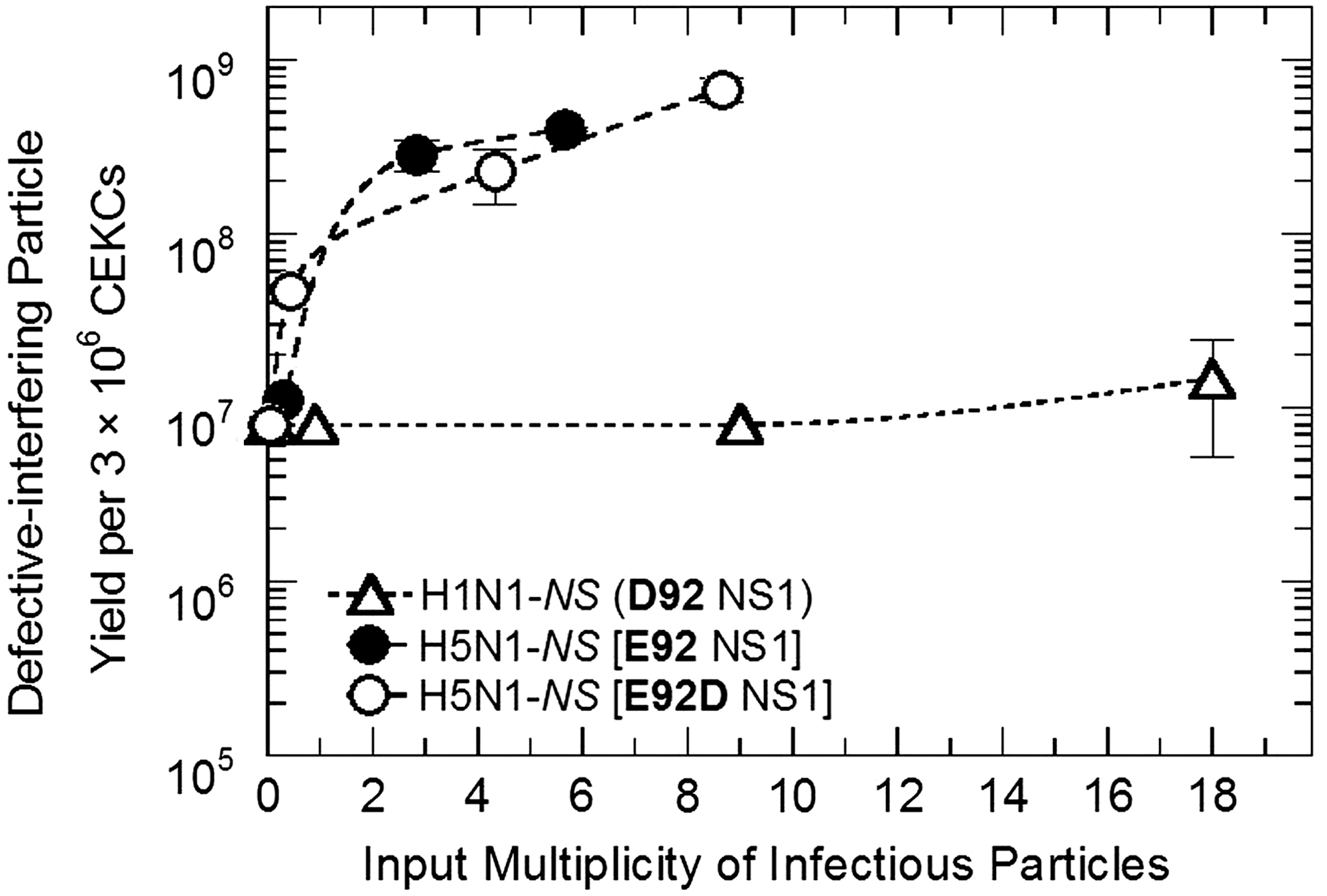
Multiplicity-dependent generation of defective-interfering particles (DIPs) in CEKCs. A series of confluent cell monolayers were infected with increasing multiplicities of infectious particles. Supernatants were harvested 24 hpi and DIPs quantified by yield-reduction assay as described in Materials and Methods section.
Full IFN-induction dose–response curves, quantum (peak) yields of IFN, and titration of IFN-inducing particles
Only when full IFN-induction dose (multiplicity of IFN-inducing particles)–response (IFN yield) curves are generated (Marcus 1986; Marcus and others 2010; Malinoski and Marcus 2012a; Ngunjiri and others 2012a) is it possible to determine: (1) the QY of IFN produced by the cells; (2) the number of particles that contribute to that yield; (3) the apparent efficiency of IFN-inducing particles; and (4) the type of IFN-induction curve produced as determined by a Poisson distribution of the IFN-inducing particles, and ISPs, among the cell subpopulations (Marcus and others 2005; Malinoski and Marcus 2012a; Ngunjiri and others 2012a). Figure 3 presents a series of dose–response curves generated in both aged CECs and Marc-145 cells. The titers of IFN-inducing particles calculated there from are shown in Table 1. Note that the H1N1-NS (D92 NS1) virus did not induce detectable amounts IFN in Marc-145 cells (<2 U/4.5
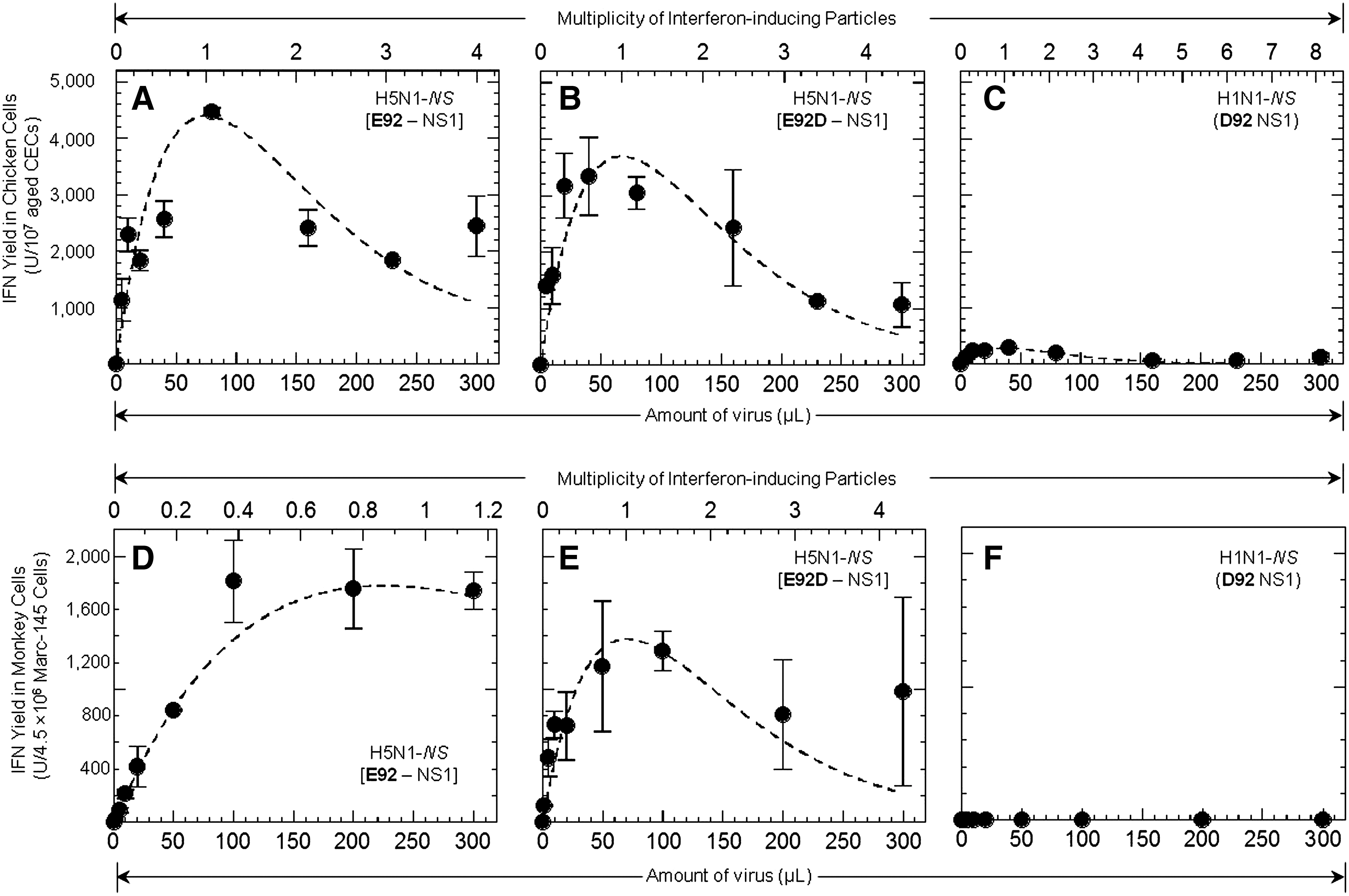
Type I IFN-induction dose–response curves. IFN yield (ordinate) as a function of virus dose (lower abscissa). The corresponding multiplicity of IFN-inducing particles was determined from the dose–response curves as detailed in Materials and Methods section.
Data generated with all 3 viruses in CECs and the 2 H5N1-NS reassortants in Marc-145 cells fit best type r=1 IFN-induction dose–response curves. These curves are observed when, in accord with the Poisson distribution of virus particles in the cell population, a single IFN-inducing particle per cell induces a QY of IFN, and the presence of
When tested in aged CECs, the H1N1-NS (D92 NS1) virus induced a QY of 300 U
Genetic basis of de novo DIP generation and enhancement of IFN-inducing particle efficiency
The large differences in the quantity and quality (efficiency) of IFN-inducing particles in populations of the H5N1-NS reassortants relative to that of the H1N1-NS (D92 NS1) virus, in spite of the shared genetic backbone, prompted a comparison of their NS gene sequences. Other than the E or D residue at position 92 of NS1 protein, the 2 H5N1-NS reassortants each differed from the H1N1-NS (D92 NS1) virus by 27 or 28 aa, and 9 aa, scattered along the NS1, and NS2 proteins, respectively (Table 2). Thus, the differences in biological activities reported herein (Figs. 1 –3 and Table 1) may be due to multiple amino acid substitutions. It is likely that not all the aa changes noted in Table 2 are required to express the observed phenotypes, but the fact that any 1 or a combination of up to 37 substitutions (between NS1 and NS2) may be the key determinant(s) makes it difficult to draw definitive conclusions (see Discussion section).
Sequenced from virus preparations used in this study.
The only difference between H5N1-NS (E92 NS1) and H5N1-NS (E92D NS1) viruses is E or D reside at position 92.
The de novo generation of DIPs by the H5N1-NS reassortants compares with that reported previously for A/Aichi/2/68 (H3N2) virus NS reassortants in the background of A/WSN/33 (H1N1) or A/Ann Arbor/6/1960 (H2N2) viruses (Odagiri and Tobita 1990; Odagiri and others 1994). In those reports, generation of DIPs was attributed to the I32T substitution in the NS2 protein even though no data were provided to support the claim that an A/Aichi/2/68-NS reassortant without the substitution did not generate these particles (Odagiri and Tobita 1990; Odagiri and others 1994). We found the I32T substitution was not critical in the context of H5N1-NS reassortants because the NS2 proteins encoded by these viruses have the consensus I32 residue.
Discussion
The accelerated rate of apoptosis induced by the H5N1-NS reassortants, encompassing all cell types present in monolayers of primary CEKCs, and apparent from the clear plaques observed at 72 hpi (Fig. 1), is characteristic of viruses encoding C-terminally truncated NS1 proteins (Zhirnov and others 2002; Ngunjiri and others 2008; Marcus and others 2010). This NS1 deficiency in downregulating apoptosis may be one of the viral factors contributing to the apoptosis-associated pathogenesis of H5N1 viruses (Uiprasertkul and others 2007).
In contrast to the H5N1-NS reassortants, the H1N1-NS (D92 NS1) backbone donor virus did not generate significant levels of DIPs even after high multiplicity passages conventionally considered to enhance formation of these particles (Table 1 and Fig. 2). Although each of the 3 viruses was independently created through reverse genetics, all were propagated under low multiplicity conditions. Accordingly, the H5N1-NS mediated de novo generation of DIPs in the A/PR/8/34 virus background was observed independent of whether the NS1 residue 92 was E or D. While our data do not rule out a causal effect between the high QYs of IFN induced by the H5N1-NS reassortants (Fig. 3) and de novo generation of DIPs, they suggest that the presence of IFN restricts high multiplicity multicycle replication that classically leads to amplification of these particles (Unpublished data). Yet, the presence of large subpopulations of DIPs in populations of different influenza viruses maintained by low multicity passages is intriguing (Marcus and others 2009). We propose that generation of DIPs depends on the degree of compatibility between the NS1 protein and the viral polymerase proteins. Our recent data support this model: isogenic variants of A/TK/OR/71(H7N3) virus that encode identical NS2 proteins, but truncated NS1 proteins of different lengths (Wang and others 2008) generated larger subpopulations of DIPs relative to the wild-type virus (Marcus and others 2010; Ngunjiri and others 2012a). Independently, a variant of the PR8 virus that lacked the entire NS1 gene was shown to synthesize small subgenomic RNAs that associated with RIG-I (Baum and others 2010), that is, potential precursors of DIPs. We contend that these particles are generated when NS1, but not NS2, fails to interact optimally with the replication/transcription complex (Wang and others 2010).
Induction of an order of magnitude or higher QYs of IFN by the H5N1-NS reassortants in both avian and mammalian cells (Table 1 and Figs. 2 and 3) was unexpected since these viruses encode full-size NS1 proteins, well known to block IFN induction (Richt and Garcia-Sastre 2009; Wolff and Ludwig 2009). Thus, the NS1 protein of A/HK/156/97 (H5N1) virus functionally mimicked deletion of the entire NS1 gene or expression of C-terminally truncated NS1 proteins by the A/PR/8/34 (H1N1) virus (Wang and others 2008; Richt and Garcia-Sastre 2009; Marcus and others 2010; Ngunjiri and others 2012a). Although we did not test the IFN-inducing capacity of the A/HK/156/97 virus, other genetically related H5N1/97 viruses have been shown to induce high levels of cytokine mRNAs, including TNF-α and IFN-α/β (Cheung and others 2002; Mok and others 2009). In those reports, H1N1 viruses, reassortant H1N1 viruses carrying the H5N1/97-NS, and H5N1-NS donor viruses induced low, intermediate, and high levels of cytokines, respectively (Cheung and others 2002; Mok and others 2009). Thus, it appears the A/HK/156/97 NS donor virus can induce QYs of IFN that are higher than those induced by the H5N1-NS reassortant viruses in Marc-145 cells and aged CECs (Fig. 3). In that case, the NS1 from the lethal H5N1 viruses isolated in 1997 appears to be intrinsically dysfunctional at suppressing induction of IFN and other cytokines.
The DIPs generated de novo by the H5N1-NS reassortants may have contributed to the QYs of IFN by enhancing IFN-inducing particle efficiency through ablation of at least one polymerase subunit gene (Ngunjiri and others 2012a) and the subsequent failure to synthesize functional viral polymerase proteins (Akkina and others 1984) required to suppress IFN induction (Marcus and others 2005; Rodriguez and others 2007, 2009; Graef and others 2010; Iwai and others 2010; Vreede and Fodor 2010; Malinoski and Marcus 2012a; Ngunjiri and others 2012a). It was recently demonstrated that the NS1 protein and the polymerase complex of the highly pathogenic A/chicken/Yamaguchi/7/04 (H5N1) virus acted in concert to suppress induction of chicken-type I IFN in HD-11 cells (Liniger and others 2012). However, the NS1 protein of the low pathogenicity A/TK/OR/71 (H7N3) virus was dominant over the viral polymerase in suppressing IFN induction in aged CECs (Malinoski and Marcus 2012b). This calls for more data from different isolates of influenza virus. However, it appears that the balance between NS1 and the viral polymerase in suppression of IFN induction may differ from strain to strain.
Significant subpopulations of IFN-inducing particles were detected in CECs for all 3 viruses, and in Marc-145 cells, only for the H5N1-NS reassortants (Fig. 2A–E and Table 1). The H1N1-NS (D92 NS1) virus failed to induce detectable yields of IFN in Marc-145 cells presumably due to the absence of functional IFN-inducing particles in these cells. However, we do not yet understand why the H1N1-NS (D92 NS1) IFN-inducing particles detected in aged CECs were very inefficient at inducing IFN (Table 1).
Are IFN-inducing particles infectious? Previously, A/TK/OR/71 (H7N3) virus and its variants, which encode C-terminally truncated NS1 proteins were shown to generate populations with IFN-inducing:infectious particle ratios that ranged from: 3–2,370; 1–4; and 0.34–1 when the inducing particles were measured in CECs, Marc-145, and L(Y) cells, respectively (Marcus and others 2010; Ngunjiri and others 2012a). In contrast, the IFN-inducing:infectious particle ratios for all 3 of the A/PR/8/34-based viruses presented herein were approximately 1.0 (range 0.4 to 1.2) in both CECs and Marc-145 cells; these are considered experimentally indistinguishable. Either (1) infectious particles also functioned as IFN-inducing particles or (2) the viruses contained distinct IFN-inducing and infectious particle subpopulations of nearly equal sizes. Based on the preferential loss of infectivity relative to the IFN-inducing capacity following exposure to heat (Isaacs and Lindenmann 1957; Marcus and others 2005; Malinoski and Marcus 2012b) or UV radiation (Marcus and others 2005; Malinoski and Marcus 2012b), it is clear that an inducing particle need not be infectious to express its phenotype (Marcus and others 2005). Nonetheless, infectious particles function as precursors of IFN-inducing particles, as they do for all other noninfectious biologically active particles (Marcus and others 2009).
Data presented herein contrast with the report that both wild-type A/PR/8/34 virus and an isogenic A/HK/156/97 (H5N1)-NS reassortant did not induce detectable levels of IFN-α in M1 cells (Dankar and others 2011). However, without data from full IFN-induction dose–response curves, it cannot be assumed that the single virus dose used in their experiments was optimal for IFN induction (contrast Fig. 7 in Dankar and others 2011, and Fig. 3 herein). Regardless, the H5N1-NS reassortants induced high QYs of IFN (Fig. 3) even though the NS1 proteins encoded by these viruses contained the L103, I106, A149, and S42 residues reported to be critical for suppression of IFN induction by H5N1 viruses (Li and others 2006; Jiao and others 2008; Dankar and others 2011). The large variation between proteins encoded by the NS gene segments of A/PR/8/34 and A/HK/156/97 viruses (Table 2) indicates that enhancement of IFN induction (Fig. 3) may not be associated with single NS1 residues. Thus, it appears that the role of individual residues of NS1 in suppressing IFN induction is dependent on the viral background in which the NS1 is expressed.
Further, reassortants that readily generate large DIP subpopulations may be desirable as live-attenuated influenza vaccines (LAIVs), since these particles serve as an attenuating factor (Bean and others 1985; Chambers and Webster 1987; Easton and others 2011) that acts independent of the virus subtype (Nayak and others 1985; Marcus and others 2010; Easton and others 2011). Similarly, enhanced levels of IFN provide an additional attenuation factor because IFN is known to exert a serotype-independent block of influenza virus replication (Portnoy and Merigan 1971; Sekellick and others 2000; Hayman and others 2006; Cauthen and others 2007; Szretter and others 2009; Marcus and others 2010; Haasbach and others 2011; Ngunjiri and others 2012b). Furthermore, reassortants that induce high QYs of IFN may be used as formulations of self-adjuvanting LAIVs (Bracci and others 2005; Hai and others 2008; Marcus and others 2010). Lastly, we suggest that in vitro subpopulation analysis of reassortant viruses as part of the process for screening candidate vaccine strains may reduce the number of animals required and provide a rational approach to maximize the development and production of vaccines (Robertson and others 2011).
Footnotes
Acknowledgments
This study benefited from the services of the Animal Cell Culture Facility of the Biotechnology-Bioservices Center of the University of Connecticut, and a consistent source of primary CECs and CEKCs from Charles River SPAFAS, Storrs, CT. This research was supported by a donation to the University of Connecticut's Virus and Interferon Research Laboratory.
Author Disclosure Statement
No competing financial interests exist