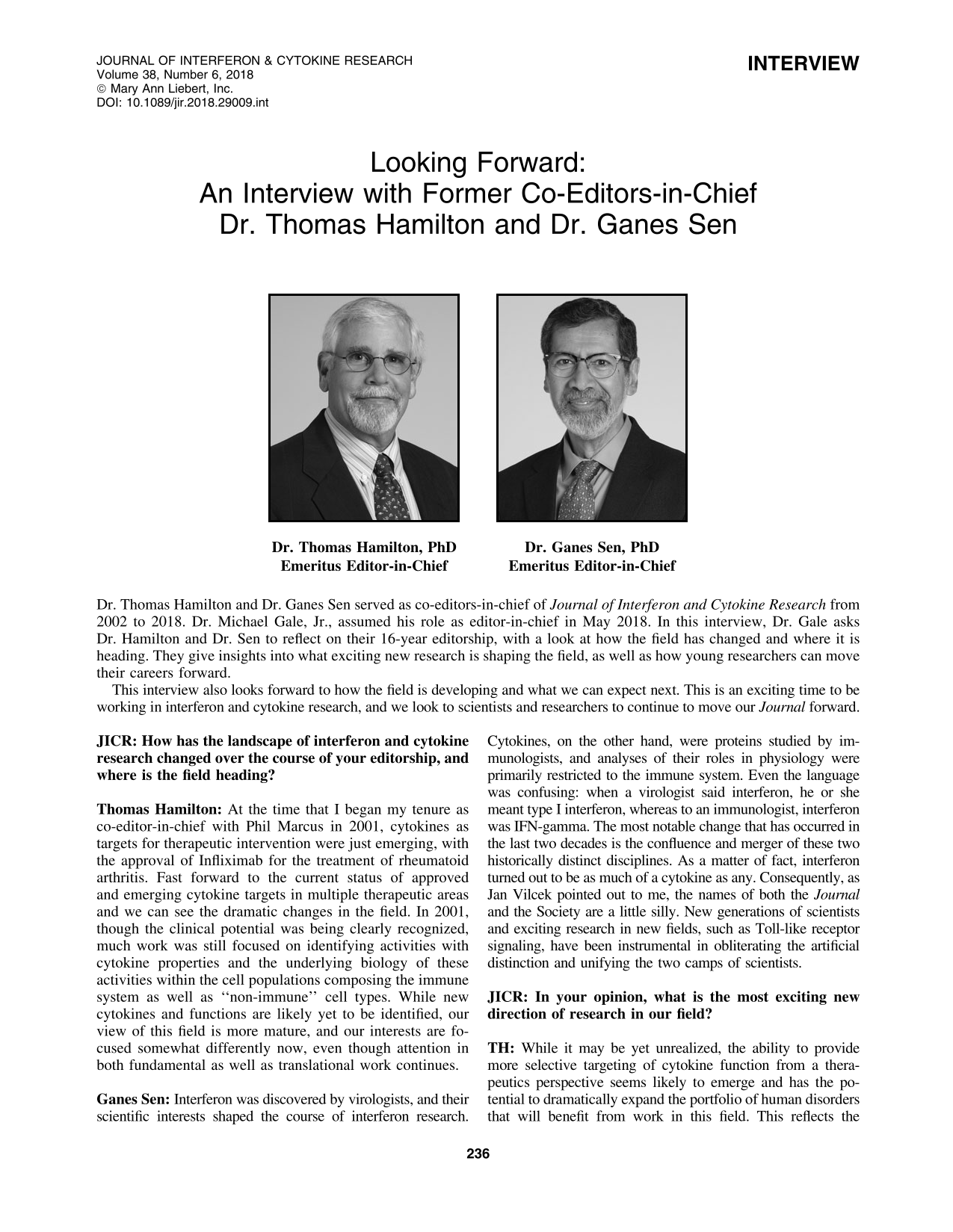
Dr. Thomas Hamilton and Dr. Ganes Sen served as co-editors-in-chief of Journal of Interferon and Cytokine Research from 2002 to 2018. Dr. Michael Gale, Jr., assumed his role as editor-in-chief in May 2018. In this interview, Dr. Gale asks Dr. Hamilton and Dr. Sen to reflect on their 16-year editorship, with a look at how the field has changed and where it is heading. They give insights into what exciting new research is shaping the field, as well as how young researchers can move their careers forward.
This interview also looks forward to how the field is developing and what we can expect next. This is an exciting time to be working in interferon and cytokine research, and we look to scientists and researchers to continue to move our Journal forward.
JICR: How has the landscape of interferon and cytokine research changed over the course of your editorship, and where is the field heading?
Thomas Hamilton: At the time that I began my tenure as co-editor-in-chief with Phil Marcus in 2001, cytokines as targets for therapeutic intervention were just emerging, with the approval of Infliximab for the treatment of rheumatoid arthritis. Fast forward to the current status of approved and emerging cytokine targets in multiple therapeutic areas and we can see the dramatic changes in the field. In 2001, though the clinical potential was being clearly recognized, much work was still focused on identifying activities with cytokine properties and the underlying biology of these activities within the cell populations composing the immune system as well as “non-immune” cell types. While new cytokines and functions are likely yet to be identified, our view of this field is more mature, and our interests are focused somewhat differently now, even though attention in both fundamental as well as translational work continues.
Ganes Sen: Interferon was discovered by virologists, and their scientific interests shaped the course of interferon research. Cytokines, on the other hand, were proteins studied by immunologists, and analyses of their roles in physiology were primarily restricted to the immune system. Even the language was confusing: when a virologist said interferon, he or she meant type I interferon, whereas to an immunologist, interferon was IFN-gamma. The most notable change that has occurred in the last two decades is the confluence and merger of these two historically distinct disciplines. As a matter of fact, interferon turned out to be as much of a cytokine as any. Consequently, as Jan Vilcek pointed out to me, the names of both the Journal and the Society are a little silly. New generations of scientists and exciting research in new fields, such as Toll-like receptor signaling, have been instrumental in obliterating the artificial distinction and unifying the two camps of scientists.
JICR: In your opinion, what is the most exciting new direction of research in our field?
TH: While it may be yet unrealized, the ability to provide more selective targeting of cytokine function from a therapeutics perspective seems likely to emerge and has the potential to dramatically expand the portfolio of human disorders that will benefit from work in this field. This reflects the increasing understanding of how cytokines work to modulate cellular function and the finding that many have the capacity to signal to multiple potentially independent endpoints through structurally distinct mechanisms. As the fundamental understanding of this complexity develops, potential applications will also expand. I would expect this to be a growth area for the next few years.
GS: It has been exciting to see revelation of new causal connections between inherited diseases and genetic defects in components of cytokine synthesis or functions. The realization of broad physiological functions of cytokines—including interferons—in health and diseases, is exciting. Is interferon a major player in reproduction? Does endogenous interferon promote or impair cancer progression? The old question of why so many interferon-alphas has been expanded by what can type III interferon do that type I interferon cannot? In real life, no cytokine functions in isolation. Our field is now mature enough to interrogate meaningfully how different cytokines regulate the functions of others. Such investigations are not only mechanistically illuminating, but they provide clinically important insights as well.
JICR: What are the most promising developments in the use of cytokines to treat various diseases?
TH: The expansion of cytokine targets in inflammatory and autoimmune disease is likely to continue, though this has often had a significant empirical component as the understanding of individual cytokine cascade dynamics in different settings of inflammatory pathogenesis remains largely incomplete. Furthermore, there are many disorders where the current spectrum of anti-cytokine therapies have been ineffective or only partially so, and there is a large subset of patients who are unresponsive, even in disorders with known efficacy. Efforts to understand the complexity of cytokine networks and how they are contributing to disease (or protecting from disease) should receive strong emphasis as a means to address these deficiencies. Continued integration of informatics with omics-based analysis of different conditions will likely contribute to the identification of genetic or proteomic nodes where intervention might be successful, and I would expect this to be a particularly productive strategy that can more rapid progress.
GS: Therapeutic use of cytokines or their antagonists requires a fine balancing act. Although hyper-inflammation contributes to several major diseases, regulated inflammatory response is required to resolve many pathological conditions. Moreover, extensive crosstalk among different cytokines compromises the specificity of any intended intervention. In spite of these limitations, interferons and other cytokines have been successfully used in treating specific diseases. More dramatic has been the use of inhibitors of specific cytokines in various autoimmune diseases. As bench research progresses, pertinent information will lead to more focused cell-type and organ-specific transient interventions that can harness the desired effects without the negative side effects.
JICR: What are the chief challenges we face in cytokine and interferon research?
TH: A significant challenge will be obtaining adequate support for fundamental cytokine biology research, as emphasis is increasingly placed on identifying and testing therapeutic potential in various disease settings. The current enthusiasm for immune/inflammatory function in cancer biology and its potential as therapeutic target is driving much of this, and this will likely continue as the success of immunotherapy expands to include a broader cohort of cancer types. This emphasis will potentially reduce work to dissect the complexity of cytokine signaling pathways and how they connect to diverse functional endpoints, and will ultimately slow the development of newer and more specific applications.
GS: Some current challenges are generic, such as the scarcity of funding from the National Institutes of Health for discovery research or the drastic reduction of in-house research in the pharmaceutical industry. As a result, it is difficult to investigate the biology of a cytokine unless it is closely connected to a specific major disease. Specifically, immunotherapy of cancer has become a popular area of research, and in this context, cytokines are bound to have major roles. It is not easy to engineer manipulation of their functions in the tumor microenvironment, and it will require more basic research on the subject to guide such therapies.
JICR: What advice would you give to students and postdocs in our field as they pursue research careers?
TH: In sticking with the themes outlined in the previous comments, I would encourage young scientists to develop and maintain some emphasis on structure and mechanism, as these are the foundation of developing successful therapeutic applications. Though it is tempting to focus on identifying strategies to interfere with or enhance cytokine functions, knowledge of how and why such strategies work and the ability to move such strategies into clinical practice is clearly dependent upon strong validation of target specificity and mechanism.
The ability to build and maintain a competitive and productive laboratory contributing high-impact outcomes depends increasingly on participating in larger teams that often span disciplines and institutions, and making the connections to enable these collaborative efforts should also be emphasized.
Finally, I think the choice of projects and strategies is a critical part of successful science. In this context, it is important to consider projects where the strategy can bring clarity to the problem. Furthermore, building projects around results and experience that provide some advantage relative to others working in the field should be an important consideration.
GS: Scientists in training should be encouraged to pursue important biological questions and/or focus on the prevention and cure of specific diseases. They should not be constrained by technical expertise. One can readily learn a technique from others, but it is much more difficult to learn how to frame an unambiguous and important question that can be answered using available experimental tools. For cytokine biologists, it is important to be comfortable doing experiments with both cultured cells and mice. Establishing a scientific identity requires defining your own niche: you can be the world's expert on IL-87 or you can be the world's expert on athlete's foot. It's even better if you are the world's expert on the role of IL-87 in athlete's foot, but you have to make the choice and stick to it. Focusing is especially important in the early stages of your independent career.
JICR: How can theJournalwork toward facilitating the success of our research field?
TH: The Journal needs to be flexible to enable change in parallel with the science of cytokine and interferon biology. The connection with the International Cytokine and Interferon Society will be important in this context, as this community is also providing vehicles (annual meeting, newsletters, etc.) for the distribution of both scientific and social information. In addition, in the new landscape of open-access publishing, being creative and developing new ways of providing scientific knowledge to the community will be critical for both survival and success. Maintaining the emphasis on fundamental mechanistic science and providing appropriate and critically reviewed coverage of the advances in application of cytokine and interferon biology in the clinical setting will both be important topic areas.
GS: Quality control of what we publish is the foremost criterion for keeping the Journal respectable. However, it needs to be financially viable as well. As the field changes, the Journal should not shy away from changing. For example, publication of more review articles could be beneficial to the field. Maybe it is time to expand membership of the club. Because cytokines are important in many contexts, scientists in other fields, such as neurosciences, reproductive biology, and ophthalmology, will benefit from participation as authors and editors. Finally, modernizing the Journal with new interactive information exchange tools will make it more accessible and useful.