




Abstract
Sedentary behavior increases the risk of many chronic disorders, in addition, these chronic diseases are associated with elevated markers interleukin-6 (IL-6). Increasing evidence indicates that physical activity can prevent chronic inflammatory disease. However, the effect of exercise on sedentary individuals with disparate basal serum IL-6 level was not well elucidated. In this study, the gene expression profile of GES12384 was downloaded from the Gene Expression Omnibus (GEO) database. This data set contained 12 sedentary middle-aged men (6 high IL-6 and 6 low IL-6 level), and their blood samples were taken in the pre-exercise period and at the end of 24 weeks of exercise. The differentially expressed genes (DEGs) of 24 weeks group were identified, followed by functional enrichment analysis. Subsequently, protein–protein interaction (PPI) network and transcription factors (TFs)-DEGs network were constructed. A total of 193 DEGs were identified between high and low IL-6 level in the 24 weeks group. Functional enrichment analysis showed that DEGs were mainly involved in African trypanosomiasis pathway. PPI network revealed that the hub genes included C-C motif chemokine receptor 7 (CCR7), hemoglobin subunit delta (HBD), and interferon gamma (IFNG). Subnetworks analysis indicated that these genes were relevant to immune response, and participated in African trypanosomiasis pathway. The TF targets network found that myocyte enhancer factor 2A (MEF2A) was a key regulatory factor. In conclusion, the inflammation-related genes (CCR7, HBD, and IFNG) in sedentary individuals could be affected by exercise, and the identified DEGs and TFs in this study promoted our understanding of exercise inhibited the development of chronic disease.
Color images are available online
Introduction
Many chronic and immune-related diseases are associated with elevated markers of inflammation, such as interleukin-6 (IL-6) (Starr and others 2015). IL-6 is a pleiotropic cytokine, which is closely related with immune response, acute phase response, and hematopoietic regulation (Larkin III and others 2013; Teles and others 2013). IL-6 has been reported to regulate the differentiation and activation of T cells (Yuk and others 2017). Besides, IL-6 is involved in the pathogenesis of many chronic inflammatory and autoimmune diseases. A study reported by Ferrucci and others (1999) indicated that higher circulating levels of IL-6 could predict disability onset in older persons, suggesting IL-6 plays pathophysiologic role in specific diseases.
In addition, Cohen and others (1997) observed that IL-6 level might be a measurement index of health, and dysregulation of IL-6 was associated with the functional disability seen with aging. Moreover, high serum level of IL-6 is related to high degree of tumor progression, systemic weakness, and several chronic inflammatory diseases (Miura and others 2015; Vafa 2019). Thus, IL-6 inhibitors have become a new idea for the autoimmune and chronic inflammatory diseases treatment (Neurath and Finotto 2011; Kim and others 2015).
Reportedly, physical exercise, as a natural and strong anti-inflammatory strategy, is also widely used in alleviating chronic progression, such as cardiovascular disease, type-2 diabetes, and obesity (Ambrose and Golightly 2015; Pedersen 2017). Exercise can change the inflammatory cycle biomarkers (Papini and others 2014). Farinha found that after 12 weeks aerobic exercise, the level of inflammatory biomarkers, including IL-6, interleukin-1β (IL-1β), tumor necrosis factor α (TNF-α), and interferon-γ (IFN-γ), was decreased in women with metabolic syndrome (Farinha and others 2015). Starkie and others (2003) also found exercise could inhibit the production of TNF-α in the body. Therefore, moderate exercise training can improve systemic inflammation and reduce the risk of low-grade inflammation (McCarthy and others 2015; Sathyan and others 2015).
Sedentary behaviors, such as sitting, watching TV, using a computer, and driving, are characterized by little physical movement and low energy expenditure. Convincing evidence indicates that sedentary behavior can increase the risk of many chronic disorders, such as type 2 diabetes (De Greef and others 2010), metabolic syndrome (Edwardson and others 2012), acute coronary syndrome (Zhu and others 2018), and obesity (Biddle and others 2017). A systematic review showed that self-directed exercise programs in sedentary middle-aged individuals were successful in improving cardiorespiratory fitness, physical characteristics, and metabolism (Byrne and others 2018). However, changes in gene expression in sedentary individuals with different basal serum IL-6 levels following an organized physical activity program has not been elucidated.
In this study, the gene expression profile (GSE12384) was downloaded from Gene Expression Omnibus (GEO) database, then differentially expressed genes (DEGs) between basal and 24 weeks exercise were identified, followed by functional enrichment. Subsequently, the protein–protein interaction (PPI) network and transcription factor (TF)-DEGs network were constructed. This study aimed to identify the genes related to both IL-6 level and exercise, revealing the effects of exercise on sedentary individuals with different basal serum IL-6 levels.
Materials and Methods
Affymetrix microarray data
The gene expression profile of GSE12384 was downloaded from the National Center for Biotechnology Information (NCBI) GEO database (Starr and others 2015), which was based on the GPL4133 Agilent-014850 Whole Human Genome Microarray 4x44K G4112F (Feature Number version) platform. This data set comprised 24 sedentary middle-aged men (mean age 52.6 years and body mass index 29.1 kg/m2), who undertook a 24-week physical activity program, and their blood samples were taken in the pre-exercise period and at the end of 24 weeks exercise. The samples were divided into 2 groups, pre-exercise (basal group) and 24 weeks physical activity (24 weeks group). Each group includes 6 low IL-6 level (0.59 pg/mL) and 6 high IL-6 level (2.13 pg/mL), respectively.
Screening of DEGs
The raw data were normalized using the R software limma package (version 3.10.3) (Smyth and others 2005), including format conversion, missing value complement, background correction (MicroArray Suite method), and quantile method. The classical Bayesian method in the limma package was used to identify the DEGs between high IL-6 and low IL-6 level samples in the 2 groups, respectively. P < 0.05 and |logFC| > 0.585 were considered significant.
The bidirectional hierarchical cluster was conducted by pheatmap package based on the DEGs. Then, the DEGs in basal and 24 weeks groups were integrated, the common DEGs between basal and 24 weeks were considered as set 1, the unique DEGs in 24 weeks as set 2. DEGs in set 1 were related to IL-6, whereas DEGs in set 2 were associated with both exercise and IL-6 level.
Functional enrichment analysis
The database for annotation, visualization, and integrated discovery (DAVID, version 6.8,
PPI network and module analysis
The interaction between proteins encoded by DEGs was predicted by the search tool for the retrieval of interacting genes/proteins (STRING) database (version 10.0) (Szklarczyk and others 2014). To explore the change of IL-6 level-related DEGs, we chose set 2 for further study. The PPIs with a confidence of 0.15 were selected, and PPI network was structured using Cytoscape (version: 3.2.0).
The CytoNCA plugin (version 2.1.6) was applied to analyze the topology properties of the node in the network (Tang and others 2015). Important nodes that participated in the protein interaction relationship in the PPI network were obtained by referring to the ranking of each node's score (Bandettini and others 2012). In addition, Cytoscape MCODE plug-in (version 1.4.2) was used for searching clustered subnetwork, score >5 was considered as the threshold.
TF target regulation prediction
The TFs of the target genes were predicted by the iRegulon plugin of Cytoscape (Verfaillie and others 2014) (version 1.3). The parameters were set as follows: minimum identity between orthologous genes, 0.05; maximum false discovery rate on motif similarity, 0.001. A gene–TF pair with normalized enrichment score >4 was retained.
Results
DEGs screening and VENN analysis
According to the screening criteria, total 65 upregulated and 113 downregulated DEGs were obtained in the basal group (Fig. 1A), and a total of 193 DEGs (85 upregulated and 108 downregulated DEGs) were identified in the 24 weeks group (Fig. 1B). VENN analysis was performed based on the DEGs in the basal group and the 24 weeks group. There were 68 common DEGs and 125 unique DEGs in the 24 weeks group (Fig. 2).

Heat map of DEGs.
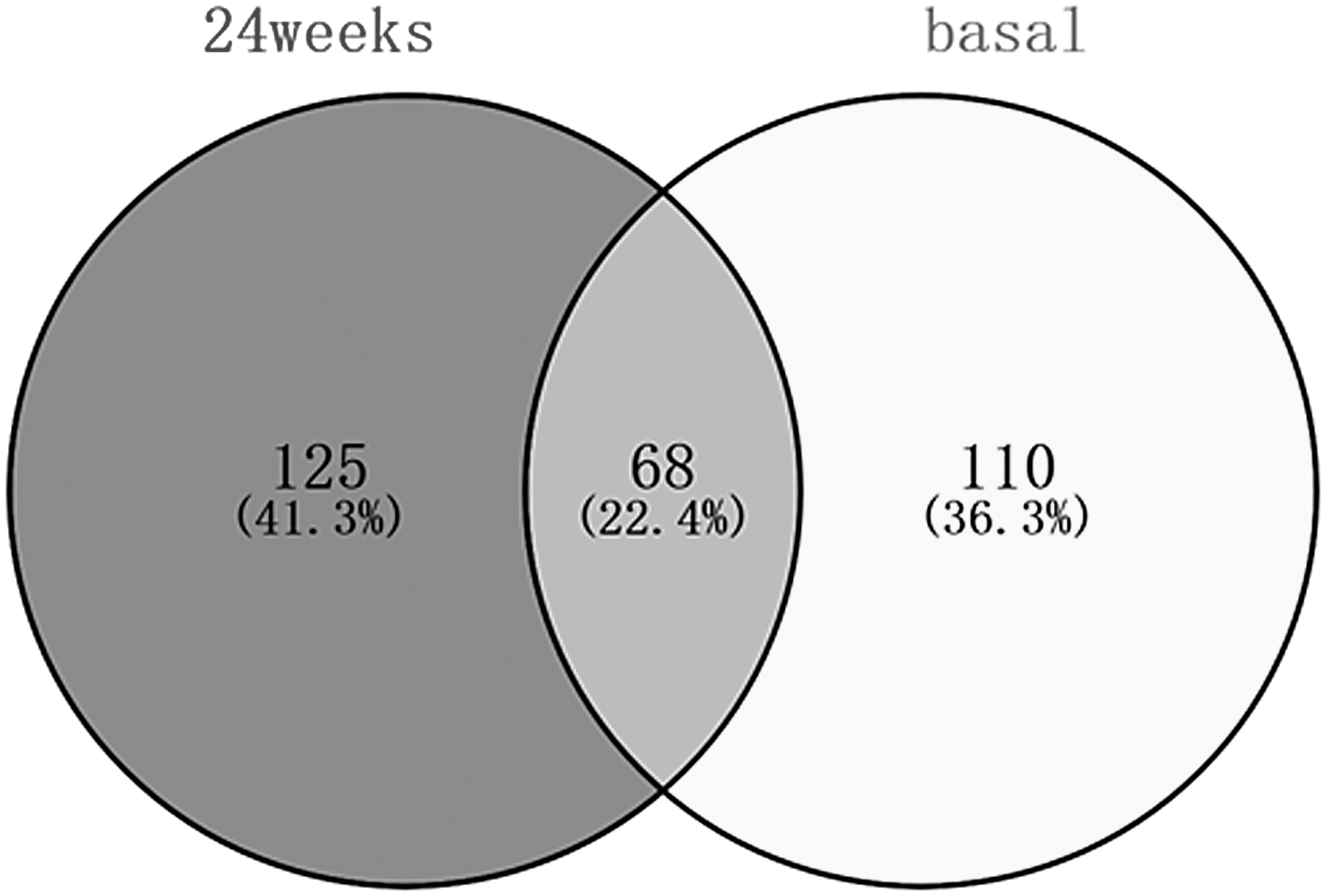
VENN analysis chart.
Functional enrichment analysis
The top 5 GO terms and KEGG pathways of the 24 weeks DEGs are listed in Table 1. The DEGs were mainly enriched in BP terms, such as oxygen transport, bicarbonate transport, response to hydrogen peroxide, and hydrogen peroxide catabolic process. Moreover, the DEGs participated in African trypanosomiasis, malaria, and cytokine–cytokine receptor interaction pathways.
The Kyoto Encyclopedia of Genes and Genomes Pathway and Top 5 Enriched Gene Ontology Terms for 24 Weeks Differentially Expressed Genes
BP, biological process; CC, cellular component; CCR7, C-C motif chemokine receptor 7; GO, Gene Ontology; HBA1, hemoglobin subunit alpha 1; HBD, hemoglobin subunit delta; IFNG, interferon gamma; KEGG, Kyoto Encyclopedia of Genes and Genomes; MF, molecular function.
PPI network and subnetwork module
According to the information in the STRING database, a PPI network consisted of 91 nodes and 260 interaction pairs were constructed (Fig. 3). Using MCODE to analyze the most significantly enriched modules, we observed there were 9 nodes and 36 interaction pairs in the subnetwork. The top 10 nodes are shown in Table 2.
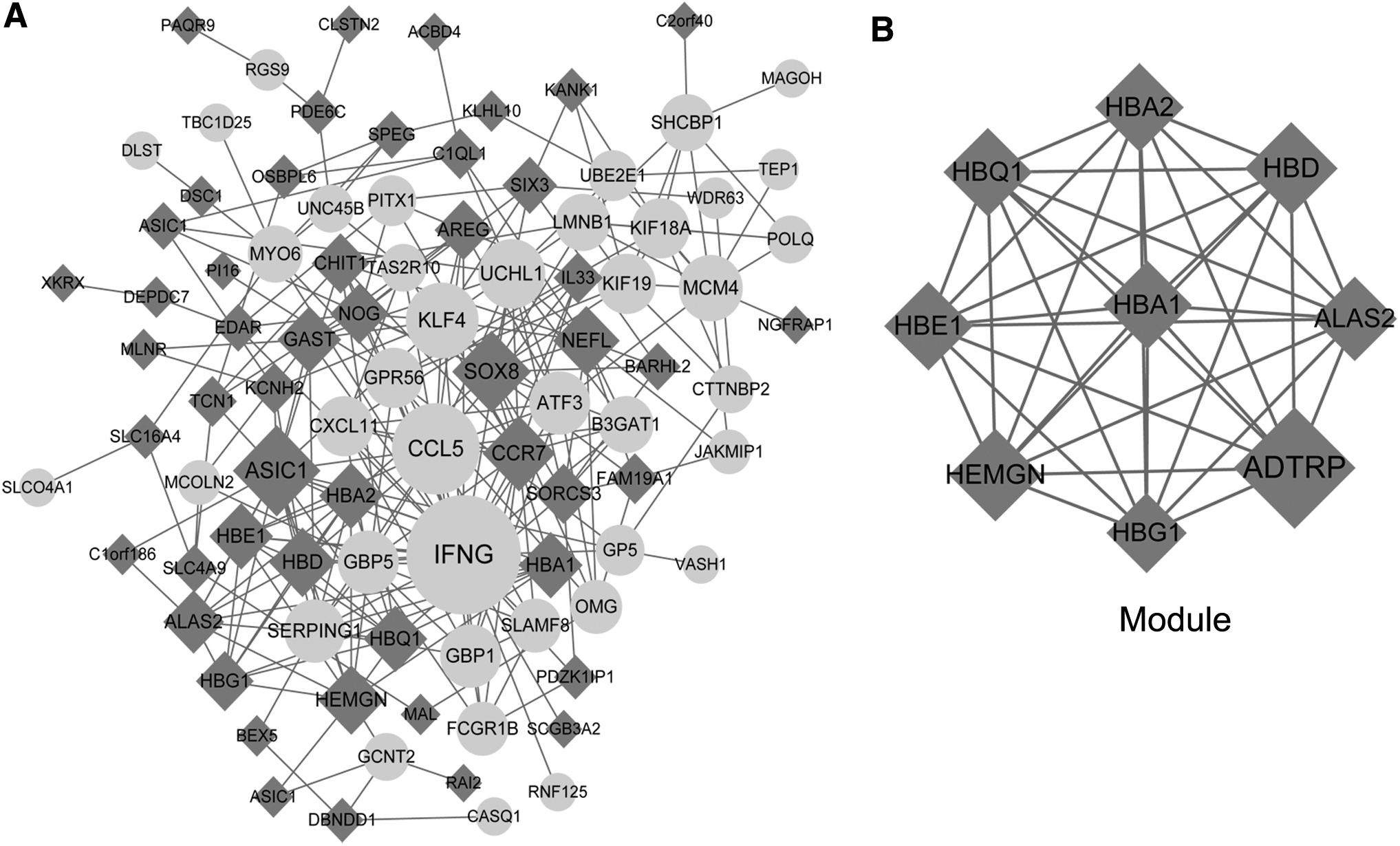
Degree Value (Top 10) and Module Gene List
ADTRP, androgen-dependent TFPI regulating protein; HEMGN, hemogen; PPI, protein–protein interaction; SOX8, SRY-box transcription factor 8.
In the PPI network, interferon gamma (IFNG, degree = 27), androgen-dependent TFPI regulating protein (ADTRP, degree = 18), C-C motif chemokine ligand 5 (CCL5, degree = 18), SRY-box transcription factor 8 (SOX8, degree = 15), and C-C motif chemokine receptor 7 (CCR7, degree = 13) might be considered as hub proteins. In the subnetwork, genes such as ADTRP (degree = 18), hemogen (HEMGN, degree = 11), hemoglobin subunit delta (HBD, degree = 11), and hemoglobin subunit alpha 1 (HBA1, degree = 10) with higher degrees, and might be recognized as key nodes. Furthermore, functional enrichment analysis of PPI and subnetwork was performed, respectively (Tables 3 and 4). The submodule was significantly involved in African trypanosomiasis and malaria.
The Kyoto Encyclopedia of Genes and Genomes Pathway and Gene Ontology Enrich Terms of Protein–Protein Interaction (Top 10)
The Kyoto Encyclopedia of Genes and Genomes Pathway and Gene Ontology Enrich Terms of Module
TF target regulatory network
The iRegulon was used to predict and analyze the TF target gene relationship pairs in the PPI network, 3 TFs, 49 genes, and 66 pairs were identified (Fig. 4). Estrogen Receptor 1 (ESR1), LIM Homeobox 9 (LHX9), and Myocyte Enhancer Factor 2A (MEF2A) were TFs.
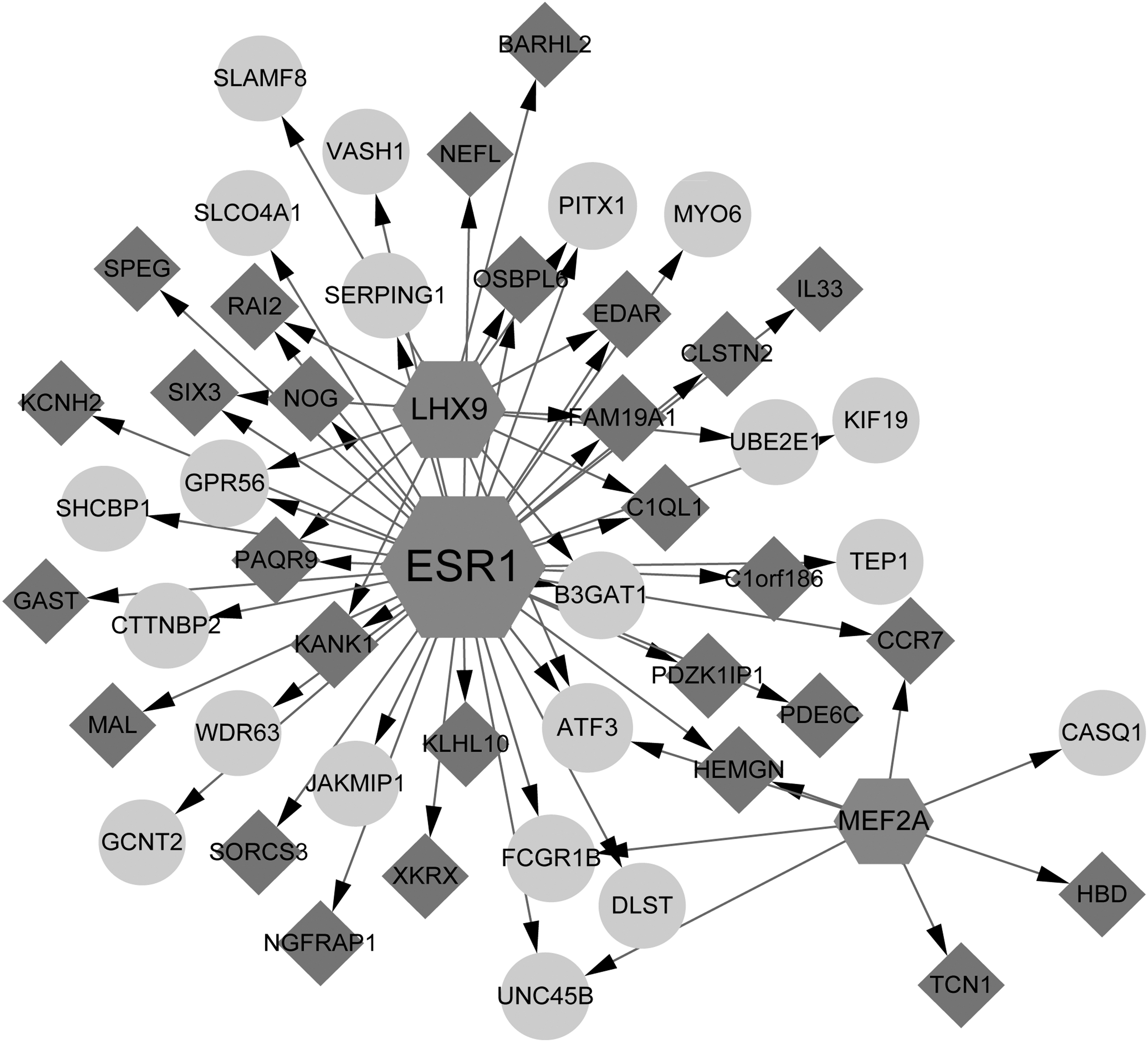
TF Target regulates the network analysis map. Circles represent the upregulated DEGs, prisms represent the downregulated DEGs, represents the TF, and the arrows connecting the lines represent the regulatory direction. TF, transcription factor.
Discussion
In this study, a total of 125 DEGs related to both IL-6 level and exercise were identified. IFNG, CCR7, and HBD genes were considered as hub genes in the PPI network, and might play crucial role in exercise among sedentary individuals. The DEGs were mainly enriched in oxygen transport, blood coagulation, and immune response. Besides, the KEGG pathways analysis showed that DEGs were involved in cytokine–cytokine receptor interaction, African trypanosomiasis, and malaria. According to the TF-DEGs network, we found ESR1, LHX9, and MEF2A were the key regulators.
During exercise, inflammatory factor IL-6 was active (Catoire and Kersten 2015); therefore, we studied the DEGs after exercise and revealed the specific effects of exercise on different IL-6 levels in sedentary individuals. In this study, we found that IFNG might be the hub gene and significantly enriched in immunoregulatory function.
IFNG is a member of the type II interferon class that encodes a soluble cytokine (Teles and others 2013). Based on its pleiotropic functions, IFNG plays a pivotal role in orchestrating immune system homeostasis (Larkin III and others 2013). Both in vitro and in vivo studies indicate that IFNG has been considered as a proinflammatory factor and showed pathogenic function in several chronic diseases (McCarthy and others 2015; Sathyan and others 2015). However, growing studies have demonstrated that IFNG also plays a protective role in immunological diseases, such as multiple sclerosis and its animal model experimental autoimmune encephalomyelitis (Billiau and others 1988; Duong and others 1992).
Ottum and others (2015) indicated that IFNG served protective effect on experimental autoimmune encephalomyelitis in low doses, whereas induced disease deterioration in high doses. These findings revealed the dual roles of IFNG in inflammation. Shaw and others (2020) observed that exercise induced the release of IFNG that modulates the immune responses of individuals. In addition, Vijayaraghava (2017) confirmed that regular physical activity of moderate nature protected against inflammation by increasing levels of IFNG. Similarly, we also found that IFNG was significantly upregulated in sedentary individuals after 24 weeks of exercise. Taken together, we speculated that moderate exercise training might induce beneficial effects on health through decreasing proinflammatory status.
Another gene, CCR7, was observed significantly downregulated in the 24 weeks exercise group. The proteins encoded by CCR7 belong to the G protein-coupled receptor family, and its receptor is expressed in various lymphoid tissues, as well as activates B and T lymphocytes (Fleige and others 2018). In addition, CCR7 has been reported to control the migration of memory T cells to inflamed tissues (Moschovakis and Förster 2012), and CCR7 promoter is involved in many inflammatory diseases through binding with nuclear factor-κB (Kumar and others 2004). Liu and others (2016) indicated that a decrease in CCR7 messenger RNA (mRNA) level could attenuate inflammatory cell infiltration into the lungs. Wei and others (2017) also found that CCR7 reduction weakened inflammatory response in serum.
Based on these findings, we suspected that CCR7 might play an important role in exercise of sedentary individuals by affecting inflammatory processes. However, follow-up investigation is needed to better understand the role of CCR7 in exercise. In the TF-DEGs regulatory network, MEF2A regulated involvement in oxygen transport and immune-related genes, such as HBD and CCR7. The protein encoded by MEF2A is involved in several cellular processes, such as cell growth control and apoptosis (Xiong and others 2019). Prior studies have suggested that through exercise training, MEF2A can be induced to be highly acetylated and enhance DNA-binding ability (Yuan and others 2014; Widmann and others 2019).
In addition, we found CCR7 and HBD were induced by MEF2A through 24 weeks exercise. James and others (2018) found that HBD was closely associated with inflammation, and upregulation of HBD was observed during infection and inflammation (Özdemir and others 2020). Furthermore, the expression of HBD-2 was inducible by inflammation in various tissues (Hosokawa and others 2006). In this study, we found that GO annotations related to HBD, including oxygen transport, iron ion binding, blood coagulation, and combination with oxygen. In the study of cardiopulmonary function and respiratory infections, HBD and inflammatory factors such as IL-6 and IFNG are involved in lung defense and repair (Smith and others 2019). Taken together, we revealed that MEF2A had turned out to be importantly involved in exercise by regulating inflammation-related genes.
In this study, the African trypanosomiasis was the most significantly enriched pathway. African trypanosomiasis is caused by infection with the tsetse fly-transmitted protozoan hemoflagellates trypanosoma brucei rhodesiense and
Moreover, the relationship between African trypanosomiasis and inflammation has been reported in many diseases, such as African trypanosomiasis-associated anemia (Yuk and others 2017), central nervous system inflammation, and inflamed gingival tissue (Vijayaraghava 2017; Fleige and others 2018). In our study, we observed the DEGs mainly participated in the African trypanosomiasis pathway, suggesting that the inflammation-related genes enriched in African trypanosomiasis were altered by exercise. Thus, exercise plays an active role in preventing inflammation.
Sedentary behavior not only increases the chronic inflammatory diseases risk, but also increases cancer risk (Lynch and others 2018; Patterson and others 2018). In addition, the level of IL-6 in inflammatory tissues were higher than that of healthy organizations (Sindhu and others 2015). Therefore, we speculated that people who were sedentary and had high levels of IL-6 might be more likely to suffer from various chronic diseases. The genes obtained in this study were principally associated with immunity and inflammation, hence exercise might prevent the chronic inflammatory disease in sedentary people.
Conclusion
In summary, our data provided a systematic bioinformatics analysis of DEGs, which might be related to both exercise and IL-6 level. CCR7, HBD, and IFNG might serve vital role in reducing inflammation by exercise, and these genes might prevent the risk of chronic diseases in sedentary individuals. However, further experimental studies are urgently demanded to validate our findings.
Footnotes
Author Disclosure Statement
The authors declare that they have no conflict of interest.
Funding Information
No funding statement was provided.