




Abstract
The purpose of this study was to observe the role of vitamin D levels with T helper 1 (Th1)-type cytokines, such as interferon γ (IFN-γ) and interleukin-12 (IL-12) efficacy, in those who had already received 2 injections of inactivated severe acute respiratory syndrome coronavirus 2 (SARS-CoV2) vaccines (CoronaVac). We also observed if these cytokines played any significance in the CoronaVac effectiveness for preventing coronavirus disease 2019 (Covid-19) infection. One hundred ninety-four volunteers were monitored for 8 months upon receiving 2 inactivated SARS-CoV2 vaccination injections (CoronaVac, Sinovac Life Sciences). The rate of confirmed Covid-19 infections was the primary outcome. Six to 7 weeks after the second vaccine injection, and blood samples were obtained to measure the serum vitamin D, IFN-γ, and IL-12 levels. Low vitamin D level was defined if vitamin D level <30 ng/mL. Subjects with low vitamin D had lower IFN-γ and IL-12 levels (P = 0.04 and P = 0.04, respectively). The receiver operating characteristics curve analysis revealed that the area under curve for IFN-γ was 0.59, whereas IL-12 was 0.59 for predicting the low vitamin D levels. During follow-up, a higher incidence of Covid-19 infections was observed in subjects with low IFN-γ levels (P = 0.03). Kaplan–Meier survival analysis revealed that the cumulative hazard of confirmed Covid-19 cases was increased in subjects with low IFN-γ levels (log-rank test, P = 0.03). We concluded that lower vitamin D level was correlated with a lower Th1 immune response, whereas the adequate IFN-γ level was required to obtain better CoronaVac effectiveness.
Introduction
The World Health Organization (WHO) declared coronavirus disease 2019 (Covid-19) a pandemic in March 2020, affecting 267.88 million people and 5.292 deaths worldwide as of December 8, 2021. The severe acute respiratory syndrome coronavirus 2 (SARS-CoV2) causes Covid-19, with a wide range of clinical symptoms, ranging from asymptomatic to severe disease (Mohamadian and others 2021). Quarantine, isolation, and physical separation are being used to contain the outbreak at the moment. However, creating a vaccine is a top priority because of the rapid global spread of SARS-CoV2 infection and the high fatality rate. Vaccination will stop Covid-19 from spreading and reduce mortality (Wibawa 2021).
China, Russia, the United Kingdom, the United States, and other countries have all developed vaccine candidates (Marian 2021). CoronaVac, created by Sinovac Life Science in Beijing, China, was the first vaccine to enter and be widely marketed in Indonesia. CoronaVac is an inactivated SARS-CoV2 vaccine demonstrated to induce neutralizing antibodies against SARS-CoV2 in mice, rats, and nonhuman primates (Gao and others 2020). CoronaVac also showed outstanding safety, tolerability, and immunogenicity in China's phase 1/2 clinical trial (Zhang and others 2021).
Several factors might contribute to antibody production after vaccination, including the T helper 1 (Th1) type cytokines. Th1 cytokines, such as interferon γ (IFN-γ), has been demonstrated can enhance the protective immunity in several vaccines (Zhu and others 2017; Zhang and others 2018). Not only IFN-γ, another cytokine that contributes to the Th1 pathway, but interleukin-12 (IL-12) is also associated with a better immunization response in several studies (Iyori and others 2017; Xie and others 2020). Another factor that may contribute to the vaccine response and effectiveness is the vitamin D levels. The role of vitamin D in enhancing immunogenicity against vaccines has been described before (Chadha and others 2011; Patel and others 2019).
In addition, vitamin D is associated with host defense mechanisms against several microbes, including against the SARS-CoV2 virus and associated with poor outcomes in patients with Covid-19 (Annweiler and others 2020; Susianti and others 2021). However, the role of vitamin D in the immune system, especially for the Th1 type cytokines, is somewhat controversial. Most studies found that vitamin D downregulates the Th1 immune responses, especially in patients with autoimmune disease (Colotta and others 2017). In other cases, such as infection, vitamin D has a vital role in modulating the Th1 immune response. Sufficient vitamin D levels are required for the production of the IFN-γ-induced antimicrobial pathway against tuberculosis (Fabri and others 2011). Moreover, Spanier and others (2012) demonstrated that IFN-γ is also needed for vitamin D receptor gene expression.
Despite the recent controversies about the role of vitamin D in the Th1-type immune responses, there has not been any single study that investigated the function of vitamin D and Th1 cytokines in the vaccine effectiveness against Covid-19. Therefore, this study aimed to observe the correlation between the vitamin D levels and Th1-type cytokines, including the IFN-γ and IL-12. In addition, we also wanted to investigate the role of these cytokines in the vaccine effectiveness in the subjects who already received a full dose of inactivated SARS-CoV2 vaccines (CoronaVac).
Materials and Methods
Study design and participants
From February to September 2021, we conducted a prospective observational study that used a prospective cohort approach. The participants in the study were between 18 and 59 years and received 2 injections of CoronaVac vaccination at the Saiful Anwar General Hospital in Malang, Indonesia. At a 14-day interval, all participants were given intramuscular injections of the CoronaVac vaccine (Sinovac Life Science, Beijing, China), which contained 3 g/dose or similar to 600 SU inactivated SARS-CoV2 virus. Subjects who were pregnant or breastfeeding had a comorbid condition that needed medication (flare or uncontrolled autoimmune disease, history of anaphylactic reaction to vaccination, asthma attack, unstable heart failure, or acute diabetes complications), or had severe liver or renal failure impairment were excluded from the study.
Subjects who had previously confirmed Covid-19 in the 3 months before vaccination were also excluded from the study. At their first visit, the participants provided baseline information, such as their age and gender. At 6–7 weeks or 42–49 days after obtaining their second dose of CoronaVac vaccine, all participants had 10 mL of venous blood taken to evaluate their Th1 cytokines and vitamin D levels. The ethics council of the Saiful Anwar General Hospital in Malang approved this study protocol (ethical clearance number 400/050/K.3/302/2001). Before taking part in the study, all respondents signed an informed consent letter.
Vitamin D levels measurement
The individuals' vitamin D levels were assessed 6–7 weeks after the second CoronaVac vaccination injection. The 25-hydroxyvitamin D (25-OHD) level of vitamin D was measured in the subjects. ECLIA kit provided by Roche Diagnostics (Switzerland) was used to monitor the vitamin D level, and the results were displayed in ng/mL. An adequate vitamin D level was defined as >30 ng/mL, whereas a low vitamin D level was defined as one that was <30 ng/mL.
IFN-γ and IL-12 levels measurement
The levels of IFN-γ and IL-12 were determined using a sandwich ELISA commercial kit (BioLegend, Inc., BioLegend Way, San Diego, CA). After washing the plate for 4 times, then put the 300 mL of wash buffer per well and blot residual buffer by firmly tapping the plate upside down on absorbent paper, continued with adding 200 μL assay diluent per well. Incubate and shake the seal plate for an hour (500 rpm with a 0.3 cm circular orbit). After a 1-h incubation at room temperature, the plates were washed 4 times with Wash Buffer and 100 μL and added to the assay diluent, then incubated for 2 h with shaking.
Repeat washed plate, then add 100 μL diluted detection antibody solution, then incubated for an hour. Wash plate 4 times with wash buffer, add 100 μL of diluted Avidin-Horseradish Peroxidase (HRP) solution and incubate for 30 min with shaking. After 30 min, wash the plate 5 times with a minimum of 30 s for each wash Avidin–HRP solution was added. After that, 100 μL TMB substrate was put into the solution and incubated in the dark for 20 min. After 20-min incubation at room temperature, the reaction was terminated with 100 μL stop Solution to each well. Then, an automated plate reader measured the optical density (490 nm for IL-12 and 450 nm for IFN-γ).
Follow-up and assessment
All participants were followed up regularly and observed for the symptoms of suspicion to Covid-19 that appeared after the vaccination. The follow-up period was done since the participants received their second dose of CoronaVac vaccination until the 6th month after the vaccine injection. The primary endpoint was the rate of confirmed Covid-19 during the follow-up period. Confirmation of the Covid-19 infection was done by the reverse transcription-polymerase chain reaction (RT-PCR) examination from the pharyngeal swabs in the subjects who reported the presence of the clinical symptoms associated with Covid-19 or had contact with confirmed Covid-19 patients. At the end of the follow-up period, all subjects performed the RT-PCR examinations despite being asymptomatic.
Statistical analysis
Categorical variables were described as frequency rates and percentages. Continuous variables were described using mean ± standard deviation if normally distributed; otherwise, median and interquartile range (IQR) values would be described. Independent t-test or Mann–Whitney tests were performed to compare the numerical variables according to the vitamin D status. The proportion for categorical variables was compared using the chi-square test, and Fisher's exact test was used when data were limited. Correlation analysis was done by Spearman analysis. The receiver operating characteristics (ROC) curve analysis analyzed the cytokine's predictive ability to predict low vitamin D levels. Kaplan–Meier curves for the cumulative hazard, followed by the log-rank tests, were performed to estimate the different incidence of confirmed Covid-19 cases between participants according to the levels of the Th1 cytokines. All statistical analyses were performed using SPSS version 25.0.
Results
Characteristics of the subjects
The characteristics of the subjects are shown in Table 1. Among 194 subjects who participated in this study, 44.8% were male and 55.2% were female. The range of age from subjects was 26–59 years. We found that most of the participants had inadequate vitamin D levels (61.3%), whereas only 38.7% of subjects had vitamin D levels ≥30 ng/mL. Median levels of IFN-γ was 48.3 (18.5–104.9) pg/mL, and the median levels of IL-12 were 2.3 (1.4–3.4) pg/mL.
Characteristics of Subjects
IFN-γ, interferon γ; IL-12, interleukin-12; IQR, interquartile range.
Correlation of the vitamin D with the levels of the Th1 cytokines
The comparison of the Th1 cytokines according to the vitamin D levels is shown in Fig. 1. IFN-γ levels were significantly lower in subjects with inadequate vitamin D levels compared with subjects with vitamin D levels >30 ng/mL [39.0 (16.0–87.6) pg/mL versus 59.2 (19.0–238.1) pg/mL, P = 0.04]. Similarly, IL-12 levels also significantly lower in subjects with vitamin D levels ≤30 ng/mL [2.3 (1.3–3.4) pg/mL versus 2.4 (1.7–7.6) pg/mL, P = 0.04]. Vitamin D levels also significantly correlated with IFN-γ levels (R = 0.210, P = 0.004) and IL-12 levels (R = 0.13, P = 0.04), as shown in Fig. 2.
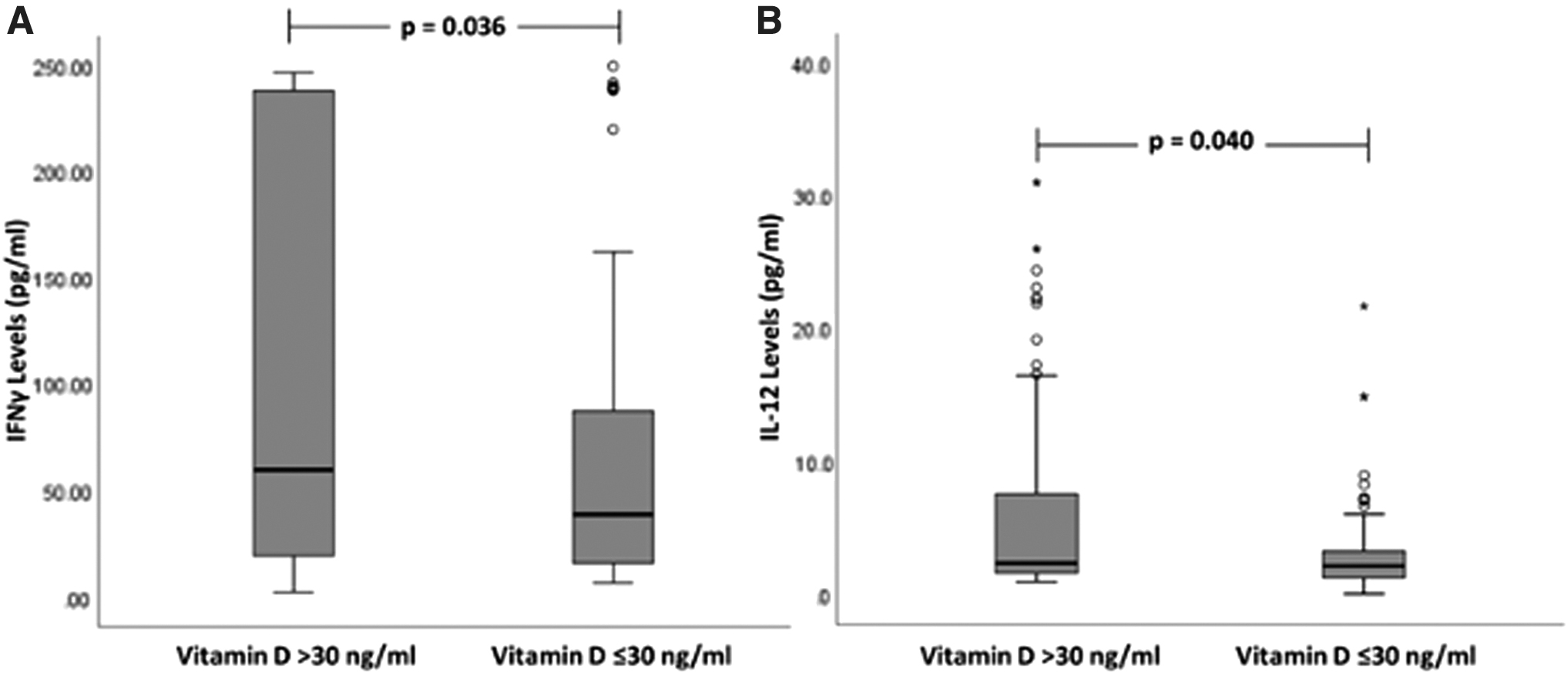
Comparison of IFN-γ levels

Correlation of IFN-γ levels
We classified IFN-γ and IL-12 levels into low and normal levels according to the median and IQR. Low cytokine levels were defined if the levels were less than the 25th interquartile. Therefore, low IFN-γ was defined if the level was <18.5 pg/mL, whereas low IL-12 was defined as <1.4 pg/mL. The ROC curve analysis for these Th1 cytokines in predicting the low vitamin D levels is shown in Fig. 3. The area under curve (AUC) of IFN-γ for predicting low vitamin D levels was 0.59 (95% CI 0.51–0.68), P = 0.036 whereas the AUC of IL-12 was 0.59 (95% CI 0.50–0.67), P = 0.043. According to the cutoff value we determined before, the sensitivity and specificity of IFN-γ were 77.3% and 26.5%, whereas the sensitivity and specificity of IL-12 were 81.9% and 30.3% for predicting the low vitamin D levels.
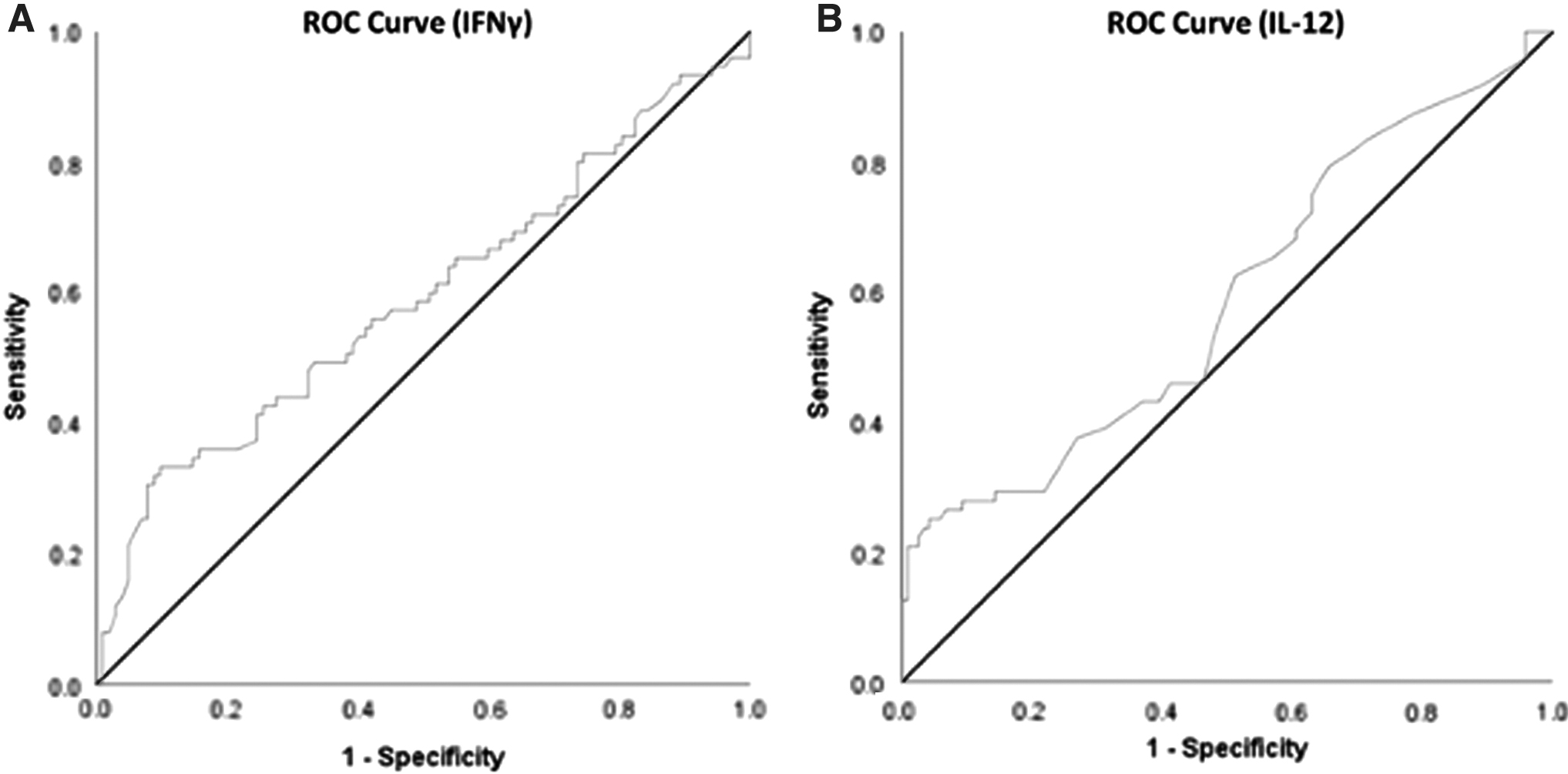
ROC curve analysis for the role of IFN-γ
Comparison of the vaccine effectiveness according to the levels of the Th1 cytokines
The vaccine effectiveness was assessed by the presence of confirmed SARS-CoV-2 infection during the follow-up period. We compared the vaccine effectiveness according to the levels of the Th1 cytokines that we classified before. During the follow-up, 58 subjects (29.9%) were confirmed for Covid-19. Twenty-four (41.4%) subjects had been confirmed for Covid-19 during follow-up in subjects with IFN-γ <18.5 pg/mL, whereas the markedly lower incidence of Covid-19 cases (25.5%) was observed in the population with IFN-γ ≥18.5 pg/mL (P = 0.03). A higher incidence of confirmed Covid-19 cases also was observed in subjects with IL-12 levels <1.4 pg/mL compared with subjects with normal IL-12 levels (34.5% versus 26.3%), although the comparison was not statistically significant (P = 0.26).
Kaplan–Meier curve for the incidence confirmed Covid-19 cases during the follow-up period according to the levels of the Th1 cytokine was shown in Fig. 4. Kaplan–Meier survival analysis revealed that the cumulative hazard of confirmed Covid-19 cases was increased in subjects with low IFN-γ levels (log-rank test, P = 0.03), whereas not significantly increased in subjects with low IL-12 levels (log-rank test, P = 0.25).

Kaplan–Meier curve analysis for cumulative hazard of the confirmed Covid-19 cases according to the T helper 1 cytokines level, including
Discussion
In many countries, including Indonesia, vaccination against the SARS-CoV2 virus is used to limit the spread of Covid-19. CoronaVac was the first vaccine that was widely distributed in Indonesia (Marian 2021). We hypothesized that vitamin D might affect the Th1 type cytokine levels and enhance vaccine effectiveness against the SARS-CoV2 virus. Our finding showed that subjects with adequate vitamin D levels had a higher level of IFN-γ and IL-12 than subjects with low levels of vitamin D. IL-12 and IFN-γ are the important cytokines initiating the downstream signaling cascade to differentiation Th1 cells (Luckheeram and others 2012).
IL-12 is secreted in large amounts by APCs after their activation through the pattern recognition receptors (Liu and others 2005). The IL-12, in turn, induces natural killer cells (NK) to produce IFN-γ and develop cytolytic T cells. IFN-γ is an essential cytokine for several antiviral responses. It acts in synergy with type I IFNs to inhibit the replication of SARS-CoV. Polymorphisms in the IFNG gene that impair IFN-γ activity showed susceptibility to SARS infection increase 5-fold than control (Chong and others 2006). This finding suggests that vitamin D might have a role in modulating the immune response to Th1 after CoronaVac vaccination.
Although respondents with adequate vitamin D tended to have higher Th1 type cytokines levels, the correlation and the predictive ability of these cytokines to the vitamin D levels were relatively low. This reason might be due to the paradoxical effect of vitamin D in the Th1 immune responses. However, it was not established yet how vitamin D might affect the production of Th1 cytokines. Administration of vitamin D reduced the IFN-γ and improved the clinical manifestation in pristane-induced lupus mice model (Correa Freitas and others 2019). Kulling and others (2018) also demonstrated that vitamin D treatment could decrease the IFN-γ through inhibition of STAT1 pathway on T cell large granular lymphocytic leukemia cell lines.
In contrast, vitamin D was also required to enhance the cellular immune responses against microbes (Fabri and others 2011). Vitamin D levels were positively correlated with the IFN-γ levels in patients with nasal polyposis and rhinitis allergy (Ozkara and others 2012). These findings suggested that vitamin D might have a significant role in modulating the response of Th1 cytokines on the different types of antigens.
Our results showed a similar finding with the real-world data regarding the CoronaVac effectiveness in preventing the Covid-19 infection (Jara and others 2021). In addition, we found that adequate IFN-γ levels were needed to obtain a better vaccine efficacy in preventing the SARS-CoV2 infection. The role of Th1 type cytokines, especially IFN-γ, in enhancing the vaccine response and effectiveness had been described previously in several studies (Zhang and others 2018; Wang and others 2013). In addition, CoronaVac and other Covid-19 vaccines also described previously could also induce the Th1-associated immune response, including BNT162b1 and ChAdOx1 (Sahin and others 2020; Ewer and others 2021).
In conclusion, we demonstrated that subjects with adequate vitamin D levels tend to have higher Th1 cytokines production after the CoronaVac vaccination. Moreover, Th1-type cytokine, especially IFN-γ, is an essential factor that affects the vaccine effectiveness against the SARS-CoV2 infection. In our understanding, this is also the first study that demonstrates the role of Th1 immune response after CoronaVac vaccination. This study also provides new insight into the role of vitamin D in modulating the Th1 immune response in individuals getting the Covid-19 vaccination. However, our study also had the weakness that it did not check for vitamin D at the beginning, so it was not able to show a causal relationship between cytokine levels and vitamin D levels examined.
Footnotes
Acknowledgments
We thank the Saiful Anwar General Hospital Malang and Badan Penelitian dan Pengabdian Masyarakat, Faculty of Medicine Universitas Brawijaya Malang, Indonesia for the funding of this study. We thank the director of Saiful Anwar General Hospital Malang, Indonesia, Dr. Kohar Hari Santoso, SpAn, KAP, KIC for supporting this study. We also thank Dr. Mochamad Bachtiar Budianto, SpB(K)Onk, assistant director of Education and Professional Development in Saiful Anwar General Hospital, Malang, Indonesia, and Dr. Syaifullah Asmiragani, SpOT(K), assistant director of Medical and Nursing Services of Saiful Anwar General Hospital, Malang, Indonesia.
Author Disclosure Statement
No competing financial interests exist.
Funding Information
No funding was received for this article.