




Abstract
The present study shows for the first time the chemical profile and the in vitro properties (antioxidant and inhibition of nitric oxide [NO] production) of the aromatic plant Pimpinella anisoides V Brig. (Family Apiaceae). The ethanolic extract of the fruits is characterized by 23 major components. Fourteen monoterpenes, two sesquiterpenes, one fatty acid, five methyl esters and one aldehyde were identified. Among them the most abundant components were the monoterpenes trans-anethole (54.5%), limonene (13.5%), and sabinene (4.4%). The extract showed significant antioxidant activity (50% inhibitory concentration [IC50], 3.02 mg/mL) using the 2,2-diphenyl-1-picrylhydrazyl test. The test for inhibition of NO production was performed using the murine monocytic macrophage cell line RAW 264.7. The ethanolic extract had significant activity with an IC50 value of 72.7 μg/mL, and this might indicate that it would have an anti-inflammatory effect in vivo. Among the pure compounds that most effectively inhibited lipopolysaccharide-induced NO production were the most abundant constituents, trans-anethole and limonene, with IC50 values of 102.7 μg/mL and 70.1 μg/mL, respectively. The cytotoxic effect of P. anisoides extract and pure compounds in the presence of lipopolysaccharide (1 μg/mL) was evaluated but found to be negligible.
Introduction
T
According to the Enciclopedia Agraria Italiana, 8 the fruits of P. anisoides (“anice selvatico”) are listed in the Italian Official Farmacopea as “anisi fructus” together with their essence (“oleum anisi”). In Calabria the degree of knowledge about this plant by local people is decreasing more and more; in fact, almost all young people interviewed did not know either the plant or its local names. Even among older persons interviewed, very few were able to distinguish common anise (P. anisum) from wild anise (P. anisoides). 9 The use of traditional medicine is widespread, and plants still represent a large source of natural antioxidants that might serve as leads for the development of novel drugs. It is commonly accepted that in a situation of oxidative stress, reactive oxygen species (ROS) such as superoxide (O2 −·, OOH·), hydroxyl (OH·), and peroxyl (ROO·) radicals are generated. ROS play an important role in the pathogenesis of various serious diseases, such as neurodegenerative disorders, cancer, cardiovascular diseases, atherosclerosis, cataracts, and inflammation. 10,11 Several anti-inflammatory drugs have recently been shown to have an antioxidant and/or radical scavenging mechanism as part of their activity. 12 Thus the neutralization of free radicals by antioxidants and radical scavengers can attenuate inflammation. 13
Nitric oxide (NO) is a diatomic free radical produced from
Considering that antioxidants and free radical scavengers can exert an anti-inflammatory effect, the aim of this work was to evaluate for the first time the chemical composition and the antioxidant activities using the 2,2-diphenyl-1-picrylhydrazyl (DPPH) test and the inhibition of NO production in the murine monocytic macrophage cell line RAW 264.7 of extract from P. anisoides fruit.
Materials And Methods
Chemicals
Ethanol and dimethyl sulfoxide were obtained from VWR International s.r.l. (Milan, Italy). Ascorbic acid, DPPH, Griess reagent [1% sulfanamide and 0.1% N-(1-naphthyl)ethylenediamine dihydrochloride in 2.5% H3PO4], 3-(4,5-dimethylthiazol-2-yl)-2,5-diphenyltetrazolium bromide (MTT), Dulbecco's modified Eagle's medium (DMEM),
Plant material
The fruits of P. anisoides used in this study were collected in September 2007 in Calabria (Southern Italy) and authenticated by Dr. Dimitar Uzunov, Natural History Museum of Calabria and Botanic Garden, University of Calabria, Rende, Italy. A voucher specimen is deposited in the Botany Department Herbarium at the University of Calabria.
Sample preparation
The fruits (10.3 g) of P. anisoides were extracted with ethanol (3 × 50 mL) through maceration (144 h × 3). The resultant total extracts were filtered and dried under reduced pressure to determine the weight and analyzed by gas chromatography (GC)-mass spectrometry (MS) and GC.
GC-MS analysis
In order to determine the composition of P. anisoides ethanol extract, analysis was carried out using a gas chromatograph system (model 6890, Hewlett-Packard Co., Milan) with a fused capillary column SE-30 (30 m length; 0.25 mm i.d.; 0.25 μm film thickness) directly coupled to a selective mass detector (model 5973, Hewlett Packard). Electron impact ionization was carried out at 70 eV. Helium was used as carrier gas. Injector and detector were maintained at 250°C and 280°C, respectively. The analytical conditions worked with the following program: oven temperature was 5 minutes isothermal at 50°C, then 50–250°C at a rate of 5°C/minute, and then held isothermal for 10 minutes. For analysis, the extract was dissolved in dichloromethane (approximately 1 mg/mL), and aliquots (1 μL) were directly injected. Identification of the compounds was based on the comparison of the mass spectral data on computer matching against Wiley 138 and NIST 98 and those described in literature. 15 Identification was confirmed by the determination of the retention index. The modified Van Den Dool and Kratz formula was used to calculate the retention index by interpolation between bracketing C9–C31 n-alkanes. 16
GC analysis
A Shimadzu (Milan) model GC 17 gas chromatograph equipped with a flame ionization detector detector and a capillary column (30 m length; 0.25 mm i.d.; 0.25 μm film thickness; static phase methylsilicone SE-30) and controlled by Borwin software was used. The carrier gas was nitrogen. The percentage composition of P. anisoides extract was computed by the normalization method from the GC peak areas related to the GC peak area of an external standard (trans-anethole) injected into the GC equipment in isothermal conditions at 100°C. Percentage of total area was obtained by their addition. All determinations were performed in triplicate and averaged.
DPPH assay
This experimental procedure was adapted from Wang et al.
17
In an ethanol solution of DPPH radical (final concentration, 1.0 × 10⁻⁴ M), test extracts at different concentrations were added. The reaction mixtures were shaken vigorously and then kept in the dark for 30 minutes. The absorbance of the resulting solutions was measured in 1-cm cuvettes, using a Perkin Elmer (Milan) Lambda 40 UV/VIS spectrophotometer at 517 nm, against a blank without DPPH. A decrease in the absorbance of the DPPH solution indicates an increase of DPPH radical scavenging activity. This activity is given as percentage DPPH radical scavenging, which is calculated with the equation:
The DPPH solution without sample solution was used as the control. All tests were performed in triplicate and averaged. Ascorbic acid was used as the positive control.
Cell culture
The murine monocytic macrophage cell line RAW 264.7 (European Collection of Cell Cultures, London, UK) was grown in plastic culture flask in DMEM with
Assay for cytotoxic activity
Cytotoxicity was determined using the MTT assay reported by Tubaro et al. 18 with some modifications. The assay for each sample analyzed was performed in triplicate, and the culture plates were kept at 37°C with 5% (vol/vol) CO2 for 1 day. After 24 hours of incubation, 100 μL of medium was removed from each well. Subsequently, 100 μL of 0.5% (wt/vol) MTT, dissolved in phosphate-buffered saline, was added to each well and allowed to incubate for a further 4 hours. After 4 hours of incubation, 100 μL of dimethyl sulfoxide was added to each well to dissolve the formazan crystals. Absorbance values at 550 nm were measured with a microplate reader (model DV 990 B/V, GDV, Rome, Italy). Cytotoxicity was expressed as 50% inhibitory concentration (IC50), which is the concentration to reduce the absorbance of treated cells by 50% with reference to the control (untreated cells).
Inhibition of NO production in LPS-stimulated RAW 264.7 cells
The presence of nitrite, a stable oxidized product of NO, was determined in cell culture media by Griess reagent [1% sulfanamide and 0.1% N-(1-naphthyl)ethylenediamine dihydrochloride in 2.5% H3PO4]. 19 One hundred microliters of cell culture supernatant was removed and combined with 100 μL of Griess reagent in a 96-well plate followed by spectrophotometric measurement at 550 nm using the DV 990 B/V microplate reader. Nitrite concentration in the supernatants was determined by comparison with a sodium nitrite standard curve.
Statistics
Data were expressed as mean ± SD values. Statistical analysis was performed by using Student's t test or by one-way analysis of variance followed by the Dunnett's test for multiple comparisons of unpaired data. Differences were considered significant at P ≤ .05. The IC50 was calculated from the Prism (GraphPad, San Diego, CA, USA) dose–response curve (statistical program) obtained by plotting the percentage of inhibition versus the concentrations.
Results and Discussion
Chemical composition
To identify putative active compounds present within the P. anisoides ethanol extract, GC-MS was used. The chemical composition of the extract is reported in Table 1 and is characterized by 23 major components comprising 14 monoterpenes, two sesquiterpenes, one fatty acid, five methyl esters, and one aldehyde. The most abundant components were the monoterpenes trans-anethole (54.5%), limonene (13.5%), and sabinene (4.4%). Other identified compounds were 3-eicosene, 5-eicosene, and 9-octadecenal.
I, retention index on the SE-30 nonpolar column.
Data are mean ± SE values (n = 3 independent determinations). Compositional values less than 0.1% are denoted as traces (Tr).
Co-GC, co-injection with authentic compound.
Antioxidant activity
The model of scavenging stable DPPH free radicals can be used to evaluate antioxidant activity in a relatively short time. The absorbance decreases as a result of a color change from purple to yellow as the radical is scavenged by antioxidants through donation of hydrogen to form the stable DPPH-H molecule, 20 although a recent article suggests that, on the basis of kinetic analysis of the reaction between phenols and DPPH, the reaction in fact behaves like a single electron transfer reaction. 21 It was found that the rate-determining step for this reaction consists of a fast electron transfer process from the phenoxide anions to DPPH. The hydrogen atom abstraction from the neutral ArOH by DPPH becomes a marginal reaction path because it occurs very slowly in strong hydrogenbond-accepting solvents, such as methanol and ethanol. The scavenging effects of extract on DPPH were examined at different concentrations (range between 100 and 5,000 μg/mL). The extract was able to reduce the stable free radical DPPH to the parent yellow-colored DPPH with an IC50 value of 3.02 mg/mL (Table 2).
Data are mean ± SD values (n = 3). NA, no activity.
Positive control.
Inhibition of NO production
An activity of P. anisoides ethanol extract and pure compounds relative to reduction of inflammation was studied in vitro by analyzing their inhibitory effects on the chemical mediator NO released from macrophages. Once activated by inflammatory stimulation, macrophages produce a large number of cytotoxic molecules. The treatment of RAW 264.7 macrophages with LPS (1 μg/mL) for 24 hours induces NO production, which can be quantified by utilizing the chromogenic Griess reaction measuring the accumulation of nitrite, a stable metabolite of NO. NO is considered to play a key role in inflammatory response, based on its occurrence at inflammatory sites and its ability to induce many of the hallmarks in the inflammatory response. The beneficial effect of P. anisoides extract on the inhibition of production of inflammatory mediators in macrophages can be mediated through oxidative degradation of products of phagocytes, such as O2 − and HOCl. As shown in Figure 1, incubation of RAW 264.7 cells with ethanol extract and pure compounds of P. anisoides induced a significant inhibitory effect on the LPS-induced nitrite production. The ethanol extract of P. anisoides showed significant inhibition of LPS-induced NO production in RAW 264.7 cells in a dose-dependent manner, with an IC50 value of 72.7 μg/mL. Among the pure compounds that most effectively inhibited LPS-induced NO production were limonene and trans-anethole, with IC50 values of 70.1 μg/mL and 102.7 μg/mL, respectively (Table 2). Any cytotoxic effect of the samples (P. anisoides ethanol extract and pure compounds) in the presence of LPS (1 μg/mL) was also evaluated. P. anisoides ethanol extract and pure compounds did not show any cytotoxicity up to 250 μg/mL concentration.
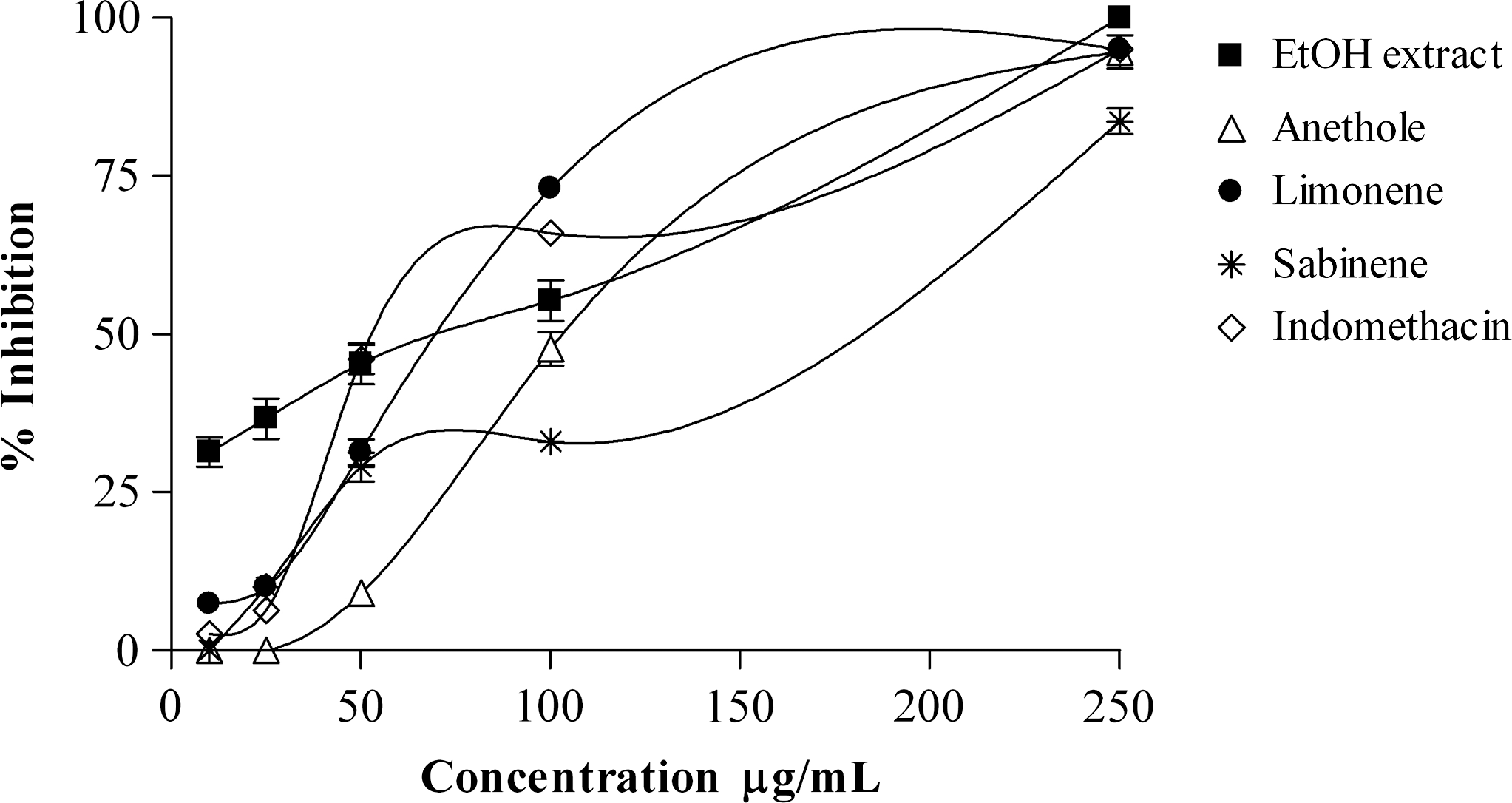
Inhibition of NO production in the murine monocytic macrophage cell line RAW 264.7 of extract and pure constituents of P. anisoides fruits. EtOH, ethanol. Data are mean ± SD values (n = 3).
Conclusions
Oxidative damage may initiate and promote the progression of a number of chronic diseases, including inflammation. The present work showed for the first time the in vitro activity of P. anisoides ethanol extract. Further in vivo investigations are needed for a possible usefulness of this extract in the treatment of inflammation. In this study we have demonstrated that the ethanol extract of P. anisoides exhibited significant antioxidant activity and an inhibitory effect on production of NO (an inflammatory mediator) in macrophages. The observed in vitro activities suggest that the investigated plant extract might also exert in vivo protective effects against oxidative and free radical injuries occurring in different pathological conditions. Therefore, we propose here the potential benefits of P. anisoides extract on the basis of the phytochemical characteristics and the observed bioactive properties. The antioxidative and anti-inflammatory properties of naturally occurring compounds appear to contribute to their chemopreventive or chemoprotective activity.
The anti-inflammatory activities of P. anisoides ethanol extract and its major components were evaluated to obtain an insight into the beneficial effects of this plant species in conditions related to inflammation, reduced risk for cardiovascular diseases, and cancer prevention by acting as anti-inflammatory agents. Further studies of the plant extracts and/or the identified compounds from P. anisoides on the pharmacokinetics or mode of action on mechanisms of chemopreventive properties are warranted. Also, the extraction technique should be investigated more widely, particularly in view of the application of supercritical fluids. Another point that should be strongly evaluated is the use of emulsions instead of solution in real applications, with the aim to prevent degradation of the extract activity due to oxygen exposure. In conclusion, this work reveals that P. anisoides can be an interesting source of anti-inflammatory and antioxidant principles, with a potential use in different fields (the food, cosmetics, and pharmaceutical industries).
Footnotes
Author Disclosure Statement
No competing financial interests exist.