




Abstract
A short-term study was carried out on Wistar strain rats to determine the effects of Xylopia aethiopica extract on serum and postmitochondrial fractions (PMFs) of visceral organs in experimental hypercholesterolemia. Animals received normal diet and were administered cholesterol orally by intubations at a dose of 40 mg/kg/0.3 mL, plant extracts at 250 mg/kg, and cholestyramine (Questran®, Bristol-Myers Squibb, Hounslow, United Kingdom) at 0.26 g/kg five times a week for 8 consecutive weeks. Thereafter the hypolipidemic effects were assessed by measuring total cholesterol, low-density lipoprotein-cholesterol (LDL-C), high-density lipoprotein-cholesterol, and triglycerides, whereas the extent of oxidative stress was assayed by measuring thiobarbituric acid–reactive substances and enzymatic antioxidants such as superoxide dismutase, catalase, and reduced glutathione (GSH) in serum and PMF of liver and kidney. We assayed two liver biomarkers—alanine aminotransferase and aspartate aminotransferase—for safety of X. aethiopica at the dose given in this experiment. Cholesterol feeding resulted in a significant increase (P < .05) in body weight of the hypercholesterolemic animals relative to control animals, and administration of X. aethiopica (250 mg/kg) caused a more than 60% reduction in body weight. Simultaneous treatment with X. aethiopica and Questran elicited 33.75% and 23.94% reductions, respectively, in serum cholesterol levels of hypercholesterolemic rats. In addition, the LDL-C level decreased significantly (P < .05) by 49.09% and 78.92% in serum and by 64.97% and 37.29% in the liver with cotreatment with the plant extract and Questran, respectively, compared to untreated hypercholesterolemic rats. X. aethiopica counteracted the decreases in enzymatic antioxidants, especially in GSH, where there was a greater than 300% increase compared with hypercholesterolemic animals. This study has shown that intake of X. aethiopica reduced the composition of lipids and produced a favorable lipid profile in the serum and PMF of visceral organs in experimental hypercholesterolemia.
Introduction
Diets rich in cholesterol tends to induce free radical production, followed by hypercholesterolemia, 5,6 and this is a major risk factor in atherosclerosis and related occlusive vascular disease. 3 Several theories such as dyslipidemia, hypercoagulability, oxidative stress, endothelial dysfunction, inflammation, and infection by certain pathogens have been propounded from time to time to explain this complex phenomenon. 1 Reactive oxygen species have been involved in the physiological and pathological events such as inflammation, aging, mutagenicity, and carcinogenicity, 7 and in the last decade evidence has abounded as to the role of free radical-mediated lipid peroxidation in the pathogenesis of arthrosclerosis, 8 neurodegenerative disorders, 9 carcinogenesis, and aging. 10,11
A major primary strategy in managing coronary heart disease is reducing the plasma low-density lipoprotein (LDL)-cholesterol (LDL-C) to <1.8 mmol/L for very high-risk individuals, 12,13 and this requires therapeutic intervention. Much work has been done on the development of hypolipidemic agents, some examples of which are colestipol, niacin, and cholestryamine. They function by lowering high blood cholesterol. Hypolipdemic agents have lots of side effects and even cause death. 14 Consequently plant foods and phytochemicals are being promoted to consumers as cardioprotective and antihypercholesterolemic and have been widely accepted as an healthy anti-atherogenic diet.
Xylopia aethiopica (Family Annonaceae), the Negro pepper locally known as “Udah” in Eastern Nigeria, is widely used in Nigeria and other parts of Africa as a spice, herb, or condiment. The dried fruits are also used as spices in the preparation of two special local soups named “obe ata” and “isi-ewu” consumed widely in the southwest and southeastern parts of Nigeria. The fruit is aromatic and somewhat pungent, and it has a slightly bitter taste. The fruits and stem bark contain essential oils, and the dried fruit is rich in diterpenic and xylopic acid. 15 The seeds are rich in crude proteins, carbohydrates, fiber, and an array of lipids. 16 Medicinal uses of the plant are as a carminative, cough remedy, postpartum tonic, and lactation aid. Other uses are as a remedy for stomachache, bronchitis, biliousness, and dysentery. 17 Essential oil of the fruits has shown insecticidal and antioxidant activities, 18 and both the crude and pure extracts have significant hypotensive and coronary vasodilatory effects accompanied by bradycardia. 19 These considerations have prompted us to investigate the effect of this extract on experimental hypercholesterolemia and the accompanying oxidative stress.
Materials And Methods
Materials
Adrenaline, thiobarbituric acid, Ellman's reagent, reduced glutathione (GSH), and bovine serum albumin were purchased from Sigma Chemical (St. Louis, MO, USA). Dietary cholesterol was obtained from Aldrich Chemical (Milwaukee, WI, USA). Cholestyramine (Questran®, Bristol-Myers Squibb, Hounslow, United Kingdom) was obtained locally from a chemist in Ibadan, Nigeria. A Randox Laboratories (Antrim, United Kingdom) diagnostic kit was used for assay of cholesterol and high-density lipoprotein (HDL)-cholesterol (HDL-C). Other reagents used were of the purest quality available.
Preparation of X. aethiopica extract
Dried fruits of X. aethiopica were purchased locally in the Bodija market, Ibadan, Nigeria and were identified at the Herbarium of the Botany Department, University of Ibadan. It was powdered using a hammer mill and was Soxhlet-extracted using methanol for 72 hours. The dark-brown concentrated methanol fraction obtained was used at a concentration of 250 mg/kg of body weight.
Animals
Twenty-nine albino rats (Wistar strain), weighing between 70 and 137 g, of both sexes were obtained from the Institute of Advanced Medical Research and Training, College of Medicine, University of Ibadan and were housed in the Animal House of the Biochemistry Department, University of Ibadan at normal room temperature. The rats were acclimatized for 2 weeks on standard diet (pelletized guinea feed, purchased from Guinea Feed, Ibadan). The animals were allowed free access to food and water ad libitum. Rats were randomly placed into six groups (five groups of five rats and a sixth group of four animals). Group A was untreated (control) and received only corn oil. Group B (positive control) received only Questran. Animals in group C (treatment group) received cholesterol and plant extract. Groups E, F, and G received cholesterol only, cholesterol and Questran, and plant extract only, respectively. Corn oil was used as the vehicle for the administration of plant extract, Questran, and cholesterol. Dietary cholesterol was given at a dose of 40 mg/kg of body weight per 0.3 mL per animal, Questran (a hypolipidemic drug) was administered orally at a therapeutic dose of 0.26 g/kg of body weight per 0.3 mL, and the methanol extract of X. aethiopica was given at 250 mg/kg of body weight in 0.3 mL. These doses were administered orally five times a week for 8 weeks.
Sample collection
The animals were fasted for 24 hours after the last dose of drugs and were sacrificed by cervical dislocation. Blood was obtained using a 2-mL syringe by cardiac puncture into clean bottles. These were spun at 3,000 g for 10 minutes, the supernatant serum was removed, and it was stored at 4°C. The various organs (liver, kidney, and heart) were quickly removed, washed with 1.15% KCl, and homogenized in 56 mM Tris-HCl buffer (pH 7.4) containing 1.15% potassium chloride, and the homogenate was centrifuged at 10,000 g for 15 minutes at 4°C.
Biochemical assays
Microsomal catalase (CAT) activity was determined by the method of Clairborne 20 using hydrogen peroxide, superoxide dismutase (SOD) activity was assayed using the method of Misra and Fridovich, 21 GSH was determined at 412 nm using the method of Jollow et al., 22 and lipid peroxidation was determined by estimating formation of thiobarbituric acid–reactive substances (TBARS). 23 Cholesterol was determined using a Randox Laboratories kit. The lipoproteins were assayed using the enzymatic colorimetric method for very LDL (VLDL) and LDL by precipitation using phosphotungstic acid and magnesium chloride. After centrifugation at 3,000 g for 10 minutes at 25°C, the clear supernatant contained the HDL fraction, which was assayed using an HDL-C precipitant kit. The LDL-C level was calculated using the formulae of Friedwald et al. 24 The protein of both the serum and postmitochondrial fraction (PMF) was determined using the method of Lowry et al. 25 with bovine serum albumin as the standard. Serum alanine aminotransferase (ALT) and aspartate aminotransferase (AST) were assayed using Randox Laboratories kits.
Results
Table 1 shows the effects of X. aethiopica on the body weight, the weight of visceral organs, and the relative weight of organs of cholesterol-fed rats. Cholesterol administration caused a significant increase (P < .05) in the body weight of hypercholesterolemic animals compared with the control group. Simultaneous administration of X. aethiopica (250 mg/kg) with dietary cholesterol (Group C) significantly (P < .05) decreased the cholesterol-induced body weight gain.
P < .05, significantly different from control group; **P < .05, significantly different from CH group.
CH, cholesterol; Qu, Questran; XA, X. aethiopica.
Feeding cholesterol to rats caused a significant (P < .05) increase in serum and PMF total cholesterol (Group D) compared with control animals as shown in Figure 1. There were 14.27% and 309.95% increases in serum and liver total cholesterol produced by cholesterol consumption relative to control animals receiving normal rat chow. Induced hypercholesterolemia (Group D) was significantly (P < .05) ameliorated by treatment with both X. aethiopica and Questran (Groups C and E). Questran produced 23.74% and 40.01% reductions in serum and liver cholesterol, whereas the corresponding values for X. aethiopica were 33.75% and 35.43%, respectively.
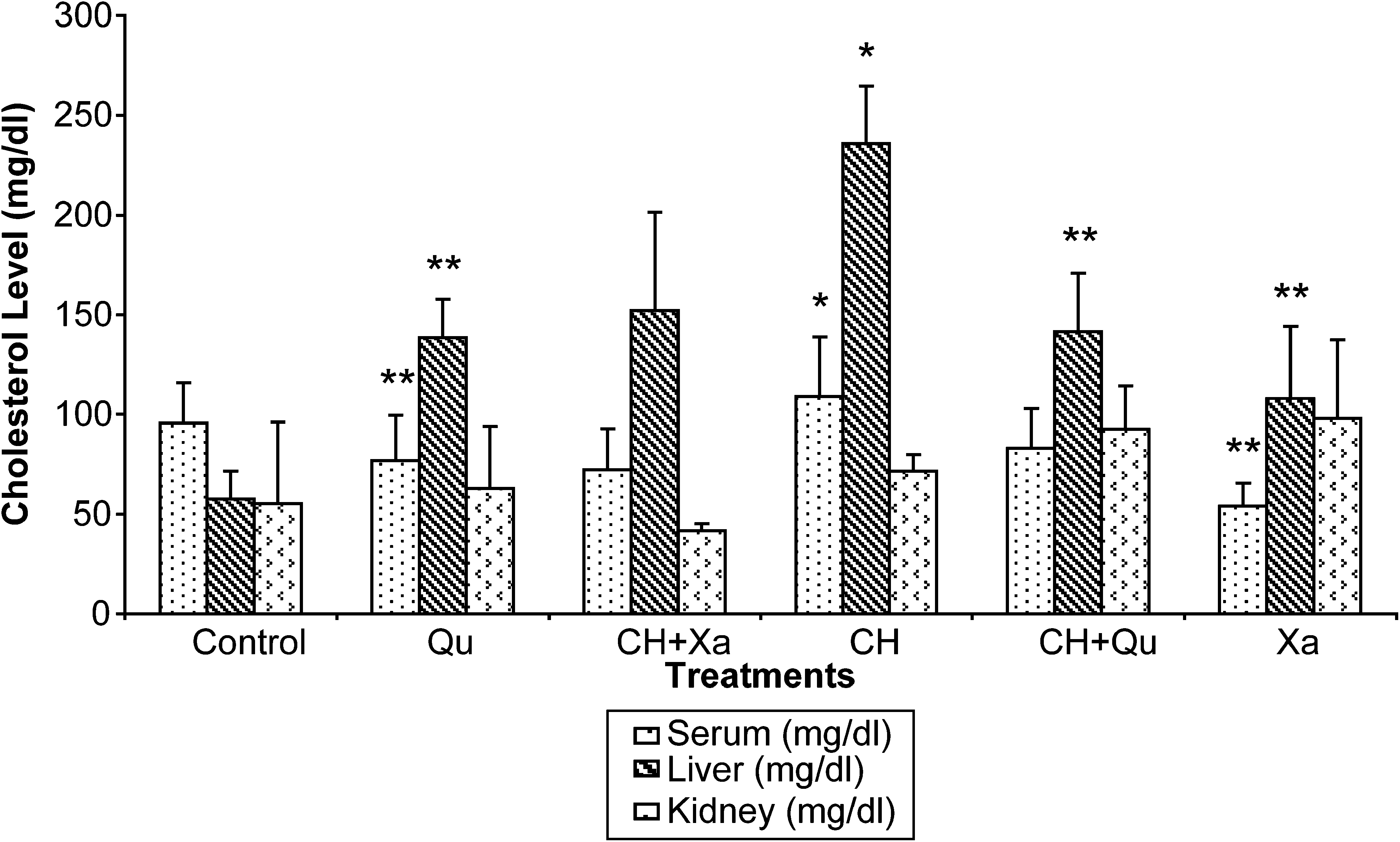
Effect of X. aethiopica on serum, liver, and kidney total cholesterol level in cholesterol-fed rats. Data are mean ± SD values (n = 5). *P < .05, significantly different from control group; **P < .05, significantly different from CH group.
Figure 2 shows data obtained on the effect of plant extract serum and PMF triglyceride level of cholesterol-fed rats. Hypercholesterolemia caused a significant increase (P < .05) in PMF triglycerides (Fig. 2) of Group D compared with control animals. The hypertriglyceridemia in the PMF induced by cholesterol administration was significantly (P < .05) ameliorated by cotreatment with X. aethiopica (250 mg/kg) and Questran. There was a 69.77% decrease in PMF triglyceride produced by treatment with X. aethiopica compared with the hypercholesterolemic group.
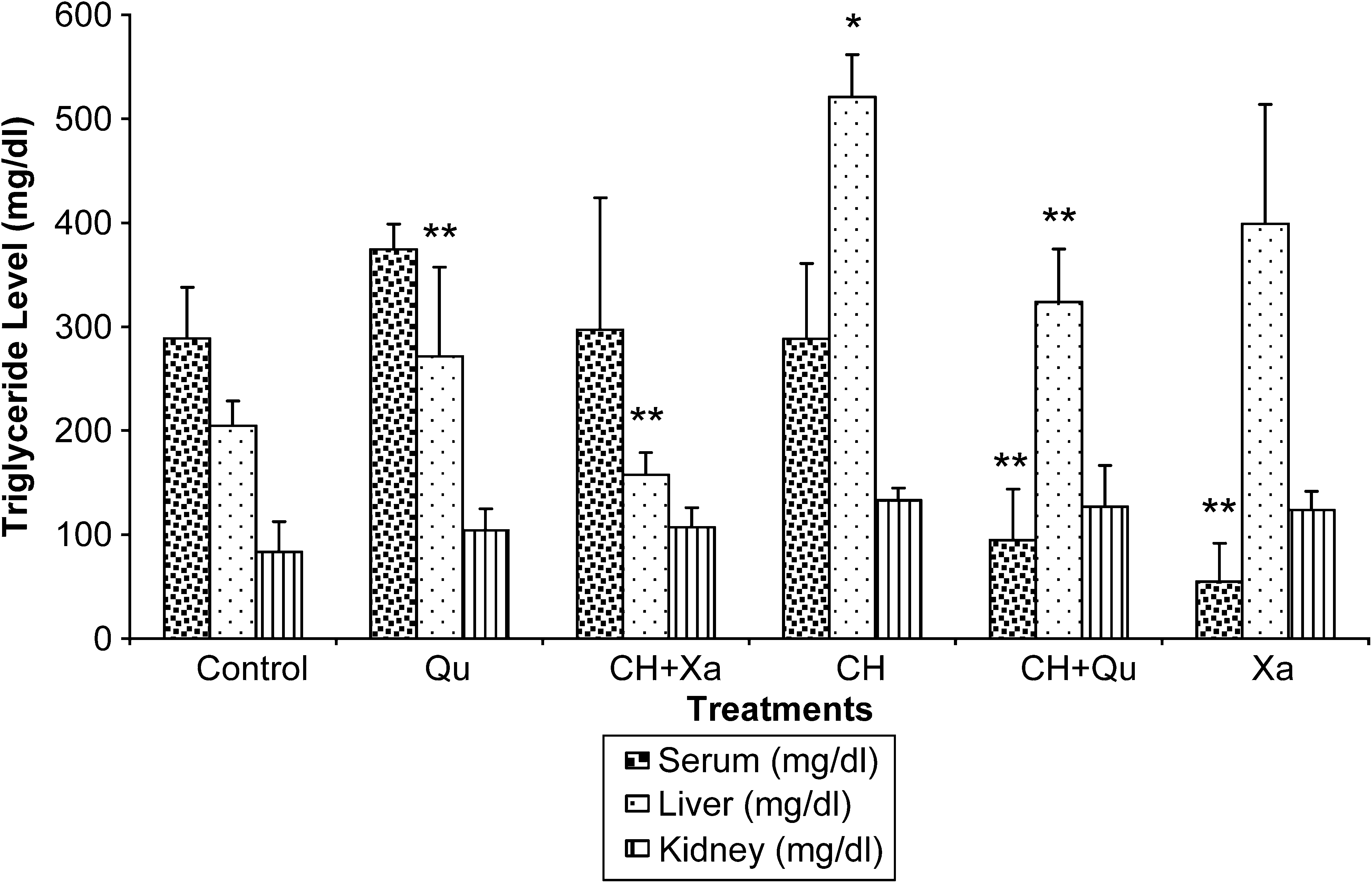
Effect of X. aethiopica on serum, liver, and kidney triglyceride level in cholesterol-fed rats. Data are mean ± SD values (n = 5). *P < .05, significantly different from control group; **P < .05, significantly different from CH group.
Feeding cholesterol to rats caused a significant increase (P < .05) in serum and PMF LDL-C compared with control animals as shown in Figure 3. X. aethiopica and Questran significantly (P < .5) decreased both serum and PMF LDL-C levels in treated hypercholesterolemic animals compared with the untreated animals. There were 49.09% and 78.92% decreases in serum LDL-C level and 64.97% and 37.29% decreases in PMF LDL-C level caused by treatment with X. aethiopica and Questran, respectively, compared with the untreated hypercholesterolemic group.
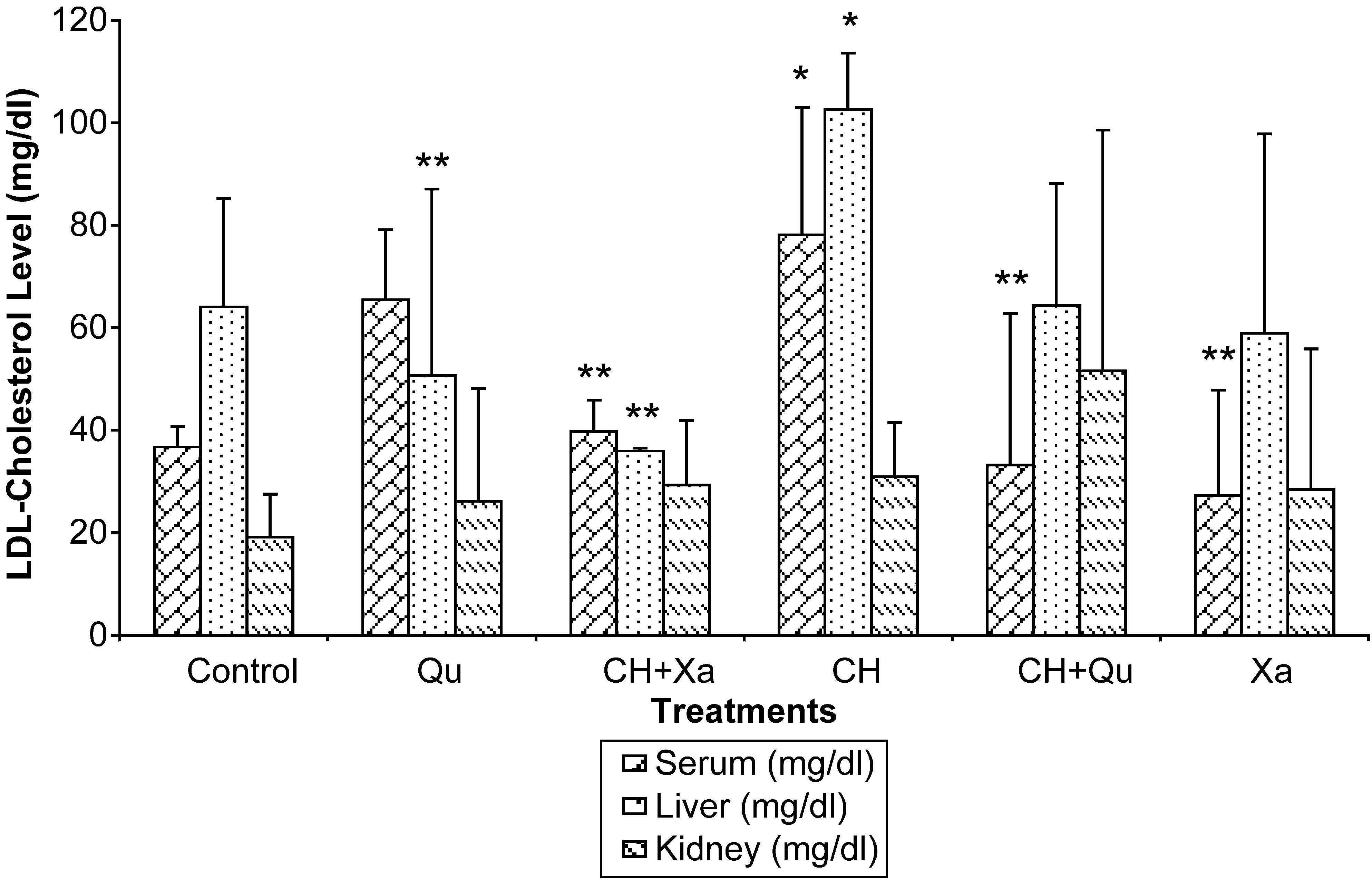
Effect of X. aethiopica on serum, liver, and kidney low-density lipoprotein level in cholesterol-fed rats. Data are mean ± SD values (n = 5). *P < .05, significantly different from control group; **P < .05, significantly different from CH group.
Table 2 gives data obtained for the effect of X. aethiopica on protein, HDL-C, and GSH levels in hypercholesterolemic rats. Feeding cholesterol to rats produced a significant (P < .05) decrease in HDL-C in serum and PMF compared with the control group. There were no significant differences (P > .05) in serum and PMF HDL-C levels in X. aethiopica- and Questran-cotreated animals compared with untreated hypercholesterolemic animals. However, feeding cholesterol to rats caused a significant (P < .05) decrease in PMF GSH activity, and this was significantly ameliorated by X. aethiopica. Specifically, there was a 403.93% increase in liver PMF GSH activity by cotreatment with X. aethiopica and a 55.00% increase in kidney PMF GSH activity by cotreatment with the plant extract compared with untreated hypercholesterolemic rats.
P < .05, significantly different from control group; **P < .05, significantly different from CH group.
GSH, reduced glutathione; HDL, high-density lipoprotein.
Table 3 shows the data obtained for SOD activity, CAT activity, lipid peroxidation, ALT, and AST in cholesterol-administered rats. Malondialdehyde, an index of lipid peroxidation, was increased by 111.54% in hypercholesterolemic rats, and this was significantly ameliorated by the spice X. aethiopica (74.55%) and Questran (27.27%), respectively. We observed a significant decrease in SOD level in cholesterol-fed rats, and this was significantly increased by X. aethiopica (40%) and Questran (20%). Liver CAT activity was unaffected by induced hypercholesterolemia, whereas there was a 103.07% increase in kidney, and this was significantly ameliorated by cotreament with plant extract relative to the control. Induced hypercholesterolemia had no significant effect on ALT and AST.
*P < .05, significantly different from control group; **P < .05, significantly different from CH group.
ALT, alanine aminotransferase; AST, aspartate aminotransferase; CAT, catalase; SOD, superoxide dismutase.
Discussion
In the present study we found an increase in the body weight gain of animals on the cholesterol diet and a corresponding increase in lipid levels of both serum and visceral organs. This is in accordance with earlier reports that diets high in cholesterol cause hypercholesterolemia. 26,27 The presence of increased cholesterol levels in the diet has been demonstrated to elevate serum and aortic tissue cholesterol and, as such, an increase in atherosclerosis. 28 Previous studies 29,30 have established a linear correlation between dietary cholesterol intake and mortality of coronary heart disease. Administration of plant extract and the hypolipidemic drug Questran significantly reduced the cholesterol-induced increment in weight and produced at least 25% reductions in serum and liver total cholesterol levels, respectively, compared with untreated hypercholesterolemic rats. This might be due to cholesterol absorption in the intestine or its production by the liver 31 or stimulation of the biliary secretion of cholesterol and cholesterol excretion in the feces. 32 Dietary cholesterol has been shown to reduce fatty acid oxidation, which in turn increases the levels of hepatic and plasma triglyceride. 33 X. aethiopica was approximately twice as effective in reducing serum triglycerides as Questran, the reference drug used in this study. Also, simultaneous treatment with X. aethiopica and Questran produced 49.09% and 78.92% decreases, respectively, in serum LDL-C level and 64.92% and 37.29% decreases, respectively, in liver LDL-C compared with untreated hypercholesterolemic animals. LDL molecules are the major transporters of cholesterol in the bloodstream and are considered “bad cholesterol” because they carry fats out of the liver to the blood vessels and seem to encourage the deposition of cholesterol in the arteries. The significant decrease in LDL-C, total cholesterol, and triacylglyceride, which in essence increases HDL-C levels, points to this plant as a potential hypolipidemic agent. This might be due to hydroxymethylglutaryl-coenzyme A reductase, an important enzyme for the manufacture of cholesterol in the liver, which is broken down rapidly in the presence of β-sitosterol, resulting in lower cholesterol production. Polyunsaturated fatty acids and monounsaturated fatty acids actually decrease LDL-C and may also reduce HDL-C. Grundy and Ahrens 3 proposed that the replacement of saturated with polyunsaturated fatty acid in the diet lowers serum cholesterol by inducing a redistribution of cholesterol between plasma and tissue pools.
The serum and tissues contain antioxidants that help combat oxidative stress. Malondialdehyde, an index of lipid peroxidation, was increased in hypercholesterolemic rats, but X. aethiopica was three times more effective in reducing TBARS than Questran in the treated groups. Hypercholesterolemia caused a 93.42% decrease in liver SOD activity compared with the control group, whereas the plant drug and Questran produced 40% and 20% increases, respectively.
This study has shown that the body's antioxidant defense system is capable of being altered by dietary means in this present study as we also observed depletion in GSH activity in the liver and kidney by cholesterol feeding. This depletion might lead to generation of reactive oxygen species and oxidative stress with a cascade of effects, thereby affecting functional as well as structural integrity of the cell membrane. However, treatment with X. aethiopica and Questran significantly reduced high cholesterol-induced GSH depletion. In essence, crude extracts of X. aethiopica and Questran were able to restore normal levels of GSH. A similar ameliorating effect was also observed on CAT activity, and the liver enzyme assay for ALT and AST did not indicate any toxic effects as observed from previous reports.
Evidence from the present study confirms the effect of X. aethiopica on lipid levels and the body's antioxidant defense system in experimental animals. X. aethiopica was found to be highly effective in reducing the levels of serum and PMF cholesterol and LDL-C (exhibiting a hypocholesterolemic effect) in the animals investigated. This plant extract were also very potent in the antioxidant defense system. Therefore, X. aethiopica shows therapeutic promise in preventing the development of atherosclerosis and possible related cardiovascular pathologies. However, further work is required to elucidate the exact mechanism responsible for the hypolipidemic effect.
Footnotes
Author Disclosure Statement
No competing financial interests exist.