




Abstract
Grifola frondosa is an edible and medicinal mushroom. The bioaccumulation and potential biovailability of Cu and Zn were studied to obtain mycelium with potential properties as a food dietary supplement. Mycelia grown in the presence of nonmycotoxic concentrations of 100 and 200 ppm of Cu or 25 and 50 ppm of Zn accumulated 200–322 ppm and 267–510 ppm of Cu or Zn, respectively. When these enriched metal mycelia were subjected in vitro to a simulated gastrointestinal digestion, the solubility in these digestive fluids was 642–669 ppm and 102–530 ppm, which represent 32–33% and 0.7–3.5% of the recommended daily intake (RDI) for Cu and Zn, respectively, in 1 g of mycelium. These results are discussed in relation to the RDI values exhibited by two commercial supplements, and arguments are given on the potential use of these mineral-enriched mycelia in capsules (in the case of Cu-enriched mycelia), in food preparations, and also as a component of cosmetic mixtures.
Introduction
C
Zn is an abundant mineral in the body and is involved together with Cu in oxygen metabolism, being an important cellular antioxidant. 6,7 It plays a role in growth and development, immune response, neurological function, and reproduction and participates in different enzymes, like CuZn-superoxide dismutase, DNA-RNA polymerase, carbonic anhydrase, and alkaline phosphatase. 8 One-third of the world's population suffers from Zn deficiency. In developing countries, 40–45% of 5-year-old children are estimated to suffer anemia. 9 The main cause of Zn deficiency in humans is nutritional.
The recommended daily intake (RDI) is 2 mg of Cu and 15 mg of Zn. The excess may have toxic effects, being deleterious for health, whereas deficiencies or scarcity produce illness or physiological disorders. 10 Zn in the diet can be inadequate for covering the daily requirements because of a low bioavailability, i.e., the proportion of the ingested element that is absorbed, transported, and transformed into its active form(s). Bioavailability may be affected by the ingested mineral level, its chemical form, solubility, interactions with other minerals and nutrients, chelating agents, inhibitors, the age and physiological state of the person, and the previous processing of the components of the food diet. 11
Studies have suggested that mineral supplements from organic sources should have greater bioavailability than inorganic sources. When Cu is supplemented in an organic form, like those chelated with lysine and methionine or associated with proteins, it is absorbed in similar or higher quantity than Cu sulfate. 11,12 The same result was reported for Zn, which was provided in similar or higher bioavailability from organic sources vis-à-vis the best inorganic source (ZnSO4). 12,13
In general, edible mushrooms are beneficial for health because of their functional food character, i.e., they have a high nutritional value and contain substances that help in prevention, treatment, and recovery from illness. 14 Wild and cultivated mushrooms can accumulate heavy metals, and they can be used as environmental contamination bioindicators or as a potential bioremediation tool. In fact, wild species can accumulate metals like Cd, Cu, Pb, Zn, Fe, Hg, and Mn. 15 Particularly, the levels of Cu and other heavy metals found in accumulating mushrooms are higher than those found in accumulative plant species, whereas for other elements, like Zn, the accumulation ability is comparable. 16,17 This suggests the presence of an effective mechanism that allows mineral absorption either from the natural environment or from the substrate in artificial cultivation. 18 –20
The Cu and Zn accumulation in Agaricus blazei mycelia was recently studied in the presence of different metal contents in culture medium. At 400 ppm, the mycelium accumulated 449 and 163 times the basal content of Cu and Zn, respectively. 21 This study also showed that mycelia obtained from a liquid culture supplemented with nonmycotoxic concentration of Cu or Zn (100 and 200 ppm) produced an enriched metal mycelium where almost 90% of these metals accumulated in the available nonresidual and then the bioavailable fraction, resulting in similar or better availability than values found in two commercial supplements. 21
Grifola frondosa (Basidiomycetes, Aphyllopherales, Polyporaceae) is an edible mushroom that has recently received much attention, not only because of its nice almondy flavor but also because of its medicinal properties, which include antioxidant, hypotensor, antitumoral, immunomodulating, immunostimulating, anti-inflamatory, hypocholesterolemic, and hypoglycemiant activities. 22 –28
Fermented Coprinus comatus mushroom enriched with vanadium at lower doses in liquid culture medium induced significant decreases of blood glucose and hemoglobin A1c levels in hyperglycemic mice. 29 That effect did not occur in the case of Ganoderma lucidum and G. frondosa. 30 These researchers found that the optimal concentration of vanadium in the medium was 0.4%, and the content of vanadium accumulated in the mycelia was 3,528.0 μg/g. At a concentration of 0.4%, the vanadium-associated toxicity was reduced, and its antidiabetic effects were maintained. 31 In the case of the biomass of G. lucidum and G. frondosa, it declined rapidly when the concentration of vanadium exceeded 0.3%, but the biomass of C. comatus did not, until the concentration of vanadium exceeded 0.4%. 32
In the case of Lentinula edodes, Turlo et al. 33 cultivated mycelia in medium enriched with selenium to obtain extracts rich in the organic forms of selenium with putative cancer-preventive properties more effective than those of selenized yeast. They found that the most effective accumulation of Se occurred at the beginning of the trophophase (log phase of growth), between the second and fourth days of cultivation. 34
This work was intended to evaluate the capacity of G. frondosa mycelium to separately accumulate Cu or Zn when cultivated in metal-enriched liquid medium and to estimate the potential bioavailability of these minerals in the resulting metal-enriched mycelium. The Cu- or Zn-enriched mycelium of G. frondosa, besides the medicinal and nutritional attributes characteristic of the species, would provide a concentrated source of essential minerals in a potentially bioavailable form, allowing coverage of an important percentage of the RDI, per mass unit. This information is needed to rationally consider the potential use of Cu- or Zn-enriched dry mycelium of G. frondosa as dietary supplements or as an ingredient in food preparations.
It is also considered that the results from the present study will be of value for the cultivation of G. frondosa in solid-state fermentation to produce carpophores enriched with either metal, e.g., by separately incorporating the salts of these elements in the substrate water.
Materials and Methods
Mushroom culture
G. frondosa (Dicks.) Gray was kindly provided by MushWorld (Seoul, Republic of Korea). The mushroom mycelium was first cultivated in modified MYPA medium (20 g/L malt extract, 5 g/L yeast extract, 2.5 g/L peptone, 10 g/L glucose, and 20 g/L agar, pH 4.6) in the dark at 25°C for 27 days.
The basal liquid medium for mycelial culture was MYP medium (20 g/L malt extract, 5 g/L yeast extract, 2.5 g/L peptone, 30 g/L glucose, and 1 ml/L soy oil). The liquid medium was made with 26% sunflower seed hull broth (260 g of sunflower seed hulls in 1 L of water, autoclaved at 120°C at 1 atm for 30 minutes and filtered), pH 4.5.
Fifty milliliters of medium was placed in 250-mL Erlenmeyer flasks, allowing an air-medium relationship of 5:1 (vol/vol), as proposed by Yang and Jong. 35 Each Erlenmeyer flask was inoculated with six pieces of young mycelium 0.6 cm in diameter grown in MYPA medium. Cultures were incubated under agitation using an orbital horizontal shaker (100 rpm) at 25–27°C in the dark for 23 days.
The dry mycelium mass was determined at 9, 14, 16, 19, 21, and 23 days after inoculation (n = 5) to analyze the mycelial growth. The mycelium was separated from the nutrient medium by three washes with a 30 g/L dextrose solution and subsequent centrifugation at 1,500 g for 20 minutes. The washed mycelium pellet was blotted on tissue paper and dried at 70°C to constant weight. After the mycelial growth curve in the control culture medium was obtained, the mycelium accumulation of Cu and Zn was evaluated by adding these metals as sulfate salts to the liquid medium at concentrations of 25, 50, 100, 200, or 400 ppm (mg/L). The inoculation and incubation procedures were as previously described.
Analysis of elemental Cu and Zn
The Cu and Zn contents in G. frondosa mycelium were measured in the dry biomass by inductively coupled plasma optical emission spectrometry (model 1000 III, Shimadzu, Tokyo, Japan) after acid digestion with 1.5 mL of a HNO3 and HClO4 (2:1 vol/vol) mixture for 2 hours at 280°C and dilution with distilled water.
Cu and Zn bioavailability
The potential bioavailability (as degree of solubility) of the Cu and Zn accumulated by G. frondosa mycelium was estimated using the method of the simulated gastrointestinal digestion. 36 G. frondosa was cultured for 23 days in liquid medium supplemented with 25 or 50 ppm Zn or 0, 100, or 200 ppm Cu. In vitro digestion of enriched dry mycelium was compared with two commercial mineral supplements: supplement I, long-acting multivitamin mineral supplement (Natural Life), containing 1.53 mg/g Cu as Cu sulfate; or supplement II (Berocca Plus, Bayer S.A., Leverkusen, Germany), containing 6.90 mg/g Zn as trihydrated Zn citrate.
Dry mycelium or mineral supplements (250 mg each, triplicate samples) were digested in vitro with simulated gastric and intestinal fluids in the following sequence:
Gastric in vitro digestion
Fifteen milliliters of distilled water was added to each sample, the mix was homogenized and adjusted to pH 2 with 5 M HCl, and 0.75 mL of pepsin solution was added (1 g of pepsin dissolved in 50 mL of 0.1 M HCl). The digestion was performed at 37°C with agitation (190–200 rpm) for 1 hour.
Intestinal in vitro digestion
Gastric digested samples were adjusted to pH 6 with 1 M NaHCO3, and 3.75 mL of biliary extract containing pancreatic enzyme was added (0.30 g of biliary extract dissolved in 35 mL of 0.1 M NaHCO3 with 0.05 g of pancreatin). The extracts were adjusted to pH 7 with 1 N NaOH, and, finally, 5 mL of 120 mM NaCl and 5 mM KCl was added to each extract. The samples were incubated at 37°C on an orbital shaker (190–200 rpm) for 1 hour. The extracts were centrifuged at 1,500 g for 10 minutes, filtered, and analyzed by inductively coupled plasma optical emission spectrometry, as described previously.
Statistical analysis
Biomass and Cu and Zn bioaccumulation data were analyzed by one-way analysis of variance. The separation of mean values was done by Tukey's test.
Results
Growth analysis of G. frondosa cultured in liquid medium
The kinetic growth of G. frondosa mycelium is showed in Figure 1: a curve with a plateau between 16 and 25 days. A highly significant biomass difference (P < .01) at day 16 and onward was found relative to those recorded for days 9 and 14. Maximum growth was reached at day 23 (27.3 g/L), and this time was chosen to perform the analysis of mineral content after challenging separate cultures with either metal.
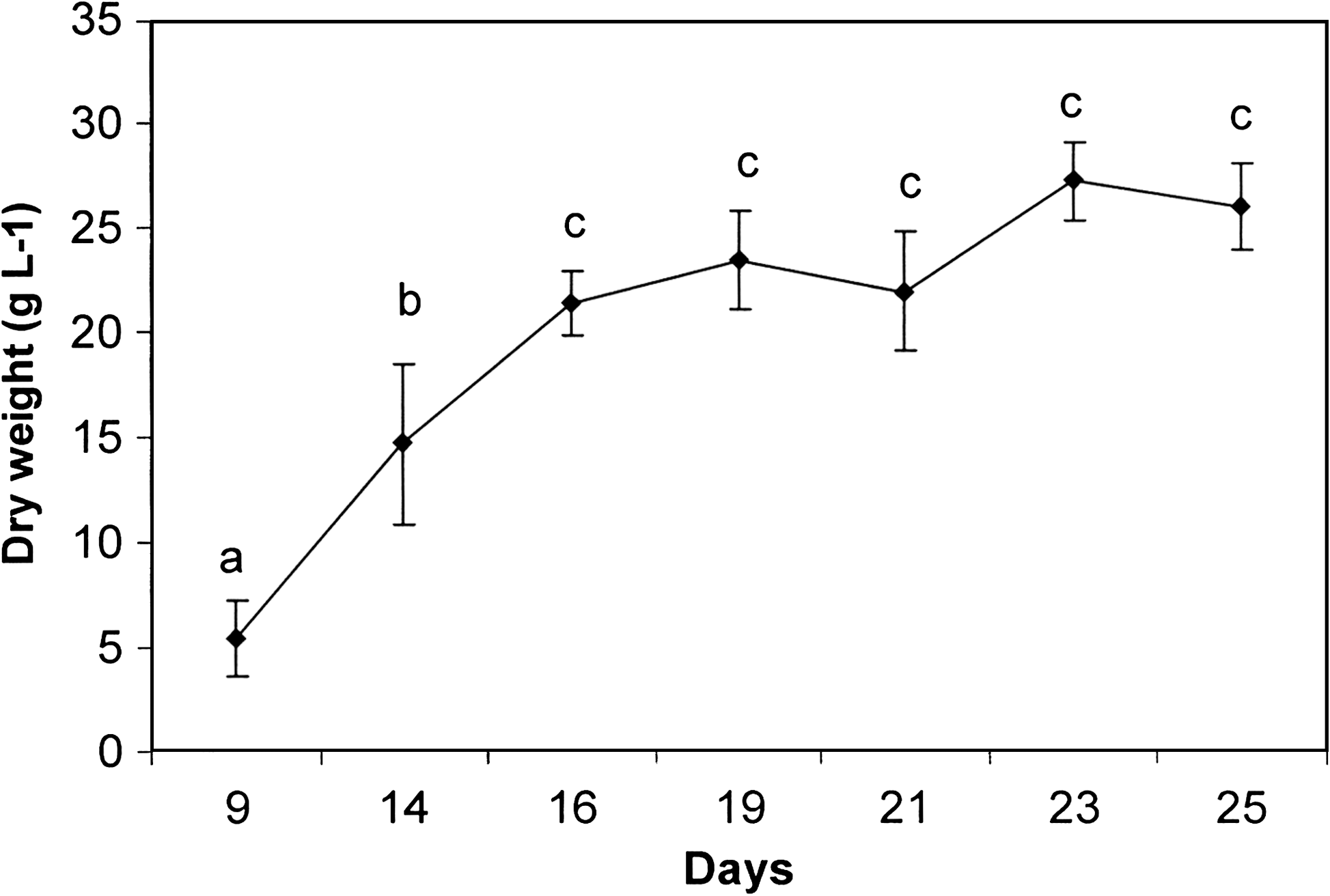
Mycelium growth of G. frondosa in modified MYP liquid medium. Data are mean ± 1 SD values of mycelial biomass (n = 5). Values with different letters have highly significant differences (P < .01 according to Tukey's test).
Cu and Zn effect on G. frondosa mycelial growth
Addition of Cu and Zn to the culture medium of G. frondosa affected the mycelial mass evolution, as shown in Figures 2 and 3, respectively. Figure 2 shows that 50, 100, and 200 ppm of Cu in the nutrient medium tended to stimulate mycelial growth, although there were no highly significant differences (P > .01) between treatments. The maximum mycelium biomass (27.8 g/L) was obtained at 100 ppm of Cu; without Cu addition to the medium, it was 24 g/L. At 400 ppm Cu, a highly significant inhibition occurred, with a value of 9.5 g/L mycelial biomass.

Effect of Cu on growth of G. frondosa mycelium cultivated on modified MYP liquid medium containing Cu as CuSO4. Data are mean ± 1 SD values of mycelium biomass (n = 5). Values with different letters presented highly significant differences (P < .01 according to Tukey's test).

Effect of Zn on growth of G. frondosa mycelium cultivated on modified MYP liquid medium containing Zn as ZnSO4. Data are mean ± 1 SD values of mycelium biomass (n = 5). Values with different letters presented highly significant differences (P < .01 according to Tukey's test).
Increasing concentrations of Zn in the culture medium reduced growth of the G. frondosa mycelium, although it was not statistically significant up to 200 ppm Cu (P > .01 according to Tukey's test). Addition of 400 ppm Zn produced a marked inhibitory effect on mycelium growth, with a dry weight mean value of 4.1 g/L, a decrease of almost 77% with respect to the control medium (17.9 g/L).
Cu and Zn bioaccumulation
Cu accumulated in the G. frondosa mycelium at 23 days of growth in response to the Cu salt addition to the medium is shown in Figure 4. It was efficiently accumulated by this mushroom, and the accumulation increased with the augmentation of Cu content in the growing medium, which reached a maximum value of 680 ppm in the presence of 400 ppm of Cu. The Cu mycelium content was 3.9, 6.6, 18.4, 29.5, and 61.6 times the concentration found in the mycelium cultivated in basal medium (10.9 ppm) after addition of 25, 50, 100, 200, and 400 ppm of Cu, respectively to the nutritive cultivation medium. Thus, G. frondosa was able to efficiently accumulate 322 ppm of Cu with no mycotoxic effect up to a Cu level in the medium of 200 ppm.

Cu accumulation by G. frondosa mycelium grown in liquid culture medium containing Cu (25, 50, 100, 200, of 400 ppm) as CuSO4. Data are mean ± 1 SD values (n = 5). Values with different letters presented highly significant differences (P < .01 according to Tukey's test).
G. frondosa also accumulated Zn. As the concentration of Zn in the culture medium increased, Zn mycelium content tended to increase, although no statistically significant differences were found in the range of concentrations from 25 to 200 ppm (Fig. 5). In the presence of 25 and 400 ppm of Zn, the mycelium accumulated 267 and 2,132 ppm of Zn, respectively, resulting in an accumulation of 13 and 103 times the Zn content in the control mycelium (20.6 ppm).

Zn accumulated by G. frondosa mycelium grown in liquid culture medium containing Zn (25, 50, 100, 200, or 400 ppm) as ZnSO4. Data are mean ± 1 SD values (n = 5). Treatments with different letters presented highly significant differences (P < .01 according to Tukey's test).
Cu and Zn bioavailability
Although maximum metal mycelium accumulation of either Cu or Zn was obtained with an element concentration in the medium of 400 ppm, this dose was toxic and inhibited mycelial growth. Hence, concentrations of 100 and 200 ppm of Cu or 25 and 50 ppm of Zn were chosen for bioavailability assays because previous results indicated that at these concentrations the biomass mycelium was considerable and an accumulation of the minerals occurred without toxicity signs.
Figures 6 and 7 show the total Cu or Zn solubilized when 1 g of either mineral-enriched mycelium or commercial dietary supplements was subjected to an in vitro gastric digestion followed by another in vitro digestion with fluids simulating the intestinal tract.

Cu solubilized after simulated gastrointestinal digestion of G. frondosa 100 or 200 ppm of Cu-enriched mycelium and commercial dietary supplement. Data are mean ± 1 SD values (n = 3).
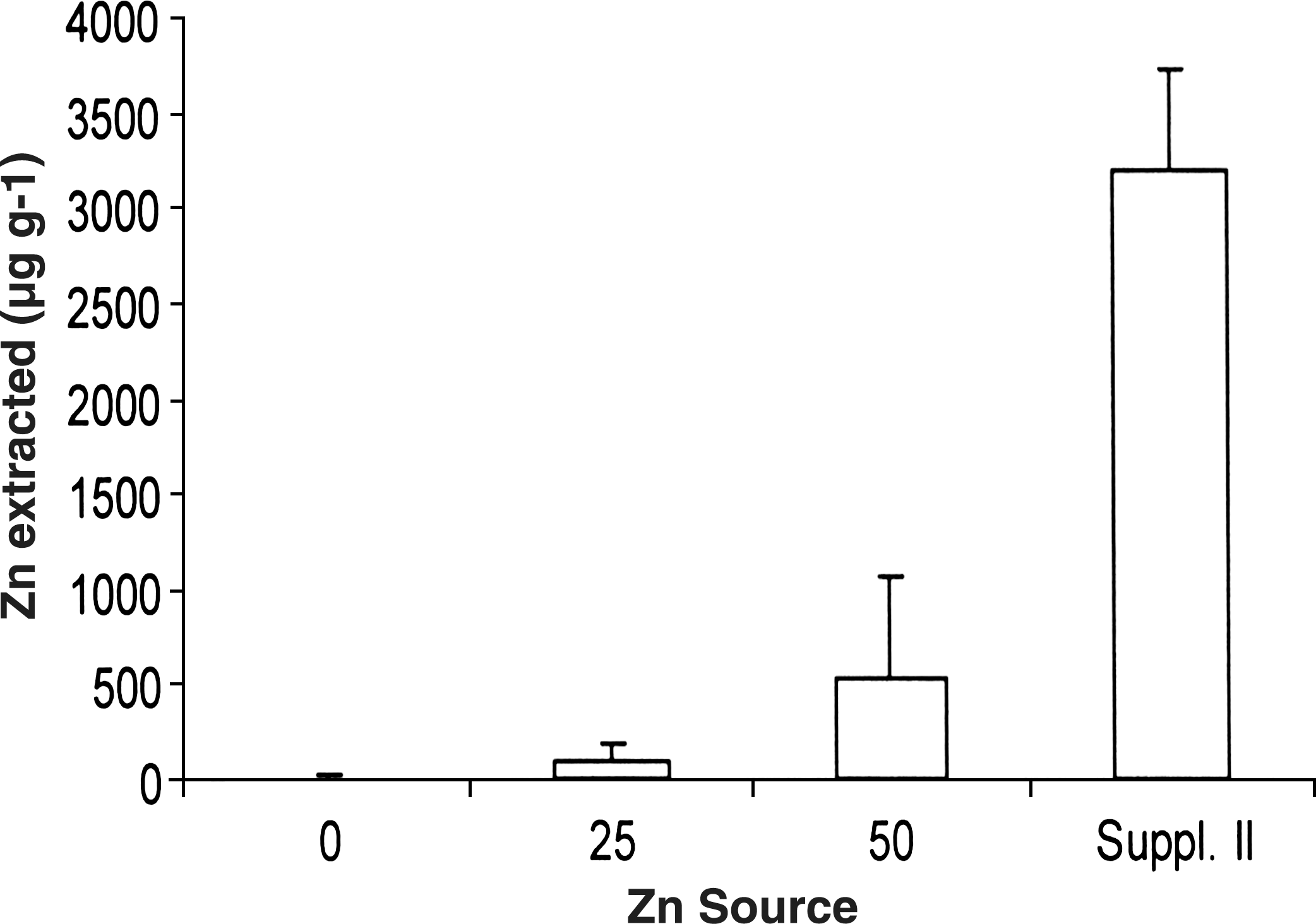
Zn solubilized after simulated gastrointestinal digestion from 25 or 50 ppm of Zn-enriched mycelium of G. frondosa and from commercial dietary supplement. Data are mean ± 1 SD values (n = 3).
The Cu extracted from the enriched G. frondosa mycelium by using the gastrointestinal digestion treatment increased relative to the control mycelium in the presence of 100 and 200 ppm of Cu, being considerably higher (642 and 669 μg/g Cu, respectively) than that obtained from control mycelium (4.9 μg/g). These values represent 85–89% of the Cu content obtained in the commercial supplement I (750 μg/g) and, per unit mass (1 g), correspond to approximately 32–33% of the RDI, whereas the Cu commercial dietary supplement contributes approximately 38% of the RDI.
The Zn extracted by simulated gastrointestinal digestion from enriched G. frondosa mycelium grown in the presence of 25 or 50 ppm Zn (102 and 530 μg/g, respectively) was substantially higher than the Zn content in the control mycelium (8.8 μg/g). However, the Zn solubilized by the digestion procedure in the 50 ppm Zn-enriched mycelium was six times lower than the Zn solubilized from the commercial supplement II (3,190 μg/g).
These results from the gastrointestinal digestion analysis, expressed as solubility (ppm) of Zn from Zn-enriched mycelium and as percentage of the RDI in comparison to the dietary supplement, show that enriched mycelium (25–50 ppm) accumulated 102 and 530 ppm of Zn, respectively. The higher value represents an RDI no more than 4% for 1 g of Zn-enriched mycelium, six times lower than that obtained from 1 g of dietary supplement representing approximately 21% of the RDI.
Discussion
G. frondosa biomass concentration was similar to that reported by Zapata et al. 37 for G. frondosa in an optimized submerged culture (21.1 ± 0.82 g/L) and higher than that reported by Lee et al. 38 of 16.8 g/L.
The optimal concentration range is narrow for micronutrients, and high concentrations result in mycotoxic effects inhibiting mycelium growth. 39 In our work, G. frondosa mycelium tolerated up to 200 ppm of Cu or Zn. There was a stimulating growth tendency, although not significant, up to 200 ppm of Cu. It is known that Cu stimulates the production and activity of laccases, extracellular mushroom enzymes that are able to degrade lignocellulosic materials. These enzymes use Cu as a prosthetic group and can be found in many edible and medicinal mushrooms like A. blazei, Pleurotus ostreatus, G. frondosa, and G. lucidum. 40 In the case of G. frondosa, when the culture medium is supplemented with 100–500 μM Cu, it can cause a significant increase in laccase activity in the first stages of growth. 41
The fact that the mycelium growth was not significantly inhibited by concentrations up to 200 ppm of Cu or Zn suggests the presence of some kind of mechanism of resistance/tolerance to an excess of these metals. Different mechanisms of tolerance have been suggested for mushrooms at high levels of heavy metals, such as Cu ion retention among the components of the cell wall, alteration in Cu absorption, extracellular chelation or precipitation by mushroom secreted metabolites, and formation of intracellular complexes with polypeptides such as metallothioneins and phytochelatins. 42,43 As an example, the lignocellulolytic mushroom Poria placenta can form a Cu complex, producing oxalic acid to form the corresponding Cu salt, which allows its growth in Cu-treated wood. On the other hand, mushrooms in culture medium are capable to produce huge amounts of polysaccharides, and it was suggested that they can act like biosorbents for heavy metals. 39
In the present study, the mycelium of G. frondosa exhibited a high accumulation capacity of the metals present in the culture medium. Copper or zinc levels in the mycelial biomass increased, following increasing concentration of the minerals in the culture medium. Thus, mushroom mycelium accumulated up to a maximum metal mushroom content of 670 ppm of Cu and 2,132 ppm of Zn in the presence of the highest concentration (400 ppm) of these elements in the medium, although this concentration was mycotoxic in both cases. With a nonmycotoxic content of 200 ppm in the nutrient medium, G. frondosa accumulated 320 ppm of Cu and 323 ppm of Zn, respectively, which represented an accumulation of 29.5 and 15.7 times the concentration, respectively, in the control.
Rabinovich et al., 21 working with a strain of A. blazei, found that a Cu or Zn concentration of 400 ppm in the culture medium produced maximum accumulation of 11,130 ppm of Cu and 14,369 ppm of Zn, respectively, i.e., an increase of 449 times for Cu and 163 for Zn, with respect to the control mycelium (88 ppm). However, 400 ppm of Cu in the medium significantly inhibited A. blazei mycelial growth, whereas at the same Zn concentration, a mycelial biomass decrease was observed, although it was not statistically significant.
To evaluate the potential utility of G. frondosa mycelium enriched with Cu or Zn as a nutritional supplement, it is important to know not only the total concentration of the minerals in the mycelium but also the degree of their bioavailability in terms of solubility. Although solubility cannot be considered as a synonym for bioavailability, it is an important factor affecting bioavailability. The Cu or Zn chemical forms with the highest solubility are considered more potentially bioavailable than less soluble forms. Moreover, for an element to be absorbed and potentially used by an organism, it should necessarily be in a soluble form in the intestinal fluid, either as free ion or chelated with another nutrient. 44 Thus, the solubility of Cu and Zn in a simulated digestive tract was used to evaluate the bioavailability of both dry mycelium and supplements. Thus Cu and Zn accumulated by G. frondosa mycelium had solubility values that represent at least 33% and less than 4% of the RDI for Cu and Zn, respectively, per gram of dry mycelium. Comparatively, the values obtained for A. blazei mycelium after simulated gastrointestinal digestion were in the range of 57–98% and 9–11% of the RDI for Cu and Zn, respectively, per gram of dry mycelium. 21
In the case of Zn-enriched mycelium of G. frondosa, it still could find some useful application where higher amounts of this mushroom could be used to increase flavor and aroma of the mushroom in food preparations with the extra value of Zn addition in a safe range, for example, as in a single serving of soup. Moreover, it could also be used in mixtures where both G. frondosa and Zn have a cosmetic value for skin rejuvenation treatments. 25,45,46
It should be recalled that within the in vitro gastrointestinal digestive environment, the fluids, pH, and temperature are simulated, and the concentration of the material digested in the solution of these fluids could be too high in comparison with actual conditions. The addition of drinking water, saliva, and other digestive juices would promote a continuous dilution of the gastrointestinal tract contents, which could generate a greater solubilization compared with in vitro conditions. Therefore, it could be possible that both the solubility and the RDI values obtained in the present study have been underestimated.
As it was mentioned above, metal chelating ability could be due to the presence of metallothioneins, which could be particularly expressed in the presence of minor elements such as Zn and Cu, regulating their homeostasis. 47 At this point, it is interesting to mention the recent findings of Sang et al. 48 regarding various biological and physicochemical properties of both extra-polysaccharides and mycelial polysaccharides of G. frondosa, with potential applications in the area of functional cosmeceuticals. These authors found that G. frondosa extra-polysaccharides and mycelial polysaccharides had antioxidant activity, stimulation of collagen biosynthetic activity, cell proliferation activity, and inhibitory activity of melanogenesis, without significant cytotoxicity.
The possibility of the presence of Cu and Zn metalloproteins present in the mycelium of G. frondosa enriched with these elements does emphasize the need for additional research in the cosmeceutical application of Cu- and Zn-enriched mycelium of G. frondosa.
It is concluded that G. frondosa mycelium can accumulate Cu or Zn and that the metal-enriched mycelium shows a marked difference to yield these elements in solution, being much superior in the case of Cu. Hence, because of the important differences between the bioavailability of the two micronutrients in the enriched mushroom mycelium, the one enriched with Cu should be more useful as a nutritional supplement because it contributes an important percentage of the RDI. In addition, attention is called to the possibility of an additional cosmeceutical application of the metal-enriched mycelium of G. frondosa.
Footnotes
Acknowledgments
The present investigation was supported by the Universidad Nacional del Sur and the National Research Council of Argentina (CONICET).
Author Disclosure Statement
No competing financial interests exist.