




Abstract
Bromelia balansae (Family Bromeliaceae) is a medicinal plant commonly used in the central region of Brazil as a cough syrup and also eaten roasted. The methanolic extract of ripe fruits was analyzed by chromatographic methods and spectrometrically. Four glycoside flavonols were isolated: kaempferol-3-O-α-
B
The Bromeliaceae family has not been well screened for its chemical constituents, probably because of the inaccessibility of its species. Despite this, in Brazil this family has a great ecological and horticultural importance interest.
Chemical investigations of Bromelia pinguin species have revealed the presence in the roots and stems of the flavones penduletin, cirsimaritin, and casticin, as well as of isoferulic acid and three diterpenoids. 3
Investigations on the secondary metabolites of Bromelia plumieri in an extract of the fruits and pulp have revealed the presence of anthranilic acid and their glycoside derivatives, as well as the presence of 34 volatile substances. 4,5
In addition, in recent years, several proteolytic enzymes from species belonging to the Bromeliaceae family have been isolated and characterized: stem and fruit bromealin, ananain, and comosain, obtained from Ananas comosus, 6,7 as well as proteases from fruits of B. pinguin and B. balansae. 8,9
In the present communication, we report results obtained on phytochemical analysis, evaluation of antituberculosis activity against Mycobacterium tuberculosis, and antioxidant activity of polar extract from B. balansae.
B. balansae was collected in the city of Dourados, MS, Brazil, in March 2006 and June 2007 and identified by M. do C. V. A voucher specimen (number 2467) is deposited in the Herbarium of the Federal University of Grande Dourados, Dourados.
The roots (900 g), leaves (1,200 g), and ripe fruits (2,000 g) in natura of B. balansae were extracted successively with CHCl3 and methanol at room temperature. Extracts were filtered and concentrated under vacuum. The methanol extract (30 g) of ripe fruits was dissolved in 1.0 L of water and fractionated by XAD-2 (Supelco, Bellefonte, PA, USA) resin column chromatography (30 cm × 3 cm) eluted with 1.5 L of water, followed by 0.7 L of methanol and finally with 0.3 L of acetone. An aliquot (2.0 g) of the methanolic fraction (FRMeOH) was dissolved in 15 mL of methanol and fractionated by Sephadex LH-20 (Amersham Pharmacia Biotech, Uppsala, Sweden) column chromatography (100 cm × 3 cm) eluted with methanol at a flow rate of 0.5 mL/minute. In total, 64 fractions of 7 mL were collected. The fractions were combined according to their behavior by thin-layer chromatography (silica gel plates; ethyl acetate/n-propanol/water, 140:8:80 by volume, upper phase). Fractions 40–45 resulted in the isolation of the compound kaempferol-3-O-α-
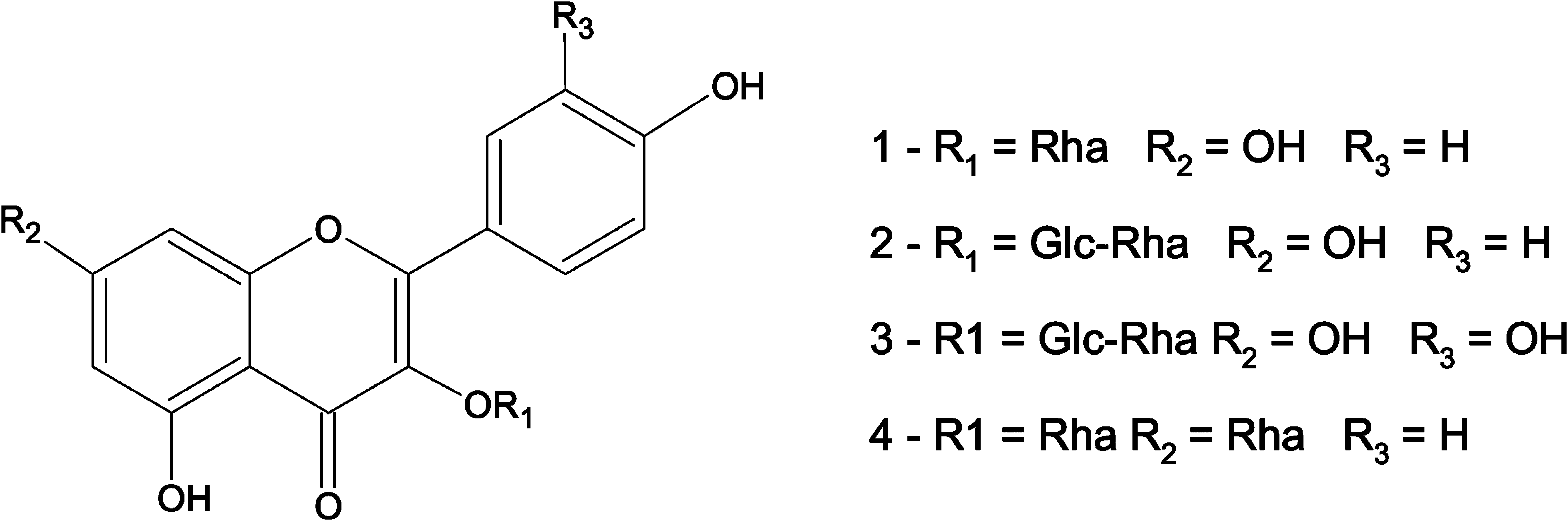
Substances isolated from fruits of B. balansae.
The identification of all compounds was achieved by the experimental data (infrared, nuclear magnetic resonance, and mass spectrometry). Their structures were also confirmed by comparing with the previously reported respective literature data. 10 –12 The methanolic extracts obtained of the fruits, leaves, and roots from B. balansae were also analyzed by an analytical high-performance liquid chromatograph (Varian 210, Varian, Sugar Land, TX, USA) system with a ternary solvent delivery system, equipped with an autosampler and a photodiode array detector. Star WS (Workstation) software (Varian) was used for chromatograms and measuring peak areas. The high-performance liquid chromatography column was an RP18 reversed-phase column (25 cm × 4.6 mm; particle size, 5 μm) (Luna, Phenomenex, Torrance, CA, USA), with a small precolumn (2.5 cm × 3 mm) containing the same packing, used to protect the analytical column. Elution was carried out with a gradient solvent program of methanol/water/acetonitrile (1:84:15 by volume), taking 15 minutes to reach 1% methanol/59% water/40% acetonitrile, taking 5 minutes to reach 1% methanol/21% water/78% acetonitrile, taking 10 minutes to reach 1% methanol/0% water/99% acetonitrile, and taking 10 minutes to reach 0% methanol/0% water/100% acetonitrile, returning after that in 10 minutes to the initial conditions. The flow rate was 1.0 mL/minute, and the volume injected was 10 μL. All chromatographic analyses were performed at 22°C.
Our phytochemical investigation of the fruits from B. balansae has led to the isolation of four glycoside flavonols (Fig. 1). The flavonoids, such as flavonols, are widely present in the plant kingdom, being found in almost all fruits and vegetables. 11 However, the occurrence of glycoside flavonols in fruits from B. balansae is reported for the first time here in this species and in the genus Bromelia.
We developed a method based on comparative high-performance liquid chromatography with diode array detection and ultraviolet analysis to check for the presence of flavonols in the crude methanol extract of fruits, leaves, and roots of B. balansae. The chromatography profiles of the methanolic extracts of fruits, leaves, and roots could be established by comparing the retention times and ultraviolet spectra of the peaks with those of isolated compounds from fruit extract.
The extracts analyzed did not show a similar qualitative chromatographic pattern. Substances
In species of subfamilies Pitcairnioideae and Tillandsioideae, Williams 13 related in the leaves the presence of the flavonols and flavones with hydroxylation or methoxylation at the 6-position. 6-Hydroxyluteolin-7-O-(1"-α-rhamnoside) was isolated from the species Vriesea sanguinolenta Cogn. and Marchal, belonging to the subfamily Tillandsioideae. 14 Williams 13 described also the presence of the myricetin and quercetin glycosides in the Bromelioideae (Portea petropolitana) in the leaves and the absence of 6-hydroxyflavonoids.
One of the few chemical studies involving secondary metabolites of plants of the subfamily Bromelioideae has been done with the genus Ananas. Studies of leaves of Ananas comosus L. detected the presence of phenylpropane diglycerides, hydroxycinnamic acids, hydroxycinnamoyl quinic acids, phenylpropane monoglycerides, flavones, and phenylpropanoid glycosides. 15 Steroids and phenolic acids were isolated from Ananas ananassoides (Baker) L.B. Smith in the leaves. 16
Because B. balansae is a plant largely used as a cough syrup and for alimentary purposes, we also decided to investigate the effect of methanol extract against M. tuberculosis and to evaluate the antioxidant activity using two different methods.
The anti-M. tuberculosis activity of the methanolic extract of fruits was determined using the resazurin microtiter assay as the analytical method. 17 The minimal inhibitory concentration (MIC) values of these compounds necessary to inhibit 90% of growth of M. tuberculosis H37Rv ATCC 27294 were determined in triplicate in sterile 96-well plates (Falcon 3072; Becton Dickinson, Franklin Lakes, NJ, USA), in a SPECTRAfluor Plus (Tecan, Männedorf, Switzerland) microfluorimeter. For the standard test, the MIC value of isoniazid was determined each time. 18 The acceptable MIC of isoniazid ranges from 0.015 to 0.03 μg/mL. 18
The methanolic extract showed an MIC value of 128 μg/mL. According to Gu et al., 19 a sample with an MIC value of ≤128 μg/mL is defined as active. According to Pauli et al., 20 the MIC of a crude natural extract may or may not be a reliable indicator of the chances for success in isolating a potent antimycobacterial agent from that extract. In our study the majority of the secondary metabolites present in the methanolic extract are glycoside flavonols.
The literature reports the flavonols are inactive or weakly to moderately active against M. tuberculosis. A series of flavonols, flavones, flavanones, and chalcones were synthesized and evaluated for inhibitory activity against M. tuberculosis H37Rv. 21
Flavonol (3-hydroxyflavone) exhibited a low potency of 38% inhibition. The presence of a 4′-methoxyl group on flavonol led to a slight, 10% increase in inhibitory activity. The authors also related that the addition of a halogen substituent on the ring 6-chloro or 7-fluoro group on 4′-methoxyflavonol did not affect the activity. However, the substitution of a 7- or 8-iodo group, a 6-fluoro or 6-bromo group, or a 6-carboxy group on 4′-methoxyflavonol resulted in a significant decrease or a complete loss of activity.
In conclusion, the authors found that compounds such as flavonoids with hydrophilic substituents, such as methoxyl, hydroxyl, and amino groups, resulted in a dramatic decrease or complete loss of activity, which strengthens the proposal that compounds with lipophilic groups are more active. The high lipophilicity is probably the main factor that allows penetration of the compounds through the mycobacterial cell wall. 21
The antioxidant activity of methanolic extract and FRMeOH of fruits, based on free radical scavenging and β-carotene/linoleic acid assays, was determined by the method described by Blois 22 and Coutinho et al., 23 respectively. For these assays the extracts were evaluated at concentrations at 40, 80, 160, 320, and 640 μg/mL. The radical scavenging effect of each sample was calculated and compared with that of quercetin (Sigma) (2.5, 5, 10, 20, and 40 μg/mL), and the experimental values in the β-carotene/linoleic acid assay were compared with those of tert-butylated hydroxytoluene. All the tests were conducted in triplicate.
The methanolic extract had low free radical scavenging activity and inhibited peroxidation with values ranging from 3.2% to 8.4%. The possible reason for the low activity might be the presence of high quantities of carbohydrates in fruit of B. balansae, which considerably reduced the activity, or that the carbohydrates are weak antioxidants.
The FRMeOH exhibited free radical scavenging activity ranging from 20.2% to 91.1%, compared with the quercetin standard having scavenging activity of 94.3% (at 40 μg/mL). The inhibition of peroxidation values ranged from 5.6% to 27.5%, compared with the tert-butylated hydroxytoluene standard of 90.6% (at 40 μg/mL). The results showed that the antioxidant activity measured for the free radical scavenging acid assay in the same concentrations was greater than that of the β-carotene/linoleic acid assay. This might be attributed to the structures present in this fraction as flavonols, which exhibit their antioxidant activity by donating hydrogen.
In conclusion, in this study we reported an investigation of the phytochemical composition of the polar extract of fruits from B. balansae, which is reported herein for the first time in the literature. We also reported for the first time the activity against M. tuberculosis and the evaluation of antioxidant activity.
Footnotes
Acknowledgments
We thank the Fundação de Apoio ao Desenvolvimento do Ensino, Ciência e Tecnologia do Estado de Mato Grosso do Sul for financial support. We also thank the CNPq for a grant given to R.G.C. and the Fundação de Amparo à Pesquisa do Estado de São Paulo for grants 2008/10390-2 and 2009/06499-1.
Author Disclosure Statement
No competing financial interests exist.