




Abstract
The antimicrobial activity of the hexanic extracts and fractions of fruits of Campomanesia pubescens pubescens (D.C) O. Berg and Campomanesia adamantium (Cambess.) O. Berg were assayed against six microorganisms. The hexanic extracts of C. pubescens and C. adamantium fruits were also investigated in their composition by gas chromatography-mass spectrometry and high-performance liquid chromatography with diode array detection. The results of this study showed the presence of 34 volatile compounds and flavonoids in the hexanic extract of C. pubescens and 33 volatile compounds and flavonoids in the hexanic extract of C. adamantium.
C
Previous phytochemical investigations of C. pubescens have revealed the identification quercetin, and myricetin by high-performance liquid chromatography (HPLC). 4 Another study found flavanones and chalcones in C. adamantium leaves. 5 Analyses of essential oil have also showed the presence of 40 components in the fruit oil and 82 compounds in the leaf oil of C. adamantium. 6 –8
The present study has as its aim the evaluation of the antimicrobial activity of hexanic extracts of Campomanesia species obtained from their fruits using the broth microdilution method. Phytochemical screening of the hexanic extracts was also done.
The fruits of C. pubescens and C. adamantium were collected in Mato Grosso do Sul State, Brazil, in the cities of Campo Grande and Bela Vista, respectively. The species were identified by Marcos Sobral of the Federal University of Mato Grosso do Sul, and voucher specimens (5199 and 5196, respectively) were deposited in the Herbarium of Mato Grosso do Sul, Campo Grande, MS, Brazil.
The antibacterial activity of the hexanic extracts and fractions was assayed using the broth microdilution method. A collection of six microorganisms were used: two Gram-positive bacteria (Staphylococcus aureus [ATCC 6538p] and Pseudomonas aeruginosa [ATCC27853]), two Gram-negative bacteria (Escherichia coli [ATCC 11103] and Salmonella setubal [ATCC 19796]), and two yeasts (Saccharomyces cerevisiae [ATCC 2601] and Candida albicans [ATCC 10231]). Standard strains of microorganisms were obtained from the American Type Culture Collection (Manassas, VA, USA), and the standard antibiotics chloramphenicol and nystatin were used in order to control the sensitivity of the microbial test. The minimal inhibitory concentration (MIC) was determined in 96-well culture plates by a microdilution method using a microorganism suspension at a density of 105 colony-forming units/mL with casein soy broth incubated for 24 hours at 37°C for bacteria and Sabouraud broth incubated for 72 hours at 25°C for yeasts. Proper blanks were assayed simultaneously, and samples were tested in triplicate.
For the phytochemical screening of the hexanic extracts from C. pubescens and C. adamantium, the samples were prepared with 100.00 mg of fruits in 5 mL of hexane (maceration in sonication for 2 hours). Removal of the solvent from the extract under reduced pressure gave the hexane extract (6.34 mg). The hexanic extract EHEX (5.00 mg) was solubilized in methanol. The clean-up was realized in Sulpelclean™ LC-18 (1 g; particle size, 55–105 μm; 6 mL) (Supelco, Bellefonte, PA, USA). 1-mL sample was added to the column, which was eluted with methanol (3 × 1 mL) and hexane (4 × 1 mL), respectively. The hexanic fraction FRHEX was filtered through a Millex (Millipore, Billerica, MA, USA) filter (pore diameter, 0.22 μm), reconstituted in a 5-mL volumetric flask with hexane, and analyzed by gas chromatography (GC)-mass spectrometry (MS) and HPLC coupled to a diode array detector (DAD). The methanolic fraction FRMeOH was filtered through a Millex filter (pore diameter, 0.22 μm), reconstituted in a 5-mL volumetric flask with methanol, and analyzed by HPLC-DAD.
The constituents of FRHEXCa and FRHEXCp obtained from C. adamantium and C. pubescens, respectively, were analyzed by GC-MS. The analyses were performed on a gas chromatograph (model GC 3900) equipped with an ion-trap mass spectrometer detector (Saturn 2100, Varian, Sugar Land, TX, USA), using a ZB-5 (5% phenyldimethylpolysiloxane) fused-silica column (30 m × 0.25 mm; film thickness, 0.25 μm), under the following conditions: carrier gas, helium (flow rate, 1.0 mL/minute); injection volume, 1 μL; split ratio 1:20; initial oven temperature, 50°C; heating from 50°C to 250°C at 3°C/minute. The injector and ion trap detector temperatures were 240°C and 200°C, respectively, with the manifold at 70°C and line transfer at 240°C. The MS scan parameters included electron impact ionization voltage of 70 eV, a mass range of 40–500 m/z, and a scan interval of 0.5 seconds. Temperature-programmed retention indices were calculated according to the equation of Van den Dool and Kratz using a mixture of normal paraffins (C8–C22) as external references. 9,10 The identifications were completed by comparing the spectra of masses obtained with those of the NIST 2.0 and Saturn Libraries (available with the Varian instrument) and literature data. 11
The FRMeOHCa and FRMeOHCp obtained from the hexanic extract of Campomanesia species were performed on an analytical HPLC (Varian 210) system with a ternary solvent delivery system, equipped with an autosampler and DAD with scanning from 200 to 800 nm, and Star WS (Workstation) software (Varian) was used for chromatograms and measuring peak areas. The HPLC column was an RP18 reversed-phase column (25 cm × 4.6 mm; particle size, 5 μm) (Luna, Phenomenex, Torrance, CA, USA), with a small precolumn (2.5 cm × 3 mm) containing the same packing, used to protect the analytical column. Elution was carried out with a gradient solvent program of methanol/water/acetonitrile (40:50:10 by volume), taking 40 minutes to reach 80% methanol/10% water/10% acetonitrile and returning after that in 20 minutes to the initial conditions. The flow rate was 1.0 mL/minute, and the volume injected was 50 μL. All chromatographic analysis were performed at 22°C.
Our analysis identified in FRHEXCp of fruits from C. pubescens 34 volatile compounds by GC-MS. The major compounds were α-pinene (15.1%), spathulenol (7.1%), β-eudesmol (5.2%), and β-caryophyllene (4.1%), whereas in FRHEXCa of fruits from C. adamantium 33 compounds were identified, and the major constituents were α-pinene (24.0%), spathulenol (8.8%), β-eudesmol (6.1%), γ-cadinene (8.6%), and γ-muurolene (6.2%) (Table 1).
Compounds listed in order of elution from the ZB-5 column.
I Cal, programmed temperature retention indices determined on an apolar ZB-5 column (50–250°C; 3°C/minute); I Lit, temperature retention indices obtained from the literature.
In comparison to previous studies on fruits of C. adamantium, we were able to confirm the presence of α-pinene, but in our oil sample analyzed, the compounds limonene and β-(Z)-ocimene were not identified as reported by Vallilo et al. 7
The compounds analyzed were not detected by HPLC-DAD in FRHEX. This failure indicates the presence of compounds that do not absorb in the ultraviolet region. Figures 1 and 2 show the chromatography profile of C. pubescens and C. adamantium, respectively. The analyses of FRMeOH showed the presence of chalcones and flavanones: 7-hydroxy-5-methoxy-6-methylflavavone (

Chromatography profile (at 296 nm) of FRMeOH from fruits of C. pubescens. mAU, milliabsorbance units.
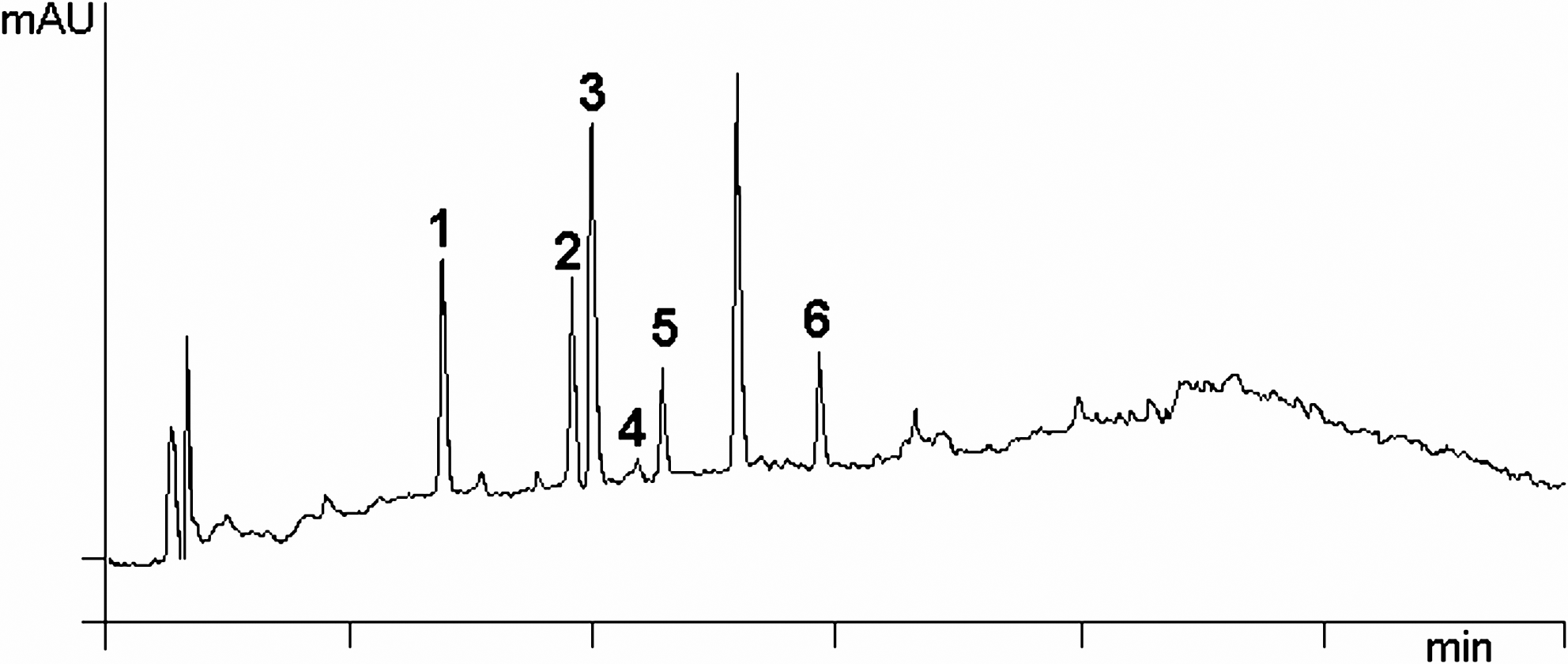
Chromatography profile (at 296 nm) of FRMeOH from fruits of C. adamantium.
The antimicrobial activity of the hexanic extracts and fractions was examined against a panel of six microorganisms. The results (Table 2) reveal that EHEXCp and FRHEXCp inhibited the growth of all microorganisms and that C. albicans with MICs of 10.0 μg/L and 5.0 μg/mL, respectively, was the most sensitive. E. coli was the most resistant microorganisms with an MIC of 20.0 μg/mL for EHEXCp and FRHEXCp, respectively.
Data are mean values of three replicates in μg/mL.
Obtained from the American Type Culture Collection.
Standard antimicrobial agents: chloramphenicol against bacteria and nystatin against yeasts.
EHEXCp, hexanic extract of C. pubescens; EHEXCa, hexanic extract of C. adamantium; FRHEXCp, hexanic fraction of C. pubescens; FRHEXCa, hexanic fraction of C. adamantium; MIC, minimal inhibitory concentration.
For C. adamantium the results reveal that EHEXCa and FRHEXCa inhibited the growth of all microorganisms and that C. albicans (MIC = 5.0 μg/mL) was the most sensitive, whereas E. coli was the most resistant microorganism (MIC = 20.0 μg/mL).
The volatile compounds present in FRHEX from fruits of C. pubescens and C. adamantium demonstrated relatively good activity against the Gram-positive and Gram-negative bacteria. 12 –14 The fractions containing volatile components were the most sensitive, whereas the fractions (FRMeOH) from both species containing flavanones and chalcones were not active against the six microorganisms in concentrations in the range of 100 μg/mL. Although the MIC values obtained with FRMeOH are lower than with FRHEX, those MIC values can be considered good. Compounds such as chalcones are considered potentially active against bacterial strains of Bacillus cereus, E. coli, P. aeruginosa, and S. aureus. 15
β-Pinene and β-caryophyllene, which are known to possess antimicrobial potential, were identified in FRHEXCp and FRHEXCa. 16 Maggi et al. 17 analyzed some pure components such as β-pinene and (E)-caryophyllene and verified that these compounds have high activity against C. albicans. In our case, we suggest that other active components play an important role on the synergistic effects of the extracts and fractions on the inhibition of bacteria. Finally, the inhibition activity exhibited by EHEXCp and EHEXCa may be attributed mainly to the volatile compounds.
Footnotes
Acknowledgments
We thank the Fundação de Apoio ao Desenvolvimento do Ensino, Ciência e Tecnologia do Estado de Mato Grosso do Sul for financial support. We also thank the CNPq for a grant given to R.G.C.
Author Disclosure Statement
No competing financial interests exist.