




Abstract
The aim of this study was to investigate whether coenzyme Q10 (CoQ10) has an antifatigue effect in mice. ICR male mice were orally given CoQ10 in the form of Bio-Quinone® (Pharma Nord, Vejle, Denmark) at doses of 0, 1.5, 15, or 45 mg/kg/day for 4 weeks. Mice were made to perform swimming exercise with loads attached to their tails, corresponding to approximately 5% of their body weights, and the total swimming time until exhaustion was measured. Furthermore, the post-exercise concentration of serum urea nitrogen (SUN), pre-/post-exercise and post-rest concentration of lactic acid (LA), and pre-exercise hepatic glycogen were determined. Mice treated with CoQ10 showed a significantly prolonged exhaustive swim time (15 mg/kg/day; P < .05), increased liver glycogen contents (15 and 45 mg/kg/day; P < .01 and P < .05, respectively), and decreased SUN levels (1.5, 15, and 45 mg/kg/day; P < .01) compared to control animals. The LA level was not significantly changed. These results suggest that CoQ10 improves swimming endurance and has an antifatigue effect.
Introduction
C
Fatigue, which is defined as a loss of force-generating capacity and can be classified into mental and physical fatigue, has become a common universal problem. Energy loss and muscle fatigue can limit the body's ability to work and physical performance. Free radicals are reactive compounds that are naturally produced in the human body. Many studies have demonstrated that muscular exercise results in an increased production of free radicals and other forms of reactive oxygen species 4,5 that contributes to decreased physical performance, muscular fatigue, and muscle damage. 6,7 The antioxidant CoQ10 has been found to attenuate free radical-induced oxidative stress in various conditions. 8 –10 However, both positive 11 –17 and no 18 –21 effect of CoQ10 supplementation on physical performance in humans at doses up to 300 mg/day have been published using varying study designs and measure parameters.
In this study we performed a dose range test in order to provide animal experimental evidence for antifatigue effect of CoQ10. Dose levels (1.5, 15, and 45 mg/kg/day) were selected on the basis of the literature reporting no adverse effects of CoQ10 up to 3,000 mg/day in humans 22 and 654 mg/kg/day in mice. 23 Administration of 45 mg/kg/day CoQ10 in mice corresponds to an intake of 2,700 mg/day in humans weighing 60 kg.
A powerful representation of antifatigue ability is improved exercise endurance. In this study, the antifatigue activity of CoQ10 in mice was examined in a weight-load swimming test, which has also previously been used to investigate antidepressant and antifatigue effects. 24 –26 Total swimming time until exhaustion was used as the index of swimming endurance capacity. Mice were orally given CoQ10 for 4 weeks and then subjected to exercise in the form of swimming. In addition, blood lactic acid (LA), serum urea nitrogen (SUN), and liver glycogen are representative blood biochemical parameters related to fatigue. Energy for exercise is derived from glycogen, fatty acid, and protein. The blood urea nitrogen test is a routine test to evaluate renal function. Urea is formed in the liver as the end product of protein metabolism. LA was measured as an index of anaerobic glucose metabolism.
Materials and Methods
CoQ10
CoQ10 used in this study was Bio-Quinone®, provided by Pharma Nord (Vejle, Denmark), which contains Kaneka Q10 produced by fermentation with yeast and complied with the European Pharmacopoeia specifications. The CoQ10 purity is over 98%, and each capsule contains 30 mg of CoQ10 (batch number 022171).
Animals
Male ICR mice with a body weight range of 20.4–23.7 g (Beijing Vital River Laboratory Animal Technical Co., Ltd., Beijing, China) were used. They were bred in the animal facility and housed in a temperature (22–24°C; 12-hour light/dark cycle)- and humidity (50–60%)-controlled environment with free access to water and food. The study was approved by the Animal Ethics Committee of the National Institute for Nutrition and Food Safety, Chinese Center for Disease Control and Prevention.
Animals were examined prior to the start of administration and during week 4 of administration. Clinical signs and mortality were observed twice a day before dosing and 1 hour after dosing during the administration period.
Experimental design and dosing
Mice were randomly divided into three groups. Group I mice were used for performing the weight-loaded swimming test (n = 60). Group II mice were used for measuring blood lactate (n = 60) and SUN (n = 60) levels. Group III mice were used for measuring hepatic glycogen (n = 60). In each group, mice were further subdivided into four subgroups (n = 15 per subgroup) and fed with CoQ10 at dose levels of 0, 1.5, 15, or 45 mg/kg/day for 4 weeks (Table 1).
The treatment groups were given CoQ10, and the control group only received 2% sucrose ester for 4 weeks. A stomach tube was used once daily to administer the test substance, and the administration dose was set up at 20 mg/kg. CoQ10 used in this study was Bio-Quinone, for which the net weight without the capsule shell is 0.502 ± 0.005 g per capsule and contains 30 mg of CoQ10. To obtain CoQ10 at 0, 1.5, 15, and 45 mg/kg/day the animals were administered orally Bio-Quinone at 0, 25, 251, and 753 mg/kg/day, respectively.
Weight-loaded forced swimming test
The procedure used in this test was similar to that described previously. 24 The swimming was performed 30 minutes after the last oral administration. Mice were placed in a water tank (50 × 50 × 40 cm) in which mice could not support themselves by touching the bottom with their feet (at 25 ± 0.5°C), and a steel washer weighing approximately 5% of their body weight was attached to the tail. The total swimming time of mice was calculated from the moment they were dropped into water until they were completely exhausted as evidenced by failing to rise to the surface to breathe and drowning.
Determination of SUN
Thirty minutes after the final administration of CoQ10, mice were individually forced to swim for 90 minutes. After swimming, mice were paper towel-dried and returned to their housing condition with a rest period of 20 minutes. Then the blood samples were collected by using the retroorbital bleeding method, cooled for 3 hours at 4°C, and centrifuged for 3 minutes at a speed of 900 g. The supernatant was collected, and SUN was assessed according to the instructions of the automatic random access biochemical analyzer (Sigma-Aldrich Chemical Co., St. Louis, MO).
Determination of hepatic glycogen
Thirty minutes after the final administration of CoQ10, the liver of each mouse was collected, washed with physiological saline, and dried with absorbent paper. One hundred milligrams of liver was accurately weighed followed by addition of 4 mL of trichloroacetic acid. Each aliquot of sample was sufficiently homogenized with a vortex-mixer and then transferred to a centrifuge tube, followed by centrifugation (3,000 g, 15 minutes). A 1-mL aliquot of the supernatant fluid was transferred to another centrifuge tube followed by addition of 4 mL of ethanol (95%, vol/vol). All sample tubes were stored overnight at 4°C. The sample homogenate was centrifuged for 15 minutes at a speed of 3,000 g. The supernatant was removed, and the glycogen was dissolved in 2 mL of water. The hepatic glycogen level was determined by anthrone colorimetry.
Determination of blood LA
The first blood samples (pre-exercise) were collected from mice with a capillary tube using the inner canthus bleeding method at 30 minutes after the last oral administration of CoQ10. Then the animals were forced to swim for 10 minutes, and the second blood samples (post-exercise) were collected. After an additional 20 minutes of rest the third samples (post-rest) were taken. The difference between the pre-exercise and post-exercise LA levels was calculated as a measure of the accumulation of LA caused by the exercise. The difference between the post-exercise and post-rest LA levels was calculated as a measure of the clearance of LA after rest. The LA concentration was determined with a Kyowa Medex commercial kit (Determiner LA, Tokyo, Japan).
Statistical analysis
Data are expressed as mean ± SEM values. The significance of the mean difference between the control group and each treatment group was assessed using one-way analysis of variance and the Tukey-Kramer multiple comparison test. A level of P < .05 was used as the criterion for statistical significance.
Results
CoQ10 administration for 4 weeks had no effect on behavior and mortality in mice. There was no significant difference in the body weight between CoQ10-treated and control mice during initial stage or 4 weeks after intake of CoQ10 (Table 2).
Data are mean ± SEM values (n = 180, 60 per group, 15 per subgroup). No statistically significant differences were found.
The mean duration of swim-to-exhaustion in control animal was 49 minutes with a steel washer weighing approximately 5% of their body weight attached to the tail. CoQ10 at 15 mg/kg/day significantly increased the swimming time to 68 minutes (P < .05) (Fig. 1). The swimming time in mice treated with 45 mg/kg/day CoQ10 was increased to 62 minutes, but there was no significant difference compared to control animal (Fig. 1).
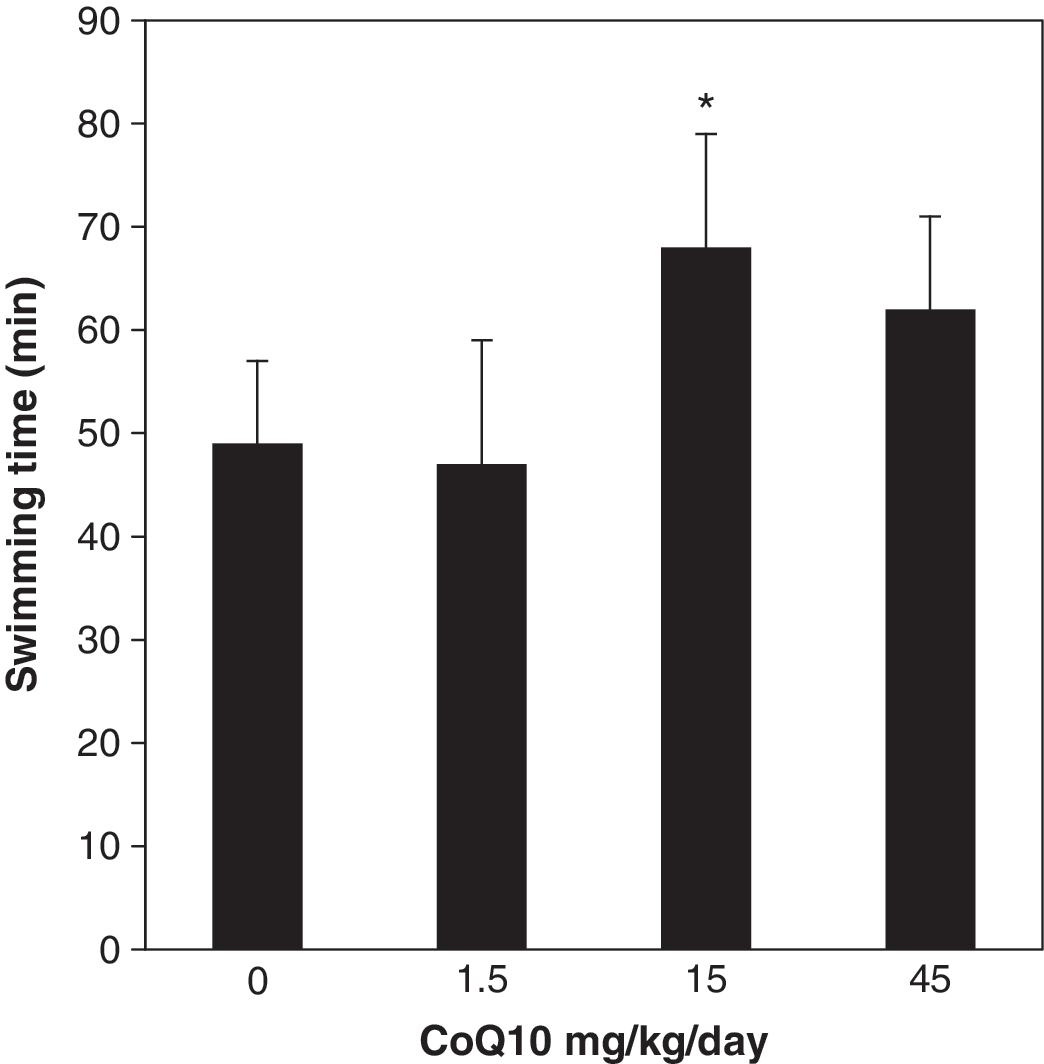
Effect of CoQ10 on swimming time to exhaustion of mice. Data are mean ± SEM values (n = 60). *Significantly different from the control, P < .05.
Table 3 shows that supplemental intake of CoQ10 at 1.5, 15, and 45 mg/kg/day significantly reduced the post-exercise SUN (P < .01). The liver glycogen content was significantly increased in mice supplemented with CoQ10 at 15 and 45 mg/kg/day (P < .01 and P < .05, respectively). The blood LA values, pre-exercise, post-exercise, and post-rest, were unaffected by CoQ10 administration.
Data are mean ± SEM values.
Compared with control: *P < .05, **P < .01.
Discussion
The results from the present study demonstrate that CoQ10 supplementation improves endurance capacity by significantly prolonging the swimming time to exhaustion, which was associated with an increased liver glycogen content and a decreased post-exercise concentration of SUN, indicating an antifatigue effect of CoQ10.
It is generally accepted that carbohydrate, fatty acid, and protein are the sources of energy during exercise. Glycogenolysis is the predominant source of energy for muscle contraction, 27 and for the muscles, liver glycogen is an important determinant for exercise capacity. 28 –30 Moreover, glycogen depletion is associated with physical exhaustion, 29 and the content of glycogen can illustrate the speed and degree of the development of fatigue. In our study, the decreased SUN levels, which reflect reduced protein metabolism and the increased hepatic glycogen storage by CoQ10, may provide an extra energy source for mice during 4 weeks of supplementation that results in improving physical stamina and endurance capacity and delaying the onset of fatigue.
LA is a product of glycolysis under anaerobic condition. Glycolysis is the primary form of metabolism used during intense exercise in a short time. The increased LA production results in decreasing the internal pH value, which may lead to impairment of muscle contraction and harm organs. The LA accumulation has been considered as a major inducer of muscle fatigue. 31,32 In our study, the mice were made to swim for 10 minutes to make glycolysis as the main energy source, 33 and the blood LA concentration was unchanged at pre-exercise, post-exercise, and post-rest, indicating there is no accumulation of lactate after exercise following CoQ10 supplementation.
The literature on antifatigue effects of CoQ10 has shown varying results. No significant effects of CoQ10 supplementation were observed on aerobic capacity in endurance athletes at 1 mg/kg/day for 28 days, 18 on maximal oxygen uptake and muscle energy metabolism in triathletes at 100 mg/day for 6 weeks, 19 and on cycling performance, maximum oxygen volume, and lipid peroxidation at 100 mg/day for 8 weeks in cyclists. 20 Conversely, it has also been reported that CoQ10 supplementation improves the physical performance and fatigue sensation at 90 mg/day for 6 weeks in skiers 13 and at 300 mg/day for 8 days in healthy volunteers, 12 reduces exercise-induced muscular injury in athletes at 300 mg/day for 20 days, 14 and improves aerobic power, anaerobic threshold, exercise performance, and recovery after exercise in trained athletes and untrained individuals at 60–100 mg/day. 15 –17 The inconsistent results might be explained by varied bioavailability of different CoQ10 preparations, which in turn produces different CoQ10 levels in plasma and tissue. Because of the hydrophobicity and large molecular weight of CoQ10, the absorption of dietary CoQ10 is slow and limited. Previous studies have suggested that oil-based preparations would be best absorbed. It is possible that the induced antifatigue effect of CoQ10 requires adequate and continual supplementation.
Our experiment results showed that the medium dose (15 mg/kg/day) could significantly prolong the weight-loaded swimming time of mice. The hepatic glycogen levels were significantly increased in the medium- and high-dose groups. Also, three doses of CoQ10 could significantly decrease the SUN level, but there were no significant differences between each of the two-dose group. These results indicated the antifatigue effect of CoQ10 is not dose-dependent.
CoQ10 appears to have satisfactory safety profiles. The risk assessment for CoQ10 described that the safety of human consumption of CoQ10 is up to 1,200 mg/day 8 and that intake of up to 900 mg/day in healthy adults does not influence the endogenous CoQ10 synthesis. 34 However, the supplemented CoQ10 seems not to accumulate in tissue, 34,35 and its plasma half-life is about 33 hours, 36 which suggests that the beneficial effects of exogenous CoQ10 require long-term administration.
Taken altogether, our results indicate that CoQ10 improves endurance capacity and has an antifatigue effect in mice, suggesting CoQ10 may be useful for the development of physical strength and intervention and/or prevention of fatigue.
Footnotes
Author Disclosure Statement
No competing financial interests exist.