




Abstract
Typheramide (N-caffeoyltyramine) and alfrutamide (N-feruloyltyramine) are phenylpropenoic acid amides found in plants. In this article, typheramide and alfrutamide were isolated from Allium sativum (garlic) and Allium fistulosum (green onion), their chemical structures were confirmed using nuclear magnetic resonance spectroscopic methods, and the potential effects on cyclooxygenases (COXs) (COX 1 and 2) and lipoxygenases (LOXs) (5- and 15-LOX) were investigated. Typheramide and alfrutamide inhibited COX 1 by 74% (P < .01) and 60% (P < .01), respectively, at the concentration of 0.1 μM; at the same concentration, they also inhibited COX 2 by 68% (P < .02) and 54% (P < .02), respectively. Typheramide was slightly stronger than alfrutamide in inhibiting COX enzymes, and the inhibition patterns of COX 1 and 2 were uncompetitive with K i = 0.032 and 0.047 μM, respectively. However, typheramide and alfrutamide were not able to inhibit 5-LOX, and they only moderately inhibited 15-LOX by 27% (P < .02) and 17% (P < .02), respectively, at the relatively high concentration of 25 μM. Altogether, the data suggest that typheramide and alfrutamide from garlic and green onions are likely to be significant inhibitors for COX 1 and 2 rather than 5- and 12-LOX.
Introduction
A
Garlic (Allium sativum) and green onion (Allium fistulosum) are well-known medicinal plants belonging to the Liliaceae family, commonly used as culinary spices and vegetables worldwide. 16 –18 Traditionally, garlic and green onion are believed to contain phytochemicals with anti-inflammatory, antithrombotic, and anti-atherosclerotic activities. 19 –23 Therefore, in this article, garlic cloves and green onions were extracted with methanol (MeOH), the extract was partitioned using ethyl acetate (EtOAc) and n-butanol (n-BuOH), and the EtOAc sample was fractionated using a silica gel column. From the gel fractions, typheramide and alfrutamide were purified using high-performance liquid chromatography (HPLC), and their chemical structures were verified using nuclear magnetic resonance (NMR) spectroscopic methods. Also, the potential effects of typheramide and alfrutamide on COX (1 and 2) and LOX (5-, 15-) enzymes were investigated because the these enzymes are involved in arachidonic acid metabolism, associated with adverse processes of inflammatory, cardiovascular, and other diseases. 1 –5
Materials and Methods
Materials
Human COX 1 and 2 enzymes, linoleic acid, and other chemicals were purchased from Sigma Chemical Co. (St. Louis, MO, USA). LOXs (5- and 15-LOX [from potato and soybean, respectively]) and the LOX inhibitor screening kit were purchased from Cayman Chemical Co. (Ann Arbor, MI, USA). Typheramide and alfrutamide were synthesized and purified as described previously. 24
Extraction and fractionation of garlic and green onion
Clean garlic (1 kg) and green onions (1 kg) were extracted three times with MeOH (2 L) at room temperature. The MeOH extract was evaporated in vacuo to yield a dark-brown residue, which was suspended in water (0.2 L) and then partitioned sequentially using EtOAc and n-BuOH (3 × 0.2 L). The EtOAc fraction was evaporated, and the residue was suspended in 10% ethanol. The sample was passed through a C18-silica gel column (120 × 10 cm) and eluted using MeOH with increasing hydrophobicity. The fractions were individually heat-dried to brown residues, which were dissolved in 10% ethanol for HPLC purification.
HPLC purification of typheramide and alfrutamide
Samples prepared above were further purified using HPLC. A 150- × 2.1-mm i.d. Nova-Pak C18 (Waters, Milford, MA) was used as the stationary phase to analyze the garlic and green onion samples. The samples were purified using a gradient condition (Buffer A [50 mM NaH2PO4, pH 4.3] for 0–5 minutes, a linear change from Buffer A to Buffer B [50 mM NaH2PO4, pH 4.3, containing 40% MeOH] for 5–25 minutes, and Buffer B for 10 minutes) at the flow rate of 1 mL/minute. The peaks of typheramide and alfrutamide were identified using their standards, which were detected by a CoulArray electrochemical detector with four electrode channels (ESA, Chelmsford, MA, USA).
NMR analysis
For NMR experiments, typheramide (20 mg) and alfrutamide (20 mg) were prepared in d 6-dimethyl sulfoxide (DMSO) (0.75 mL). 1 H NMR, 13 C NMR, heteronuclear multiple quantum correlation, and heteronuclear multiple bond correlation spectra were acquired at ambient temperature on the JEOL BCX-400 NMR spectrometer (JEOL, Tokyo, Japan) operating at 400 MHz for 1 H and 100 MHz for 13 C. Chemical shifts were referenced to DMSO (2.50 ppm for 1 H, 39.5 ppm for 13 C).
COX inhibition assay
COX 1 and 2 activities were measured in a 96-well plate using a chemiluminescent COX kit (Assay Designs Inc., Ann Arbor). In brief, 50 μL of Tris-phenol buffer (100 μM Tris and 0.5 μM phenol buffer, pH 7.3) was added into the wells. Fifty microliters of hematin solution (hematin was dissolved in DMSO at 0.380 mg/mL and diluted 5,000-fold with 100 mM phosphate buffer, pH 7.5) was added, and 50 μL of COX 1 (700 units) or COX 2 (700 units) was added into the wells. The samples were incubated at room temperature for 5 minutes. After the incubation, typheramide, alfrutamide, or COX inhibitors (aspirin and NS-296) were added, and the samples were incubated at room temperature (in the dark) for 10 minutes. COX activity was measured using a luminometer by injecting 50 μL of chemiluminescent COX substrate (at 4°C) and arachidonic acid, respectively. Relative light units output was measured to determine COX activity.
Kinetic analysis
Kinetic analyses of the COX 1 and 2 inhibition by typheramide were performed, and K i values were determined using Lineweaver–Burk plots. Data points in all figures represent the mean ± SD values of more than three samples.
LOX inhibition assay
The 5- and 15-LOX activities were measured in a 96-well plate using a LOX kit (Cayman Chemical) according to the manufacturer's protocol. In brief, 99 μL of 5-LOX or 15-LOX enzyme mixture was added into the wells. Then, typheramide or alfrutamide (1 μL) was added to the sample wells, and the samples were incubated at room temperatures for 5 minutes. After the incubation, arachidonic acid (for 5-LOX) or linoleic acid (for 15-LOX) was added to sample wells, and the samples were incubated for an additional 5 minutes with shaking. After that, 100 μL of chromogen was added to sample wells, followed by incubation at room temperatures for 5 minutes. The 5- and 10-LOX activities were measured by reading the absorbance of 490 nm using a 96-well plate reader.
Statistical analysis
Treatment effects on the parameters measured were compared by analyzing the means for differences using one-way analysis of variance followed by Bonferroni's test. Differences were considered to be significant when P < .05. Data points represent the mean ± SD values of three or more samples.
Results and Discussion
Extraction and fractionation of garlic and green onion
The MeOH extracts of garlic and green onion were prepared as described in Materials and Methods. The MeOH extract was partitioned sequentially, using EtOAc and n-BuOH. Because most of the typheramide and alfrutamide were extracted with EtOAc, the EtOAc fraction was evaporated, and the residue was suspended in 10% ethanol for silica gel purification. The sample was passed through a preparative C18-silica gel column, and 30 fractions (F1–F30) were eluted using MeOH. Each fraction was heat-dried to a brown residue, which was then dissolved in 10% ethanol for HPLC purification.
HPLC purification of typheramide and alfrutamide
The fraction samples from the silica gel column were further purified using HPLC (Waters), as described in Materials and Methods. First, in order to accurately and reproducibly detect typheramide and alfrutamide in standard and extract samples, HPLC conditions were developed as described in Materials and Methods. The HPLC profiles of typheramide and alfrutamide standards were used in identifying the two compounds in garlic and green onion samples (Fig. 1). The garlic (F20) and green onion (F23) fractions were found to contain typheramide and alfrutamide, respectively. As shown in Figure 1, two dominant peaks from garlic and green onion samples were detected at the retention time of 18.3 and 22.2 minutes, which were matched to those of the typheramide and alfrutamide standards.
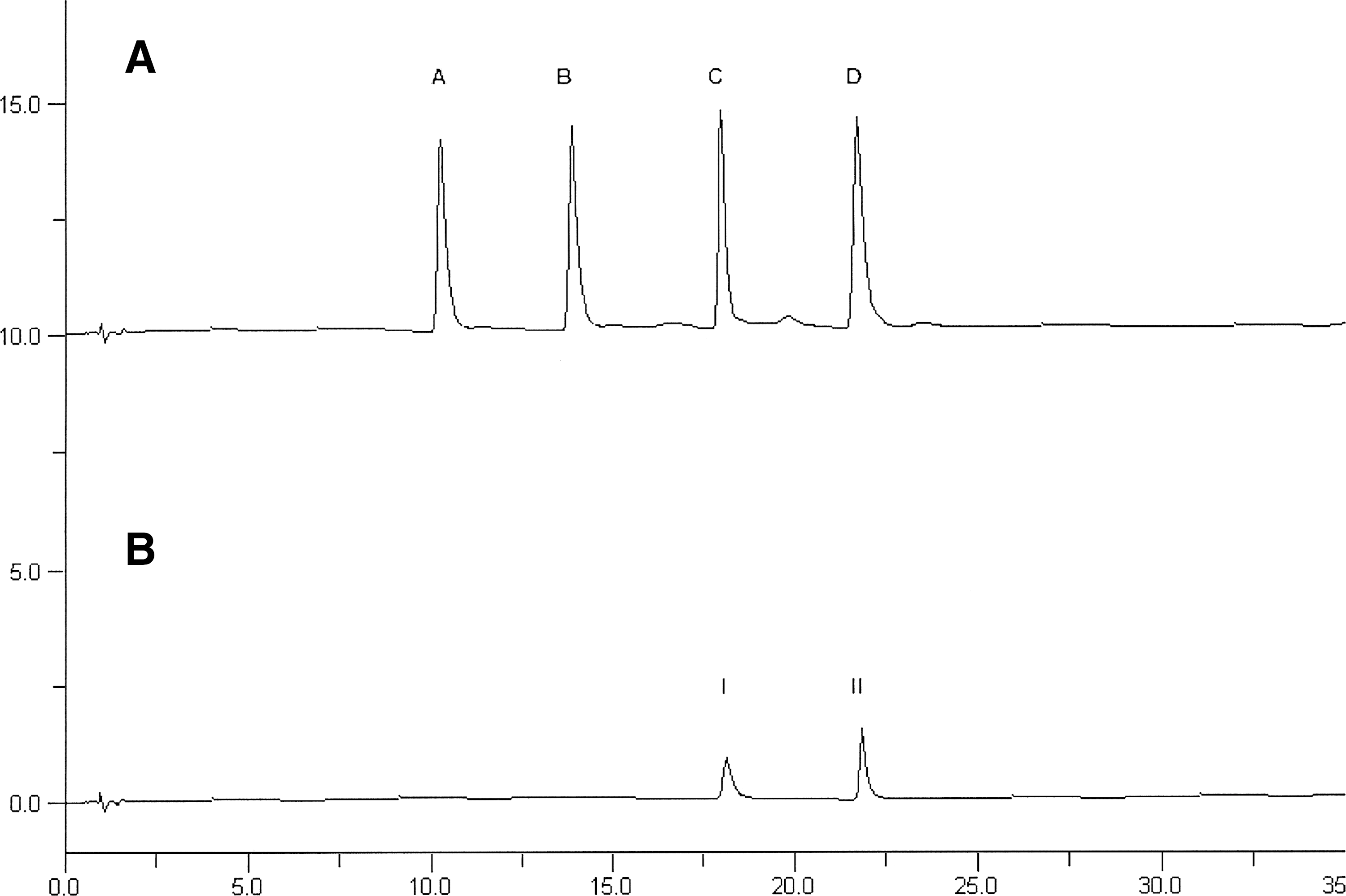
High-performance liquid chromatograms of typheramide and alfrutamide from standards and garlic and green onion fractionations. Garlic and green onion extracts were prepared and fractionated, as described in Materials and Methods. The garlic fraction (F20) and green onion fraction (F23) were further purified using high-performance liquid chromatography. (
NMR analyses
To confirm that the two peaks from garlic and green onion were typheramide and alfrutamide, respectively, the compounds were purified using HPLC and analyzed using NMR spectroscopic methods as described in Materials and Methods. For typheramide (20 mg), the NMR data were as follows: 1 H NMR (d 6-DMSO, 400 MHz), 7.50 ((1H, d, J) 15.7 Hz, H-7), 7.06 ((1H, d, J) 8.4 Hz, H-13), 7.01 ((1H, dd, J) 8.2, 1.5 Hz, H-5), 6.48 ((1H, d, J) 15.7 Hz, H-8), 6.83 ((1H, d, J) 1.5 Hz, H-4), 6.77 ((1H, d, J) 8.4 Hz, H-14), 7.08 ((1H, d, J) 8.2 Hz, H-1), 3.82 (1H, s, H-16), 3.51 ((1H, t, J) 7.5 Hz, H-10), 2.78 ((1H, t, J) 7.5 Hz, H-11); and for 13 C NMR (d 6-DMSO, 100 MHz), 167.9 (C, C-9), 155.5 (C, C-15), 148.5 (C, C-3), 147.9 (C, C-2), 140.9 (C, C-7), 130.0 (C, C-12), 129.5 (C, C-13), 127.0 (C, C-6), 122.0 (C, C-5), 117.6 (C, C-8), 115.3 (C, C-4), 115.1 (C, C-14), 110.3 (C, C-1), 41.3 (C, C-10), 34.5 (C, C-11). Based on NMR data, the structure of the HPLC-purified compound was determined as 3-(3,4-dihydroxyphenyl)-N-[2-(4-hydroxyphenyl)-ethyl]-acrylamide (N-caffeoyltyramine), and the compound was designated as typheramide (Fig. 2A). For alfrutamide (20 mg), the NMR data were as follows: for 1 H NMR (d 6-DMSO, 400 MHz), 7.50 ((1H, d, J) 15.7 Hz, H-7), 7.06 ((1H, d, J) 8.4 Hz, H-13), 7.01 ((1H, dd, J) 8.2, 1.5 Hz, H-5), 6.48 ((1H, d, J) 15.7 Hz, H-8), 6.83 ((1H, d, J) 1.5 Hz, H-4), 6.77 ((1H, d, J) 8.4 Hz, H-14), 7.08 ((1H, d, J) 8.2 Hz, H-1), 3.83 (1H, s, H-16), 3.51 ((1H, t, J) 7.5 Hz, H-10), 2.79 ((1H, t, J) 7.5 Hz, H-11); and for 13 C NMR (d 6-DMSO, 100 MHz), 167.9 (C, C-9), 155.5 (C, C-15), 148.5 (C, C-3), 147.9 (C, C-2), 140.9 (C, C-7), 130.1 (C, C-12), 129.5 (C, C-13), 127.1 (C, C-6), 122.0 (C, C-5), 117.5 (C, C-8), 115.3 (C, C-4), 115.1 (C, C-14), 110.4 (C, C-1), 55.1 (C, C-16), 41.3 (C, C-10), 34.5 (C, C-11). Based on NMR data, the structure of the HPLC-purified compound was determined as 3-(4-hydroxy-3-methoxyphenyl)-N-[2-(4-hydroxyphenyl)-ethyl]-acrylamide (N-feruloyltyramine), and the compound was designated as alfrutamide (Fig. 2B).
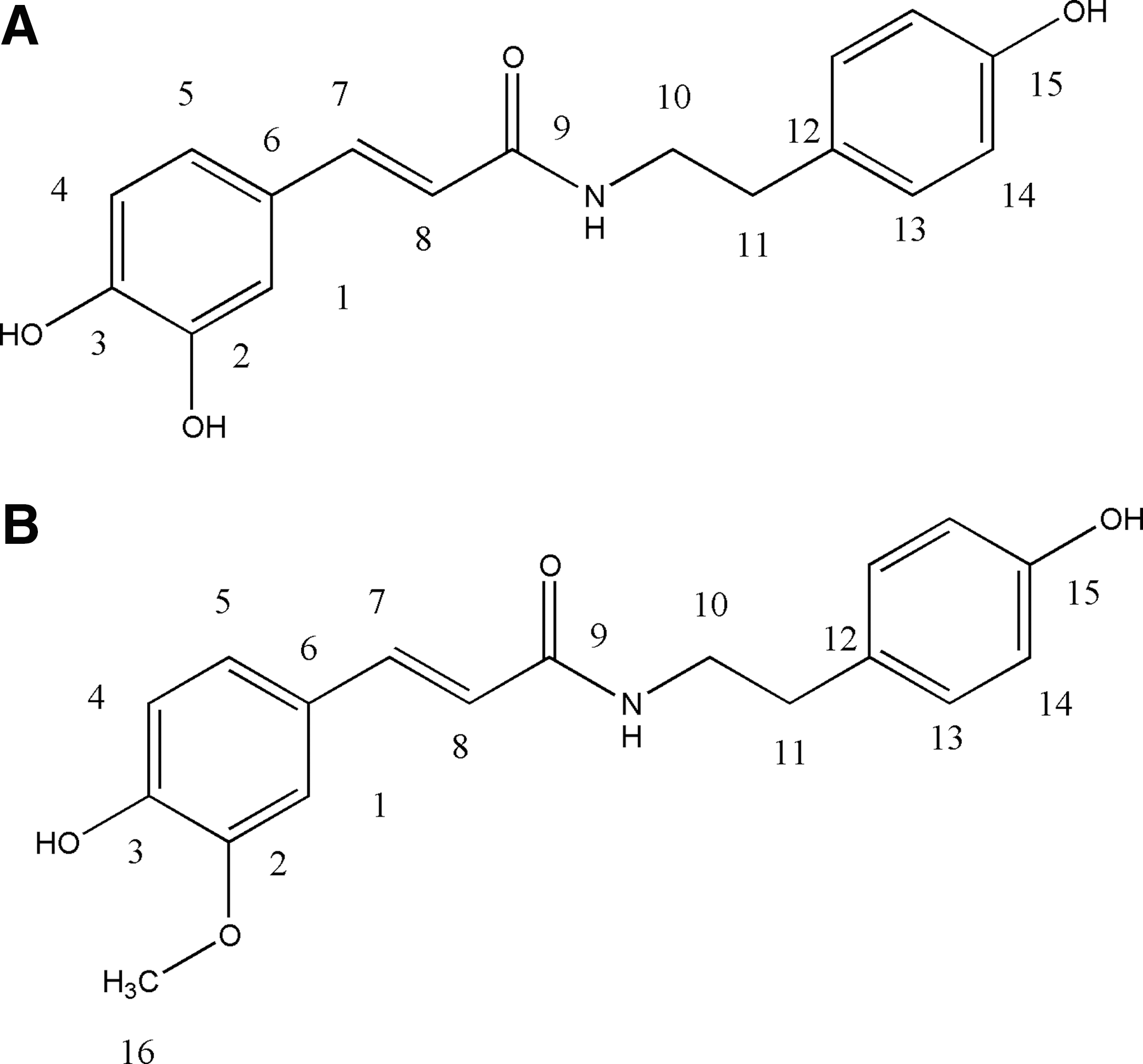
Chemical structures of (
Effect of typheramide and alfrutamide on COX 1 and 2
COXs (COX 1 and 2) are expressed in many cell types, and they are actively involved in generating various prostanoids (PGD, PGE, PGFα, PGI, and thromboxane A) that play important roles in diverse biological processes in human chronic diseases. 6 –10 In particular, COX 1 enzyme is known to regulate platelet activation via numerous mechanisms related to the progress of cardiovascular diseases. 25 Therefore, the effects of typheramide and alfrutamide on COX1 enzyme were investigated. As shown in Figure 3A, typheramide and alfrutamide potently inhibited COX 1 enzyme by 74% (P < .01) and 60% (P < .01) at the concentration of 0.05 μM. Typheramide and alfrutamide were able to inhibit COX 1 to a greater extent than a well-known COX 1 inhibitor, aspirin. Also, the effects of typheramide and alfrutamide on COX 2 were investigated because COX 2 is involved in many important physiological processes. 26 At the concentration of 0.05 μM, both typheramide and alfrutamide were also able to inhibit COX 2 enzyme by 68% (P < .02) and 54% (P < .02), respectively. Although alfrutamide was not as potent as the COX 2-specific inhibitor NS-398, typheramide was slightly more potent than NS-398 at the concentration of 0.1 μM (Fig. 3B). Overall, the data suggest that typheramide and alfrutamide are potent compounds able to inhibit both COX 1 and 2 enzymes.
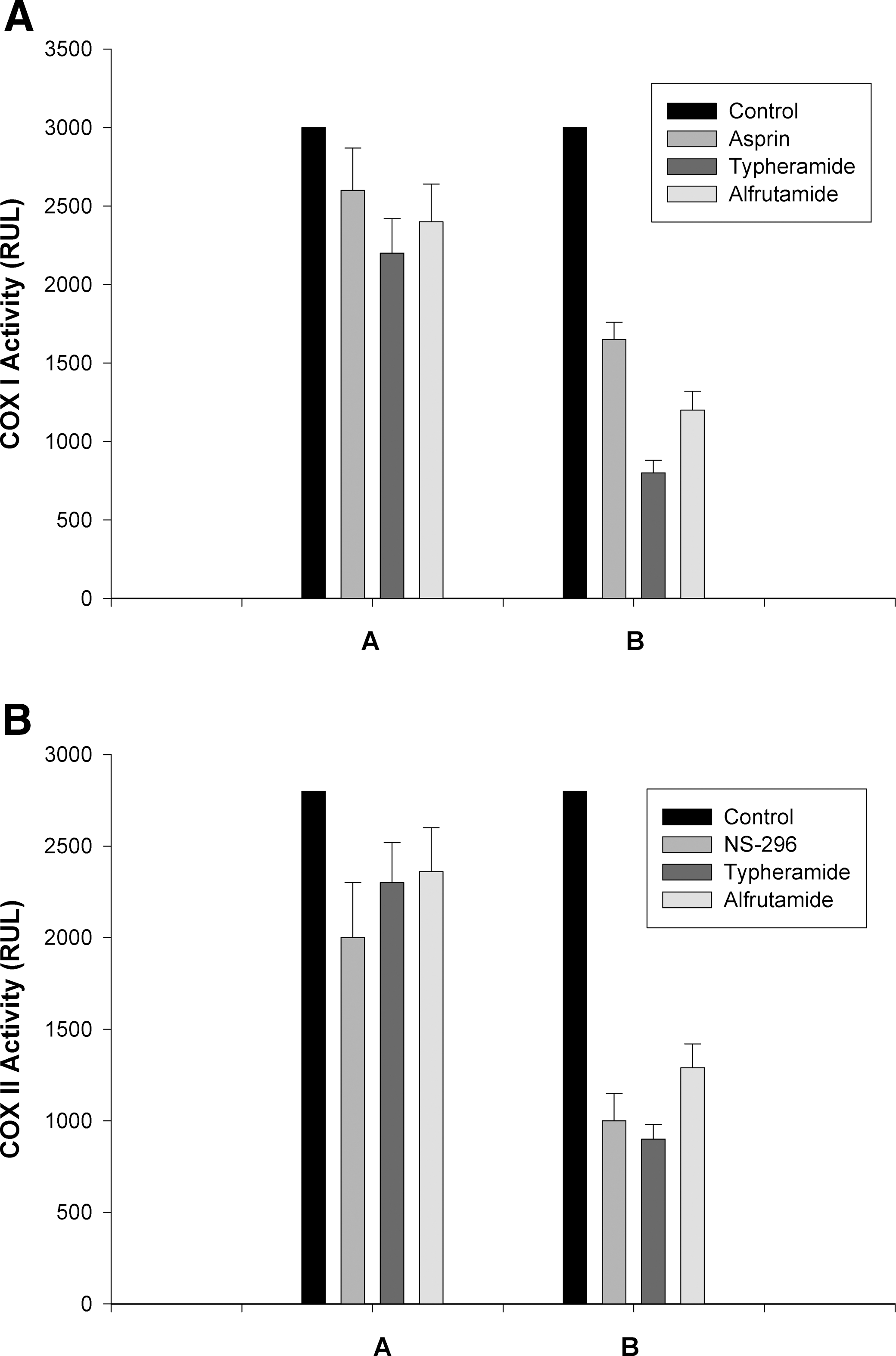
Effects of typheramide and alfrutamide on (
Kinetic study of COX inhibition
To further define the pattern of the COX inhibition by typheramide, kinetic experiments were performed to determine the K i values. As shown in Figure 4, typheramide inhibited COX 1 and 2 uncompetitively. The K i values for COX 1 and 2 were approximately 0.032 and 0.047 μM, respectively. These data indicate that typheramide may be an uncompetitive COX inhibitor.

COX 1 and 2 inhibition by typheramide. K i values were determined using Lineweaver–Burk plots. Data are mean ± SD values of more than three samples. COX activity was measured with arachidonic acid at 2, 2.5, 3.3, 5, and 10 μM, in the absence or the presence of typheramide.
Effects of typheramide and alfrutamide on 5- and 15-LOX
LOXs (5-, 8-, 12-, and 15-LOX) consist of a family of non–heme iron–containing enzymes, widely found in animals and plants. 27,28 In particular, 5-and 15-LOXs have been studied in detail because these enzymes play distinctive biological roles in some human diseases, including allergy, asthma, arthritis, psoriasis, atherosclerosis, and cancer. 29,30 5-LOX is able to convert arachidonic acid to 5-hydroperoxy-6,8,11,14-eicosatetraenoic acid and subsequently into LTs such as LTA4, LTB4, LTC4, LTD4, and LTE4. LTC4, LTD4, and LTE4 are potent bronchoconstrictors, whereas LTB4 is a chemotactic agent for eosinophils, neutrophils, and monocytes in inflamed tissues via pro-inflammatory cytokine production. 31 Meanwhile, 15-LOX is able to convert arachidonic acid to 15-hydroperoxyicosa-5,8,11,13-tetraenoic acid and its metabolites, which are believed to play significant biological roles in the progress of atherosclerosis and cancer. Therefore, in this study, we investigated the effects of typheramide and alfrutamide on 5- and 15-LOX activities. Surprisingly, typheramide and alfrutamide were not able to inhibit 5-LOX even at the relatively high concentration of 25 μM (Fig. 5A). However, they were moderately able to inhibit 15-LOX by 27% (P < .02) and 17% (P < .02), respectively, only at the concentration of 25 μM (Fig. 5B). All together, the data suggest that typheramide and alfrutamide are likely to be potent inhibitors for COX 1 and 2, not 5- and 15- LOX, because the COX inhibition is more effective than the LOX inhibition at low concentrations (less than 1 μM). In summary, typheramide and alfrutamide found in garlic and green onion are likely to modulate the metabolism of arachidonic acid via inhibiting COX enzymes rather than LOX enzymes, which may support traditional uses of these two plants in preventing and/or treating disease conditions related to inflammation and cardiovascular diseases rather than asthma and immune diseases.
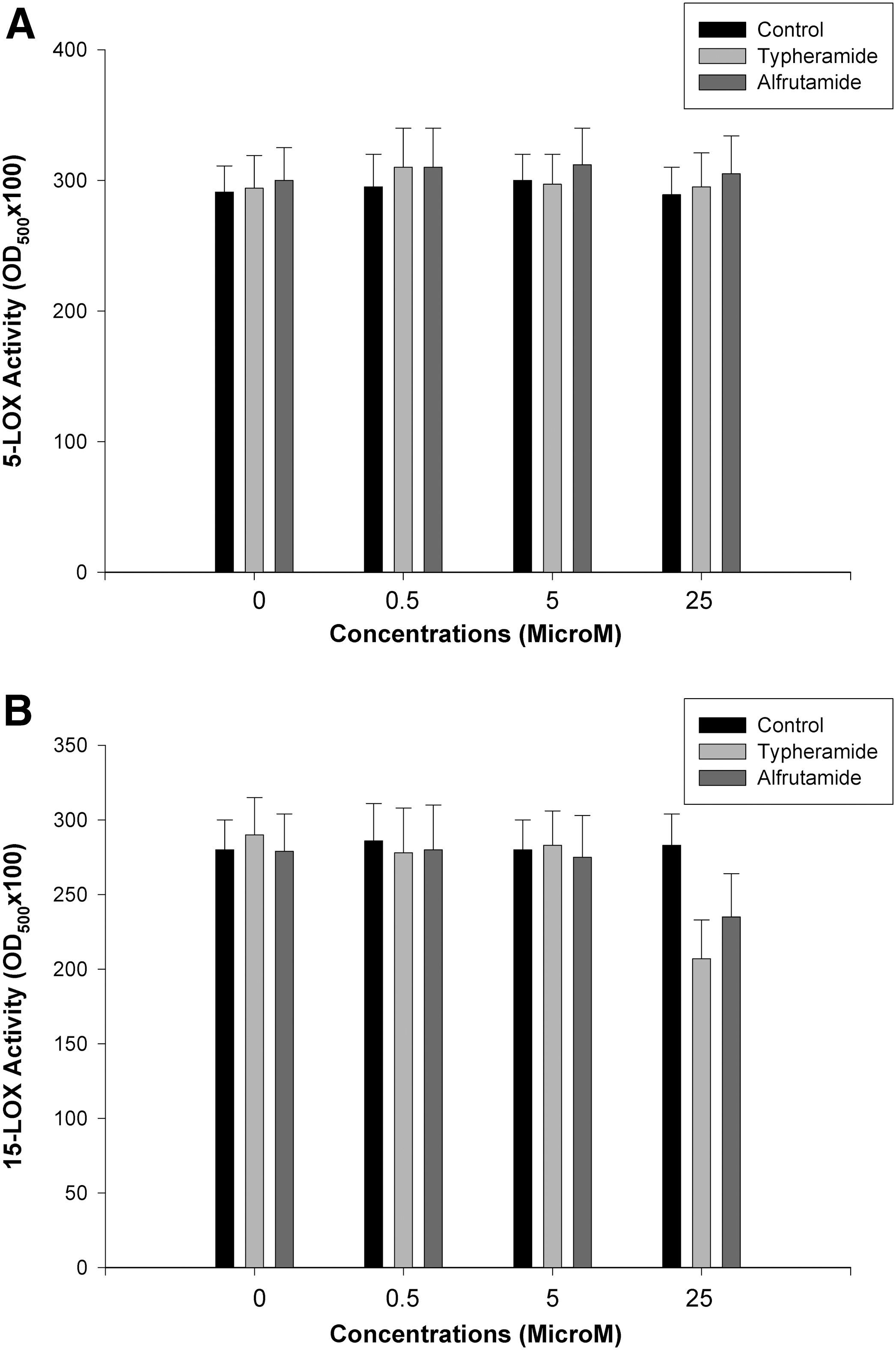
Effects of typheramide and alfrutamide on (
Footnotes
Author Disclosure Statement
No competing financial interests exist.