




Abstract
This study compares the curative effect of three antioxidants—ascorbic acid, quercetin, and thiamine—on ethanol-induced toxicity in rats. Administration of ethanol at a dose of 4 g/kg of body weight/day for 90 days initiated chronic alcohol-induced oxidative stress as shown by increased malondialdehyde level and DNA fragmentation in liver and brain. Ethanol administration also led to a decrease in DNA content. Activities of toxicity marker enzymes—alanine aminotransferase, aspartate aminotransferase, and γ-glutamyltranspeptidase—in liver and serum increased progressively upon ethanol administration. After ethanol administration for 90 days, the efficacy of antioxidant treatment of the alcohol-induced toxicity was studied by supplementing ascorbic acid (200 mg/100 g of body weight/day), quercetin (50 mg/kg of body weight/day), and thiamine (25 mg/kg of body weight/day) for 30 days. These groups were compared with the abstention group (not treated with ethanol). All the alterations induced by alcohol were reduced significantly by the supplementation of antioxidants and also with abstention. The regression by antioxidants was greater that of abstention. Antioxidants significantly reduced the oxidative stress induced by ethanol intoxication, increased membrane integrity, and also increased organ regeneration. Ascorbic acid was shown to be more effective than quercetin and thiamine in treating both hepatotoxicity and neurotoxicity induced by alcohol administration. This may be due to the higher antioxidant potential of ascorbic acid in physiological conditions.
Introduction
A
One of the most important problems faced by those who have stopped alcohol consumption after chronic intake is the recovery of damaged cells to normal levels. Ethanol impairs the regenerative capacity of damaged organs. The time required for regeneration of tissues varies depending on the severity of damage, which in turn is determined by the dose and duration of alcohol intake. Although the removal of alcohol still represents the most effective intervention to prevent the manifestation of alcohol-related diseases, formulation of an effective and economic way for accelerating regeneration is of particular importance, but studies regarding the reversing damage once alcohol consumption is stopped are rare.
Oxidative stress is one of the major mechanisms of ethanol-induced toxicity. Antioxidants have beneficial effects in reducing the incidence of ethanol-induced changes in cellular lipids, proteins, and nucleic acids. 3 Ascorbic acid has usually been mentioned as a strongly effective nutrient in counteracting alcohol and acetaldehyde toxicity. 4 Previous studies in our laboratory have shown that studies suggest that a mega dose of ascorbic acid helps in the prevention of alcohol-induced oxidative stress by enhancing the antioxidant capacity and also by decreasing levels of lipid peroxidation products. The combined effect of selenium and ascorbic acid provides protection against alcohol-induced oxidative stress as evidenced from the decreased levels of lipid peroxidation products and enhanced activities of scavenging enzymes. 5 High-dose metformin–ascorbic acid co-administration is known to protect the liver against the deleterious effects of chronic high-dose alcohol. 6
It has been shown that pretreatment of quercetin protects against ethanol-induced oxidative stress by directly quenching lipid peroxides and indirectly by enhancing the production of the endogenous antioxidant glutathione. 7 Earlier studies showed that chronic quercetin treatment reverses cognitive deficits in aged and ethanol-intoxicated mice, which is associated with its antioxidant property, 8,9 which suggests a protective effect of quercetin in the management of ethanol withdrawal.
A deficiency in the essential nutrient thiamine, resulting from chronic alcohol consumption, is one factor underlying alcohol-induced brain damage. Thiamine acts as an antioxidant, preventing oxidative stress toxicity. 10 High doses of thiamine in association with chronic alcohol intake can prevent ethanol-induced damage in the rat central nervous system. 11
From these observations, it can be seen that the three antioxidants in our present study—ascorbic acid, quercetin, and thiamine—can be used in alleviating alcohol-induced toxicity. All three are effective for alleviating the oxidative stress produced by alcohol administration, even though there was significant variation in their activity. Hence we compared the efficacy of the three antioxidants in the treatment of ethanol-induced hepatotoxicity.
Materials and Methods
Selection of animals
Male Sprague-Dawley rats weighing between 150 and 200 g were housed in polypropylene cages in a room that was maintained between 28°C and 32°C with a 12-hour dark and light cycle. The study protocol was approved by our Institutional Animal Ethics Committee. Animals were handled using laboratory animal welfare guidelines. Rats were fed with rat feed (Lipton India Ltd., Bangalore, India). Water was given ad libitum. Ascorbic acid, quercetin, and thiamine were purchased from M/s SRL Ltd. (Mumbai, India), and ethanol was obtained from M/s Merck Ltd. (Mumbai).
Ethanol diluted with distilled water (1:1) was given orally by gastric tube. The antioxidants ascorbic acid, quercetin, and thiamine were freshly dissolved in distilled water during treatment and given orally by gastric tube.
Groups
A total of 42 animals were first divided into two groups as follows: Group 1, control; and Group 2, ethanol (4 g/kg of body weight/day).
After 90 days, ethanol administration was stopped, and the animals were subdivided into four groups as follows (Scheme 1): Group 3, abstention; Group 4, abstention + ascorbic acid (200 mg/100 g of body weight/day); Group 5, abstention + quercetin (50 mg/kg of body weight/day); and Group 6, abstention + thiamine (25 mg/kg of body weight/day).
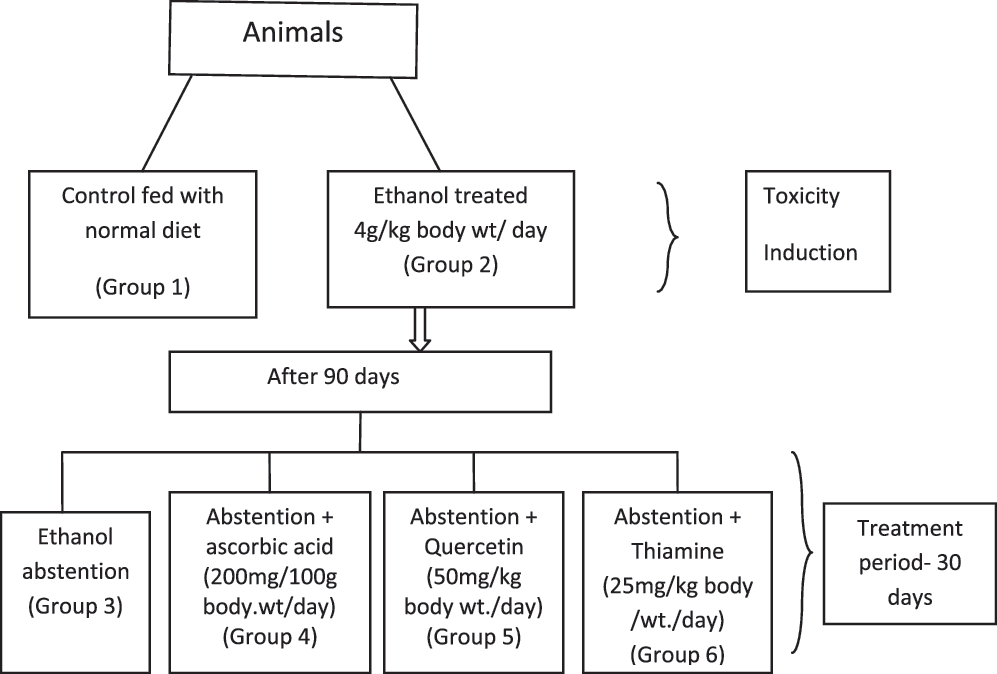
Experimental design and study groups.
Blood was collected weekly from the tail of rats, and the progression and regression of hepatotoxicity was assessed by assaying the activity of the toxicity markers alanine aminotransferase (ALT), aspartate aminotransferase (AST), and γ-glutamyltranspeptidase (GGT) in serum. At the end of the experimental period, animals were sacrificed after overnight fasting. The liver and brain were dissected out, cleaned with ice-cold saline, blotted dry, and immediately transferred to an ice-cold container for various evaluations.
Biochemical methods
The liver and serum activities of AST and ALT were determined by the method of Reitman and Frankel as described by Wooten. 12 GGT in the serum was assayed by the method of Szaz. 13 Malondialdehyde in liver and brain was estimated by the method of Ohkawa et al. 14 Hepatic and brain regeneration was determined by the estimation of the total DNA concentration. DNA concentration was determined according to the method of Burton et al. 15 DNA fragmentation was determined by the colorimetric diphenylamine assay as described by Collota et al. 16 Liver samples from different groups were homogenized in chilled lysis buffer (10 mmol Tris-HCl, 20 mmol EDTA, and 0.5% Triton X-100, pH 8.0). Homogenates (1 mL) were then centrifuged at 27,000 g for 20 minutes to separate intact DNA in the pellet from fragmented/damaged DNA in the supernatant fractions. Perchloric acid (to reach a final concentration of 0.5 M) was added separately to both the pellets and supernatant samples. Samples were heated at 90°C for 15 minutes and then centrifuged at 1,500 g for 10 minutes to remove proteins. Resulting supernatants, whether containing whole or fragmented DNA, were left to react with diphenylamine for 16–20 hours at room temperature; afterward, absorbance was measured at 600 nm. DNA fragmentation was expressed as a percentage of total fragmented DNA.
The progression and regression of hepatotoxicity were assessed by assaying the activity of toxicity markers weekly in the serum.
Statistical analysis
The results were analyzed using SPSS/PC + version 10 (SPSS Inc., Chicago, IL, USA). Significance of differences among groups was determined by one-way analysis of variance and Duncan's post hoc multiple comparison test with P ≤ .05 considered significant.
Results
Monitoring the activity of toxicity marker enzymes (GGT, AST, and ALT) in serum (Fig. 1a–c) and liver (Fig. 1d) showed a gradual increase in the activities upon administration of ethanol. Abstinence from ethanol significantly decreased the activities of all the markers. All three antioxidants decreased the activities of marker enzymes more significantly compared to the abstention-alone group. A more significant and rapid decrease was found with ascorbic acid supplementation compared to that of quercetin and thiamine. The activities were nearly normalized by ascorbic acid.

Oxidative damage was significantly increased by chronic ethanol consumption as evidenced by increased production of malondialdehyde compared to the control group (Fig. 2). Lipid peroxidation was significantly decreased in the abstention group compared to the ethanol-fed group. Supplementation with antioxidants significantly decreased lipid peroxidation compared to the abstention group. The ascorbic acid-supplemented group exhibited the most significant decrease in lipid oxidative damage in liver compared to the other treated groups.
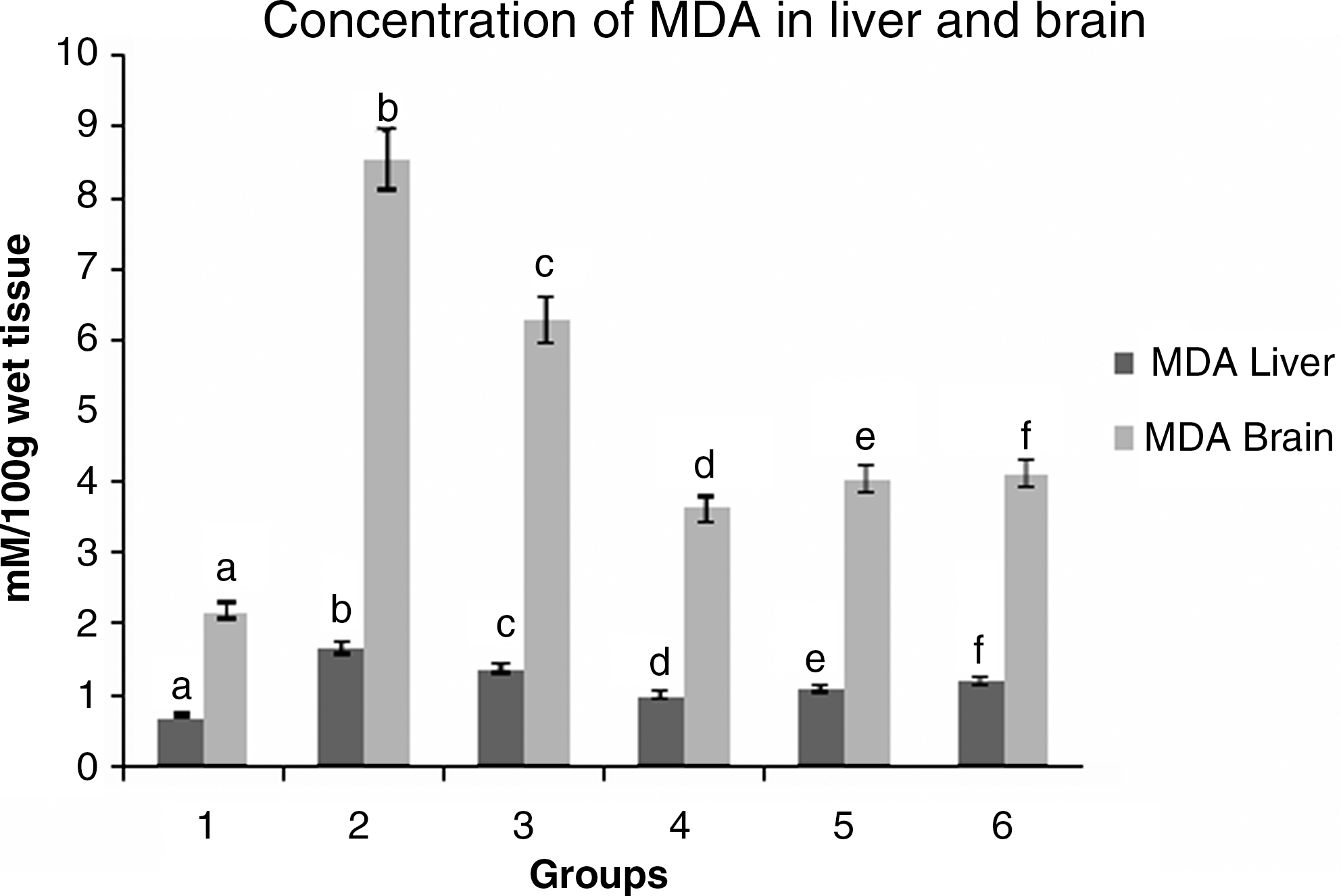
Concentration of malondialdehyde (MDA) in liver and brain. Values not sharing a common superscript differ significantly at P < .05.
DNA fragmentation in the ethanol-fed group was much higher than in the control group (Fig. 3). The percentage of fragmentation was significantly decreased by abstention from ethanol with and without antioxidant supplementation compared to the ethanol-fed group. The ascorbic acid-supplemented group exhibited the most significant decrease in DNA fragmentation compared to the other treatment groups, in both brain and liver tissues.

Percentage of DNA fragmentation in liver and brain. Values not sharing a common superscript differ significantly at P < .05.
DNA content was found to be significantly lower with ethanol administration (Fig. 4). Abstinence from ethanol resulted in a significant increase in DNA content. Supplementary antioxidants resulted in a significantly higher DNA content in liver and brain compared to abstinence alone, but ascorbic acid supplementation increased liver DNA content more significantly than supplementation with quercetin or thiamine.

Concentration of DNA. Values not sharing a common superscript differ significantly at P < .05.
Discussion
Alcoholism is a problem affecting a large segment of the society. Treatment of alcoholism should use different approaches, including abstention, medication, and psychological and spiritual methods. One of the molecular mechanisms of alcohol-induced toxicity is mediated by oxidative stress. 17 Hence our studies were focused on the effect of antioxidants on the reversal of alcohol-induced toxicity and comparison of the reversal with abstention alone. We observed that administration of ascorbic acid caused a faster recovery in both liver and brain than for the quercetin- and thiamine-supplemented groups.
There was a significant increase in the conventional markers associated with hepatocellular injury, which included AST, ALT, and GGT, after ethanol administration. Ethanol perturbs the biomembranes and causes severe damage and leakage of markers of liver injury into the circulation. The gradual increase in the activities of the marker enzymes in our study is suggestive of progressive hepatic injury during alcohol ingestion. Abstention from ethanol decreased the activities of these enzymes in serum. This shows normal liver regeneration after the removal of the causative agent of liver damage. After treatment with ascorbic acid, the activities of these enzymes decreased to near normal levels. The results showed a faster decrease in liver enzyme concentrations in the ascorbic acid-supplemented group compared to the abstention-alone group and the other treated groups. This indicates that ascorbic acid supplementation potentiates the recovery of liver from ethanol-induced damage more efficiently compared to quercetin and thiamine.
In the present study we observed that there was a significant increase in the lipid peroxidation product malondialdehyde in liver and brain with ethanol consumption as shown by earlier studies. 18 –20 In accordance with earlier studies, antioxidant supplementation decreased the generation of free radicals and thus reduced oxidative damage caused by alcohol administration. Ascorbic acid was more effective in decreasing liver and brain lipid peroxidation compared to the other antioxidants.
In accordance with the results of the present study, hepatic DNA fragmentation has been reported in many models of hepatotoxicity following treatment with certain drugs or chemicals, indicating crucial associations between the generation of reactive oxygen species, oxidative damage to membrane lipids plus DNA molecules, lipid peroxidation, and DNA fragmentation. 21 Acetaldehyde is also a highly reactive electrophile and can react with DNA to form a DNA adduct. 22 Antioxidant supplementation decreased DNA fragmentation by scavenging reactive oxidants. A more significant decrease in DNA fragmentation was found with ascorbic acid supplementation.
The level of DNA in tissues indicates the regeneration potential of tissues. Abstention from ethanol significantly increased DNA levels. This indicates the normal regeneration potential of the tissues once the causative agent for damage is removed. This is in agreement with the views of Crews and Nixon 23 that alcohol-induced neurodegeneration occurs primarily during intoxication and is related to increased oxidative stress and pro-inflammatory proteins that are neurotoxic. Abstinence after binge ethanol intoxication results in brain cell genesis that could contribute to the return of brain function and structure found in abstinent humans. Supplementation of antioxidants caused faster tissue regeneration compared to normal regeneration during abstention. Among the antioxidants, ascorbic acid was found to be more effective in reducing the damage to liver and brain caused by ethanol-induced toxicity.
It can be concluded from biochemical observations that ascorbic acid offers curative efficacy against ethanol-induced hepatotoxicity and neurotoxicity, in part by decreasing lipid peroxidation. Regeneration of liver was faster in the ascorbic acid-supplemented group as evidenced by the DNA content and percentage fragmentation of DNA. It can be used as a supplement for accelerating the reversal of chronic ethanol-induced toxicity during an abstention period.
Footnotes
Author Disclosure Statement
No competing financial interests exist.