




Abstract
The infusions and extracts obtained from leaves with flowers, fruit peel, and seed from hawthorn (Crataegus monogyna Jacq., Family Rosaceae) were subjected to evaluation as potential sources of antioxidant phytochemicals on the basis of their total content of phenolics, levels of phenolic acids, and in vitro antiradical activity. Total phenolic content of extracts was determined using the modified Folin–Ciocalteau method. Antioxidant activity was determined for phenolic extracts by a method involving the use of the free radical 2,2-diphenyl-1-picrylhydrazyl (DPPH). Phenolic acids containing extracts and infusions from hawthorn leaves, fruit peel, and seeds were obtained using different polarity solvents and separated by reverse-phase high-performance liquid chromatography, which enabled improved separation by the use of a C18 column, an acidic mobile phase, and gradient elusion. The highest total phenolic content (343.54 mg of gallic acid equivalents/g) and the highest DPPH radical scavenging activity as the inhibition percentage (60.36%) were obtained in ethyl acetate extract from hawthorn leaves with flower. Also, the highest phenolic acid content was measured in the extracts of hawthorn leaves with flowers: protocathechuic (108–128 mg/100 g), p-hydroxy benzoic (141–468 mg/100 g), caffeic (137–3,580 mg/100 g), chlorogenic (925–4,637 mg/100 g), ferulic (3,363–3,462 mg/100 g), vanillic (214 mg/100 g), and syringic (126 mg/100 g) acids. The results indicate that hawthorn is a promising plant because of its high antioxidant activity.
Introduction
H
C. monogyna fruits, leaves, and flowers are known to contain numerous chemical constituents, such as 1–2% flavonoids (hyperoside, apigenin, luteolin-7-glucoside, rutin, quercetin, vitexin, vitexin rhamnosides, and spirein), 2,3 2–3% proanthocyanidins, 4 sterols, trace amounts of cardioactive amines, 5 triterpenes, 6 phenolic acids (chlorogenic and caffeic acids), 2,7 and essential oil. 4
Extracts of hawthorn (C. monogyna Jacq.) have become a popular herbal drug for their well-recognized cardiotonic effects in addition to other activities, including anti-arrhythmic, 6 hypotensive, 8 hypolipidemic, 4 and antioxidant 7,9,10 effects.
It is reported that reactive oxygen species cause the development of many chronic disorders, such as cancer, arteriosclerosis, nephritis, diabetes mellitus, rheumatism, and cardiovascular diseases, as well as being active in gastrointestinal tract disorders and inflammatory injury. 11 Phenolic compounds (such as flavonoids, anthocyanins, proanthocyanins, and phenolic acids), naturally occurring substances essentially in all plant materials, are also potent antioxidants that play an important role in human nutrition as preventative agents against several diseases, protecting the body tissues against oxidative stress. 12
Phenolic acids are secondary metabolites that are commonly found in plant-derived foods. Substituted derivatives of hydroxybenzoic and hydroxycinnamic acids are the predominant phenolic acids in plants, with hydroxycinnamic acids being the more common. These derivatives differ in the patterns of the hydroxylations and methoxylations of their aromatic rings. 13 They can be analyzed by thin-layer chromatography, 14,15 gas chromatography, 15 high-performance liquid chromatography (HPLC)–diode array detection, 2,15 and capillary electrophoresis. 16 –18
According to our literature survey, there has been no study yet on the chemical and physical properties of hawthorn fruit peel and seeds. Thus, it was aimed to investigate the content of phenolic acids in seeds, fruit peel, and leaves with flowers of hawthorn (C. monogyna) using certain extraction methods with solvents of different polarities. In addition, the total phenolic content (TPC) values were determined, and each extract was evaluated for antiradical activity using the 2,2-diphenyl-1-picrylhydrazyl (DPPH) assay. In assay-guided screening of plant samples, simple, sensitive, and rapid methods that are applicable to different sample types and give reproducible results are preferable. The DPPH method, which is very rapid, simple, sensitive, and reproducible, does not require special instrumentation. In this study, it was very convenient for the screening of large numbers of samples of different polarity. The scavenging abilities of the extracts were also compared with that of tert-butylhydroxytoluene (BHT) as a synthetic antioxidant.
Materials and Methods
Reagents
Chemicals used for HPLC (methanol and formic acid) were of chromatographic grade (Sigma-Aldrich, St. Louis, MO, USA). The phenolic acid standards gallic acid (GA), protocathechuic acid (protoCA), p-hydroxybenzoic acid (p-hydBA), vanillic acid (VA), caffeic acid (CA), chlorogenic acid (ChA), syringic acid (SA), and ferulic acid (FA), propylparaben as the internal standard, DPPH, and Folin–Ciocalteau reagent were purchased from Sigma-Aldrich and Merck GmbH (Darmstadt, Germany).
Samples
Plant materials, purchased from a local herbalist store in Eskişehir, Turkey, had been prepared in different times of the seasons. It was stated that leaves with flowers were harvested wilting and fruits were collected and prepared after the fruits were grown to some extent to be eaten.
Extraction
Extraction procedures were applied as described elsewhere. 2 Dried leaves with flowers, fruit peel, and seeds of hawthorn were ground and extracted with petroleum ether in a Soxhlet apparatus. Fat-free air-dried material was extracted with methanol:water (70:30 vol/vol) in a 40°C water bath for 30 minutes four times. The extract was concentrated to dryness in vacuo, and aqueous solution was lyophilized (methanol extract [ME extract]). Second extracts were prepared as follows: fat-free air-dried material was extracted with methanol:water (70:30 vol/vol) in a 40°C water bath for 30 minutes four times and concentrated in vacuo, and the aqueous phase was extracted with ethyl acetate at room temperature. Then it was concentrated to dryness in vacuo (ethyl acetate extract [EA extract]), and the aqueous solution was lyophilized (water extract [W extract]). The infusions from dried plant material were prepared as 2% solutions, and then they were lyophilized (infusion). The phenolic acids were then recovered with solvents of different polarities. All extracts obtained were weighed to determine the yields of soluble constituents.
Analytical HPLC
An HPLC system consisting of a model 600 E HPLC pump, model 717 Plus Autosampler, model 996 photodiode array detector, and the data processor of a Millenium 32 chromatograph was used for the analysis (all from Waters Corp., Milford, MA, USA). Standards or hawthorn extracts were analyzed on a reverse-phase C18 Ultrasphere column (Teknokroma, Barcelona, Spain) (100×4.6 mm i.d.; particle size, 3 μm), and a Shimadzu (Kyoto, Japan) model 160A spectrophotometer was used.
Ultra pure deionized water was purified by Synergy Water Purification System (Millipore, Rotterdam, Netherlands) to a specific resistance of 18 mΩ cm.
Determination of TPC
The amounts of total phenols were determined spectrophotometrically at 750 nm, based on a colorimetric measurement for extracts as described previously. 19,20 This method gives a general measurement of phenolic content, as it is not completely specific for phenolic compounds and not all phenolic compounds exhibit the same level of activity in the assay.
Separation and analysis of phenolic acids by HPLC
Chromatographic analysis of the extracts was carried out by a gradient elution (solution A, methanol:water:formic acid [10:88:2 by volume]; solution B, methanol:water:formic acid [90:8:2 by volume]) as reported elsewhere. 21 Chromatography was performed by using a linear gradient program. The flow-rate was 1 mL/minute, and the injection volume was 10 μL. Signals were detected at 280 nm. The internal standard technique was applied to increase the repeatability.
The relevant extracts were dissolved in a mixture of methanol and water (1:1 vol/vol), and the mixture was injected into the HPLC apparatus.
Radical scavenging activity using the DPPH method
The DPPH assay was used as a rapid spectroscopic method to provide an evaluation of antioxidant activity due to scavenging free radicals. Being a stable free radical colored purple, DPPH· is reduced to the yellow diphenylpicryl hydrazine.
Free radical scavenging effects of the extracts on DPPH· were estimated according to the method of Sanchez-Moreno et al. 22 applying some modifications. The reaction mixture was left at ambient temperature for 30 minutes in dark, and the absorbance of the resulting solution was then measured spectrophotometrically at 517 nm.
Results and Discussion
Analysis of phenolic acids by HPLC
Chromatographic analysis was used to identify and quantify phenolic acids present in hawthorn. Screening of the studies indicates us that little information is available in the literature on the content and types of phenolic acids in hawthorn. In addition to that lack of knowledge, isolation and quantifications are difficult because of the great variety of species present and the wide variations in their levels. Thus, it is essential to devise a sample preparation stage that will ensure reliable identification and quantification.
The phenolic acids in different parts of hawthorn were analyzed by gradient elution using a validated HPLC method that has a good repeatability using the internal standard technique in the range of 0.35%–1.65% relative standard deviation (RSD); as percent they have limits of detection (LOD) values in the range of 2.49×10⁻⁶–9.69×10⁻⁶ M and limits of quantification (LOQ) values of 1.27×10⁻⁶–2.93×10⁻⁵ M as reported elsewhere. 21
Most of the phenolic acids have absorption maxima in the ultraviolet absorption spectra at a wavelength of 280 nm, and they were identified by matching their retention times (peak normalization) and ultraviolet spectra of samples with those of authentic standards, using the HPLC–diode array detection system. The original chromatograms of hawthorn EA extracts from fruit peel, seeds, and leaves with flowers and methanol containing only internal standard (blank) are shown in Figure 1.
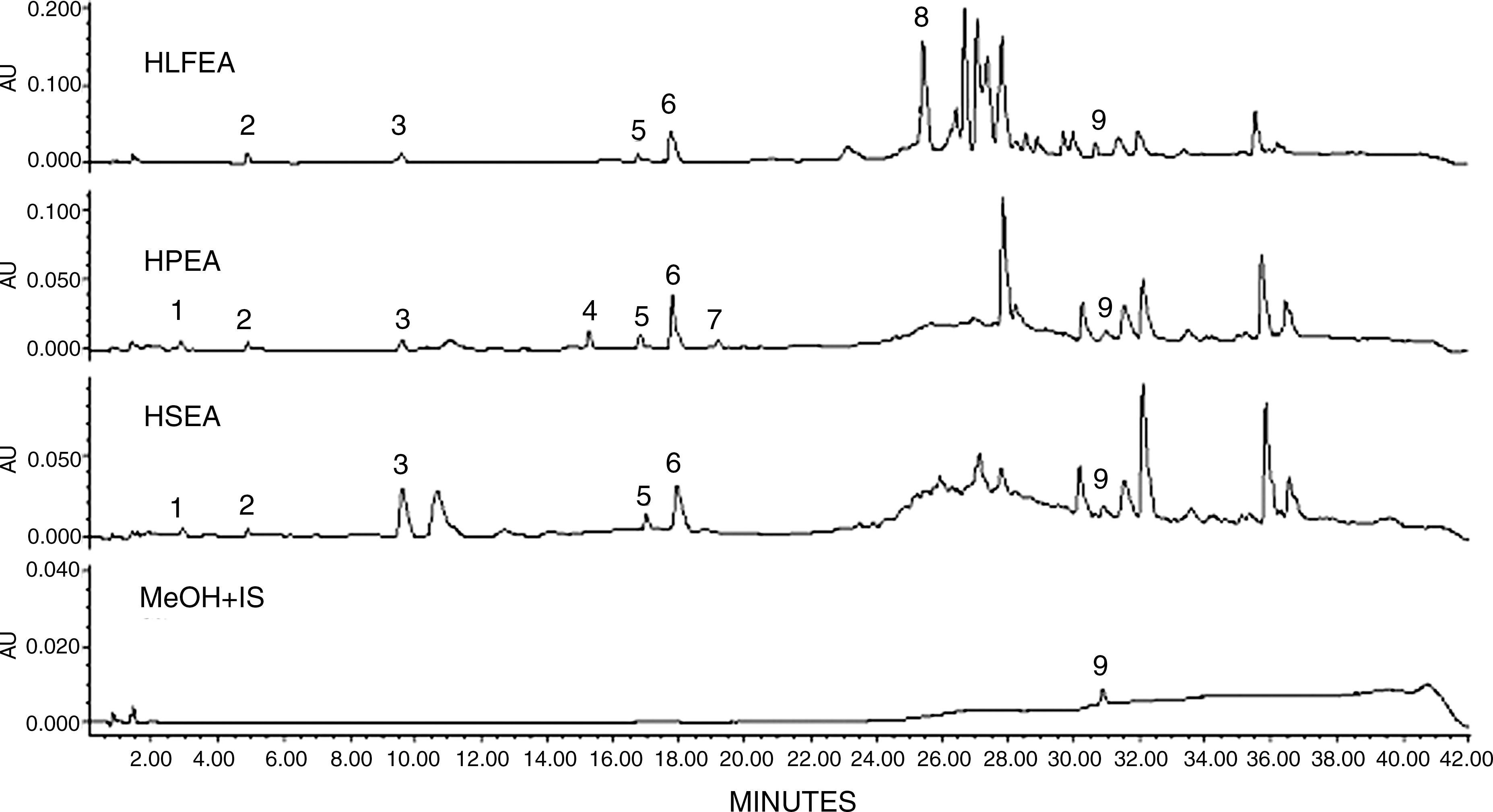
Representative chromatograms of ethyl acetate extracts of hawthorn fruit peel (HPEA), seeds (HSEA), and leaves with flowers (HLFEA) and methanol containing only internal standard (MeOH+IS) (blank). The phenolic acids marked are gallic acid (peak 1), protocathechuic acid (peak 2), p-hydroxybenzoic acid (peak 3), vanillic acid (peak 4), caffeic acid (peak 5), chlorogenic acid (peak 6), syringic acid (peak 7), ferulic acid (peak 8), and propylparaben internal standard (peak 9) on the chromatograms. AU, arbitrary units.
The amounts of the relevant phenolic acids were calculated by using their calibration equations (Table 1). As shown in Table 1, by HPLC analysis ChA was most abundant (43–4,637 mg/100 g of extract), followed by FA (3,363–3,462 mg/100 g of extract), CA (12–3,580 mg/100 g of extract), p-hydBA (41–2,651 mg/100 g of extract), protoCA (19–588 mg/100 g of extract), VA (34–214 mg/100 g of extract), SA (21–126 mg/100 g of extract), and GA (19.8–86 mg/100 g of extract).
CA, caffeic acid; ChA, chlorogenic acid; EA, ethyl acetate extract; FA, ferulic acid; GA, gallic acid; HLF, hawthorn leaves with flowers; HP, hawthorn fruit peel; HS, hawthorn fruit seed; p-hydBA, p-hydroxybenzoic acid; Inf, infusion; ME, methanol extract; ND, not detectable; protoCA, protocathechuic acid; SA, syringic acid; VA, vanillic acid; W, water extract.
There are five phenolic acids (ChA, CA, protoCA, p-hydBA, and FA) in the extracts of C. monogyna leaves with flowers. These extracts contain high levels of ChA, with the concentration in the ME extract being 4,145 mg/100 g, in the EA extract 4,637 mg/100 g, and in the W extract 4,145 mg/100 g.
Although the presence of ChA and CA in dried flowers and leaves of hawthorn has already been shown in previous studies using HPLC methods with reference compounds, 2,3 protoCA, p-hydBA, and FA have not been reported previously. In the present study, we found these three compounds in addition to ChA and CA for the first time.
In the fruit peel of C. monogyna, according to our HPLC findings, the most abundant compound is ChA in ME and EA extracts; however, the infusion form has mostly p-hydBA. The ME fraction has also five phenolic acids (GA, p-hydBA, CA, ChA, and SA), whereas the EA fraction has seven phenolic acids (GA, protoCA, p-hydBA, VA, CA, ChA, and SA). The amounts of phenolic acids detected in the W extract are very small.
The main component in the seed of the hawthorn fruit is p-hydBA. FA is not detectable in the seeds as well as in the leaves with flowers. The seeds contain GA, protoCA, ChA, and CA. GA, protoCA, p-hydBA, VA, CA, and SA are found in the infusion of hawthorn fruit seeds. In general agreement with our findings, the presence of ChA in dried hawthorn fruits has been demonstrated in a previous study. 23
Based on the quantitative results, it is evident that phenolic acids are much more abundant in leaves with flowers than in fruit peel and seeds of hawthorn.
TPC and antiradical activity
The major shortcoming in the qualitative or quantitative evaluation of plant phenolics lies in the current lack of an appropriate methodology. At present, the most widely used method for evaluating the polyphenolic content of plant materials is the Folin–Ciocalteau colorimetric assay. This method is not an absolute measurement of the amount of phenolics because some other substances such as organic acids, residual sugars, amino acids, proteins, and other hydrophilic compounds interfere with this assay. 24
In our study, the Folin–Ciocalteau assay was very convenient for the screening of large numbers of samples of different polarity. This method is not discriminative with respect to the radical species but gives a general idea about the radical quenching ability. 25
The results of TPC and free radical scavenging potentials tested by the DPPH method of different extracts from hawthorn leaves with flowers, fruit peel, and seed and BHT at different concentrations are given in Table 2.
BHT, tert-butylhydroxytoluene; GAE, GA equivalents.
The TPC for the extracts studied falls within the range of 33.56 (hawthorn fruit seed W extract) to 343.54 (hawthorn leaves with flowers EA extract) mg of GA equivalents/g. The TPC for EA extracts, however, is over double that for infusions.
The hawthorn extracts investigated showed dose-dependent radical scavenging activities. The percentage inhibition value is a parameter widely used to measure the free radical scavenging activity. That is, a higher percentage inhibition value corresponds to a higher antioxidant activity. 26
Antiradical activity ranges from very active (hawthorn leaves with flowers EA extract, 60.36 μg/mL) to inactive (hawthorn fruit seed W extract, 16.73 μg/mL). Hawthorn leaves with flowers EA extract, with higher than average TPC (343.54 mg of GA equivalents/g), is the most active extract in the DPPH assay. Its antioxidant activity was concentration-dependent. These data indicate that extract obtained from C. monogyna leaves with flowers was as effective as BHT in radical scavenging ability. The high radical scavenging activity observed in C. monogyna leaves with flowers is due, most probably, to the presence of phenolic glycosides and phenolic acids (especially CA and ChA). CA and ChA have also been studied, and these compounds were found to have effective antioxidant capacity using ferric reducing antioxidant power and 2,2′-azinobis-3-ethylbenzthiazoline-6-sulfonic acid assays 27 or β-carotene bleaching and DPPH methods. 28
It was found that the average antioxidant activity of hawthorn fruit peel extracts was higher than the activity of hawthorn seed at those same concentrations. The ranking of antioxidant activity of the extracts is as follows: EA > ME > infusion > W extracts.
Conclusions
In general, antioxidant activity of plant materials significantly increases with the presence of high levels of TPC. In our study, TPC was more closely correlated with antiradical activity, suggesting that the antiradical activity of these extracts is a complicated synergy that may also involve compounds not yet identified or quantified. A potent antioxidant activity of extracts obtained from C. monogyna leaves with flowers was shown, considering the scavenging abilities displayed against DPPH. This scavenging activity can be mainly attributed to the phenolic derivatives present in the extracts.
Phenolic acids are responsible for the pharmacological activity attributed to medicinal plant extracts. Therefore, the profile of their content represents a useful fingerprint to find out the identity and the quality of these crude drug and phytopreparations. 13 The results mentioned above showed the proposed liquid chromatography method was very suitable for rapid determination of phenolic acids in extracts of hawthorn. This work also confirmed that HPLC is a powerful technique for the investigation of phenolic acids in the complex extracts obtained from medicinal plants.
Footnotes
Acknowledgments
The authors acknowledge the Research Foundation of University of Anadolu (project number 030353) and the Plant, Drug and Scientific Research Centre of Anadolu University for their kind support of this study.
Author Disclosure Statement
No competing financial interests exist.