




Abstract
Bromelain, an enzyme extracted from the stem of the pineapple plant, has been reported to reduce pain and swelling in acute soft tissue injuries, but no study has been done to compare its effect with that of fresh pineapple juice on the healing of acute tendon injuries. This study compared the effects of commercial bromelain and fresh pineapple juice on tenocyte proliferation and the malondialdehyde (MDA) level in the early stage of healing in a crush injury to the Achilles tendon of Sprague–Dawley rats. Twenty-four male rats were divided randomly into three groups of eight rats each; all the rats had induced crush injury to the Achilles tendon: Group 1 (control), no treatment; Group 2, oral bromelain treatment at a dosage of 7 mg/kg of body weight daily; and Group 3, fresh diluted pineapple juice at a dosage of 30 mg/kg of body weight. Treatment was given over the first 14 days post-injury. On day 15 post-injury, the animals were sacrificed, and the tendons were excised and processed for histological study and MDA assay. Results show a significant difference in the tenocyte population between the bromelain group and the control (P < .05), whereas pineapple juice also increased the tenocyte population, although not significantly (P = .36). Pineapple juice, however, significantly lowered the MDA level compared with both the control and bromelain-treated groups. Based on this study, 600 GDU bromelain given at a dosage of 7 mg/kg had a better effect on tenocyte proliferation than fresh pineapple juice given once daily in acute tendon injury.
Introduction
T
At present there are limited scientifically proven management modalities for acute tendon injury, and the common available treatment options have been found to inhibit tenoblast proliferation and are therefore detrimental to healing. 4 To promote wound healing in the shortest time possible, exploration of nutritional and botanical influences on wound outcome has been suggested. 5 It has been reported that tendinitis can be treated with enzymes, one of which is the enzyme bromelain from pineapple, which has been shown to improve healing time and wound outcome. 5
Commercially available bromelain preparations contain predominantly stem bromelain, whereas the major proteinase present in pineapple fruit is fruit bromelain. A study by Hale et al. 6 suggested that different biologic effects may occur following exposure to commercial bromelain tablets that contain primarily stem bromelain versus eating pineapple fruit. Although fresh pineapple is not a concentrated source of bromelain enzymes, it does, however, contain carotenoids, which at sufficient concentrations can prevent lipid oxidation and related oxidative stress. 7,8 Evidence suggests that antioxidants or bioactive compounds are best acquired through whole-food consumption rather than expensive dietary supplements, and to avoid the occasional side effects of bromelain, which includes nausea and vomiting, it is suggested that eating whole pineapples or drinking pineapple juice may be a better alternative. 8,9
There are presently no available studies to show the same potential benefits of bromelain compared with a normal intake of pineapple. The aim of this study therefore is to compare the effects of bromelain supplement with pineapple juice extracted from the flesh of the fruit on the proliferation of tenoblasts and the tendon MDA level in a crush injury model of the Achilles tendon in the rat.
Materials and Methods
Animals
Twenty-four 10-week-old male Sprague–Dawley albino rats weighing 140–160 g were used for this study. The animals were kept in the animal room of the Department of Anatomy, College of Medicine, University of Lagos, Lagos, Nigeria, where the study was carried out. They were kept under standard conditions of 12-hour light and 12-hour darkness photoperiodicity. Ethical approval of the study was obtained from the Ethical Committee of the College of Medicine, University of Lagos. The rats were fed on commercial rat chow and water ad libitum.
Bromelain
Bromelain tablets (500 mg, 600 GDU) manufactured by Holland and Barrett (Nuneaton, United Kingdom) were used for this study. The tablet was constituted into syrup by adding 500 mL of water to each 500-mg crushed tablet. Each milliliter contains 1 mg of bromelain.
Pineapple
Fresh pineapple fruits of the species Ananas sativus (voucher number 65743 from the Federal Institute of Forestry Research, Ibadan, Nigeria) were purchased in February 2009 from an open market near Badagry, Lagos.
Pre-injury protocol
The animals were kept in standard cages at room temperature in the animal room of the Department of Anatomy under standard conditions of 12-hour light and 12-hour darkness photoperiodicity. They were allowed to acclimatize to the environment for 2 weeks, after which a point 2.0 cm above the calcaneal insertion of the left Achilles tendon of all the rats in the injury groups was marked. The pre-injury circumference of the left hind limb for each rat was taken at this point by means of a flexible inextensible marked cord.
Injury procedure
Using gripping forces with a number 1 artery forceps, a standard crush injury was inflicted in the middle third of the tendon of the left hind limbs, with the maximum clamping of the instrument for 60 seconds as modified from the procedure used by Carvalho et al. 10 The left limb was randomly selected because rats have not been reported to have a dominant limb.
Post-injury protocol
The post-injury circumference of the left hind limb of each of the rats was taken at the same marked points 24 hours post-injury to ascertain the presence of inflammation as indicated by edema.
Bromelain administration
Oral bromelain administration commenced 24 hours post-injury by gavage at a dosage of 7 mg/kg of body of weight using a calibrated oropharyngeal metal cannula. The animals were given between 1.0 and 1.1 mL of syrup depending on the body weight. Treatment commenced 24 hours post-injury and was given once a day for the next 14 days. Only the rats in Group 2 were treated with bromelain.
Pineapple juice
The fruit was peeled, and the core was removed. Six hundred fifty grams of the flesh of the fruit was blended in 2 L of distilled water and filtered. The juice was dehydrated in a rotary evaporator, and the concentrate was diluted with 1 part to 9 parts of water. One milliliter of extract thus contains 3.2 mg of concentrate. The syrup was given orally by gavage using a calibrated oropharyngeal metal cannula at a dosage of 30 mg/kg of body weight once daily. 11 The animals were given between 1.4 and 1.6 mL of syrup depending on the body weight. The administration of the extract commenced 24 hours post-injury over the next 14 days.
Experimental protocol
The animals were randomly divided into three groups with eight rats in each group. All the rats in the three groups had a crush injury to the left Achilles tendon. The animals were treated as follows: Group 1 (control), no treatment was administered; Group 2, the rats were given oral bromelain once daily; and Group 3, the rats were given pineapple flesh juice once daily.
The animals were further divided into two subgroups of four rats each: Subgroup A, effects of injury and treatment protocols on tenocyte population; and Subgroup B, effects of injury and treatment protocols on MDA expression.
Animal sacrifice and tendon harvest process
On day 15 post-injury, the animals were sacrificed, and the Achilles tendons were excised and fixed in 10% formol saline. The fixed tissues were then transferred to graded series of alcohol: 70% alcohol for 7 hours and 90% alcohol overnight. On day 2, the tissues were passed through three changes of absolute alcohol for an hour each and then cleared in xylene. Once cleared, the tissues were infiltrated in molten paraffin wax in the oven at 58°C.
Three changes of molten paraffin wax at 1-hour intervals were done, after which the tissues were embedded in wax and blocked out. Prior to embedding, it was ensured that the mounted sections to be cut by the rotary microtome were oriented vertically. Serial vertical sections 10 μm thick were made, and every fifth section was randomly selected for morphometric analysis using the technique of stereology described by Young and Dyson. 12 Sections were floated in a bath water, picked by albuminized slides, and dried on a hot plate at 52°C.
Staining was carried out according to the following procedure: dried sections were dewaxed in xylene and then rehydrated in 90%, 70%, and 50% alcohol in turns. The rehydrated sections were washed in water and stained in hematoxylin for 10 minutes, after which the excess stain was washed off and then differentiated in 1% acid alcohol for 10 seconds before rinsing in water.
Sections were rinsed under running tap water for 5 minutes for bluing and then counterstained in eosin for 1 minute. Excess stain was washed off with water. Stained sections were dehydrated with 50%, 70%, 90%, and absolute alcohol and then cleared in xylene. A drop of mountant was placed on the surfaces of each slide and covered with a 22- × 22-cm coverslip. Prepared slides were then subjected to microscopic examination.
Stereological analysis
The slides were observed under the light microscope fitted with an ocular test grid at a magnification of × 100 using the method of Cruz-Orive and Weibel. 13 The tenocyte profile identified was the nucleus. Forty random values (10 per animal) were obtained for each group. The numerical density is the number of tenocyte profiles per unit area of field. 14 This is estimated as the profile number of tenocytes within the frame of the test grid. The profile number of tenocytes was determined by counting all the tenocyte profiles partially or totally within the frame area that did not intersect the forbidden lines, which are the top and left margins of the test grid. 13 The tenoblasts were further differentiated from the typical tenocytes by their shapes. The elongated cells were identified as tenocytes, whereas the ovoid cells were identified as tenoblasts. 15
One hundred twenty random (30 per animal) values were obtained for each group.
Determination of tendon MDA
Tendon MDA levels were determined using the modified thiobarbituric acid method of Buege and Aust. 16 MDA reacts with thiobarbituric acid to give a red compound absorbing at 535 nm. The stock reagent contains 2 mL of 15% (wt/vol) trichloroacetic acid, 0.375% (wt/vol) thiobarbituric acid, and 0.25 mol/L HCl. The excised tendon was homogenized in 2 mL of normal saline, the homogenate was centrifuged at 1,000 g for 10 minutes in a Uniscope laboratory centrifuge (model SM800B, Surgifriend Medicals, Essex, United Kingdom), and the supernatant was collected. An aliquot of 2 mL of the stock reagent was added to 1 mL of tendon homogenate supernatant, mixed thoroughly, and placed in an Equitron (Mumbai, India) water bath (80–90°C) for 15 minutes. It was then cooled, and the flocculent precipitate was removed by centrifugation at 1,000 g for 10 minutes. Then the absorbance of the supernatant was determined with a Spectronic (Bohemia, NY, USA) spectrophotometer at 535 nm against a blank containing all the reagents. The concentration of MDA was calculated using the molar absorptivity coefficient of MDA, which is 1.56 × 10⁵ M −1 cm−1.
Statistical analysis
The statistical software used was Epi Info™ version 3.5.1 (2008, Centers for Disease Control and Prevention, Atlanta, GA, USA). The data obtained from the stereological evaluation of the tenocyte population and the MDA values were subjected to statistical analysis and expressed as mean ± SD values. Differences between groups were compared using analysis of variance. In order to eliminate the possibility of the nonsignificant values masking the effect of the significant values as a result of the large sample sizes, paired samples were further analyzed using Student's t test. The null hypothesis was set at a significance level of .05 or 5%.
Results
The injury protocol adopted in this study evidently elicited a crush injury as seen in the observable hyperemia over the skin and soft tissue of the crush-injured tendons 24 hours post-injury. There was also a mean circumference increase of 0.2 ± 0.1 cm in the affected limbs, indicating the presence of edema.
The results of the tenocyte population showed a significant (P < .05) tenocyte proliferation in the bromelain-treated group compared with the control group, whereas fresh pineapple juice resulted in a marginal increase (Table 1). Bromelain, however, had no significant effect on the reduction of MDA level compared with the injured untreated group, whereas fresh pineapple juice significantly reduced the MDA value (Table 2).
Experimental control animals received the tendon injury but no treatment.
P = .06 for control versus bromelain versus pineapple; P = .03 (significant difference) for control versus bromelain; P = .36 for control versus pineapple; and P = .11 for bromelain versus pineapple.
Experimental control animals received the tendon injury but no treatment.
P = .04 (significant difference) for control versus bromelain versus pineapple; P = .97 for control versus bromelain; P = .05 (significant difference) for control versus pineapple; and P = .03 (significant difference) for bromelain versus pineapple.
MDA, malondialdehyde.
Regarding the morphology of the healing tendon, the bromelain-treated tendon showed coarse, well-aligned collagen fibers with mature tenocytes (Fig. 1), whereas the pineapple-treated tendon also showed well-aligned collagen fibers but with active proliferating tenoblasts (Fig. 2). This is in contrast to the injured untreated tendon, which showed evidence of inflammation at 14 days post-injury as well as immature proliferating tenoblasts and collagen fibers that are randomly oriented (Fig. 3).

Longitudinal section of a tendon from a rat treated with 600 GDU of oral bromelain at 7 mg/kg daily shows coarse, dense, well-laid-out collagen fibers (C) and mature tenocytes (T). Hematoxylin and eosin, × 100. Color images available online at
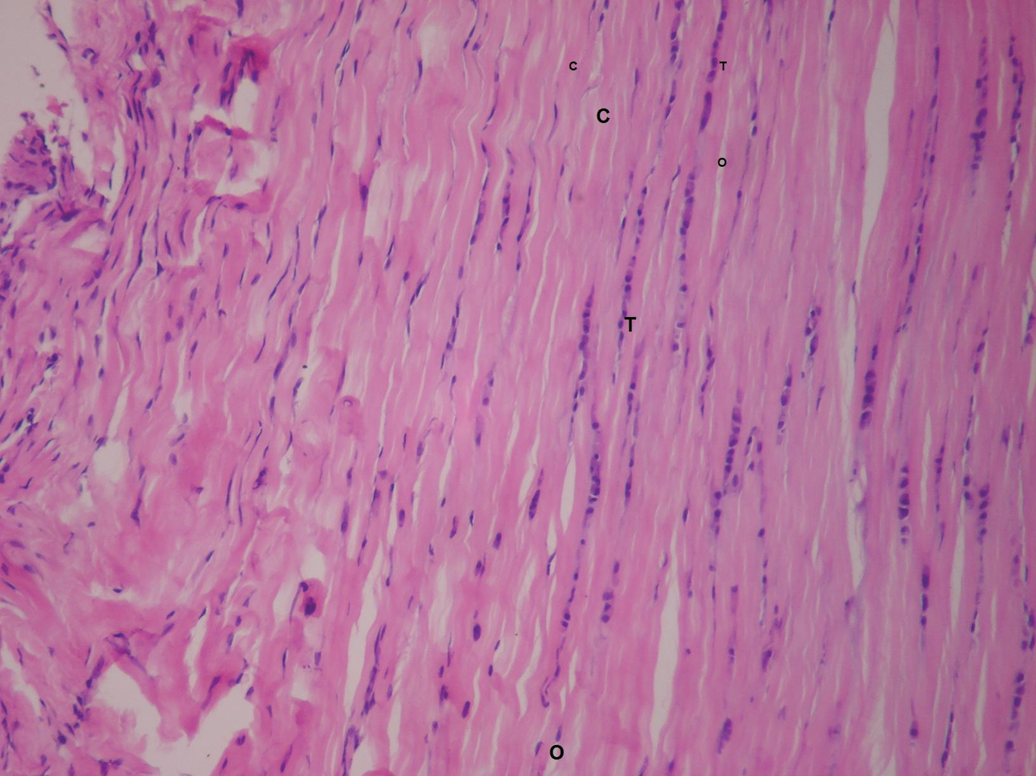
Longitudinal section of a tendon from a rat treated with fresh pineapple juice daily showing well-laid-out collagen fibers (C), mild edema (O), mild inflammation, and proliferating tenoblasts (T). Hematoxylin and eosin, × 100. Color images available online at
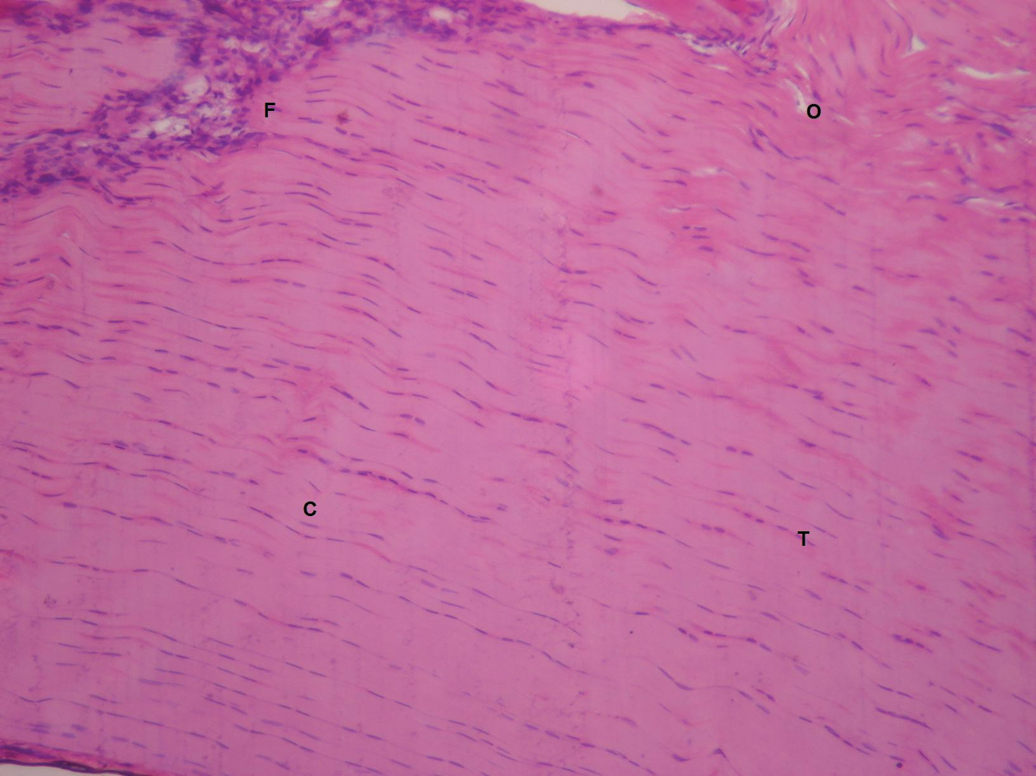
Longitudinal section of the injured untreated tendon of a rat showing proliferating plump immature tenoblasts (T), infiltration of mononuclear inflammatory cells (F), mild edema (O), and relative absence of well-formed collagen fibers (C). Hematoxylin and eosin, × 100. Color images available online at
Discussion
One of the requirements for complete soft tissue healing is that the resident cells must be able to regenerate. 17 This study has shown that commercial bromelain, which is predominantly stem bromelain, resulted in a significant increase in tenocyte proliferation compared with the control and fresh pineapple juice groups (Table 1). This finding agrees with prior studies that pineapple fruit is not a concentrated source of bromelain enzyme. 7 Pineapple, however, contains carotenoids, which are antioxidants, and this is responsible for the significant lowering of the MDA level compared with both the control and the bromelain-treated groups (Table 2).
In the bromelain-treated group, the marginal reduction in the MDA level compared with the control group coupled with the significant (P < .05) increase in the tenocyte population could suggest a role for reactive oxygen species together with bromelain in inducing tenoblast proliferation. This is quite pertinent as it has been reported that reactive oxygen species can stimulate cellular proliferation and act as a second messenger in cellular signaling. 18 The marginal increase in the population of tenocytes seen in the pineapple-treated tendon, however, may be due to other factors other than reactive oxygen species as there was a significant (P < .05) reduction of the MDA level. This may suggest that reactive oxygen species play a very minimal role on the effect of fresh pineapple juice on the proliferation of tenocytes.
This study has shown that whereas bromelain resulted in a significant increase in the population of the tenocytes, its effect in reducing the MDA level was very marginal, unlike pineapple juice, which significantly lowered the MDA content compared with the other groups, although its effect on the proliferation of tenoblasts was marginal. There was no significant difference, however, between the tenocyte population of the bromelain- and pineapple-treated groups as both induced a proliferation of tenoblasts.
Considering the fact that the juice was administered just once daily, it may be pertinent to further study the effects of pineapple juice given twice or three times daily or ad libitum and compare the result with the effect of commercial bromelain. The effects of different species of pineapple fruit juice on tendon healing also need to be investigated. This is important because pineapple juice has the advantage of significantly lowering the oxidative stress and thus, coupled with its obvious potential to induce tenocyte proliferation, might be a natural, readily available alternative in treating acute tendon injuries.
In conclusion, our findings suggest that bromelain and fresh pineapple juice had therapeutic effects on the healing tendon, but bromelain had a better effect on tenocyte proliferation and may be an option to consider in the management of acute tendon injuries.
Footnotes
Author Disclosure Statement
No part of this work has been submitted to any other journal for publication, and there are no conflicting financial interests.