




Abstract
In this study, antioxidant and antimicrobial activities of essential oils obtained from oregano (Origanum vulgare ssp. hirtum) were determined by using solvent-free microwave extraction (SFME), supercritical fluid extraction, and conventional hydrodistillation (CH) methods. The inhibitory effects on the 2,2′-azino-bis(3-ethylbenzothiazoline-6-sulfonic acid) radical of essential oils obtained from oregano by using SFME and CH were similar. However, essential oil extracted by CH showed greater (2.69 μmol/μL of oil) Trolox equivalent antioxidant capacity (TEAC) than oregano oils obtained by SFME (P < .05). The difference between percentage inhibition and TEAC values most probably is due to the fact that undiluted and diluted samples are used in the percentage inhibition assay and the TEAC assay, respectively. TEAC values of oregano essential oils obtained by SFME at different microwave power levels were found to be similar and ranged from 0.72 to 0.84 μmol/μL of oil. Essential oils obtained by CH and SFME at different microwave powers inhibited the survival of Listeria monocytogenes, Salmonella typhimurium, and Escherichia coli O157:H7, whereas survival of Staphylococcus aureus was not influenced. In addition, oregano oil obtained by SFME at 40% power level did not show any inhibitory effect on E. coli O157:H7.
Introduction
I
It is well known that the extraction procedure has a great impact on the quality of the final product such as extraction efficiency, retention of volatile compounds, and bioactive components. 14 Essential oils are most commonly produced commercially by steam distillation or hydrodistillation methods. Environmentally friendly methods such as supercritical fluid extraction (SFE) and microwave extraction have been developed recently. The other reason for the development of new extraction methods is to protect beneficial components of volatile oils from being decomposed or oxidized.
In the present study, the aim was to investigate antioxidant activity against linoleic acid peroxidation, 2,2′-azino-bis(3-ethylbenzothiazoline-6-sulfonic acid) (ABTS) diammonium salt and 2,2-diphenyl-1-picrylhydrazyl (DPPH) radicals, and antimicrobial activity of essential oils obtained from oregano by using solvent-free microwave extraction (SFME) at different power levels, SFE, and conventional hydrodistillation (CH) methods.
Materials and Methods
Materials and chemicals
Oregano (Origanum vulgare ssp. hirtum) was kindly donated by Kütaş (Kütaş Tarım Ürünleri Dıs Tic. San. A.S., Izmir, Turkey). DPPH (catalog number D9132), linoleic acid (catalog number L1376), phosphate buffer tampon (catalog number P4417), hemoglobin (catalog number H2500), FeCl2 (catalog number 372870), and methanol were purchased from Sigma-Aldrich (Munich, Germany). ABTS diammonium salt (catalog number 11557) was obtained from Sigma-Aldrich Fluka (Munich). Ammonium thiocyanate was purchased from Merck (Darmstadt, Germany).
Pure cultures of E. coli O157:H7, L. monocytogenes Scott-A, Salmonella typhimurium NRRL E 4463, and S. aureus 6538P were obtained from the Microbiology Laboratory, Food Engineering Department, Ege University, Izmir, Turkey and used as pathogen cultures for the determination of antimicrobial activity.
CH
An herb:water ratio of 1:10 was used for CH by using a Clevenger apparatus. The process was continued until no more essential oil was obtained. The experiments were conducted twice. The essential oil was collected in amber-colored vials, dehydrated with anhydrous sodium sulfate, capped under nitrogen, and kept at 4°C until analysis.
SFME
The experimental setup for the SFME was a Clevenger apparatus placed in a microwave oven (White-Westinghouse, Pittsburgh, PA, USA) operating at 2,450 MHz. The maximum power of the oven was 622 W, which was measured by the IMPI 2 L test. 15 Extractions were carried out at four power levels: 100% (622 W), 80% (498 W), 60% (373 W), and 40% (249 W).
Fifty grams of dried O. vulgare ssp. hirtum was soaked in 700 mL of distilled water at room temperature (25°C) for 1 hour to hydrate the external layers of the herb. At the end of the soaking period excess water was drained off. The moistened herb was placed in a flat-bottom flask, and SFME was performed at the given power level. The extraction process was performed until no more essential oil was obtained. For each condition, experiments were replicated twice. The essential oil was collected in amber-colored vials, dehydrated with anhydrous sodium sulfate, capped under nitrogen, and kept at 4°C until analysis.
SFE
SFE was performed by using an ISCO (Lincoln, NE, USA) supercritical fluid extractor (model SFX5100) at 40°C temperature and 105 bar pressure for 30 minutes. Stainless steel cartridges having a capacity of 10 mL were filled with 0.3 g of sample. The CO2 flow rate was 2 g/mL. The extract was trapped in a tube containing n-hexane, placed in dry ice to provide condensation. After extraction, the extract was transferred to amber colored vials, n-hexane was evaporated under nitrogen, and the vials were kept at 4°C until analysis. Because it was not possible to work with greater amounts of sample in SFE, in order to reach the desired volume for the analysis of antioxidant activity and antimicrobial activity, essential oils were collected from replicated (at least 10) SFE procedures. Therefore, antioxidant and antimicrobial activity analyses were performed as two parallels.
Antioxidant activity
ABTS decolorization assay
ABTS radical scavenging activities of the samples were determined by the method of Re et al.
16
In brief, ABTS was dissolved in water to a 7 mM concentration. ABTS radical cation was produced by reacting ABTS stock solution with 2.45 mM potassium persulfate (final concentration) and allowing the mixture to stand in the dark at room temperature for 12–16 hours before use. For the determination of antioxidant activity, the ABTS radical solution was diluted with ethanol to an absorbance of 0.70 (±0.02) at 734 nm. After addition of 1.0 mL of diluted ABTS radical solution to 10 μL of the sample, the absorbance was read (Cary 50 Scan UV-Visible spectrophotometer, Varian Australia Pty Ltd., Mulgrave, VIC, Australia) 5 minutes after initial mixing. Percentage inhibition was calculated by using the following equation:
where A sample is the absorbance reading obtained for the sample and A ABTS solution is the absorbance reading obtained for the ABTS solution.
DPPH radical scavenging activity
The free radical scavenging activity was determined using DPPH,
17
which is a stable free radical that has an unpaired valence electron at one atom of a nitrogen bridge. In this experiment 50 μL of each extract was added to 950 μL of a 0.030 mg/mL methanol solution of DPPH. Then, the mixture was shaken vigorously and left in darkness for 5 minutes. Finally, the absorbance of the mixture was measured against methanol (blank) at 515 nm by using a spectrophotometer (Cary 50 Scan UV-Visible) The DPPH scavenging activity was expressed as the inhibition of free radical DPPH:
where A sample is the absorbance of the sample and A blank is the absorbance of the DPPH.
Inhibition of linoleic acid peroxidation
Inhibition effect of the samples on linoleic acid peroxidation was determined by the method of Kuo et al.
18
Ten microliters of sample, 0.37 mL of 0.05 M phosphate buffer (pH 7.0) containing 0.05% Tween 20, and 4 mM linoleic acid were mixed in a test tube. This mixture was equilibrated at 37°C for 3 minutes. The peroxidation of linoleic acid in the mixture was initiated by adding 20 μL of 0.035% hemoglobin prepared in water. Then the mixture was incubated at 37°C in a shaking water bath at 100 rpm for 10 minutes. The reaction was stopped by addition of 5 mL of 0.6% HCl prepared in ethanol. The hydroperoxide formed was quantified according to the ferric thiocyanate method. Absorbance readings were taken at 480 nm with a spectrophotometer (Cary 50 Scan UV-Visible). Antioxidant activity of the sample was calculated according to the following equation:
where A 0 is the absorbance obtained for the reaction mixture that does not contain hemoglobin, A 100 is the absorbance obtained for reaction mixture that does not contain sample, and A s is the absorbance obtained for the reaction mixture.
Trolox equivalent antioxidant capacity
The Trolox equivalent antioxidant capacity (TEAC) assay based on the reaction of ABTS radical with Trolox was performed in order to compare radical scavenging activity of a sample with that of Trolox. In brief, this method is based on the ability of antioxidant to quench the ABTS radical cation relative to that of Trolox, a water-soluble vitamin E analog. 19 The antioxidant activities of the samples were estimated within the range of the dose–response curve of Trolox and expressed as the TEAC. The latter is defined as the concentration of Trolox having the antioxidant capacity equivalent to a 1.0 mmol/L solution of the substance under investigation. In this study, the TEAC values were expressed as μmol of TEAC/μL of sample.
Antimicrobial activity
Gram-positive and Gram-negative bacterial species used in this study were kindly obtained from the culture collection of the Microbiology Laboratory, Food Engineering Department, Ege University. The bacterial species include L. monocytogenes Scott-A, S. aureus 6538P, E. coli O157:H7, and S. typhimurium NRRLE 4463.
Tryptone soya broth (catalog number CM 129, Oxoid, Basingstoke, UK) was used as the medium for the development of the strains of pathogenic cultures, whereas plate count agar (catalog number CM 325, Oxoid) was used for the enumeration.
Inocula used in antimicrobial assay were obtained from cultures grown on Tryptone soya broth at 35°C for 24 hours. Essential oils were sterilized by filtration through Millipore (Bedford, MA, USA) filters (pore size, 0.45 μm). Antimicrobial tests were then carried out by the disc diffusion method using 100 μL of suspension containing 108 colony-forming units of pathogenic bacteria/mL spread on nutrient agar (catalog number CM0003, Oxoid). The sterilized paper discs (6 mm in diameter) were impregnated aseptically with 10 μL of essential oil placed on the inoculated agar. Three discs were placed on each Petri plate. Sterilized water was used as a control. Plates were kept at ambient temperature for 1 hour and then incubated at 37°C for 24 hours. Antimicrobial activity was evaluated by measuring the zone of inhibition against the test organisms. 20 Each assay was performed in parallels and triplicates.
Statistical analysis
The data were expressed as mean ± SD values. Statistical analysis was performed using SPSS for Windows version 10.0 (SPSS, Inc., Chicago, IL, USA). Analysis of variance (one-way) was conducted, and Tukey's HSD multiple range test was used to determine significant differences at P < .05.
Results and Discussion
The maximum extraction levels of essential oils obtained from oregano following SFME were 0.054, 0.053, 0.052, and 0.049 mL of oil/g of oregano for 100%, 80%, 60%, and 40% microwave power levels, respectively. However, the yield from CH was 0.048 mL of oil/g of oregano, which was lower than those of SFME extracts obtained at different microwave power levels (P < .05). The highest yield was obtained with SFE (0.055 mL of oil/g). The time needed for obtaining the highest oil yield was 3 hours for CH, but this period for SFME was decreased up to 35 minutes and was related to the microwave power level. The time to reach the highest oil yield for SFE was 30 minutes. Therefore, the extraction time was reduced by about 80% and 83% by using SFME and SFE, respectively.
Antioxidant activity
Several methods have been introduced for determination of total antioxidant activity of foods and/or pure compounds. These methods are based on the generation of a different radical and inhibition extent of the scavenging by antioxidant compounds that are hydrogen or electron donors. 16
Against ABTS radical
Generation of the ABTS radical cation forms the basis of one of the spectrophotometric methods that have been applied to the measurement of the total antioxidant activity. 15 Inhibition effects of oregano essential oils obtained by SFME at different power levels and CH on ABTS radical cation oxidation are shown in Figure 1.
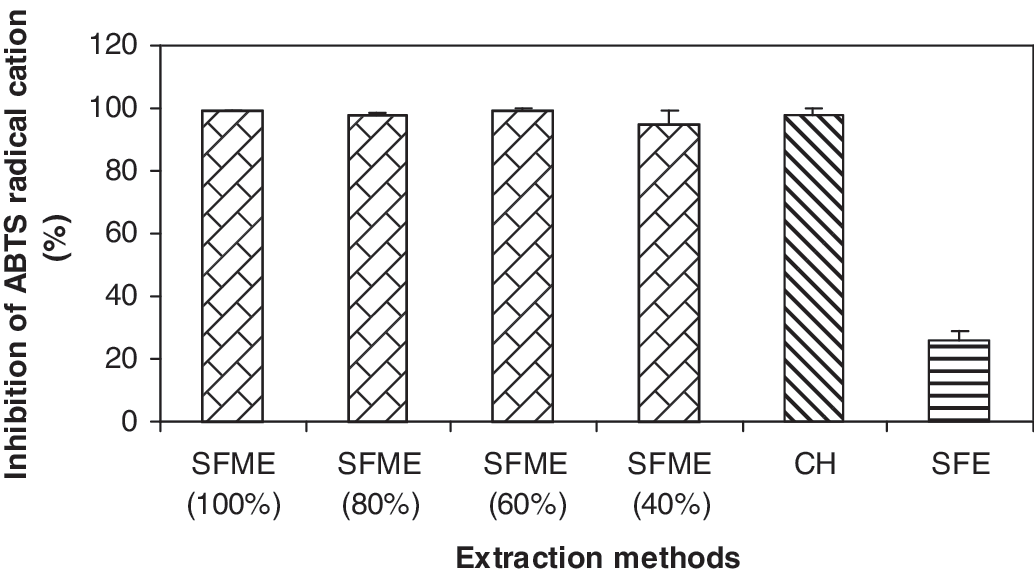
Effects of oregano essential oils obtained by different extraction methods on the inhibition of 2,2′-azino-bis(3-ethylbenzothiazoline-6-sulfonic acid) (ABTS) radical cation. CH, conventional hydrodistillation; SFE, supercritical fluid extraction; SFME, solvent-free microwave extraction.
The inhibition effect on ABTS radical cation of oregano essential oils obtained by SFME at different power levels ranged between 99.09% and 94.77%. The inhibition effect of oregano oil obtained by CH was similar (97.45%), whereas that of the extract obtained by SFE was quite low (30.45%). The reason for this may be due to the difference in the composition of essential oil. A part of this project 21 was published by Bayramoglu et al., 22 and they reported that the composition of the essential oils obtained by both SFME and CH methods was virtually the same. The main components of O. vulgare ssp. hirtum essential oil were determined to be thymol (650–750 mg/mL), followed by p-cymene (60–85 mg/mL), carvacrol (40–60 mg/mL), γ-terpinene (35–50 mg/mL), β-mrycene (approximately 15 mg/mL), and α-terpinene (10–15 mg/mL). Oxygenated compounds were the main components of essential oil (80–85%), followed by monoterpene hydrocarbons (13–16%) and sesquiterpenes (1.0–1.6%). However, oxygenated compounds, monoterpene hydrocarbons, and sesquiterpenes in the extract of O. vulgare ssp. hirtum obtained by the SFE method were 73.16%, 24.57%, and 0.75%, respectively. p-Cymene was not determined in the SFE extract.
There was no significant difference between the inhibition effects of oregano oils obtained by SFME and CH on ABTS radical oxidation. In contrast, TEAC values of oregano oils obtained by SFME and CH were significantly different (P < .05) (Table 1). Oregano oil extracted by CH showed higher TEAC value (2.69 μmol of Trolox/μL of oil) than oregano oils obtained by SFME (P < .05). TEAC values of oregano oils obtained by SFME at different microwave power levels were found to be similar and ranged from 0.72 to 0.84 μmol of Trolox/μL of oil. Puertas-Mejia et al. 23 found that total antioxidant activity of O. vulgare L. essential oil isolated by hydrodistillation against ABTS radical was 25.1 mmol of Trolox/kg of oil.
Results are given as mean ± SD values.
Different letters in the same column indicate significant differences (P < .05).
The reason of the similarity between the inhibition effects of SFME and CH extracts can be explained by the fact that diluted essential oils are not being used in the inhibition analysis (ABTS decolorization assay). In the ABTS decolorization assay, instead of the dose–response relationship, the inhibition capacity of the intact material against ABTS radical cation oxidation is measured. Therefore, it is not possible to distinguish differences among inhibition values that are above 90%. However, in the TEAC method essential oils are diluted to three different concentrations to obtain three different percentage inhibition values within the range of the dose–response curve of Trolox and expressed as the TEAC. Chun et al. 24 reported that ethanol-soluble extracts of clonal oregano showed about 85% inhibition and water-soluble extracts of clonal oregano displayed about 95% inhibition for the ABTS radical. Su et al. 25 evaluated the ABTS radical scavenging ability of oregano leaf extracts by the means of Trolox equivalents. The ABTS scavenging ability of the acetone extract of oregano leaf was 337 μmol of Trolox/g of botanicals. Data obtained from literature and also obtained from our study revealed that oregano leaves, water- and organic solvent-soluble extracts of oregano, and essential oils of oregano have a strong inhibitory effect on ABTS radical cation oxidation.
Against DPPH radical
DPPH is a stable radical and has been used to evaluate the radical scavenging capacities of antioxidants. Essential oils obtained from SFME at different microwave power levels showed scavenging effects on the DPPH radical ranging from 89.15% to 92.74% (Table 2). Oregano essential oils extracted by SFME at different microwave power levels exhibited antiradical activity similar to that of the essential oil obtained by CH (P > .05). Radical scavenging effects of essential oils obtained by SFME and CH were found to be significantly higher (P < .05) than that of essential oil obtained by SFE (8.10%). The reason for the difference may be due to the differences between the oil composition of oregano obtained by SFE and the other two methods (SFME and CH). The antioxidant activity of oregano extracts was tested using different methods, and it was reported that there was a good relationship between antioxidant activity and the total phenols they contain. 26 Puertas-Mejia et al. 23 reported that O. vulgare L. showed the highest inhibition with a 50% effective concentration value of < 0.01 kg of oil/mmol of DPPH. Ethanol-soluble extracts of clonal oregano inhibited the oxidation generated by DPPH radical. The percentage inhibition of DPPH radical was about 80–82%. 24 Several extracts and fractions with different polarity and/or structural properties (phenolic and nonphenolic fractions) were obtained from Mexican oregano; some fractions with different polarity and functional groups had a high antioxidant capacity that was similar to the antioxidant activity of tert-butylated hydroxytoluene at 0.01% concentration. 27 Kulisic et al. 28 studied the DPPH radical scavenging effect of oregano essential oil, its fractions, and the pure constituents thymol and carvacrol; they reported that only the hydrocarbon fraction showed a poor radical scavenging effect. Also, some researchers isolated different phenolic fractions from an ethanolic extract of European oregano, with antioxidant activities similar to tert-butylated hydroxyanisole and tert-butylated hydroxytoluene at a 0.02% concentration. 29
Results are given as mean ± SD values.
Different letters in the same row indicate significant differences (P < .05).
DPPH, 2,2-diphenyl-1-picrylhydrazyl.
Inhibition of linoleic acid peroxidation
Apart from ABTS and DPPH radical scavenging effects, inhibition of linoleic acid peroxidation is an indicator that the sample is an effective inhibitor of lipid peroxidation. Results showed that oregano oil obtained by SFME at 100% power level as a weaker inhibitor of linoleic acid peroxidation (32.85%) than those of obtained by SFME at 80%, 60%, or 40% microwave power and CH (P < .05). Antioxidant capacities of SFME extracts obtained by 80%, 60%, and 40% of microwave power were 89.93%, 74.62%, and 85.57%, respectively (Table 3). Antioxidant capacity of CH extract was found to be 90.43% (Table 3). SFE extracts of oregano showed the strongest inhibition of linoleic acid peroxidation (by 99.73%) (P < .05).
Results are given as mean ± SD values.
Different letters in the same row indicate significant differences (P < .05).
Nakiboğlu et al. 30 studied the antioxidant activity of Sideritis sipylea Boiss and Origanum sipleum L., which are endemic to Turkey. They found that extracts of S. sipylea and O. sipleum were able to reduce the formation of peroxides. Total antioxidant capacities of methanol-soluble and ethanol-soluble extracts of S. sipylea and tert-butylated hydroxyanisole were found to be similar and significantly higher than the other extracts. Şahin et al. 8 reported that essential oil (2 mg/mL) of oregano obtained by water distillation for 3 hours inhibited linoleic acid peroxidation by 36%; the researchers concluded that antioxidant activity might be improved at higher concentrations, which were not used in the study. Our results were not in agreement with the study of Şahin et al. 8 This difference may be due to not only the concentrations used in both study but also the different chemical composition of the samples used in the studies. It is well known that essential oils are a heterogeneous group of complete mixtures of organic substances, the quality and quantity of which vary with growth stages, ecological conditions, and other plant factors. They found that thymol and carvacrol contents of oregano essential oil were 0.8% and 0.6%, respectively. 8 However, we found that thymol and carvacrol contents of CH extracts of oregano were about 75% and 4.8%, respectively. 21 Kulisic et al. 28 reported that oregano oil possessed remarkable antioxidant properties. The antioxidant effect was due to the presence of thymol and carvacrol, but a possible synergistic effect among oxygen-containing compounds could be suggested too. Similarly, Martinez-Rocha et al. 31 demonstrated the variety of antioxidant compounds present in oregano and the reason why oregano is considered one of the best antioxidant species.
Antimicrobial activity
Table 4 shows the inhibitory antimicrobial activity of oregano essential oils obtained by SFME, CH, and SFE against the growth of E. coli O157:H7, S. aureus 6538P, S. typhimurium NRRL E 4463, and L. monocytogenes Scott-A. As can be seen from Table 4, oregano essential oil was inhibitory for all pathogenic bacteria except S. aureus. The largest inhibition zone (10 mm) was observed for the pathogens E. coli O157:H7 and S. typhimurium NRRL E 4463. Although inhibitory effects of oregano essential oils obtained by SFME at four microwave power levels against the survival of both L. monocytogenes Scott-A and S. typhimurium NRRL E 4463 were found to be similar, oregano oil obtained by SFME at 40% microwave power did not show any inhibitory effect on the survival of E. coli O157:H7 (P < .05). There were no significant differences among the antimicrobial activities of oregano essential oils obtained by CH and SFME (P > .05). However, all SFE extracts were not able to inhibit survival of the bacterial strains used in this study. This result can be due to the differences in the composition of essential oils obtained by SFE and both SFME and CH. As indicated above, the amount of oxygenated compounds in SFE extract was lower than those of both SFME and CH extracts. It was reported that phenolic components of essential oil have the strongest antimicrobial activity, followed by aldehydes, ketones, and alcohols. 32 Burt 33 reviewed the antibacterial properties of essential oils and reported that different extraction procedures could lead to obtaining essential oils with different sensory characteristics and also different antimicrobial activities, which were strongly related with the composition of the final product.
Different letters in the same row indicate significant differences (P ≤ .05).
In other research, the antimicrobial effect of volatile oil of O. vulgare on several Gram-positive and Gram-negative bacteria and saprophytic and/or foodborne pathogenic bacteria was investigated; results showed that this volatile oil has a strong antimicrobial activity. 34 Özkalp et al. 35 reported that Gram-positive bacteria were more sensitive to the oregano essential oil than Gram-negative ones.
The effect of two different types of thyme on the changes in basic protoplasmic structure of L. monocytogenes was investigated, and it was determined that the anti-listerial effect of thyme oil was stronger than the antimicrobial effect obtained by using nisine and electrical shock at the same time. 36 Two kinds of thymus extracts (Thymus vulgaris L. and Thymus serpyllum L.) and three types of oregano (O. vulgare L., Origanum onites L., and Origanum majorana L.) obtained by hydrodistillation showed inhibitory effects on the growth of E. coli ATCC 25922, E. coli O157:H7 ATCC 33150, S. aureus ATCC 392, and Yersinia enterocolitica ATCC 1501. 12 Saraç et al. 37 reported that the essential oils of O. onites and O. vulgare ssp. hirtum inhibited the growth of all bacteria tested with inhibition zones ranging between 28 and 32 mm and 26 and 33 mm, respectively. The major components characterized in the essential oils of these plants were reported as carvacrol (79.32% and 68.19%, respectively), p-cymene (4.32% and 6.81%, respectively), and γ-terpinene (3.94% and 4.63%, respectively). Özkan et al. 38 reported that O. sipyleum extracts showed antimicrobial activity against the bacterial strains Aeromonas hydrophila ATCC 7965, B. cereus FMC 19, Enterobacter aerogenes CCM 2531, E. coli DM, E. coli O157:H7 KUEN 461, Enterococcus faecalis ATCC 15753, Klebsiella pneumoniae FMC 5, Mycobacterium smegmatis RUT, Proteus vulgaris FMC 1, Pseudomonas aeruginosa ATCC 27853, Pseudomonas fluorescens EU, Salmonella enteritidis, S. typhimurium, and S. aureus Cowan 1 but not against Y. enterocolitica EU. Burt and Reinders 39 investigated the antibacterial effects of essential oils of daphne, carnation, O. vulgare, and two kinds of T. vulgaris at three different temperatures; they stated that essential oils of oregano and the two kinds of thymus could be used for the inhibition or prevention of the growth of E. coli O157:H7 in foods. It was determined that volatile oils obtained from several types of thymus (Thymus mastichina L. ssp. mastichina, Thymus camphoratus, and Thymus lotocephalus) cultivated in different regions of Portugal have antimicrobial activities against Candida albicans, E. coli, L. monocytogenes, Proteus mirabilis, Salmonella spp., and S. aureus. 40
All these studies cited above are in accord with the results of our study, except for the survival of S. aureus. None of the oregano essential oils obtained by SFME, SFE, and CH showed antimicrobial activity against the survival of S. aureus 6538P.
In conclusion, TEAC values determined for SFME at four microwave power levels were significantly lower than the TEAC value obtained for CH. Also, no significant differences were found for the essential oils obtained by SFME at different microwave power levels. DPPH radical scavenging activities of the essential oils obtained by SFME and CH were almost the same, but the SFE extract displayed the lowest activity. However, SFE extract showed the strongest inhibitory activity against linoleic acid peroxidation. Essential oil obtained by SFME at 100% microwave power exhibited the lowest antioxidant activity against linoleic acid peroxidation. Essential oils obtained by SFME and CH inhibited the survival of the bacteria E. coli O157:H7, S. typhimurium, and L. monocytogenes. However, essential oil obtained from SFE showed no antimicrobial activity against the microorganisms used in this study. Therefore, it can be concluded that SFME is a good alternative for the extraction of essential oils from O. vulgare ssp. hirtum because it provides essential oils of similar quality and antimicrobial activity compared with CH while reducing the time of the process drastically.
Footnotes
Acknowledgments
The Scientific and Technological Research Council of Turkey is greatly acknowledged for supporting this project (grant TOVAG 104 O 265). Dried oregano leaves were provided by Kütaş (Kütaş Tarım Ürünleri Dış Tic. San. A.S., Izmir, Turkey).
Author Disclosure Statement
No competing financial interests exist.