




Abstract
Because of its good sensorial attributes, lemon verbena is used as a primary ingredient in infusions and nonalcoholic drinks. The present study was designed to assess the antioxidant activity (AA) of lemon verbena infusion (LVI) as well as the thermal stability of its AA and the content of polyphenolic compounds. The values reflecting the AA of LVI, including AA index, fast scavenging rate against 2,2-diphenyl-1-picrylhydrazyl, Trolox equivalent antioxidant capacity, and hydroxyl radical scavenging, are higher than those of many herbal infusions and antioxidant drinks estimated from reported data. In addition, the slope lag time and specific oxyradical antioxidant capacity values of LVI are comparable to those of a commercial antioxidant drink based on green tea. Hence, LVI is a source of bifunctional antioxidants, and thus in vivo studies of the antioxidant capacity of LVI would be useful to evaluate its potential as an ingredient in antioxidant drinks.
Introduction
L
Lemon verbena infusion (LVI) increases the antioxidant capacity of plasma in an animal model of acrylamide-induced damage, at least in part because of the polyphenolic compounds that it contains: verbascoside (phenylpropanoid) and luteolin 7-diglucoronide. 4 Verbascoside also inhibits plasma lipid peroxidation during hindlimb immobilization of white rabbits, as shown by the reduction in malondialdehyde levels. 5 Indeed, the highest verbascoside concentration in plasma and the maximum plasma antioxidant capacity were observed in rats orally administered aqueous lemon verbena extract. 3 Other phenylpropanoids, such as acteoside and isoverbascoside, also identified in LVIs, 6 have been shown to inhibit membrane lipid peroxidation in rat cortical cells because of the overexpression of antioxidant enzymes and an increase in glutathione. 7
It is well documented that oxidative stress plays an important role in the pathogenesis of many diseases, including cardiovascular disease, rheumatoid arthritis, Alzheimer's disease, Parkinson's disease, and cancer, as well as in aging. 8 Indeed, antioxidants represent promising preventive agents to combat oxidative stress-related diseases. 9
Functional drinks, including antioxidant drinks, are considered to be healthy, and they represent the fastest growing segment of the functional foods market. The incorporation of herbal extracts as functional ingredients into such drinks has several advantages, such as the wide range of bioactive compounds and the increasing market trend towards the use of natural products. 10 From a manufacturing point of view, such products are relatively easy to formulate and process. 11
The aim of this study was to evaluate the potential of an aqueous lemon verbena extract as an antioxidant by assessing (1) its antioxidant activity (AA) against several free radicals in relation to that of other herbs used in infusions, (2) its antioxidant capacity in comparison with commercial antioxidant drinks formulated with herbal extracts, and (3) the thermal stability of its AA and that of its polyphenolic compounds.
Materials and Methods
Chemicals
Ascorbic acid, 2,2′-azino-bis(3-ethylbenzothiazoline-6-sulfonic acid) diammonium salt (ABTS+), 2,2′-azobis(2-methylpropionamidine) dihydrochloride, 2,2-diphenyl-1-picrylhydrazyl (DPPH), ethanol, ethyl acetate, fluorescein (FL), ferrous sulfate, Folin–Ciocalteu (FC) reagent, formic acid, luminol, monobasic and dibasic potassium phosphate, potassium persulfate, sodium carbonate, quercetin, sodium chloride, 6-hydroxy-2,5,7,8-tetramethylchromane-2-carboxylic acid (Trolox), and high-performance liquid chromatography (HPLC)-grade acetonitrile were all purchased from Sigma-Aldrich (St. Louis, MO, USA). Hydrogen peroxide (30% [vol/vol]) was acquired from Panreac (Barcelona, Spain). HPLC-grade acetonitrile and ultra-high-quality deionized water (>18 Ω/cm resistivity) were used in all experiments.
Plant material
Lemon verbena (A. triphylla) was bought fresh from a wholesale food market in Huancayo (Peru). We identified the sample as A. triphylla L'Hér based on its botanical taxonomic characterization. 12 The herb was characterized by light-green lancet-shaped hairy leaves approximately 10 mm long, with a blunt base and a sharp tip, which exhibited a powerful lemon scent. The lemon verbena leaves were dehydrated for 5 hours at 60°C at atmospheric pressure, milled, meshed using a number 40 sieve, vacuum-packed in high-density polyethylene bags at 200 mbar, and stored at −20°C until they were used.
LVI preparation
The LVI was prepared by adding the dehydrated lemon verbena leaves (250 mg) to 200 mL of boiling water for 2 minutes with constant stirring at 300 rpm. The aqueous solution was filtered through number 3 Whatman filter paper, and it was cooled in an ice–water bath to 20°C. The final volume was adjusted to 250 mL with water.
Total LVI polyphenols
The total polyphenol content was assessed by the FC micromethod. 13 In brief, 100 μL of the LVI, a quercetin solution (standard), or water (blank) was pipetted in triplicate into separate test tubes, and 100 μL of the FC reagent was added to each, mixed well, and equilibrated at room temperature. After 2 minutes, 800 μL of sodium carbonate (5% [wt/vol]) was added to establish alkaline conditions, and the reaction was carried out at 40°C for 20 minutes. Thereafter, the final mixture was cooled to room temperature in an ice–water bath, and the absorbance at 740 nm was read in an ultraviolet–visible spectrophotometer (Genesys™ 8 UV-Vis, Thermo Scientific Spectronic, Rochester, NY, USA). The total polyphenol content in the LVI samples was expressed as quercetin equivalents (QE), in mg of QE/L.
LVI AA
DPPH scavenging activity
DPPH scavenging activity was determined for LVI and green tea infusion (GTI). Green tea was prepared as described previously.
14
The tea leaves were first blanched at 100°C for 60 seconds to inactivate degrading enzymes, and they were then air-dried at room temperature for 2 hours and at 100°C for 50 minutes. Thereafter, the leaves were ground to 1-mm-diameter particles and air-dried at 60°C for 40 minutes to reach a final moisture content between 6% to 9%. The GTI was then prepared as described above for the LVI. The LVI or GTI aliquot (50 μL) was mixed quickly with 950 μL of DPPH ethanolic solution (100 μM), and the absorbance at 515 nm was monitored every 60 seconds for 10 minutes with a computer-assisted Genesys 8 UV-Vis spectrophotometer. The DPPH scavenging activity was calculated from Eq. 1. The AA, defined as the AA index (AAI), was calculated as μg of DPPH/mL divided by 50% inhibitory concentration (IC50) (in μg/mL of total polyphenols).
15
The kinetic data obtained for each diluted LVI and GTI were fitted to a power function, and the first derivatives at 0.1 minute and 2 minutes (Rs) were used to estimate the rate of DPPH scavenging at the fast reaction step as the Rs ratio0.1/2min:
16
ABTS°+ scavenging activity
The ABTS°+ scavenging activity of the LVI was assessed in a 96-well plate as reported previously.
17
The Trolox equivalent antioxidant capacity (TEAC) was estimated as the LVI/Trolox slope ratio from the curves obtained from a linear regression analysis of the percentage of ABTS°+ scavenging versus the total polyphenol content of the LVI or the Trolox concentration. The ABTS scavenging was calculated from Eq. 2:
Peroxyl radical scavenging activity
The FL oxyradical antioxidant capacity (ORACFL) was assessed in a microplate reader as described previously.
17
The area under the curve (AUC) was calculated by a numerical trapezoid method (Eq. 3), and the antioxidant activity was calculated as the ORACFL value (Eq. 4):
where f 0 and f i are the initial fluorescence reading and that at a given reaction time, respectively, and DF is the sample dilution factor.
OH scavenging activity
The OH scavenging activity of the LVI was assessed by a fast chemiluminescence method
18
adapted to the final 1-mL volume of the reaction.
17
The inhibition of luminol oxidation (ILO) by OH (ILOOH) was calculated using the AUC (Eq. 5). The ILOOH data were fitted to the exponential rise to the max function, and they were used to calculate the IC50 value taking into account the total polyphenol content:
Antioxidant quality of LVI
The quality of the antioxidants in the LVI was measured in terms of the maximum velocity of FL oxidation induced by peroxyl radical (ROO) (V max FLOROO) and the lag time in the ORACFL assay. These parameters were compared with those of certain commercial antioxidant drinks. A well-defined lag phase results from a repair reaction for fluoresceinyl radical (equilibrium reaction between antioxidant and fluoresceinyl radicals), and it is considered as an indicator of the antioxidant's effectiveness. 19
The V
max FLOROO and the lag time were estimated from the regression lines obtained with a short reaction time and at the reaction time corresponding to the V
max from the modified ORACFL curve plotting the FLOROO (Eq. 6) against the reaction time:
where f 0 and f i are the initial fluorescence reading and that at a given reaction time i, respectively.
Thermal stability of LVI
The LVI was prepared as described above, and the pH value was adjusted to 3.3 with citric acid. Thereafter, 1 mL of the LVI was transferred to each tube that was then hermetically sealed. The tubes were kept in a water bath at 70°C, 80°C, and 90°C for 8 hours, and at 1-hour intervals, three samples from each temperature were cooled in an ice–water bath and stored at −20°C until analysis.
Stability of AA and polyphenolic compounds
The samples were thawed in an ice–water bath and used to assess the stability of the AA. Besides the relative ORACFL value, we calculated the lag time and V max FLOROO.
The total polyphenol content was assessed by the FC micromethod described above. 13 The polyphenolic profile of the LVI was analyzed by HPLC diode array detector/electrospray ionization–mass spectrometry (MS) after the samples were purified on C18 Sep-Pak cartridges using the following eluents: 0.01 M HCl to eliminate sugar and acid water-soluble compounds and ethyl acetate to extract polyphenols. The HPLC system consisted of a LC/MSD Agilent instrument with two detectors (model 1100 diode array detector and LC/MS single quad-multimode ES/APCI source), a model 1100 pump system, and a model 1100 autosampler (Agilent Technologies, Palo Alto, CA, USA). The liquid chromatography conditions used were as reported previously. 6 The polyphenolic compounds of LVI were identified by comparing the HPLC diode array detector/electrospray ionization–MS data obtained and those reported previously (retention time and ultraviolet and MS spectra).
Statistical analysis
The linear and nonlinear regression analysis, one-way analysis of variance, and Bonferroni's test were performed with GraphPad Prism version 4.0 software (GraphPad Software, Inc., San Diego, CA, USA). A value of P < .05 was considered significant.
Results and Discussion
Polyphenolic profile of LVI
Phenylpropanoids represent the main class of polyphenolic compounds in the LVI, in accordance with previous findings in freeze-dried leaves and lemon verbena leaf extracts. 3,6 We identified seven major phenylpropanoids in the LVI (Fig. 1), with verbascoside being the most abundant of these. Under the experimental conditions used, iridoid derivatives, luteolin, and apigenin diglucuronides were not detected in the LVI, as previously described, 6 as well as other phenylpropanoids such as forsythoside A and martinoside. 20 The fact that flavone diglucuronides were not found in the LVI might be related to the drying conditions used in this study (60°C × 5 hours at atmospheric pressure). Hot air-drying destroys the leaf vacuole structure, producing an increase in pH and destabilizing the flavonoid glycosides present in the vacuoles at low pH. 21 By contrast, derhamnosylverbascoside (peak 5, Fig. 1) was identified in LVI, a phenylpropanoid not previously identified in dried aerial parts of lemon verbena 20 or in the lemon verbena decoctions and infusions prepared from dried leaves. 3,6 However, derhamnosylverbascoside has been found in other herbs belonging to the Verbenaceae family. 22,23 The stability testing carried out in this work showed that the combination of heat and acidic pH increased the derhamnosylverbascoside content in LVI (see Thermal stability testing). Therefore, it is possible that this compound is released in the initial drying step, prior to vacuole destruction (low pH).
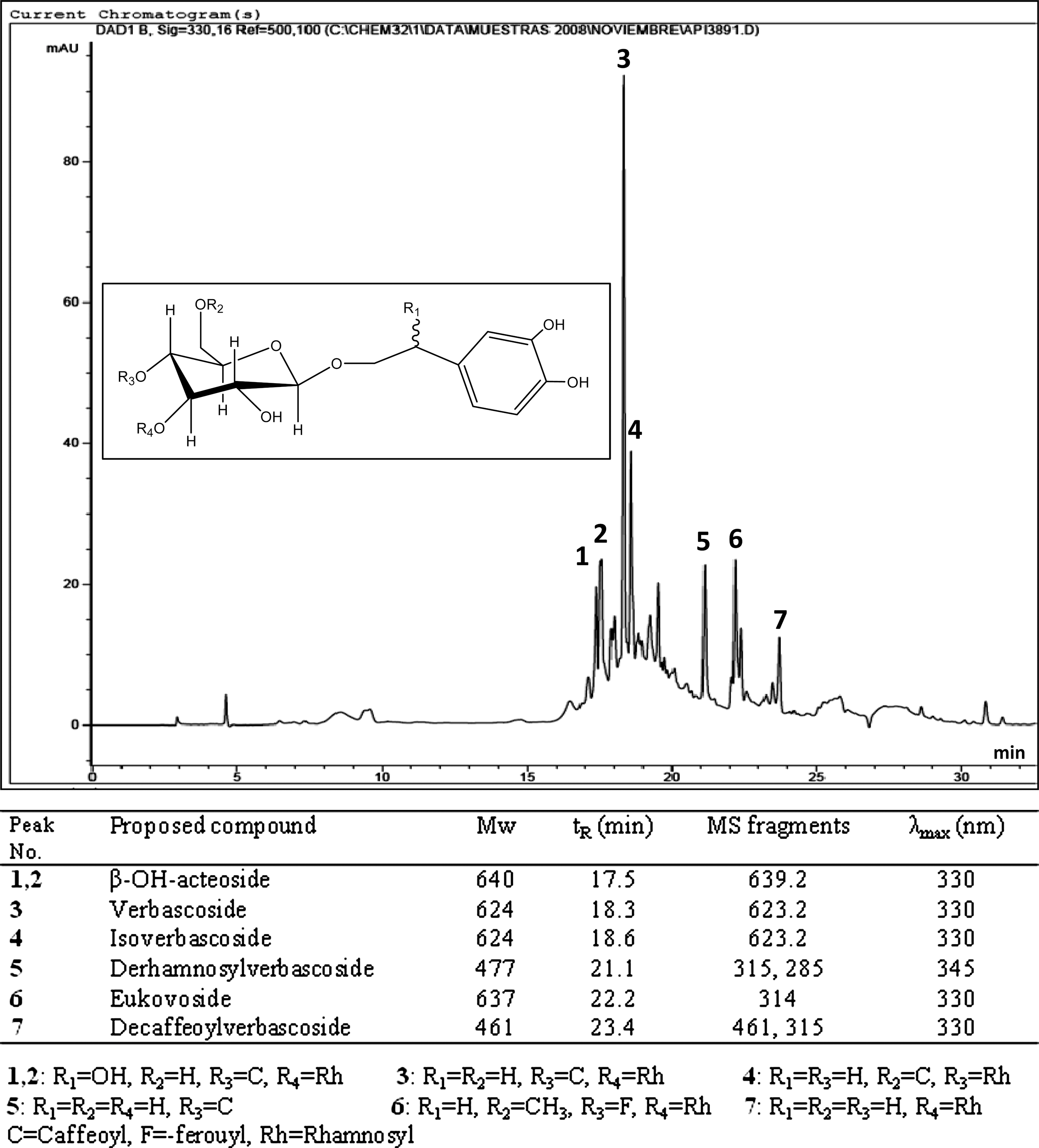
Phenylpropanoid compounds from lemon verbena infusion identified by high-performance liquid chromatography diode array detector/electrospray ionization–mass spectrometry (MS). tR, retention time.
AA of LVI
We compared the results obtained on the AA of LVI through different in vitro methods with those reported in the literature for other herbs used in infusions with known AA. This comparison should provide valuable information regarding the capacity of LVI as a source of antioxidants, although such a comparison has several limitations. First, the differences in the protocols are likely to influence the final results (e.g., reaction times, temperatures, or reagent concentrations). Second, different parameters may be used to evaluate AA, such as the percentage scavenging capacity or antioxidant equivalents (ascorbic acid, gallic acid, Trolox, etc.). All these differences make it difficult to contrast our data with those reported in the literature, and thus we have only chosen those methods that were as close as possible to our experimental conditions. For example, we have been able to compare data on herbal infusions with that of LVI obtained with the DPPH, ABTS, and ILO assays. To obtain additional information on the antioxidant mechanism, we also found it of interest to calculate a new parameter for the ORACFL assay.
DPPH scavenging activity
DPPH is a stable artificial radical that has been widely used to determine the AA of all kinds of matrices, such as fruits, vegetables, drinks, and herbs. 24 The results of DPPH assays have been presented in many ways, such as the percentage of residual DPPH and inhibition of the free radical, 25 ascorbic acid equivalent antioxidant capacity, 26 and the IC50 value, defined as the amount of antioxidant necessary to decrease the initial DPPH concentration by 50%. 27 None of the parameters described above enables us to compare the antioxidant strength of different extracts or that of pure compounds. However, an AAI using DPPH has recently been proposed to standardize such results. The AAI is calculated by considering the mass of DPPH and the mass of the compound tested in the reaction, producing a constant for each compound that is independent of the concentration of DPPH and the sample used. This AAI may be useful to define the antioxidant strength, and accordingly plant extracts or pure compounds exhibiting an AAI < 0.5 are considered as poor antioxidants, those with a value between 0.5 and 1.0 are considered moderate antioxidants, and compounds or extracts giving an AAI value between 1 and 2 or above 2 can be considered as strong or very strong antioxidants. 15
The LVI had very strong AA in the DPPH assay with an AAI value of 5.3 ± 0.2 at 10 minutes (Table 1). This parameter was similar to that found for GTI (AAI = 8.8 ± 0.1). However, the AAI of LVI changed as the reaction proceeded, increasing to 7.2 ± 0.1 at 30 minutes. It is difficult to compare the AAI value of LVI with that of other herbal infusions because this parameter has not been reported previously. 28 From data regarding the DPPH and antioxidant concentration and those of DPPH inhibition reported previously, 29 we estimated the AAI values (expressed as final DPPH concentration/total polyphenols [in μg/mL). We only considered DPPH inhibition <75%, which corresponds to the linear region between the concentration and AA of standard compounds or natural food extracts. 30,31 The IC50 (in μg of gallic acid equivalents [GAE]/mL) was estimated as ([mM total polyphenols × 170.12] × 50/DPPH inhibition [in %])/(dilution factor of the sample). Using a final concentration of DPPH of 26.3 μg/mL, we estimated the AAI values after a 30-minute reaction for several herbal teas. 28 Green tea (11.2 ± 0.01), lemongrass (9.0 ± 0.8), chamomile (6.9 ± 0.3), peppermint (7.1 ± 0.4), Gingko (6.6 ± 1.6), thyme (6.4 ± 0.4), rosemary (6.2 ± 0.3), and Echinacea (4.7 ± 0.6) all exhibited very strong AA, whereas liquorice (1.2 ± 0.2) had only strong AA over this period. In addition, the previously reported 32 AAI values at 30 minutes of isoverbascoside (6.87) and asteoside (7.43), two phenylpropanoids found in the LVI used here, were similar to the global value found for LVI (7.2 ± 0.1). To estimate the AAI of other herbal infusions that inhibited DPPH ≥ 75%, complete experimental data and the use of nonlinear models (logit, probit, and angular) to correctly quantify the IC50 were required. 30
The 50% inhibitory concentration (IC50) is expressed as total polyphenols (mg of quercetin equivalents/L) in the mixture, and the Trolox equivalent antioxidant capacity (TEAC) is given in mg of Trolox/mg of quercetin equivalents.
ABTS+, 2,2′-azino-bis(3-ethylbenzothiazoline-6-sulfonic acid) diammonium salt; AAI, antioxidant activity index; DPPH, 2,2-diphenyl-1-picrylhydrazyl; FLO, fluorescein oxidation; ORAC, oxyradical antioxidant capacity; ROO, peroxyl radical; Rs ratio0.1/2min, ratio of the first derivatives at 0.1 minute and 2 minutes.
The kinetic parameters of DPPH scavenging provide information on how quickly an antioxidant acts, 16 and such parameters are necessary to evaluate the differences between AAI values at different reaction times. The rate, defined as the Rs ratio0.1/2min, at which LVI scavenges DPPH (11.4 ± 1.7) was similar to that of GTI (12.0 ± 1.5; P < .05). In biological systems, reactive oxygen species react rapidly and indiscriminately with biomolecules such as DNA, lipids, and proteins, 33 and hence we suggest that the Rs ratio might be a relevant parameter in vivo. 34 The Rs ratios for other herbal infusions have not been reported, and therefore they could not be compared with that found here.
ABTS°+ scavenging activity
The ABTS°+ scavenging activity of the LVI at 4 and 8 minutes was 3.9 ± 0.1 and 4.7 ± 0.1, respectively, expressed as the TEAC value (in mg of Trolox/mg of total polyphenols) (Table 1). The TEAC value was dependent on time, and LVI displayed two distinct phases (fast and slow steps), which might reflect the formation of dimers or covalent adducts among the polyphenolic compounds, oxidation products, and ABTS°+. The ability to scavenge more free radicals at a slower rate is typical of polyphenol-containing samples. 35 The relationship between the TEAC values and reaction time displayed a good fit to the power function (R 2 > 0.998), similar to that reported for the DPPH assay. 16 Thus, this model was used to estimate the TEAC value of LVI at 5 minutes to compare its scavenging activity with that of other herbal infusions.
We calculated the TEAC value for several herbal infusions from earlier data, 36 and the TEAC value of LVI (4.19 ± 0.04) at 5 minutes was comparable to the values estimated for Wendita calysina, a Paraguayan folk tea (6.5 ± 1.9), green tea (5.0 ± 2.6), black tea (6.8 ± 2.6), and mate (6.4 ± 3.0), and it was higher than the value of rooibos (2.9 ± 2.5). Nevertheless, the TEAC values of drinks based on green, black, and white tea were lower than the LVI TEAC (2.4 ± 0.6, 2.3 ± 0.2, and 1.1 ± 0.2, respectively, at 5 minutes 37 ). All these drinks have ascorbic acid in their formulation, which can interfere with the quantification of phenolic compounds by the FC method. Ascorbic acid produces an overestimation of phenolic content and consequently an underestimation of the TEAC values. A similar behavior was observed with the phenol antioxidant coefficient measured at 5 minutes for mixed tea assam (2.22 ±0.47), belleza (2.35 ± 0.18), and citrus (2.59 ± 0.24), each of which contained escaramujo, a fruit rich in ascorbic acid. 38
Reactive oxygen species scavenging activity
OH scavenging
The LVI reduced the relative luminescence intensity in a dose-dependent fashion in the fast reaction system (Fig. 2A), and the percentage ILOOH increased in function of the total polyphenol content (Fig. 2B). The LVI could scavenge 92% of OH, which is a significant antioxidant response if we consider the capacity of ascorbic acid (80%) and tea polyphenols (75%). 39 The ascorbic acid equivalent value of the LVI (3.26 ± 0.01 mg of ascorbic acid/mg of QE) was higher than that reported for Eucalyptus (2.84 ± 0.12), linden (2.0 ± 0.06), mint (1.71 ± 0.12), and chamomile (1.31 ± 0.05) but lower than that of green tea (5.94 ± 0.12), black tea (5.59 ± 0.14), and Dictamnus (4.00 ± 0.17). 29 Furthermore, the LVI had an IC50 value of 1.3 ± 0.0 mg of QE/L (estimated by exponential function), which was lower, and thus better, than the values reported for several pure phenolic acids, such as p-coumaric acid (10.1 ± 0.6 mg/L), ferulic acid (11.3 ± 0.6 mg/L), caffeic acid (7.2 ± 0.3 mg/L), and gallic acid (7.3 ± 0.3 mg/L), 18 and for (+)-catechin (4.9 mg/L) and (–)-epicatechin (3.6 mg/L). 40 Verbascoside, the main polyphenol found in LVI, can scavenge OH and protect against the damage caused by ionizing radiation to DNA in a metal-independent manner 41 or by acting as a chelating agent in a Fenton system. 39
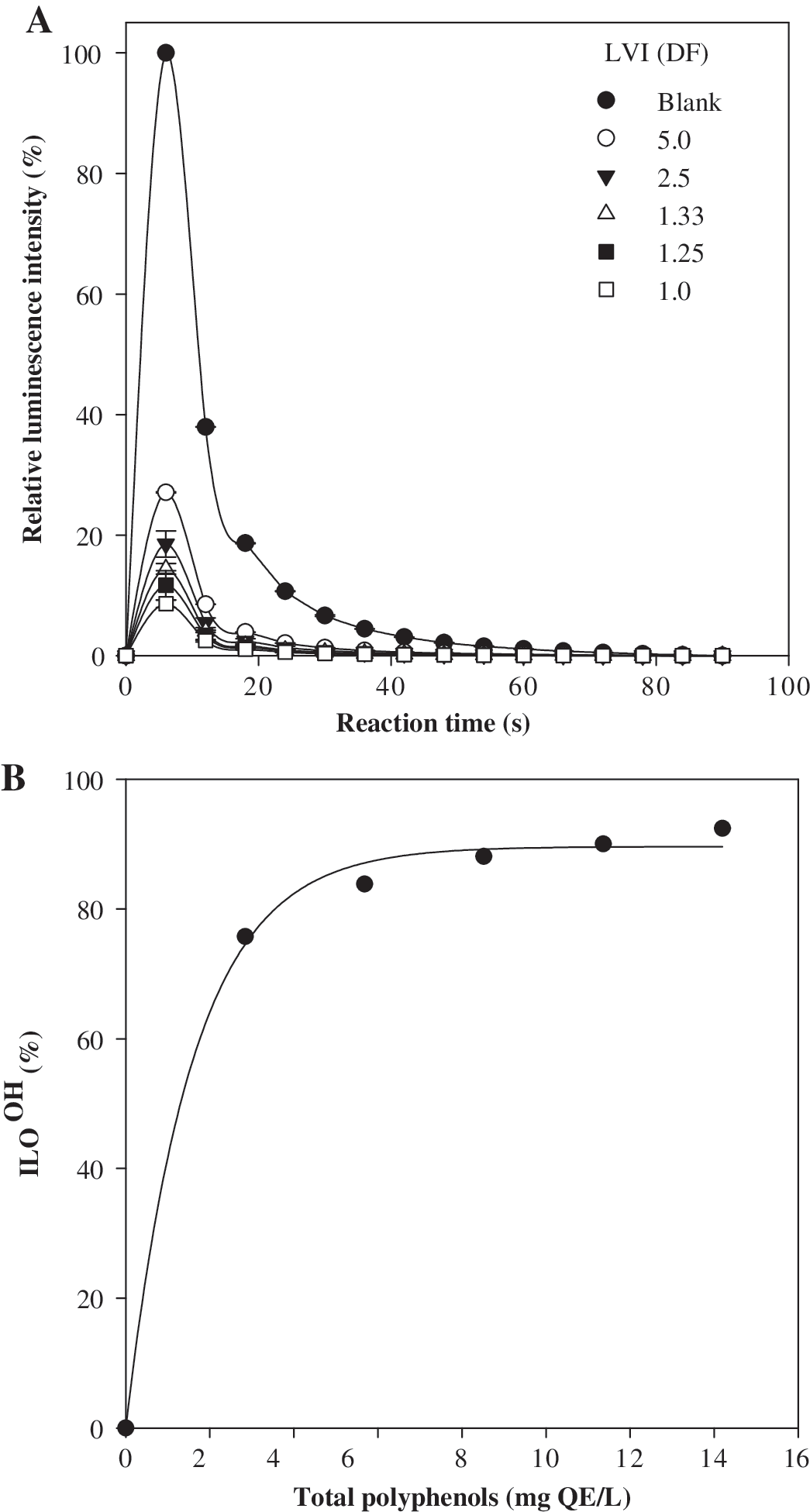
OH scavenging of lemon verbena infusion (LVI): (
ROO scavenging and the antioxidant qualities of LVI
The LVI could scavenge ROO, attenuating FL oxidation in the ORACFL assay. The ORACFL value of LVI (Table 1) was lower than that measured for the commercial antioxidant drinks evaluated (Table 2). The total polyphenol content of LVI (14.2 ± 1.8 mg of QE/L) is probably lower than that of commercial antioxidant drinks, which usually contain between 400 and 3,800 mg of GAE/L. 37
The ORACFL value is in μmol of Trolox/L.
Coca Cola Company (Atlanta, GA, USA), Grupo Leche Pascual (Madrid, Spain), and Minute Maid, a Coca Cola Company company (Sugar Land, TX, USA).
The ORACFL measures the antioxidant capacity against ROO. In the basic assay, the radical reacts with FL to form several nonfluorescent oxidation products. 42 The reaction between the ROO and the antioxidant has been verified as a classic hydrogen atom transfer. 43 Recently, kinetic modeling and pulse radiolysis demonstrated that the lag phase for the loss of fluorescence depends on the value of the equilibrium constant of the reaction F° + AH ↔ FL + A°, where Fo is the fluoresceinyl radical and AH is the antioxidant. This reaction constitutes a repair reaction for an efficient antioxidant (inversely related to their redox potential 19 ). The influence of the repair reaction on the ORACFL assay has been confirmed by comparing the ORACFL values reported for quercetin (7.06 ± 0.15) and epigallocatechin gallate (3.51 ± 0.16). 44 The values of the bonding dissociation energy of the hydroxyl group and C-2 of quercetin (which are inversely related to the hydrogen atom transfer mechanism) are higher than for other polyphenols. 45,46 However, quercetin has a lower redox potential (i.e., a higher reduction capacity 39,47 ), suggesting that a different mechanism of action is at play. The repair of 2P-deoxyadenosine-5P-monophosphate, 2P-deoxyguanosine-5P-monophosphate, and 2P-deoxycytidine-5P-monophosphate has been attributed to verbascoside, 41 which has a low redox potential. Similarly, quercetin (with a redox potential of 330 mV) could also repair deoxythymidine radical anions formed by the reaction of hydrated electrons, and it has been suggested that this repair mechanism may be common to efficient phenolic antioxidants. 39
We calculated a new parameter here, the specific ORACFL, which is based on the ratio of the ORACFL and total polyphenol content of the sample, and thus it takes into account the redox potential of the samples. This value was 7.8 ± 0.4 mg of Trolox/mg of QE for LVI. To compare the antioxidant activity of LVI against the ROO with that of another commercial antioxidant drinks and herbal infusions, we calculated this parameter from the data reported in the literature. For example, the specific ORACFL of clear apple was 0.4 mg of Trolox/mg of GAE, and red grape drinks exhibit a value of 2.8 mg of Trolox/mg of GAE. The polyphenol profiles of both samples evaluated by HPLC were different, as the clear apple drink was rich in hydroxycinnamic acid and the red grape drink contains anthocyanins. 48 The redox potential of the cyanindin-3-O-β-glucopyranoside identified and quantified in the red grape drink is very low compared with that of several other hydroxycinnamic acids, explaining the larger specific ORACFL of red grape drinks. 49 Our data showed that the specific ORACFL of LVI was higher than that of green tea (4.0 ± 0.2), black tea (4.4 ± 0.7), and white tea (3.9 ± 0.7) calculated from data reported previously. 50 We suggest that this might be related to the lower redox potential reported for verbascoside when compared with the catechins and theaflavins present in the tea samples. 45 It is known that the TEAC value of an antioxidant is related to the single electron transfer mechanism, and ORACFL is classically recognized as a measure of the hydrogen atom transfer. 43 In addition, the redox potential of an antioxidant influences the ORACFL assay, 19 suggesting that additional mechanisms affect the FL repair reaction in antioxidants with a low redox potential. Thus, the TEAC and ORACFL values are likely to be correlated between samples that use common mechanisms, whereas samples with a poor correlation are likely to use different mechanisms. We have used the specific ORACFL assay as a possible indicator of the redox potential of a sample. Thus, we calculated the correlation between the TEAC and specific ORACFL values and compared them with those reported for TEAC and ORACFL. The data suggest that when a sample exhibits a good correlation between TEAC and ORACFL (r = 0.897, P < .0001), 51 it also exhibits a good correlation between the TEAC and specific ORACFL values (r = 0.73, P < .0003). On the other hand, there is no correlation between the TEAC and specific ORACFL values (r = –0.25, P < .2) in samples with a moderate TEAC and ORACFL correlation (r = 0.551, P < .01). 52 In general, phenolic antioxidants lose much of their hydrogen atom transfer activity in polar, hydrogen bond–accepting solvents because H-bonded antioxidants are unreactive toward hydrogen atom transfer. 53 For example, the reaction rate of quercetin or epicatechin with the ROO generated by 2,2-azobisisobutyronitrile substantially decreases when switching from chlorobenzene to tert-butyl alcohol. 54
The antioxidant effectiveness of LVI phenylpropanoids was confirmed through the ORACFL assay, including two new parameters that have not been quantified previously: slope lag time and V max FLOROO at different sample volume (linear range). These parameters were evaluated for commercial antioxidant drinks of the A, B, C, and D type, and only the LVI and the commercial type A antioxidant drinks exhibited a distinct slope lag time of 1.6 ± 0.05 minute/μL and 2.4 ± 0.1 minute/μL, respectively (Fig. 3 and Table 2), and a V max FLOROO of 3.6 ± 0.1 minute–1, similar to the blank. This is related to the low redox potential of the verbascoside present in LVI, as discussed above. The type B and C drinks did not exhibit a lag phase, and they had a V max FLOROO of 1.6 ± 0.2 and 1.4 ± 0.1 FLOROO/minute, respectively. Both drinks can be considered as a source of retardant antioxidants, and they have more complex kinetics because they react relatively slowly with ROO, such that the reaction is also terminated by the self-reaction of peroxyls. In an aqueous medium, biological molecules like biliverdin, 55 liver growth factor, an albumin–bilirubin complex, 17 and melatonin 56 have a retarded action in several antioxidant systems that included ROO, as does quercetin in tert-butyl alcohol. 57 Finally, the type D drinks did not exhibit a lag time, and it was not possible to calculate the V max FLOROO because it was affected by the volume of the sample.
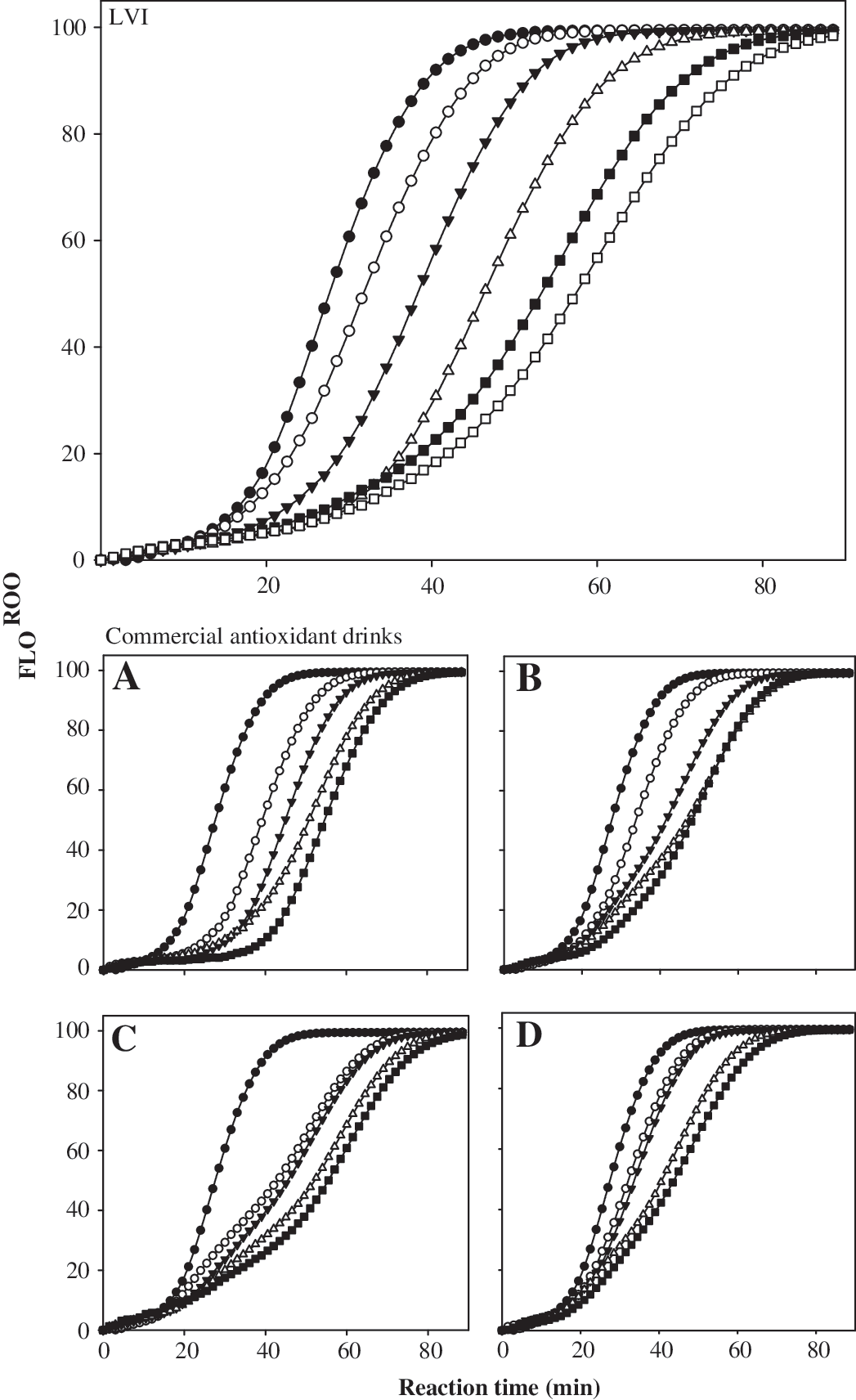
Modified ORACFL curves for diluted LVI and commercial antioxidant drinks (types A–D): FLOROO. (•) Blank did not include sample. The values correspond to four replicates (coefficient of variation was below 5%).
It is known that cellular protection against oxidative stress involves three types of small molecules: direct, indirect, or bifunctional (both direct and indirect) antioxidants. The direct antioxidants include molecules that can undergo redox reactions and that can scavenge reactive oxygen and nitrogen intermediates that are redox active (e.g., ascorbate, glutathione, tocopherols, lipoic acid, vitamin K, and ubiquinol). These types of molecules may be modified during the reaction, and they must therefore be replenished or regenerated. Indirect antioxidants are small molecules that may or may not have redox activity, exerting their antioxidant effects by up-regulating cytoprotective proteins, like those involved in antioxidant enzyme defense (e.g., heme oxygenase-1, glutathione transferase, glutathione peroxidase, thioredoxine reductase). 58 The potency of indirect or bifunctional antioxidants (i.e., those that can play a dual protective role) is positively correlated with the energy of the highest occupied molecular orbital (E HOMO). The smaller the absolute E HOMO (i.e., the lower its redox potential), the stronger its capacity as an electron donor, and the greater its inductive potential. 59 Therefore, considering the lag phase exhibited by LVI in the ORACFL assay, as well as its specific ORACFL value, LVI might be a source of bifunctional antioxidants that act in biological systems.
Thermal stability testing of AA and phenylpropanoid compounds in LVI
The effect of temperature on the AA in the LVI at pH 3.3 (typical in the formulation of herbal and fruit drinks) was assessed through the ORACFL, including ORACFL value, lag time, and V max FLOROO. Incubation of the LVI under accelerated storage conditions (70°C, 80°C, and 90°C) increased the ORACFL value and lag time to 300 minutes (Fig. 4), although it did not change the total polyphenol content and V max FLOROO, which remained at 14.2 ± 1.8 mg of QE/L and 3.52 ± 0.01 minute–1, respectively. The chromatographic profile of the samples highlighted an increase in the derhamnosylverbascoside content, a verbascoside aglycone released by acid hydrolysis of verbascoside (peak 5, Fig. 5). It is known that chemical breakdown of quercetin glycoside during the first hours of accelerated shelf-life testing increases the antioxidant capacity of enriched apple juice. 60 Likewise, the enzymatic hydrolysis of naringin and neohesperidin glycosides present in citrus fruits produces an increase in the ORACFL values. 61 The oxidation potential of flavonoid glycoside can be increased when compared with aglycone by introducing a sugar into the molecule, and this may reduce the AA in systems where single electron transfer is important. 62 As discussed above, the ORACFL value of LVI is related to the redox potential of verbascoside. In fact, the lag time and ORACFL of the LVI were strongly correlated (r = 0.68, P < .001), and therefore the increase in the ORACFL value may be related to the decrease in the oxidation potential produced by verbascoside hydrolysis.
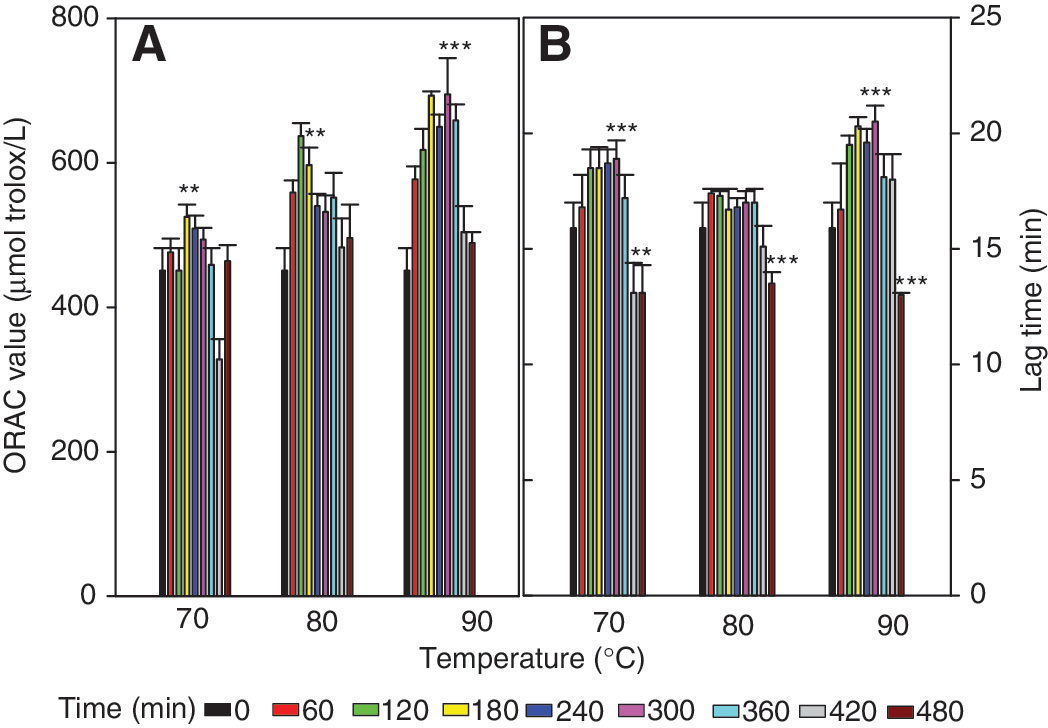
Antioxidant activity stability of the LVI (pH 3.3) measured as (
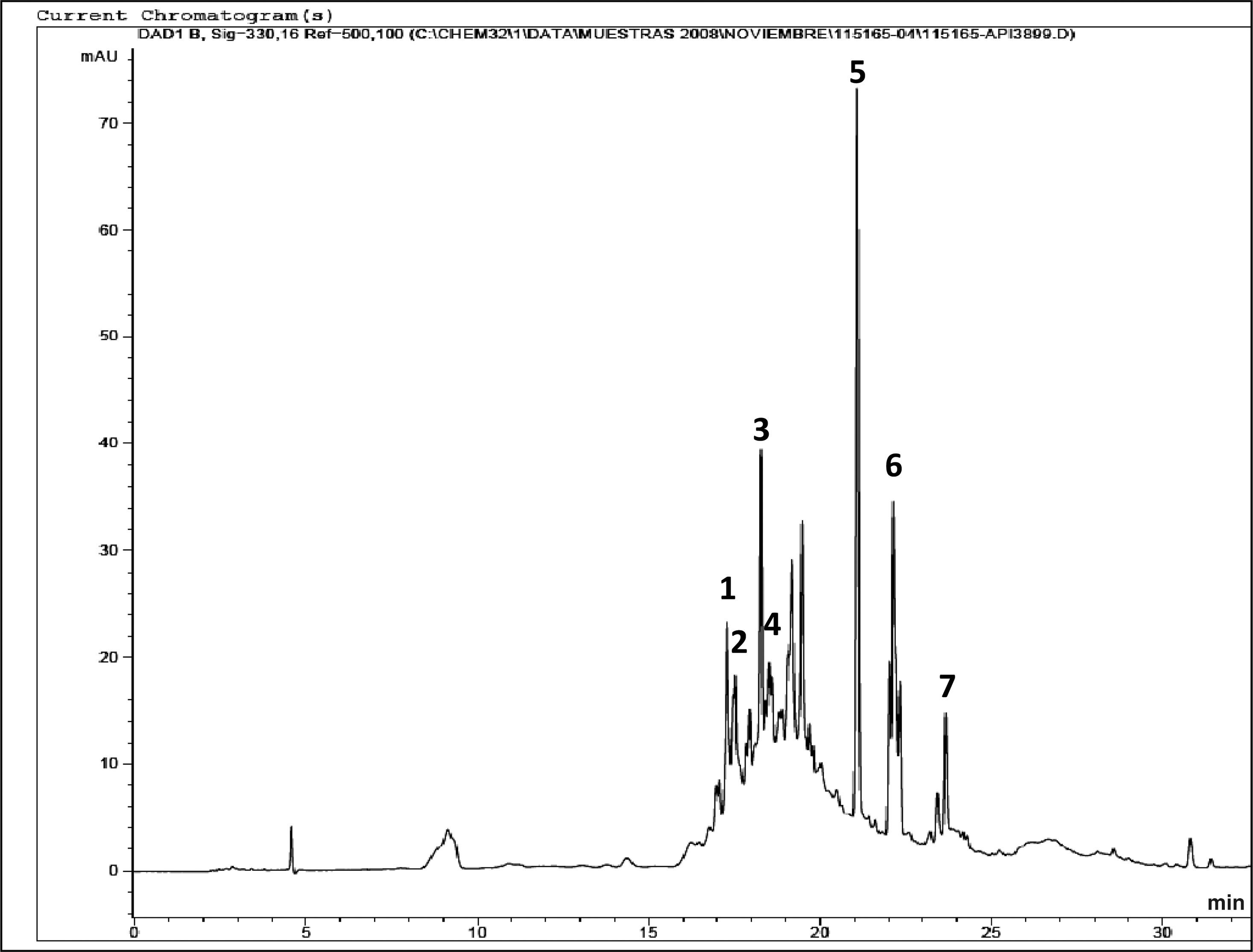
Phenylpropanoid compounds from LVI (pH 3.3) after heating at 90°C for 8 hours. The profile corresponds to the chromatogram at 330 nm. The peaks are the same as those shown in Figure 1.
After 30 minutes, the verbascoside and isoverbascoside in the LVI (peaks 3 and 4, respectively, Fig. 5) gradually degraded, as reflected by the decrease in the lag time (Fig. 4). A similar behavior was observed in the oxidative and nonoxidative degradation of quercetin aglycone in apple juice, 60 as well as that of hydroxytyrosol and oleuropein aglycones in olives. 63 It is noteworthy that although derhamnosylverbascoside was degraded under accelerated storage conditions, the β-hydroxyacteoside, eukovoside, and decaffeoylverbascoside in the LVI were stable. Therefore, the maintenance of the cold chain for the storage of LVI-based drinks could serve to increase the stability of its phenylpropanoid compounds.
The present study demonstrates that LVI displays an important AA against several free radicals, including reactive oxygen species. Moreover, the LVI was associated with a distinct lag phase in the ORACFL assay, with values for slope lag time and V max FLOROO comparable with a drink based on green tea and pomegranate and better than those of other commercial antioxidant drinks evaluated. The ORACFL value and lag time were strongly correlated (r = 0.68, P < .001). Indeed, when acting as an indirect or bifunctional antioxidant the redox potential of an antioxidant depends on the lag time, a parameter related to the induction of several cytoprotective proteins. The degradation of verbascoside and isoverbascoside, the most abundant polyphenolic compounds in LVI, at high temperature and at pH 3.3, is catalyzed by acid hydrolysis, which might be overcome in cold storage conditions. To evaluate the potential of LVI, as an ingredient of herbal-based antioxidant drinks, further studies will be necessary to assess the antioxidant capacity of the drink following consumption.
Footnotes
Acknowledgments
This work was supported by the Universidad Autonóma de Madrid (project number UAM/27). We thank Dr. Rosa Sedano in the chromatography laboratory (Sidi-UAM) for her technical assistance and Dr. Mark Sefton for assistance in the revision of the final version of the manuscript.
Author Disclosure Statement
C.S. is an employee of Lamas Trading Export S.A.C. F.A., S.E., S.M.A., M.C.G., and L.C.-H. declare no competing financial interests exist.