




Abstract
The aim of the study was to investigate antioxidant activities of Ganoderma lucidum and Funalia trogii. Ethanol and water crude extracts from G. lucidum and F. trogii were investigated for their antioxidant capacity in some different assays, namely, the 2,2-diphenyl-1-picrylhydrazyl (DPPH) radical scavenging activity, metal chelating activity against ferrous ions, and plasma lipid peroxidation inhibitory. In addition, the amounts of total phenol, ascorbic acid, β-carotene, and lycopene components in the extracts were determined. Among the four mushroom extracts, G. lucidum water extract and G. lucidum ethanol extract showed the highest scavenging activity against DPPH radicals (50% inhibitory concentration = 0.055 ± 0.001 mg/mL). Total phenol was the major antioxidant component found in the mushroom extracts. These results showed that G. lucidum may be used in pharmaceutical applications because of its effective antioxidant properties.
Introduction
R
In recent years the use of natural antioxidants has been promoted because of concerns regarding the safety of synthetic ones. Dietary components, including polyphenols, carotenoids, and vitamins C and E, are considered effective antioxidants useful in the prevention of oxidative stress and related diseases. 6,7 Increasing intake of dietary antioxidants may help to maintain an adequate antioxidant status and, therefore, the normal physiological function of a living system. 6,8
Mushrooms have long been appreciated for their flavor and texture. Now they are recognized as a nutritious food as well as an important source of biologically active compounds of medicinal value. 9 Ganoderma lucidum (Curtis) P. Karst is an edible mushroom, and it has been used as a medicinal food. The mushroom is a popular health food supplement marketed around the world because of its perceived health benefits, including in the treatment of chronic hepatitis, nephritis, hepatopathy, neurasthenia, arthritis, bronchitis, asthma, gastric ulcer, and insomnia. 10 –12 G. lucidum was reported to have many biological activities, including antioxidant. 13,14 Also, the ability of Funalia trogii extracts to protect cells against ROS was assessed by measuring the contents of protective enzymes in extract preparations. 15
The main objectives of this study were to evaluate the antioxidant activity of the mushroom extracts by using complementary in vitro assays and to determine the contents of total phenol, β-carotene, lycopene, and ascorbic acid components in the extracts.
Materials and Methods
Chemicals
Anhydrous sodium carbonate, Folin–Ciocalteu phenol reagent, iron(II) sulfate heptahydrate (FeSO4 · 7H2O), methanol, ethanol, acetone, 1-butanol, hydrogen peroxide (H2O2), glacial acetic acid, and n-hexane were purchased from Merck (Darmstadt, Germany). EDTA, 2,2-diphenyl-1-picrylhydrazyl (DPPH), 3-(2-pyridyl)-5,6-bis(4-phenylsulfonic acid)-1,2,4-triazine (ferrozine), iron (II) chloride (FeCl2), gallic acid, butylated hydroxyanisole (BHA), 2,6-di-tert-butyl-4-methylphenol (BHT), trichloroacetic acid, 2-thiobarbituric acid (TBA), 2,6-dichloroindophenol, metaphosphoric acid, ascorbic acid, and α-tocopherol were purchased from Sigma-Aldrich GmbH (Steinheim, Germany). All other chemicals were analytical grade and obtained from either Sigma or Merck.
Mushroom materials
G. lucidum (Curtis) P. Karst. and F. trogii (Berk.) Bondartsev & Singer macrofungi materials were collected in April 2007 in Kemaliye from Erzincan in Turkey. The identification of macrofungi materials was confirmed by a taxonomist, Dr. Hakan Alli, in the Department of Biology, Mugla University, Mugla, Turkey.
Preparation of extracts
Collected macrofungi material was dried in the shade and ground in a grinder with a 2-mm-diameter mesh. Fifteen grams of the dried and powdered mushroom materials was separately extracted with solvents by using a Soxhlet apparatus for 6 hours. The extracts were filtered and concentrated under vacuum by using a rotary evaporator (Laborota 4000, Heidolph Instruments GmbH, Schwabach, Germany) and stored in the dark at 4°C until used within a maximum period of 1 week. Ethanol (high-performance liquid chromatography grade) and water (ultrapure) were used as the solvents.
DPPH radical scavenging assay
Radical scavenging activity was determined by a spectrophotometric method based on the reduction of a methanol solution of DPPH using the method of Blois.
16
The extract solutions were added to a 0.004% methanol solution of DPPH. The mixture was shaken vigorously and left to stand at room temperature for 30 minutes in the dark. Then the absorbance was measured at 517 nm against a blank with a spectrophotometer (model U-1800, Hitachi, Tokyo, Japan). Inhibition of DPPH free radical as a percentage (I%) was calculated according to the formula:
where A control is the absorbance of the blank and A sample is the absorbance of the test compound.
Tests were carried out in triplicate. BHA, BHT, and α-tocopherol were used as positive controls.
Metal chelating activity on ferrous ions (Fe2+)
Metal chelating activity was determined according to the method of Decker and Welch
17
with some modifications.
18
In brief, 0.5 mL of the mushroom extracts was mixed with 0.05 mL of 2 mM FeCl2 and 0.1 mL of 5 mM ferrozine. The mixture was was diluted to the desired total volume with the solvent. Then, the mixture was shaken vigorously and left standing at room temperature for 10 minutes. After the mixture had reached equilibrium, the absorbance of the solution was then measured spectrophotometrically at 562 nm. The percentage of inhibition of ferrozine–Fe2+ complex formation was calculated using the formula given below:
where A control is the absorbance of the ferrozine–Fe2+ complex and A sample is the absorbance of the test compound. EDTA was used for comparison.
Plasma lipid peroxidation inhibitory assay
Plasma lipid peroxidation was analyzed by the method developed by Rodriguez-Martinez and Ruiz-Torres, 19 with some modifications. Plasma (0.4 mL; obtained from the BloodCenter, Gazi University, Ankara, Turkey), 0.1 mL of FeSO4 solution (0.5 mM), 0.1 mL of H2O2 (0.5 mM), and 0.2 mL of mushroom extracts (2 mg/mL) were mixed and incubated at 37°C. After 12 hours of incubation, the reaction solution was mixed with 375 μL of trichloroacetic acid (4%) and 75 μL of BHT (0.5 mM) and held in an ice bath for 5 minutes. The upper phase was obtained by centrifugation at 5,000 g for 15 minutes. TBA (0.2 mL; 0.6%) was then added. This mixture was incubated at 95°C for 30 minutes and allowed to cool. The mixture was mixed with the same volume of 1-butanol. The absorbance was then measured at 532 nm.
Determination of bioactive component contents
Total phenolic contents of the extracts were analyzed using Folin–Ciocalteu reagent according to the method of Singleton and Rossi 20 using gallic acid as standard, with some modifications. 18 The extract solutions (0.1 mL) were mixed with 0.2 mL of 50% Folin–Ciocalteu reagent. The mixture was allowed to react for 3 minutes, and 1 mL of aqueous solution of 2% Na2CO3 was added. Then, the mixture was vortex-mixed vigorously. At the end of incubation for 45 minutes at room temperature, absorbance of each mixture was measured at 760 nm. The same procedure was also applied to the standard solutions of gallic acid. Total phenol contents were expressed as mg of gallic acid equivalents/g of the extracts.
Ascorbic acid was determined according to the method of Klein and Perry.
21
The dried extract (100 mg) was extracted with 10 mL of 1% metaphosphoric acid for 45 minutes at room temperature and filtered through disposable filters (pore size, 0.45 μm; Millipore, Bedford, MA, USA). The filtrate (1 mL) was mixed with 9 mL of 2,6-dichlorophenolindophenol, and the absorbance was measured at 515 nm against a blank. Content of ascorbic acid was calculated on the basis of the calibration curve of authentic
β-Carotene and lycopene were determined according to the method of Nagata and Yamashita.
22
The dried extract (100 mg) was vigorously shaken with 10 mL of acetone–hexane mixture (4:6 vol/vol) and filtered through disposable filters (pore size, 0.45 μm; Millipore). The absorbance of the filtrate was measured at 453, 505, and 663 nm. Contents of β-carotene and lycopene were calculated according to the following equations:
where A 453, A 505, and A 663 represent the absorbance at 453, 505, and 663 nm, respectivley. The results were expressed as mg of carotenoid/g of extract.
Statistical analysis
All experiments were done in triplicate, and mean values are presented. The results were expressed as mean ± SD values. Statistical analyses were performed using SPSS version 11.0 (SPSS, Chicago, IL, USA). Pearson's correlation analysis was used to determine the statistical significance of differences between the values. The analysis was used for comparisons of total phenol contents and the antioxidant activity of the extracts. The level of statistical significance was taken at P < .05.
Results
DPPH radical scavenging assay
DPPH percentage scavenging activities of the mushroom extracts and the synthetic antioxidants were measured at different concentrations ranging between 0.05 and 0.25 mg/mL (Fig. 1). The 50% inhibitory concentration (IC50) values for DPPH scavenging activities of the mushroom extracts, BHA, α-tocopherol, and BHT are compared and shown in Table 1, as calculated from the percentage inhibition versus log concentration of the extract curves. The IC50 values showed that the DPPH scavenging activity decreased in the following order: G. lucidum water extract (GWE) = G. lucidum ethanol extract (GEE) > F. trogii water extract (FWE) > F. trogii ethanol extract (FEE).
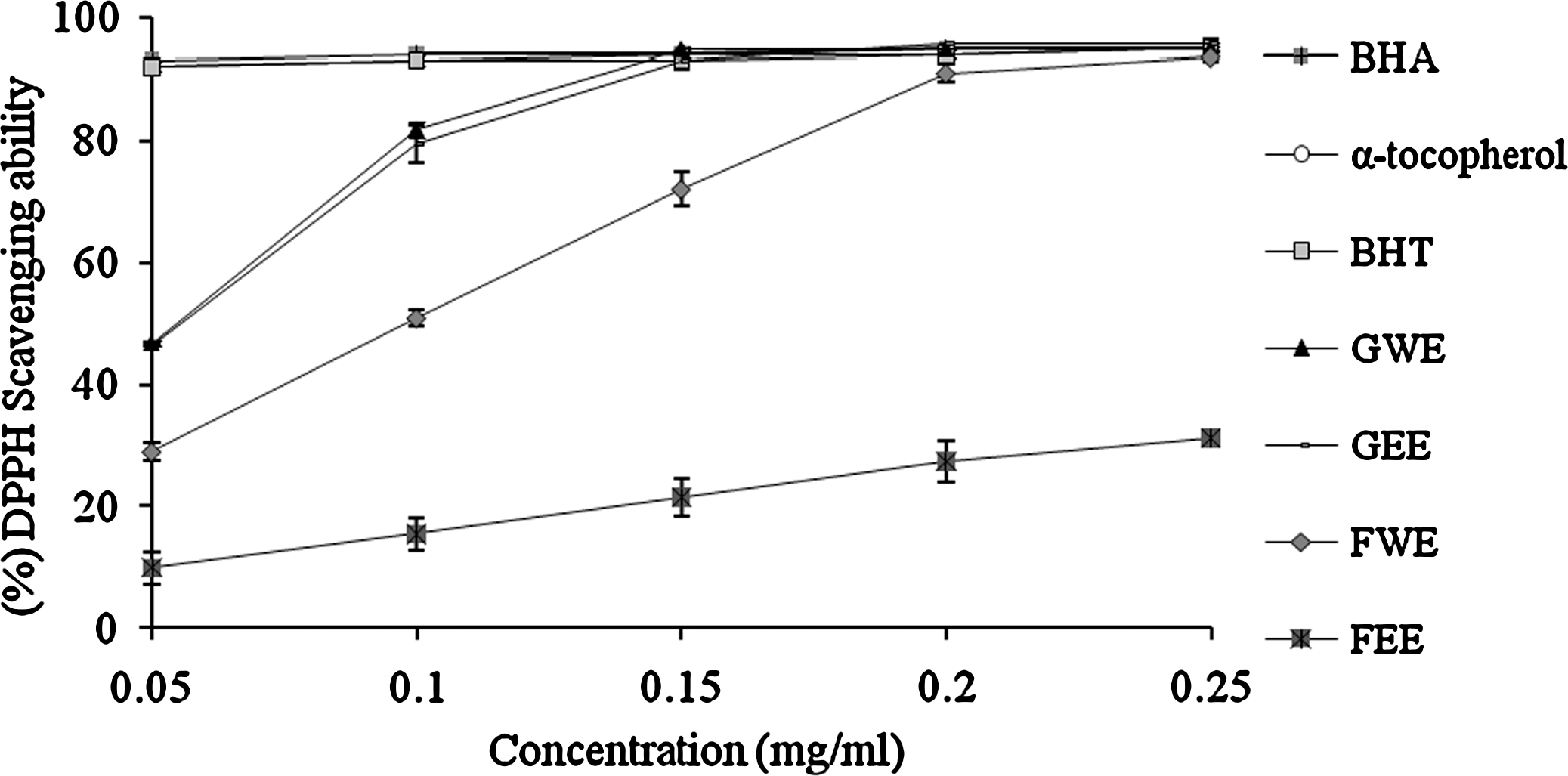
2,2-Diphenyl-1-picrylhydrazyl (DPPH) radical scavenging activity of the mushroom extracts. Data are mean ± SD values for triplicate experiments. BHA, butylated hydroxyanisole; BHT, 2,6-di-tert-butyl-4-methylphenol; FEE, F. trogii ethanol extract; FWE, F. trogii water extract; GEE, G. lucidum ethanol extract; GWE, G. lucidum water extract.
Data are average ± SD values for triplicate experiments.
Values in the same column with different superscripts are significantly (P < .05) different.
IC50, 50% inhibitory concentration; NS, not studied.
Plasma lipid peroxidation inhibitory assay
The inhibition of lipid peroxidation on plasma was measured by the color intensity of malondialdehyde–TBA complex formation by the two extracts of each of the two mushrooms. The generation of malondialdehyde was substantially controlled by the mushroom extracts. The extracts exhibited in the range of 8.62 ± 2.52%–56.69 ± 1.15% inhibition against plasma lipid peroxidation (Table 1).
Metal chelating activity on ferrous ions (Fe2+)
Chelating activity of the extract was determined by the ferrozine assay. Effects of the extracts on inhibition of ferrylbipyridyl formation are presented in Table 1. GEE showed the highest ferrous iron chelating ability (IC50 = 2.69 ± 0.67 mg/mL). The second highest ability was shown by FEE (IC50 = 4.99 ± 0.35 mg/mL). On the other hand, water extracts of both of the mushrooms exhibited weak chelating activity. The synthetic chelating agent EDTA had potent excellent chelating ability at the tested concentrations (approximately 94%).
Determination of contents of bioactive compounds
The amounts of total phenols, ascorbic acid, β-carotene, and lycopene in the mushroom extracts were determined. Total phenol was the major antioxidant component found in the mushroom extracts (Table 2). The total phenolic contents of the ethanol and water extracts of G. lucidum were significantly higher than those of F. trogii. Ascorbic acid was found in moderate amounts, whereas β-carotene and lycopene were only found in trace amounts in the mushroom extracts (Table 2).
Data are average ± SD values for triplicate experiments.
Values in the same column with different superscripts are significantly (P < .05) different.
ND, not determined.
Discussion
The DPPH radical scavenging assay is commonly used in evaluating the antioxidant activity of extracts as to the ability of antioxidant molecules to scavenge free radicals. The IC50, meaning the concentration of antioxidant needed to decrease (by 50%) the initial substrate concentration, is a parameter widely used to measure the antiradical efficiency. The lowest IC50 value was found for GWE (IC50 = 0.055 ± 0.001 mg/mL) and GEE (IC50 = 0.055 ± 0.001 mg/mL), suggesting that G. lucidum could be a potential source of radical scavenger in inhibiting lipid peroxidation. Among the four mushroom extracts, FEE exhibited the weakest radical scavenging activity (IC50 = 0.396 ± 0.038 mg/mL). Compared with the reference antioxidants, the extracts of the mushrooms provided a higher IC50 values (Table 1). These results showed G. lucidum extracts have more effective scavenging ability against DPPH radicals than F. trogii extracts.
Plasma concentrations of TBA-reactive substances are an index of lipid peroxidation and oxidative stress. The polyunsaturated fatty acids located in cells and in blood are highly prone to attack, which results in the generation of lipid peroxides. 23 GEE exhibited the highest inhibition activity against TBA-reactive substances formation (56.69 ± 1.15%). The TBA-reactive substances formation inhibitory effects of G. lucidum extracts were higher than those of the F. trogii extracts. Also, this result was similar to data from the DPPH radical scavenging assay. In these assays, G. lucidum extracts showed better antioxidative capacity than the F. trogii extracts.
Ferrous iron can initiate lipid peroxidation by the Fenton reaction. Ferrozine can quantitatively form complexes with Fe2+. In the presence of other chelating agents, the complex formation is disrupted with the result that the purple color of the complex is decreased. Significant differences in chelating activity were observed among the extracts. The ethanol extracts showed higher chelating activity than the water extracts. GEE (IC50 = 2.69 ± 0.67 mg/mL) interfered with formation of the ferrous–ferrozine complex, suggesting that it has chelating activity and captures ferrous ion before ferrozine. GEE can be observed as a potent iron chelating source for further investigation.
The antioxidant activity of phenolic compounds is mainly attributed to their redox properties, which allow them to act as reducing agents, hydrogen donors, and quenchers of singlet oxygen. In addition, they may also possess metal chelation properties. 24 A mushroom phenolic compound has been found to be an excellent antioxidant and synergist that is not mutagenic. 25 A strong positive correlation was found between total phenolic contents in the extracts and their antioxidant activities (P < .05). These results showed that the antioxidant activities of these mushroom extracts were related to their phenolic content. Many researchers have shown that a high total phenol content increases antioxidant activity and that there is a linear correlation between phenolic content and antioxidant activity. 26 GEE had the highest total phenol content (69.80 ± 0.66 mg/g) and exhibited the highest plasma lipid peroxidation inhibitory and DPPH radical scavenging activities (P < .05). On the other hand, FEE possessed the lowest total phenol contents (26.47 ± 0.24 mg/g), and it exhibited the lowest antioxidant activity except for chelating activity.
Ascorbic acid was found in small amounts in the mushroom extracts. β-Carotene and lycopene were not found in the mushrooms water extracts because of their fat-soluble nature. The highest ascorbic acid (11.75 ± 0.05 mg/g), β-carotene (0.465 ± 0.004 mg/g), and lycopene (0.067 ± 0.001 mg/g) contents were found in GEE. Our results indicated that the water extracts have higher total phenol contents than the ethanol extracts but that the ethanol extracts have higher ascorbic acid and carotenoid contents than the water extracts. The ethanolic extracts were more effective in chelating ability against ferrous ions than the water extracts. This is probably because ascorbic acid and carotenoids may be effective components against chelating activity.
It can be concluded from the present investigation that the ethanolic and the water extracts of the edible mushroom G. lucidum show biopharmaceutical potentiality. However, whether such extracts will act as effective therapeutic agents remains to be investigated, and the identification of the bioactive compounds and the study of mechanisms of actions are necessary prior to application.
Footnotes
Acknowledgment
The authors wish to thanks to Hakan Alli, Department of Biology, Faculty of Science and Art, University of Mugla, for identification of the mushroom materials collected.
Author disclosure statement
No competing financial interests exist.