




Abstract
Honey has been used as a medicine throughout the ages and has recently been reintroduced to modern medical practice. Much of the research to date has addressed honey's antibacterial properties and its effects on wound healing. Laboratory studies and clinical trials have shown that honey is an effective broad-spectrum antibacterial agent. Honey antimicrobial action explains the external and internal uses of honey. Honey has been used to treat adult and neonatal postoperative infection, burns, necrotizing fasciitis, infected and nonhealing wounds and ulcers, boils, pilonidal sinus, venous ulcers, and diabetic foot ulcers. These effects are ascribed to honey's antibacterial action, which is due to acidity, hydrogen peroxide content, osmotic effect, nutritional and antioxidants content, stimulation of immunity, and to unidentified compounds. When ingested, honey also promotes healing and shows antibacterial action by decreasing prostaglandin levels, elevating nitric oxide levels, and exerting prebiotic effects. These factors play a major role in controlling inflammation and promoting microbial control and healing processes. This article reviews data supporting the effectiveness of natural honey in eradicating human pathogens and discusses the mechanism of actions.
History of Medicinal Honey
T
Antibacterial Action and Honey Origin
Antibacterial action and geographic origin
Table 1 summarizes the antibacterial properties of honey as studied in different geographic areas.
MRSA, methicillin-resistant Staphylococcus aureus; MRSE, methicillin-resistant Staphylococcus epidermidis.
A study investigated the effects of honey collected from the United Arab Emirates and a mixture of the honey, olive oil, and beeswax on the growth of Staphylococcus aureus isolated from human specimens. Honey mixture was poured on holes made on plates seeded with S. aureus. The microorganisms were cultured onto media made of honey mixture alone or nutrient agar honey mixture. A clear zone of inhibition was observed around holes filled with the honey mixture on media seeded with S. aureus. No microorganism grew on media made of honey mixture alone. The minimum inhibitor concentration (MIC) of honey mixture in nutrient agar–honey mixture media required to inhibit S. aureus was 50%. S. aureus did not grow on media containing honey, whereas mild to moderate growth occurred on media containing olive oil or beeswax. 14
A study by Al-Waili et al. 15 evaluated the activity of United Arab Emirates honey toward pathogens when grown in media containing honey and when honey was added to cultures after inoculation. Various human pathogens were studied, including S. aureus, Streptococcus pyogenes, and Escherichia coli; these were cultured in broth containing 10%/100% (w/v) honey concentrations. In addition, honey was added to broth inoculated with isolates after inoculation, and the optimum growth of isolates, therapeutic period of honey, and time taken for the honey to show optimum effect was measured. The optimum times were 10 hours for E. coli and 12 hours for S. aureus.
Honey (30%–70%) prevented growth of all isolates tested. Honey (80%) inhibited growth of small (1 μL) and large (10 μL) inoculum of E. coli and S. aureus when added to their cultures within 24 hours of inoculation. The investigators concluded that the therapeutic period of honey and recovery of the inhibited isolates require adjustment of the honey dose according to type of isolate and rate of growth. 15
Another study tested United Arab Emirates honey against common human pathogens, including E. coli, Enterobacter cloacae, Pseudomonas aeruginosa, Shigella dysenteriae, Klebsiella species, Haemophilus influenzae, Proteus species, S. aureus, Streptococcus hemolyticus group B, and Candida albicans. 16 Growth of all the isolates was completely inhibited by 30%–100% honey concentrations. The most sensitive microbes were E. coli, P. aeruginosa, and H. influenzae. The antibacterial activity of honey was stronger in acidic media than in neutral or alkaline media.
The antimycobacterial effect of Iranian honey toward mycobacteria was evaluated in vitro. Two bacilli from positive cultures and 2 from positive smears of the affected patients were inoculated on plates containing various concentrations of honey. The results showed that the growth of mycobacteria was inhibited by adding 10% honey to the media. Mycobacteria can grow in culture media containing 5%, 2.5%, and 1% honey. 17
In Jerusalem, a study investigated the antibacterial properties of Israeli honey against oral streptococci in vitro and in vivo. Honey at high concentrations inhibited bacterial growth in vitro, and salivary counts of total bacteria and Streptococcus mutans were lower for 1 hour after application of honey. 18
Honey collected in Saudi Arabia was investigated against Helicobacter pylori; all isolates of this bacterium tested were inhibited by 20% honey. 19
A study from Oman investigated 24 honey samples (16 from different parts of Oman and 8 from elsewhere in Africa) for their antibacterial activity against S. aureus, E, coli, and P. aeruginosa using standard antimicrobial assays. 20 Fourteen of 16 Omani samples and 5 of 8 African samples showed antibacterial activity. Another study investigated the antistaphylococcal activity of Omani honey compared with gentamicin and a combination of the 2. Omani honey was found to possess anti–S. aureus activity, which enhanced gentamicin activity by 22% in the early phases of interaction. 21
Another study evaluated the antimicrobial effect and the ability of Omani honey to prevent Salmonella enteritidis from adhering to intestinal epithelial cells in vitro. The antimicrobial activity of the honey was demonstrated at dilutions of up to 1:8 and showed reduced bacterial adherence from a mean ± standard deviation of 25.6 ± 6.5 to 6.7 ± 3.3 bacteria per epithelial cell. 22
In Turkey, the antibacterial activity of honey samples collected from different sources was investigated against Bacillus cereus, S. aureus ATCC 25923, P. aeruginosa ATCC 27853, Klebsiella pneumoniae ATCC 27736, Morganella morganii, Micrococcus luteus NRRL B-4375, E. coli ATCC 35218, and C. albicans. Each of these pathogens exhibited different sensitivities toward the honey samples. 23
Fifteen bacterial strains (7 Pseudomonas and 8 Klebsiella species) isolated from various samples that showed multidrug resistance were studied to verify in vitro antibacterial action of Indian honey on the principle of MIC and its synergism with 3 common antibiotics: gentamicin, amikacin, and ceftazidime. The MIC of honey with saline for both organisms was 1:2. The synergistic action was seen with Pseudomonas species but not with Klebsiella species. 24
Another study assessed the antibacterial activity of different types of honey (manuka honey from Australia, heather honey from the United Kingdom, and locally marketed Indian honey). The agar dilution method was used to assess the antibacterial activity of these honeys against 152 isolates of P. aeruginosa by determining MIC. The locally available (khadikraft) honey produced the best activity against P. aeruginosa and was better than all of the imported varieties of therapeutic honey. 25
The antibacterial activity of Malaysian tualang honey was compared with that of manuka honey against 13 wound and enteric microorganisms. Results showed that the MICs ranged from 8.75% to 25% for tualang honey compared with 8.75%–20% for manuka honey. The lowest MIC value (8.75%) for both types of honey was against Stenotrophomonas maltophilia. Tualang honey had a lower MIC (11.25%) against Acinetobacter baumannii compared to manuka honey (12.5%). 26
In New Zealand, manuka honey has been extensively studied for its antibacterial activity. Pseudomonas species isolated from swabs from infected wounds were inoculated on the surface of nutrient agar plates containing various concentrations of manuka or pasture honey in the medium. The MIC of manuka honey for the isolates ranged from 5.5% to 8.7% (v/v). 27 Furthermore, the sensitivity of 17 strains of P. aeruginosa isolated from infected burns exposed to 2 types of honey collected in the United Kingdom (a pasture honey and a manuka honey) was tested. All strains showed similar sensitivity to honey, with an MIC below 10% (v/v), and both honeys maintained bactericidal activity even when diluted more than 10-fold. 28
In another study, the sensitivity of 58 strains of coagulase-positive S. aureus, isolated from infected wounds, to a pasture honey and a manuka honey was investigated. The MICs were between 2% and 3% (v/v) for the manuka honey and between 3% and 4% for the pasture honey. With use of an agar incorporation technique to determine MIC, the sensitivity of 18 strains of methicillin-resistant S. aureus, 7 strains of vancomycin-sensitive enterococci, and 20 strains of vancomycin-resistant enterococci to 2 natural honeys was measured and compared with that of an artificial honey solution. 29 For all the strains tested, MIC values against manuka and pasture honey were below 10% (v/v). However, concentrations of artificial honey at least 3 times higher were required to achieve similar inhibition of the isolates.
A patient with a subclinical methicillin-resistant S. aureus (MRSA) leg ulcer infection was treated by topical application of manuka honey with concomitant administration of hydroxyurea or cyclosporine. The MRSA organisms were eradicated from the ulcer and rapid healing was achieved. 30
In vitro studies in New Zealand showed that honey was active against S. aureus, Streptococcus faecalis, C. albicans, K. pneumoniae, P. aeruginosa, E. coli, Salmonella species, and S. dysentriae. 31
A total of 345 samples of unpasteurized New Zealand honey obtained from commercial apiarists throughout the country were tested against S. aureus. Antibacterial activity ranged from the equivalent of less than 2% (w/v) phenol to 58% (w/v) phenol; the median ± standard deviation was 13.6% ± 12.5%. Neither the age of the honey samples nor whether they had been processed by the apiarist was associated with lower activity. 32 The antimicrobial activity of New Zealand honey may range from concentrations lower than 3% to concentrations of 50% and higher. 32
The species of bacteria that commonly cause mastitis in dairy cows were tested for their sensitivity to the antibacterial activity of honey collected in New Zealand. The growth of all species tested was completely inhibited by topical honey at a concentration of 10% (v/v) on agar plates. 33
In addition, the effect of manuka honey on various stains of Campylobacter was investigated; the MIC of the manuka honey against all Campylobacter samples tested (20 strains of Campylobacter jejuni and 7 strains of E. coli) was found to be around 1%. Honey might still inhibit the growth of Campylobacter organisms after dilution by fluid in the gut; however, the actual concentration of honey that can be achieved in the intestine is unknown. 34
Brazilian honey was tested against S. aureus to explore its antibacterial activity. The MICs ranged from 126 to 185 mg/mL for Apis mellifera honey and from 142 to 214 mg/mL for Tetragonisca angustula honey. 35
An Australian study compared the spectrum of antimicrobial activity of samples of honey from stingless bee with that of medicinal, table, and artificial honeys. MIC ranged from 4% to greater than 10% (w/v) for gram-positive bacteria, 6% to greater than 16% (w/v) for gram-negative bacteria, and 6% to greater than 10% (w/v) for Candida species. Geometric MIC (w/v) means for honey from stingless bees ranged from 7.1% to 16.0% and were 11.7% for medicinal honey and 26.5% for table honey. Treatment of organisms with 20% (w/v) stingless-bee honey for 60 minutes resulted in decreases of 1- to 3-log for S. aureus, greater than 3-log for P. aeruginosa, and less than 1 log for C. albicans. 36
A randomized, controlled trial was performed in Australia to determine the efficacy and safety of the exit-site application of a standardized antibacterial honey versus mupirocin in preventing catheter-associated infections. The incidence rates of catheter-associated bacteremias in honey-treated and mupirocin-treated patients were similar. In a Cox proportional-hazards model analysis, the use of honey was not significantly associated with bacteremia-free survival (unadjusted hazard ratio, 0.94; 95% confidence interval, 0.27–3.24; P = 0.92). No exit-site infections occurred. The authors concluded that thrice-weekly application of standardized antibacterial honey to hemodialysis catheter exit sites was safe, cheap, and effective and resulted in a rate of catheter-associated infection similar to that obtained with mupirocin. 37
A U.S. study was designed to determine whether the anti–H. pylori activity of honey differed regionally (honey from Texas, Iowa, and New Zealand) and to determine whether this activity was due to the presence of hydrogen peroxide. The study included 28 clinical isolates of H. pylori. The results showed that solutions containing fructose, glucose, glucose, and fructose combinations, or honey were equally effective in inhibiting the growth of H. pylori. Honey solutions, with or without catalase, inhibited 24 of 28 isolates at a concentration of 10% and 28 of 28 isolates at a concentration of 15%. The researchers concluded that the effect of killing was not related to the presence of hydrogen peroxide in the honey samples; osmotic effects were shown to be the most important parameter for killing H. pylori. 38
American honeys from 6 floral sources were compared for their inhibitory activity against E. coli O157:H7, Salmonella typhimurium, Shigella sonnei, Listeria monocytogenes, S. aureus, and B. cereus. Growth of B. cereus was least affected. The inhibition of growth of S. sonnei, L. monocytogenes, and S. aureus in 25% solutions of honeys was reduced by treating solutions with catalase, indicating that hydrogen peroxide contributes to antimicrobial activity. Darker-colored honeys, which contain a higher amount antioxidants, were generally more potent than light-colored honeys, and their antimicrobial activity was not eliminated by catalase treatment. 39
Researchers from Cornell University investigated the antimicrobial activity of different types of American honeys against 6 food pathogens and 6 food-spoilage microorganisms in vitro. The honeys exhibited both peroxide and nonperoxide antimicrobial activity, which varied according to the floral source. Tarwood and Montana buckwheat honey impeded the growth of L. monocytogenes at one-quarter and one-eighth dilution, respectively. 40 At stronger dilutions, honey impeded the growth of Bacillus species, E. coli, and Salmonella species.
Bacterial strains isolated from US domestic honey were screened for antibacterial activity against Paenibacillus larvae ssp. larvae, the causative agent of American foulbrood in apiaries. A bacterial isolate (TH13) showing a high level of antimicrobial activity against P. larvae ssp. larvae ATCC 9545 was selected and identified as Paenibacillus polymyxa by 16S recombinant RNA gene sequencing. The producer strain showed a broad range of antibacterial activity against gram-positive and -negative bacteria. 41 Further, more than 2,000 bacterial strains isolated from 6 US domestic honeys and 2 manuka honeys from New Zealand were screened for production of antimicrobial compounds. Researchers found that 2217 isolates out of 2398 strains (92.5% of total isolates) exhibited antimicrobial activity against at least 1 of the tested microorganisms. Antifungal activity by bacterial isolates originating from the 8 honeys ranged from 44.4% to 98.0%. Bacterial isolates from manuka honey exhibited antimicrobial activity against Bacillus subtilis ATCC 6633 and B. cereus F4552. The authors concluded that the high rate of antimicrobial activity exhibited by the bacterial strains isolated from different honey sources could provide potential sources of novel antimicrobial compounds. 42
Antibacterial activities of 42 Canadian honeys against 2 bacterial strains were determined: E. coli (ATCC 14948) and B. subtilis (ATCC 6633). Results showed that all Canadian honeys exhibited antibacterial activity, with higher selectivity against E. coli than B. subtilis; these antibacterial activities were correlated with hydrogen peroxide production in honeys. 43
A biofilm protects bacteria from antibiotic therapy and the patient's immune response. Antibacterial activity of Canadian honey against 11 methicillin-susceptible S. aureus, 11 methicillin-resistant S. aureus, and 11 P. aeruginosa isolates was assessed. Honeys were tested against both planktonic and biofilm-grown bacteria. Results showed that honey was effective in killing 100% of the isolates in the planktonic form. The bactericidal rates for the sidr and manuka honeys against methicillin-susceptible S. aureus, 11 methicillin-resistant S. aureus, and P. aeruginosa biofilms were 63%–82%, 73%–63%, and 91%–91%, respectively. 44
In Argentina, honeys collected from the southeast region of Buenos Aires province exerted antimicrobial activity against E. coli ATCC 25922 at 25% and 50% (w/v) concentrations. 45
In South Africa, honey had an MIC of 25% (v/v) for the oral streptococci tested. The exceptions were Streptococcus anginosus and Streptococcus oralis, which were inhibited by 17% (v/v) and 12% (v/v) honey, respectively. 46
Natural honeys collected in Egypt were tested for their antibacterial effect on Bacteroides species, mainly the pathogenic black-pigmented Bacteroides melaninogenicus isolated from 10 cases of dental infections. The results revealed that the inhibitory effect of honey was not due to its high sugar content or to its acidic pH, according to use of Schaedler's broth adjusted to the same pH as control. 47
The antimicrobial activities of Egyptian honey toward 21 types of bacteria and 2 types of fungi were examined. The results demonstrated the presence of antimicrobial substance (inhibines) in honey. 48 In addition, Egyptian Fennel honey and aqueous propolis extracts were used in rats infected with S. aureus. Each rat received 2 mL of broth inoculated with 1 × 10⁵ colony-forming units/mL intraperitoneally. Results showed that both honey and propolis could significantly challenge the induced S. aureus infection. 49
Six varieties of honey from different regions in Algeria were used to determine their potency against P. aeruginosa. Four varieties originated from northern Algeria and 2 were from the Sahara. Honey from the Sahara was more potent than the other types of honeys. 50 Four varieties of Algerian honey were used to evaluate the antimicrobial action against P. aeruginosa (ATCC 27853). The MIC of the honeys ranged from 12% to 18 % (v/v). 51 Another study evaluating synergistic effect of addition of starch to Algerian honey showed that addition of starch to honey increased its antibacterial effect. The amylase present in honey hydrolyzed the starch chains to randomly produce dextrin and maltose. This increased the osmotic effect of the media, which consequently increased the antibacterial activity. 52
Studies in Nigeria have shown that unprocessed honey inhibits the growth of most fungi and bacteria that causes wound and surgical infections except P. aeruginosa and Clostridium oedematiens. 53 Sugar syrup with physical properties similar to that of honey did not inhibit any of the bacteria or fungi tested except S. pyogenes (which was only moderately inhibited). This finding demonstrates that honey is superior to any hypertonic sugar solution in antimicrobial activity. 53
Nigerian honey undiluted and at concentrations of 40% and above were found to be inhibitory to all isolates of bacterial agents of diarrhea tested. Zones of inhibition of growth around the disc margin of the various enteropathogens tested ranged from 16 to 18 mm in diameter for the local undiluted honey and from 7 to 12 mm in diameter for concentrations of honey at 40% and 50%. 4 Another study investigated the effect of Nigerian honey on diarrhea-causing bacteria (E. coli, C. jejuni, Salmonella enterocolitis, and S. dysenteriae). The natural honey samples used inhibited the growth of all the test organisms. The inhibitory effect of the honey samples on E. coli was similar to that of amoxicillin and chloramphenicol. 54
In the United Kingdom, 20 strains of Burkholderia cepacia, isolated principally from the sputum of patients with cystic fibrosis, were tested for their susceptibility to 8 antibiotics with a modified Kirby–Bauer disc diffusion technique. All strains exhibited multiple but not identical patterns of antibiotic resistance. All strains exhibited susceptibility to concentrations of honey below 6% (v/v). 55
The investigators found that 10%–20% (v/v) honey collected in the Netherlands can kill B. subtilis, methicillin-resistant S. aureus, extended-spectrum β-lactamase–producing E. coli, ciprofloxacin-resistant P. aeruginosa, and vancomycin-resistant Enterococcus faecium, whereas greater than 40% (v/v) of a honey-equivalent sugar solution was required for similar activity. 56
Evaluation of the effects of Netherlands honey on bacterial translocation and intestinal villus histopathology in experimental obstructive jaundice showed that supplementation of honey in the presence of obstructive jaundice ameliorates bacterial translocation and improves ileal morphology. 57
Another study from the same region using topical honey showed that 10%–40% (v/v) honey can kill antibiotic-susceptible and -resistant isolates of S. aureus, Staphylococcus epidermidis, E. faecium, E. coli, P. aeruginosa, E. cloacae, and Klebsiella oxytoca within 24 hours. After 2 days of topically applied honey, the extent of forearm skin colonization in healthy volunteers was reduced 100-fold, and the numbers of positive skin cultures were reduced by 76%. The authors concluded that honey preparation is a promising topical antimicrobial agent for prevention or treatment of infections, including those caused by multidrug-resistant bacteria. 58
Another study was done to determine the effects of different concentrations of ‘Medihoney’ therapeutic honey and Norwegian forest honey on the real-time growth of typical chronic-wound bacteria, on biofilm formation, and on the same bacteria already embedded in biofilm. Both honeys were bactericidal against all the strains of bacteria tested, which included methicillin-resistant S. epidermidis, MRSA, extended-spectrum β-lactamase–producing K. pneumoniae, and P. aeruginosa, and biofilm was penetrated by biocidal substances in honey. 59
In Ireland, a prospective open-label multicenter randomized controlled trial sought to determine the effect of manuka honey on wound microorganisms. After 4 weeks the MRSA in 70% of the manuka-honey treated wounds versus 16% of the hydrogel-treated wounds had been eradicated. In addition, after 4 weeks P. aeruginosa had been eliminated in 33% of the wounds treated with honey versus 50% of those treated with hydrogel. Manuka honey was effective in eradicating MRSA from 70% of chronic venous ulcers. The potential to prevent infection is increased when wounds are desloughed and MRSA is eliminated. 60
In another study from Northern Ireland, community-acquired MRSA (n = 6 isolates) was examined for its susceptibility to natural honey (3 honeys produced from bees in Northern Ireland and 1 commercial French honey). All the honeys reduced the cultural count of all community-acquired MRSA from approximately 106 colony-forming units to none detectable within 24 hours. 61
In Portugal, phenolic compounds of dark and clear honeys from the Trás-os-Montes region were evaluated for their antioxidant and antimicrobial activities. The antimicrobial activity was screened by using B. subtilis, S. aureus, Staphylococcus lentus, P. aeruginosa, K. pneumoniae, and E. coli. The honey phenolic compounds were phydroxibenzoic acid, cinnamic acid, naringenin, pinocembrin, and chrysin. Dark honey phenolic compounds were more potent than those obtained from clear honey. Further the results showed that S. aureus, B. subtilis, S. lentus, K. pneumoniae, and E. coli were sensitive to the antimicrobial activity of honey extracts. 62
Antibacterial action and honey origin
The question of how much honey is needed for optimal antibacterial action is an important one. When whole honey is topically applied on wounds, it is subject to dilution. In addition, ingested honey is diluted in the body. Much of the literature on the use of honey in microbial infections and wound healing does specify the type of honey used. Honeys are not equal in their effectiveness. Those collected from different geographic areas showed various activities. 63 –65
Few clinical reports have defined the specific type of honey applied to infected wounds, burns, or ulcers. Studies have shown the variability in antimicrobial activity among honeys. 32,66 –69
It is clear that honeys from all geographic areas exhibit considerable, although variable, antimicrobial activity against gram-positive and gram-negative bacteria, as well as fungi. Honey is a natural product, and the characteristics associated with antibacterial activity and wound-healing properties may be affected by honey processing, species of the bee, geographic location, and botanical origin. Bees use a variety of plants to create honey, and therefore the nutritional and medicinal profile of honey varies.
The compositional differences of honeys can influence medicinal value. Honeys differed in levels of peroxide and nonperoxide factors, which vary by floral source and processing. Recently, we found that various honeys contain different amount of nitric oxide end products. The presence of trace elements, ascorbic acid, antioxidants, and catalase from the nectar can affect the honey activity. In addition, physical factors such as heat and light may change the composition of honey and its activity.
Review of the different antibacterial studies shows that the antibacterial action of honey depends on the geographic origin. In most studies reviewed here, the geographic origin of the honey was known while its botanical origin was often not determined. It is highly probable that the antibacterial activity depends mostly on the botanical origin of honey because unifloral honeys from different geographic origins have the same physicochemical properties. 70
Different honeys vary substantially in the potency of their antibacterial activity, probably because of variations in plant source. 71 –75 Honey inhibits major wound-infecting species of bacteria at concentration of 1.8%–11% (v/v) 34%. 11
In many of the preceding studies, manuka honey had a high activity. However, other honeys have similarly strong activities. As shown by Tan et al., 26 tualang honey has almost the same antibacterial activity as manuka honey (both honeys have a dark color). Bogdanov reviewed the antibacterial action of unifloral honeys and found that dark honeys (honeydew, chestnut, heather, and cotton) have antibacterial activity similar to that of manuka honey, whereas lighter honeys have a lower antibacterial activity. 63
Effects of Storage and Heat
Theoretically, the strongest antibacterial effect is achieved by fresh and unheated honey. However, honey is often offered in trade after heating and storage. Thus, it is important to know how antibacterial action changes after the storage of honey.
In our laboratories, the antibacterial activities of 10%–100% (w/v) concentrations of fresh United Arab Emirates honey, stored honey, heated honey, ultraviolet-exposed honey, and heated stored honey were tested against common human pathogens, including E. coli, E. cloacae, P. aeruginosa, S. dysenteriae, Klebsiella species, H. influenzae, Proteus species, S. aureus, S. hemolyticus group B, and C. albicans. 16
The antibacterial activity of honey was tested in acidic, neutral, or alkaline media. These were compared with similar concentrations of glucose in nutrient broth. Growth of all isolates was completely inhibited by 30%–100% honey concentrations. The most sensitive microbes were E. coli, P. aeruginosa, and H. influenzae. The antibacterial activity of honey was stronger in acidic media than in neutral or alkaline media. Heating of fresh or stored honey to 80°C for 1 hour decreased antibacterial activity (demonstrated by increased MIC), and honeys lost their activity against S. aureus and S. dysenteriae after heating. Storage of fresh honey for 5 years decreased its antimicrobial activity (shown by increased MIC), and ultraviolet light exposure increased its activity against some of the microorganisms. Single doses of honey at 60% concentration were bactericidal for P. aeruginosa and bacteriostatic for S. aureus and Klebsiella species during 4 days of incubation.
Bogdanov tested the effect of heat on and storage on peroxide and nonperoxide antibacterial activity of blossom and honeydew honey against S. aureus. Heating at 70°C for 15 minutes resulted in a decrease of the initial peroxide activity of blossom honey by 92% and of honeydew honey by 22%, whereas the nonperoxide activity of both honey types was decreased only slightly. Storage for 15 months at room temperature in the light resulted in a decrease in the initial peroxide activity of blossom honey by 81% and of honeydew honey by 37%; the effect was less pronounced if honey was stored in the dark. Storage only slightly influenced the nonperoxide activity. The author concluded that unheated fresh honey has the strongest antibacterial activity, which can be conserved best by storing it in the dark or in dark jars. 74
Bacteriostatic and Bacteriocidal Action
Many studies have reported inhibitory effects of various kinds of honey. However, they did not clearly indicate whether this inhibition was due to bacteriocidal or bacteristatic activity. Tualang honey from Malaysia had a bactericidal as well as bacteristatic effect on E. cloacae, K. pneumoniae, Pseudomonas species, Acinetobacter species, S. aureus, coagulase-negative S. aureus, and Streptococcus species. 75 Comparison of tualang honey from Malaysia with manuka honey showed that the lowest minimum bactericidal concentrations were 20% for tualang honey and 11.25% for manuka honey against 13 wound and enteric microorganisms. The lowest MIC value (8.75%) for both types of honey was against S. maltophilia. It seems that tualang honey had a lower minimum bactericidal concentration (11.25%) against A. baumannii compared with manuka honey (12.5%). 26
Al-Waili found that single doses of honey used to prepare the 60% concentration in nutrient broth were bacteriocidal for P. aeruginosa and bacteriostatic for S. aureus and Klebsiella species. 16 Honey at 10%–20% (v/v) was found to be bacteriocidal against B. subtilis, MRSA, extended-spectrum β-lactamase–producing E. coli, ciprofloxacin-resistant P. aeruginosa, and vancomycin-resistant E. faecium. 56
Manuka honey has a bacteriocidal mode of inhibition on S. aureus. In this regard, marked structural changes in honey-treated cells were seen only with transmission electron microscopy; a statistically significant increase in the number of whole cells with completed septa compared with untreated cells were observed. 76 A pasture honey and a manuka honey maintained bactericidal activity when diluted more than 10-fold against 17 strains of P. aeruginosa isolated from an infected burn. 28
The bactericidal rates for the sidr and manuka honeys against methicillin-susceptible S. aureus, MRSA, and P. aeruginosa biofilms were 63%–82%, 73%–63%, and 91%–91%, respectively. 44 Honey was effective in killing 100% of the isolates in the planktonic form. Medihoney therapeutic honey and Norwegian forest honey were bactericidal against methicillin-resistant S. epidermidis, MRSA, extended-spectrum β-lactamase–producing K. pneumoniae, and P. aeruginosa, and biofilm was penetrated by the biocidal substances in honey. 59
Antibiotic-susceptible and -resistant isolates of S. aureus, S. epidermidis, E. faecium, E. coli, P. aeruginosa, E. cloacae, and K. oxytoca were killed within 24 hours by 10%–40% (v/v) honey. The variation in bactericidal activity of 11 batches of medical-grade honey was greater than 2-fold. After 2 days of application of honey, the extent of forearm skin colonization in healthy volunteers was reduced 100-fold, and the numbers of positive skin cultures were reduced by 76%. 58
Mechanism of Antibacterial Action
Honey has many effects, such as antibacterial, antioxidant, antitumor, anti-inflammatory, and various metabolic effects. Despite many publications, the exact mechanisms of action require further investigation. Regarding antibacterial activity, inhibition of bacterial growth has been shown by using impregnated honey discs or incorporating honey into agar plates and incubation of honey in liquid bacterial growth media. 24,28,74 The issue of using different tests is an important one for detecting the different types of antibacterial activity. Bogdanov detected only peroxide activity in honey with the agar diffusion test and only no-peroxide activity with the liquid broth test. 77
How much of this inhibition is due to honey's antimicrobial properties or its acidity and hyperosmolar nature is not well established. 27,28,78 In this regard, hyperosmolar sugar paste also has antibacterial properties and is superior to antiseptics. 78 Honey may inhibit bacterial growth for several different reasons. High sugar concentration (reduced water activity), low pH, hydrogen peroxide generation, proteinaceous compounds, or other unidentified components present in the honey may all provide or support antimicrobial activity. 79 Nitric oxide and prostaglandin might also explain some of the activities promoted by honey.
Honey combats bacteria by direct and indirect action (Fig. 1). Direct action is based on direct inhibition or killing of bacteria by specific honey components, and indirect action honey induces the antibacterial reaction of the whole organism toward bacteria.
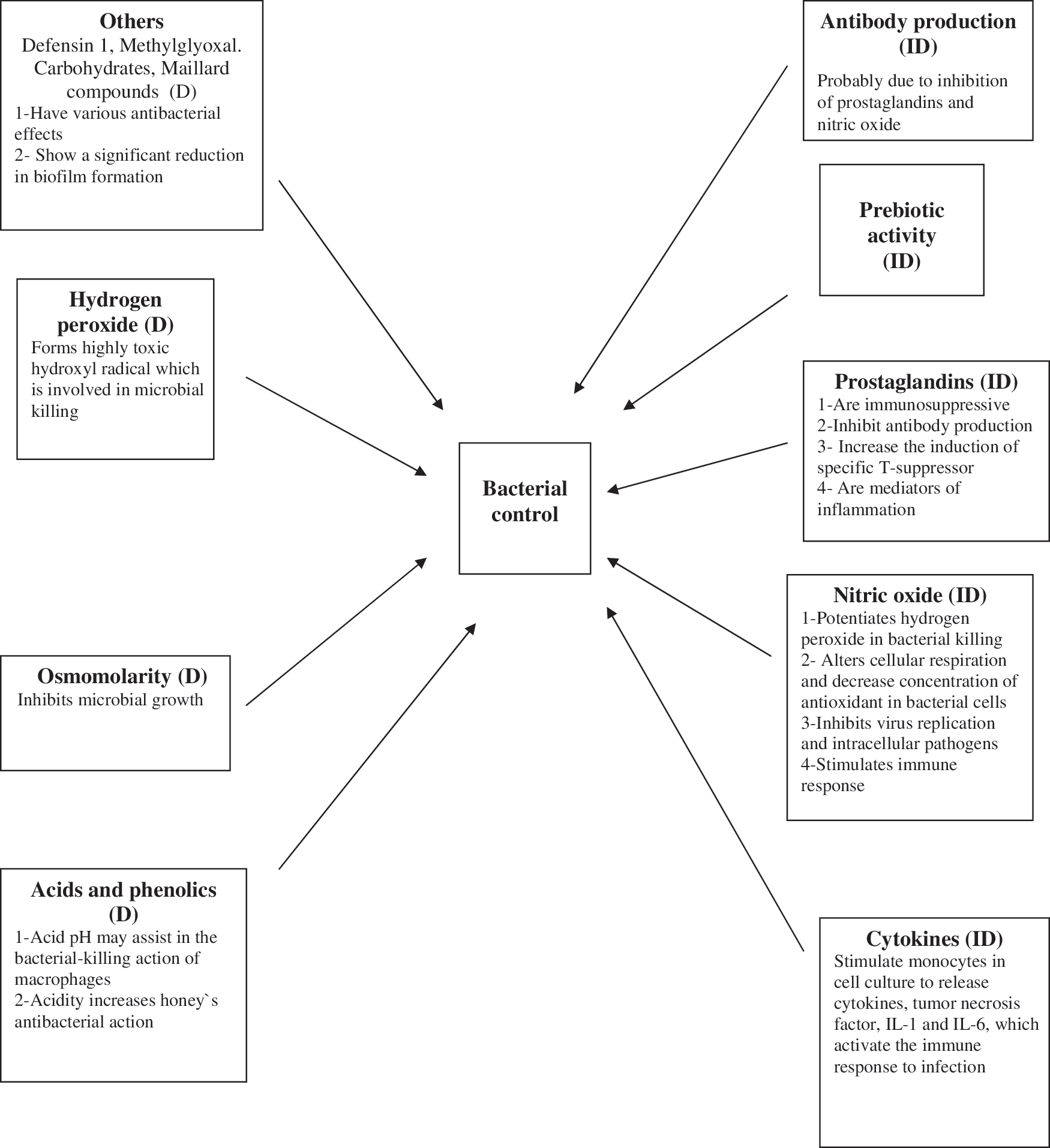
Factors involved in honey bacterial control. D, direct action; ID, indirect action; IL, interleukin.
Direct action of honey components
Honey has certain characteristics and properties that are toxic to pathogens. These include hydrogen peroxide, high osmolality, acidity, nonperoxide factors, and phenols. These factors have various toxic effects on microorganisms that directly affect their metabolism and structure.
Hydrogen peroxide
Hydrogen peroxide is formed by the respiratory burst that consumes O2 and generates hydrogen peroxide from O2 −. Hydrogen peroxide is deposited intracellularly near bacteria within phagocytic vacuoles, where it can react with the myeloperoxidase. Hydrogen peroxide–halide system forms toxic hyperchlorous acid or possibly singlet oxygen. Furthermore, hydrogen peroxide can also react with O2 − or iron (Fe++) from lactoferrin or bacteria to form the highly toxic hydroxyl radical. 79
Hydrogen peroxide is an oxidizing agent released by the action of the enzyme glucose oxidase that is added by bees to the nectar. 80 Hydrogen peroxide is generated on dilution of honey. 81 It has been assumed that the antibacterial activity of natural honey is due to hydrogen peroxide. 7,82 Hydrogen peroxide production can peak at different times for different honeys. Some may take as long as 24 hours. 83
Hydrogen peroxide produced by the action of glucose oxidase in honey is activated when the honey is diluted. 84 However, antibacterial activity persists in honeys treated with catalase to stop the hydrogen peroxide activity. 82 –84 The concentration of hydrogen peroxide produced in honey is about 1000 times less than in the 3% solution commonly used as an antiseptic. 7 Exposure of E. coli to low concentrations of hydrogen peroxide results in DNA damage that causes mutagenesis and kills the bacteria, whereas higher concentrations of peroxide reduce the amount of such damage. 85
The literature shows that rates of hydrogen peroxide production by glucose oxidase in honey vary greatly and increase disproportionately with different degrees of honey dilution. 86,87 Hydrogen peroxide production was assessed in New Zealand honey. The results showed that the rates of hydrogen peroxide production increased from 0.16 μmol/mL per hour at 3.1% honey to 1.14 μmol/mL per hour at 50%–60% honey, the concentration range at which maximal enzyme activity was observed.
The maximum levels of accumulated hydrogen peroxide occurred in honey (solutions diluted to concentrations between 30% and 50% [v/v]), with at least 50% of the maximum levels occurring at 15%–67% (v/v). The rate of hydrogen peroxide production per mL of honey solution decreased at higher honey concentrations. 88 It has been found that honey accumulated up to 5.62 ± 0.54 mM hydrogen peroxide and contained 0.25 ± 0.01 mM methylglyoxal; enzymatic neutralization of these 2 compounds did not significantly affect activity. When B. subtilis was used for activity-guided isolation of the additional antimicrobial factors, bee defensin-1 was identified in honey. 65
Hydrogen peroxide has been reported to stimulate fibroblast proliferation in vitro and angiogenesis in vivo. 83,87 Antigen receptors themselves are H2O2-generating enzymes, and the oxidative burst in macrophages seems to play a role in pathogen killing. 89 Interestingly, honey has high levels of antioxidants, which would protect wound tissues from oxygen radicals that may be produced by hydrogen peroxide. 90
A mixture of hydrogen peroxide and ascorbic acid was found to generate an antibacterial mechanism that is active against gram-negative bacteria. It results in bacterial death and renders the organism sensitive to lysis by lysozyme. 91
In our previous study, we found that honey contains a good amount of ascorbic acid. 92 Therefore, ascorbic acid in honey might potentate the action of hydrogen peroxide to kill microbes. Our earlier studies on United Arab Emirates honey showed that honey contains nitric oxide end products and increases nitric oxide in biological fluids. 92,93 Therefore, nitric oxide generation and hydrogen peroxide generation by honey might potentiate antimicrobial killing. Nitric oxide protects mammalian cells from the cytotoxic effects of hydrogen peroxide.
A study that included treating bacteria (E. coli) with nitric oxide and hydrogen peroxide for 30 minutes found that exposure to nitric oxide resulted in minimal toxicity but greatly potentiated (up to 1,000-fold) hydrogen peroxide–mediated killing. The combination of nitric oxide/hydrogen peroxide induced DNA double-strand breaks in the bacterial genome, and this increased DNA damage may correlate with cell killing. Nitric oxide also altered cellular respiration and decreased the concentration of the antioxidant glutathione to a residual level of 15%–20% in bacterial cells. 94
Osmolarity
Solutions with high osmolarity, such as honey, glucose, and sugar pastes, inhibit microbial growth because the sugar molecules tie up the water molecules so that bacteria have insufficient water to grow. 95 High osmolarity is valuable in the treatment of infections because it prevents the growth of bacteria and encourages healing. 77,96 Sugar was used to enhance wound healing in several hundred patients. 97 It has been claimed that the sugar content of honey is responsible for its antibacterial activity. 27,76,98,99 This is due entirely to the osmotic effect of its high sugar content. 98 –100
The New Zealand honeys were inhibitory at dilutions as low as 3.6 ± 0.7% (v/v) for the pasture honey, 3.4 ± 0.5% (v/v) for the manuka honey, and 29.9 ± 1.9% (v/v) for the sugar syrup. Typical honeys are about 8 times more potent against coagulase-negative staphylococci than if bacterial inhibition were due to osmolarity alone. 101
Osmotic effects of American honey were shown to be the most important variable for killing H. pylori. All carbohydrate solutions 15% or greater (v/v) inhibited 100% of the organisms. 38
Its physical properties provide a protective barrier and, by osmosis, create a moist wound-healing environment that does not stick to the underlying wound tissues.
Acids and phenolics
The glucose content of honey and the acid pH may assist in the bacterial-killing action of macrophages. Honey activity increases in acidic media. 16 However, the antibacterial activity was not significantly suppressed upon neutralization of its acidity. 16 Another study found that adjustment of the pH of Netherlands honey from 3.3 to 7.0 reduced the activity to that of sugar alone. 56 In addition, many bacteria and fungi can survive or resist acidic media and tolerate extremely acidic conditions. 102,103 Therefore, as previously demonstrated, the acidity of honey cannot be the sole factor responsible for its antibacterial activity. 16
Darker honeys are more potent than light-colored honeys in bacterial killing. Because antimicrobial activity of the darker honey was not eliminated by catalase, nonperoxide components such as antioxidants may contribute to controlling the growth of some food-borne pathogens. 104 Some floral sources provide additional antibacterial components by way of plant-derived chemicals in the nectar, such as flavonoids and aromatic acid. 39
Basically, the major antioxidant properties in buckwheat honey derive from its phenolic constituents, which are present in relatively large amounts. 105 Regarding biofilm formation, phenol and natural phenolic compounds except ethyl linoleate and tocopherol show a significant reduction in biofilm formation by P. aeruginosa. 106
Recently, the antioxidant activity of honey and its Maillard reaction products content was shown to be correlated with the antibacterial activity against E. coli. The novel finding in this study was a highly significant correlation between the antioxidant activity and the content of Maillard reaction products in unheated honeys. Another novel observation was the strong correlation between antioxidant activity and Maillard reaction product content and the antibacterial activity against E. coli in unheated honey. 107 Compounds formed during the Maillard reaction in several model systems, as well as melanoidins that have been isolated from food, demonstrated antibacterial activity. 107 –110 The intermediate-stage products of the Maillard reaction, such as glyoxal and methylglyoxal, showed cytotoxic effects. 111
Others
Manuka honey had an exceptionally high level of nonperoxide antibacterial activity, which was due to the action of methylglyoxal. 74,112 Methylglyoxal in manuka honeys is derived from the nonenzymatic conversion of dihydroxyacetone, which occurs at high levels in the nectar. 113
Freshly produced manuka honey contained low levels of methylglyoxal (139–491 mg/kg), but during storage at 37°C its content increased. The levels of methylglyoxal in multifloral honeys are low, ranging from 0.4 to 5.4 mg/kg. 114
Kwakman et al. characterized an antibacterial honey protein as defensin-1, which originates in royal jelly. 115 Honey accumulated up to 5.62 ± 0.54 mM H2O2 and contained 0.25 ± 0.01 mM methylglyoxal. After enzymatic neutralization of these 2 compounds, honey retained substantial activity. With use of B. subtilis for activity-guided isolation of the additional antimicrobial factors, bee defensin-1 in honey was found. After combined neutralization of H2O2, methylglyoxal, and bee defensin-1, 20% honey had only minimal activity left, and subsequent adjustment of the pH of this honey from 3.3 to 7.0 reduced the activity to that of sugar alone.
It has been proposed that the acidic honey fraction is the main antibacterial factor of honey. 63,116 These acids could be 10-hydroxydecenoic acid 117 and phenolic acids. The phenolic components were extracted from 2 different local floral honeys, and their effects on the growth of pathogens were examined. The phenolic fractions of gelam and coconut honeys showed potent antibacterial activities. Both honeys contain gallic, caffeic, and benzoic acids. However, gelam honey contains additional phenolic acids (ferulic and cinnamic acids). Because phenolic acids exert an antibacterial effect, their presence in honey explains its antibacterial activity. 118 Polyphenols and flavonoids extracted from honey inhibit bacterial growth in vitro to varying extents. 119,120
Truchado et al. found an antibacterial water-soluble antibacterial factor probably belonging to the carbohydrate fraction. 121 Quorum sensing inhibitory activity of 29 unifloral honeys was evaluated. Chestnut and linden honey samples showed the highest inhibitory activity, while orange and rosemary were less effective. When honey samples from the same floral origin obtained from different geographic regions were compared, they showed similar inhibitory activity. One of the factors that influence the inhibitory activity could be derived from the floral origin; it was observed that unifloral honey samples showed “nonperoxide” antiquorum sensing activity, which was not linearly correlated with total or individual phenolic compounds. 121
Indirect antimicrobial action
Lymphocyte and antibody production
Honey stimulates proliferation and activation of peripheral blood B lymphocytes and T lymphocytes in cell culture. Honey also stimulates monocytes in cell culture to release cytokines, tumor necrosis factor, interleukin-1, and interleukin-6, which activate the immune response to infection. 122 We found that United Arab Emirates honey increased monocytes and lymphocytes in healthy individuals. 123 Emirates honey increased antibody production during primary and secondary immune responses against thymus-dependent and thymus-independent antigens.
The actual mechanism to stimulate antibody production was not identified. 124 Nitric oxide is a very important mediator of immune responses. 125 Single dose of L-arginine, a known precursor of nitric oxide, caused a significant increase in humoral response. 125
Therefore, honey might increase humoral immunity by means of its ability to enhance nitric oxide production. Prostaglandins are widely regarded as immunosuppressive products of cells that can decrease many aspects of B- and T-lymphocyte function. 126 Because honey decreases prostaglandin concentration, the enhancing effect of honey on antibody production was suggested to be its ability to inhibit prostaglandins. 124
Cytokines and immunomodulation
Honey and its dominant protein MRJP1 induce the production of cytokines, which are powerful immunostimulants and play an important role in wound healing. 127,128
Nitric oxide
Honey contains nitric oxide end products. 93,129 In addition; honey increases nitric oxide end products in various biological fluids, such as urine, saliva, and plasma. 92 Intravenous honey increased nitric oxide end product in plasma and urine. 129
Nitric oxide is important for healing; bacteria killing; viral inhibition; immunologic response; and respiratory, renal, cardiovascular, and nervous system functions. Investigators have implicated nitric oxide in the inflammatory and proliferative phases of wound healing. 130 Wound healing involves platelets, inflammatory cells, fibroblasts, and epithelial cells; all of them are capable of producing nitric oxide. 131,132 Nitric oxide can reverse impaired healing in diabetic patients. 133,134 Nitric oxide plays a role in the host defense against various infections. The killing of intracellular pathogens is mediated by nitric oxide, and the replication of many viruses can be inhibited. 135 Nitric oxide is also a very important mediator of immune responses.
The antimicrobial activity of honey was found to be decreased by exposure to heating and prolonged storage. 16 Heating and prolonged storage decrease nitric oxide metabolites identified in various kinds of honey.
The concentration of nitric oxide metabolites varies by type of honey, which might help to explain the fact that the antimicrobial activity of honey varies markedly with its origin. 130,136 Furthermore, the effects of honey on immunity, bacterial infections, and wound healing could be explained partly by the ability of honey to increase nitric oxide production. 92,93 In addition, it is believed that nitric oxide (3)(-) is a potentially reliable marker of a honey's origin and quality. 136
Prostaglandins
Prostaglandins are mediators of inflammation and pain. They are widely regarded as immunosuppressives that can decrease many aspects of B- and T-lymphocyte functions. 137 They inhibit antibody production by B lymphocytes and increase the induction of specific T suppressors. 126
Al-Waili was the first to report the immunosuppressive effects of prostaglandin on antibody production; consequently, prostaglandin synthesis inhibitors have been used to combat tumor and increase immunity. 136 –140 In addition, prostaglandin changes serum protein components during antigen stimulation. 141 Honey decreased plasma prostaglandins concentrations in healthy individuals. 142 Its inhibitory effect was increased with time. The site of actions could be at cyclooxygenase-1 or -2 or both.
Recently, it was found that artificial honey made of glucose and fructose increased prostaglandin concentrations. 143 Therefore, natural honey might contain raw materials that can inhibit prostaglandin synthesis. 142 The inhibition of prostaglandins by honey therefore might reduce edema and inflammation and activate lymphocytes to produce antibody against pathogens.
Prebiotic activity
Increase of growth of probiotic bacteria is thought to inhibit the growth of pathogenic intestine bacteria. 144 Honey contains oligosaccharides, which are thought to have a prebiotic activity, stimulating the growth of probiotic bacteria. 145
Prebiotic activity enhances the growth of probiotic microorganisms, mostly Bifidus and Lactobacillus species. On the other hand, increase in probiotic bacteria will cause the decrease of harmful microorganisms in the intestines.
Honey has prebiotic effects. In the United States, 5 human intestinal Bifidobacterium species (B. longum, B. adolescentis, B. breve, B. bifidum, and B. infantis) and intestinal microorganisms (Bacteroides thetaiotaomicron, Clostridium perfringens, Eubacterium aerofaciens, and E. faecalis) were cultured with different unifloral U.S. honeys (sourwood, alfalfa, or sage). Growth of intestinal microorganisms co-cultured with Bifidobacterium species in the presence of different unifloral honeys was also examined. All 3 honeys enhanced the growth and activity of the 5 intestinal Bifidobacterium species, whereas the growth of C. perfringens and E. aerofaciens was inhibited in the presence of honey and further inhibited when co-cultured with Bifidobacterium species. 146
A study conducted in India investigated the effect of honey and sucrose on lactic acid bacteria in vitro and in rat gut. The number of Lactobacillus acidophilus and Lactobacillus plantarum counts increased 10- to 100-fold in the presence of Indian honey compared with sucrose. Feeding honey to rats also resulted in a significant increase in lactic acid bacteria counts. 147
Antifungal Action
Fungal infections and cutaneous mycoses are common diseases in humans and are among the most difficult to treat successfully. 148 Bacterial infections may also be present. Table 2 summarizes the effect of honey from different regions on fungal growth. Unprocessed American honey was inoculated with toxigenic strains of Aspergillus flavus NRRL 5862 and Aspergillus parasiticus NRRL 2999. The fungi grew and sporulated in varying amounts of honey diluted with water, but none of the cultures produced aflatoxin. Growth and subsequent sporulation were seen only in media containing up to and including 60% honey. Media having 40% honey showed growth and sporulation by day 2. Neither species of Aspergillus produced toxins, even in 10% honey. These results confirm that pure honey inhibited fungal growth and that diluted honey seems capable of inhibiting or possibly neutralizing toxin production. 78
A bacterium (H215) isolated from American honey showed high antifungal activity against Byssochlamys fulva H25. The antifungal producer strain was identified as B. subtilis using 16S recombinant DNA sequencing. The broad-spectrum antifungal activity produced by a bacterium was determined to be due to the production of bacillomycin F. 149
New Zealand honey has an inhibitory effect to some yeasts and species of Aspergillus and Penicillium, as well as to dermatophytes. 150 However, when catalase was present, no inhibitory activity was detected with any of the common dermatophytes exposed to pasture honey at any concentration up to the highest tested 50% (v/v). No inhibitory activity was detected with the artificial honey at 100% or any other concentration. Other researchers found that 0.1 and 0.2 mL of volatile oil from Hungarian honey was inhibitory. 66
In Nigeria, the susceptibility of 72 isolates of C. albicans to the antimicrobial Nigerian honey distillate fraction (HY-1) and several antimycotic agents was studied. All the isolates were sensitive to HY-1, and about 10% of the isolates were variably resistant to nystatin, miconazole nitrate, and clotrimazole. The nystatin-, miconazole nitrate–, and clotrimazole-resistant isolates were inhibited by HY-1. 151
A comparative method of adding Algerian honey to culture media with and without starch was used to evaluate the action of starch on the antifungal activity of honey. The MICs expressed, in percentage (v/v), for 2 varieties of honey without starch against C. albicans were 42% and 46%, respectively. For Aspergillus niger, the MICs without starch were 51% and 59%, respectively. When starch was incubated with honey and then added to media, the MICs for C. albicans were 28% and 38%, respectively, with a starch concentration of 3.6%, whereas the MICs for A. niger were 40% and 45%, with starch concentrations of 5.6% and 5.1%, respectively. 152
Effects of United Arab Emirates honey, olive oil, and beeswax and their mixture on growth of C. albicans isolated from human specimens were investigated. A clear zone of inhibition was observed around holes filled with honey mixture on media seeded with C. albicans. The microorganism did not grow on media made of honey mixture alone. The MIC of honey mixture in nutrient agar–honey mixture media required to inhibit C. albicans growth was 66%. 14 In addition, United Arab Emirates honey inhibited growth of C. albicans when added 2–6 hours after inoculation. The therapeutic period of honey for C. albicans was 2–6 hours. 15
Recently, 37 patients with Pityriasis versicolor, Tinea cruris, Tinea corporis, and Tinea faciei were treated by United Arab Emirates honey mixture with olive oil and beeswax. Clinical response was obtained in 86% of patients with P. versicolor, 78% of patients with T. cruris, and 75% of patients with T. corporis. Mycologic cure was obtained in 75%, 71%, and 62% of patients with these 3 organisms, respectively. The patient with T. faciei showed clinical and mycologic cure 3 weeks after commencement of therapy. 153 Moreover, honey inhibited growth of C. albicans isolated form human specimens. 16
Honey samples from different floral sources collected in Turkey were evaluated for their ability to inhibit the growth of 40 yeast strains (C. albicans, Candida krusei, Candida glabrata, and Trichosporon species). All the strains tested were inhibited by honeys. Little or no antifungal activity was seen at honey concentrations less than 2%. Rhododendron and multifloral honeys have generally more inhibitory effect than eucalyptus and orange honeys. Fluconazole-resistant yeast strains were examined for their susceptibility to Turkish honeys. The study demonstrated that these honeys had antifungal activity at the high concentration of 80% (v/v) in the fluconazole-resistant strains. 154
Antiparasitic Action
Syrian honey and sugar both have antileishmanial effects in vitro, but results indicated that honey is superior to sugar. 155 Honey has been used to treat bladder ulcer caused by Schistosomia hematobium infection. 156
Antiviral Action
The effect of Syrian honey versus thyme on rubella virus survival in vitro shows that honey has good antirubella activity. 157 Honey also shows antivibriocidal activity. 158
In Iran, researchers recruited 60 men and women within 24 hours of developing a cold. All the patients were given decongestants and antipyretics, and half of them were also given a dose of honey. Honey reduced the duration of the common cold. 159
Recently, 16 adults with a history of recurrent attacks of herpetic lesions (8 labial and 8 genital) were treated by topical application of acyclovir cream or United Arab Emirates honey. For labial herpes, the mean duration of attacks and pain, occurrence of crusting, and mean healing time with honey treatment were 35%, 39%, 28%, and 43% better, respectively, than with acyclovir treatment. For genital herpes, the mean duration of attacks and pain, occurrence of crusting, and mean healing time with honey treatment were 53%, 50%, 49%, and 59% better, respectively, than with acyclovir. Two cases of labial herpes and 1 case of genital herpes remitted completely with the use of honey. The lesions crusted in 3 patients with labial herpes and in 4 patients with genital herpes. With acyclovir treatment none of the attacks remitted, and all the lesions, labial and genital, developed crusts. 160
A case of chronic hepatitis B cured with use of Yemeni honey has been reported. 161 A 7-year-old boy presented with positivity for hepatitis B surface antigen and cross-impairment of liver function. The patient was treated with 2 spoonfuls of natural honey per day (morning and evening) for 2 years. Hepatitis B surface antigen and hepatitis C virus antibody became negative. Hepatitis B DNA by polymerase chain reaction was less than 0.7 mg/mL. All the liver function test results returned to normal.
In another case, an HIV-positive woman was treated with United Arab Emirates honey. Her plasma prostaglandins level was elevated. After ingestion of honey, the nitric oxide level was elevated, the prostaglandin concentration decreased, and all biochemical and hematologic test results improved. 162
Pathogenic Microorganisms in Honey and Honey Sterilization
Honey as food
Honey may contain microorganisms, such as yeasts and spore-forming bacteria. Microorganisms in honey have been identified. 163 Certain vegetative microbes can survive in honey, at cool temperatures, for several years. 163 C. perfringens and some other microorganisms have been found in some commercial honeys. 164 Clostridium botulinum is found in a small percentage of honeys. 163,164
Aerobic spore-forming Bacillus species are frequently encountered on the external surface, crop, and intestine of honey bees. 165 Microorganisms that survive in honey are those that withstand the concentrated sugar, acidity, and other antimicrobial characters of honey. Sackelt has observed that Bacillus, Micrococcus, and Saccharomyces species could be readily isolated from honeycombs and adult bees. 166 Many microbial species have been isolated from the feces of bee larvae. 165
The source of microbial contamination of honey might be insects, air, trees, pollen, soil, nectar, and dust introduced during its collection and production by bees and during processing and handling by humans. 163 The intestine of bees has been found to contain 1% yeast, 27% gram-positive bacteria (including Bacillus, Bacteridium, Streptococcus, and Clostridium species), 70% gram-negative or gram-variable bacteria (including E. coli and Achromobacter, Citrobacter, Enterobacter, Erwinia, Flavobacterium, Klebsiella, Proteus, and Pseudomonas species). 167
Most bacteria and other microbes cannot grow or reproduce in honey. However, spore-forming microorganisms can survive in honey at low temperatures. B. cereus, C. perfringens, and C. botulinum spores were inoculated into honey and stored at 25°C. The C. botulinum population did not change over a year at 4°C. At 65°C, however, no spores were found after 5 days of storage. If honey is diluted with water, it supports the growth of nonpathogenic bacterial strains and killing of pathogenic strains. 166 It has therefore been concluded that the probability of honey acting as a carrier of typhoid fever, dysentery, and various diarrheal infections is very slight. 166 Not only did C. botulinum not grow in honey, undiluted and diluted 1:2, but also on incubation the number of spores decreased. 168
A total of 294 honey samples produced in Denmark, Norway, and Sweden were studied for the presence of C. botulinum types A, B, E, and F. The prevalence of C. botulinum significantly varied between types of honey. 169 In Finland, spores of C. botulinum were detected in 8 of the 114 Finnish and in 12 of the 76 imported honey samples. 170 Two main groups of bacteria, classified as Gluconobacter and Lactobacillus, are present in ripening honey. A third bacterial group, classified as Zymomonas, and several types of yeast are occasionally isolated. 171
Studies have shown that the ingestion of honey is linked with infant botulism. 163,164,172 Honey samples across the United States have tested positive for C. botulinum spores and toxins. 169 This substantial evidence led the Centers for Disease Control and Prevention to recommend that honey not be given to infants younger than 12 months old. 173 Other than this risk in babies younger than 1 year of age, honey pathogens present no risk for humans.
Honey for wound treatment
Extensive data have been published reporting the effectiveness of honey in eradicating infection from wounds, with no adverse effects, and the ability of honey to promote healing. 80 Although honey can contain pathogens, it can be applied to wounds in modern hospitals without sterilization. Descotte reported that nonsterile honey was used without risk in hundreds of wound treatments in a modern hospital in France. 174
Honey sterilization
Generally, honey cannot be considered completely sterile. It should be sterilized before being applied in clinical conditions. High heat is known to inactivate the antimicrobial factors but also decreases the activity of honey. In addition, sterilization of honey by filtering through microporous membranes is not easy to do because of the high viscosity of honey. Treatment with γ-irradiation has killed the spores without affecting the antibacterial activity of honey. 175
Testing of honey seeded with spores of C. perfringens and Clostridium tetani showed that 25 kGy of γ-irradiation was sufficient to achieve sterility. 176 To find the lowest dose of irradiation needed for sterilization, 6 batches of honey were γ-irradiated with 6, 12, 18, 22, and 25 kGy cobalt-60. After a dose of 25 kGy the antibacterial activity was not altered. 176
We have found that ultraviolet exposure of dark yellow honey for 24 hours had little effect on antibacterial activity against some pathogens but increased activity against other pathogens. 16 Ultraviolet light has been used to disinfect gram-negative bacteria in recycled water and to inactivate bacteria. 177 Ultraviolet light could be used for sterilization of honey.
An investigation assessed the effect on the antibacterial activity of honey when the honey was subjected to a sterilization procedure using γ-irradiation (25 kGy). Two honeys with antibacterial activity due to enzymically generated hydrogen peroxide and 3 manuka honeys with nonperoxide antibacterial activity were investigated. Neither type of antibacterial activity against S. aureus changed significantly, even when the radiation was doubled (to 50 kGy). Testing of honey seeded with spores of C. perfringens and C. tetani showed that 25 kGy of γ-irradiation was sufficient to achieve sterility. 176
In Poland, the degree of microbiological decontamination and organoleptic and physicochemical properties of natural honeys were investigated after radiation treatment. Seven kinds of honeys were irradiated with the beams of 10 MeV electrons. After irradiation, the total count of aerobic and anaerobic bacteria and molds decrease by 99. The consistency, content of water and saccharose, acidity, and diastase and 5-hydroxymethylfurfural values were not changed significantly after irradiation of honey. Decontamination by irradiation is needed when honeys are used in the surgical treatment of injuries and in nutrition of babies with food deficiency. 178
Sterilization is thought to be necessary in modern hospitals and is demanded whether the honey is used externally or internally. Long-term experience, however, has shown that except for the above-mentioned risk in small babies, nonsterilized honey does not present a health risk.
Footnotes
Author Disclosure Statement
No competing financial interests exist.